
Animals of Florida Spring & Rivers — A Visual Field Guide to 34 Signature Species
From Spring Runs to Cypress-Lined Channels
Key takeaways
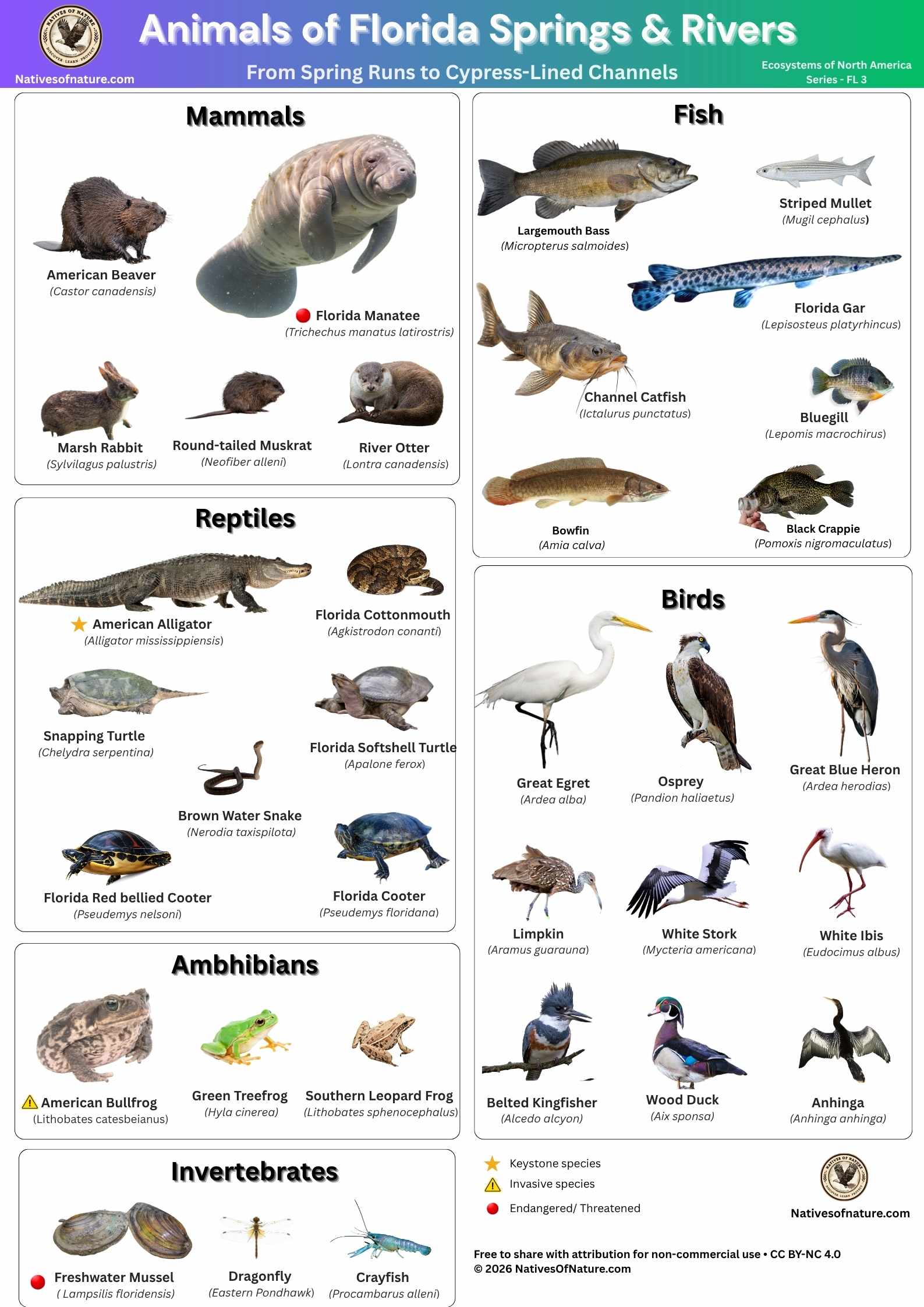
- The poster identifies 34 signature animals of Florida's springs and rivers — five mammals, seven reptiles, three amphibians, seven fish, nine birds, and three invertebrates — selected to represent the
- Three symbols mark species of particular significance: a star for keystone species, a triangle for invasive species, and a red marker for species currently endangered or threatened under state or fede
- The poster covers the full range of Florida freshwater habitats — from spring-fed crystalline runs and tannic blackwater rivers to the cypress-lined channels of the central peninsula — making it usefu
About this resource
The water emerging from Florida’s first-magnitude springs has been underground for an average of forty years before it reaches the surface — filtered through limestone aquifer, held at a constant 72°F regardless of season, and emerging at a combined rate of more than two billion gallons per day. This is the geological engine that powers the ecosystem this poster celebrates: an environment so stable that the same eelgrass beds, the same mussel banks, and many of the same individual manatees can be found in the same spring runs decade after decade. Florida holds more first-magnitude springs than any other state, region, or country on Earth.
The 34 animals featured here were selected to represent the ecological architecture of Florida’s springs and rivers — not the most photogenic species, but the species that actually define this ecosystem. Five mammals (manatee, river otter, beaver, round-tailed muskrat, marsh rabbit), seven reptiles (alligator, cottonmouth, snapping turtle, softshell turtle, brown water snake, and two cooter species), three amphibians, seven fish (from the prehistoric bowfin and gar to the largemouth bass that Florida designated its state freshwater fish), nine birds, and three invertebrates. Together they trace the food web from filter-feeding mussels that have spent twenty years anchored in a single river bend, through the apple-snail-specialist limpkins whose nocturnal calls have terrified spring-run paddlers for generations, to the apex-predator alligators that have patrolled these waters essentially unchanged since the Miocene.
Three symbols on the poster identify species of particular significance: a star for keystone species that disproportionately shape their ecosystem, a triangle for invasive species (included to acknowledge ecological reality, not to celebrate them), and a red marker for species currently endangered or threatened under state or federal listing. Every scientific binomial has been verified against ITIS and IUCN taxonomic standards. Species selection and ecological framing have been reviewed by our specialists. The poster is offered free for non-commercial use under Creative Commons BY-NC 4.0 — educators, naturalists, paddling guides, and parents are welcome to download, print, and share it.
Featured animals in this resource
Mammals
-
State animal of West Virginia, State Mammal of Louisiana
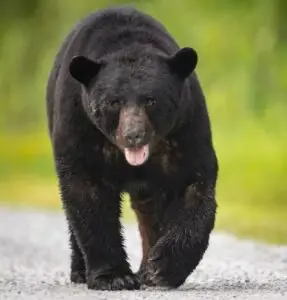
American Black Bear
S. name: <em>Ursus americanus</em>
IUCN: Least Concern (LC)
Diet: Omnivore
Habitats: Forests, Mountains, Wetlands
-
State Marine Mammal of Florida, USA
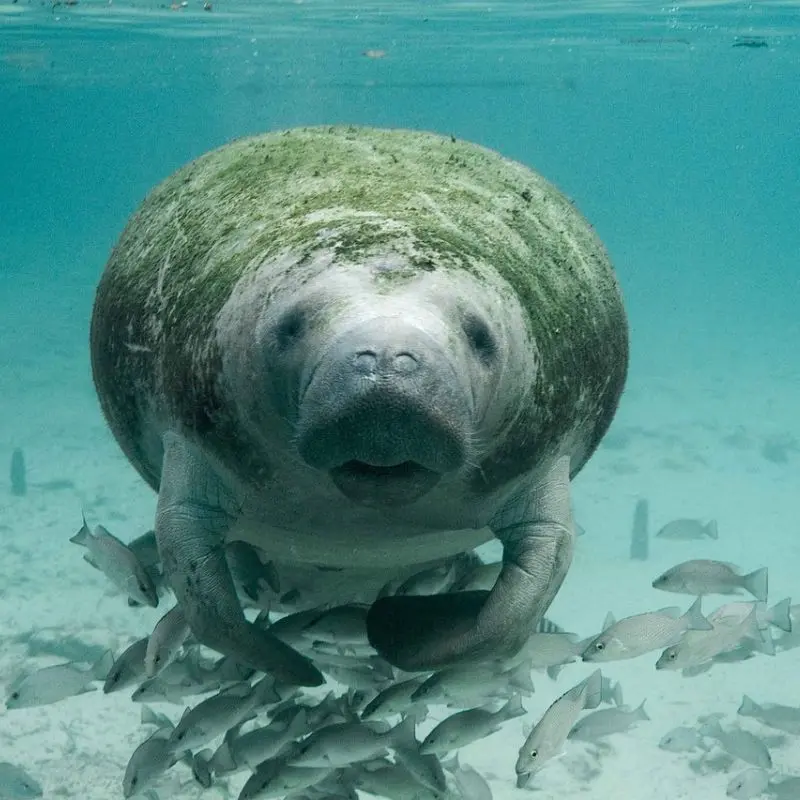
Florida Manatee
S. name: <em>Trichechus manatus latirostris</em>
IUCN: Threatened
Diet: Herbivore
Habitats: Oceans, Wetlands
Related visual resources
Authorship & review

Sreeraj Vijaydas is involved in the editorial and research direction at NativesOfNature. His work centers on developing clear, accurate wildlife content that promotes understanding of biodiversity, conservation challenges, and sustainability,…

Arya Sankar is a postgraduate in Zoology with academic and research experience in wildlife and marine sciences. She has worked on research projects at the Central Marine Fisheries Research Institute…
Frequently asked questions
- How many species are featured on the Animals of Florida Spring & Rivers — A Visual Field Guide to 34 Signature Species?
- This poster features 34 species, each labeled with its common and scientific name.
- Can I print and share this poster?
- Yes. This poster is released under CC BY-NC 4.0, which permits free non-commercial sharing, printing, and reuse with attribution to NativesofNature.com.
- What print sizes are available?
- PDF versions are available in A4, A3, A2 and US Letter. A high-resolution JPG and transparent PNG are also offered for anyone repurposing the poster.