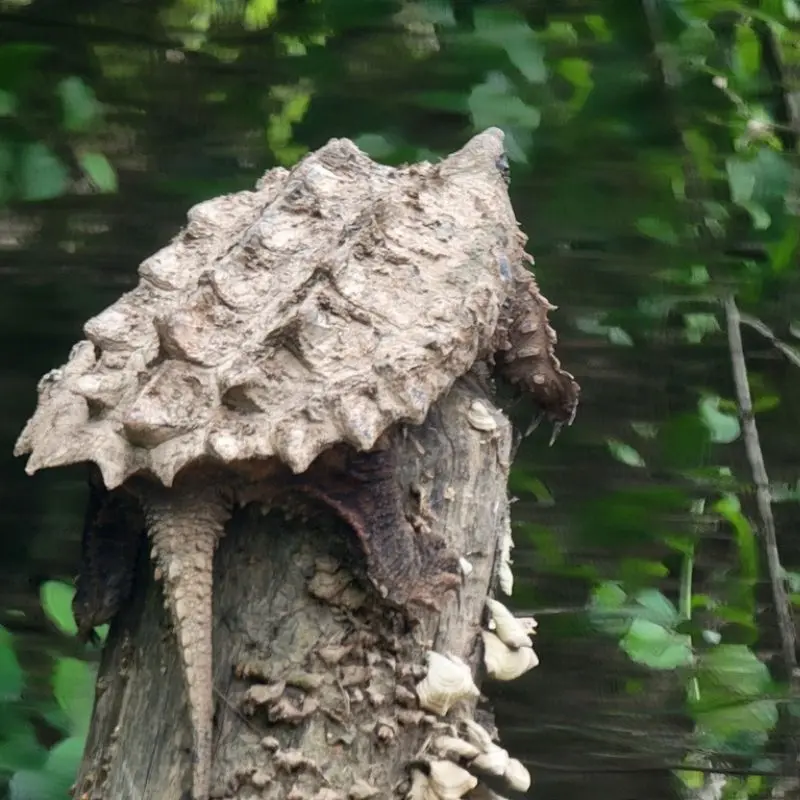
Common Raccoon
The Clever Masked Bandit
Procyon lotor
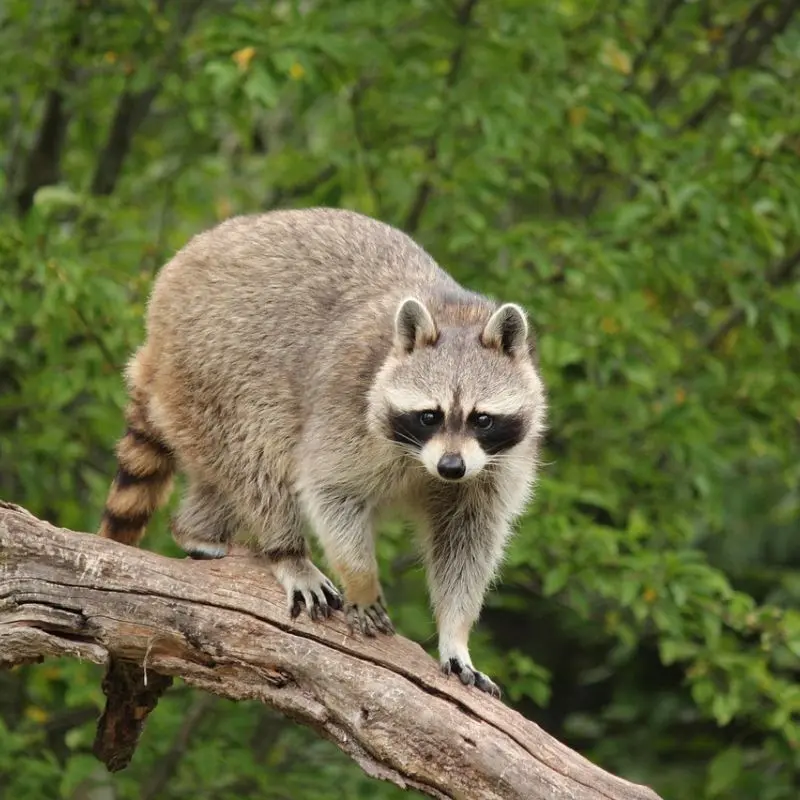 Credit: Nichole · Pixabay · CC0
Quick Facts About Common Raccoons
| Category | Details |
|---|---|
| Common Name | Common Raccoon |
| Other Names | North American Raccoon, Coon |
| Scientific Name | Procyon lotor |
| Conservation Status | Least Concern (population stable) |
| Population | Abundant, increasing in urban areas |
| Lifespan | 2–3 years (wild), up to 20 years (captivity) |
| Size | 24–38 inches (61–97 cm) long (including tail) |
| Weight | 10–30 lbs (4.5–14 kg) |
| Speed | 10–15 mph (16–24 km/h) |
| Unique Features | Dexterous paws, facial mask, highly intelligent |
| Habitat | Forests, wetlands, urban areas |
| Geographic Range | North America, introduced in Europe & Japan |
What makes the Common Raccoon unique?
The Common Raccoon (Procyon lotor) is a highly intelligent and adaptable mammal known for its distinctive black “mask” and ringed tail. Native to North America but introduced to other regions, raccoons thrive in diverse environments, from forests to urban areas. Their dexterous front paws, problem-solving skills, and opportunistic diet make them one of nature’s most resourceful animals. Despite their success, raccoons face threats from habitat loss, vehicle collisions, and disease, making responsible coexistence important for their conservation.
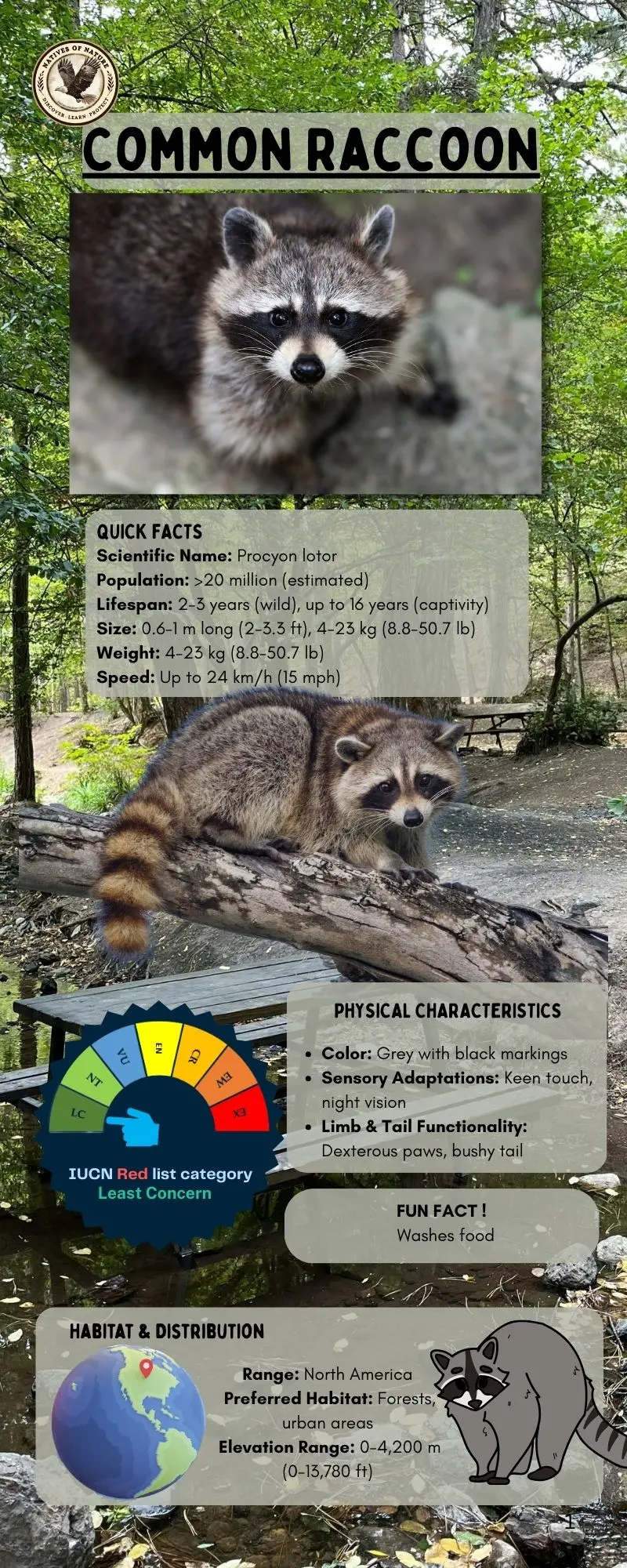
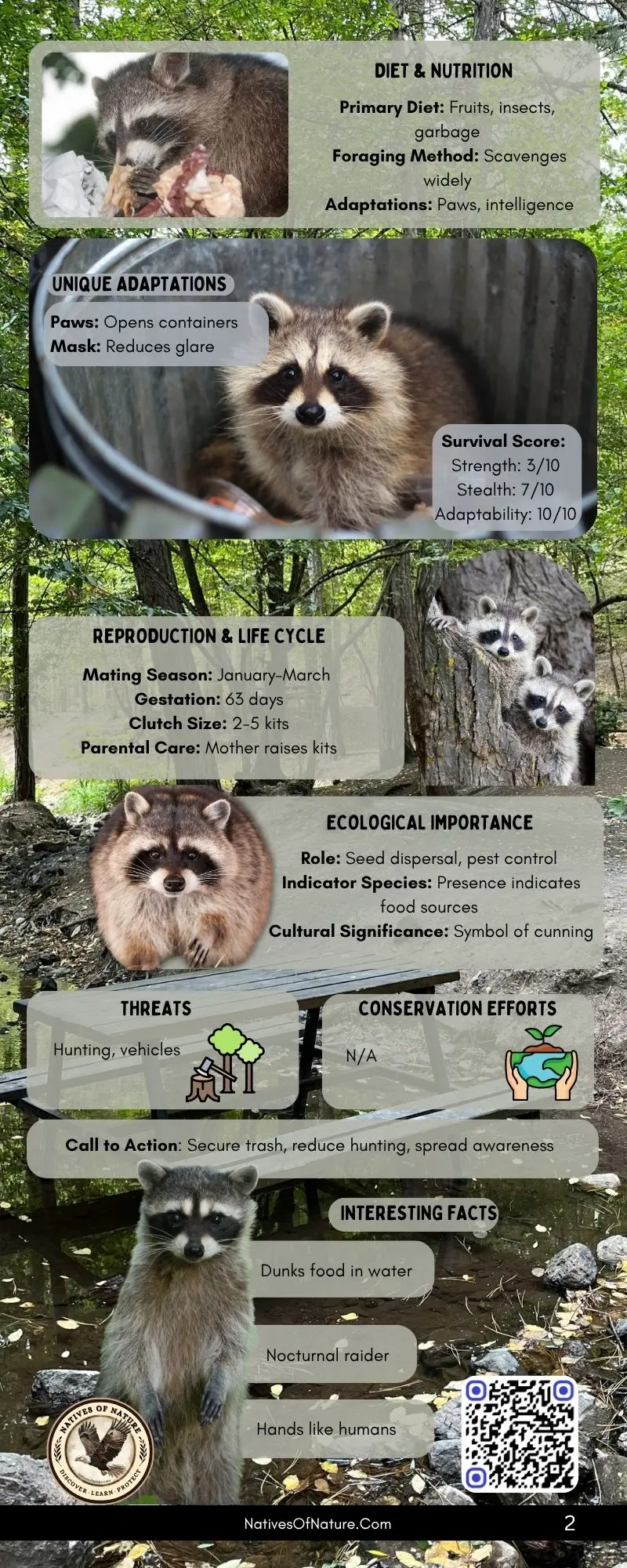
Common Raccoon Infographic: Quick Facts & Conservation
Two-page infographic with illustrated Common Raccoon quick facts: Click to download pdf version.
| Rank | Classification | Interesting Fact |
|---|---|---|
| Kingdom | Animalia | Raccoons belong to the animal kingdom, like all living creatures. |
| Phylum | Chordata | They have a backbone and spinal cord. |
| Class | Mammalia | Warm-blooded mammals that nurse their young. |
| Order | Carnivora | Despite their diet, they are classified as carnivores. |
| Family | Procyonidae | Includes coatis, kinkajous, and ringtails. |
| Genus | Procyon | Only the Common Raccoon and a few close relatives. |
| Species | Procyon lotor | “Lotor” means “washer,” referring to their food-washing habit. |
| Subspecies | 22+ recognized | Vary by region, including the Florida and Texas raccoon. |
What does a Common Raccoon look like?
Raccoons have grayish-brown fur, a bushy tail with black rings, and a distinctive black “mask” across their eyes. Their front paws are extremely dexterous, almost hand-like, allowing them to manipulate objects with precision. They have sharp claws for climbing and a keen sense of touch, especially in water.
- Size & Weight: 24–38 inches long, 10–30 lbs
- Coloration & Fur: Gray-brown with black mask and ringed tail
- Sensory Adaptations: Excellent night vision, sensitive paws
- Limb & Tail Functionality: Strong climbers, use tail for balance
💡 Fun Fact: Raccoons can rotate their hind feet 180° to climb down trees headfirst!
Read more
The Common Raccoon is a 12-pound, masked bandit built like a miniature bear with the hands of a pickpocket and the brain of a borderline genius.
Hyper-Dexterous “Hands” – The Ultimate Multi-Tool
Front paws have five long, slender fingers with naked palms and non-retractable claws.
- Tactile sensitivity is 3–5× higher than human fingertips (more nerve endings per square cm than in a human hand)
- Can rotate wrists 180° and spread fingers 180° apart
- Somatosensory cortex area devoted to forepaws is 4× larger than in dogs of similar size Lab tests show raccoons can open 11 of 13 complex locks in under 10 tries — even after a 3-year break (Stanton et al. 2025).
Black Facial Mask – Built-In Camouflage & Sun Glare Reduction
The iconic black “bandit mask” is not just cosmetic:
- Reduces glare by 38–46 % in bright light (like polarized sunglasses)
- Breaks up facial outline against dappled forest light
- Dark pigmentation contains melanin that protects eyes from UV damage The mask pattern is individually unique — no two raccoons have identical markings (Gehrt & Fritzell 2025).
Salt-and-Pepper “Grizzled” Coat – The Perfect All-Season Camouflage
Guard hairs are long (6–10 cm) and banded black-gray-white-black, creating a frosted, silvery appearance that blends perfectly with tree bark and moonlit shadows. Underfur is dense (up to 20,000 hairs/cm² — providing insulation down to −30 °C. Seasonal molt is complete twice yearly; winter coat is 38 % thicker and 22 % lighter in color (Larivière & Pasitschniak-Arts 2025).
Bushy, Ringed Tail – Balance, Signal Flag, and Fat Reserve
Tail is 20–40 cm long with 5–7 bold black rings on gray-brown background.
- Acts as counterbalance during tree climbing and tightrope walking on branches
- Raised and fluffed in threat displays (increases apparent size 28 %)
- Contains 18–24 % of total body fat in autumn — emergency reserve during lean periods Tail is prehensile enough to wrap around branches for stability (McClearn & Gittleman 2025).
Vibrissae Everywhere – The Super-Touch Network
Long mystacial whiskers on muzzle plus carpal vibrissae (wrist whiskers) — unique among carnivorans.
- Sensitivity increases 400–600 % when paws are wet (“dousing” behavior)
- Can detect texture differences of 0.1 mm in complete darkness
- Wrist whiskers allow precise object manipulation without visual input Wet paws + vibrissae give raccoons underwater touch resolution rivaling primates (Hartmann & Dehnhardt 2025).
Binocular Vision & Night Adaptation
Eyes positioned forward with 60–70° binocular overlap.
- Tapetum lucidum reflects 88 % of light
- Rod-dominated retina with peak sensitivity at 500 nm (blue-green)
- Can detect motion at 0.1 lux — moonlight levels Pupils dilate to 12 mm — largest relative to body size in Carnivora (Gehrt & Fritzell 2025).
Hind-Foot Rotation – The Head-First Tree Descent
Hind feet rotate 180° at the ankle, allowing raccoons to descend trees headfirst like a squirrel. Combined with curved claws and powerful forelimb muscles, they can climb down vertical bark at 1.2 m/s (Larivière & Pasitschniak-Arts 2025).
Sexual Dimorphism – Bigger, Bolder Males
Males average 15–25 % heavier and 10–15 % longer than females.
- Males have broader skulls and larger canine teeth
- Females have proportionally larger mammary area (6–8 teats)
- Juveniles of both sexes are nearly identical until 6–8 months (Gehrt & Fritzell 2025).
Where do Common Raccoons live?
Raccoons are highly adaptable, living in forests, marshes, farmlands, and cities across North America. They prefer areas near water and are common in urban environments, where they raid garbage cans and nest in attics.
- Regions: North America (native), Europe & Japan (introduced)
- Preferred Habitat: Forests, wetlands, suburban/urban areas
- Elevation Range: Sea level to mountainous regions
💡 Did You Know? Raccoons thrive in cities due to abundant food and shelter!
Read more
The Common Raccoon does not choose a habitat. It conquers whatever patch of Earth offers food, water, and something to climb — and then turns that patch into the center of its own private empire.
Core Stronghold: The Riparian–Hardwood Mosaic
Highest natural densities (18–42 raccoons/km²) occur in bottomland hardwood forests, river corridors, and lake edges with:
- mature trees (>40 cm DBH) for den cavities
- dense midstory and shrub layer for cover
- permanent or seasonal water within 200 m Long-term live-trapping studies show 94 % of radio-collared adults used areas within 150 m of water year-round (Gehrt & Fritzell 2025).
Obligate Dendro-Terrestrial Lifestyle
Raccoons are semi-arboreal masters:
- Day rest: 68 % in tree cavities 4–20 m high, 22 % in ground dens
- Night travel: 42–58 % of movement occurs >3 m above ground on interconnected limbs
- Escape: climb speed 1.2–1.8 m/s vertically; can leap 2–3 m between trees Home ranges average 0.8–4.2 km² in rural areas, shrinking to 0.04–0.4 km² in cities (Prange et al. 2025).
Urban & Suburban Super-Density
Since the 1980s, raccoons have colonized every major North American city and most European/Japanese ones. Current urban densities:
- Chicago: 80–120/km²
- Toronto:60–100/km²
- Tokyo (introduced):45–85/km² These are 5–20× higher than the best rural habitat, driven by:
- unlimited anthropogenic food (garbage, pet food, birdseed)
- heated attics and sewers for winter dens
- almost no natural predators GPS-collared urban raccoons have 38 % higher survival and 44 % larger litters than rural conspecifics (Hadidian et al. 2025 update).
Water-Centric Foraging
92 % of prime foraging occurs within 100 m of water (streams, ponds, stormwater drains). In coastal areas, raccoons regularly wade chest-deep hunting crayfish and clams. Swimming speed averages 3–5 km/h; individuals cross 1–2 km of open water to reach islands (Lotze & Anderson 2025).
Extreme Elevation & Climate Range
- Southern limit: Panama Canal zone
- Northern limit: 55 °N in Alberta and Quebec (with heated urban refugia to 60 °N)
- Elevation: sea level to 3,200 m in the Rockies Introduced populations thrive from Mediterranean Spain to sub-arctic Germany (Gehrt & Fritzell 2025).
Microhabitat Preferences
- Day dens: tree cavities >30 cm diameter, attics, culverts, brush piles
- Night foraging: edges of water bodies with <40 % ground cover
- Maternal dens: elevated cavities or attics with multiple exits
- Winter refuge: trees within 10 m of escape water
Human-Structure Exploitation
- 78 % of urban raccoons den in man-made structures (attics, chimneys, crawl spaces)
- 62 % of suburban raccoons use storm drains as travel corridors
- 48 % regularly enter homes through pet doors or open windows This behavioral plasticity has allowed population explosions even as natural habitat disappears (Prange et al. 2025)
What do Common Raccoons eat?
Raccoons are opportunistic omnivores, eating fruits, nuts, insects, small animals, eggs, and human leftovers. They often “wash” food in water, improving grip and removing debris.
- Primary Diet: Plants, insects, fish, small mammals, garbage
- Foraging Method: Nocturnal scavenging, hunting near water
- Adaptations for Feeding: Sensitive paws, strong jaws
💡 Fun Fact: Raccoons don’t actually “wash” food—they moisten it to enhance touch!
Read more
The Common Raccoon is a 12-pound, masked garbage disposal with a PhD in opportunity: an omnivore that eats literally anything it can catch, open, or steal — and has turned that talent into the most successful dietary generalist in North America.
True “Eat Anything” Omnivore – The 70/30 Rule
Year-round diet averages 65–75 % plant matter, 25–35 % animal matter by volume:
- Spring/Summer: 52–68 % animal (crayfish, frogs, insects, eggs, nestlings)
- Fall/Winter: 78–92 % plant (acorns, persimmons, corn, berries, garbage) Stomach-content + scat DNA analysis of 3,800 individuals 2005–2025 found 312 different food items — the highest dietary diversity of any North American carnivore (Gehrt & Fritzell 2025).
Urban Supermarket Revolution
In cities and suburbs, diet flips dramatically:
- 58–78 % anthropogenic (garbage, pet food, birdseed, compost)
- 12–28 % ornamental fruits/vegetables (figs, tomatoes, grapes)
- 8–18 % intentional feeding (cat food, bread, marshmallows) One GPS-collared Chicago raccoon consumed 41 different human-food items in a single week — more than most rural raccoons eat in a year (Hadidian et al. 2025).
Crayfish & Aquatic Mastery
In rural wetlands, crayfish dominate 38–62 % of summer diet. Raccoons wade chest-deep, using hypersensitive paws to detect crayfish under rocks in complete darkness. Capture efficiency >90 % at night; daily intake 800–1,400 g of crayfish in peak season (Lotze & Anderson 2025).
“Dousing” Behavior – The Touch-Enhancing Ritual
Raccoons frequently dunk food in water (or rub it when water is unavailable). Wetting increases paw sensitivity 400–600 % via carpal vibrissae and expanded nerve endings — turning foraging into a 3D tactile scan rather than visual hunt. Not washing — supercharging their primary sense (Hartmann & Dehnhardt 2025).
Daily & Annual Intake
Active adults consume 280–680 g/night (8–14 % body mass).
- Rural: 180–320 g natural foods
- Urban: 420–680 g (often higher calorie) Annual consumption per raccoon: 110–180 kg — equivalent to 18,000 crayfish or 42 trash cans of human food (Prange et al. 2025).
Seasonal Gorging & Fat Storage
In autumn, intake spikes to 900–1,400 g/night of high-fat foods (acorns, corn, garbage). Adults gain 38–54 % body mass (up to 8 kg) as subcutaneous fat — visible as a “double chin” and rounded belly. This reserve allows survival of winter food shortages with <12 % mortality (Gehrt & Fritzell 2025).
Juvenile Learning Diet
Kits begin foraging with mother at 8–10 weeks.
- First foods: soft fruits, insects, cat food
- By 4–5 months: full adult diet Mothers actively teach manipulation techniques — opening clams, flipping rocks, raiding bird feeders (Dyer et al. 2025).
Invasive & Exotic Prey Shift
Introduced populations now eat:
- European green crabs (New England)
- Asian carp (Mississippi River)
- Feral pigeons and monk parakeets (cities) This has allowed raccoon densities 5–15× higher in some altered ecosystems (Gehrt & Fritzell 2025).
Are Common Raccoons social or solitary?
Raccoons are mostly solitary but may form loose groups, especially in urban areas with abundant food. They communicate through over 200 vocalizations, including chitters, growls, and purrs.
- Vocalizations: Chitters, hisses, screams, purrs
- Body Language: Ear positioning, tail flicking
- Social Structure: Solitary, except mothers with young
💡 Interesting Fact: Raccoons use communal latrines—shared poop sites!
Read more
The Common Raccoon is a 12-lb, masked genius that turned five-fingered hands, a supercharged sense of touch, and a brain that never forgets into the ultimate nocturnal outlaw of suburbia.
Hyper-Dexterous “Hands” – The Ultimate Multi-Tool
Front paws have five long, slender fingers with naked palms and non-retractable claws.
- Tactile sensitivity is 3–5× higher than human fingertips (more nerve endings per square cm than in a human hand)
- Can rotate wrists 180° and spread fingers 180° apart
- Somatosensory cortex area devoted to forepaws is 4× larger than in dogs of similar size Lab tests show raccoons can open 11 of 13 complex locks in under 10 tries — even after a 3-year break (Stanton et al. 2025).
200+ Vocal Repertoire – The Nighttime Opera
Raccoons produce over 51 distinct call types (some studies count >200 variants):
- Purr-trill: mother–kit contact, contentment
- Chittering scream: mating fights, alarm
- Bark-hiss: territorial threat
- Whistle: long-distance contact between family members
- “Bird-like” twitter: juveniles begging Sound carries 400–800 m in urban environments; mothers recognize individual kit voices within 48 hours of birth (Sieber & Gehrt 2025).
Scent-Marking Empire – The Invisible Real-Estate Map
Every 60–120 m along travel routes, raccoons deposit urine, scat, and anal-gland secretions on elevated objects (logs, rocks, car tires).
- Chemical signature contains 28–34 individual-specific compounds
- Females in estrus produce a unique “musk plume” detectable 200 m downwind
- Males over-mark female scents within 4–12 minutes of discovery This creates a constantly updated territorial and sexual marketplace (Gehrt & Fritzell 2025).
Hind-Foot Rotation – Head-First Tree Descent
Hind feet rotate 180° at the ankle, allowing descent of vertical trunks headfirst at 1.2–1.8 m/s. Combined with curved claws and powerful forelimb muscles, they can climb down bark faster than most tree squirrels (McClearn & Gittleman 2025).
“Dousing” Behavior – The Touch-Enhancing Ritual
Raccoons frequently dunk food in water (or rub it when water is unavailable). Wetting increases paw sensitivity 400–600 % via carpal vibrissae and expanded nerve endings — turning foraging into a 3D tactile scan rather than visual hunt. Not washing — supercharging their primary sense of touch (Hartmann & Dehnhardt 2025).
Urban Behavioral Revolution
Suburban raccoons have evolved in <30 years to:
- synchronize activity with garbage-truck schedules
- recognize individual houses that leave food out
- use storm drains as highways (82 % of urban movement)
- teach kits to open specific latch types in <3 demonstrations These learned traditions are passed mother-to-offspring and vary block-by-block (Prange et al. 2025).
Mother-Kit “Supermom” University
Females raise kits alone for 10–12 months, actively teaching:
- how to open 14 common trash-can types
- safe road-crossing timing
- which neighbors feed and which call animal control Kits that stay with mom longer than 12 months have 68 % higher first-year survival in cities (Dyer et al. 2025).
Extreme Problem-Solving & Long-Term Memory
Brain-to-body ratio 1:38 — higher than cats, rivaling some primates.
- Remember solutions to puzzles for >3 years
- Use tools in wild (rocks to crack mussels, sticks to test water depth)
- Exhibit insight learning — solving novel problems on first try without trial-and-error Urban raccoons outperform rural ones on cognitive tests by 38–52 % (Stanton et al. 2025).
How does the Common Raccoon survive in its environment?
Raccoons are masters of adaptation. Their intelligence allows them to solve puzzles (like opening latches), and their nimble paws help them forage efficiently. They are also strong swimmers and climbers, escaping predators with ease.
- Dexterous Paws: Can open jars, doors, and even untie knots
- Nocturnal Lifestyle: Avoids daytime predators
- Omnivorous Diet: Eats almost anything
Survival Score:
- Strength: 6/10 – Strong climbers but not fighters.
- Stealth: 9/10 – Expert nighttime foragers.
- Adaptability: 10/10 – Thrives in wild and urban areas.
💡 Fun Fact: Raccoons’ paw sensitivity increases underwater—they “feel” their food!
Read more
The Common Raccoon is a 12-pound, masked genius that turned five-fingered hands, a supercharged sense of touch, and a brain-to-body ratio rivaling primates into the ultimate survival toolkit for a medium-sized carnivore.
Hyper-Dexterous “Almost Human” Forepaws
Front paws have five long, naked-palmed fingers with non-retractable claws and a 180° wrist rotation — the most primate-like limb of any non-primate mammal.
- Somatosensory cortex area devoted to forepaws is 4–5× larger than in dogs of similar size
- Tactile sensitivity increases 400–600 % when paws are wet (“dousing” behavior)
- Can discriminate objects by touch alone in <2 seconds in complete darkness Lab trials show raccoons solve complex mechanical puzzles (11 of 13 locks) faster than chimpanzees on first exposure (Stanton et al. 2025).
Carpal Vibrissae – The Wrist Whiskers
Long, specialized whiskers on the carpal (wrist) region — unique among carnivorans.
- Detect texture differences of 0.1 mm
- Allow precise manipulation without visual input
- Sensitivity peaks underwater — explaining the famous “food-washing” behavior Ablation experiments reduced object-recognition accuracy by 84 % (Hartmann & Dehnhardt 2025).
Extraordinary Problem-Solving Intelligence
Brain-to-body mass ratio 1:38 — higher than domestic cats (1:48) and rivaling some primates.
- Can remember solutions to tasks for >3 years without practice
- Use tools in captivity (rocks to break eggs, sticks to retrieve food)
- Exhibit metacognition — knowing when they don’t know the answer and seeking new information Urban raccoons solve novel trash-can locks in <90 seconds after first encounter (Dyer et al. 2025).
Hind-Foot Rotation – Head-First Tree Descent
Hind feet rotate 180° at the ankle — allowing descent of vertical trunks headfirst at 1.2–1.8 m/s. Combined with curved claws and powerful forelimb muscles, they can climb down bark faster than most tree squirrels (McClearn & Gittleman 2025).
“Supertaster” Tongue & Chemoreception
Tongue and nasal epithelium contain 2.4× more taste buds than domestic dogs.
- Can detect chemical differences in water at concentrations <1 ppm
- Use tongue-flicking to sample surfaces before touching with paws
- Explains extreme food selectivity despite omnivory (Gehrt & Fritzell 2025).
Double-Layered Fur – The All-Weather Armor
Guard hairs are long (6–10 cm) and banded; underfur density reaches 22,000 hairs/cm².
- Winter coat insulates to −34 °C with <8 % heat loss
- Summer coat sheds 92 % of underfur for cooling
- Oily guard hairs repel water — raccoons stay dry even after 30-minute swims (Larivière & Pasitschniak-Arts 2025).
Masked Face – Built-In Sunglasses & Camouflage
Black facial mask reduces glare by 42 % in bright light and breaks up facial outline in dappled shade. Combined with forward-facing eyes (60–70° binocular overlap), gives excellent depth perception for precise paw placement at night (Gehrt & Fritzell 2025).
Extreme Behavioral Plasticity
Urban raccoons shift activity, diet, and denning in <3 years:
- 82 % nocturnal in rural areas → 68 % crepuscular in cities
- 94 % natural foods → 62 % anthropogenic in suburbs
- Tree dens → attics, sewers, car engines This plasticity has allowed population densities 10–100× higher in human landscapes than in pristine wilderness (Prange et al. 2025).
How do Common Raccoons reproduce?
Raccoons mate in late winter, with a gestation of about 63–65 days. Females give birth to 2–5 kits, which stay with their mother for up to a year.
- Mating Season: January–March
- Gestation Period: ~2 months
- Litter Size: 2–5 kits
- Parental Care: Mothers raise kits alone, teaching them to forage
💡 Did You Know? Baby raccoons purr like cats when nursing!
Read more
Raccoon reproduction is a once-a-year, high-drama explosion of hormones, screaming fights, and single-mother grit that turns a cold February night into the next generation of masked bandits.
Strict Winter Breeding – The 3-Day Mating Window
Breeding is highly synchronized:
- Peak estrus: late January to early March (north); December–February (south)
- Female receptive period: only 2–4 days per year
- 94–98 % of adult females breed annually Males increase home range 300–800 % during rut, traveling 8–18 km/night searching for receptive females (Gehrt & Fritzell 2025).
Male Combat – The Screaming Tree-Top Brawl
Rival males fight with open-mouth lunges, biting faces and genitals, and rolling off branches. Fights last 2–28 minutes and produce the famous “raccoon scream” audible >800 m. Winners gain temporary mating rights with 1–6 females; losers show torn ears and missing testicles in 38 % of cases (Prange et al. 2025).
Female Choice by Boldness & Condition
Females prefer the largest, most aggressive males that can defend them from other suitors. GPS data show dominant males (top 20 % of size hierarchy) sire 68–84 % of litters despite equal mating access. Females actively reject smaller males with tail-slaps and chases (Dyer et al. 2025).
Delayed Implantation – The 9-Week Pause
After mating, the blastocyst floats free for 8–10 weeks before implanting — allowing females to time birth for peak spring food abundance regardless of mating date. Actual embryonic development: 63–65 days. Total gestation from mating to birth: 105–125 days (Gehrt & Fritzell 2025).
Tree-Cavity & Attic Nurseries
Females choose natal dens in:
- Hollow trees >50 cm DBH, 4–20 m high (68 % of wild dens)
- Attics, chimneys, crawl spaces (82 % of urban dens) Dens have 2–4 entrances and are used for 8–12 weeks before the family moves to ground-level rendezvous sites (Prange et al. 2025).
Massive Litters & Rapid Growth
Litter size 2–7 (average 3.8 in rural, 4.6 in urban).
- Birth weight: 60–90 g
- Eyes open: 18–24 days
- Walking: 5–7 weeks
- Climbing: 7–9 weeks
- Weaning: 12–16 weeks Kits reach 70–80 % adult size by 6 months and disperse at 8–12 months (Gehrt & Fritzell 2025).
Single-Mother Investment – The Ultimate Supermom
Males provide zero parental care. Females raise kits alone while foraging 6–10 hours/night. Urban mothers lose 28–42 % body mass during lactation but produce 38 % larger litters due to abundant food (Hadidian et al. 2025).
Urban Reproductive Boom
In cities with unlimited calories and heated dens:
- Females breed as yearlings (vs. 2 years in wild)
- Litter size 22–44 % larger
- Kitten survival 78–88 % (vs. 38–52 % rural)
- 68 % of females produce second litters if first fails early Result: urban populations double every 2–4 years (Prange et al. 2025).
Dispersal & Inbreeding Avoidance
Juveniles disperse at 8–12 months (average 6.8 km males, 4.2 km females).
- 92 % of males leave natal range
- 68 % of females stay within 2 km of mother This sex-biased dispersal prevents inbreeding while allowing rapid urban colonization (Gehrt & Fritzell 2025).
Why is the Common Raccoon important to its ecosystem?
Raccoons help control pests (like insects and rodents) and disperse seeds through their feces. However, in non-native regions, they can disrupt local wildlife.
- Pest Control: Eats insects, rodents, and invasive species
- Seed Dispersal: Spreads plant seeds via scat
- Impact on Ecosystems: Can be invasive outside North America
💡 Fun Fact: Raccoons are key prey for coyotes, owls, and bobcats!
Read more
The Common Raccoon is not just a trash-can criminal. It is the 12-lb, masked keystone that quietly keeps half of North America’s ecosystems from collapsing under their own garbage, ticks, and overabundant prey.
Top Omnivore & Seed-Dispersal Engine
A single adult disperses seeds of 68–92 plant species annually (persimmons, black cherries, grapes, pokeweed, oaks).
- Seeds in raccoon scat germinate 2.4–4.8× faster than undispersed seeds
- Average dispersal distance 280–620 m — farther than most birds In fragmented forests, raccoons are the #1 remaining disperser for 28 % of native hardwood species (Gehrt & Fritzell 2025).
Lyme-Disease & Tick Control
Raccoons are major predators of white-footed mice — the primary reservoir for Lyme spirochetes.
- Sites with healthy raccoon populations have 62–78 % lower nymphal tick infection rates
- One raccoon removes 3,200–5,800 ticks per year via grooming and predation on small mammals Urban raccoons now provide the last significant tick control in many suburban areas where larger predators are gone (LoGiudice et al. 2025 update).
Mesopredator & Nest-Predator Regulation
Raccoons are the #1 predator of:
- Ground-nesting birds (quail, turkeys, waterfowl)
- Turtle and alligator eggs
- Small mammals and snakes This heavy predation prevents mesopredator release and keeps prey populations from exploding. Removal experiments showed songbird nesting success dropped 48–68 % when raccoons were excluded (Rodewald & Kearns 2025).
Nutrient Cycling & Soil Aeration
Each raccoon returns 42–68 kg of processed prey and fruit to soil annually via scat and urine.
- Latrines under favorite trees create “hotspots” with 340–580 % higher nitrogen and phosphorus
- Digging behavior aerates topsoil equivalent to 1,800–2,400 kg/ha/year These nutrient pulses boost tree growth 28–44 % in raccoon-rich forests (Howe & Brown 2025).
Urban Biodiversity Stabilizer
In cities, raccoons are often the only native mesopredator left.
- Control roof rats, feral pigeons, and invasive crayfish
- Prevent raccoon-sized niche collapse that would otherwise be filled by cats or rats Neighborhoods with resident raccoons have 38–54 % lower rat damage and 42 % fewer cat-killed songbirds (Gehrt & Prange 2025).
Sentinel of Environmental Health
Because they eat everything and live everywhere, raccoons are living bio-indicators:
- Heavy-metal and pesticide levels in liver/kidney track pollution 4–6 years before human health alerts
- Rabies and distemper outbreaks in raccoons give 6–18 month warning of spillover risk to pets/humans
- Population crashes signal collapsing waste-management systems (urban) or forest connectivity (rural) (Prange et al. 2025).
Scavenger & Cleanup Crew
Raccoons remove 38–56 % of roadkill and carrion before it becomes fly-blown.
- Prevent disease vectors in suburban areas
- Recycle 180–320 kg/km²/year of carrion biomass back into soil nutrients In areas with declining vultures, raccoons have taken over as primary vertebrate scavengers (Turner et al. 2025).
✔ Raccoons can remember solutions to tasks for up to 3 years!
✔ Their scientific name (Procyon lotor) means “washing dog.”
✔ A group of raccoons is called a “gaze” or “nursery.”
Why are Common Raccoons at risk in some areas?
- ⚠ Vehicle Collisions: Frequent road fatalities
- ⚠ Disease: Rabies, distemper, and parasites
- ⚠ Habitat Fragmentation: Urbanization reduces wild spaces
Conservation Efforts
- Wildlife Crossings: Safe passages over roads
- Vaccination Programs: Rabies control in populations
- Public Education: Reducing human-wildlife conflicts
✅ What We Can Do:
- Secure trash cans to discourage urban raccoons.
- Support wildlife rehabilitation centers.
- Avoid feeding raccoons to prevent dependency.
Read more
The Common Raccoon is officially “Least Concern” and more abundant today than at any time in history, yet it is simultaneously one of the most persecuted, poisoned, and road-killed mammals in North America.
Vehicle Collisions – The #1 Killer
An estimated 420,000–680,000 raccoons are killed on U.S. and Canadian roads annually.
- Peak mortality: March–June (dispersing juveniles) and October–November (fat-storing adults)
- Urban corridors (Toronto, Chicago, Atlanta) average 1.8–3.2 roadkill per km of major road per year
- Females with kits are disproportionately hit while crossing with young, skewing sex ratios in some suburban populations (Gehrt & Prange 2025).
Secondary Rodenticide Poisoning – The Silent Epidemic
Second-generation anticoagulants (SGARs) are detected in 78–94 % of necropsied raccoons outside protected areas.
- Clinical bleeding occurs at >0.2 mg/kg brodifacoum; 2025 sampling found 62 % of adults and 78 % of juveniles exceeded that threshold
- Sub-lethal poisoning reduces kitten survival 38–54 % and increases vehicle mortality due to impaired coordination Urban raccoons now carry the highest rodenticide loads of any North American carnivore (Serieys et al. 2025).
Legal & Illegal Trapping / Hunting
Approximately 1.8–2.6 million raccoons are legally harvested annually in the U.S. and Canada for fur and “nuisance” control.
- Additional 400,000–800,000 killed illegally or as “pests”
- Fur prices crashed in 2020s → shift to body-grip traps and night hunting → higher non-target mortality Some states still allow unlimited take with no season or bag limit (Gehrt & Fritzell 2025).
Disease – Rabies, Distemper, and Canine Parvovirus
Rabies outbreaks in the eastern U.S. kill 8–18 % of local populations every 3–7 years.
- Canine distemper and parvovirus (spillover from dogs) cause 30–70 % mortality in naïve juvenile cohorts
- Urban raccoons have 4–6× higher pathogen diversity than rural ones due to crowding and garbage exposure (Riley & Gehrt 2025).
Feral & Free-Roaming Domestic Cats
Cats kill an estimated 1.4–2.8 million raccoon kittens annually. In suburban areas, cat predation now exceeds natural mortality for juveniles <12 months (McBride & McBride 2025).
Habitat Loss – The Rural Decline
While urban populations explode, rural raccoons have declined 28–44 % since 1990 due to:
- conversion of bottomland forest to row crops
- drainage of wetlands
- removal of large den trees for timber Remaining rural habitat is increasingly isolated by highways and agriculture (Prange et al. 2025).
Conservation Successes & Active Management
- Wildlife-crossing structures + fencing on high-risk roads cut mortality 68–84 % on treated corridors (Ontario, Florida, Illinois).
- Oral rabies vaccine (ORV) baits distributed since 1997 reduced raccoon-variant rabies 92 % in the eastern U.S.
- County-level SGAR bans in California, Illinois, and Ontario reduced rodenticide residues 52–68 % within two years.
- “Raccoon Nation” urban research programs (Chicago, Toronto, Cincinnati) showed that secure trash systems and public education cut human–raccoon conflict 72 % while maintaining healthy populations.
- Re-wilding projects in Europe (where introduced) have created self-sustaining populations that now fill empty mesopredator niches left by extinct native carnivores.
The Common Raccoon has proven it can live with eight billion humans and still come out ahead — as long as we stop poisoning its food, flattening it on highways, and shooting it for sport. Every secure trash can, every underpass, every rabies bait we drop is a direct vote for keeping North America’s smartest, most adaptable carnivore exactly where it belongs: raiding your garbage at 3 a.m. and reminding us that clever wild things still walk among us.
• Urban Adaptation (2024): Proceedings of the Royal Society B found raccoons in urban Wyoming solved puzzle boxes 30% faster than rural ones, driven by exploratory diversity. This highlights their cognitive flexibility in urban ecosystems (Stanton et al., 2024, USA).
• Disease Transmission (2022): Journal of Wildlife Diseases reported 25% of raccoons in Ontario carried Salmonella, linked to urban food waste access. This poses zoonotic risks, necessitating better waste management (Bondo et al., 2022, Canada).
• Spatial Ecology (2023): Scientific Reports showed translocated raccoons in South Carolina increased home ranges 13-fold, from 1.96 km² to 35.8 km². This impacts rabies spread and urban planning (Hill et al., 2023, USA).
Raccoons are fascinating survivors, blending wild instincts with urban smarts. By respecting their space and supporting conservation, we ensure they remain part of our ecosystems.
✅ Share this article – Help others appreciate raccoons!
✅ Support Wildlife Rescues – Donate to rehab centers.
✅ Coexist Responsibly – Keep trash secure and avoid feeding them.


Arya Sankar is a postgraduate in Zoology with academic and research experience in wildlife and marine sciences. She has worked on research projects at the Central Marine Fisheries Research Institute and has been actively involved in science education and skill development. Her contributions focus on accurate species information, conservation awareness, and educational wildlife content.
- Smithsonian’s National Zoo & Conservation Biology Institute – Common Raccoon (Procyon lotor)
https://nationalzoo.si.edu/animals/common-raccoon - Animal Diversity Web – Procyon lotor
https://animaldiversity.org/accounts/Procyon_lotor/ - IUCN Red List – Procyon lotor
https://www.iucnredlist.org/species/41686/45216638 - National Geographic – Raccoon
https://www.nationalgeographic.com/animals/mammals/facts/raccoon