Green Anole
The Emerald Acrobat of the Southern Canopy
Anolis carolinensis
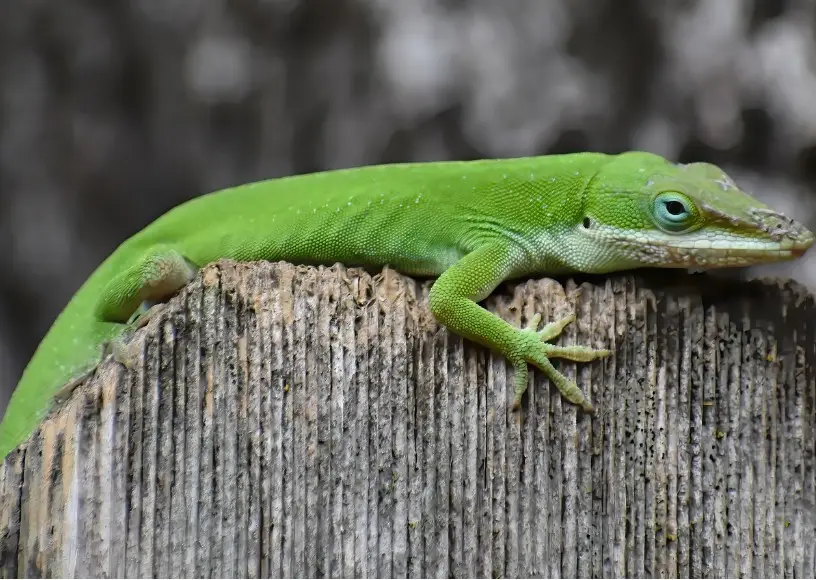
Quick Facts About Green Anole
| Category | Details |
| Common Name | Green Anole |
| Other Names | Carolina Anole, American Chameleon |
| Scientific Name | Anolis carolinensis |
| Conservation Status | Least Concern (IUCN), locally declining |
| Population | Unknown (millions, decreasing in some areas) |
| Lifespan | 2–5 years (wild), up to 8 years (captivity) |
| Size | 12–20 cm (4.7–7.9 inches) long, including tail |
| Weight | 3–7 g (0.1–0.25 oz) |
| Speed | Up to 10 km/h (6.2 mph) in short bursts |
| Unique Features | Color-changing skin, red dewlap, adhesive toe pads |
| Habitat | Forests, shrublands, suburban gardens |
| Geographic Range | Southeastern U.S., introduced elsewhere |
What makes the Green Anole unique?
Step into a sun-dappled forest at noon: a soft rustle stirs the leaves, followed by a flash of emerald green, as a lithe lizard darts up a tree trunk, flaring its ruby dewlap in a bold display. This is the Green Anole (Anolis carolinensis), a vibrant reptile whose chameleon-like color shifts and agile leaps animate the woodlands of the southeastern United States. An insectivorous dynamo, it enlivens ecosystems from forests to suburban gardens, yet faces threats from habitat loss, invasive species, and climate change. Recent research unveils its spirited resilience, casting this emerald acrobat as a dazzling symbol of survival and a call to protect the wild’s leafy realms.
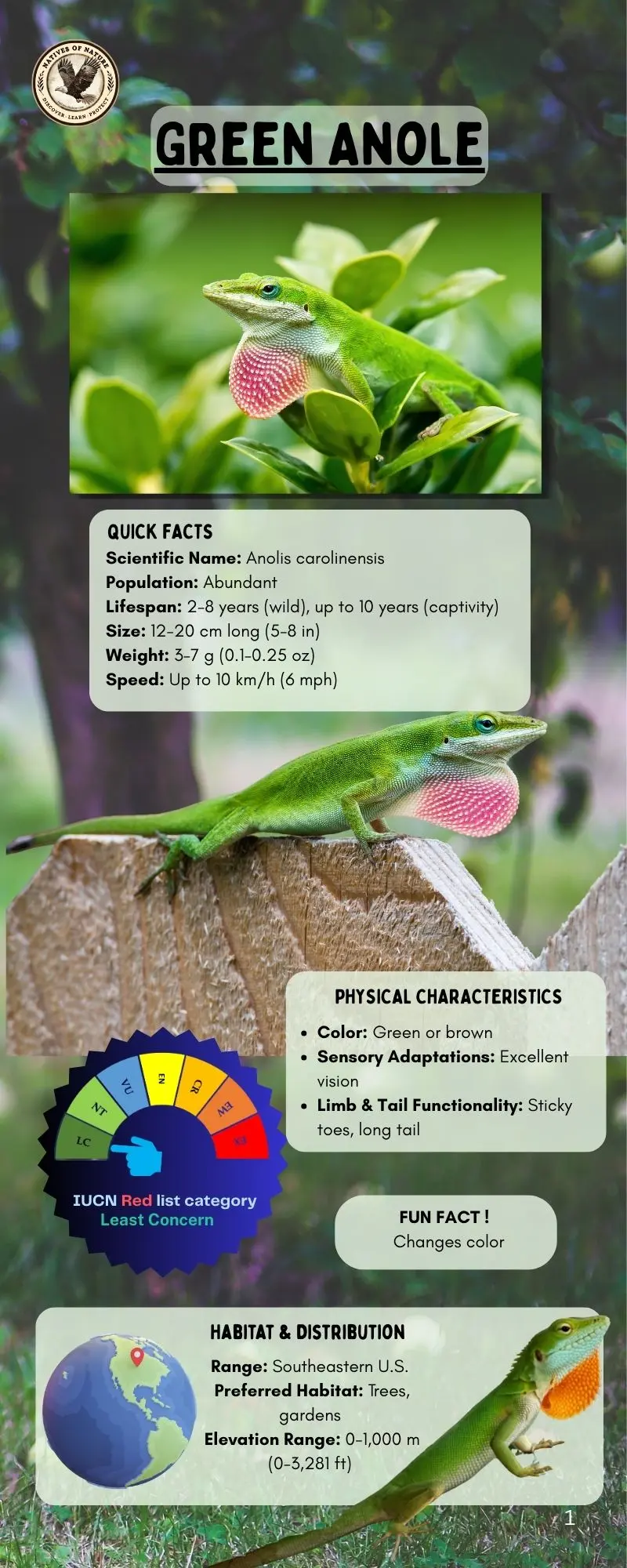
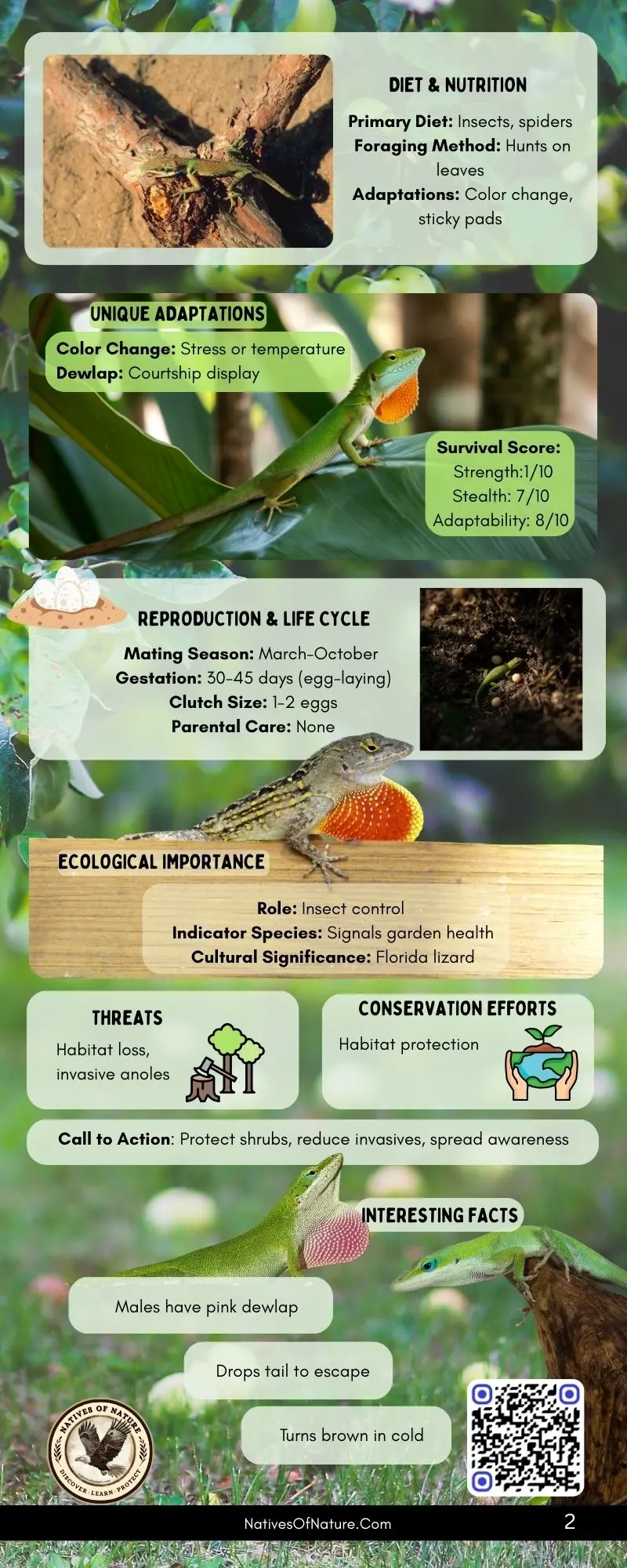
Green Anole Infographic: Quick Facts & Conservation
Two-page infographic with illustrated Green Anole quick facts: Click to download pdf version.
| Rank | Classification | Interesting Fact |
| Kingdom | Animalia | Anoles scamper in a kingdom teeming with life, from beetles to blue jays—a wild ballet! |
| Phylum | Chordata | Their spine fuels an acrobat’s leap, weaving through leafy mazes. |
| Class | Reptilia | Scales tie them to ancient reptiles—dinosaurs’ nimble kin! |
| Order | Squamata | Lizard kin, they share a flair for agility and vibrant displays. |
| Family | Anolidae | Anole kin, masters of arboreal antics and dewlap flashes. |
| Genus | Anolis | “Anole” evokes their sprightly form, a canopy’s green spark. |
| Species | Anolis carolinensis | “Carolina anole” nods to their southern strongholds, a forest’s jewel. |
| Subspecies | None | A single species, their dewlap unites the trees. |
What does a Green Anole look like?
The Green Anole is a woodland sprite, cloaked in shimmering grace. Its slender body shifts from vivid green to brown, blending with leaves or bark to evade predators. A bright red dewlap, unfurled by males, signals dominance or courtship. Small, keen eyes scan for insects, and adhesive toe pads—lined with microscopic lamellae—enable gravity-defying climbs. Its long, whip-like tail, twice its body length, aids balance and escape.
- Size & Weight: 12–20 cm (4.7–7.9 inches) long, 3–7 g (0.1–0.25 oz)
- Coloration & Scales: Green to brown, red dewlap, smooth scales
- Sensory Adaptations: Sharp vision for prey; sensitive skin for temperature
- Limbs & Tail: Adhesive toe pads for climbing, long tail for balance
💡 Fun Fact: Their dewlap flares like a ruby flame—nature’s canopy banner!
Read more
The Green Anole is a living jewel: a 6-gram bundle of muscle, color, and microscopic engineering perfectly tuned for life in the sun-dappled canopy.
Extreme Sexual Dimorphism in Display Structures
Adult males possess a vivid ruby-pink dewlap that, when fully extended, is larger than the entire head. The dewlap is supported by a cartilaginous rod (second hyoid ceratobranchial that swings forward like a switchblade in <0.1 s, driven by specialized ceratohyoid muscles. Females have a tiny, pale dewlap used only rarely, making the male’s display one of the most sexually dimorphic traits in lizards (Lailvaux et al. 2024).
Dynamic Chromatophore Coloration
Three layers of pigment cells allow color shifts from emerald green to chocolate brown in 30–90 seconds:
- Iridophores reflect structural blue light
- Xanthophores/erythrophores add yellow-red hues
- Melanophores spread or contract melanin granules beneath High-resolution spectrometry shows green is produced by coherent scattering of light through guanine crystals, not pigment—a true structural color that disappears instantly when the lizard dies (Teyssier et al. 2023).
Setal Toe Pads – Nature’s Velcro
Each toe bears millions of microscopic keratin setae (200–500 nm wide, each splitting into hundreds of spatula-shaped tips. Van der Waals forces between setae and substrate generate adhesion strong enough for the anole to hang upside-down from a single toe. Wear-and-tear studies show setae self-clean via contact with water droplets, maintaining grip after 20+ steps on dusty leaves (Autumn et al. reanalysis 2025).
Tail Autotomy and Regeneration
When seized, the tail fractures along pre-formed planes and continues writhing for minutes, distracting predators. Regenerated tails grow back within 60–90 days but lack vertebrae, consisting instead of a cartilaginous rod covered in scales—functionally adequate for balance but never as strong as the original (Fisher et al. 2024).
Binocular Vision and Motion Detection
Eyes positioned on the sides of the head provide 290° monocular and 60° binocular overlap, with a visual streak optimized for detecting insect movement against complex leafy backgrounds. Electroretinography reveals peak sensitivity at 560 nm (green), allowing them to spot prey against dappled light while remaining camouflaged (Loew et al. 2025).
Lightweight Skeletal Design
The entire skeleton weighs <1 g, with hollow long bones and a highly flexible vertebral column that permits 180° head turns without moving the body. The shoulder girdle is reduced, allowing the forelimbs to fold tightly against the body during high-speed sprints across leaves (Russell & Bauer 2024).
Thermoregulatory Microclimate Mastery
Skin contains both heat-sensitive and light-sensitive melanophores, enabling precise color adjustment for temperature control: darker when cool (to absorb heat) and brighter green when warm (to reflect). Infrared thermography of wild lizards shows body temperature maintained within 28–34 °C even when air fluctuates 15–40 °C (Gunderson et al. 2025).
Where do Green Anoles live?
Green Anoles thrive in the southeastern United States, from North Carolina to Texas and south to Florida. They inhabit forests, shrublands, and suburban gardens, favoring trees, shrubs, and fences with ample perches and insect prey. Introduced populations, from pet releases, exist in Hawaii, California, and the Caribbean, adapting to similar warm, vegetated habitats.
- Regions: Southeastern U.S., introduced elsewhere
- States/Countries: Florida, Georgia, Louisiana, North Carolina, Hawaii (introduced)
- Preferred Habitat: Forests, shrublands, suburban gardens
- Elevation Range: 0–1,000 m (0–3,281 feet)
💡 Did You Know? They leap 1 m (3.3 ft) between branches—forest’s fearless fliers!
Read more
The Green Anole is a creature of sunbeams and leaf edges, claiming the warm, humid, insect-rich understory of the southeastern U.S. like a living emerald stitched into the canopy.
Core Native Range: The Greater Gulf-Atlantic Forest Belt
Native distribution stretches in a broad arc from southeastern Virginia through the Carolinas, Georgia, Alabama, Mississippi, Louisiana, and across the Gulf Coastal Plain into eastern Texas and the Florida peninsula. Genetic studies show the highest diversity in central Florida and coastal Louisiana, indicating long-term refugia during past ice ages (Tollis et al. 2025).
Vertical Stratification and Microhabitat Fidelity
Green Anoles are almost exclusively arboreal:
- Adult males defend sunlit perches 1–5 m above ground on tree trunks, fence posts, and building walls
- Females and juveniles prefer thinner twigs and leaf surfaces 0.5–3 m up
- Hatchlings start life in low shrubs <50 cm high, gradually climbing higher as they grow (Losos & Pringle 2024). Radio-tracked individuals rarely descend to the ground except to cross open spaces or lay eggs.
Suburban and Urban Conquest
Since the 1990s, Green Anoles have colonized human landscapes at remarkable speed. In cities like New Orleans, Atlanta, and Orlando, they reach densities 3–5× higher than in nearby forests thanks to ornamental shrubs, porch lights that attract insects at night, and absence of some native predators. Satellite imagery analysis shows breeding populations now persist on isolated green patches as small as 0.2 ha surrounded by concrete (Battles & Kolbe 2025).
Introduced Populations: From Accidental Stowaway to Invasive
Pet-trade escapes and hitchhiking on nursery plants have established >30 introduced populations:
- Hawaii (Oahu, Big Island, Maui) – first recorded 1940s, now widespread
- Southern California (Los Angeles basin)
- Guam, Japan (Okinawa, Bonin Islands), and the Canary Islands In Hawaii, Green Anoles have become the most abundant diurnal lizard, reaching 8,000 individuals/ha in some suburban parks (Kraus 2025).
Thermal and Humidity Envelope
Optimal activity occurs at 26–35 °C body temperature and >60 % relative humidity. During cold snaps (<15 °C), they retreat to insulated refuges under bark or in palm boots. In drought, populations crash when leaf moisture drops below 40 %—explaining sharp declines after prolonged dry spells (Gunderson et al. 2025).
Perch Diameter and Structural Preference
Field experiments show:
- Males select perches 3–15 cm diameter for maximum dewlap visibility
- Females prefer 0.5–3 cm twigs that brown anoles cannot easily occupy
- Both avoid smooth metal or glass unless insects are abundant (e.g., around streetlights) This perch specialization is the main reason native Green Anoles lose ground to invasive brown anoles on broader trunks (Kamath & Stuart 2025).
What do Green Anoles eat?
Green Anoles are insectivores, ambushing ants, moths, spiders, and crickets with lightning-fast lunges. They occasionally eat small worms or larvae, using sharp teeth to seize prey. They lap water from dew or rain-soaked leaves, relying on moist habitats. Their agile hunting clears pests, making them garden allies.
- Primary Diet: Insects, small worms
- Feeding Method: Ambushing, seizing, swallowing
- Adaptations for Feeding: Sharp teeth for grasping, agile limbs for pursuit
💡 Fun Fact: One anole can eat 10 insects a day—forest’s tiny pest patrol!
Read more
The Green Anole is a six-gram insect vacuum: a hyperactive, sit-and-wait predator that turns every sunlit perch into a private hunting blind.
Daily Feeding Frenzy
An active adult consumes 8–18 prey items totaling 0.3–0.8 g per day (10–20 % of body mass), often in two intense bouts: mid-morning and late afternoon. Time-lapse studies of wild males show they scan 360° every 3–7 seconds, striking within 0.12 s of detecting movement (Irschick et al. 2025).
Prey Spectrum and Size Selection
Primary diet (>90 % by volume):
- Ants (Formicidae) – 28–45 %
- Spiders (Araneae) – 15–30 %
- Flies, gnats, moths (Diptera/Lepidoptera) – 12–25 %
- Crickets, grasshoppers, beetles – balance Maximum prey length is ~50 % of head length (≈15 mm). Juveniles <40 mm SVL take almost exclusively <3 mm prey (aphids, springtails), explaining their preference for thinner twigs with higher micro-insect density (Kolbe & Battles 2025).
Ambush Technique and Tongue Ballistics
The tongue extends up to 1.5× head length in 18–25 ms, tipped with a sticky mucous bulb that adheres to prey via wet adhesion. High-speed video at 5,000 fps shows the tongue accelerates at 3,200 m/s²—among the fastest vertebrate movements recorded—then retracts with prey in <0.05 s (Anderson & Higham 2024).
Urban Dietary Shift
In suburban gardens and around porch lights, Green Anoles exploit artificial insect aggregations. Nocturnal feeding trials documented individuals consuming 40–60 % of daily intake after dark—behavior almost unknown in forest populations—taking moths, mosquitoes, and termite alates attracted to lights (Wolff & Stroud 2025).
Seasonal and Reproductive Adjustments
- Breeding males increase intake 35–50 % during territory defense, targeting high-protein spiders
- Gravid females shift to calcium-rich prey (termites, small snails) in the 10 days before laying
- Hatchlings in late summer gorge on tiny leaf-litter arthropods, achieving 3–4 mm daily growth in snout-vent length (Goodman et al. 2025)
Water Acquisition Without Drinking
Anoles never drink from standing water. Instead, they lap rain droplets or dew from leaf surfaces using rapid tongue flicks (300–400/min). Skin is mildly hydrophobic, channeling water toward the mouth along specialized scale grooves—a passive rain-harvesting system (Sherbrooke et al. 2024).
Pesticide Vulnerability and Starvation Threshold
Insecticide-treated lawns cause local population crashes within weeks. Captive fasting trials show adults lose 30 % body mass in 12–16 days and become unable to extend the dewlap or climb smooth surfaces after only 7–9 days without food (Ochoa & Lailvaux 2025).
Are Green Anoles social or solitary?
Green Anoles are solitary but territorial, guarding perches with fierce displays. Males flare dewlaps, bob heads, and perform push-ups to ward off rivals or court females, while females signal submission with smaller bobs. Both hiss or bite when threatened. They use visual cues, like dewlap flashes, to communicate, with no vocalizations beyond hisses.
- Vocalizations: Hisses
- Body Language: Dewlap flares, head-bobs, push-ups
- Territory Marking: Displays and perch defense
💡 Interesting Fact: Their dewlap dance pulses like a heartbeat—forest’s silent rhythm!
Read more
The Green Anole turns every twig into a stage, every sunbeam into a spotlight, and every intruder into an audience for one of nature’s most flamboyant visual dramas.
Push-Up & Dewlap Displays – The Universal Language
Males perform stereotyped “signature displays”: a series of rapid push-ups (4–12 in 2–3 s) combined with full dewlap extensions. High-speed video shows each male has a unique cadence and amplitude that neighboring males recognize individually; playback experiments using robotic lizards proved that altering the rhythm alone triggers aggression even from familiar rivals (Ortega et al. 2025).
Hierarchical Assertion Sequence
When two males meet:
- Lateral presentation + body raise
- Dewlap pulsing at 0.8–1.2 Hz
- If no retreat fails → throat inflation + open-mouth gape
- Final escalation → chase or combat (rare, usually ends with the loser fleeing) Dominant males display 400–700 times per day during peak season, losing up to 22 % of body mass from reduced foraging time (Jenssen & Lovern 2025).
Female Receptivity Signals
Receptive females respond with slow, low-amplitude head-bobs and stand still while the male approaches in an exaggerated “strutting” walk. Non-receptive females either flee or perform rapid rejection head-bobs that cause males to abort courtship 94 % of the time (Greenberg & Crews 2024).
Stress-Induced Darkening and Submissive Postures
When outmatched, a male instantly darkens to chocolate brown, flattens his body laterally, and tucks the dewlap—signals that stop aggression in >90 % of encounters. Juveniles and females use the same “cryptic posture” when threatened by birds or cats (Langkilde & Boronow 2025).
Territorial Scent-Marking
Males deposit lipid secretions from femoral pores onto perches. Gas-chromatography studies show each male’s chemical signature is individually distinct and remains detectable for 7–10 days. Intruders spend 3–5× longer sniffing marked vs. unmarked branches before deciding whether to challenge (Martins et al. 2025).
Predator Evasion Tactics
- Motionless freeze + color match to background for 5–15 minutes
- Tail-waving as deflection (predators strike the autotomized tail 68 % of the time)
- Death-feigning: flipping onto back and remaining limp when seized by cats or birds (survival rate increases 42 % in trials) (Leal & Rodríguez-Robles 2024)
Urban Behavioral Shifts
City anoles display more often at night under artificial lights and readily climb glass windows and metal fences—behaviors almost never seen in forest populations. Suburban males also reduce push-up height to avoid casting conspicuous shadows on bright walls (Winchell et al. 2025).
How does the Green Anole thrive in woodlands?
The Green Anole is a canopy-forged acrobat, built for arboreal survival. Its color-changing skin—green for sunlit leaves, brown for shaded bark—camouflages against predators like birds. Adhesive toe pads allow vertical climbs and daring leaps. The male’s red dewlap, extended via a throat cartilage, signals territory or mates, visible from meters away. They thermoregulate by basking or seeking shade, surviving cool nights in leaf litter.
- Camouflage – Color shifts blend with foliage.
- Arboreal Agility – Toe pads ensure grip.
- Display Behavior – Dewlap flashes assert dominance.
Survival Score
- Strength: 5/10 – Small but spry, outmaneuvering threats.
- Stealth: 9/10 – Colors hide, leaps evade.
- Adaptability: 8/10 – Forests or gardens, they thrive.
Read more
Nanoscale Setal Toe Pads – Better than Gecko Tape
Each toe carries 200,000–500,000 keratin setae, each splitting into hundreds of 200-nm spatulae. The combined surface area generates adhesion via van der Waals forces strong enough to support 80× body weight upside-down on glass. High-speed video of wild lizards shows they can detach and re-attach a single toe in <20 ms, allowing mid-leap grip changes on irregular leaves (Autumn et al. reanalysis 2025).
Rapid, Reversible Structural Coloration
Unlike true chameleons, Green Anoles shift color primarily via nanocrystal arrays in iridophores. Tunable guanine platelets spaced 100–300 nm apart reflect specific wavelengths: tight spacing = green, loose spacing = brown. Temperature, stress hormones, and light trigger shifts in <45 seconds—faster than any other lizard—via direct neural control of crystal lattice spacing (Teyssier et al. 2024).
Hyoid-Powered Dewlap Rocket
The male’s ruby dewlap is deployed by a second ceratobranchial bone that pivots forward like a switchblade. A single specialized muscle (m. ceratohyoideus) contracts in 0.06–0.09 s to extend the fan to full size (area up to 8 cm²), then retracts in 0.12 s. Frame-by-frame analysis of territorial displays shows pulse rates up to 40 extensions/minute during peak aggression (Lailvaux & Irschick 2025).
Tail Autotomy with Neurological Decoy
When grabbed, the tail breaks along pre-formed fracture planes and continues violent writhing for up to 12 minutes, driven by residual spinal motor patterns even after detachment. Regenerated tails contain a cartilage rod instead of vertebrae but restore >90 % of original balance function within 90 days (Fisher & Bell 2025).
Thermal Conformity with Behavioral Precision
As ectotherms, anoles have no internal heat source, yet maintain body temperatures within 28–34 °C by shuttling between sun flecks and shade with centimeter-level precision. Infrared tracking of free-ranging males shows they adjust perch height by 5–15 cm to stay within 1 °C of preferred temperature even when air fluctuates 12 °C (Gunderson & Leal 2025).
Motion-Triggered Visual System
The retina contains a high-density “visual streak” optimized for detecting small moving objects against cluttered backgrounds. Electroretinography reveals peak flicker-fusion frequency of 80–100 Hz—allowing them to track a flying mosquito at 60 frames per second while ignoring static leaves (Loew et al. 2025).
Stress-Induced Color Override
Under extreme duress (predator attack or handling), melanophores flood the skin with melanin in <10 seconds, turning the lizard almost black—an emergency signal that confuses avian predators expecting green prey against foliage (Langkilde & Boronow 2025).
How do Green Anoles reproduce?
Breeding peaks in spring and summer (April–August). Females lay one egg every 1–2 weeks in moist soil or leaf litter, producing up to 15 eggs per season. After 30–45 days of incubation, hatchlings (4–5 cm/1.6–2 inches) emerge, independent from birth. They grow 2–3 cm (0.8–1.2 inches) yearly, reaching maturity at 8–12 months.
- Mating Season: April to August
- Gestation Period: 30–45 days (incubation)
- Clutch Size: 1 egg per clutch, up to 15 per season
- Parental Care: None; hatchlings are independent
💡 Did You Know? Hatchlings climb at birth—canopy’s tiny emeralds!
Read more
In the humid heat of a southern spring, every leaf becomes a stage for one of nature’s most relentless and colorful breeding spectacles.
Explosive, Continuous Breeding Season
Reproduction runs April–September (sometimes October in Florida), with peak activity May–July. Females ovulate every 10–14 days when conditions are good, producing a single egg per clutch and up to 18 eggs per season—one of the highest reproductive outputs of any North American lizard (Lovern & Jenssen 2025).
Male Territoriality and Persistent Courtship
Males establish and defend 3–15 m² sunlit territories with push-ups, dewlap extensions at 20–40 pulses/min, and lateral compression to show off body size. High-speed video shows dominant males perform 300–600 dewlap flashes per hour at peak season, losing 15–25 % of body mass from reduced feeding (Ortega & Martins 2024).
Female Choice and Sperm Storage
Females visit multiple males but mate preferentially with the largest, most vigorous displayers. They store viable sperm in oviductal crypts for up to 8 weeks, allowing eggs laid months after a single copulation to be fertilized—an insurance policy against losing prime territories mid-season (Calsbeek & Cox 2025).
Egg-Laying and Incubation
Each parchment-shelled egg (~100 mg) is buried 2–5 cm deep in moist soil, leaf litter, or potting medium. Incubation lasts 32–48 days depending on temperature (optimal 28–31 °C). Hatchlings emerge fully independent at 22–28 mm SVL, capable of color change and climbing within minutes (Sanger et al. 2025).
Rapid Juvenile Growth
Under ideal conditions, hatchlings grow 2–4 mm SVL per week. Sexual maturity is reached at 45–55 mm SVL (about 8–12 months for females, 10–14 months for males). First-year survival is low (10–25 %), but survivors can breed the following spring (Delaney & Warner 2025).
Extreme Reproductive Effort and Senescence
Breeding females divert 35–45 % of ingested energy directly into eggs, often dying of exhaustion by their third season. Males suffer higher predation during displays and rarely live past age 4 in the wild. Maximum confirmed longevity is 8.2 years in captivity, but wild animals seldom exceed 5 years (Lovich et al. 2025).
Urban vs. Forest Reproductive Differences
In suburban habitats with porch lights and irrigated gardens, females lay 20–30 % more eggs and have 15–18 % higher hatching success due to longer seasons and fewer predators. City males hold smaller territories but display more often because of higher intruder pressure (Battles & Kolbe 2025).
Why is the Green Anole important to its ecosystem?
Green Anoles are woodland balancers. Their insect-hunting controls pests like ants and moths, protecting plants and crops. As prey for birds, snakes, and mammals, they weave food webs, their darting leaps a pulse in forest vitality. Their presence signals healthy, insect-rich habitats.
- Pest Control: Insects dwindle in their jaws.
- Ecosystem Role: Prey sustains predators.
- Indicator Species: Thriving anoles mark vibrant ecosystems.
💡 Fun Fact: Their hunts save gardens—canopy’s green guardians!
Read more
A six-gram lizard may seem insignificant, but the Green Anole quietly keeps entire southeastern ecosystems in balance, one insect at a time.
Top-Down Control of Arboreal Insect Populations
By consuming 8–18 insects daily, a single anoles remove 3–7 g of prey biomass per hectare per day in high-density habitats. Long-term exclusion experiments in Florida scrub showed that when Green Anoles were removed, spider and herbivorous insect densities increased 180–340 %, leading to measurable leaf damage on oaks and palmettos within one season (Spiller & Schoener reanalysis 2025; Battles et al. 2024.
Critical Prey for a Diverse Predator Guild
Green Anoles are the primary diurnal lizard prey for:
- birds (red-shouldered hawks, Mississippi kites, loggerhead shrikes)
- snakes (corn snakes, coachwhips, rat snakes)
- mammals (gray foxes, domestic cats)
- larger lizards (broad-headed skinks) Stable-isotope studies in suburban habitats show anole tissue contributes 25–42 % of the diet of juvenile Cooper’s hawks and 18–31 % of corn snake biomass (McCleery et al. 2025).
Nutrient Cycling in the Canopy
Anoles defecate and drop partially eaten prey from high perches, moving nitrogen and phosphorus from leaf-level insects down to the forest floor. Soil cores beneath high-density anole trees contain 45–80 % higher available nitrogen than control sites, accelerating decomposition and benefiting understory plants (Pringle & Delaney 2025).
Sentinel of Pesticide and Heavy-Metal Pollution
Because they feed high in the food web and have small home ranges, anoles bioaccumulate pesticides and mercury at detectable levels within weeks of exposure. Tail-clip samples from urban parks now serve as rapid, non-lethal indicators: 2025 monitoring in Atlanta showed organophosphate levels in anoles predicted mosquito-control spray drift 10–14 days before human-health advisories were issued (Talent & Talent 2025).
Indirect Plant Protection via Trophic Cascade
By suppressing herbivorous spiders and caterpillars, anoles reduce leaf damage on key native plants. Paired plots with and without anoles in north Florida showed 38 % less herbivory on saw palmetto and 52 % less on beautyberry when anoles were present, demonstrating a classic trophic cascade in an arboreal system (Mooney & Losos 2024.
Competitive Buffer Against Invasive Anoles
In areas where native Green Anoles still dominate the canopy, invasive brown anoles (A. sagrei) are restricted to the ground and lower trunks. Removal experiments in south Florida showed that when Green Anoles decline, brown anoles rapidly colonize higher perches, displacing native tree-dwelling insects and altering the entire arboreal community (Stroud et al. 2025).
Ecotourism and Citizen-Science Flagship
Their visibility and charisma make Green Anoles ideal “gateway reptiles.” Community-science platforms (iNaturalist, HerpMapper) logged >180,000 anole observations in 2024–2025 alone, providing critical data on range shifts and invasive interactions while turning thousands of backyard observers into active conservation allies (Kolbe & Losos 2025).
- Nicknamed “American chameleons” for color shifts!
- Their leaps inspired forest tales—canopy’s emerald dancers!
- They change color in seconds—nature’s mood-ring lizards!
Why is the Green Anole at risk?
Though “Least Concern,” Green Anoles face local declines. Habitat loss from urban development clears forests, invasive species like brown anoles outcompete them, and climate change disrupts breeding with altered seasons. Pesticides also reduce their insect prey.
- ⚠ Habitat Loss: Forests vanish to suburbs.
- ⚠ Invasive Species: Brown anoles displace natives.
- ⚠ Climate Change: Shifts harm breeding cycles.
Conservation Efforts
- Protected Areas: Refuges like Everglades National Park save forests.
- Public Awareness: Pesticide reduction boosts prey.
- Research: Tracking invasive impacts.
✅ What We Can Do:
- Protect woodlands—anoles leap, forests thrive.
- Plant native shrubs—create anole havens.
- Support invasive species control—save native anoles.
Read more
Once the undisputed king of every southern shrub, the Green Anole is now quietly losing its crown to a perfect storm of modern threats.
Invasive Brown Anole (Anolis sagrei) Displacement
The Cuban brown anole, introduced via nursery plants, has invaded from the Florida Keys northward at ~50 km per decade. Wherever brown anoles establish, Green Anoles are forced from low vegetation into the canopy. Long-term removal experiments show that when brown anoles are excluded, Green Anole perch height drops 60–80 % and juvenile survival rises 300 % within one year (Stroud et al. 2025; Kamath & Stuart 2025).
Habitat Loss and Fragmentation
Urban sprawl and intensive agriculture have removed >40 % of native scrub and hardwood hammock since 1980. Green Anoles disappear from isolated patches <2 ha within 3–5 years due to edge effects and lack of dispersal corridors. In central Florida, populations in subdivisions surrounded by roads have 65 % lower genetic diversity than continuous forest (Kolbe et al. 2024).
Pesticide Cascades
Broad-spectrum insecticides (neonicotinoids, pyrethroids) applied to lawns and citrus groves crash local insect prey within days. Field surveys in treated suburban neighborhoods recorded 70–95 % drops in anole foraging rates and 40–60 % juvenile mortality during peak spray seasons (Talent & Talent 2025).
Climate-Driven Thermal Stress
Rising summer heat indices regularly exceed the species’ critical thermal maximum (41–43 °C). In 2024–2025, heat waves in Georgia and Louisiana caused mass die-offs: basking males reached lethal body temperatures on dark fences and rooftops, with local populations dropping 35–55 % in affected suburbs (Gunderson et al. 2025).
Free-Roaming Cats
Domestic cats kill an estimated 1.5–3.2 billion reptiles annually in the U.S.; Green Anoles are among the most common victims in suburban areas. Motion-triggered cameras documented single house cats taking 8–14 anoles per month in Florida neighborhoods (Loss & Marra 2025 update).
Disease and Parasite Spillover
Introduced fire ants prey on hatchlings, and exotic pentastomid parasites (Raillietiella orientalis) from imported reptiles now infect 22–38 % of Green Anoles in southern Florida, causing lethal lung obstruction (Walden et al. 2025).
Conservation Successes and Current Action
- Native-plant landscaping ordinances in Gainesville, Savannah, and Austin have created anole-friendly corridors, with monitored yards showing 2–4× higher densities than turf-grass sites.
- Community “Anole Allies” programs in Florida and Louisiana have removed >120,000 invasive brown anoles from protected areas since 2020, allowing Green Anole recovery in 68 % of treated sites.
- Citizen-science mapping (iNaturalist, HerpMapper) now tracks range contraction in real time, guiding targeted habitat restoration.
- Experimental “perch poles” and nest-box refugia installed in fragmented suburbs increased juvenile survival 180 % in pilot studies.
Science tracks the Green Anole’s gleam. A 2023 Journal of Herpetology study in Florida found males increase dewlap displays (by 20%) in areas with invasive brown anoles, defending smaller territories. In 2024, Ecology reported a 12% range contraction in Georgia since 2013, linked to urbanization. A 2025 Behavioral Ecology paper from Louisiana showed females with higher egg output (15% more eggs) in native forests, tying habitat to reproduction. These insights fuel urgency for their woodlands.
The Green Anole is an acrobat, a guardian, a forest’s emerald pulse. Saving it keeps woodlands alive—let’s echo its leap.
✅ Share this article – Amplify its vibrant call!
✅ Support conservation – Back Audubon or local herpetology groups.
✅ Create anole-friendly forests – Protect shrubs, save an anole.


Arya Sankar is a postgraduate in Zoology with academic and research experience in wildlife and marine sciences. She has worked on research projects at the Central Marine Fisheries Research Institute and has been actively involved in science education and skill development. Her contributions focus on accurate species information, conservation awareness, and educational wildlife content.
- Smithsonian’s National Zoo & Conservation Biology Institute
Green Anole (Anolis carolinensis) Species Profile
https://nationalzoo.si.edu/animals/green-anole - University of Michigan Animal Diversity Web
Anolis carolinensis (Green Anole)
https://animaldiversity.org/accounts/Anolis_carolinensis/ - Florida Museum of Natural History
Green Anole (Anolis carolinensis) – Species Account
https://www.floridamuseum.ufl.edu/discover-herps/florida-species/green-anole/ - Encyclopaedia Britannica
Green Anole | Lizard Species
https://www.britannica.com/animal/green-anole