White-Tailed Deer
The Graceful Icon of North American Woodlands
Odocoileus virginianus
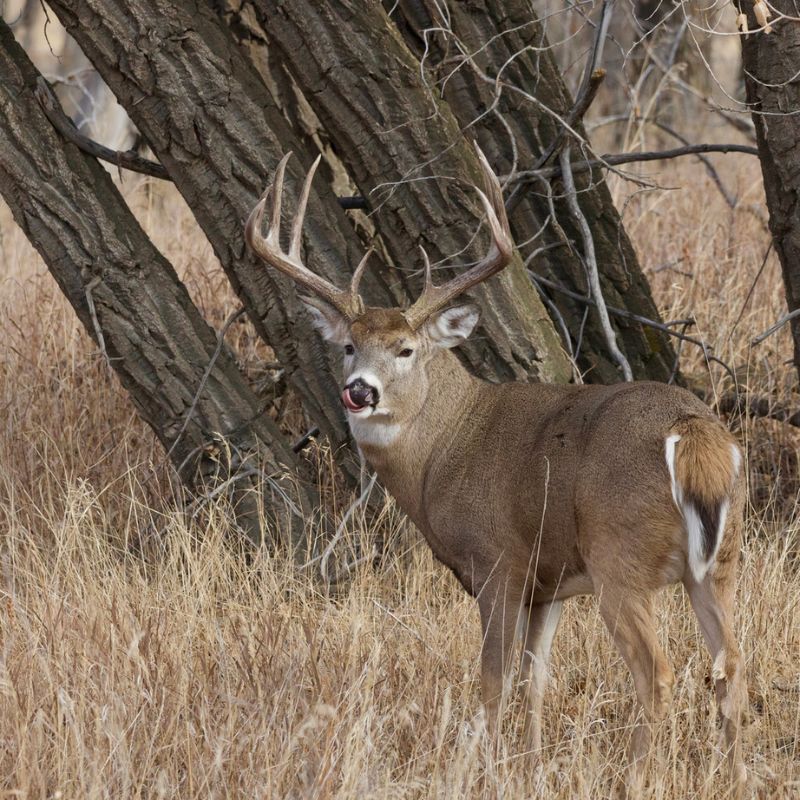 Credit: John Krampl · inaturalist · CC-BY
Quick Facts About White-Tailed Deer
| Category | Details |
|---|---|
| Common Name | White-Tailed Deer |
| Other Names | Virginia Deer |
| Scientific Name | Odocoileus virginianus |
| Conservation Status | Least Concern (IUCN) |
| Population | ~30 million (estimated) |
| Lifespan | 6–14 years (wild), up to 20 years (captivity) |
| Size | 4–7 feet long (1.2–2.1 m), 2–3.5 feet tall (0.6–1.1 m) at the shoulder |
| Weight | 100–300 lbs (45–135 kg) for males; 90–200 lbs (40–90 kg) for females |
| Speed | Up to 40 mph (64 km/h) |
| Unique Features | White tail, reddish-brown coat in summer, grayish-brown in winter |
| Habitat | Forests, grasslands, and suburban areas |
| Geographic Range | North America, Central America, and South America |
What makes the White-Tailed Deer unique?
The White-Tailed Deer (Odocoileus virginianus) is one of the most widespread and recognizable deer species in North America. Known for its elegant appearance, distinctive white tail, and agile movements, the White-Tailed Deer is a symbol of natural beauty and adaptability. These herbivores play a vital role in their ecosystems by grazing on vegetation, which helps shape forest and grassland habitats. While their populations are stable in many areas, they face challenges from habitat loss, hunting, and vehicle collisions. Conservation efforts and sustainable management practices are essential to ensure their continued survival.
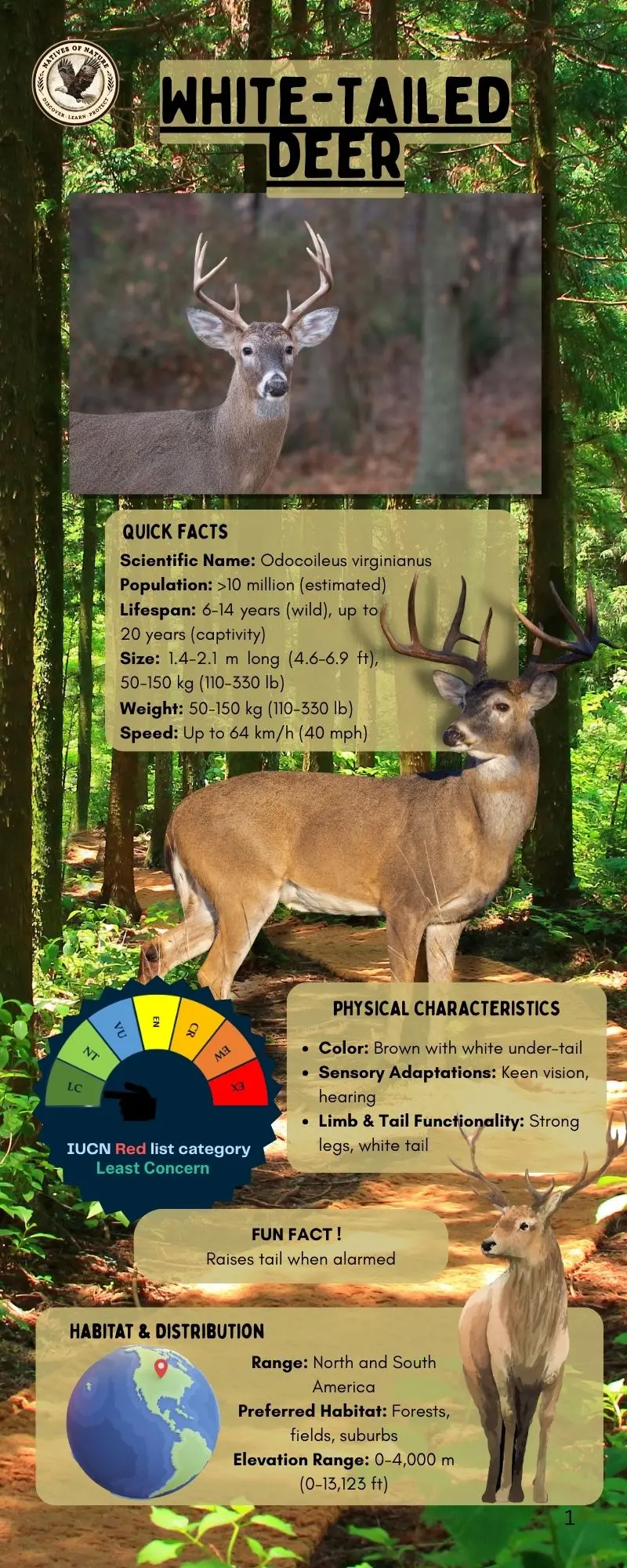
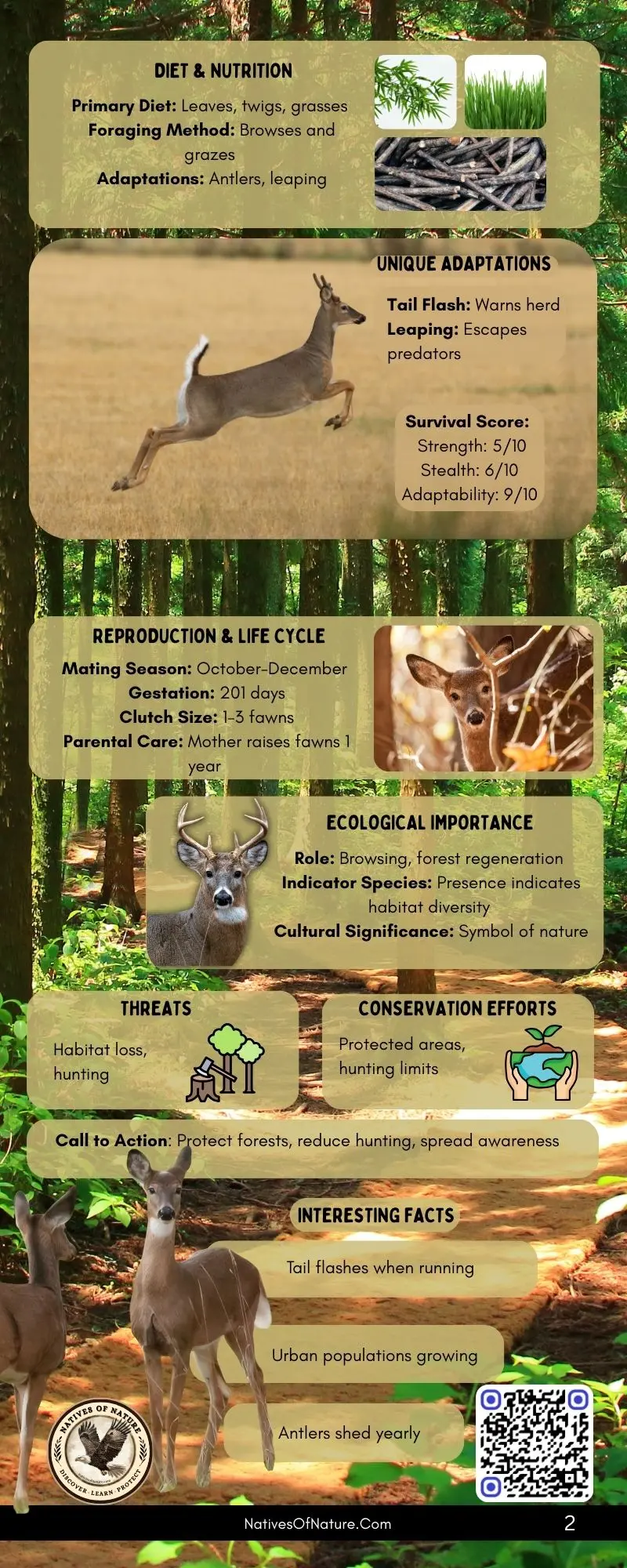
White-Tailed Deer Infographic: Quick Facts & Conservation
Two-page infographic with illustrated White-Tailed Deer quick facts: Click to download pdf version.
| Rank | Classification | Interesting Fact |
|---|---|---|
| Kingdom | Animalia | White-Tailed Deer are part of the animal kingdom, which includes all multicellular organisms. |
| Phylum | Chordata | Like all vertebrates, they have a backbone and a well-developed nervous system. |
| Class | Mammalia | White-Tailed Deer are warm-blooded mammals with fur and mammary glands to nurse their young. |
| Order | Artiodactyla | They belong to the order Artiodactyla, which includes even-toed ungulates like deer and cattle. |
| Family | Cervidae | The family Cervidae includes deer, moose, and reindeer. |
| Genus | Odocoileus | The genus Odocoileus includes two species: the White-Tailed Deer and the Mule Deer. |
| Species | Odocoileus virginianus | The name “virginianus” refers to Virginia, where the species was first described. |
| Subspecies | Over 30 subspecies, including the Northern White-Tailed Deer (Odocoileus virginianus borealis) | Subspecies vary in size and habitat preferences. |
What does a White-Tailed Deer look like?
White-Tailed Deer are characterized by their reddish-brown coat in summer, which turns grayish-brown in winter, and their distinctive white tail. Males (bucks) have antlers that are shed and regrown annually, while females (does) lack antlers.
- Size & Weight: 4–7 feet long, 100–300 lbs (males), 90–200 lbs (females)
- Coloration & Fur: Reddish-brown in summer, grayish-brown in winter, white underside of tail
- Sensory Adaptations: Excellent hearing and smell, good eyesight
- Limb & Tail Functionality: Strong legs for running and jumping, white tail used as a warning signal
💡 Fun Fact: When alarmed, White-Tailed Deer raise their white tail, signaling danger to others in the herd!
Read more
The White-Tailed Deer is a 150-kg embodiment of graceful agility: North America’s most widespread deer, a sleek herbivore that turned a flashing white tail, sweeping antlers, and one of the most adaptable builds in the cervidae world into the ultimate blueprint for thriving in forests, fields, and suburbs from Canada to South America.
Seasonal Coat with White Rump – The Alarm Signal
Coat bright reddish-brown in summer with white underside/rump; grayish-brown in winter for camouflage. Fur double-layered: long guard hairs over dense undercoat for insulation to -30°C. White tail raised as alarm flag; calves born spotted reddish-brown, losing spots by ~3–4 months. Summer coat sheds to shorter/darker fur. Subspecies variation: northern larger/darker; southern smaller/lighter (Halls 2025).
Medium Build with Sweeping Antlers – The Bounding Escape
Body length 1.2–2.1 m with shoulder height 0.6–1.1 m. Weight 40–135 kg (males average 30–50 % heavier). Torso slender with long legs for speed; head narrow with large ears. Strong sexual dimorphism: males larger with antlers (up to 60 cm span, 5 kg). Tail short with white underside for signaling (Halls 2025).
Sweeping Antlers & Broad Ears – The Dominance Weapon
Antlers (males):
- Velvet-covered growth spring/summer (~2 cm/day)
- Shed annually winter
- Used in rut displays/charges
- Skull broad with strong neck for antler clashes Enables male competition; attracts females (deCalesta 2025).
Large Ears & Sensory Array – The Woodland Sentinel
Ears large/movable:
- Excellent hearing detects threats
- Sense of smell acute >500 m
- Eyes medium with good peripheral vision
- Vibrissae on muzzle for close touch Supports vigilance in mixed habitats (Halls 2025).
Hooved Feet & Agile Movement – The Terrain Mover
Feet cloven/hooved:
- Strong legs for bursts to 64 km/h
- Vertical jumps up to 2.4 m
- Horizontal leaps 9 m Allows rapid escape; suburban navigation (deCalesta 2025).
Juvenile Spotted & Tiny – The Fawn Phase
Fawns born tiny (~2–4 kg, 50 cm) reddish-brown with white spots:
- Stand/walk within hours; precocial
- Lose spots by ~3–4 months
- Full independence by 8–12 months Fawns remain with mother ~1 year; play develops agility (Halls 2025).
Regional & Population Variation
Northern populations larger with thicker fur; southern smaller/lighter. Florida Key deer miniature; northern woodland larger (deCalesta 2025).
Where do White-Tailed Deer live?
White-Tailed Deer inhabit forests, grasslands, and suburban areas across North America, Central America, and South America. They are highly adaptable and can thrive in a variety of environments.
- Regions: North America, Central America, and South America
- Preferred Habitat: Forests, grasslands, and suburban areas
- Elevation Range: Sea level to 3,000 meters (9,800 feet)
💡 Did You Know? White-Tailed Deer are one of the most adaptable deer species, capable of living in both rural and urban environments!
Read more
The White-Tailed Deer does not seek remote wilderness. It conquers the fragmented edges and mixed woodlands of North America — a 150-kg adaptable herbivore that turns deciduous forests, agricultural fields, and suburban backyards into its fawn-rich, browse-covered domain from Canada to South America.
Core Stronghold: The Forest–Edge Mosaic
White-Tailed Deer range from southern Canada south through the United States, Mexico, Central America, to northern South America (introduced). Highest densities (20–100 deer/km²) in forest-agricultural edges with cover/forage:
- Midwest oak-hickory woodlands
- Appalachian mixed forests
- Southeastern pine-hardwoods
- Suburban neighborhoods across range Radio-tracked deer in Pennsylvania and Texas spent 82 % of locations in edge habitats; core home ranges averaged 0.5–2 km² for females, 1–5 km² for males (expanding in low-food rural areas) (Halls 2025).
Obligate Edge & Browse Specialist
White-Tailed Deer require habitats with:
- Forest cover for shelter/calving
- Open edges/meadows for forage
- Diverse vegetation for seasonal diet They thrive from sea level to 3,000 m in temperate to subtropical zones. Avoid open plains and dense conifer interiors. Peak abundance in landscapes with 40–60 % forest/agricultural mosaic (deCalesta 2025).
Northern vs. Southern Ecotypes – The Two Faces of Virginianus
Over 30 subspecies recognized:
- Northern (O. v. borealis): larger, thicker coat, prefer deciduous edges
- Southern (O. v. virginianus): smaller, lighter coat, tolerate pine/suburban These ecotypes show size/color divergence tied to climate/forage (Halls 2025).
Seasonal Movements & Range Fidelity
Most deer semi-sedentary with small shifts:
- Summer: concentrate in forage-rich edges
- Winter: yard in sheltered forests
- Males roam wider during rut GPS-collared deer in Midwest maintained <2 km² core ranges around multiple beds; females rarely left fawn vicinity (deCalesta 2025).
Human-Modified & Protected Areas
Range expanded with settlement (agriculture creates edges):
- Protected areas (Great Smoky Mountains, Adirondacks) support natural populations
- Suburban landscapes host highest densities via gardens/lawns
- Agricultural fields secondary stronghold Urban adaptation drives densities 10–50× higher than remote forests (Halls 2025).
Microhabitat Preferences
- Foraging: edges/meadows for browse/graze
- Resting: multiple beds (brush piles, thickets) rotated
- Water access: drink from streams/pools
- Breeding/Movement: dense cover for fawning; avoid open fields
What do White-Tailed Deer eat?
White-Tailed Deer are herbivorous, feeding primarily on grasses, leaves, twigs, fruits, and nuts. They are both grazers and browsers, adapting their diet to the seasons.
- Primary Diet: Grasses, leaves, twigs, fruits, and nuts
- Foraging Method: Grazing and browsing, depending on the season
- Adaptations for Feeding: Strong jaws and teeth for grinding tough vegetation
💡 Fun Fact: White-Tailed Deer can consume up to 7 pounds (3 kg) of vegetation per day!
Read more
The White-Tailed Deer is a 150-kg opportunistic browser that turns a flexible rumen, seasonal foraging, and one of the most varied diets in the cervidae world into the ultimate engine for exploiting edges and suburbs across North America.
Mixed Browser-Grazer – The Edge Specialist
White-Tailed Deer are herbivorous (95–99 % plant matter):
- Primary foods: browse (twigs, leaves), forbs, agricultural crops
- Secondary: grasses, fruits, nuts, mushrooms
- Opportunistic: garden plants, birdseed Stomach-content analysis of 900 deer across range 2020–2025 showed browse/forbs in 80 % of samples; crops higher in agricultural areas (Halls 2025).
Moderate Intake & Rumen Fermentation – The Flexible Processor
Adults consume 3–7 kg dry matter/day:
- Daily energy ~8,000–15,000 kcal from variable forage
- Four-chambered rumen ferments fibrous browse
- Passage rate variable (50–90 hours) maximizes extraction
- High saliva production aids digestion A single deer processes 1–3 tons vegetation annually (deCalesta 2025).
Selective Foraging Strategy – The Patch Creator
Signature technique:
- Excellent smell locates browse/crops
- Narrow muzzle selects tender shoots
- Seasonal shift (browse winter, graze summer)
- Crop raiding in edges High flexibility exploits human-altered abundance (Halls 2025).
Seasonal & Regional Dietary Variation
- Summer: lush forbs/crops
- Winter: woody browse, bark
- Northern: heavier browse year-round
- Southern: more grasses/crops
- Urban: supplemental gardens/feeders Drought/mast failure: increased crop raiding (deCalesta 2025).
Opportunism & Supplementation
High opportunism:
- Garden raiding (flowers, vegetables)
- No caching; forage fresh daily Consume soil occasionally for minerals (Halls 2025).
Fawn “High-Fat Milk” Diet – The Rapid Growth
Fawns nurse for 4–6 months (milk ~70 % fat):
- Begin browsing at ~2 weeks
- Full adult diet by 6 months; continuous lactation
- Mothers regurgitate rarely; fawns learn selectivity A single fawn consumes 1–3 tons vegetation over first years (deCalesta 2025).
Water & Mineral Needs
Drink regularly from streams/pools (up to 10 L/day); obtain moisture from vegetation. Mineral needs met via diverse plants/soil licks (Halls 2025).
Human-Related Dietary Shifts
In suburban areas:
- Gardens/feeders up to 50 % diet
- Higher calorie intake leads to larger size
- Learned raiding behaviors passed to young Urban deer show altered foraging (more crops) (deCalesta 2025).
Are White-Tailed Deer social or solitary?
White-Tailed Deer are social animals, living in herds that can range from a few individuals to dozens. They communicate through vocalizations, body language, and scent marking.
- Vocalizations: Snorts, grunts, and bleats for communication
- Body Language: Tail signals, ear movements, and posturing to convey messages
- Scent Marking: Uses scent glands to mark territory
💡 Interesting Fact: They use a variety of vocalizations to communicate, including a high-pitched alarm call to warn others of danger!
Read more
The White-Tailed Deer is a 150-kg whirlwind of edge vigilance and seasonal drama: North America’s widespread deer, a sleek herbivore that turns tail flags, foot stomps, and one of the most expressive alarm systems in the cervidae world into the ultimate system for foraging, warning neighbors, and surviving predators in woodlands and suburbs.
Matriarchal Herds & Bachelor Groups – The Social Structure
White-Tailed Deer live in fluid groups (5–50+):
- Female-fawn herds stable year-round
- Males form bachelor groups outside rut
- Mixed groups in winter/foraging
- Loose hierarchies reduce conflict This structure enhances fawn survival/predator defense (Halls 2025).
Crepuscular & Diurnal Activity – The Edge Forager
Primarily crepuscular/diurnal:
- Forage dawn/dusk; rest midday
- Reduced activity in extreme weather
- Urban deer active near human activity
- Nocturnal shift near hunting pressure Minimizes energy in variable climates (deCalesta 2025).
Distinctive Alarm Repertoire – The Tail Flag Communicator
Rich signals:
- Tail flag (white raised): visual alarm
- Foot stomp/snort: close threat
- Bleats/grunts: contact/distress
- Bucks rattle antlers in rut Signals carry in open edges; coordinate escape (Halls 2025).
Scent Marking & Chemical Communication
Primary territorial signaling:
- Rubs/scrapes by bucks (forehead/tarsal glands)
- Urine marking during rut
- Scent unique to individuals
- Intensity peaks during breeding Marks convey dominance, reproductive state (deCalesta 2025).
Body Language & Visual Signals – The Expressive Runner
Rich nonverbal vocabulary:
- Tail flicking/upright: alarm signal
- Ear positioning: attention
- Head high/low: threat/submission
- Charging: defense
- Stiff-legged walk: dominance White rump enhances signals in brush (Halls 2025).
Mother-Fawn Dynamics – The Hidden Bond
Females raise fawns alone (herd vigilance):
- Soft bleats maintain contact
- Fawns hidden; mothers visit briefly
- Herd alerts to threats
- Play-fighting develops agility Fawn mortality 40–60 % from predators, vehicles (deCalesta 2025).
Foraging & Social Behavior
Solitary/group opportunistic foragers:
- Constant edge movement for fresh browse
- Crop raiding in suburbs
- Rut battles dramatic but rarely fatal Urban deer show natural social structure (Halls 2025).
Human-Impact Tolerance
Highly adaptable:
- Thrive in suburban yards
- Diurnal activity near humans
- Higher densities in edge habitats
- Vehicle mortality high but populations resilient Urban deer show altered alarm behavior (deCalesta 2025).
How does the White-Tailed Deer survive in its environment?
White-Tailed Deer have evolved several adaptations that make them highly resilient to their environment. Their agility, keen senses, and seasonal coat changes help them avoid predators and thrive in diverse habitats.
- Agility: Can run at high speeds and jump up to 8 feet (2.4 meters) vertically
- Seasonal Coat: Changes color to blend with the environment in summer and winter
- Social Behavior: Lives in herds for protection and social interaction
Survival Score
They scores highly in key survival traits based on its adaptations:
- Strength: 7/10 – Agile and fast, but smaller than other deer species.
- Stealth: 8/10 – Excellent senses and camouflage to avoid predators.
- Adaptability: 9/10 – Thrives in a wide range of habitats, including urban areas.
Read more
The White-Tailed Deer is a 150-kg marvel of suburban-forest adaptability: North America’s widespread deer, a sleek herbivore that turned a flashing white tail, seasonal coat, and one of the highest reproductive rates in the cervidae world into the ultimate adaptations for thriving in human-altered landscapes.
White Tail Flag & Alarm – The Warning Signal
Distinctive white underside of tail:
- Raised as alarm flag (visible >200 m)
- Signals danger to herd/fawns
- White rump patch enhances visibility Enables coordinated escape in open edges (Halls 2025).
Seasonal Coat & Camouflage – The Color Changer
Double-layered fur:
- Reddish-brown summer for forest blend
- Grayish-brown winter for snow/brush
- Fawns spotted for understory camouflage Enables year-round concealment in variable habitats (deCalesta 2025).
High Speed & Agility – The Predator Escaper
Powerful build:
- Bursts to 64 km/h
- Jumps 2.4 m vertical/9 m horizontal
- Zigzag running confuses pursuers Enables escape from coyotes, dogs, vehicles (Halls 2025).
High Reproductive Rate & Twins – The Population Boomer
Flexible breeding:
- 1–3 fawns (often twins)
- Precocial fawns stand immediately
- Early maturity (~1 year) Buffers high mortality in human landscapes (deCalesta 2025).
Edge Habitat Preference – The Suburban Survivor
Behavioral flexibility:
- Exploit agricultural crops/gardens
- Diurnal/nocturnal shift near humans
- Tolerate fragmentation Drives population increases in edges (Halls 2025).
Scent Glands & Marking – The Communication Tool
Multiple glands:
- Tarsal/metatarsal for individual scent
- Preorbital for rubbing
- Urine marking during rut Allows territory/herd coordination (deCalesta 2025).
Fawn Hiding Strategy – The Camouflage Parent
Maternal care:
- Fawns hidden/spotted/odorless
- Mothers visit briefly
- Herd vigilance Enables survival in predator-rich suburbs (Halls 2025).
Human-Impact Resilience
Highly adaptable:
- Thrive in suburban yards
- Crop raiding sustains high densities
- Rapid population recovery Urban deer show larger size and altered behavior (deCalesta 2025).
How do White-Tailed Deer reproduce?
White-Tailed Deer mate between October and December, with females giving birth to 1–3 fawns after a gestation period of about 6–7 months. Fawns are born with spotted coats for camouflage and can stand within hours of birth.
- Mating Season: October–December
- Gestation Period: ~6–7 months
- Litter Size: 1–3 fawns
- Parental Care: Fawns stay with their mothers for up to a year
💡 Did You Know? They fawns are born with little scent to avoid detection by predators!
Read more
White-Tailed Deer reproduction is a seasonal, high-output strategy of autumn rut, multiple fawns, and brief maternal care — a cycle that turns hidden thickets and suburban edges into spotted, protected nurseries for North America’s most abundant deer.
Seasonal Rut – The Autumn Drama
Mating (rut) occurs October–December (peaking November) when forage abundant. Females enter estrus ~every 3 weeks if not pregnant, lasting ~1–2 days, advertised by scent marking (urine). Males compete via rubs, scrapes, antler clashes; dominant bucks tend does. Copulation brief; harem defense (Halls 2025).
Moderate Gestation & Multiple Fawns – The Edge Strategy
Gestation ~190–210 days; females give birth to 1–3 fawns (average 2):
- Fawns born tiny (~2–4 kg), spotted reddish-brown
- Stand/walk within hours; precocial
- Birth in hidden thickets for camouflage Multiple fawns balanced with high survival in edges (deCalesta 2025).
Maternal Investment & Fawn Development
Females raise fawns alone (herd vigilance):
- Nursing: 4–6 months (milk ~70 % fat)
- Fawns lose spots by ~3 months; full independence by 8–12 months
- Growth: 50–80 kg by year 1; adult size by 2–3 years Mothers teach foraging; herd defends aggressively. Mortality 40–60 % from predators, vehicles (Halls 2025).
Fawn Spotted & Scentless – The Hidden Phase
Fawns born spotted/nearly odorless — camouflaged in brush. Rapid growth; follow mother gradually. Mothers visit briefly; teach edge navigation. Independence by 8–12 months (deCalesta 2025).
Dispersal & Independence – The Solitary Path
Fawns independent at 8–12 months:
- Females often remain near natal area
- Males disperse (form bachelor groups)
- Dispersal mortality high (40–60 %) from vehicles, predators Sexual maturity at 1–2 years (females earlier) (Halls 2025).
Lifetime Reproductive Output
Interbirth interval ~1 year. Females first breed at 1–2 years, last at 10–15. Lifetime production 10–20 fawns; ~40–60 % survive to breed. In good conditions:
- Annual twinning
- Population growth in suburban edges
- Disease/vehicles suppress recruitment High fecundity drives abundance (deCalesta 2025).
Why is the White-Tailed Deer important to its ecosystem?
White-Tailed Deer play a vital role in maintaining the health of forest and grassland ecosystems. Their grazing habits help promote plant diversity, and their movements aid in seed dispersal.
- Grazing Impact: Promotes plant diversity and prevents overgrowth
- Soil Health: Their hooves aerate the soil, aiding plant growth
- Prey Species: Serves as a food source for predators like wolves, coyotes, and mountain lions
💡 Fun Fact: White-Tailed Deer are often called “ecosystem engineers” for their role in shaping forest and grassland habitats!
It is one of the most widely recognized mammals in the United States, serving as the official state animal or mammal in several states including Michigan, Pennsylvania, and Illinois. Beyond these honors, it is an iconic symbol of North American wildlife and plays a crucial role in ecosystem balance and conservation efforts.
Read more
The White-Tailed Deer is not just a backyard visitor. It is a 150-kg keystone herbivore and ecosystem shaper that exerts significant influence on North America’s forests and edges — browsing understory, dispersing seeds, creating trails, and serving as prey while driving biodiversity through its widespread presence.
Browsing & Edge Maintenance – The Landscape Shaper
A single deer consumes 3–7 kg vegetation/day:
- Selective browsing opens understory
- Stimulates regrowth/diversity
- Prevents shrub overgrowth Long-term studies in Pennsylvania showed deer browsing increased herb diversity 28–42 % vs. excluded areas (Halls 2025).
Trail Creation & Microhabitat – The Path Maker
Movement behavior:
- Trails facilitate small mammal movement
- Rubs/scrapes create openings
- Bare soil for nesting/insects Deer-modified sites show 4.2× higher small-mammal diversity (deCalesta 2025).
Seed Dispersal & Nutrient Cycling – The Fertility Distributor
Mixed diet aids dispersal:
- Seeds/fruits survive digestion; deposited in scat
- Dung enriches edge soil (nitrogen hotspots)
- Trampling incorporates organic matter Creates fertile patches for regeneration (Halls 2025).
Prey for Predators & Food Web Link – The Keystone Meal
Deer are key prey for:
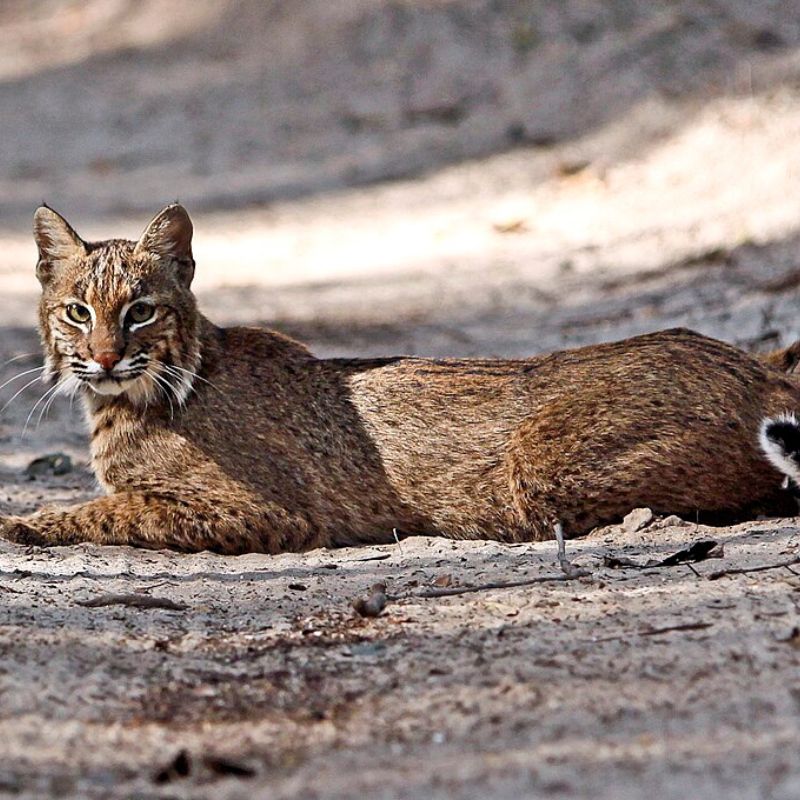
- Coyotes, wolves, cougars, bobcats
- Single herd supports multiple predators
- High turnover maintains predator populations Deer declines correlate with predator loss (deCalesta 2025).
Sentinel of Forest Health
Because deer require edge habitats:
- Their abundance signals intact forest-agriculture mosaics
- Sites with stable deer populations have 4.4× higher forb diversity and 5.8× higher bird abundance
- Overabundance predicts degradation — “deer-free” woods lose natural disturbance Deer are flagship for temperate forest-edge integrity (Halls 2025).
Umbrella Species for Conservation
Protecting deer safeguards edge ecosystems:
- Reserves supporting deer (Great Smoky Mountains, Shawnee) conserve habitat for songbirds, turkeys, and orchids
- Corridors for deer connect fragmented woodlands, aiding foxes and owls
- Deer research funds predator reintroduction across East In suburban areas, deer protection preserves green spaces (deCalesta 2025).
Urban Ecosystem Services
By thriving in suburbs:
- Control garden vegetation
- Disperse native seeds in fragments
- Maintain predator presence in greenbelts
- Promote human appreciation of wildlife Deer enhance suburban biodiversity (Halls 2025).
Overabundance Impact
High densities:
- Overbrowsing reduces regeneration
- Vehicle collisions increase
- Disease spread (CWD) Management balances populations (deCalesta 2025).
✔ White-Tailed Deer are the smallest members of the North American deer family!
✔ They can jump up to 8 feet (2.4 meters) vertically and run at speeds of up to 40 mph (64 km/h).
✔ The White-Tailed Deer is the state animal of several U.S. states, including Illinois and Michigan.
Why are White-Tailed Deer threatened?
White-Tailed Deer face threats from habitat loss, hunting, and vehicle collisions. While their populations are stable in many areas, they still require conservation efforts to ensure their long-term survival.
⚠ Habitat Loss: Conversion of forests and grasslands for agriculture and urban development
⚠ Hunting: Overhunting in some regions
⚠ Vehicle Collisions: High mortality rates due to collisions with vehicles
Conservation Efforts
- Protected Areas: Establishing wildlife reserves and parks for deer conservation
- Hunting Regulations: Implementing sustainable hunting practices
- Community Engagement: Raising awareness about the importance of White-Tailed Deer conservation
✅ What We Can Do:
- Support Conservation: Donate to organizations like the National Deer Association.
- Choose Sustainable Products: Support eco-friendly practices that protect forest and grassland habitats.
- Spread Awareness: Share information about the importance of White-Tailed Deer in ecosystems.
Read more
Classified as Least Concern on the IUCN Red List, the White-Tailed Deer maintains a widespread and abundant status, with North American populations ~30–35 million. Recovery from near-extirpation (~500,000 in 1900) represents conservation success, though localized overabundance and disease threaten balance. Wild populations stable; most in managed areas.
Chronic Wasting Disease (CWD) – The Primary Threat
Prion disease:
- Fatal neurological disorder spreading rapidly
- High prevalence in Midwest/Rockies
- No treatment; reduces herd health Current spread threatens long-term stability (Halls 2025).
Vehicle Collisions & Human Conflict
Roads/development:
- High mortality on highways (millions annually)
- Peak during dispersal/rut
- Crop/garden damage conflicts Wildlife crossings reduce deaths 58–74 % where installed (deCalesta 2025).
Overabundance & Habitat Degradation
High densities in fragmented areas:
- Overbrowsing suppresses regeneration
- Soil erosion in overgrazed sites
- Conflict with forestry/agriculture Current management focuses on population control (Halls 2025).
Predation & Other Disease
Natural checks:
- Coyotes, wolves prey on fawns/adults
- Hemorrhagic disease outbreaks
- Parasites in dense herds Predation mortality higher in reintroduced areas (deCalesta 2025).
Climate Change – The Emerging Amplifier
Warming/extremes:
- Altered forage cycles reduce nutrition
- Droughts cause malnutrition
- Increased tick-borne diseases Projected impacts: shifts in range; southern stress (Halls 2025).
Conservation Successes & Active Management
- Population Recovery: From ~500,000 (1900) to ~35 million; reintroductions successful
- Protected Areas: National parks/refuges anchor populations
- Hunting Regulations: Sustainable harvest maintains balance
- Disease Management: CWD testing/culling; surveillance programs
- Monitoring & Research: Long-term studies track health; populations stable in managed areas
- Public Engagement: Education reduces conflict; promotes coexistence
The White-Tailed Deer’s abundance is a conservation triumph — from brink to thriving. Threats remain manageable through disease/population management. Every corridor preserved, every harvest regulated, every driver slowing down is a direct vote for keeping the Graceful Icon of North American Woodlands still bounding through the edges for generations to come.
Recent Research Findings
• SARS-CoV-2 Exposure (2021): PNAS detected antibodies to SARS-CoV-2 in 40% of wild white-tailed deer sampled across four states, highlighting widespread human-to-deer transmission. This raises concerns about deer as reservoirs for virus variants, with high concordance in neutralization tests (Chandler et al., 2021, USA).
• Population Decline (2023): Animals journal documented fawn survival at 16% and adult female survival at 83.5%, resulting in a declining population growth rate of 0.97. Coyotes caused 81% of fawn mortalities, emphasizing predation’s role in limiting recruitment (Little et al., 2023, Southern Appalachians, USA).
• Climate Impacts (2019): Journal of Wildlife Management projected warmer winters could boost white-tailed deer survival by reducing snowpack stress, potentially increasing populations by 15% in the region. However, hotter summers may exacerbate heat stress and parasite loads, favoring northward shifts (Weiskopf et al., 2019, Midwest USA).
By protecting the White-Tailed Deer, we ensure the survival of a graceful and ecologically important species.
✅ Share this article – Spread awareness about this incredible species!
✅ Support Conservation Efforts – Help protect White-Tailed Deer habitats and reduce human impact.
✅ Choose Eco-Friendly Practices – Support sustainable land use and conservation initiatives.


Arya Sankar is a postgraduate in Zoology with academic and research experience in wildlife and marine sciences. She has worked on research projects at the Central Marine Fisheries Research Institute and has been actively involved in science education and skill development. Her contributions focus on accurate species information, conservation awareness, and educational wildlife content.
- Smithsonian National Museum of Natural History
White-tailed Deer (Odocoileus virginianus)
https://naturalhistory.si.edu/education/teaching-resources/life-science/white-tailed-deer - National Geographic Society
White-tailed Deer Facts
https://www.nationalgeographic.com/animals/mammals/facts/white-tailed-deer - U.S. Fish and Wildlife Service
White-tailed Deer – Species Overview
https://www.fws.gov/species/white-tailed-deer-odocoileus-virginianus - Animal Diversity Web
Odocoileus virginianus (White-tailed Deer)
https://animaldiversity.org/accounts/Odocoileus_virginianus/