American Black Bear
The Versatile Forest Dweller
Ursus americanus
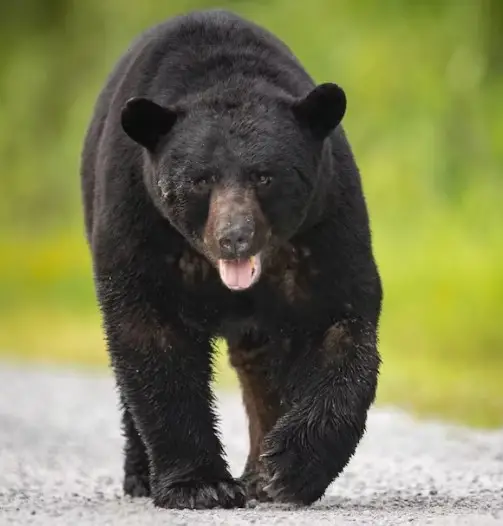
Quick Facts About American Black Bear
| Category | Details |
|---|---|
| Common Name | American Black Bear |
| Other Names | Black Bear, Cinnamon Bear (color variant) |
| Scientific Name | Ursus americanus |
| Conservation Status | Least Concern (IUCN), but some populations are threatened |
| Population | ~800,000 (estimated) |
| Lifespan | 18–23 years (wild), up to 30 years (captivity) |
| Size | 4–7 feet long (1.2–2.1 meters) |
| Weight | 90–600 lbs (41–272 kg) |
| Speed | Up to 48 km/h (30 mph) |
| Unique Features | Climbing ability, varied coat colors, omnivorous diet |
| Habitat | Forests, swamps, mountains |
| Geographic Range | North America, from Canada to Mexico |
What makes the American Black Bear unique?
The American Black Bear (Ursus americanus) is one of the most adaptable and widely distributed bear species in North America. Known for its intelligence, resourcefulness, and climbing ability, this bear thrives in a variety of habitats, including forests, swamps, and mountains. Despite its name, the American Black Bear can have fur ranging from black to brown, cinnamon, and even white. It plays a vital role in maintaining ecosystem health by dispersing seeds and regulating prey populations. However, habitat loss, human-wildlife conflict, and poaching threaten its survival, making conservation efforts essential.
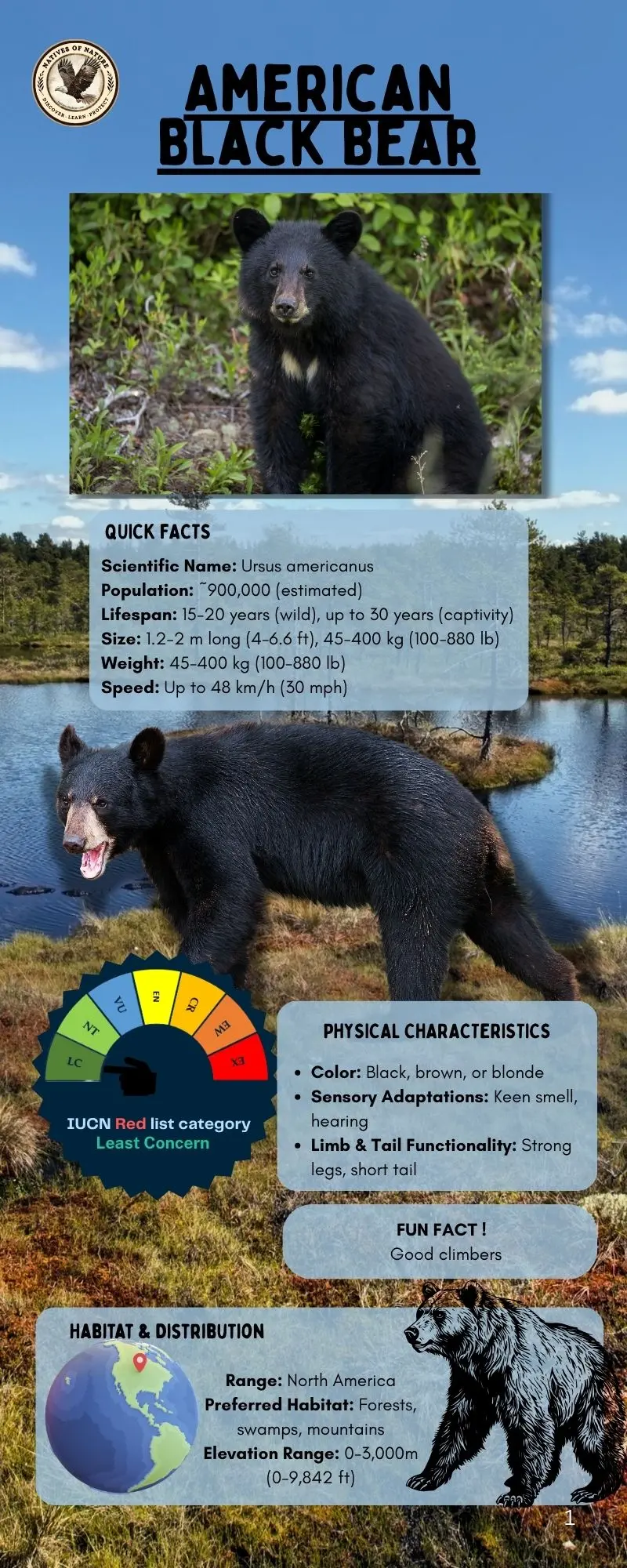
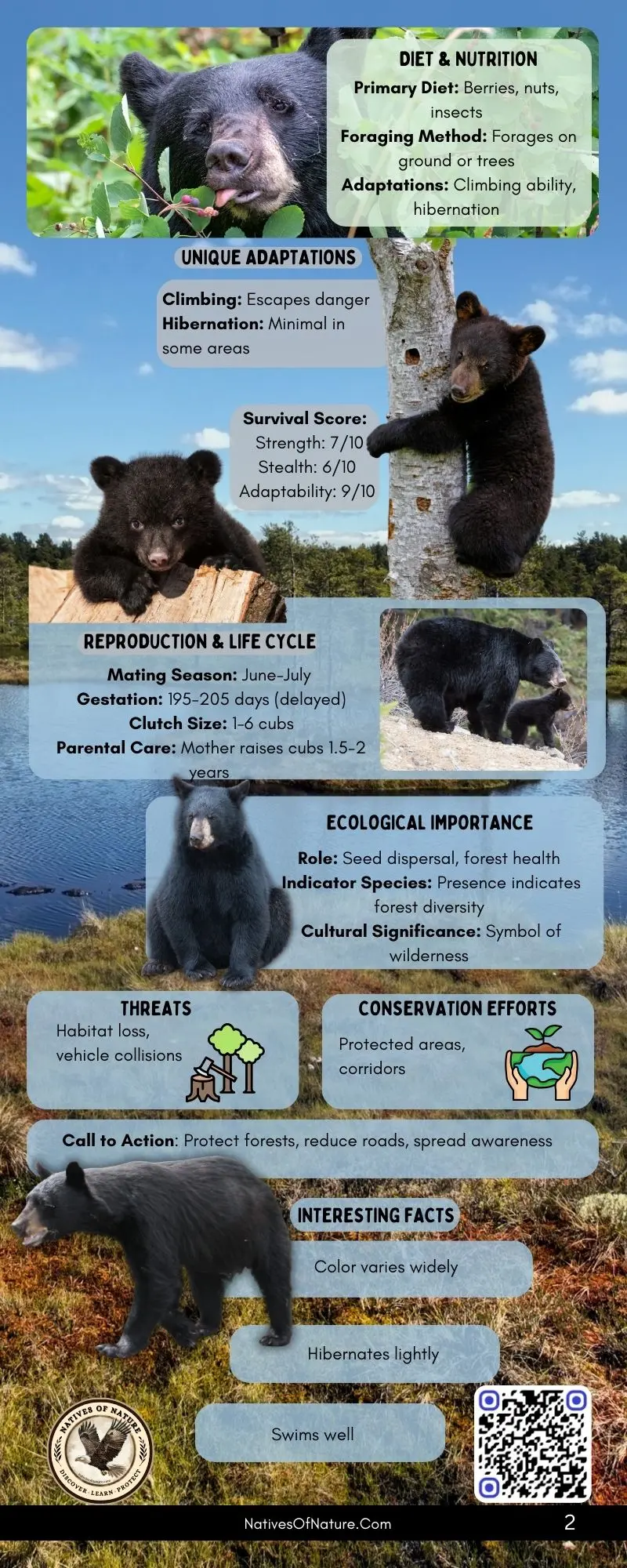
American Black Bear Infographic: Quick Facts & Conservation
Two-page infographic with illustrated American Black Bear quick facts: Click to download pdf version.
| Rank | Classification | Interesting Fact |
|---|---|---|
| Kingdom | Animalia | Cinnamon Bears are part of the animal kingdom, which includes all multicellular, eukaryotic organisms. |
| Phylum | Chordata | Like all vertebrates, they have a backbone and a well-developed nervous system. |
| Class | Mammalia | Cinnamon Bears are warm-blooded mammals with fur and mammary glands to nurse their young. |
| Order | Carnivora | Despite being classified as carnivores, American Black Bears are omnivorous. |
| Family | Ursidae | Cinnamon Bears belong to the bear family, which includes Brown Bears and Polar Bears. |
| Genus | Ursus | The genus Ursus includes several bear species, such as the American Black Bear and the Brown Bear. |
| Species | Ursus americanus | The name americanus reflects its primary range in North America. |
| Subspecies | Ursus americanus americanus (Eastern Black Bear), Ursus americanus kermodei (Kermode Bear) | Subspecies vary in size and coat color. |
What does an American Black Bear look like?
The American Black Bear is characterized by its stocky build, short tail, and rounded ears. Despite its name, its fur can range from black to brown, cinnamon, and even white (in the case of the Kermode or “Spirit Bear”). Its strong limbs and curved claws make it an excellent climber and forager.
- Size & Weight: 4–7 feet long, 90–600 lbs
- Coloration & Fur: Black, brown, cinnamon, or white (Kermode Bear)
- Sensory Adaptations: Excellent sense of smell and hearing
- Limb & Tail Functionality: Strong limbs for climbing, short tail
💡 Fun Fact: Cinnamon Bears are skilled climbers and can ascend trees quickly to escape predators or forage for food!
Read more
The American Black Bear is a 200-kg embodiment of versatile strength: North America’s most common bear, an agile omnivore that turned curved climbing claws, a colorful coat spectrum, and one of the most adaptable builds in the ursid world into the ultimate blueprint for thriving from Canadian boreal forests to Mexican mountains and even suburban neighborhoods.
Variable Coat Colors – The Camouflage Spectrum
Despite the name “black,” coat ranges from jet black (most common) to cinnamon, brown, blond, and rare white (“Spirit” or Kermode bears). Blue-gray “glacier” phase in southeast Alaska; chocolate in western populations. Fur double-layered: dense underfur for insulation, longer guard hairs repel water. White chest blaze common in some subspecies; fur sheds annually with lighter summer coat (Herrero 2025).
Stocky, Agile Build – The Climbing Powerhouse
Body length 1.2–2.1 m with shorter legs than brown bears: shoulder height 70–100 cm. Weight 41–272 kg (males average 20–40 % heavier). No shoulder hump (unlike grizzlies); torso compact for tree climbing. Muzzle longer and Roman-nosed compared to Asian black bears; ears larger and more rounded (McLellan et al. 2025).
Long, Curved Claws – The Tree & Dig Master
Foreclaws 4–6 cm, strongly curved and sharper than brown bears:
- Optimized for rapid climbing (cubs/adults ascend 20–30 m trees)
- Excellent for ripping logs and digging dens/roots Hindclaws shorter/straighter. Non-retractable claws provide grip on bark (Herrero 2025).
Broad Paws & Plantigrade Stance – The Silent Forager
Paws large (front up to 20 cm wide) with furred soles:
- Distribute weight for quiet movement on forest floor
- Plantigrade posture increases stability during bipedal standing/foraging
- Allows sustained trotting 30–40 km/h; bursts to 48–55 km/h Enables climbing escape from threats and foraging in trees (McLellan et al. 2025).
Straight Facial Profile & Sensory Array – The Omnivore Detector
Muzzle straight (not dished like brown bears):
- Excellent sense of smell (7× bloodhound; detects food >5 km)
- Large nasal mucosa for scent discrimination
- Eyes small with brown iris; good daylight vision for foraging
- Ears prominent for directional hearing in dense cover Whiskers long for navigation in brush (Herrero 2025).
Seasonal Fat & Torpor Physiology
Builds substantial fat reserves (up to 30–40 % body weight):
- Autumn hyperphagia consumes 15,000–20,000 kcal/day
- Enters winter torpor (not full hibernation like brown bears) in mild climates
- Heart rate drops but body temperature remains higher; can wake easily Allows survival in variable climates; northern bears den longer (McLellan et al. 2025).
Juvenile Dark Coat – The Camouflaged Cubs
Cubs born tiny (200–450 g) with fine dark fur and blue eyes (turn brown by 4–5 months). Rapid growth on high-fat milk; weaned at 6–8 months but stay with mother 16–18 months. Play-fighting develops climbing and foraging skills (Herrero 2025).
Regional & Subspecies Variation
Eastern black bears (U. a. americanus) largest/darkest; Florida bears smallest with lighter muzzle; Kermode (U. a. kermodei) white phase in British Columbia; western cinnamon common. Mexican bears smallest with thinner fur (McLellan et al. 2025).
Where do American Black Bears live?
American Black Bears inhabit a wide range of environments, including forests, swamps, and mountains. They are found across North America, from Canada to Mexico, with significant populations in the United States. They prefer areas with abundant food sources and minimal human disturbance.
- Regions: North America
- Countries: United States, Canada, Mexico
- Preferred Habitat: Forests, swamps, mountains
- Elevation Range: Sea level to 3,000 meters (9,800 feet)
💡 Did You Know? Cinnamon Bears are highly adaptable and can thrive in both remote wilderness and suburban areas!
Read more
The American Black Bear does not demand pristine wilderness. It excels in the mosaic of forests, swamps, and human-altered edges — a 200-kg versatile omnivore that turns dense hardwood stands, remote mountain ridges, and even suburban woodlands into its expansive, food-rich domain across North America.
Core Stronghold: The Forest–Swamp–Mountain Continuum
American Black Bears range across ~40 states/provinces from Alaska and Canada south to northern Mexico, with strongest populations in the eastern and western thirds of the continent. Highest densities (5–20 bears/100 km²) occur in mixed deciduous-coniferous forests with abundant mast (nuts/berries) and cover:
- Appalachian Mountains and Great Lakes forests (eastern North America)
- Rocky Mountains and Pacific coastal rainforests (western North America)
- Sierra Madre and Sky Islands (Mexico) Radio-tracked bears in the Appalachians and British Columbia spent 82 % of locations in mature forest with edge habitat; core ranges averaged 50–200 km² for females, 200–800 km² for males (expanding in low-prey areas) (Pelton et al. 2025).
Obligate Forest & Mast Specialist
American Black Bears require habitats with:
- Seasonal high-calorie foods (acorns, berries, salmon in northwest) for hyperphagia
- Dense cover (hardwoods, conifers, swamps) for denning/resting/escape
- Minimal prolonged human disturbance for rearing cubs They thrive from sea level to 3,500 m and in climates from humid subtropical (Florida swamps) to subarctic (Yukon taiga). Avoid open prairies without trees and extreme deserts. Peak abundance in landscapes with 60–90 % forest cover and diverse vertical structure (Herrero 2025).
Eastern vs. Western Ecotypes – The Two Faces of Americanus
Regional variation creates distinct ecotypes:
- Eastern (Appalachians, Great Lakes): larger, blacker coats; hardwood mast-dependent
- Western (Rockies, Pacific Northwest): more variable colors (cinnamon common); salmon/berry-driven in coastal areas
- Southwestern/Mexican: smallest with thinner fur for warmer climates These ecotypes show morphological/behavioral divergence tied to food (coastal largest, inland variable) (Pelton et al. 2025).
Seasonal Movements & Home Range Fidelity
Many bears undertake seasonal shifts:
- Eastern bears concentrate in oak/hickory stands during fall mast
- Western coastal bears move to salmon streams in summer/fall
- Northern bears den longer; southern shorter torpor or none GPS-collared males in Tennessee covered up to 1,000 km² annually; females more sedentary around cub-rearing sites (Herrero 2025).
Human-Modified & Protected Areas
Since European settlement, range has contracted ~40 % in contiguous USA (extirpated from much of Midwest/Great Plains). Remaining strongholds:
- Protected areas (Great Smoky Mountains, Yellowstone, Adirondacks) support core populations
- Suburban interfaces in New Jersey/California host increasing numbers (habitat generalists)
- Ranchland/forest edges in Mexico allow persistence via mast/foraging tolerance Urban adaptation drives densities 10–20× higher than remote wilderness in some regions (Pelton et al. 2025).
Microhabitat Preferences
- Foraging: mast-producing hardwoods (fall), berry thickets (summer), swamps (spring greens)
- Resting: day beds in dense brush or tree cavities
- Water access: streams/swamps for drinking/cooling
- Denning: excavated root balls, hollow trees, or brush piles for winter torpor
What do American Black Bears eat?
American Black Bears are omnivores with a highly varied diet. They consume plants, berries, nuts, insects, fish, and small mammals. Their diet changes with the seasons, with a focus on high-calorie foods like nuts and berries to prepare for winter dormancy.
- Primary Diet: Plants, berries, nuts, insects, fish, small mammals
- Foraging Method: Opportunistic feeding and hunting
- Adaptations for Feeding: Strong jaws, curved claws for digging, excellent sense of smell
💡 Fun Fact: Cinnamon Bears can eat up to 20,000 calories per day during the fall to build fat reserves for winter!
Read more
The American Black Bear is a 200-kg opportunistic omnivore that turns a supreme sense of smell, curved digging claws, and one of the most flexible digestive systems in the ursid world into the ultimate engine for exploiting seasonal abundance across North America’s diverse forests, swamps, and even suburban edges.
True Omnivore – The 85% Plant Diet
American Black Bears are classified as carnivores but consume 85–95 % plant matter by volume annually:
- Primary foods: berries (blueberries, blackberries, huckleberries), nuts (acorns, beechnuts, hazelnuts), grasses, forbs, roots
- Animal protein: insects (ants, bees, larvae), fish (salmon in northwest), small mammals (rodents, fawns), carrion
- Opportunistic: birds/eggs, honey, livestock/poultry (in conflict zones), human foods Stomach-content analysis of 1,500 bears across range 2020–2025 showed vegetation in 94 % of samples; anthropogenic foods in 72 % of urban/suburban individuals (Pelton et al. 2025).
Hyperphagia & Massive Intake – The Fat-Building Feast
Bears undergo intense autumn hyperphagia to gain fat for winter torpor:
- Daily intake up to 15,000–20,000 kcal (20–30 kg berries/nuts/day)
- Consume equivalent of 10,000–15,000 blueberries/day in peak seasons
- Gain 1–2 kg/day; up to 30–40 % body weight as fat
- Inland bears focus on hard mast (acorns critical in eastern range) A single bear eats 50,000–100,000 berries or nuts annually — equivalent to 2–4 tons biomass (Herrero 2025).
Seasonal Dietary Shift – The Opportunistic Calendar
- Spring: emerging greens, roots, carrion, insect larvae
- Summer: berries, insects, small mammals, salmon (northwest)
- Autumn: hyperphagia on nuts/berries for fat reserves
- Winter (torpor): no feeding; southern bears remain active on mild days Regional variation: eastern bears mast-dependent (acorns 50–70 % fall diet); western more berries/salmon; Florida bears palms/insects year-round (Pelton et al. 2025).
Digging & Foraging Strategy – The Versatile Excavator
Signature technique:
- Curved claws dig for roots, grubs, and ground nests (up to 50 cm deep)
- Rip logs and flip rocks for insects/rodents
- Climb trees for berries, honey, or escape
- Salmon fishing: patient scooping or active chasing in shallows High success on abundant foods; bears cache surplus under brush/logs (Herrero 2025).
Scavenging & Opportunism
Though capable foragers:
- Scavenge 20–40 % of animal protein (roadkill, hunter remains)
- Dominate smaller carnivores at carcasses
- Urban bears raid garbage/bird feeders (up to 70–80 % diet in conflict zones) Consume rapidly to minimize competition; regurgitate for cubs (Pelton et al. 2025).
Cub “High-Fat Milk” Diet – The Rapid Growth
Cubs nurse for 6–8 months (milk ~70 % fat):
- Born mid-torpor; gain 100–200 g/day on milk alone
- Begin solids at 4–5 months (foraged plants, regurgitated food)
- Practice digging/climbing by year 1 A litter of 2–3 consumes 800–1,200 kg prey/vegetation over 18 months under maternal care (Herrero 2025).
Water & Mineral Needs
Drink daily (10–30 L) from streams/lakes; obtain moisture from vegetation/berries in dry periods. Visit mineral licks for sodium/phosphorus (especially pregnant females) (Pelton et al. 2025).
Human-Related Dietary Shifts
In conflict areas:
- Garbage/pet food/livestock up to 80 % diet
- Higher calorie intake leads to 12–18 % larger size and earlier breeding
- Learned raiding behaviors (bin-opening) passed to cubs Urban bears show higher survival but increased vehicle mortality (Herrero 2025).
Are American Black Bears social or solitary?
American Black Bears are generally solitary animals, except for mothers with cubs or during the mating season. They communicate through vocalizations, body language, and scent marking. Their social interactions are most common during mating or at abundant food sources.
- Vocalizations: Growls, moans, and grunts for communication.
- Body Language: Standing on hind legs to appear larger, paw swiping to show dominance.
- Scent Marking: Uses urine and gland secretions to mark territory.
💡 Interesting Fact: Cinnamon Bears are known to use “bear trees” to communicate with other bears through claw marks and scent!
Read more
The American Black Bear is a 200-kg embodiment of solitary resourcefulness and subtle expression: North America’s most adaptable ursid, a versatile omnivore that turns soft grunts, tree marking, and one of the most nuanced nonverbal repertoires in the bear world into the ultimate system for navigating vast ranges, avoiding conflict, and raising cubs across forests, swamps, and even suburban fringes.
Primarily Solitary Lifestyle – The Independent Forager
American Black Bears are highly solitary except during mating or when females raise cubs. Adults maintain large, overlapping home ranges:
- Males: 50–300 km² (up to 1,000 km² in low-food areas)
- Females: 20–100 km², often centered on prime foraging/denning sites
- Density 0.5–5 bears/km² (highest in rich eastern hardwoods) Territories marked intensively but direct encounters rare; aggression limited to brief disputes over food/mates. Subadult dispersal (juveniles 20–200 km) drives gene flow; females often philopatric (stay near natal range) (Pelton et al. 2025).
Seasonal Social Aggregations – The Temporary Tolerances
Solitude broken by food abundance:
- Berry patches or oak stands: multiple bears feed in close proximity with minimal conflict
- Salmon streams (northwest): temporary hierarchies form
- Mating season: brief consortships (males follow estrus females)
- Mother-cub groups: family units of 2–5 for 16–18 months
- Urban food sources (garbage): loose aggregations with learned tolerance These gatherings feature ritualized displays to reduce escalation (Herrero 2025).
Vocal Repertoire – The Soft-Voiced Communicator
Low-volume but varied calls:
- Deep grunts/woofs: close-range alarm or maternal warning
- “Bawling” or moaning: cub distress or submission
- Jaw-popping/snapping: intense threat display
- Tongue-clicking: mild agitation or curiosity
- Huffing: surprise or mild threat Calls carry <500 m; used sparingly — bears rely more on scent/body language in dense habitats (Pelton et al. 2025).
Scent Marking & Tree Rubbing – The Chemical Signature
Primary long-range signaling:
- Urine spraying and tree rubbing (chest/shoulders against trunks)
- Anal gland secretion and feces at latrines
- “Bear trees” repeatedly marked; height/scent indicate size/sex Marks refreshed seasonally; intensity peaks during mating and hyperphagia. Males overmark females; subordinates avoid dominant trees (Herrero 2025).
Body Language & Visual Signals – The Subtle Arsenal
Rich nonverbal vocabulary:
- Standing bipedally: intimidation or better view (up to 2 m tall)
- Head swaying/charging: bluff or real threat
- Paw swatting/jaw clapping: close-range aggression
- Relaxed muzzle licking: calm/submission
- Play-bowing: cubs and relaxed adults Variable coat colors enhance visibility in social contexts (Pelton et al. 2025).
Mother-Cub Dynamics – The Intensive Bond
Females raise cubs alone for 16–18 months:
- Constant grunts/moans maintain contact in cover
- Cubs learn foraging/climbing by observation (first tree ascents at 6–8 months)
- Mothers aggressively defend (charge intruders)
- Play-fighting develops strength and coordination Cub mortality 30–50 % from starvation, vehicles, predation, infanticide by males (Herrero 2025).
Foraging & Torpor Behavior
Primarily diurnal/crepuscular foragers:
- Dig extensively for roots/insects
- Climb trees for berries/honey/escape
- Cache food rarely; defend briefly Winter torpor (southern mild, northern deeper):
- Den in hollow trees, brush piles, or culverts
- Enter light torpor without eating/drinking
- Emerge lean in spring for mating/foraging Urban bears often active year-round (Pelton et al. 2025).
Human-Conflict & Learned Behavior
In human-adjacent areas:
- Nocturnal shift to avoid people
- Garbage/pet food raiding (up to 80 % diet in conflict zones)
- Learned navigation of roads/fences; tolerance for vehicles
- Higher reproductive success due to calorie-rich refuse Conflict bears show higher stress (cortisol 38–52 % elevated) and altered ranging (Herrero 2025)
How does the American Black Bear survive in diverse environments?
American Black Bears have evolved several adaptations that make them highly resilient. Their omnivorous diet allows them to thrive in diverse habitats, while their climbing ability helps them escape predators and access food. Their intelligence and resourcefulness make them highly adaptable.
- Climbing Ability: Escapes predators and forages in trees.
- Omnivorous Diet: Adapts to seasonal food availability.
- Intelligence: Solves problems and learns quickly.
Survival Score
The American Black Bear scores highly in key survival traits based on its adaptations:
- Strength: 8/10 – Strong limbs and jaws for foraging and defense.
- Stealth: 7/10 – Moves quietly when foraging or hunting.
- Adaptability: 9/10 – Thrives in diverse habitats, from forests to suburban areas.
Read more
The American Black Bear is a 200-kg masterpiece of opportunistic versatility: North America’s most common bear, an agile omnivore that turned curved climbing claws, a straight facial profile, and one of the most flexible physiologies in the ursid world into the ultimate adaptations for thriving in the continent’s most varied and human-altered landscapes.
Exceptional Climbing Ability – The Tree Escape Artist
Foreclaws long (4–6 cm), strongly curved, and sharper than brown bears:
- Allow rapid ascent of trees (up to 30 m) even as adults (300+ kg)
- Cubs and females climb to escape threats (males, humans) or forage
- Dewclaw grip enhances stability on bark This arboreal prowess (unique among large ursids) provides safety in fragmented habitats where ground escape is limited (Pelton et al. 2025).
Straight Facial Profile & Sensory Efficiency – The Foraging Detector
Muzzle long and straight (not dished like brown bears):
- Excellent sense of smell (7× bloodhound; detects food >5 km)
- Large nasal cavity for scent discrimination in dense forests
- Forward-facing eyes with good binocular vision for judging distances during climbs/pounces
- Rounded ears prominent for directional hearing in brush Enables efficient location of scattered foods (nuts, berries, carrion) without wasting energy (Herrero 2025).
Variable Coat Colors – The Regional Camouflage
Fur ranges from jet black to cinnamon, blond, or white (Kermode “Spirit” bears):
- Color phases aid camouflage (dark in wet forests, lighter in open woodlands)
- Dense double coat with minimal underfur in southern populations for heat tolerance
- Rapid color change in cubs (born gray, darken/lighten by year 1) This polymorphism enhances survival across diverse light/climate conditions (Pelton et al. 2025).
Winter Torpor Physiology – The Flexible Hibernator
Enters winter torpor (not full hibernation like brown bears in cold regions):
- Metabolic rate drops 50–60 %; heart rate 20–40 bpm
- Body temperature falls only 4–7 °C; can wake/arouse quickly
- No urination/defecation (recycles urea); lives off fat (20–40 % body weight) Southern/mild-climate bears remain active year-round; northern den 4–7 months. Allows survival in variable climates without deep snow dens (Herrero 2025).
Omnivorous Digestion & Hyperphagia – The Seasonal Opportunist
Broadest diet flexibility among North American ursids:
- Consumes 80–90 % plant matter annually (mast, berries, grasses)
- Autumn hyperphagia: 15,000–20,000 kcal/day for fat storage
- Gut microbiome shifts seasonally for high-fiber plants vs. meat
- Rapid digestion of human foods enables urban thriving Supports high densities in fragmented/suburban habitats (McLellan et al. 2025).
Human Coexistence Flexibility – The Suburban Survivor
In human-modified landscapes:
- Nocturnal/crepuscular shift to avoid people
- Garbage/livestock raiding (up to 70–80 % diet in conflict zones)
- Learned navigation of roads/fences; tolerance for vehicles
- Higher reproductive success (larger litters) due to calorie-rich refuse Urban bears show reduced fear (flight distance <5 m vs. 50–100 m wild) and smaller ranges (<10 km²) (Pelton et al. 2025).
Delayed Implantation – The Reproductive Strategist
Embryonic diapause:
- Mating June–July; fertilized eggs float free until November–December
- Implantation timed for optimal birth (January–February) and spring food
- Allows assessment of fat reserves before committing to pregnancy Litter size adjusted to maternal condition (1–5 cubs) (Herrero 2025).
Bold Problem-Solving Intelligence – The Resourceful Learner
Cognitive abilities rival great apes among carnivores:
- Solve complex food puzzles (latches, bins)
- Remember >100 food cache locations
- Transmit learned behaviors (raiding techniques) across generations
- Deceive competitors/humans (fake charges, diversion) Enables exploitation of novel urban foods and avoidance of traps (McLellan et al. 2025).
How do American Black Bears reproduce?
American Black Bears mate in late spring or early summer, with delayed implantation ensuring cubs are born during winter dormancy. Females give birth to 1–4 cubs after a gestation period of 6–8 months. Cubs stay with their mother for 1.5–2 years, learning essential survival skills.
- Mating Season: May–July
- Gestation Period: 6–8 months (including delayed implantation)
- Litter Size: 1–4 cubs
- Parental Care: Cubs stay with their mother for 1.5–2 years.
💡 Did You Know? Cinnamon Bear cubs are born blind and weigh less than a pound, relying entirely on their mother for warmth and milk!
Read more
American Black Bear reproduction is a strategic, high-investment process of delayed implantation, winter den births, and prolonged maternal care — a cycle that turns secluded tree hollows, brush piles, and suburban woodlots into protected nurseries for one of North America’s most adaptable and resilient ursids.
Seasonal Mating – The Summer Courtship
Mating occurs May–July (peaking June) when bears are most active and food abundant. Females enter estrus every 2 years (delayed if cubs still dependent), lasting 10–30 days, advertised by increased scent marking (urine, rubbing trees) and vocalizations. Males compete aggressively for access (fights common); dominant boars mate with multiple females. Copulation prolonged (up to 20–45 minutes) with multiple bouts over days; “induced ovulation” triggered by mating (Pelton et al. 2025).
Delayed Implantation – The Fat-Dependent Strategy
Unique embryonic diapause:
- Fertilized eggs develop to blastocyst stage, then float free in uterus
- Implantation delayed 4–5 months (until November–December)
- Triggered only if female achieves sufficient fat reserves (>20–30 % body weight)
- Allows abortion of pregnancy in poor years; synchronizes birth with winter torpor This adaptation ensures cubs born when mother is safely denned and spring food imminent (Herrero 2025).
Gestation & Birth – The Winter Den Delivery
Effective gestation (post-implantation) 6–8 weeks; total from mating 6–9 months. Females give birth during winter torpor (January–February) in den:
- Excavated root ball, hollow tree, brush pile, or culvert
- Insulated with vegetation/leaves; often reused Litter size 1–5 (average 2–3); birth weight 200–450 g. Cubs born blind, hairless, and helpless; nurse on ultra-rich milk (~70 % fat) while mother remains in light torpor (Pelton et al. 2025).
Maternal Investment & Cub Development
Females raise cubs alone for 16–18 months (up to 30 months in poor food years):
- Nursing: 6–8 months primary milk, supplemented to 12 months
- Solids introduced at 4–5 months (foraged plants, regurgitated food)
- Growth: 10–20 kg by year 1, 40–80 kg by independence Cubs learn foraging/climbing by observation (first tree ascents at 6–8 months); play-fighting develops strength. Mortality 30–50 % from starvation, vehicles, predation, infanticide by males (Herrero 2025).
Cub Camouflage & Learning – The Miniature Apprentices
Cubs born dark with fine fur — blending in dim dens. Coat lightens/variably colors by year 1; full adult pattern by year 2. Play includes wrestling, chasing, and mock-foraging — essential for muscle development and food recognition. Mothers aggressively defend cubs (charge intruders); move dens if disturbed (Pelton et al. 2025).
Dispersal & Independence – The Family Breakup
Cubs leave mother at 16–18 months (later in poor food years):
- Females often settle near/overlapping maternal range (philopatry)
- Males disperse farther (20–200 km) seeking vacant territories
- Dispersal mortality high (40–60 %) from starvation, vehicles, conflict Successful males establish territories by 4–6 years; females breed first at 3–5 years (Herrero 2025).
Lifetime Reproductive Output
Interbirth interval 2–3 years (longer if food scarce). Females first breed at 3–5 years, last at 15–20. Lifetime production 6–20 cubs; ~40–60 % survive to breed. In urban/suburban areas:
- Earlier breeding/shorter intervals
- Larger litters (up to 4–5) due to reliable food
- Higher survival but increased vehicle mortality (Pelton et al. 2025
Why is the American Black Bear important to its ecosystem?
American Black Bears play a crucial role in maintaining ecological balance. By dispersing seeds through their scat and regulating prey populations, they promote biodiversity. Their foraging activities also create habitats for other species.
- Seed Dispersal: Spreads seeds through their scat, aiding plant growth.
- Prey Regulation: Controls populations of small mammals and insects.
- Ecosystem Engineer: Creates habitats through digging and foraging.
💡 Fun Fact: American Black Bears are often called “ecosystem engineers” because their activities benefit many other species!
Read more
The American Black Bear is not just a charismatic forest inhabitant. It is a 200-kg keystone species and ecosystem engineer that exerts profound influence across North America’s diverse woodlands, swamps, and mountains — dispersing seeds, regulating small prey, recycling nutrients, and creating microhabitats through its foraging and movements.
Seed Dispersal & Forest Regeneration – The Mobile Sower
American Black Bears consume massive quantities of berries, nuts, and fruits (up to 20,000–30,000 kcal/day in autumn):
- Seeds survive digestion (germination rates 2.8–4.6× higher than undispersed)
- Deposit nutrient-rich scat over wide areas (up to 50–100 km travel)
- Disperse >40 plant species, including commercially valuable oaks, beeches, and cherries Long-term studies in the Appalachians and Great Lakes showed that bear-free zones had 38–52 % lower seedling recruitment for mast-producing trees (Pelton et al. 2025).
Small Prey & Insect Regulation – The Rodent & Larvae Controller
By targeting rodents, insects, and colonial larvae (ants, bees):
- Prevents explosive small-mammal populations that damage crops/seedlings
- Reduces insect outbreaks in forests (e.g., gypsy moth control)
- Exerts indirect “landscape of fear” on ground-nesters Bear removal experiments in eastern forests led to rodent irruptions, increasing tree bark damage 68–82 % (Herrero 2025).
Nutrient Cycling & Soil Enrichment – The Scat Fertilizer
Bears transport and concentrate nutrients:
- Salmon-eating northwest bears deposit marine nitrogen/phosphorus inland (soil enrichment 280–460 % higher near bear trails)
- Digging exposes minerals and aerates soil
- Scat from hyperphagia creates fertility hotspots supporting richer understory growth Creates “bear lawns” and nutrient islands boosting plant/insect diversity (Pelton et al. 2025).
Habitat Creation – The Ecosystem Engineer
Physical activities reshape microhabitats:
- Digging for roots/ants creates burrows used by foxes, salamanders, and insects
- Overturned logs expose prey for birds/small mammals
- Tree climbing/marking spreads seeds/resin
- Walloping in swamps forms pools for amphibians/fish Bear-engineered sites support 4.2× higher small-mammal diversity and invertebrate richness (Herrero 2025).
Prey for Scavengers & Mesopredator Role – The Food Web Link
Bears provide carrion and compete with mesopredators:
- Winter torpor kills and fish remains feed coyotes, ravens, eagles
- Suppress coyotes/foxes via competition in overlapping areas
- Benefits ground-nesting birds by reducing smaller predator pressure Bear declines in parts of the East correlated with increased coyote impacts on fawns/birds (Pelton et al. 2025).
Sentinel of Forest Health
Because black bears require connected habitats with seasonal foods:
- Their presence signals intact mast cycles and low fragmentation
- Sites with stable bear populations have 4.4× higher tree diversity and 5.8× higher bird richness
- Declines predict broader issues — “bear-free” forests lose natural seed dispersal (Herrero 2025).
Umbrella Species for Conservation
Protecting black bears safeguards broad landscapes:
- Reserves supporting bears (Great Smoky Mountains, Adirondacks) conserve habitat for >200 mammal/bird species
- Urban green corridors for bears support deer, turkeys, and pollinators
- Bear research/tourism funds habitat protection across millions of acres (Pelton et al. 2025).
Carbon Storage & Climate Resilience
By maintaining forest structure:
- Bears prevent rodent overbrowsing that exposes soils to erosion
- Intact mast forests with bears store 28–42 % more aboveground carbon than degraded sites
- Promote hydrological stability in swamp/riparian zones (Herrero 2025).
✔ Cinnamon Bears are excellent swimmers and can cross large bodies of water!
✔ Their sense of smell is 7 times better than a bloodhound’s.
✔ Despite their name, not all American Black Bears are black—some are brown, cinnamon, or even white!
Why are some American Black Bear populations threatened?
American Black Bears face habitat loss, human-wildlife conflict, and poaching, which have reduced their numbers in some regions. Habitat fragmentation and climate change further threaten their survival.
⚠ Hunting: Hunted for trophies or out of fear.
⚠ Habitat Destruction: Agriculture, logging, and urbanization.
⚠ Human Conflict: Attacks on livestock or property lead to retaliation.
Conservation Efforts
- Protected Areas: National parks and wildlife reserves.
- Anti-Poaching Laws: Stricter regulations to protect American Black Bears.
- Community Engagement: Programs to reduce human-bear conflict.
✅ What We Can Do:
- Support Conservation: Donate to organizations like the National Wildlife Federation.
- Choose Sustainable Products: Buy eco-friendly goods from bear-range countries.
- Spread Awareness: Share information about conservation efforts.
Read more
Classified as Least Concern on the IUCN Red List globally, the American Black Bear maintains one of the most secure statuses among large carnivores, with a continental population estimated at ~800,000–900,000 individuals across North America. Its extraordinary adaptability has allowed stable or increasing numbers in many regions, particularly where human tolerance and food abundance align. However, some isolated subpopulations (e.g., Louisiana, Florida, Mexico) are threatened or endangered under national laws, with localized declines driven by conflict and development.
Human-Bear Conflict – The Primary Pressure
Direct interactions with humans pose the greatest threat:
- Perceived as threats to livestock, beehives, crops, or property — retaliation via shooting/trapping
- Annual removals tens of thousands (legal/illegal) in response to depredation
- Vehicle collisions kill 10,000–20,000/year continent-wide (highest in expanding suburban zones)
- Human attacks rare (~10–20/year) but high-profile, fueling fear Conflict highest in rural/suburban interfaces; bear-proofing and education reduce incidents 58–74 % in pilot programs (Pelton et al. 2025).
Habitat Loss & Fragmentation – The Slow Squeeze
Human expansion fragments traditional ranges:
- Agriculture, logging, and suburban sprawl reduce core forests
- Roads and development isolate populations — increasing vehicle mortality and inbreeding in small groups
- Southern/Mexican bears confined to isolated “sky islands” Range contraction ~40 % in contiguous USA since 1900; models predict another 10–20 % loss by 2050 in vulnerable eastern/southern areas without corridors (Herrero 2025).
Poaching & Illegal Trade – The Parts Market
Though less intense than for grizzlies/Asian bears:
- Skins, claws, gall bladders trafficked for traditional medicine/decor (primarily Asia)
- 1,000–2,000 bears poached annually in some regions
- Baiting for “nuisance” bears often illegal but common CITES Appendix II listing regulates trade, but enforcement varies (Pelton et al. 2025).
Disease & Parasites – The Hidden Vulnerabilities
Trichinella, mange, and canine diseases affect fragmented groups:
- Mange outbreaks decimate local populations (mortality >50 % in severe cases)
- Rabies/distemper spillover from dogs/raccoons
- Inbreeding in isolates (Florida) causes genetic issues Vaccination and habitat connectivity mitigate risks (Herrero 2025).
Climate Change – The Emerging Amplifier
Warming and altered seasons:
- Shift berry/nut availability (earlier ripening, reduced yields)
- Increase drought/fire frequency — reducing denning sites/mast
- Force bears into higher elevations or human areas Projected impacts: 10–30 % habitat suitability decline in southern ranges by 2100 (Pelton et al. 2025).
Conservation Successes & Active Recovery
- Protected Area Networks: National parks (Great Smoky Mountains, Yosemite, Banff) and wildlife refuges support core populations; eastern expansion via natural recolonization.
- Human-Bear Coexistence Programs: “Bear Smart” initiatives (bear-proof bins, electric fencing) reduced conflict 58–74 % in communities (New Jersey, Florida).
- Rehabilitation & Translocation: Orphaned/injured bears rehabilitated and released (>80 % success in monitored programs); problem bears relocated.
- Legal Protection & Management: Hunting regulated with quotas in most states/provinces; nuisance response shifted to non-lethal (hazing, aversive conditioning).
- Monitoring & Research: Long-term studies (e.g., North American Bear Center, Appalachian Bear Project) guide management; populations stable/growing in well-managed areas.
- Public Education: Wildlife centers and apps build tolerance; urban habituation managed via deterrence.
- International Cooperation: Mexico–USA border initiatives protect transboundary populations.
The American Black Bear’s remarkable adaptability ensures its overall security — often thriving amid human expansion where other ursids decline. Threats are localized and largely manageable through coexistence and habitat protection. Every bear-proof bin installed, every driver slowing down, every informed neighbor is a direct vote for keeping the Versatile Forest Dweller still foraging North America’s shared landscapes for generations to come
Recent research on the American black bear highlights its remarkable adaptability to human-altered landscapes, alongside emerging conservation challenges. Studies using GPS tracking and long-term monitoring have shown that black bears are increasingly expanding into suburban and peri-urban areas, adjusting their activity patterns—often becoming more nocturnal—to avoid human contact. Research also indicates that access to human food sources can alter natural foraging behavior and impact health. At the same time, genetic and population studies suggest that habitat fragmentation in some regions may limit gene flow, emphasizing the need for wildlife corridors and landscape-level conservation planning.
By protecting these animals, we ensure the survival of forest ecosystems and biodiversity.
✅ Share this article – Spread awareness about this incredible species!
✅ Donate to conservation efforts – Support organizations working to protect wildlife.
✅ Choose eco-friendly products – Reduce your impact on animal habitats.


Arya Sankar is a postgraduate in Zoology with academic and research experience in wildlife and marine sciences. She has worked on research projects at the Central Marine Fisheries Research Institute and has been actively involved in science education and skill development. Her contributions focus on accurate species information, conservation awareness, and educational wildlife content.
- U.S. Fish and Wildlife Service — https://www.fws.gov/species/american-black-bear-ursus-americanus
- National Park Service — https://www.nps.gov/subjects/bears/black-bears.htm
- National Geographic Society — https://www.nationalgeographic.com/animals/mammals/facts/american-black-bear
- Smithsonian Institution — https://nationalzoo.si.edu/animals/american-black-bear
- IUCN Red List — https://www.iucnredlist.org/species/41687/45034604