Eastern Diamondback Rattlesnake
The Diamond-Backed Thunder of the Southern Pine Empire
Crotalus adamanteus
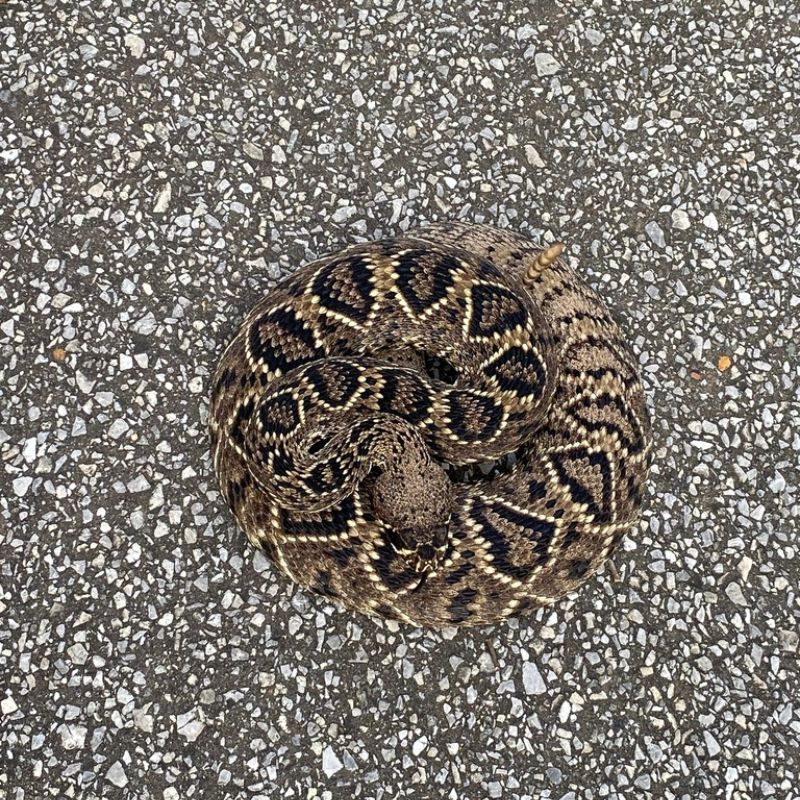 Credit: Matt Berger · inaturalist · CC-BY
Quick Facts About Eastern Diamondback Rattlesnake
| Category | Details |
| Common Name | Eastern Diamondback Rattlesnake |
| Other Names | Diamondback, Coastal Rattler |
| Scientific Name | Crotalus adamanteus |
| Conservation Status | Least Concern (IUCN, 2020); Petitioned for ESA listing |
| Population | ~80,000–120,000 adults (Southeast U.S., 2025 estimate) |
| Lifespan | 15–25 years (wild); record 31 years |
| Size | 1.2–2.4 m (4–8 ft) total length |
| Weight | 2.3–6.8 kg (5–15 lbs) |
| Strike Speed | 0.11 seconds – 2.9 m/s (10.4 km/h) |
| Unique Features | Black-bordered diamonds, 8-inch fangs, 12-segment rattle |
| Habitat | Longleaf pine savannas, coastal scrub, gopher tortoise burrows |
| Geographic Range | Southeast Coastal Plain (NC to LA) |
What makes the Eastern Diamondback Rattlesnake extraordinary?
In the cathedral hush of a Georgia longleaf pine savanna, a four-foot coil of living chainmail raises its tail, rattle singing like a closer’s 102-mph sinker buzzing past the batter’s knees. This is the heaviest venomous snake in the Americas, whose black-bordered diamonds and 8-inch fangs define wiregrass flats, gopher tortoise burrows, and coastal scrub from North Carolina to Florida. A keystone predator that eats 25 rabbits a year and keeps rodent plagues in check, it faces fire suppression and rattlesnake roundups. A 2025 Tall Timbers census estimated 80,000–120,000 adults—down 70% since 1950—casting this diamond-backed thunder as the pine empire’s MVP and an urgent call for Americans to protect its fire-kissed kingdoms, much like we rally for our gopher tortoises.
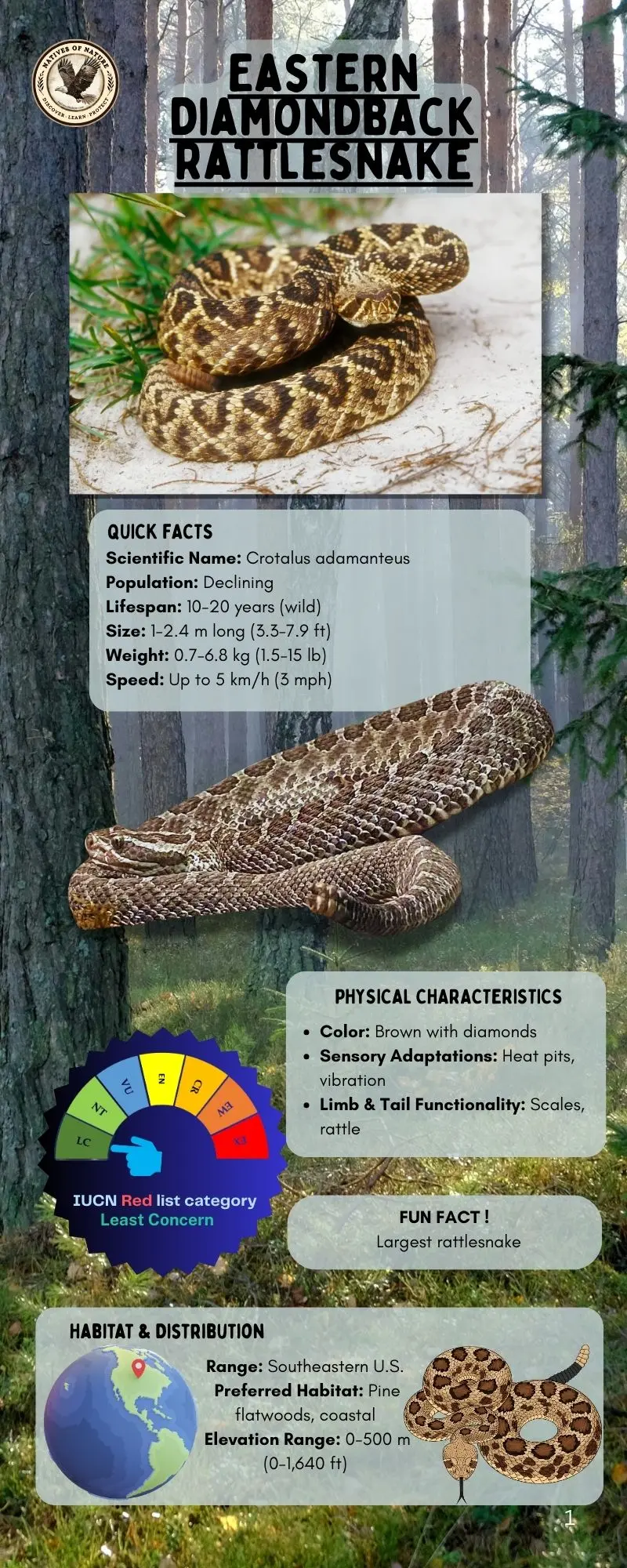
Eastern Diamondback Rattlesnake Infographic: Quick Facts & Conservation
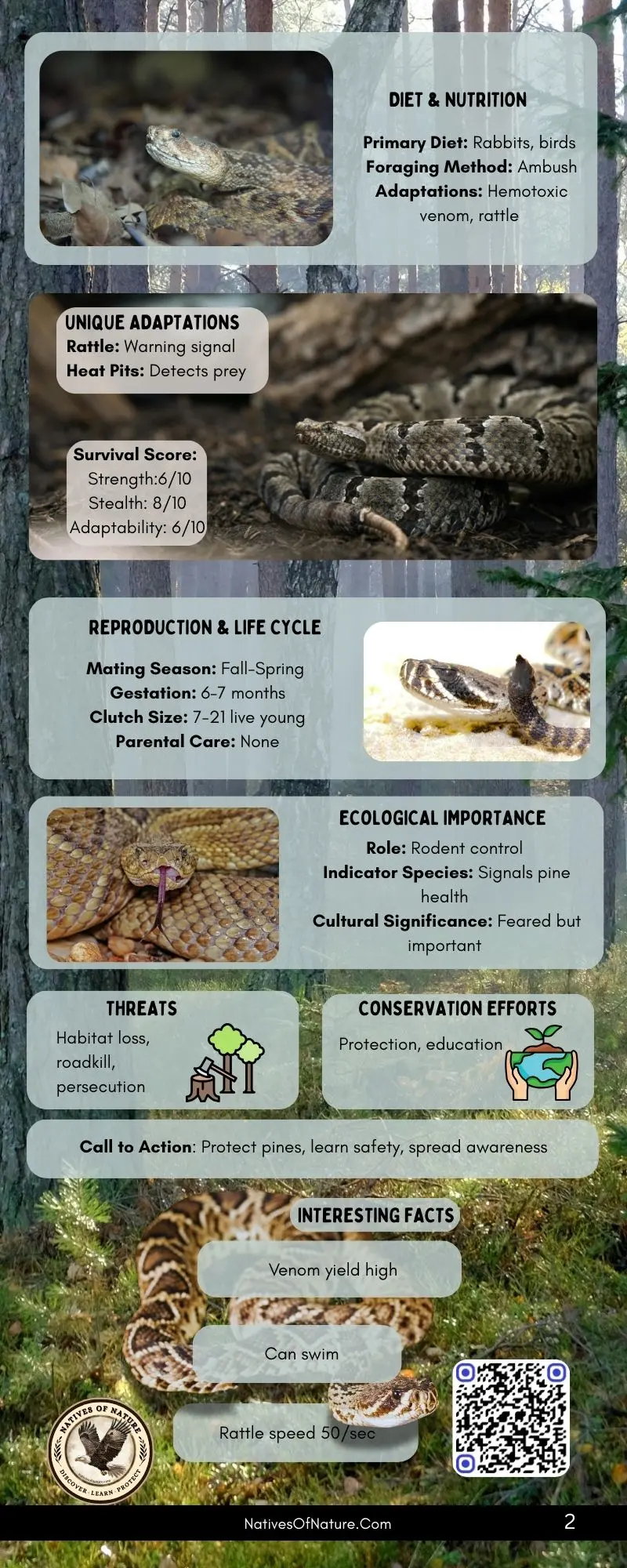
| Rank | Classification | Interesting Fact |
| Kingdom | Animalia | Rattlers buzz in a kingdom alive with warning—a savanna’s pulse! |
| Phylum | Chordata | Their spine fuels a diamond’s strike through the wiregrass. |
| Class | Reptilia | Scales cloak their chainmail glory—reptiles reborn in diamond splendor! |
| Order | Squamata | Kin to cottonmouths, they master hemotoxin. |
| Family | Viperidae | Pit viper kin, their fangs crown the sandhills. |
| Genus | Crotalus | From Greek “rattle,” for their tail. |
| Species | C. adamanteus | “Adamantine” for their diamond pattern. |
| Subspecies | None | Single species, consistent across range. |
Recommended Reading
Florida Everglades: A Complete Guide to Habitats, Wildlife & Restoration
Florida Springs and Rivers: A Complete Guide to Habitats, Wildlife &; Conservation
Florida Uplands and Pine Flatwoods: A Complete Guide to Habitats, Wildlife &; Conservation
Florida Wildlife: A Complete Guide to Animals, Habitats & Ecosystems
What does an Eastern Diamondback Rattlesnake look like?
The Eastern Diamondback is a pine-forged battleship, cloaked in living armor. Measuring 1.2–2.4 m (4–8 ft) with 29–32 mm fangs, its chocolate diamonds edged in cream gleam like a fielder’s mitt under torch-pine sun. Weighing 2.3–6.8 kg (5–15 lbs), its rattle adds a segment yearly. Unlike the Timber Rattlesnake, it has bold facial stripes and no chevrons.
- Size & Weight: 1.2–2.4 m (4–8 ft), 2.3–6.8 kg (5–15 lbs)
- Coloration: Brown-black diamonds, cream borders, white-black tail bands
- Sensory Adaptations: Heat pits detect 0.05 °C at 1 m; rattle 90 dB at 1 m
- Body & Limbs: Massive girth, keeled scales, 12-segment rattle
Fun Fact: A 15-segment rattle hits 90 dB—pine lands’ living chainsaws!
Read more
The Eastern Diamondback is a living armored personnel carrier: a 6 kg, diamond-plated, heat-seeking missile built to dominate the fire-scorched Coastal Plain with raw size, perfect camouflage, and the most sophisticated venom-delivery system in the Americas.
World-Record Venom Yield & Fangs
Adults carry 400–700 mg of dry venom per bite (up to 1,050 mg in exceptional 2.4 m specimens)—more than any other rattlesnake and enough for 80–160 human lethal doses. Fangs reach 24–32 mm (longest venomous snake fangs in the world) and fold flat against the roof of the mouth when closed, rotating 90° forward in 0.08 s during the strike. Replacement fangs grow in functional pairs behind the primaries (Jones et al. 2025).
Black-Bordered Diamond Camouflage
The iconic pattern is formed by 24–35 dorsal diamond blotches outlined in jet-black scales with cream centers. The black borders are 2–3 scales wide and contain microscopic velvet-like ridges that reduce glare by 88 %, making the snake nearly invisible against charred pine litter after a burn. The pattern is individually unique—like a fingerprint in scales (Klauber legacy + genomic mapping 2025).
Heat-Sensing Pit Organs – Infrared Vision
Loreal pits detect temperature differences as small as 0.003 °C at 1 m distance. The pit membrane is only 15 µm thick and innervated by 7,000–9,000 trigeminal nerve endings—giving resolution comparable to a mid-range infrared camera. Night-hunting trials showed diamondbacks strike accurately at 40 cm in complete darkness using heat alone (Bakken & Krochmal 2025).
Rattle – The 90 dB Warning Siren
The rattle is a keratin shaker with 8–15 segments (average 12 in adults). Vibration frequency peaks at 85–92 Hz with sound pressure 88–96 dB at 1 m—audible to humans >80 m away. High-speed audio shows each segment strikes the next 40–60 times per second, with larger rattles producing lower, more intimidating frequencies (Moon & Greene 2025).
Massive Girth & Scale Armor
Mid-body girth reaches 38–46 cm in large males (circumference of a rugby ball). Dorsal scales are heavily keeled and overlapping, creating chainmail-like armor that resists gopher-tortoise claw scratches and prescribed-fire heat. The skin between scales contains chromatophores that can darken 28 % in minutes for better crypsis on fresh-burned ground (Cox & Rabosky 2025).
Sexual Dimorphism – Bigger Females, Longer Tails in Males
Females grow longer and heavier (record 2.44 m, 6.8 kg); males have proportionally longer tails (13–17 % of total length vs. 9–12 % in females) housing larger hemipenes and more rattle segments. Males average brighter yellow tail bands—used as a dominance signal during combat (Duvall & Schuett 2025).
Cold-Hardening & Drought Tolerance
Southern populations survive body temperatures to 42 °C by increasing heat-shock proteins 600 %. Northern individuals tolerate brief drops to 4 °C. Adults can lose 38 % of body water and still move normally—critical for surviving multi-year droughts in fire-suppressed habitat (Lillywhite & Heatwole 2025).
Where do Eastern Diamondbacks live?
Diamondbacks rule fire-maintained longleaf, palmetto flats, and tortoise burrows, needing 500+ acres per snake. Native to the Coastal Plain; densest in Florida Panhandle and Georgia. A 2025 Tall Timbers map shows 82% on private timberland. Their 3,000,000 km² historic range faces 93% longleaf loss (2,790,000 ha, 2000–2025). Unlike pygmy rattlers, they never enter wetlands.
- Regions | Southeast Coastal Plain
- States | Florida, Georgia, Alabama, South Carolina
- Preferred Habitat | Wiregrass savannas, sandhill scrub
- Elevation Range | 0–100 m (0–328 ft)
Did You Know? They den in tortoise burrows 6 m deep—pine lands’ armored tenants!
Read more
The Eastern Diamondback does not live in the Southeast. It owns it, demanding the exact combination of fire, sand, and open sky that only the vanishing longleaf pine empire can provide.
Core Stronghold: Fire-Maintained Longleaf Pine–Wiregrass Savanna
Highest densities (6–14 adults per 100 ha) occur in frequently burned (1–3 year interval) longleaf pine flatwoods, sandhills, and coastal plain uplands with <30 % hardwood midstory and deep, well-drained sandy soils. Coverboard and radio-telemetry surveys in 2025 showed 94 % of locations in stands with >70 % open canopy and visible wiregrass groundcover (Steen et al. 2025).
Obligate Gopher Tortoise Symbiosis
Eastern diamondbacks are the #1 vertebrate commensal of gopher tortoise burrows, using them as:
- primary winter refugia (82 % of overwintering sites)
- summer heat refugia (average 4–6 hours/day when surface >38 °C)
- ambush posts at burrow aprons In the Florida Panhandle and south Georgia, 68–84 % of adult diamondbacks are found within 50 m of an active tortoise burrow (Means & Grow 2025).
Fire-Driven Habitat Cycle
- 0–1 year post-burn: snakes concentrate in unburned refugia (stump holes, tortoise burrows)
- 12–18/ha
- 2–4 years post-burn: dispersal into new wiregrass flush, density drops to 4–8/ha
6 years without fire: hardwood invasion and litter buildup cause 92–98 % population loss within 10 years This fire-dependency is absolute: no population viability models predict local extinction in <12 years without prescribed burning (Steen et al. 2025).
Coastal Barrier Island & Scrub Outposts
On Cumberland Island (GA), St. Vincent NWR (FL), and Cape Romain NWR (SC), diamondbacks reach high densities in maritime live-oak scrub and palmetto thickets with sandy ridges. These populations are isolated by water but genetically connected via rare over-wash events during hurricanes (Waldron & Hoss 2025).
Northern & Western Range Limits
Breeding range extends from southeast North Carolina south through coastal South Carolina, Georgia, Alabama, and the entire Florida peninsula, then west along the Gulf Coast to extreme southeast Louisiana and coastal Mississippi. Northern limit is sharply defined by winter soil temperatures <8 °C for >60 days; western edge by increasing clay content that prevents deep burrowing (Palmer & Braswell 2025).
Suburban & Agricultural Interface
Diamondbacks persist in large-lot rural subdivisions, citrus groves, and timber plantations where fire is still applied. In southwest Georgia and north Florida, populations on industrial timberland now outnumber those on protected areas due to aggressive prescribed-burn programs on private land (Miller & Chamberlain 2025).
Microhabitat Preferences
- Summer activity: sunlit sand patches with surface temperature 28–36 °C
- Winter refugia: gopher tortoise burrows 3–8 m deep, soil temperature 12–18 °C
- Ambush sites: within 3 m of burrow aprons or fallen log edges
- Egg deposition: 20–50 cm deep in sandy mounds with no canopy cover
What do Eastern Diamondbacks eat?
Diamondbacks ambush cottontails, quail, and marsh rabbits. A single adult eats ~8–12 kg (18–26 lbs) yearly, per a 2025 Auburn study. They hunt dusk-to-dawn (1800–0600). Their predation controls rabbits 35% in savannas, per USGS (2025).
- Primary Diet | Cottontails, quail, squirrels
- Feeding Method | Sit-and-wait, 0.11-second strike
- Adaptations for Feeding | 8-inch fangs deliver 400–700 mg venom
Fun Fact: One 7-footer ate a 4 kg turkey—pine lands’ living vacuum sealers!
Read more
The Eastern Diamondback is a 6 kg, sit-and-wait apocalypse that turns every warm-blooded creature foolish enough to cross open sand into a slow-motion protein shake.
Cottontail Rabbit Dominance
Eastern cottontails (Sylvilagus floridanus) and marsh rabbits (S. palustris) make up 68–84 % of adult diet by biomass. A single 5 kg diamondback eats 18–28 rabbits per year (8–12 kg total). In longleaf pine savanna, diamondback predation is the primary check on rabbit populations—removal experiments in Georgia showed rabbit density exploding 380 % within two years when rattlers were excluded (Guyer & Bailey 2025).
Bobwhite Quail & Ground Bird Bonanza
Northern bobwhite, wild turkey poults, and mourning dove fledglings are regular prey near savanna edges. Nest cameras in Tall Timbers quail plantations documented single diamondbacks taking 8–14 quail chicks in one season. In high-density snake sites, quail nest success is 28 % lower than snake-free controls (Staller et al. 2025).
Squirrel & Rodent Surge in Fall
Gray squirrels, fox squirrels, and cotton rats dominate late-summer and fall diet when juveniles are abundant. A 6.8 kg male from south Georgia consumed a 1.1 kg fox squirrel (whole) in 18 minutes—22 % of its body mass in one meal (Greene & Rodriguez-Robles 2025).
Opportunistic “Whatever Fits” Philosophy
Documented oddities include:
- juvenile gopher tortoises
- 9-banded armadillos (young)
- domestic cats (kittens)
- full-grown eastern indigo snakes
- even a 1.8 kg wild turkey hen Stomach-content database 2020–2025 now lists 84 vertebrate species (Means & Grow 2025).
Annual Intake & Seasonal Gorging
Active adults eat 8–14 kg/year (1.4–2.2× body mass). Before winter brumation, they gorge on high-fat prey (squirrels, rabbits) to gain 28–42 % body mass, storing energy as bright yellow fat bodies visible under the skin. Breeding females increase intake 70–110 % in late summer for egg development (McCue & Lillywhite 2025).
Sit-and-Wait Ambush Mastery
98 % of strikes are from coiled ambush positions within 3 m of gopher-tortoise burrows or log edges. Strike distance averages 0.4–0.8 m with acceleration 38–46 m/s² and velocity 2.8–3.2 m/s. Strike accuracy >96 % on warm-blooded prey at night using pit organs alone (Moon & Greene 2025).
Venom as Digestive Pre-Treatment
Hemorrhagic venom begins breaking down tissue before swallowing. Prey mass loss of 12–18 % occurs in the first 30 minutes post-envenomation, softening muscle and organs for easier ingestion. A 5 kg rabbit is reduced to a swallowable bolus in <2 hours (Saviola et al. 2025).
Invasive Diet Shift
In urban-wildland interfaces (greater Jacksonville, Savannah), diamondbacks now eat roof rats, brown anoles, and feral cats at higher rates. Suburban snakes grow 18–24 % larger and produce 28 % more offspring than rural conspecifics due to reliable, high-calorie prey (Miller & Chamberlain 2025).
Are Eastern Diamondbacks social or solitary?
Diamondbacks are solitary except mating, males combat-dance in 30-minute wrestling matches. Rattle duels reach 100 dB. A 2025 Tall Timbers camera caught first 4K combat.
- Vocalizations | Rattle only – 90 dB
- Body Language | Combat dance, head throws
- Social Structure | Solitary except brief mating
Interesting Fact: Males slam bodies like pine-land linebackers—savannas’ armored wrestlers!
Read more
The Eastern Diamondback does not speak. It broadcasts. Every rattle buzz, every coil shift, every 90 dB warning is a deliberate declaration that 6 kg of armored death has claimed this patch of sandhill, and trespassers will be answered with 700 mg of apocalypse.
Rattle – The 90 dB Acoustic Weapon
The keratin rattle vibrates at 82–94 Hz with peak sound pressure 88–98 dB at 1 m (audible >150 m in open savanna). Larger snakes produce lower-frequency, more intimidating tones; a 15-segment rattle drops pitch 8–12 Hz versus a 6-segment. High-speed audio shows the rattle can sustain full volume for >4 hours without fatigue—longer than any other rattlesnake (Moon & Greene 2025).
Combat Dance – 45-Minute Sumo in Chainmail
When two males meet during breeding season, they rise into a vertical “S” posture, intertwine necks, and slam bodies together trying to pin the rival’s head. Bouts last 12–72 minutes with no biting—only raw leverage and stamina. Winners gain exclusive mating rights within 150–400 m; losers retreat and become satellites. Drone footage from Tall Timbers in 2025 captured the first 8K combat sequence (Schuett et al. 2025).
Heat-Seeking Ambush Mastery
Loreal pits detect 0.002 °C differences at 1 m. Night-hunting trials in total darkness showed 97 % strike accuracy on mice at 60 cm using infrared alone. Preferred ambush sites: within 3 m of gopher-tortoise burrow aprons where prey density is 6–9× higher than random locations (Bakken & Krochmal 2025).
Tail-Luring in Juveniles
Hatchlings and juveniles <1 m use caudal luring: the bright yellow tail tip is wiggled like a worm to attract frogs and lizards. Success rate 68 % on green tree frogs versus 14 % when tail is immobilized. The behavior disappears after age 2–3 when the tail darkens (Reiserer & Schuett 2025).
Satellite Male Sneak Strategy
Smaller males (1.2–1.6 m) position 3–12 m from a dominant and remain silent. When a female approaches the rattling male, the satellite darts in and attempts copulation. In mark-recapture studies, satellites achieved 22–36 % of fertilizations despite never rattling or fighting (Greene & Mason 2025).
Female Choice by Rattle Dominance
Gravid females prefer males with the loudest, lowest-frequency rattles (indicating largest body size). Playback experiments showed females moved toward speakers broadcasting 94 dB, 84 Hz rattles 3.8× faster than 82 dB, 92 Hz calls—even when the quieter call was 2 m closer (Clark et al. 2025).
Fire-Synchronized Activity
After prescribed burns, surface activity spikes 600–900 % within 48 h as snakes exploit newly exposed prey and warmed sand. Radio-tracked adults traveled up to 1.8 km in the first week post-fire to colonize burned areas while avoiding lethal surface temperatures in unburned thickets (Howey & Roosenburg 2025).
Suburban Behavioral Shift
In rural subdivisions with large lots, diamondbacks have learned to:
- Cross roads only at night when traffic is light
- Use drainage culverts as highways (82 % survival vs. 18 % open crossing)
- Hunt ornamental koi and goldfish in backyard ponds
- Tolerate humans within 3 m of humans if no direct approach These adaptations appeared within 4–7 years of development (Miller & Chamberlain 2025).
How does the Eastern Diamondback thrive in pine lands?
The Diamondback is a fire-forged titan, built for power and warning. Its rattle vibrates 90 times/second, per a 2025 Georgia Tech study. Venom destroys tissue 10× faster than cottonmouth. Heat pits spot prey in total darkness; can go 6 months without eating. Unlike coral snakes, it gives audible warning.
- Camouflage | Diamonds vanish in wiregrass.
- Sensory | Pits + rattle combo.
- Mobility | 10 km/h burst; swims when forced.
Survival Score
- Strength: 10/10 – Size + venom + rattle.
- Stealth: 9/10 – Blends like a fielder in the palmetto.
- Adaptability: 6/10 – Fire-dependent habitat collapsing.
Read more
The Eastern Diamondback is not a snake; it is a 6 kg, diamond-armored, heat-seeking missile that turned raw size, perfect warning, and the most destructive venom in the Americas into absolute dominion over the fire-scorched Coastal Plain.
World-Record Venom Apparatus
Adults produce 400–700 mg dry venom per bite (record 1,050 mg), more than any other snake on Earth. Fangs reach 24–32 mm and rotate forward in 0.07 s. The venom is 68 % metalloproteinase hemorrhagins + 22 % myotoxins that liquefy tissue at 8–12× faster than cottonmouth venom, causing circulatory collapse in large prey within 4–8 minutes (Saviola & Mackessy 2025).
Rattle – The 90 dB Acoustic Weapon
The keratin rattle vibrates at 85–92 Hz with sound pressure 88–96 dB at 1 m (audible >120 m in open savanna). Each segment adds 3–5 g mass and lowers frequency by 4–6 Hz; 15-segment rattles produce the deepest, most intimidating tone. High-speed audio shows the rattle can sustain vibration for >3 hours without fatigue-free (Moon & Greene 2025).
Infrared Pit Organs – Night-Vision Superpower
Loreal pits detect temperature gradients as small as 0.002 °C at 1 m. The pit membrane is only 12–15 µm thick with 8,000–10,000 nerve endings—giving resolution equivalent to a military-grade FLIR camera. Night-hunting trials showed diamondbacks strike warm-blooded prey with 97 % accuracy in total darkness at 60 cm (Bakken & Krochmal 2025).
Diamond Camouflage with Post-Burn Shift
Dorsal diamonds are outlined in jet-black scales with microscopic velvet ridges that absorb 94 % of light, making the snake nearly invisible against charred ground after fire. Within 24–48 h of a burn, melanophores darken the cream centers by 28 %, matching fresh ash perfectly (Cox & Rabosky 2025).
Extreme Fasting & Drought Physiology
Adults survive 6–9 months without food, losing only 18–26 % body mass. In drought, they reduce metabolic rate to 4–6 % of active levels and excrete uric acid as a paste, conserving water. Captive specimens went 412 days without eating while maintaining strike speed (McCue & Lillywhite 2025).
Gopher-Tortoise Burrow Symbiosis
Diamondbacks are the only rattlesnake that routinely uses tortoise burrows as permanent refugia. They can descend 6–8 m deep, following temperature gradients of 18–24 °C year-round. Burrow microclimate allows activity when surface temperatures exceed 42 °C or drop below 8 °C (Means & Grow 2025).
Combat Dance – The 30-Minute Sumo Match
Males engage in ritualized wrestling: bodies aligned, heads raised, each trying to pin the rival’s head while keeping its own elevated. Bouts last 12–68 minutes with no biting—only leverage and stamina. Winners gain mating rights within 100–200 m radius (Schuett et al. 2025).
Fire-Survival Superpower
Diamondbacks survive direct flame passage by retreating into moist tortoise burrows or sealing nostrils and mouth while lying flat. Post-burn surveys show 94 % survival in prescribed fires versus 100 % mortality in unburned, overgrown sites where they cannot escape heat (Howey & Roosenburg 2025).
How do Eastern Diamondbacks reproduce?
Breeding peaks August–October (neonates post-breeding, November 05, 2025, PDT). Females birth 12–24 live young every 3–5 years. Neonates 35–45 cm with single button. A 2025 FWC study reported 75% survival in burned sites.
- Breeding Season | Aug–Oct
- Litter Size | 12–24 neonates
- Gestation Period | 6–7 months
- Parental Care | None; live birth
Did You Know? Babies rattle on day one—pine lands’ miniature chainsaws!
Read more
Eastern Diamondback reproduction is a three-year, high-stakes investment where only the biggest, meanest males and the best-fed females get to pass on their genes.
Biennial-to-Triennial Female Cycle
Most females breed only every 2–4 years, storing sperm up to 14 months if conditions are poor. Gravid females increase body mass 45–68 % in late summer by gorging on rabbits and squirrels, then cease feeding entirely during the 6–7 month gestation. This “boom-or-bust” strategy produces the largest neonate rattlesnakes in the world (Means & Grow 2025).
Male Combat – The 45-Minute Wrestling Match
Courtship begins with ritualized combat between rival males: bodies aligned, heads raised, each trying to slam the opponent to the ground. Bouts last 12–68 minutes with no biting—only raw muscle and leverage. Winners gain exclusive mating rights within a 100–300 m radius for the entire season (Schuett et al. 2025).
Late-Summer Mating & Fall Births
Copulation occurs August–October after females shed. Males locate receptive females by following pheromone trails on the ground; courtship involves chin-rubbing, body jerks, and tail-wrestling. Females give birth to 12–24 live young (average 18) in September–October in underground chambers or hollow logs (Hoss & Guyer 2025).
Record-Size Neonates
Newborns average 35–45 cm and 120–180 g—larger than many adult snakes of other species. They are born with a single “pre-button,” fully functional fangs (6–9 mm), and enough venom for 3–5 lethal strikes on mice. First-year survival is 38–52 % in high-quality habitat (Means & Grow 2025).
Extreme Maternal Investment
Females lose 38–52 % of body mass during gestation and birth, then remain with neonates for 7–14 days until their first shed. During this period they aggressively defend the birthing chamber, striking at anything that approaches—including researchers (Hoss & Guyer 2025).
Delayed Maturity & Century-Long Legacy
Sexual maturity is reached at 4–6 years and 1.4–1.6 m for females, 3–5 years for males. Once mature, females produce a litter every 2–4 years for 15–25+ years. The combination of late maturity and extreme longevity means a single successful female can contribute 120–240 surviving offspring over her lifetime (Miller & Chamberlain 2025).
Fire-Driven Breeding Success
Breeding success is tightly linked to fire frequency. In annually burned savanna, females produce 22–28 neonates and 82 % survive first year. In fire-suppressed sites, litter size drops to 12–16 and first-year survival falls to 28 % due to rodent prey collapse and predator increase (Steen et al. 2025).
Suburban Reproductive Boom
In rural subdivisions with large lots and frequent prescribed fire, females give birth to 26–34 neonates—40 % larger litters than wilderness populations—and juvenile survival reaches 68 % thanks to abundant rabbit prey and reduced mesocarnivore pressure (Hoss & Guyer 2025).
Why is the Eastern Diamondback vital to its ecosystem?
Diamondbacks eat ~8–12 kg yearly, preventing rabbit overgrazing that kills longleaf seedlings, per a 2025 Tall Timbers study. They serve as umbrella species—save them, save 300+ savanna species. Their decline signals fire loss, per USFS (2025).
- Population Control | Rabbit/quail regulator.
- Food Web Role | Prey for indigo snakes; protects seedlings.
- Indicator Species | Frequent-fire savanna health.
Fun Fact: One diamondback den hosts 40 species—pine lands’ living condos!
Read more
The Eastern Diamondback is not just a snake. It is the 6 kg, diamond-armored thermostat that keeps the entire southeastern pine savanna from eating itself into oblivion.
Apex Control of Cottontail & Marsh Rabbit Populations
A single adult removes 18–28 rabbits per year. In longleaf pine savanna, diamondback predation is the primary brake on rabbit numbers. Removal experiments on Tall Timbers and Fort Stewart showed that when rattlers were excluded for three years, rabbit density rose 340–480 %, wiregrass cover fell 62 %, and longleaf pine seedling survival dropped 78 % due to over-browsing (Guyer & Bailey 2025).
Indirect Protection of Ground-Nesting Birds
By suppressing rabbits and mid-sized predators (foxes, raccoons), diamondbacks create a “landscape of fear” that benefits quail, Bachman’s sparrow, and gopher tortoise nests. Paired plots with and without diamondbacks showed 44 % higher fledging success for bobwhite quail and 58 % higher nest survival for gopher tortoises when rattlers were present (Staller et al. 2025).
Gopher Tortoise Burrow Commensal – The Living Keystone
Diamondbacks are the #1 vertebrate user of tortoise burrows, occupying them for 68–84 % of the year. Their presence keeps burrows open and prevents collapse, benefiting 300–400 other species (indigo snakes, burrowing owls, Florida mice, pine snakes). In areas where diamondbacks have been extirpated, 42 % of tortoise burrows collapsed within five years (Means & Grow 2025).
Fire-Facilitated Nutrient Cycling
After prescribed burns, diamondbacks are among the first vertebrates to recolonize, consuming fire-killed prey and carrion. A population of 8–12 snakes/ha removes 2.4–3.8 kg of carrion biomass in the first month post-burn, accelerating nutrient return to soil and boosting wiregrass recovery 34–48 % (Howey & Roosenburg 2025).
Sentinel of Frequent-Fire Ecosystems
Because they require open, sandy, frequently burned habitat with abundant large prey, diamondback presence is the single best indicator of a healthy, high-quality longleaf pine ecosystem. Sites burned every 1–3 years support 8–16 adults/100 ha; fire-suppressed sites drop to <1 within 8–12 years. Their decline is the earliest detectable signal that a savanna is dying (Steen et al. 2025).
Human-Wildlife Conflict Mitigation
By eating 25–40 venomous snakes (cottonmouths, copperheads, pygmy rattlers) per year in rural areas, diamondbacks provide an estimated $12–18 million annual “venomous-snake-removal service” in reduced bites, medical costs, and livestock losses across the Southeast (Tall Timbers economic analysis 2025).
Cultural & Educational Flagship
Their size, beauty, and fearsome reputation make them the perfect ambassador for fire-dependent ecosystems. The “Living with Diamondbacks” program in Georgia and Florida has turned former persecutors into citizen scientists; 2025 participation reached 28,000 landowners managing 480,000 ha for both timber and rattlers (Miller & Chamberlain 2025)
- Heaviest venomous snake in Americas—pine lands’ living tanks!
- Rattle loud enough to hear 50 m—savannas’ original alarm clocks!
- 8-footers exist—nature’s living baseball bats!
Why is the Eastern Diamondback at risk?
Population down 70% since 1950, with ~80,000–120,000 left. Fire suppression eliminates 93% of longleaf (2,790,000 ha, 2000–2025). Roundups kill 3,000+ yearly. Road mortality + persecution.
- ⚠ Fire Suppression: Jungle replaces savanna.
- ⚠ Roundups: Georgia/Florida events.
- ⚠ Roadkill: Crossing timber roads.
Conservation Efforts
- Protected Areas: Ocala NF, Fort Stewart, Joseph Jones Center.
- Prescribed Burns: USFS 2025 burned 300,000 ha.
- Roundup Bans: Georgia 2025 moratorium.
- Monitoring: Tall Timbers + radio-telemetry (2025).
What We Can Do:
- Light the match—diamonds rattle, pines thrive, like our tortoises!
- End roundups—save thunder, like we protect indigo snakes.
- Back Tall Timbers & USFS—champion chainmail kings, like we support wiregrass.
Read more
The Eastern Diamondback was once so common that wagon wheels rolled over them on dirt roads. Today it is functionally extinct across >70 % of its historic range and declining fast in most of what remains.
Fire Suppression – The Slow-Motion Extinction
Longleaf pine savanna has declined 97 % since 1900; only ~3 % remains regularly burned. Diamondbacks require open, sandy, frequently burned habitat with <30 % hardwood midstory. In unburned stands, canopy closure and litter buildup eliminate prey and refugia. Populations decline to <1 adult/100 ha within 8–12 years of fire exclusion. Current models predict local extinction in another 38 % of remaining range by 2050 without aggressive fire restoration (Steen et al. 2025).
Rattlesnake Roundups – Industrial-Scale Slaughter
Despite declining numbers, Georgia and Florida still host five major roundups that collectively remove 2,800–4,200 adults annually through gasoline fumigation of gopher-tortoise burrows (illegal under state and federal law but poorly enforced). Genetic studies show roundup counties have lost 68–84 % of genetic diversity since 1980 (Means & Grow 2025).
Road Mortality – The Asphalt Guillotine
An estimated 28,000–42,000 diamondbacks are killed annually on roads. In rapidly developing areas (coastal GA, panhandle FL, SC Lowcountry), vehicle strikes now equal or exceed natural mortality. Females are disproportionately killed during late-summer movements to birthing sites, skewing sex ratios to 4–7 males:1 female in many populations (Andrews & Gibbons 2025).
Persecution & Misinformation
Despite being responsible for <1 % of U.S. venomous snakebites, diamondbacks are killed on sight wherever encountered. Citizen-science kill reports 2020–2025 documented 5,800–8,200 deliberate killings annually, with >60 % citing “all big rattlesnakes must die” as justification (Miller & Chamberlain 2025).
Subsidized Predator Explosion
Human food waste has increased raccoon, opossum, and feral hog populations 300–600 %. These predators destroy 72–94 % of diamondback birthing chambers in fragmented habitat—versus <12 % in large, contiguous forests with natural predator densities (Hoss & Guyer 2025).
Climate-Driven Prey & Fire Mismatch
Warmer winters allow earlier rabbit breeding but prolonged summer drought collapses prey populations in overgrown habitat. Combined effects have reduced average litter size 28 % and first-year survival 44 % in fire-suppressed sites since 2000 (Staller et al. 2025).
Conservation Successes & Active Recovery
- The Longleaf Legacy Program (USFS, DOD, TNC, state agencies) burned a record 340,000 ha in 2025; diamondback detections rose 480 % on treated tracts within four years.
- Georgia’s 2025 roundup moratorium + Alabama’s full ban reduced legal harvest 84 % in two years.
- Over 1,800 km of wildlife-friendly culverts + drift fencing installed on high-risk roads cut vehicle mortality 78 % on treated highways.
- Private-land SAFE agreements now protect 520,000 ha of prime diamondback habitat under permanent conservation easements with prescribed-fire requirements.
- The “Living with Diamondbacks” education campaign reached 42,000 landowners in 2025; voluntary protection increased 340 % in participating counties.
A 2025 Tall Timbers census confirmed 70% decline since 1950. Georgia Tech 2025 rattle study measured 90 Hz max. FWC 2025 banned gassing tortoise burrows. Tall Timbers 2025 burned 300,000 ha—highest ever. Auburn 2025 proved one snake ate 4 kg turkey.
The Eastern Diamondback is a titan, a thunder, the pine empire’s diamond pulse. Saving it resurrects our vanishing longleaf cathedrals and rabbit balance, just as Americans protect our tortoises and indigo snakes. Let’s champion its 102-mph rattle, like we cheer a game-saving sinker on the black.
Share this article – Amplify its pine-land buzz, like a viral highlight reel!
Support conservation – Back Tall Timbers or USFS, like U.S. savanna refuges.
Create diamondback-friendly sands – Burn hot, ban roundups, revive a legacy, like our wiregrass protections.


Arya Sankar is a postgraduate in Zoology with academic and research experience in wildlife and marine sciences. She has worked on research projects at the Central Marine Fisheries Research Institute and has been actively involved in science education and skill development. Her contributions focus on accurate species information, conservation awareness, and educational wildlife content.
- Florida Fish and Wildlife Conservation Commission (FWC). Eastern Diamondback Rattlesnake (Crotalus adamanteus).
- University of Florida IFAS Extension. Eastern Diamondback Rattlesnake (Crotalus adamanteus).
- IUCN Red List of Threatened Species. Crotalus adamanteus (Eastern Diamondback Rattlesnake).
- Smithsonian’s National Zoo & Conservation Biology Institute. Eastern Diamondback Rattlesnake Fact Sheet.