There is a moment, when you first drop below the surface of a Florida spring, that feels like crossing into another world.
The water is impossibly clear — visibility measured in tens of metres rather than centimetres — and a constant 68 to 72 degrees Fahrenheit regardless of whether it is July or January. The bottom is white limestone, the aquatic plants trail in slow, hypnotic currents, and the fish move through the water column with the unhurried confidence of animals in an environment that has remained essentially unchanged for thousands of years.
That impression of permanence is both accurate and urgently misleading. Florida’s freshwater spring systems are among the most stable natural environments on Earth in terms of temperature and chemistry — anchored by the vast Floridan Aquifer that delivers groundwater at a rate measured in hundreds of millions of gallons per day. They are also among the most threatened aquatic ecosystems in North America, with spring flows declining, water clarity degrading, and the aquatic plant communities that define the spring ecosystem collapsing under the weight of nitrogen pollution from agriculture and development.
Florida’s rivers compound this richness. From the blackwater tannic rivers of the panhandle — the Blackwater, Escambia, and Choctawhatchee, draining ancient longleaf pine uplands — to the spring-fed crystalline runs of the Ichetucknee, Santa Fe, and Silver, to the wide, slow tidal reaches of the St. Johns and Peace Rivers in the south — no other state outside Alaska compresses this range of freshwater ecosystem character into a single peninsula.
Florida holds 33 first-magnitude springs — more than any other U.S. state, and more than most countries.
This guide is the gateway to NativesOfNature’s complete Florida springs and rivers coverage. Each section introduces a major component of the freshwater system, its defining wildlife, and the ecological and conservation context that makes it significant. The species profile and habitat pages linked throughout provide the depth each topic deserves.
📊 Florida Springs & Rivers by the Numbers
- First-magnitude springs: 33 confirmed — more than any other U.S. state (Florida Geological Survey Bulletin 66; FDEP)
- Silver Springs peak historical discharge: 500+ million gallons per day (Florida Springs Institute) — highest of any U.S. spring
- Floridan Aquifer extent: ~100,000 square miles across Florida, Georgia, Alabama, and South Carolina
- Spring water temperature: constant 68–72°F (20–22°C) year-round
- Blue Spring State Park manatee count record: 932 animals on a single January morning (2024, Florida State Parks)
- Spring flow decline: 25–30% at most major systems since the mid-20th century
- Florida manatee population: recovered from ~1,300 (1991) to over 8,800 (2020), before the seagrass crisis (USFWS)
The Floridan Aquifer: Source of Every Spring
A 100,000-square-mile network of porous limestone produces the water that emerges, decades later, in over 1,000 named springs and feeds the rivers that drain the peninsula.
To understand Florida’s springs and rivers, you must first understand what lies beneath them. The Upper Floridan Aquifer is one of the most productive aquifer systems in the world: a vast, interconnected network of porous and cavernous limestone extending beneath approximately 100,000 square miles of Florida, southern Georgia, Alabama, and South Carolina. In Florida, it is the source of virtually all freshwater that emerges at the surface as springs.
The aquifer is recharged by rainwater percolating downward through sandy upland soils on the interior peninsula. The key entry points — called karst windows — are places where the limestone is shallow or exposed, allowing rainfall to move directly into the rock below. Water entering the system near the Lake Wales Ridge or Gainesville area may travel through the limestone matrix and cave systems for months or even decades. It eventually re-emerges at spring vents, driven upward by the hydraulic pressure of the water column above it.
This geological plumbing creates a phenomenon unique to Florida: first-magnitude springs, defined as vents with a mean discharge of at least 100 cubic feet per second (approximately 64.6 million gallons per day). Silver Springs in Marion County historically discharged more than 500 million gallons per day, according to the Florida Springs Institute — the highest average flow recorded for any spring in the United States. That figure has since declined significantly — a warning about the health of the aquifer that sustains it.
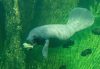
Manatees cannot survive in water below 68°F. The spring vent is, for the manatee, the difference between survival and death.
The 68–72°F discharge temperature — maintained year-round by the insulating depth of the aquifer — is the ecological cornerstone of the spring system. West Indian manatees, which cannot tolerate water below 68°F without cold stress syndrome, depend entirely on Florida’s spring discharges as winter refugia. Kings Bay on the Nature Coast regularly shelters several hundred manatees in winter — with some of the highest per-bay concentrations recorded in the state. Blue Spring State Park in Volusia County set a new count record of 932 animals on a single January morning in 2024 (Florida State Parks), up from just 14 individuals when research began in 1970.
West Indian Manatee
Trichechus manatus latirostris
IUCN: Vulnerable (VU)
- Consumes 4–9% of body weight daily in aquatic vegetation
- Cannot survive in water below 68°F — spring refugia are non-negotiable winter habitat
- Blue Spring record count: 932 animals on a single January morning (2024, Florida State Parks)
- Population recovered from <1,300 (1991) to >8,800 (2020) before seagrass crisis
- Grazing maintains open-water channels used by wading birds and fish
Life in Perpetual Clarity
Constant temperature, constant chemistry, high clarity, and directional flow shape a biological community unlike any other freshwater system in North America.
A Florida spring is not a hole in the ground. It is a structured biological community shaped by constant temperature, constant chemistry, high clarity, and the directional movement of water from vent to run to receiving river. Each element of this physical template drives a distinct ecological response.
The spring vent itself — the aperture in the limestone from which water emerges — is inhabited by cave-adapted invertebrates and, in larger springs, by fish that exploit the concentrated food resources near the boil. The spring run, the stream channel carrying water from vent to river, is the most productive zone. Submerged aquatic vegetation dominates healthy runs: eelgrass (Vallisneria americana) and tapegrass form dense beds that oxygenate the water, shelter invertebrates and juvenile fish, and serve as the primary food source for wintering manatees.
Healthy runs support mixed communities of eelgrass, southern naiad (Najas guadalupensis), water celery (Vallisneria neotropicalis), muskgrass (Chara spp.), and various pondweeds (Potamogeton spp.) — a three-dimensional mosaic of microhabitats. When nitrogen loading degrades the system, this community collapses into algal mats, with cascading consequences for every dependent species.
Spring run aquatic plant diversity is the single most reliable indicator of spring ecosystem health.
The structural engineers of the spring run are largely invisible. Florida freshwater mussels — many species in the family Unionidae — bed in the limestone substrate of healthy spring runs, each animal filtering 10 to 40 litres of water per day. Dense mussel beds maintain the very clarity that defines the spring ecosystem. Their absence is one of the earliest signals that a system has broken: mussels require host fish for the parasitic glochidial phase of their larval development, and when the fish community declines, the mussel bed cannot persist.
Florida Freshwater Mussels
Family Unionidae (multiple spp.)
IUCN: Critically Endangered (multiple spp.)
- A single mussel filters 10–40 litres of water per day
- Dense beds in healthy spring runs maintain the clarity that defines the ecosystem
- Require specific host fish for their larval (glochidial) parasitic stage
- Presence confirms an intact fish community; absence signals a broken food web
- Suwannee moccasinshell, Gulf moccasinshell, oval pigtoe — all under active restoration
Above the mussel beds, the American alligator is the apex predator and largest ecosystem engineer of Florida’s freshwater systems. Alligators move freely between freshwater springs, blackwater rivers, and brackish estuaries, structuring fish populations across this entire mosaic. Their excavated “gator holes” — depressions dug into peat and marl that retain water through the dry season — provide dry-season refugia for fish, amphibians, turtles, and the waterbirds that follow them. Removal of the alligator has no functional substitute.
American Alligator
Alligator mississippiensis
IUCN: Least Concern (LC)
- Excavates “gator holes” — critical dry-season refugia for fish, amphibians, and birds
- Apex predator regulating prey populations across the freshwater food web
- Moves freely between freshwater springs, rivers, and brackish estuaries
- Nest mounds create elevated dry land used by nesting turtles and ground birds
- Range-wide population: estimated 5 million in the southeastern U.S.
Florida’s Major Spring Systems at a Glance
| Spring System | County | Magnitude | Key Wildlife | Primary Threat |
|---|---|---|---|---|
| Silver Springs | Marion | 1st | Bass, gar, manatee, rhesus macaque | Flow decline, nitrate |
| Ichetucknee | Columbia | 1st | Unionidae mussels, limpkin, alligator | Groundwater withdrawal |
| Wakulla Springs | Wakulla | 1st | Manatee, alligator, limpkin, anhinga | Nitrate, development |
| Homosassa | Citrus | 1st | Manatee (hundreds winter), tarpon, alligator | Boat traffic, nitrate |
| Chassahowitzka | Citrus | 1st | Manatee, spotted seatrout, wading birds | Water withdrawal |
| Blue Spring | Volusia | 2nd | Manatee (record 932 in 2024), bass, gar | Recreational pressure |
| Manatee Springs | Levy | 1st | Manatee, Suwannee cooter, mussel beds | Nitrate, flow decline |
| Rainbow Springs | Marion | 1st | Snook, manatee, softshell turtle | Nitrate, flow decline |
Florida’s Most Significant Springs
From the highest-flow spring in the United States to the deepest known freshwater vent in the world, each system carries its own ecological signature.
Silver Springs and the Silver River, Marion County
Silver Springs holds the highest recorded average discharge of any spring in the United States — a boil of crystalline water emerging from a cluster of vents in a shallow bowl of white limestone. The springs feed the 5.5-mile Silver River before it flows east to the Ocklawaha River and on to the St. Johns. Silver Springs State Park protects the spring run; the springs themselves are accessible via glass-bottom boat tours that have operated since the 1870s, making this the oldest tourist attraction in Florida.
The Silver River supports one of Florida’s most intensively studied freshwater fish communities, including Florida largemouth bass (Micropterus salmoides floridanus), longnose gar (Lepisosteus osseus), bowfin (Amia calva), and mullet (Mugil cephalus) that move freely between spring run and river. It is also home to a wild population of rhesus macaques (Macaca mulatta) — descendants of six individuals released onto a small island by a tour operator in 1938 who underestimated their swimming ability. The population now numbers over 200 animals and has generated significant management controversy.
Ichetucknee Springs, Columbia County
The Ichetucknee Springs system is one of the most visited natural areas in Florida: nine named springs feeding a 6-mile run through a pristine forest corridor of cypress, tupelo, and floodplain hardwoods, protected within Ichetucknee Springs State Park. The water is exceptional even by Florida spring standards — among the clearest in the state, maintained by strict visitor capacity limits.
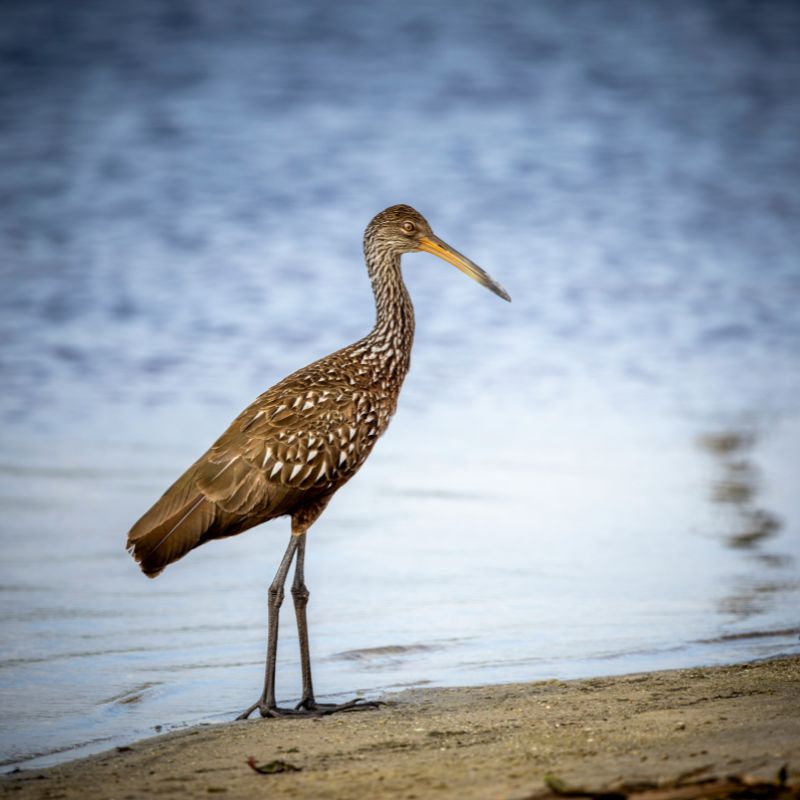
Limpkins call from the Ichetucknee banks year-round — their wail is the soundtrack of the spring.
Swallow-tailed kites (Elanoides forficatus) hunt over the canopy in summer; prothonotary warblers (Protonotaria citrea) nest in riverside cypress cavities. The Ichetucknee also supports exceptional populations of Florida freshwater mussels — among the most imperilled animal groups in North America.
Limpkin
Aramus guarauna
IUCN: Least Concern (LC) — Florida state-monitored
- Specialist forager on Florida apple snails and freshwater mussels
- Distribution in Florida tracks apple snail abundance — a direct biological indicator
- Distinctive haunting wail audible at long distances along spring-run corridors
- Range-expanding northward since 2010s, including into Georgia and the Carolinas
- Vulnerable to spring-run aquatic vegetation collapse and apple snail decline
Wakulla Springs, Wakulla County
Wakulla Springs, within Edward Ball Wakulla Springs State Park south of Tallahassee, is recognised by the Florida Springs Institute as the largest and deepest freshwater spring in the world. The main vent descends over 300 feet into an unexplored cave system. Its spring run flows to the St. Marks River and ultimately Apalachee Bay on the Gulf. Excavations in the spring’s sediments have recovered bones of mastodons (Mammut americanum) and giant ground sloths (Eremotherium laurillardi) — a palaeontological record that makes Wakulla one of the most significant Pleistocene fossil sites in North America. Today the springs winter large numbers of manatees and support thriving populations of limpkins, anhingas, and American alligators.
Homosassa and Chassahowitzka, Citrus County
These two spring complexes anchor Florida’s Nature Coast — a region where the landscape from spring boil to estuarine mangrove remains largely intact, one of the few places in Florida where that continuum still exists. The Homosassa River receives several hundred wintering manatees between October and March — sometimes several hundred animals on the coldest days. The Chassahowitzka National Wildlife Refuge protects a contiguous corridor of spring run, river, and estuarine habitat that serves as a model for what restored freshwater-to-coastal connectivity could look like across the peninsula.
From Blackwater Tannic to Spring-Fed Crystal
No other state outside Alaska compresses this range of freshwater ecosystem character into a single peninsula — from northward-flowing inland seas to deep-amber blackwater rivers.
The Suwannee River: A Blackwater Giant
The Suwannee River begins in Georgia’s Okefenokee Swamp and runs 246 miles through the Big Bend region to the Gulf of Mexico at Suwannee Sound. It is one of the few relatively undeveloped major river systems in the southeastern U.S. — draining a sparsely populated watershed with no major impoundments on its main stem. The upper Suwannee is a classic blackwater river: stained deep amber by tannins leached from Okefenokee peat soils, with low pH and low nutrient levels. As it moves south and receives spring discharge from dozens of first- and second-magnitude springs along its banks — Manatee Springs, Ichetucknee via the Santa Fe tributary, Troy Spring — the character of the river changes, spring inputs diluting the tannins and raising the pH.
The Suwannee cooter (Pseudemys concinna suwanniensis) is named for this river and remains one of its defining reptiles — a large, herbivorous river turtle basking on cypress logs in spring-run tributaries and foraging on aquatic vegetation in clear-water reaches. The Suwannee basin hosts one of the highest freshwater mussel diversities in Florida; robust redhorse (Moxostoma robustum), a large cyprinid nearly extirpated from most of its range, has a remnant population here.
The St. Johns River: Florida’s Inland Sea
The St. Johns is one of the most geographically unusual rivers in North America: it flows north — one of the very few northward-flowing rivers in the United States — draining a wide, flat basin for 310 miles from Indian River County to its mouth at Jacksonville on the Atlantic coast. For much of its length, it is less a conventional river than a connected series of shallow lakes and marshes, rarely more than three metres deep, merging imperceptibly with the surrounding wetland matrix.
Its middle reaches, around Blue Spring State Park in Volusia County, consistently record one of the most significant manatee winter aggregations in the world. Snail kites (Rostrhamus sociabilis plumbeus) hunt apple snails over the headwater marshes. In the lower river, American shad (Alosa sapidissima) still run in late winter, and Atlantic sturgeon (Acipenser oxyrinchus) make occasional appearances in the tidal reaches.
The snail kite is one of the most ecologically constrained raptors in North America. Its entire conservation fate is tied to the population dynamics of a single mollusc.
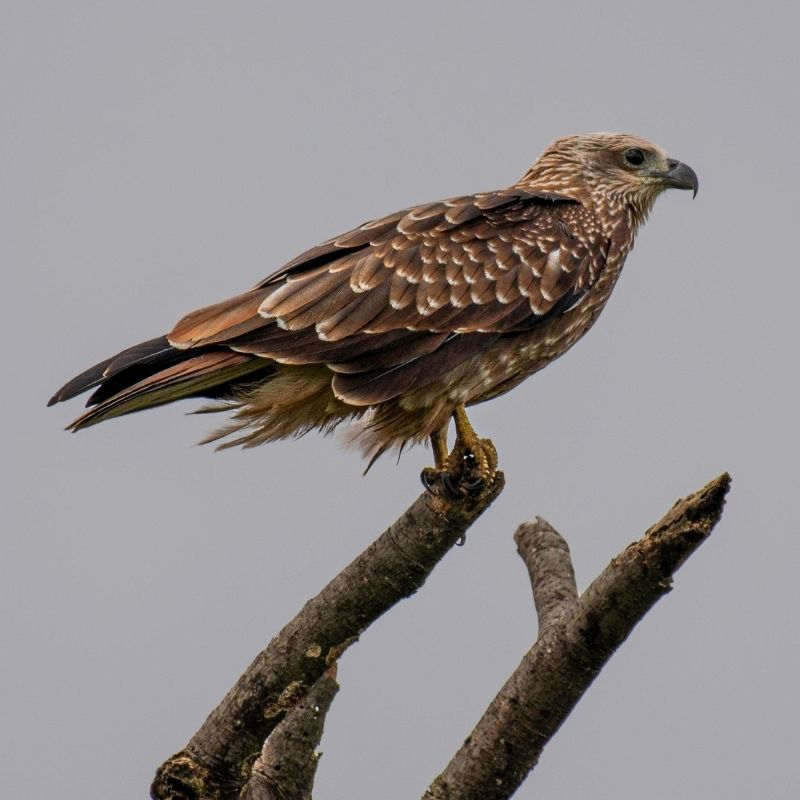
The kite eats, in Florida, almost exclusively one prey item: the Florida apple snail. Its curved, slender bill — anatomically specialised for extracting the snail from its shell without breaking either bill or shell — is the morphological signature of a dietary specialisation so complete that the bird and the snail have become a single conservation question.
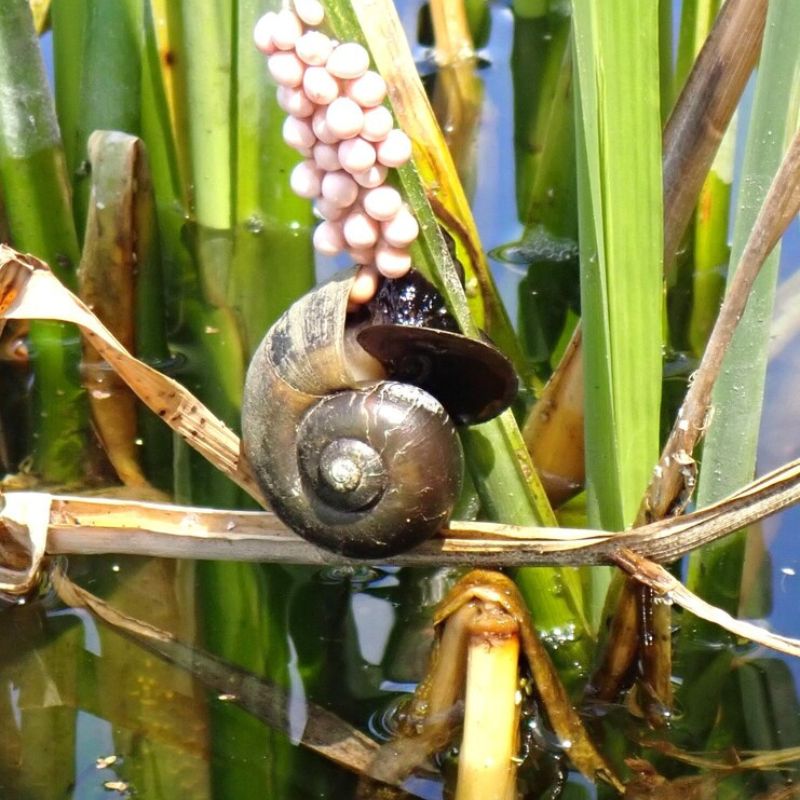
Florida Apple Snail
Pomacea paludosa
IUCN: Not Evaluated (NE)
- Sole prey of the Endangered snail kite — its population status drives kite conservation
- Primary diet of limpkins, whose distribution mirrors apple snail abundance
- Requires intact aquatic vegetation for egg-laying and juvenile shelter
- Declining in degraded spring-run systems due to vegetation loss
- Competing exotic species (P. maculata) are larger and harder for kites to handle
The snail kite crashed to approximately 700 individuals in the early 2000s, driven by droughts and the degradation of shallow-water aquatic vegetation that the Florida apple snail requires. An unexpected recovery followed. By 2022, the population had expanded to over 4,500 birds, partly driven by the bird’s ability to exploit the larger exotic island apple snail (Pomacea maculata and P. canaliculata) as a supplementary food source (FWC/University of Florida, 2023). The recovery has revised the species’ conservation outlook — though researchers note that reproductive success on exotic snails is lower than on the native species, and the population’s long-term trajectory remains a subject of active study.
Snail Kite
Rostrhamus sociabilis plumbeus
U.S. ESA: Endangered (EN)
- Curved, slender bill specialised for extracting apple snails from their shells
- Crashed to ~700 birds in early 2000s; recovered to over 4,500 by 2022 (FWC/UF, 2023)
- Recovery partly driven by exploiting larger exotic island apple snail as supplementary prey
- Reproductive success on exotic snails lower than on native species — long-term outlook uncertain
- One of the most ecologically constrained raptors in North America
Blackwater Rivers of the Panhandle
The Blackwater, Yellow, Choctawhatchee, Escambia, and Perdido Rivers drain the ancient longleaf pine uplands of northwest Florida into Pensacola Bay and the eastern Gulf. They represent some of the highest-quality blackwater river ecosystems in the eastern United States, fed by rainwater seeping through deep sandy soils rather than from the carbonate aquifer that dominates the peninsula. The Blackwater River runs through a nearly unbroken corridor of longleaf pine flatwood and floodplain swamp, with white sand bottom visible through the tannin-stained water — one of the finest blackwater paddling environments remaining in the South.
The Choctawhatchee River’s floodplain forests host the Swainson’s warbler (Limnothlypis swainsonii), swallow-tailed kite, and wood duck (Aix sponsa) and were the site of contested ivory-billed woodpecker reports in 2005–2006 — sightings never definitively verified, but which focused national conservation attention on the bottomland hardwood forests of the Panhandle system.
Florida’s Major Rivers Compared
| River | Length | Character | Key Species | Best Access |
|---|---|---|---|---|
| Suwannee | 246 mi | Blackwater + spring-fed | Suwannee cooter, manatee, mussel beds | Manatee Springs SP, Suwannee Wilderness Trail |
| St. Johns | 310 mi | Slow, lake-chain, tidal lower | Manatee, snail kite, shad, alligator | Blue Spring SP, Lake Monroe |
| Blackwater | 58 mi | Pure blackwater, white sand | Alligator snapping turtle, striped newt | Blackwater River SF, Karick Lake |
| Choctawhatchee | 174 mi | Blackwater, large floodplain | Swallow-tailed kite, Swainson’s warbler | Holmes Creek, Falling Waters SP |
| Ichetucknee | 6 mi | Spring run (purest in FL) | Mussel beds, limpkin, alligator | Ichetucknee Springs SP |
| Silver River | 5.5 mi | Spring run, glass-clear | Bass, gar, rhesus macaque | Silver Springs SP |
| Wakulla | 14 mi | Spring run + tidal lower | Manatee, anhinga, limpkin | Wakulla Springs SP |
Threats to Florida’s Freshwater Systems
Spring flow is declining. Nitrate is rising. Invasive species are restructuring food webs. Each threat is significant; together they are transformative.
What threatens a Florida spring is, almost always, happening miles away on land.
Because the Floridan Aquifer is the source of spring water, anything that affects the aquifer — its level, its chemistry, its recharge — eventually manifests at the spring vent. The threats below are not in the spring run. They are in the watershed.
1. Declining Spring Flow
Spring flow has declined measurably across most of Florida’s major spring systems over the past century. The primary driver is groundwater withdrawal: Florida’s population of over 22 million people draws heavily on the Floridan Aquifer for drinking water, irrigation, and industrial use. As the water table drops, the hydraulic pressure driving water to the surface diminishes, and discharge falls.
⚠️ Conservation Alert
- Silver Springs discharge has declined approximately 30% since the 1930s.
- Ichetucknee discharge has declined roughly 25% since the 1970s.
- Several springs that flowed continuously throughout recorded history now cease flow during dry periods.
- Without flow recovery, spring-run aquatic plant communities cannot be restored — manatee winter refuge is at long-term risk.
2. Nitrogen Pollution and Algae Dominance
The second major threat is elevated nitrate in spring water, originating from agricultural fertiliser, septic systems, and treated wastewater percolating through recharge areas. The porous limestone matrix of the Floridan Aquifer transmits nitrogen from land surface to spring vent with minimal attenuation — the filtration that most aquifers provide simply does not happen here at scale.
Concentrations above 0.25 mg/L are sufficient to trigger the shift from native plants to algae (UF, 2022).
Elevated nitrate drives a systematic shift in the spring plant community. The diverse, structured native plant community is replaced by dense mats of filamentous green algae (Cladophora and Vaucheria) and the exotic cyanobacteria Microseira wollei, which tolerate high nitrogen and outcompete native vegetation. Every species that depends on aquatic vegetation — from manatees to aquatic invertebrates — is affected by this shift.
Healthy vs. Nitrogen-Degraded Spring Run: Ecosystem Comparison
| Feature | Healthy Spring Run | Nitrogen-Degraded Run |
|---|---|---|
| Water clarity | Visibility 20–30+ metres, white limestone bottom visible | Reduced visibility, algae mats blocking substrate |
| Dominant vegetation | Eelgrass, tapegrass, muskgrass, pondweeds — diverse mix | Filamentous algae mats; Microseira wollei (cyanobacteria) |
| Nitrate level | Below 0.25 mg/L | Often 0.5–3.0 mg/L in affected systems |
| Manatee use | Active foraging and resting; population presence year-round | Vegetation loss reduces food availability; animals depart |
| Fish diversity | High; structured habitat supports many species and life stages | Reduced; loss of plant structure compresses habitat |
| Mussel beds | Present; actively filtering; host fish present | Absent or sparse; filtered water cannot compensate for nitrogen |
| Limpkin activity | Regular; apple snail populations stable | Reduced; apple snail decline follows vegetation loss |
| Spring discharge | Stable within historical range | Often declining due to aquifer drawdown in same watersheds |
3. Invasive Species
Hydrilla (Hydrilla verticillata), introduced from Asia and now the most widespread aquatic invasive in Florida, forms dense, light-blocking monocultures that suppress native aquatic plants and reduce the structural diversity that native fish and invertebrate communities require. The exotic island apple snail competes with the native Florida apple snail and is a more challenging prey item for snail kites due to its larger size — a mismatch linked to kite reproductive failure in some areas.
4. Altered Hydrology and River Channelisation
The channelisation of Florida’s rivers — most dramatically the Kissimmee River, straightened into a canal (C-38) in the 1960s — destroyed enormous floodplain wetland areas and severed the hydrological connectivity between rivers and their adjacent landscapes.
The Kissimmee was straightened into a canal in the 1960s. Forty miles of its meander has since been restored.
The Kissimmee River Restoration Project, widely cited as one of the most ambitious river restoration projects ever undertaken, has restored approximately 40 miles of historic meandering channel and several thousand acres of floodplain wetland since the late 1990s, with measurable responses in wading bird populations, fish communities, and water quality documented by South Florida Water Management District researchers.
Protecting Florida’s Springs and Rivers
A strengthening legal framework, decades of funded restoration, and a manatee population that recovered against the odds — what has worked, and what is still fragile.
The single most tractable threat is groundwater withdrawal. The single most complex threat is nitrogen.
The conservation framework for Florida’s springs and rivers has strengthened considerably since the 2000s, driven by public concern over visible spring degradation and the advocacy of organisations including the Florida Springs Institute, the Ichetucknee Alliance, and the Sierra Club Florida Chapter.
The Florida Springs Initiative, administered through FDEP, has funded spring restoration projects — native aquatic plant restoration, exotic plant removal, spring run clearing — at dozens of systems since 2001. Minimum flow and level (MFL) rules, established by Florida’s five water management districts, define the minimum spring discharge below which ecological harm is unacceptable. When discharge approaches the MFL threshold, water management districts are legally obligated to reduce permitted withdrawals — a mechanism that has proven difficult to enforce in practice but creates a legal framework for protecting flows.
The Crystal River National Wildlife Refuge, established specifically to protect manatee wintering habitat at Kings Bay and its tributary spring systems, is managed with strict boat speed zones, swimming restrictions during peak aggregation periods, and active water quality monitoring. The population of Florida manatees, once reduced to fewer than 1,300 individuals, recovered to over 8,800 by 2020 before the recent seagrass die-off crisis — demonstrating both the effectiveness of targeted protection and the fragility of that recovery when dependent habitats are lost.
🔧 Restoration in Progress
- Florida Springs Initiative (FDEP, since 2001): native plant restoration, exotic removal, and run clearing across dozens of spring systems.
- Kissimmee River Restoration: 40+ miles of channelised river restored to meandering channel since late 1990s; measurable wading bird, fish, and water-quality responses (SFWMD).
- Crystal River NWR: boat speed zones, seasonal access restrictions, and continuous water quality monitoring around Kings Bay manatee wintering habitat.
- MFL rule-making across five Florida water management districts — the legal lever for restricting groundwater withdrawals when spring discharge approaches ecological thresholds.
- Suwannee Mussel Restoration (FWC / Florida Museum, 2024): three Unionidae species propagated and reintroduced with >40% two-year survival.
💡 Key Takeaway
- The Kissimmee Restoration proves large-scale recovery is achievable with sustained commitment.
- Groundwater withdrawal is the single most tractable spring flow threat — MFL rules give water management districts a legal lever not available for other threats.
- Nitrogen reduction requires landscape-scale changes to agriculture and wastewater management in spring recharge areas — the most complex and expensive conservation challenge in Florida freshwater.
Where and When to See the Wildlife
From the only legally permitted swim-with-manatees site in the United States to a 207-mile paddling corridor through the Suwannee wilderness.
Florida’s spring systems offer some of the most intimate wildlife encounters available anywhere in the United States. The clarity of the water, the accessibility of most spring parks, and the tendency of spring-associated animals to habituate to calm human presence create conditions for wildlife observation simply not replicable in other habitat types.
| Site | Habitat Type | Target Species | Best Season | Entry Notes |
|---|---|---|---|---|
| Blue Spring SP, Volusia Co. | Spring run / St. Johns | Manatee (record: 932 counted Jan 2024) | Nov–Mar | Free day-use; arrive early in peak winter |
| Crystal River NWR, Citrus Co. | Spring complex / bay | Manatee (guided snorkel) | Nov–Mar | Guided tours required for water entry |
| Ichetucknee Springs SP | Spring run / forest | Limpkin, mussel beds, turtle | Year-round | Tube or kayak; capacity limits apply |
| Silver Springs SP, Marion Co. | Spring / spring run | Bass, gar, glass-bottom boat views | Year-round | Glass-bottom tours recommended |
| Wakulla Springs SP | Deep spring / river | Alligator, limpkin, anhinga, manatee | Year-round | Boat tours depart from park lodge |
| Three Lakes WMA, Osceola Co. | River / marsh | Snail kite, sandhill crane, alligator | Oct–Apr | Free; snail kite most reliable Nov–Mar |
| Blackwater River SF, Santa Rosa | Blackwater river | Alligator snapping turtle, watersnakes | Sep–May | Canoe/kayak rental at park |
| Suwannee Wilderness Trail | Blackwater + spring runs | Suwannee cooter, osprey, alligator | Oct–Apr | 207-mile multi-day paddling corridor |
🗓️ Florida Springs & Rivers Seasonal Guide
- Nov–Mar (Peak Manatee Season): Cold air drives manatees to congregate at warm spring discharge. Wading birds — herons, egrets, anhingas, cormorants — concentrate at spring runs as surrounding wetlands dry.
- Mar–May (Breeding Activity): Limpkins, swallow-tailed kites, and prothonotary warblers return to spring-fed rivers. Clear, lower-water conditions are most visually compelling for paddling and snorkelling.
- Jun–Sep (Summer Wet Season): Heavy afternoon thunderstorms; rivers rise; manatees disperse widely. Spring runs remain a constant 68–72°F — cool refuges from summer heat.
Recent Research in Florida Springs and Rivers (2020–2025)
Scientific understanding of Florida’s freshwater ecosystems has advanced considerably in recent years, with several findings of direct management relevance:
- Manatee mortality crisis and seagrass connection: Research published in Marine Mammal Science (Worthy et al., 2023) documented that the 2021–2022 Unusual Mortality Event — in which over 1,100 manatees died — was driven almost entirely by starvation resulting from near-total collapse of Indian River Lagoon seagrass beds. The Indian River Lagoon manatee subpopulation, which relies on lagoon seagrass rather than migrating to spring refugia, was particularly vulnerable, with body condition indices of recovered carcasses among the lowest ever recorded for the species.
- Spring nitrate thresholds revised downward: A 2022 study by University of Florida researchers, published in Freshwater Biology, established that native aquatic plant communities in Florida spring runs begin to show compositional shifts toward algae-dominated states at nitrate concentrations as low as 0.25 mg/L — lower than previous regulatory thresholds assumed — suggesting current water quality standards are insufficiently protective.
- Snail kite population expansion: Research by FWC and the University of Florida (2023) documented an unexpected expansion of the snail kite population from approximately 700 birds in 2007 to over 4,500 by 2022 — driven partly by the kite’s ability to exploit the larger exotic island apple snail as an alternative prey source. The study revised the kite’s conservation outlook upward, though researchers cautioned that productivity on exotic snails is lower than on native snails and continued monitoring is warranted.
- Suwannee mussel restoration: A collaborative FWC and Florida Museum of Natural History programme documented successful propagation and reintroduction of three imperilled Unionidae species — Suwannee moccasinshell (Medionidus walkeri), Gulf moccasinshell (M. penicillus), and oval pigtoe (Pleurobema pyriforme) — to restored Suwannee basin reaches, with survival rates exceeding 40% at two years post-release (FWC, 2024).
🔬 Recent Research Highlight
Sostoa et al. (2022, Freshwater Biology): Nitrate concentrations as low as 0.25 mg/L are sufficient to trigger algae dominance in Florida spring-run plant communities — substantially below the regulatory thresholds in force when the study was published.
Worthy et al. (2023, Marine Mammal Science): The 2021–22 Unusual Mortality Event reset assumptions about manatee recovery. Spring-site protection is necessary but not sufficient — habitat collapse outside the spring network can crash subpopulations that do not migrate to refugia.
The Springs as Mirror
Florida’s springs are not merely beautiful. They are legible.
The clarity of the water that has defined them for millennia is itself a kind of transparency — a window into the health of the aquifer system that produces it. When that clarity dims, when the aquatic plants disappear beneath a carpet of algae, when spring flow drops and the thermal refuge it provides is reduced, the spring is reporting something: that the recharge area above has changed, that nitrogen has entered the system, that more water is being withdrawn than the land can replace.
The species that define these systems — manatee, limpkin, snail kite, Suwannee cooter, freshwater mussel — are not passive inhabitants. They are products of millions of years of evolution within a specific set of physical conditions. The spring water that was the right temperature, the right chemistry, the right flow for those species to thrive was not an accident. It was the expression of a functioning aquifer in a landscape that absorbed and filtered rainfall efficiently and returned it to the surface slowly and cleanly.
“None of this is simple. All of it is possible.”
Restoring and protecting the relationship between the land above and the water below — between the spring vent and the wildlife that depends on it — is the central conservation challenge of Florida’s freshwater future. Reducing agricultural nitrogen, managing groundwater withdrawal against demonstrable ecological thresholds, and maintaining the natural lands that allow the aquifer to recharge at the pace it was built for: each of these is achievable. None of them is happening fast enough.
NativesOfNature’s Florida freshwater coverage is built around the understanding that the aquifer, the spring, and the river are a single system.
Frequently Asked Questions
Q: What animals live in Florida springs?
Florida springs support West Indian manatees (wintering), American alligators, limpkins, Florida softshell turtles, alligator snapping turtles, longnose gar, Florida largemouth bass, bowfin, multiple species of freshwater mussels, and a diverse community of aquatic invertebrates. Wading birds including great blue herons, anhingas, and tricoloured herons regularly forage along spring runs.
Q: Why are Florida springs so clear?
Florida spring water originates from the Floridan Aquifer — a vast underground limestone reservoir. As rainwater percolates through the sandy soils and limestone, suspended particles are filtered out before the water emerges at the spring vent. The result is water that has been naturally filtered over months to decades, with virtually no suspended sediment. Nitrate pollution from agriculture and development is the primary cause of clarity loss in degraded spring systems, as it drives the algae growth that clouds the water.
Q: Where can you swim with manatees in Florida?
Crystal River National Wildlife Refuge in Citrus County is the only place in the United States where guided snorkelling with wild manatees is legally permitted. The tour season runs November through March, when manatees congregate in Kings Bay around the warm spring discharge. Guided tours are required for water entry; visiting independent of a licensed operator is not permitted during manatee season. Blue Spring State Park in Volusia County allows close observation from a boardwalk but does not permit water entry during the manatee aggregation period.
Q: What is the Floridan Aquifer?
The Floridan Aquifer is one of the most productive groundwater systems in the world — a vast network of porous and cavernous limestone extending beneath approximately 100,000 square miles of Florida, Georgia, Alabama, and South Carolina. In Florida, it is recharged by rainfall percolating through sandy soils on the interior peninsula, and it discharges at the surface through more than 1,000 named springs. The aquifer is the source of drinking water for the majority of Florida’s population and the ecological engine behind the state’s extraordinary spring ecosystems.
Q: Why are Florida springs turning green?
The green discoloration in degraded Florida spring runs is caused primarily by filamentous green algae (Cladophora spp.) and the cyanobacteria Microseira wollei, both of which thrive in elevated nitrogen conditions. Nitrogen enters the aquifer as nitrate from agricultural fertilisers, septic system effluent, and treated wastewater applied to or draining through the spring recharge zone. Once nitrate concentrations exceed approximately 0.25 mg/L in the spring discharge, native aquatic plant communities begin to give way to algae-dominated states — and restoring them requires reducing nitrogen at the source, in the recharge area, not simply in the spring run itself.
Q: What is the largest spring in Florida?
Silver Springs in Marion County has the highest recorded average discharge of any spring in the United States, historically exceeding 500 million gallons per day according to the Florida Springs Institute. However, its discharge has declined by approximately 30% since the 1930s due to groundwater withdrawal from the Floridan Aquifer. Wakulla Springs in Wakulla County is the world’s deepest known freshwater spring, with the main vent descending over 300 feet. Both are accessible to the public within their respective state parks.
Q: Are manatees at Blue Spring year-round?
Manatees are present at Blue Spring State Park year-round, but the large aggregations that make Blue Spring famous occur only from approximately November through March, when ambient water temperatures outside the spring run fall below the manatees’ cold-stress threshold of 68°F. During these months, up to 900+ manatees may congregate in the 72°F spring run on the coldest days — the park record stands at 932 animals, set in January 2024. In summer, most animals disperse widely across the St. Johns River and beyond, with some individuals travelling as far as Virginia and the Gulf coast before returning to the spring in autumn.
References & Sources
- Florida Department of Environmental Protection (FDEP). (2023). Florida Springs Locations and Annual Flow Data. Tallahassee, FL.
- Florida Fish and Wildlife Conservation Commission (FWC). (2024). Suwannee River Mussel Restoration Progress Report. Tallahassee, FL.
- Florida Fish and Wildlife Conservation Commission (FWC). (2023). Florida Manatee Population Status Report. Tallahassee, FL.
- Florida Springs Institute. (2022). The State of Florida’s Springs: 2022 Report. High Springs, FL.
- Notestein, S.K., et al. (2003). Water quality and aquatic macrophyte community structure of Silver Springs, Florida. Archiv für Hydrobiologie, 158, 461–479.
- Odum, H.T. (1957). Trophic structure and productivity of Silver Springs, Florida. Ecological Monographs, 27, 55–112.
- Sostoa, A. de, et al. (2022). Nitrate thresholds in Florida spring-run macrophyte communities. Freshwater Biology, 67(4), 812–829.
- U.S. Fish and Wildlife Service (USFWS). (2024). West Indian Manatee 5-Year Review. Jacksonville, FL.
- Welch, R.A., et al. (2023). Snail kite population expansion and exotic apple snail use in Florida. Biological Conservation, 278, 109871.
- Worthy, G.A.J., et al. (2023). Body condition of stranded manatees and the 2021 Unusual Mortality Event. Marine Mammal Science, 39(2), 441–460.