In the spring of 2000, biologists conducting small mammal surveys in Everglades National Park began noticing something deeply wrong. Raccoons — ordinarily one of the most abundant mammals in South Florida — were nearly impossible to find. Marsh rabbits had vanished from large areas. Opossum captures fell to nearly zero. Over the following decade, systematic road surveys confirmed what field researchers feared: in areas where Burmese pythons had established themselves, populations of medium-sized mammals had declined by 85 to 99 percent (Dorcas et al., PNAS, 2012). Not reduced. Not stressed. Functionally eliminated across hundreds of thousands of acres of one of the most protected landscapes in the United States.
The Burmese python is the most visible symbol of a broader ecological crisis. Florida supports more than 500 established non-native species — the highest count of any state in the continental United States — and the damage they collectively inflict on native ecosystems, agriculture, and public health runs into billions of dollars annually (Florida Fish and Wildlife Conservation Commission). Some arrived as stowaways in cargo. Others escaped from gardens or aquariums. Many were deliberately released by people who underestimated what they were setting loose. All of them found, in Florida’s subtropical climate and habitat diversity, conditions favorable enough to survive, reproduce, and spread.
Understanding Florida’s invasive species crisis is not optional for anyone who wants to understand Florida’s wildlife. Invasive species are now a primary driver of native biodiversity loss in the state — operating alongside habitat destruction, hydrological alteration, and climate change to reshape ecosystems that took millions of years to assemble.
How to Use This Hub
This hub covers Florida’s most ecologically significant invasive species — animals, plants, and fish — with full profiles, identification guides, and reporting information linked throughout. If you are a student or educator, the food web and ecosystem impact sections connect directly to the Florida Wildlife and Florida Wetlands hubs. If you encounter a suspected invasive species in the field, jump to the Reporting Invasive Species section at the bottom of this page.
Why Florida Is So Vulnerable to Biological Invasion
No state in the continental United States is more susceptible to biological invasion than Florida, and the reasons are structural rather than accidental.
Florida’s subtropical climate means that species from tropical Asia, the Caribbean, South America, and Africa — regions that supply the bulk of the global pet and ornamental plant trade — can survive outdoors year-round. A Burmese python released in Minnesota dies in its first winter. Released in Miami, it finds conditions functionally similar to its native range in Southeast Asia. The same is true for dozens of other tropical and subtropical species that cannot establish in colder states but thrive in Florida.
Florida is also the leading port of entry for live animals and exotic plants in the United States. Miami International Airport and the Port of Miami together handle a staggering volume of wildlife trade — legal and otherwise — and despite inspection programs, the sheer scale of trade means stowaways and escape events are inevitable. The brown anole (Anolis sagrei), now one of the most abundant lizards in Florida, arrived in cargo shipments from Cuba in the early 20th century and has since spread to most of the southeastern United States.
The state’s enormous and geographically dispersed human population also creates pathways that purely wild landscapes do not have. Canals connect water bodies that were historically isolated. Roads carry seeds, animals, and aquarium water across watershed boundaries. Landscaping with non-native plants — still common despite decades of awareness campaigns — continuously introduces propagules into adjacent natural areas.
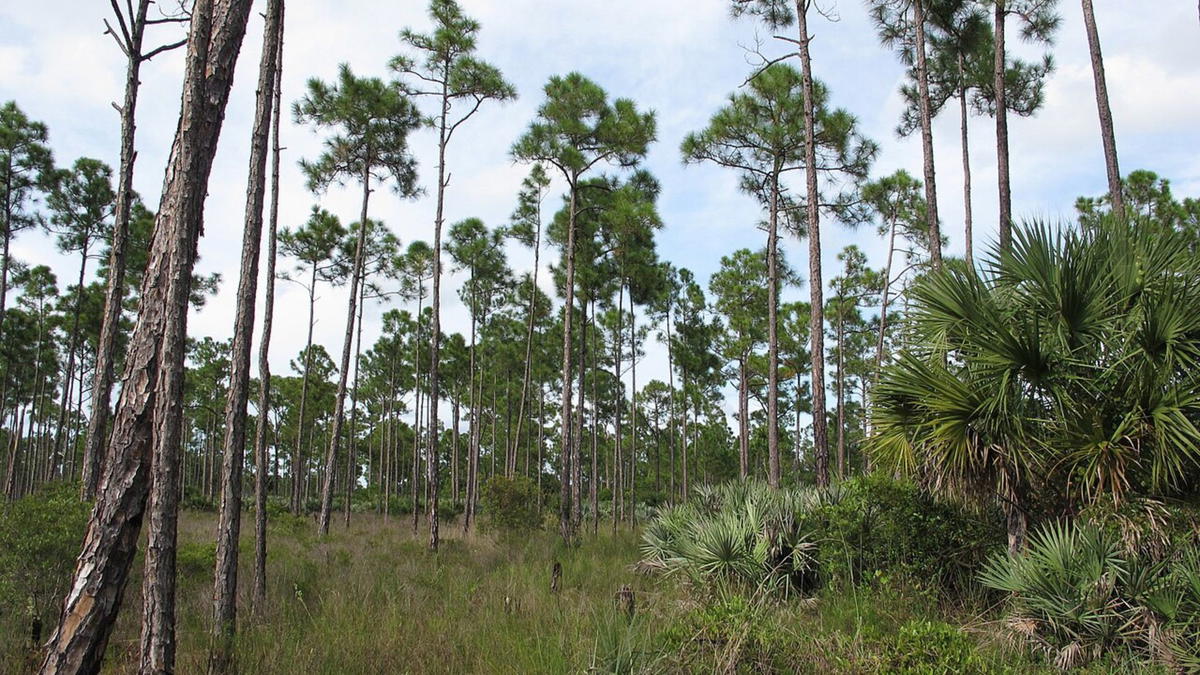
Finally, Florida’s extraordinary habitat diversity means that almost any introduced species can find a suitable niche. A species that fails to establish in a pine flatwood may thrive in a wetland margin, a coastal mangrove fringe, or a suburban retention pond. The landscape offers, in effect, dozens of different ecological opportunities for any given invader.
Major Invasive Animals
Burmese Python (Python bivittatus)
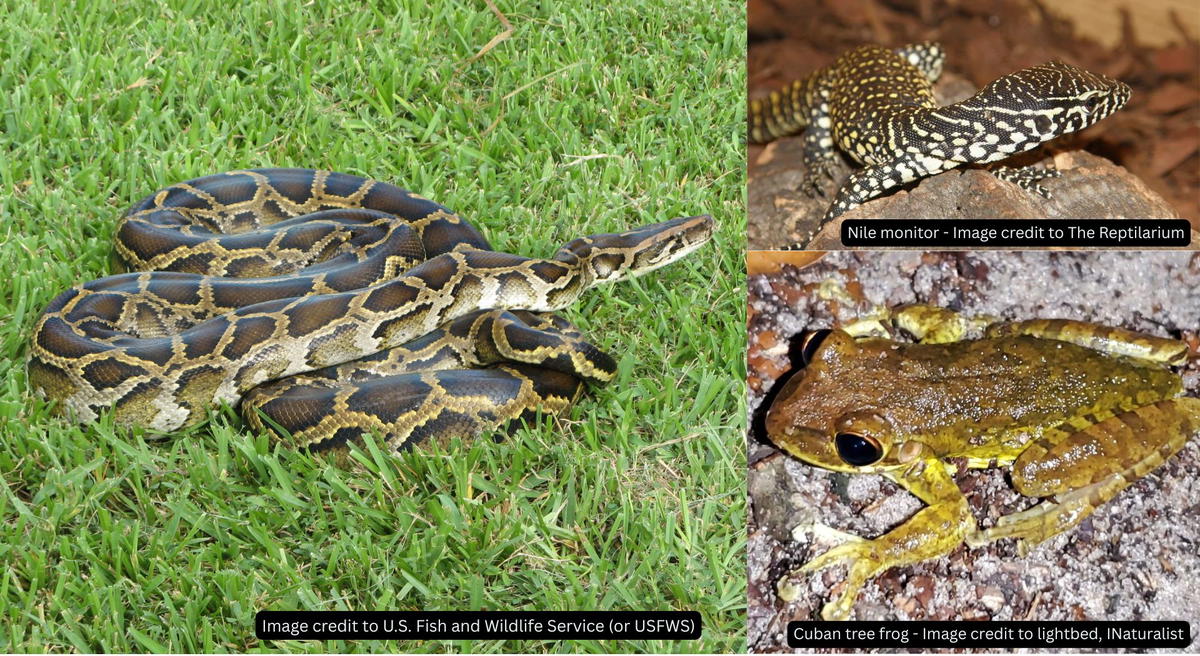
No invasive species in the history of American conservation has produced documented ecological damage at the scale of the Burmese python in South Florida. Native to Southeast Asia, pythons were imported in large numbers for the pet trade throughout the 1980s and 1990s. Populations established in the Everglades are now estimated to number in the tens of thousands, potentially more — population estimates are inherently uncertain because pythons are extraordinarily cryptic, spending most of their time hidden in dense vegetation (Willson et al., Biological Invasions, 2011).
Pythons are generalist predators with no size ceiling that is ecologically meaningful in Florida. They consume deer, bobcats, wading birds, alligators, and virtually everything in between. The 2012 Dorcas study, which compared small mammal survey data from before and after python establishment across a large area of the park, found raccoon detections down 99.3%, opossum detections down 98.9%, and bobcat detections down 87.5% (Dorcas et al., PNAS, 2012). These are not marginal declines. They represent the near-total functional removal of the mammal community from large areas of the Everglades food web.
The downstream consequences extend upward. Raptors that depend on rabbits and raccoons have fewer prey. Alligators compete with pythons for medium to large prey. The ecological simplification that follows the removal of a diverse mammal community affects predators, scavengers, and the nutrient cycling pathways that depend on mammal activity.
Python removal programs — operated by the Florida Fish and Wildlife Conservation Commission, the South Florida Water Management District, and contracted professional hunters — have removed over 17,000 pythons from South Florida since formal management began. This represents a meaningful effort, but experts are candid that removal alone cannot eradicate or even substantially reduce an established python population at Everglades scale. Research into biological control, improved detection methods (including trained detector dogs and environmental DNA sampling), and early interception of range expansion northward represents the current frontier of python management.
→ [Read the full Burmese Python profile]
Nile Monitor (Varanus niloticus)
The Nile monitor is a large, highly intelligent Old World lizard — adults can exceed six feet in length — native to sub-Saharan Africa and established in Lee and Charlotte counties in Southwest Florida since at least the late 1990s (Enge et al., Herpetological Review, 2004). It is a dietary generalist that consumes eggs, small mammals, birds, fish, invertebrates, and carrion. In Florida, its primary documented ecological impact is predation on gopher tortoise eggs and hatchlings — a serious concern given the tortoise’s already threatened status — and on the eggs and chicks of ground-nesting birds.
Unlike the python, whose cryptic habits make detection difficult, Nile monitors are large, fast, and highly visible in suburban and semi-rural areas, where they frequently raid chicken coops, raid garbage, and cause alarm. Their established range in Southwest Florida appears to be expanding slowly, and surveys suggest the population is breeding successfully in multiple counties (Davis et al., FWC, 2011).
Argentine Black-and-White Tegu (Salvator merianae)
The Argentine tegu is a large, powerfully built South American lizard — adults reach four to five feet and can weigh up to ten pounds — that has established breeding populations in Hillsborough and Miami-Dade counties and is spreading (FWC). Tegus are omnivorous, consuming fruits, eggs, small vertebrates, invertebrates, and carrion with equal facility. They are also unusually intelligent for reptiles, capable of learning, and thermophysiologically unusual — they can elevate their body temperature above ambient through metabolic heat production during the breeding season, enabling activity at temperatures that would render most reptiles torpid.
The primary ecological concern in Florida is egg predation. Tegus readily excavate and consume the nests of American alligators, gopher tortoises, sea turtles, and ground-nesting birds — species that in many cases are already under conservation pressure from other threats. A single tegu can consume multiple nests in a single foraging bout. FWC has listed the tegu as a high-priority invasive species and operates an active removal program. Unlike pythons, tegus can be effectively trapped using standard cage traps, making targeted removal feasible — but the window for containment before populations become unmanageable is narrow.
Cuban Treefrog (Osteopilus septentrionalis)
The Cuban treefrog is the largest treefrog species in North America, and it has colonized most of the Florida peninsula since its arrival in the Florida Keys, likely via cargo, in the 1920s (Meshaka, The Cuban Treefrog in Florida, 2001). It is a dietary generalist that readily consumes Florida’s five native treefrog species — including the green treefrog (Hyla cinerea) and squirrel treefrog (Hyla squirella) — as well as small lizards, invertebrates, and juvenile frogs of other species.
The impact of Cuban treefrogs on native treefrog populations has been documented through community surveys showing inverse abundance relationships: where Cuban treefrogs are most abundant, native treefrogs are least abundant (Wyatt & Forys, Florida Scientist, 2004). Cuban treefrogs also produce a skin secretion that causes significant irritation to human eyes and mucous membranes, and they are notorious for short-circuiting electrical equipment by sheltering in outdoor utility boxes — an economic nuisance that has earned them particular attention from Florida homeowners.
Humane euthanasia using benzocaine gel is the recommended removal method for individual frogs encountered on private property (FWC). No landscape-scale control exists.
Lionfish (Pterois volitans and P. miles)
The red lionfish and its congener the devil firefish are venomous Indo-Pacific reef fish that were first recorded in Florida waters in the mid-1980s and have since spread throughout the Atlantic coast of the United States, the Gulf of Mexico, and the Caribbean — one of the fastest marine invasions ever recorded (Albins & Hixon, Marine Ecology Progress Series, 2008). They are believed to have been introduced through aquarium releases.
Lionfish are voracious, opportunistic predators of small reef fish and invertebrates, consuming prey at rates that have been measured at up to 79% reduction of juvenile fish on experimental reef patches within just five weeks of lionfish introduction (Albins & Hixon, 2008). They have no natural predators in the Atlantic that consistently prey on them, and their venomous spines deter most native predators that might otherwise consume them. Their cryptic, slow-moving behavior on reef structure makes them highly effective ambush predators.
The ecological impact on Florida’s coral reef fish communities — already under stress from bleaching, disease, and overfishing — is significant and measurable. Current management relies on spearfishing by recreational and commercial divers; lionfish derbies, which incentivize removal through prizes and public events, have become a fixture of Florida’s diving community. The REEF organization coordinates lionfish population monitoring and removal programs across Florida and the wider Caribbean.
Wild Boar / Feral Hog (Sus scrofa)
Feral hogs are established across virtually all of Florida’s 67 counties and represent perhaps the most geographically widespread invasive animal in the state, with an estimated population of 500,000 or more (FWC). They are descendants of domestic pigs brought by Spanish explorers in the 16th century, supplemented by later introductions of Eurasian wild boar for hunting purposes, and the two lineages have interbred extensively.
Feral hogs are omnivores that root extensively in soil searching for invertebrates, roots, and tubers — a foraging behavior that physically disturbs soil structure, destroys native ground cover, increases erosion, and creates wallows that become mosquito breeding habitat. Their rooting damage to native ground-layer vegetation in pine flatwoods and wetland margins is severe and well-documented. They also consume the eggs of ground-nesting birds and sea turtles, depredate agricultural crops, and serve as reservoirs for diseases including pseudorabies and brucellosis that can be transmitted to native wildlife and livestock (Corn et al., Journal of Wildlife Diseases, 1986).
Hunting is currently the primary management tool, and feral hogs are a popular game animal in Florida. However, hunting pressure has not demonstrably reduced population levels statewide — feral hog populations are highly productive, with females capable of producing two litters per year, and hunting selectively removes the most accessible animals while leaving core populations intact.
Major Invasive Plants
Burmese Python of the Plant World: Melaleuca (Melaleuca quinquenervia)
Melaleuca, also called paperbark tree or punk tree, is an Australian tree introduced to Florida in the early 20th century — initially deliberately, as engineers and land managers believed it would help drain the Everglades and stabilize soils. What it actually did was the opposite of what was intended. Melaleuca is extraordinarily aggressive in Florida’s wetlands, forming dense, closed-canopy monocultures that exclude native vegetation, shade out the open, sunlit conditions that sawgrass marshes and wet prairies depend on, and dramatically reduce wildlife diversity. A stand of melaleuca supports a fraction of the bird, reptile, and invertebrate diversity of the native marsh it replaces.
At its peak, melaleuca had invaded an estimated 400,000–500,000 acres of South Florida, spreading at rates of up to 50 acres per day (Laroche, Florida Department of Environmental Protection, 1998). One tree can produce more than a million seeds per year, and seeds are released in massive quantities in response to fire — the very management tool used to maintain native wetland communities. A prescribed burn in a melaleuca-infested marsh can trigger a seed release that worsens the invasion rather than controlling it.
Decades of intensive biological control — using a suite of insects from Australia including the melaleuca psyllid (Boreioglycaspis melaleucae) and a weevil (Oxyops vitiosa) — have significantly reduced melaleuca’s rate of spread and allowed native vegetation to recover in treated areas (Rayamajhi et al., Biological Control, 2009). This represents one of the genuine successes of invasive plant management in Florida, though melaleuca remains widely established and requires ongoing suppression.
Old World Climbing Fern (Lygodium microphyllum)
Old world climbing fern is a wiry, vine-like fern from Southeast Asia and Australia that has invaded over 150,000 acres of South Florida and is considered one of the most destructive invasive plants in the state (USDA APHIS). It climbs over and smothers native vegetation — including mature cypress trees, sawgrass marshes, and pine flatwoods canopies — creating dense, continuous mats of fine, highly flammable biomass that dramatically alter fire behavior. In a native Florida flatwood or marsh, a natural fire burns at low intensity along the ground. In a lygodium-infested site, fire climbs the fern mat into the forest canopy, producing intense crown fires that kill native trees that evolved to survive ground-level burns.
Lygodium spreads by wind-dispersed spores — microscopic, nearly impossible to intercept — and a single mature plant can produce millions of spores annually. Chemical control using herbicides is effective at the plant level but logistically difficult across large infested areas. A biological control agent, the lygodium moth (Neomusotima conspurcatalis), has shown promise in early trials and is under further evaluation.
Brazilian Pepper (Schinus terebinthifolia)
Brazilian pepper is a dense, fast-growing shrub or small tree from South America that has become one of the most widespread invasive plants in Florida, infesting an estimated 700,000 acres across the state (FWC). It forms nearly impenetrable monocultures that exclude native ground-cover plants, reduce habitat value for most native wildlife species, and are nearly impossible to remove manually due to vigorous resprouting from cut stumps.
Brazilian pepper is closely related to poison ivy and mango, and its sap and berries cause skin irritation and respiratory distress in sensitive individuals. Despite its ecological damage, it produces abundant red berries that are consumed and dispersed by birds — particularly American robins during their winter migration through Florida — which has accelerated its spread along bird movement corridors (Ewel et al., Florida Scientist, 1982).
Biological control research targeting Brazilian pepper has been underway for decades and is now focused on a thrips species (Pseudophilothrips ichini) approved by USDA for release following extensive host-specificity testing. Early results from release sites are promising.
Water Hyacinth (Eichhornia crassipes) and Hydrilla (Hydrilla verticillata)
Aquatic invasive plants pose a distinct set of ecological problems. Water hyacinth, a floating plant native to South America with attractive purple flowers, and hydrilla, a submerged aquatic plant native to Asia, together cover enormous areas of Florida’s lakes, rivers, and canals. Both grow at extraordinary rates — hydrilla can grow up to an inch per day under favorable conditions — and form dense mats that block sunlight from native aquatic vegetation, deplete dissolved oxygen as masses of plant material decompose, impede water flow through canals and drainage structures, and make recreational use of water bodies impossible.
In systems like Lake Okeechobee and the St. Johns River, aquatic plant management is a continuous, expensive operational necessity rather than a one-time intervention, requiring millions of dollars annually in herbicide application, mechanical harvesting, and biological control (grass carp) to keep infestations from completely choking navigation channels and degrading fish habitat.
The Pathways of Invasion: How Invasives Arrive in Florida
Understanding how invasive species arrive is essential for prevention — the only genuinely cost-effective strategy for managing biological invasions. In Florida, five pathways account for the vast majority of established invasive species.
The pet trade is the single largest pathway for vertebrate invasives. Florida is the largest importer of live animals in the United States, and Miami-area businesses have historically retailed thousands of species of reptiles, amphibians, fish, birds, and mammals — many of which were eventually released or escaped. The Burmese python, the Argentine tegu, the Nile monitor, the red-eared slider turtle, and dozens of invasive fish species all entered Florida’s wild through the pet trade.
The ornamental plant trade accounts for the majority of invasive plant introductions. Brazilian pepper, melaleuca, old world climbing fern, air potato, and many other invasive plants were deliberately introduced for landscaping or erosion control before their invasive potential was recognized.
The aquarium trade introduced lionfish, hydrilla, water hyacinth, and numerous invasive aquarium fish species — including the Mayan cichlid and several oscar species now established in South Florida canals and water bodies.
Agricultural and shipping cargo introduces invertebrates, fungi, pathogens, and small vertebrates as stowaways. The brown anole arrived in Cuban cargo; the Mediterranean fruit fly arrives repeatedly in produce shipments.
Natural spread from adjacent states and the Caribbean accounts for some expansions — particularly of plants with wind-dispersed seeds or spores — but the dominant pathway for novel introductions remains human-mediated.
Ecological Cascades: How Invasive Species Destabilize Florida’s Food Webs
The damage caused by invasive species is rarely limited to the direct impact of the invader on its immediate prey or competitors. In complex, interconnected food webs like those of the Everglades, the removal or reduction of one species creates cascading effects that reshape communities far beyond the original point of impact.
The python’s elimination of the Everglades mammal community provides a stark example. Raccoons are important predators of turtle and crocodilian eggs in Florida wetlands — their removal may reduce predation pressure on those nests, altering nest success rates in ways that affect reptile population dynamics. Raccoons and opossums are also important seed dispersers for certain native plants; their absence may affect plant community composition over time. And the removal of a diverse mammal community reduces prey availability for raptors, large owls, and other predators that were not themselves directly affected by pythons.
Similarly, when melaleuca converts open sawgrass marsh to closed-canopy monoculture, it eliminates the structural habitat that wading birds require for foraging, destroys the periphyton community that forms the base of the Everglades food web, and reduces the open water that alligators depend on for thermoregulation and hunting. The loss of one plant community type cascades through every trophic level that depended on it.
These cascading effects mean that the true ecological cost of invasive species is almost certainly greater than any direct measurement of their individual impacts.
Threats to Human Health, Agriculture, and Economy
The economic costs of invasive species in Florida are substantial and span multiple sectors. The Florida Department of Agriculture and Consumer Services estimates that invasive pests and diseases cost Florida agriculture over $1 billion annually in lost production, treatment, and management costs. Citrus greening disease (Candidatus Liberibacter asiaticus), spread by the invasive Asian citrus psyllid (Diaphorina citri), has caused catastrophic losses in Florida’s historically dominant citrus industry — statewide citrus production has declined by over 90% from its peak as growers struggle to manage a disease for which no cure currently exists.
Aquatic invasive plants cost Florida water management districts and local governments tens of millions of dollars annually in management and removal. The economic impact of pythons on Everglades-related ecotourism — through the reduction in wildlife viewing opportunities caused by mammal community collapse — has not been formally quantified but is likely significant.
Invasive species also affect public health. Feral hogs spread brucellosis and pseudorabies. Invasive mosquito species — including Aedes aegypti and Aedes albopictus, both established in Florida — are vectors for dengue, chikungunya, and Zika virus. The tiger mosquito (Aedes albopictus) is now one of the most abundant mosquito species in urban and suburban Florida.
Conservation Response: What Is Being Done
Florida has invested more in invasive species management than virtually any other state, and several programs represent genuine models for how biological invasion can be confronted at scale.
The South Florida Water Management District’s python removal program, which began in earnest around 2017, has removed thousands of pythons annually using professional contracted hunters operating year-round across the Everglades system. Python Challenge events, organized by FWC, engage public participants in removal efforts and generate public awareness. Research into environmental DNA (eDNA) sampling — detecting python presence through genetic traces left in water — is advancing as a survey tool that could help map population boundaries and guide removal effort allocation.
Biological control programs targeting melaleuca, old world climbing fern, and Brazilian pepper represent decades of careful scientific work. Biological control agents must pass extensive host-specificity testing before release to ensure they do not attack native or economically important plants. When successful, biological control can provide cost-effective, self-sustaining suppression at landscape scales that chemical and mechanical methods cannot achieve.
The FWC’s Exotic Species Hotline (1-888-Ive-Got1 / 1-888-483-4681) and associated smartphone app allow citizens to report sightings of invasive species in real time, creating a distributed early detection network that has helped intercept new populations before they become established. Early detection is the most powerful tool in invasive species management — removing ten animals before a population is established is orders of magnitude more cost-effective than attempting to remove ten thousand animals after establishment.
Regulatory efforts — restrictions on importation and possession of high-risk species — have been strengthened in recent years. FWC’s Prohibited Species list bans possession of Burmese pythons, tegus, and other established invaders as pets, closing a pathway that historically contributed to establishment.
Recent Research
The science of invasive species in Florida is advancing rapidly, driven by the urgency of the management challenges. A 2020 study published in Ecology and Evolution used stable isotope analysis to characterize the diet breadth of Burmese pythons across seasons and habitats, confirming that pythons switch prey opportunistically across a wider range of species than previously documented — including substantial consumption of wading birds during nesting season (Romagosa et al., 2020).
Research on Argentine tegu impacts has been formalized through systematic nest predation studies. A 2021 study at Archbold Biological Station confirmed that tegus in proximity to gopher tortoise burrow areas significantly increased rates of burrow intrusion and egg predation, quantifying a threat that wildlife managers had observed anecdotally for years (Freidenfelds et al., Biological Invasions, 2021).
On the plant side, a 2022 assessment of old world climbing fern management outcomes across treated sites in Big Cypress found that integrated management — combining herbicide treatment with biological control releases — produced significantly better long-term suppression than either method alone, providing evidence-based guidance for resource allocation decisions (USDA Forest Service, 2022).
Environmental DNA technology is being rapidly deployed across South Florida for python detection. A 2023 pilot program by the USGS demonstrated that eDNA collected from canal water could reliably detect python presence in areas where traditional visual surveys found no animals, suggesting that eDNA may eventually serve as a sensitive early-warning system for range expansion (Hunter et al., USGS Open-File Report, 2023).
How You Can Help
Individual action genuinely matters in invasive species management, primarily through prevention and early detection — the two points in the invasion process where intervention is most effective.
Never release pets, aquarium fish, or plants into the wild. This is illegal in Florida and is the primary introduction pathway for reptile and fish invasives. If you can no longer care for an exotic pet, Florida’s Exotic Pet Amnesty Program allows no-questions-asked surrender at designated events and facilities (FWC).
Learn to identify high-priority invasive species in your region. The IveGot1 reporting app, operated by FWC, allows you to submit georeferenced photos of suspected invasive species directly to wildlife managers. Early reports of new species or range expansions have directly led to eradication efforts that prevented establishment.
Choose native plants for landscaping. Native plant communities support native insects, which support native birds, which support the food webs that make Florida’s wildlife what it is. Replacing invasive ornamentals like Brazilian pepper, Chinese tallow, and air potato with native species reduces propagule pressure on adjacent natural areas.
Support and participate in organized removal events. Python Challenges, lionfish derbies, and invasive plant pulls organized by local conservation groups, water management districts, and FWC provide meaningful removal impact and connect participants to the broader conservation community.
Conclusion: The Ongoing Transformation
Florida’s invasive species crisis is not a temporary problem approaching resolution. It is a permanent feature of the state’s ecological reality — a consequence of geography, climate, human population density, and global trade that will require sustained scientific attention, management investment, and public engagement indefinitely into the future.
Some battles are already lost. The Burmese python is established in the Everglades in numbers that preclude eradication. Brazilian pepper infests hundreds of thousands of acres. Lionfish are embedded in Atlantic reef communities from North Carolina to Brazil. The realistic goal in these cases is not elimination but management — keeping populations below thresholds where ecological damage accelerates beyond recovery, and preventing range expansion into areas not yet affected.
Other battles can still be won — but only with speed. The Argentine tegu’s range in Florida is still geographically limited enough that sustained removal effort, combined with regulatory restrictions on new introductions, could contain or reduce it. New introductions detected early, before populations become established, can often be eradicated entirely with modest investment. The lygodium biological control program is demonstrating that landscape-scale recovery is possible in the right circumstances.
What determines the outcome, more than any other factor, is whether Florida’s residents, managers, and policymakers maintain the sustained commitment that the scale of the problem demands. The ecosystems at stake took millions of years to assemble. The species being lost cannot be replaced on any human timescale. That asymmetry should sharpen the urgency of every decision made about Florida’s biological invasions.
→ Continue exploring: [Florida Wildlife Hub] · [Florida Wetlands Hub] · [Everglades Food web] ·
References & Sources
- Albins, M.A. & Hixon, M.A. (2008). Invasive Indo-Pacific lionfish Pterois volitans reduce recruitment of Atlantic coral-reef fishes. Marine Ecology Progress Series, 367, 233–238.
- Corn, J.L., et al. (1986). Diseases of feral swine from the southeastern United States and Hawaiian Islands. Journal of Wildlife Diseases, 22(3), 423–425.
- Davis, M., et al. (2011). Nile monitor distribution and ecology in Lee County, Florida. Florida Fish and Wildlife Conservation Commission.
- Dorcas, M.E., et al. (2012). Severe mammal declines coincide with proliferation of invasive Burmese pythons in Everglades National Park. PNAS, 109(7), 2418–2422.
- Enge, K.M., et al. (2004). Status of the Nile monitor in southwestern Florida. Herpetological Review, 35(3), 230–234.
- Ewel, J.J., et al. (1982). Invasion of disturbed and undisturbed habitats by Brazilian pepper. Florida Scientist, 45(1), 24–37.
- Florida Fish and Wildlife Conservation Commission. Invasive Species Program. myfwc.com.
Frequently Asked Questions
What is the most invasive species in Florida?
By ecological impact, the Burmese python is the most damaging invasive animal in Florida — having caused 85–99% population declines in small and medium mammals across large areas of the Everglades (Dorcas et al., PNAS, 2012). By geographic extent, feral hogs are the most widespread, present in all 67 Florida counties. Among plants, Brazilian pepper infests the most acreage statewide at an estimated 700,000 acres, while melaleuca has caused the most concentrated damage in wetland ecosystems.
How did Burmese pythons get to Florida?
Burmese pythons were introduced to South Florida primarily through the exotic pet trade. Florida was the largest importer of live reptiles in the United States during the 1980s and 1990s, and pythons — which are docile as juveniles — were widely sold as pets. As they grew to adult size and became difficult to manage, many were released or escaped. A 1992 hurricane that damaged a python breeding facility near the Everglades may have contributed a significant number of individuals to the founding population (Snow et al., Biological Invasions, 2007)
Can you kill invasive species in Florida?
Florida law allows the removal and humane killing of many invasive species without a permit, including Burmese pythons, Argentine tegus, Cuban treefrogs, and others on the FWC’s prohibited or conditional species lists, on private property or on designated public lands. Specific rules vary by species and land type. FWC’s website provides current guidance by species. Participating in organized removal programs through FWC or the South Florida Water Management District is the most legally straightforward approach for most residents.
Are all non-native species invasive?
No. Many non-native species — often called exotic or introduced species — live in Florida without causing measurable ecological harm. The cattle egret (Bubulcus ibis), native to Africa and now found throughout Florida’s agricultural landscapes, arrived naturally via the Caribbean in the 20th century and has not caused documented harm to native species. A species is considered invasive when it causes ecological, economic, or human health harm in its introduced range. The distinction matters for management prioritization — resources are most effectively directed at species causing demonstrable damage.
What should I do if I see a Burmese python?
If you encounter a Burmese python in Florida, do not approach or attempt to handle it. Report the sighting using the IveGot1 app or by calling FWC’s Exotic Species Hotline at 1-888-483-4681. Include your location, a photograph if safely possible, and the size of the animal. FWC and partner agencies track sightings to map population boundaries and guide removal efforts. On designated state and federal lands in South Florida, permitted python hunters may be contacted through FWC to respond to confirmed sightings.
What invasive species can I remove myself?
Florida residents can remove and humanely kill several invasive species on their own property without a permit, including Burmese pythons, Argentine black-and-white tegus, Cuban treefrogs, and several invasive fish species. FWC recommends humane killing methods appropriate to each species — benzocaine gel for Cuban treefrogs, for example — and provides guidance on its website. Removal of invasive plants on private property is generally unrestricted. For removal on public lands, participation in organized programs is the appropriate pathway.
Why can’t Florida just eradicate invasive species?
Eradication of an established invasive species requires detecting and removing every breeding individual before the population can recover — a standard that becomes biologically and logistically impossible once populations exceed a few hundred individuals across a large, heterogeneous landscape. Burmese pythons in the Everglades, for instance, are estimated to number in the tens of thousands across millions of acres of dense wetland habitat where individual detection rates are extremely low. The realistic management goal for most established invasives is suppression below ecologically damaging levels and prevention of range expansion, not eradication. Eradication remains achievable for new introductions caught early, which is why rapid reporting and early detection are so valuable.