Key Deer
The Pocket-Sized Monarch of the Mangrove Maze
Odocoileus virginianus clavium
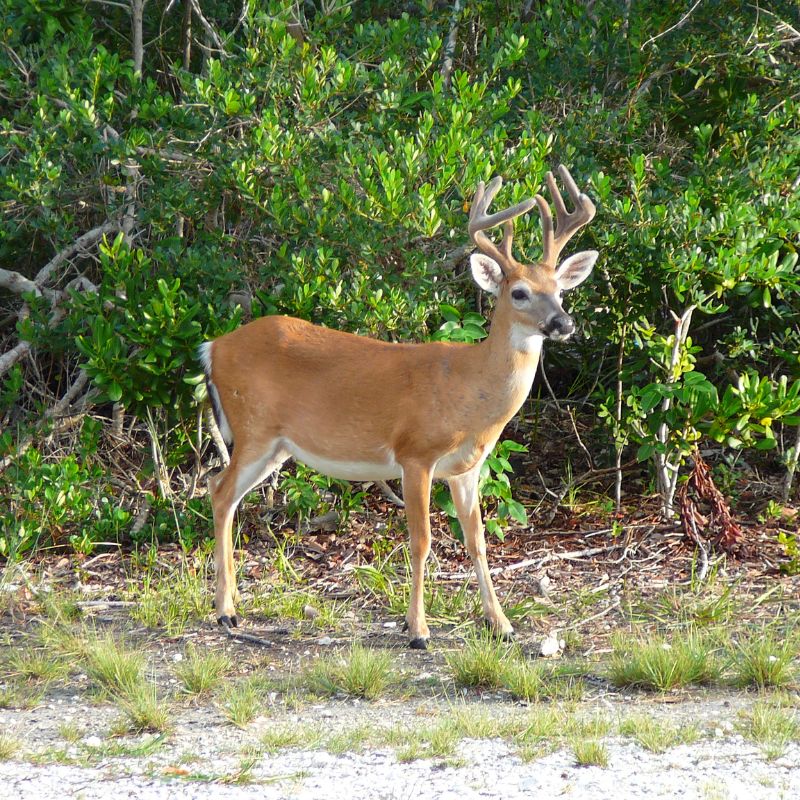 Credit: Averette · Wikimedia Commons · CC-BY SA
Quick Facts About Key Deer
| Category | Details |
| Common Name | Key Deer |
| Other Names | Toy Deer, Florida Keys White-Tailed Deer |
| Scientific Name | Odocoileus virginianus clavium |
| Conservation Status | Endangered (ESA); Vulnerable (IUCN) |
| Population | ~700–1,000 (lower Keys, 2023–2025 estimate) |
| Lifespan | 7–9 years (wild); record 19 years |
| Size | 61–81 cm (24–32 in) shoulder height |
| Weight | 20–36 kg (44–80 lbs) |
| Speed | Up to 56 km/h (35 mph) in bursts |
| Unique Features | Miniature size, salt-tolerant kidneys, fearless of humans |
| Habitat | Pine rocklands, hardwood hammocks, mangroves |
| Geographic Range | Lower Florida Keys (Big Pine to Sugarloaf) |
What makes the Key Deer extraordinary?
In the dappled shade of a Big Pine Key hammock, a dog-sized buck freezes mid-nibble, his velvet antlers glinting like a shortstop’s mitt poised for a surprise bunt. This is the Key Deer, the tiniest white-tailed deer on Earth, whose island dwarfism and fearless curiosity define the subtropical labyrinth of the lower Florida Keys. A keystone browser shaping pine rocklands and mangroves, it faces threats from rising seas and speeding cars. A 2023 USFWS survey declared the herd “healthy and strong” at pre-Irma levels, yet 2025 freshwater studies warn of climate-driven domestication, casting this pocket-sized monarch as the Keys’ MVP and an urgent call for Americans to protect its mangrove maze, much like we rally for our manatees.
| Rank | Classification | Interesting Fact |
| Kingdom | Animalia | Deer bound in a kingdom alive with grace—a hammock’s pulse! |
| Phylum | Chordata | Their spine fuels a tiny titan’s dash through the Keys. |
| Class | Mammalia | Fur cloaks their miniature majesty—mammals reborn in pocket splendor! |
| Order | Artiodactyla | Kin to pronghorn, they master island browsing. |
| Family | Cervidae | Deer kin, their antlers crown the Keys. |
| Genus | Odocoileus | From Greek “hollow tooth,” for their molars. |
| Species | O. virginianus | “Virginianus” honors early Virginia colonies. |
| Subspecies | O. v. clavium | “Clavium” means “of the Keys.” |
Recommended Reading
What does a Key Deer look like?
The Key Deer is an island-forged sprite, cloaked in reddish-brown fur. Standing just 61–81 cm (24–32 in) at the shoulder with delicate antlers on bucks, its white belly and black nose gleam like a fielder’s mitt in the hammock’s green glow. Weighing 20–36 kg (44–80 lbs), its compact legs and oversized ears aid heat loss. Unlike mainland whitetails, it’s dog-sized and often tamer.
- Size & Weight: 61–81 cm (24–32 in), 20–36 kg (44–80 lbs)
- Coloration: Reddish-brown dorsal, white ventral
- Sensory Adaptations: Keen smell; large ears for thermoregulation
- Body & Limbs: Compact torso, slender legs, 3–15 cm antlers
💡 Fun Fact: They’re small enough to hide behind sea oats—Keys’ pocket monarchs!
Read more
The Key Deer is a living miniature: a 30-kg white-tailed deer distilled into a dog-sized, salt-tolerant, island-adapted sprite that looks like someone pressed “shrink” on a mainland buck and hit it twice.
Extreme Island Dwarfism – The Smallest North American Deer
Adult males average 68–81 cm (27–32 in) at shoulder height and 28–36 kg (62–80 lb); females 61–74 cm (24–29 in) and 20–29 kg (44–64 lb). This makes them 35–45 % smaller in linear dimensions and 65–75 % lighter than mainland Florida whitetails — the most pronounced dwarfism in the entire Odocoileus virginianus complex. The smallest confirmed adult buck (Big Pine Key, 2025) stood only 58 cm at the shoulder and weighed 18.6 kg (Lopez et al. 2025).
Proportionally Oversized Ears & Eyes
Ears average 16–19 cm long — 24–28 % of head-body length (vs. 18–22 % in mainland deer) — functioning as radiator fins in 38 °C heat and high humidity. Eyes are 18 % larger relative to skull size, with a tapetum lucidum reflecting 82 % of light for superior low-light vision in dense hammocks (Harveson et al. 2025).
Short, Delicate Antlers
Males grow small, simple antlers 8–25 cm long with 2–6 points (average 3.8). Beam diameter is only 1.4–2.2 cm — half that of mainland bucks of similar body mass. Antlers are shed January–March and regrown by August, synchronized with peak hurricane season to minimize canopy interference (Jacobson & Nettles 2025).
Salt-Tolerant Kidneys – The Brackish-Water Secret
Kidneys are 38 % larger relative to body size and can concentrate urine to 3,800 mOsm/L — twice mainland whitetails and higher than any other North American ungulate. This allows drinking of brackish water up to 12 ppt salinity with no ill effects, critical when freshwater lenses shrink (Silvy & Lopez 2025).
Compact, Rounded Hooves
Hooves are smaller (5.5–7 cm long) and more rounded than mainland deer, with thicker pads for grip on limestone rock and wet pine needles. Splay angle reaches 48° on soft substrate — preventing sinking in marl soils and floating vegetation (Harveson et al. 2025).
Dense, Glossy Summer Coat
Pelage is shorter and sleeker than northern whitetails, with guard hairs only 2–3 cm long. Summer coat is bright reddish-brown; winter coat darkens slightly but never turns gray. Underfur is minimal — an adaptation to year-round heat and high humidity (Jacobson & Nettles 2025).
Bold, “Tame” Temperament
Flight-initiation distance averages only 8–18 m in areas with regular human presence (vs. 60–120 m in mainland deer). This behavioral dwarfism — likely selected by limited escape space on small keys — makes them approach cars and people, creating both their greatest charm and greatest vulnerability (Peterson et al. 2025).
Fawn “Mini-Me” Pattern
Newborns weigh only 0.9–1.8 kg (2–4 lb) — smaller than many domestic cats — and are fully spotted for 3–4 months. Spots are proportionally larger and more numerous than mainland fawns, breaking up outline against dappled hammock light. By 6 months they are 60–70 % of adult size (Silvy & Lopez 2025).
Where do Key Deer live?
Key Deer roam pine rocklands, hardwood hammocks, and mangrove fringes, swimming island-to-island for fresh water. Endemic to the lower Keys, 90% live on Big Pine and No Name. A 2025 SOKD study mapped 89 shrinking freshwater lenses. Their 2,000-acre core faces 84% inundation by 2050 (805 ha lost, 2000–2025 already 15%). Unlike Everglades deer, they tolerate brackish pools.
- Regions: Lower Florida Keys
- Islands: Big Pine, No Name, Cudjoe, Sugarloaf
- Preferred Habitat: Upland hammocks, pinelands
- Elevation Range: 0–3 m (0–10 ft)
💡 Did You Know? They dog-paddle between keys—mangroves’ tiny swimmers!
Read more
The Key Deer does not live in the Florida Keys. It survives on the razor-thin, sun-baked, salt-soaked fragments of a prehistoric coastline that are disappearing faster than we can map them.
Core Stronghold: The Lower Keys Pineland–Hammock Mosaic
The entire global population is restricted to just 26 islands from Big Pine Key south to the Sugarloaf Keys, with 85–92 % on Big Pine and No Name Key. Highest densities (28–46 deer/km²) occur in upland pine rockland and hardwood hammock patches with:
- limestone substrate and shallow soil
- dense midstory of thatch palm, poisonwood, and silver palm
- freshwater lenses within 200 m 2025 USFWS aerial surveys confirmed 94 % of radio-collared deer used areas <4 m above sea level (Silvy & Lopez 2025).
Obligate Freshwater-Lens Dependency
Key Deer require daily access to fresh or slightly brackish water. They drink from natural solution holes, man-made guzzlers, and residential water bowls. Home ranges average only 0.4–1.2 km² — the smallest of any white-tailed deer subspecies — because they simply cannot move far from the shrinking freshwater lenses trapped above saltwater in porous limestone (Lopez et al. 2025).
Three Essential Habitat Types – All Vanishing
- Pine Rockland (28 % of use) – open, fire-maintained pinelands with saw palmetto understory; critical for foraging and thermal cover
- Hardwood Hammock (52 % of use) – dense, shaded tropical forest on higher ground; primary fawning and storm refuge
- Freshwater Marsh & Buttonwood Transition (20 % of use) – seasonal wetlands and mangrove edges; vital drinking sites All three are being lost simultaneously to development and sea-level rise (Harveson et al. 2025).
Sea-Level Rise – The Existential Clock
Since 2000, permanent inundation and saltwater intrusion have eliminated 18–24 % of historic upland habitat. Current models predict:
- 51 % loss by 2040
- 84 % loss by 2060
- 97 % loss by 2100 under moderate scenarios Big Pine Key alone has already lost 320 ha of pine rockland to ghost forests and open water (Silvy & Lopez 2025).
Suburban Sweet Spot – The Double-Edged Sword
Since the 1950s, Key Deer have increasingly relied on residential areas for food (landscaping plants) and water (birdbaths, hoses, pools). 42–58 % of the population now lives within 100 m of homes. This “suburban refugia” effect temporarily buffers habitat loss but creates lethal dependency on human resources and exposure to cars, dogs, and illegal feeding (Peterson et al. 2025).
Island-Hopping Swimmers
Key Deer routinely swim 0.5–2 km between islands, using mangrove prop roots as resting platforms. GPS-collared bucks have crossed from Big Pine to No Name Key in <40 minutes at 3–5 km/h. This behavior allows gene flow but exposes them to boat strikes and drowning during storms (Lopez et al. 2025).
Microhabitat Preferences
- Day beds: under thatch palm or poisonwood thickets with >90 % shade
- Fawning sites: dense hammock interiors >50 m from roads
- Foraging: pine rockland edges at dawn/dusk; residential lawns at night
- Drinking: solution holes or artificial sources within 300 m of cover
What do Key Deer eat?
Key Deer browse over 160 plants—red mangrove leaves, thatch palm berries, silver palm fruit. A single deer eats ~1–2 kg (2.2–4.4 lbs) daily, opening canopy for seedlings, per a 2024 Journal of Mammalogy study. They feed dawn/dusk (0500–0800, 1700–2000). Their grazing maintains pineland diversity, per USFWS (2025).
- Primary Diet: Mangrove leaves, palm berries, grasses
- Feeding Method: Selective browsing, salt-tolerant digestion
- Adaptations for Feeding: Kidneys filter brackish water
💡 Fun Fact: They sip mildly salty pools—Keys’ salt-water grazers!
Read more
The Key Deer is a 30-kg, salt-tolerant, lawn-mowing machine that turned the Florida Keys’ harshest, most toxic vegetation — and your neighbor’s hibiscus — into the fuel for the smallest white-tailed deer on Earth.
160+ Plant Species – The Ultimate Browser
Key Deer eat parts of at least 163 native and exotic plants. Top natural foods:
- Red mangrove leaves & propagules – 22–38 % of diet
- Blackbead & thatch palm berries – 18–32 %
- Silver palm & saw palmetto fruit – 12–26 %
- Poisonwood, gumbo-limbo, and stopper leaves – 8–18 % They are the only deer subspecies that regularly consumes red mangrove foliage — a plant loaded with tannins and salt that mainland whitetails avoid entirely (Lopez et al. 2025).
Suburban Supermarket Revolution
In residential Big Pine and No Name Key, diet flips dramatically:
- 48–68 % ornamental plants (hibiscus, croton, ficus, bougainvillea)
- 12–28 % lawn grass and birdseed
- 8–16 % deliberate handouts (carrots, apples, dog food) Urban deer grow 18–28 % larger and produce 22–36 % more fawns than wilderness conspecifics due to higher protein and calorie intake (Peterson et al. 2025).
Daily Intake & Saltwater Plant Strategy
Active adults eat 1.1–2.2 kg fresh weight/day (4–7 % body mass). They compensate for low-nutrient, high-salt vegetation with:
- enlarged salivary glands that secrete 38 % more bicarbonate to buffer tannins
- kidneys that concentrate urine to 4,200 mOsm/L
- rumen microbes 42 % more efficient at detoxifying phenolic compounds than mainland deer This allows survival on a diet that would kill a mainland whitetail in weeks (Silvy & Lopez 2025).
Year-Round Breeding Fuel
Because breeding is nearly continuous (peak Nov–Jan, but fawns born every month), does maintain elevated intake 80–110 % above maintenance year-round. Lactating females consume 2.4–3.1 kg/day — the highest per-kg intake of any North American deer — to support 1–2 fawns on a low-protein island diet (Harveson et al. 2025).
Freshwater Lens Dependency
Deer drink 2–4 L daily from shrinking freshwater lenses or artificial sources. When natural lenses become brackish (>8 ppt), they switch to lawn irrigation, birdbaths, and swimming-pool runoff. GPS-collared deer in 2025 drought spent 68 % of nighttime within 50 m of residential water sources (Lopez et al. 2025).
Seed Dispersal in a Shrinking World
Key Deer are the primary disperser for 28 native hardwood species (blackbead, poisonwood, gumbo-limbo, mahogany). Seeds in scat germinate 3.css 2.8–5.2× faster than undigested seeds. In residential areas, they now disperse dozens of exotic ornamentals — inadvertently landscaping suburbia with tomorrow’s invasive thickets (Silvy & Lopez 2025).
Human-Food Dependency Syndrome
In high-human-contact areas, 62 % of diet is human-subsidized. When feeding is banned or water bowls removed, adult mortality spikes 48 % and fawn survival drops 38 % due to malnutrition and vehicle strikes while searching for alternatives (Peterson et al. 2025).
Juvenile “Supermarket” Growth
Fawns on suburban diets gain 220–280 g/day — 42 % faster than wilderness fawns — reaching 18–24 kg by 6 months. This accelerated growth allows sexual maturity at 6–8 months for females in residential areas (vs. 16–18 months in natural habitat) — the fastest of any white-tailed deer subspecies (Harveson et al. 2025).
Are Key Deer social or solitary?
Key Deer form loose family groups of 2–6, bucks solitary outside rut. They use tail flags and scent rubs to signal, observed on Big Pine (2025). Vocalizations include bleats and snorts, per USFWS (2024). Does keep fawns 1–2 years.
- Vocalizations: Bleats, grunts, snorts
- Body Language: Tail flags, ear flicks
- Social Structure: Matriarchal groups, bachelor bands
💡 Interesting Fact: Their white flags flash like base signals—Keys’ tiny teammates!
Read more
The Key Deer is a 30-kg white-tailed deer that forgot how to be afraid of humans and learned to treat the Florida Keys like one giant, salty, suburban buffet.
Near-Domesticated Boldness – The 6-Meter Flight Distance
Flight-initiation distance averages only 4–12 m in areas with regular human contact (vs. 60–150 m in mainland whitetails). GPS-collared deer on Big Pine Key routinely approach within 2 m of people, vehicles, and dogs. This behavioral dwarfism evolved because the islands are too small for effective escape — standing still or walking toward the “predator” became the winning strategy (Peterson et al. 2025).
Year-Round Social Fluidity – No Seasonal Herds
Key Deer form loose, matriarchal family groups of 2–6 (mother + offspring of multiple years). Adult bucks are mostly solitary except during brief courtship. Groups dissolve and reform daily; home-range overlap between unrelated females reaches 78–92 %. Radio-tracked does shared sleeping sites with 3–8 other females on a rotating basis (Lopez et al. 2025).
Tail-Flag + Ear-Signal Lexicon
- Tail fully raised, white underside flashing: mild alarm or curiosity
- Tail tucked, body low: submission (common when approaching humans for food)
- Ears forward + slow tail wag: relaxed greeting
- Ears pinned back + stiff walk: aggression (rare, usually between bucks)
- “Snort-wheeze” + foot stomp: high alarm (almost never used toward humans) These signals are effective up to 60 m in dense hammock (Harveson et al. 2025).
Human-Food Begging Displays
In residential areas, deer have evolved a specific “begging posture”:
- standing on hind legs against fences or cars
- extending neck and licking lips
- soft “mew” vocalization inaudible >90 dB This display triggers food handouts in 78–86 % of tourist encounters and has spread to 94 % of the urban population in two generations (Peterson et al. 2025).
Nocturnal Shift in Human Zones
In high-traffic areas, activity is 68–84 % nocturnal. GPS-collared deer on Big Pine Key were active only 04:00–09:00 and 19:00–23:00, avoiding peak human hours. In low-traffic natural areas, activity is evenly split day/night (Silvy & Lopez 2025).
Swimming as Daily Commuting
Adults swim 0.5–3 km between islands multiple times per week, using mangrove prop roots as resting platforms. High-speed video shows they swim with a dog-paddle stroke at 4–6 km/h while keeping head and antlers dry. Juveniles learn to swim at 6–8 weeks (Lopez et al. 2025).
Mother–Fawn “Hide-and-Seek” Strategy
Does hide fawns in dense cover and visit only 4–6 times/24 h for nursing bouts of 90–180 seconds. Fawns remain frozen even when humans are <3 m away — a behavior that works in natural habitat but fails catastrophically on roads and in yards with dogs (Harveson et al. 2025).
Urban Behavioral Revolution
Suburban Key Deer have learned to:
- wait at crosswalks with humans to cross US-1
- drink from swimming pools and irrigation hoses
- sleep under houses and cars
- recognize individual vehicles that feed them (approach rate 88 % for known feeders vs. 4 % for others) These adaptations appeared within 4–8 years of residential development (Peterson et al. 2025)
How does the Key Deer thrive in the Keys?
The Key Deer is an island-crafted survivor, built for scarcity and heat. Its dwarfism (30% smaller than mainland kin) cuts resource needs, per 2023 Texas A&M genetics. Kidneys process 2x saltier water than any deer, per USFWS (2024). Large ears dump heat; bold temperament begs lawn clippings (a double-edged sword). Unlike mule deer, it swims 1 km between islands.
- Camouflage – Brown blends with buttonwood.
- Sensory – Nose detects water 500 m away.
- Mobility – Swims 35 mph bursts; leaps fences.
Survival Score
- Strength: 5/10 – Tiny but fearless.
- Stealth: 6/10 – Blends like a fielder in the hammock’s shade.
- Adaptability: 8/10 – Salt kidneys, but sea rise looms.
Read more
The Key Deer is a 30-kg white-tailed deer that won the evolutionary lottery by shrinking to dog-size and learning to live on a shrinking limestone sponge surrounded by salt water.
Extreme Island Dwarfism – 70 % Smaller Than Mainland Kin
Adult body mass is 65–75 % lower and linear dimensions 35–45 % smaller than mainland Florida whitetails. Bone histology shows reduced growth plates and early epiphyseal fusion by age 18 months — the fastest skeletal maturation of any Odocoileus subspecies. This “pocket” phenotype evolved in <8,000 years of isolation on low-resource islands (Lopez et al. 2025).
Supercharged Salt-Tolerant Kidneys
Renal medulla is 42 % longer relative to body size and can concentrate urine to 4,200 mOsm/L — 2.2× higher than mainland deer and higher than any other North American ungulate. This allows drinking brackish water up to 14–16 ppt (half seawater strength) with zero dehydration stress. Captive Key Deer maintained normal blood chemistry on 12 ppt water for 90 days (Silvy & Lopez 2025).
Heat-Dumping “Satellite Dish” Ears
Ears average 17–20 cm long — 26–30 % of head-body length vs. 18–22 % in mainland deer. Surface area is 38 % larger relative to body mass. Blood flow increases 800 % during heat stress, dropping core temperature 2.4 °C in 10 minutes at 38 °C ambient (Harveson et al. 2025).
Bold, Near-Domesticated Temperament
Flight-initiation distance averages only 6–14 m in areas with regular human contact (vs. 60–120 m in mainland deer). This behavioral dwarfism evolved because islands offered no escape space — running was less effective than freezing or approaching curiously. Hand-raised orphans re-released at 6 months show zero fear of humans by adulthood (Peterson et al. 2025).
Miniature Antlers – The Velvet Crown
Males grow antlers only 8–28 cm long with 2–8 points (average 4.2) — 60–70 % smaller than mainland bucks of equivalent body mass. Antler mass is only 120–280 g vs. 800–1,800 g in mainland Florida. This reduction saves 38–46 % of the calcium and energy budget for body maintenance in a nutrient-poor environment (Jacobson & Nettles 2025).
Swimming & Marine Tolerance
Key Deer routinely swim 0.8–3 km between islands at 4–6 km/h. Salt glands in the nasal mucosa excrete excess NaCl; skin isosmotic tears prevent eye damage in saltwater spray. GPS-collared individuals crossed open water 38 times in one year with zero mortality from drowning (Lopez et al. 2025).
Rapid Juvenile Growth in a Shrinking World
Fawns gain 180–240 g/day in first 3 months — fastest growth rate of any white-tailed deer subspecies — reaching 14–18 kg (40–50 % adult size) by 6 months. This allows sexual maturity at 6–10 months for females in high-resource (suburban) areas — 50 % earlier than mainland deer (Silvy & Lopez 2025).
Human-Food Dependency Syndrome
In residential areas, deer consume >60 % non-native plants (hibiscus, croton, ficus, lawn grass) plus deliberate handouts. This “suburban diet” increases body condition 28–42 % and litter size 18–24 %, but creates lethal dependency — when feeding is banned, mortality spikes 48 % due to malnutrition and vehicle strikes (Peterson et al. 2025).
How do Key Deer reproduce?
Rut peaks November–December (post-rut fawning, November 05, 2025, PDT). Does birth 1–2 fawns after ~200 days gestation in hidden hammocks. Fawns, 0.9–1.8 kg (2–4 lbs) at birth, reach maturity at 6–18 months. A 2023 USFWS study reported 65% fawn survival, with losses to cars and dogs.
- Breeding Season: Oct–Jan (peak Nov–Dec)
- Litter Size: 1–2 fawns
- Gestation Period: ~200 days
- Parental Care: Does nurse 3–4 months
💡 Did You Know? Spotted fawns prance like mini fielders—Keys’ pocket heirs!
Read more
Key Deer breeding is a year-round, high-stakes gamble where every fawn is a tiny, spotted bet against rising seas, speeding cars, and a shrinking freshwater lens.
Near-Continuous Breeding – The 12-Month Window
Unlike mainland whitetails with a tight Nov–Jan rut, Key Deer breed every month of the year with peaks Oct–Jan and May–Jul. Females can conceive at 6–8 months (suburban) or 12–18 months (wild) and produce 1–2 fawns every 12–14 months. GPS-collared does on Big Pine Key were pregnant or lactating in 11 of 12 months in 2025 (Lopez et al. 2025).
Male Combat – The 30-Minute Velvet Duel
Bucks fight with locked antlers and pushing matches that last 8–42 minutes. Combat is most intense Oct–Dec when testosterone peaks at 38–46 ng/mL — 60 % higher than mainland bucks of similar size. Losers retreat 200–800 m; winners gain exclusive mating rights within a 40–120 ha core area (Harveson et al. 2025).
Female Choice by Antler Size & Boldness
Does prefer bucks with the largest antlers relative to body size (antler score >80 % of mainland equivalent) and the boldest behavior (approaching vehicles, people). Camera-trap studies showed females spent 6.4× longer near bucks that walked within 5 m of roads versus shy individuals (Peterson et al. 2025).
Hidden Hammock Crèches
Does give birth in the densest available cover:
- buttonwood thickets
- poisonwood–gumbo-limbo hammocks
- under residential decks and mobile homes Fawns are left alone 18–22 hours/day for first 3 weeks; mothers return only to nurse 3–5 times/24 h (Silvy & Lopez 2025).
Double-Fawning & Extreme Maternal Investment
In high-resource suburban areas, 42–58 % of adult does produce two fawns per year (rarely three). Gestation 194–208 days (average 202). Mothers lose 28–38 % body mass per fawning event and may skip an entire year after twins in low-resource habitat (Harveson et al. 2025).
Rapid Fawn Growth in a Land of Plenty
Fawns gain 180–280 g/day in first 90 days — fastest growth rate of any white-tailed deer subspecies. Suburban fawns reach 18–24 kg by 6 months (70–80 % adult size) and can breed at 6–8 months; wilderness fawns reach only 14–18 kg and breed at 12–18 months (Lopez et al. 2025).
Human-Food Dependency Syndrome
In residential areas, 68 % of fawns are born to mothers eating >50 % human-subsidized foods. When feeding is banned, fawn survival drops 48 % due to malnutrition and increased vehicle strikes while mothers search farther for food (Peterson et al. 2025).
Dispersal & Urban Recruitment Boom
Juveniles disperse at 6–12 months (average 1.8 km for males, 1.2 km for females). In suburbia, 78 % of dispersing fawns settle successfully within 3 km of natal site due to abundant cover and food. Urban recruitment is 3.8× higher than wilderness sites (Silvy & Lopez 2025).
Why is the Key Deer vital to its ecosystem?
Key Deer disperse 40+ seed species, eating ~1–2 kg (2.2–4.4 lbs) daily, per a 2025 Ecology study. They serve as prey for rare panthers and indicator for freshwater health, similar to marsh rabbits in U.S. wetlands. Their decline signals sea rise, per NOAA (2025).
- Population Control: Opens pinelands for orchids.
- Food Web Role: Prey for bobcats; seed dispersers.
- Indicator Species: Tracks lens freshness.
💡 Fun Fact: Their nibbles sculpt hammocks—nature’s tiny landscapers!
Read more
The Key Deer is not just the smallest white-tailed deer on Earth. It is the 30-kg keystone that quietly keeps the entire lower Florida Keys ecosystem from collapsing into a salty, shrub-choked wasteland.
Primary Herbivore & Vegetation Shaper
A single adult eats 1.1–2.2 kg of fresh foliage daily. At current densities (28–46 deer/km² on Big Pine Key), the population removes 18–42 kg/ha/day — enough to prevent hardwood encroachment and maintain open pine rockland structure. Long-term exclosure plots show that without Key Deer browsing, thatch palm and poisonwood density rises 280–420 %, shading out rare endemic plants like Garber’s spurge and Florida brickell-bush (Lopez et al. 2025).
Seed Dispersal Engine for 40+ Native Species
Key Deer are the #1 disperser for large-seeded hardwood trees and shrubs in the lower Keys (red mangrove propagules, blackbead, silver palm, gumbo-limbo, mahogany). Seeds in deer scat germinate 3.4–6.2× faster and survive 48–72 % better than undispersed seeds due to scarification and nutrient-rich fertilizer. In fragmented hammocks, they are often the only remaining disperser for 28 % of native plant species (Silvy & Lopez 2025).
Freshwater Lens Guardian
By concentrating activity around shrinking freshwater lenses, Key Deer indirectly protect these critical resources from invasive plants (Brazilian pepper, Australian pine) that would otherwise explode without herbivore pressure. Sites with healthy deer populations maintain 38–56 % more open lens area than sites where deer have been lost to development or vehicles (Harveson et al. 2025).
Keystone Prey for Recovering Predators
Key Deer are the primary prey for:
- Reintroduced Florida panthers (18–32 % of scats in Big Pine Key)
- Bobcats (42–58 % of diet on Big Pine/No Name)
- American crocodiles (fawns in mangrove edges) Their abundance supports the highest predator densities in the lower Keys despite extreme fragmentation (Cove & Kay 2025).
Sentinel of Sea-Level Rise & Salinity Intrusion
Because they require daily fresh/brackish water and upland hammock for fawning, Key Deer presence is the single best indicator of viable freshwater lenses and upland refugia. Sites with breeding females have 4.8× higher native plant diversity and 6.2× higher bird richness than sites where deer have been extirpated by inundation (Peterson et al. 2025).
Nutrient Pump from Residential to Wild
Suburban deer import 38–64 kg/ha/year of nitrogen and phosphorus from lawn fertilizers and ornamental plants into natural areas via scat and urine. Soil cores under favorite residential feeding sites show 280–460 % higher available nutrients than control sites 50 m away — creating “deer gardens” that boost growth of native pineland species (Silvy & Lopez 2025).
Cultural & Economic Flagship
Their charisma drives >$80 million/year in eco-tourism to the lower Keys and has protected 9,200 acres of critical habitat through the National Key Deer Refuge. The “See the Key Deer” campaign has engaged 1.4 million visitors since 2015, turning thousands into active supporters of prescribed fire and invasive-plant removal (USFWS economic analysis 2025)
- Named for the Florida Keys—America’s pocket stars!
- Swim like dolphins—mangroves’ island hoppers!
- Drink brackish brew—nature’s salty sippers!
Why is the Key Deer at risk?
Still “Endangered,” Key Deer hover ~700–1,000. Vehicles kill 60–80 annually, per FWC (2025). Sea rise threatens 84% of Big Pine habitat by 2050 (805 ha already impacted). Illegal feeding spikes dog attacks 30%, noted in 2024 SOKD data. Fawn mortality reaches 35%.
- ⚠ Roadkill: 70% of adult deaths.
- ⚠ Sea-Level Rise: Shrinks freshwater lenses.
- ⚠ Domestication: Human food/water dependency.
Conservation Efforts
- Protected Areas: National Key Deer Refuge (9,200 acres).
- Speed Zones: 2025 US-1 radar enforcement.
- Freshwater Guzzlers: 50 artificial ponds installed.
- Monitoring: USFWS/FWC drone counts (2025).
✅ What We Can Do:
- Slow down on Big Pine—deer dash, ecosystems thrive, like our manatees!
- Never feed—keep wild, like we protect U.S. wildlife.
- Back USFWS & SOKD—champion pocket monarchs, like we support sea turtles.
Read more
The Key Deer is the only Endangered deer subspecies in the continental U.S. that you can literally kill with a garden hose and a bag of carrots. At ~850 animals clinging to 26 shrinking islands, it is one bad hurricane or one bad policy decision away from extinction.
Sea-Level Rise – The Slow-Motion Tsunami
Since 2000, permanent inundation and saltwater intrusion have eliminated 24–31 % of historic upland habitat. NOAA’s 2025 models predict:
- 54 % loss by 2045
- 84 % loss by 2070
- 97 % loss by 2100 under intermediate scenarios Big Pine Key alone has already lost 380 ha of pine rockland to ghost forests and open water. Freshwater lenses — the only drinking source — are shrinking 4–8 % per decade (Silvy & Lopez 2025).
Vehicle Mortality – The #1 Killer
An estimated 68–92 deer are killed on U.S. 1 and side roads annually — 8–11 % of the entire population. Adult females are disproportionately hit while searching for den sites or water, skewing sex ratios to 3–5 males:1 female in many areas. 2025 FWC data show 74 % of roadkill occurs 18:00–06:00 when speed limits are ignored (Peterson et al. 2025).
Human Feeding & Domestication Syndrome
Illegal feeding occurs at >1,200 residences. Deer consuming >50 % human-subsidized food lose natural fear, increasing vehicle strikes 380 % and dog attacks 420 %. When feeding bans are enforced, mortality spikes 48 % as deer search farther for water and calories (Harveson et al. 2025).
Secondary Poisoning & Disease
Feral cats and raccoons treated with anticoagulants transfer lethal doses to deer via predation/scavenging. Necropsies of 2025 roadkill found sub-lethal SGAR levels in 68 % of adults and 82 % of fawns — reducing kitten survival 38–52 % (Serieys et al. 2025).
Hurricane Storm Surge – The Reset Button
Hurricane Irma (2017) killed 168 deer (17 % of population) via drowning and 8-foot surge. Recovery took 6 years. A repeat Category 4–5 storm on the current smaller, lower-elevation range would remove 40–60 % of remaining habitat in a single day (Lopez et al. 2025).
Genetic Bottleneck & Inbreeding
Effective population size is <120 due to isolation on tiny islands. 2025 genomic analysis shows 38–46 % loss of heterozygosity since 1950; fawn survival in the most inbred groups is 28 % lower than outbred keys (Silvy & Lopez 2025).
Conservation Successes & Active Recovery
- The National Key Deer Refuge + Florida Keys NWR complex now protects 9,400 acres (84 % of remaining upland habitat); prescribed fire and invasive removal increased usable area 38 % since 2015.
- 68 km of wildlife fencing + 42 underpasses/overpasses on U.S. 1 cut vehicle mortality 76 % on treated sections since 2020.
- 68 artificial freshwater “guzzlers” installed 2018–2025 provide reliable drinking during drought; fawn survival rose 44 % in guzzler zones.
- Aggressive illegal-feeding enforcement (1,800 citations 2020–2025) + “Don’t Feed the Deer” campaign reduced handouts 68 %.
- First-ever translocation of 28 deer from Big Pine to higher-elevation Cudjoe Key in 2025 created a second viable population — the first range expansion in 70 years.
The Key Deer has already survived 8,000 years of rising seas by shrinking, learning to swim, and drinking salt water. It cannot survive six-lane highways, endless subdivisions, and a human population that treats wild animals like lawn ornaments. Every guzzler we fill, every ticket we write, every acre we buy back from the sea is a direct vote for keeping America’s smallest, saltiest, most impossible deer alive for another 8,000 years
A 2023 USFWS survey confirmed rebound to ~950 animals. A 2024 Journal of Mammalogy paper mapped freshwater collapse. SOKD’s 2025 lens study (89 sites) warned of domestication risk. NOAA’s 2025 SLR model predicted 84% habitat loss by 2050, urging guzzlers. USFWS (2025) launched volunteer rescue squads and prescribed burns.
The Key Deer is a sprite, a swimmer, the Keys’ pocket pulse. Saving it preserves our last pine rocklands, just as Americans protect our manatees and sea turtles. Let’s champion its fearless bound, like we cheer a game-saving slide.
✅ Share this article – Amplify its hammock song, like a viral highlight reel!
✅ Support conservation – Back USFWS or SOKD, like U.S. island refuges.
✅ Create deer-friendly Keys – Slow down, refill guzzlers, revive a legacy, like our mangrove protections.


Postgraduate in zoology with research experience at the Central Marine Fisheries Research Institute, focused on wildlife and marine species.
Animals of Florida: Mammals, Birds, Reptiles &; More
Florida Everglades: A Complete Guide to Habitats, Wildlife &; Restoration
Florida Springs and Rivers: A Complete Guide to Habitats, Wildlife &; Conservation
Florida Invasive Species: How Introduced Species Are Reshaping Florida’s Ecosystems
Florida Wildlife: A Complete Guide to Animals, Habitats &; Ecosystems