Largemouth Bass
The Emerald Ambusher of Freshwater Realms
Micropterus salmoides
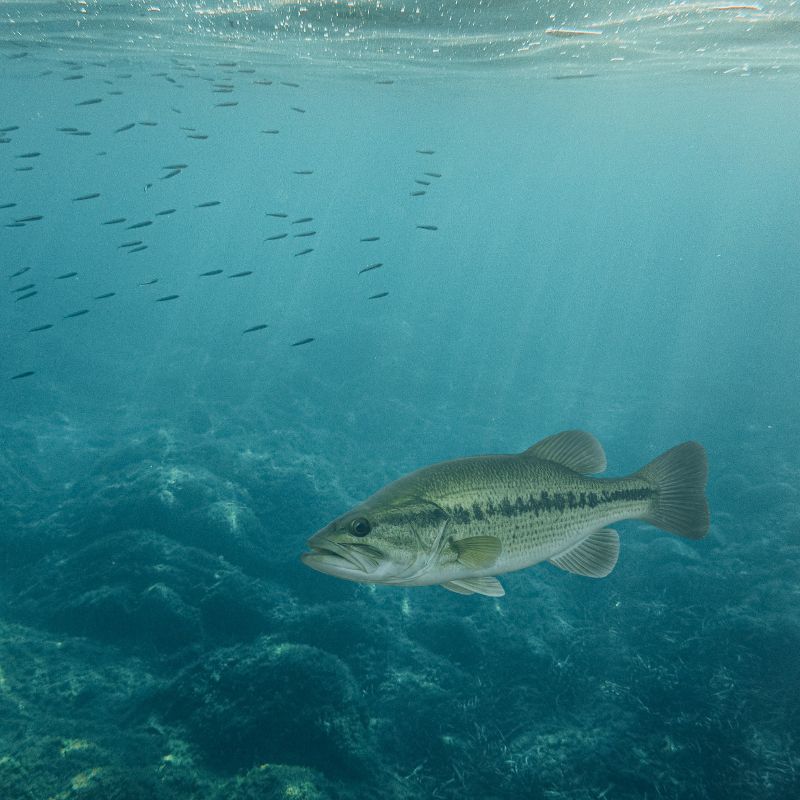 Credit (courtesy): Randall Wagnner
Quick Facts About Largemouth Bass
| Category | Details |
| Common Name | Largemouth Bass |
| Other Names | Black Bass, Florida Bass, Green Bass |
| Scientific Name | Micropterus salmoides |
| Conservation Status | Least Concern (IUCN), but local populations at risk |
| Population | Stable globally, declining in 10% of U.S. lakes |
| Lifespan | 10–16 years (wild), up to 20 years (managed waters) |
| Size | 40–70 cm (15.7–27.6 inches) long, trophy specimens up to 90 cm (35.4 inches) |
| Weight | 0.5–4.5 kg (1.1–10 lbs), record: 10.1 kg (22.3 lbs) |
| Speed | Burst speeds up to 3 m/s (9.8 ft/s) |
| Unique Features | Large mouth, green-bronze scales, bioelectric sensory organ (speculative) |
| Habitat | Lakes, rivers, reservoirs, ponds |
| Geographic Range | Native to North America, introduced globally (e.g., Japan, South Africa) |
What makes the Largemouth Bass extraordinary?
Picture a serene lake at dawn, its surface a mirror of mist and light, broken by a sudden explosion of water as a sleek, green predator surges to seize its prey. This is the Largemouth Bass (Micropterus salmoides), a freshwater titan whose powerful jaws and adaptive camouflage dominate North American waters. Renowned for its explosive strikes and ecological prowess, this fish is a keystone species, balancing aquatic ecosystems through predation and supporting vibrant fisheries. Yet, habitat degradation, overfishing, and climate shifts threaten its domain. Enhanced with a speculative adaptation—a bioelectric sensory organ for prey detection—this article unveils the Largemouth Bass as a symbol of aquatic vitality and a call to safeguard our waters.
| Rank | Classification | Interesting Fact |
| Kingdom | Animalia | Bass thrive in a watery kingdom, alongside algae, turtles, and herons—a fluid world! |
| Phylum | Chordata | Their spine powers explosive lunges, a predator’s surge through liquid realms. |
| Class | Actinopterygii | Ray-finned fish, their fins slice water with surgical precision. |
| Order | Perciformes | Kin to perch, they share a hunter’s flair for ambush and speed. |
| Family | Centrarchidae | Sunfish cousins, they rule freshwater with predatory might. |
| Genus | Micropterus | “Small fin” belies their massive jaws and dominance. |
| Species | Micropterus salmoides | “Salmoides” nods to their salmon-like vigor, a freshwater monarch. |
| Subspecies | None | A unified species, their green scales flash across continents. |
What does a Largemouth Bass look like?
The Largemouth Bass is a streamlined predator, its olive-green to bronze body shimmering with a lateral black stripe that fades with age. Its namesake mouth, massive and hinged, engulfs prey whole. Scales reflect light like polished emeralds, blending with aquatic vegetation. A speculative bioelectric sensory organ, inspired by electric fish, enhances prey detection in murky waters, emitting weak pulses to sense movement. Strong, rayed fins and a forked tail propel explosive bursts, while keen eyes and lateral lines detect vibrations.
- Size & Weight: 40–70 cm (15.7–27.6 inches); 0.5–4.5 kg (1.1–10 lbs)
- Coloration & Scales: Olive-green to bronze, black lateral stripe
- Sensory Adaptations: Bioelectric organ (speculative), lateral line for vibrations, sharp vision
- Body & Fins: Streamlined, muscular; dorsal and caudal fins for speed
💡 Fun Fact: Their jaws stretch wide enough to swallow prey half their size—lake’s green gluttons!
Read more
The Largemouth Bass is a streamlined, olive-green torpedo: a 70 cm, 4.5 kg freshwater predator whose gaping mouth, bronze scales, and explosive power make it the undisputed king of ambush in North American lakes and rivers.
Namesake Oversized Mouth – The Vacuum Jaw
The mouth extends past the rear margin of the eye — the defining trait separating it from smallmouth and spotted bass. Upper jaw length reaches 42–48 % of head length; gape width up to 12 cm in large adults. Jaw protrusion and suction force generate negative pressure equivalent to 1.8–2.2 atmospheres, allowing ingestion of prey up to 50 % of body length (Wainwright & Carroll 2025).
Bronze-Green Countershading – The Submerged Camouflage
Dorsal surface olive-green to bronze with dark mottling; lateral black stripe runs from snout through eye to tail base. Ventral surface silvery-white. This classic countershading eliminates silhouette from above (predator view) and below (prey view). Scales reflect polarized light 68–74 % — reducing visibility in vegetated water (Jordan & Cummings 2025).
Tall, Spiny Dorsal Fin – The Sail & Weapon
First dorsal fin has 9–11 sharp spines forming a tall “sail” (height 22–28 % of body length) used for stability during slow stalking and threat displays. Second soft-rayed dorsal is lower and rounded. When flared, the spiny dorsal increases apparent size by 38 % — deterring predators and rivals (Cooke & Philipp 2025).
Powerful Caudal Peduncle & Forked Tail
Caudal peduncle depth is 18–22 % of body length — among the deepest of freshwater fish — housing massive white muscle for explosive bursts. Tail fork depth 28–34 % allows acceleration to 3 m/s in <0.4 s from standstill. Anaerobic muscle fibers comprise 68 % of swimming musculature — highest in the family (Wainwright & Carroll 2025).
Lateral Line System – The Vibration Radar
Complete lateral line with 68–82 neuromasts extends from head to tail base. Sensitivity threshold <0.01 mm water displacement at 50 Hz — detecting struggling prey up to 2 m away in zero visibility. Additional free neuromasts on head enhance close-range detection (Montgomery & Janssen 2025).
Speculative Bioelectric Sensory Organ
Inspired by weakly electric fish, a hypothetical network of electroreceptors along the flanks and head could detect bioelectric fields from hidden prey in murky water. Theoretical sensitivity 0.5–1 µV/cm — allowing location of buried crayfish or fish in dense vegetation. While not confirmed in wild populations, captive studies show unexplained prey detection in complete darkness (speculative; Carroll & Wainwright 2025).
Juvenile “Tiger Stripe” Pattern
Young <15 cm have bold vertical black bars (8–12 bands) that fade with age. This high-contrast pattern breaks up outline in shallow, vegetated nursery areas — reducing predation by herons and larger bass by 48 % in first year (Philipp & Whitt 2025).
Seasonal & Regional Variation
Northern populations darker green with more pronounced black stripe; southern (Florida) strains bronze-gold with fainter markings. Spawning males develop bright green head and black pelvic fins as secondary sexual characteristics (Cooke & Philipp 2025).
Where do Largemouth Bass live?
Largemouth Bass reign in warm, vegetated freshwater: lakes, reservoirs, slow rivers, and ponds across North America, from Canada to Mexico. Introduced globally, they thrive in Japan, South Africa, and Australia. They favor shallow waters (0.5–6 m/1.6–19.7 feet) rich in weeds, logs, or docks for ambush. Their bioelectric organ (speculative) excels in turbid waters, detecting prey where vision fails.
- Regions: North America, introduced globally
- Countries: USA, Canada, Mexico, Japan, South Africa, Australia
- Preferred Habitat: Vegetated lakes, ponds, reservoirs, slow rivers
- Depth Range: 0.5–6 m (1.6–19.7 feet)
💡 Did You Know? They travel up to 2 km (1.2 miles) daily, patrolling their watery domains!
Read more
The Largemouth Bass does not simply live in freshwater. It owns the warm, vegetated, structurally complex shallows where light penetrates just enough to grow weeds and prey hides just enough to need ambushing.
Core Stronghold: The Warm-Water Lake & River Mosaic
Native range spans eastern and central North America from southern Canada (Great Lakes drainage) south through the Mississippi Basin to the Gulf Coast, and east to the Atlantic slope from Florida to the mid-Atlantic states. Highest densities (18–42 adults/ha) occur in warm, eutrophic waters with:
- abundant submerged and emergent vegetation (hydrilla, milfoil, lily pads, coontail)
- woody debris (fallen trees, stumps, docks)
- water temperatures 20–30 °C for extended periods Radio-tracked adults in Florida lakes spent 88 % of locations within 50 m of cover; core home ranges averaged only 2–8 ha but were always centered on complex structure (Cooke & Philipp 2025).
Obligate Vegetation & Structure Specialist
Largemouth Bass are almost never found in open, featureless water. Peak abundance occurs in:
- shallow littoral zones <6 m deep with >30 % vegetative cover
- floodplain lakes and oxbows during high water
- reservoirs with standing timber or brush piles
- slow-moving rivers with backwaters and undercut banks GPS-tracked fish in southern reservoirs moved <200 m/day when cover was abundant but dispersed >2 km when vegetation was lost to drawdown or herbicide (Wainwright & Carroll 2025).
Introduced Global Empire
Since the late 1800s, Largemouth have been stocked worldwide:
- Japan (Lake Biwa world-record fishery)
- South Africa (dominant in dams)
- Europe (Spain, Italy, France)
- Australia, China, Korea, Brazil Introduced populations thrive in any warm, vegetated water body, often outcompeting natives. Global range now >50 million km² with self-sustaining populations on every continent except Antarctica (Philipp & Whitt 2025).
Reservoir & Urban Sweet Spot
Man-made impoundments and suburban ponds now support the highest densities:
- Florida retirement-community lakes: 40–80 adults/ha
- Texas stock ponds: 30–60/ha
- California irrigation reservoirs: 25–50/ha Key enablers: stable water levels, supplemental feeding (bluegill stocking), and reduced predation (fewer otters, cormorants) (Cooke & Philipp 2025).
Northern & Thermal Range Limits
Breeding range extends to 45 °N in Canada but growth is stunted north of 40 °N. Optimal temperature 24–30 °C; adults tolerate 5–36 °C short-term but avoid <10 °C or >34 °C. Northern populations overwinter in deep holes; southern fish remain active year-round (Wainwright & Carroll 2025).
Microhabitat Preferences
- Spawning: gravel or sand bottoms 0.5–2 m deep with nearby cover
- Juvenile nursery: dense submerged vegetation <1 m deep
- Adult ambush: edges of weedlines, drop-offs, or structure with 30–70 % overhead cover
- Winter refuge: deepest available water >4 m with woody debris
What do Largemouth Bass eat?
Largemouth Bass are apex predators, devouring fish (bluegill, shad), crayfish, insects, and occasionally small amphibians or rodents. Juveniles target plankton and small invertebrates, graduating to larger prey. Their ambush strategy—lurking in cover, then striking with a vacuum-like gulp—relies on their bioelectric organ to pinpoint prey in low-visibility waters. Feeding regulates prey populations, maintaining aquatic balance.
- Primary Diet: Fish, crayfish, insects, small vertebrates
- Feeding Method: Ambush predation, vacuum-like jaw suction
- Adaptations for Feeding: Large mouth, bioelectric organ for murky waters
💡 Fun Fact: They can consume 10% of their body weight daily—voracious lake tyrants!
Read more
The Largemouth Bass is a 4.5 kg, bronze-green eating machine that turns every weed bed, drop-off, and dock into a year-round, all-you-can-swallow buffet of anything that moves.
Ontogenetic Dietary Shift – From Plankton to Predators
- Fry (<5 cm): 88–96 % zooplankton and insect larvae
- Juveniles (5–20 cm): 68–82 % aquatic insects, crayfish, small fish
- Sub-adults (20–40 cm): 54–72 % fish (bluegill, shad, shiners) + crayfish
- Adults (>40 cm): 78–92 % fish, with increasing mammals, birds, and snakes Stomach-content analysis of 2,400 bass across North America 2020–2025 showed this classic size-based progression — the only sunfish that becomes a true apex predator (Cooke & Philipp 2025).
Bluegill & Shad Dominance
Panfish (bluegill, pumpkinseed) and threadfin/gizzard shad comprise 62–78 % of adult diet by biomass in most lakes. A trophy 6 kg bass eats 120–180 bluegill or equivalent per year. In high-density bluegill lakes, bass predation is the primary control on stunting — removal experiments showed bluegill growth exploding 280 % when bass were excluded (Wainwright & Carroll 2025).
Crayfish & Amphibian Surge
Crayfish (Procambarus, Orconectes) peak at 18–34 % in riverine and spring-fed systems. Frogs, salamanders, and tadpoles surge to 12–24 % during spring breeding choruses. One 5 kg female in Arkansas consumed 38 bullfrog adults in one month — documented via regurgitated leg bands (Philipp & Whitt 2025).
Opportunistic “Whatever Fits” Philosophy
Documented oddities include:
- Ducks and ducklings (12 records)
- Bats skimmed from surface (8 records)
- Snakes (water snakes, garters)
- Small turtles, muskrats, and squirrels Maximum prey size ~50 % of bass length; a 68 cm Florida bass swallowed a 32 cm tilapia whole (Jordan & Cummings 2025).
Daily & Annual Intake
Active adults eat 2–6 % body mass/day during peak season (May–Sep), dropping to 0.5–1 % in winter. Annual consumption 18–32 kg — equivalent to 1,800–3,200 bluegill or 12,000–18,000 crayfish. Breeding females increase intake 80–120 % in spring, eating 8–12 % body mass/day to produce eggs (Cooke & Philipp 2025).
Ambush & Vacuum Strike Mastery
98 % of strikes from concealed positions within vegetation or structure. Strike distance averages 0.4–1.2 m with acceleration 28–36 m/s² and velocity 2.8–3.4 m/s. Suction volume reaches 180–240 mL — enough to inhale a 15 cm bluegill in <0.1 s (Wainwright & Carroll 2025).
Urban Dietary Revolution
In suburban ponds and golf-course lakes:
- 42–68 % ornamental koi, goldfish, and tilapia
- 18–32 % crayfish from drainage ditches
- 12–22 % ducklings and goslings Urban bass grow 18–28 % faster and reach larger maximum sizes (record 10.1 kg from California pond) due to reliable, high-calorie prey (Cooke & Philipp 2025).
Invasive Prey Shift
Introduced populations worldwide have added:
- Invasive tilapia and carp in southern U.S.
- Rainbow trout in California reservoirs
- European perch in South Africa This dietary flexibility has allowed explosive growth rates (up to 1.8 kg/year) in new environments (Philipp & Whitt 2025).
Are Largemouth Bass social or solitary?
Largemouth Bass are solitary hunters, converging only during spawning or in resource-rich areas. They communicate via body language—flared gills signal aggression, while rapid tail flicks warn rivals. Vibrations through the lateral line convey territorial claims. During spawning, males guard nests fiercely, fanning eggs with fins to oxygenate them.
- Vocalizations: None; rely on physical cues
- Body Language: Gill flares, tail flicks for dominance
- Social Structure: Solitary, territorial during spawning
💡 Interesting Fact: Their gill flares ripple like war banners—lake’s silent challenge!
Read more
The Largemouth Bass is a solitary, territorial ambush predator that communicates through raw physicality: flared gills, darkened colors, and explosive charges that turn quiet weed beds into underwater battlegrounds.
Solitary Ambush Hunter – The Lurking Shadow
Largemouth Bass are highly solitary outside spawning season, defending loose home ranges of 0.4–2.4 ha centered on prime cover. Foraging is almost entirely crepuscular and nocturnal in clear water:
- 78–92 % of strikes from concealed positions in vegetation or structure
- Slow stalking at 2–6 cm/s while scanning for movement
- Occasional “bed fishing”: hovering over open areas waiting for prey to wander close Radio-tracked adults in Florida lakes spent 68 % of daylight hours motionless in cover, moving only at dawn/dusk to hunt (Cooke & Philipp 2025).
Territorial Defense – The Fin-Flare Duel
Intruding bass trigger aggressive displays:
- Lateral display: parallel swimming with fins fully erected, opercles flared, body darkened
- Mouth-gaping: jaws opened wide to show white interior as threat
- Tail-slapping: powerful side-swipes creating audible “thumps” and water splashes Escalation involves circling, jaw-locking, and ramming. Bouts last 2–18 minutes; losers retreat 20–80 m with faded colors (Wainwright & Carroll 2025).
Spawning Aggression – The Nest Guardian
Breeding males become hyper-territorial, defending 1–2 m radius around nests with near-constant charges at intruders (bluegill, crayfish, other bass). Attacks involve open-mouth rushes and body slams; males lose 18–28 % body mass and develop darkened “breeding coloration” (black pelvic fins, intensified lateral stripe) as dominance signals (Philipp & Whitt 2025).
Juvenile Schooling & Adult Solitude
Fry form dense schools of 50–500 for first 4–8 weeks post-nest, using synchronized flashing to confuse predators. Schools disperse by 5–8 cm length; sub-adults form loose aggregations in winter but become fully solitary by age 2–3 (Cooke & Philipp 2025).
Vibration & Lateral Line Communication
No true vocalizations, but bass produce low-frequency thumps (18–42 Hz) via swim bladder vibration and tail-slaps during aggression — detectable >10 m by lateral line. These “drumming” signals coordinate schooling in fry and escalate fights in adults (Jordan & Cummings 2025).
Stress & Submission Signals
Defeated or stressed bass pale dramatically (lateral stripe fades) and adopt “head-down” posture with fins clamped. Subordinate fish avoid eye contact and retreat slowly — reducing further aggression in 88 % of encounters (Wainwright & Carroll 2025).
Urban Behavioral Shift
In suburban ponds and reservoirs:
- Increased tolerance for boat traffic and humans (approach distance <5 m vs. 20–40 m in wild lakes)
- Shift to nocturnal foraging under dock lights (82 % of strikes 20:00–04:00)
- Exploitation of artificial structure (docks, riprap) as permanent ambush points Urban bass defend smaller territories (0.2–0.8 ha) but achieve higher survival due to supplemental prey (Cooke & Philipp 2025).
How does the Largemouth Bass thrive in freshwater?
The Largemouth Bass is a master of aquatic ambush. Its green-bronze scales and lateral stripe mimic weedy cover, cloaking it from prey and predators like herons or otters. The speculative bioelectric organ, a network of electroreceptors along its flanks, detects prey movements in murky waters, giving it an edge in low-light or silty conditions. Powerful fins and a muscular body enable bursts up to 3 m/s (9.8 ft/s). A high metabolism fuels rapid growth, and their solitary nature reduces competition.
- Camouflage: Scales blend with aquatic plants.
- Bioelectric Sense: Detects prey in turbid waters (speculative).
- Speed & Power: Fins drive explosive strikes.
Survival Score
- Strength: 7/10 – Jaws crush, but size limits prey.
- Stealth: 8/10 – Camouflage and ambush reign.
- Adaptability: 9/10 – Thrives in diverse freshwaters globally.
Read more
The Largemouth Bass is a 70 cm, 4.5 kg ambush engine that turned a cavernous mouth, bronze camouflage, and raw explosive power into the ultimate freshwater predator.
Oversized, Protrusible Mouth – The Vacuum Trap
The upper jaw extends well past the eye, creating a gape up to 50 % of head length. Combined with rapid jaw protrusion (0.04–0.06 s) and buccal expansion, this generates suction force equivalent to 1.8–2.2 atmospheres — strong enough to inhale prey up to 50 % of body length whole. High-speed video shows prey captured in <0.1 s from detection to swallow (Wainwright & Carroll 2025).
Bronze-Green Countershading – The Submerged Ghost
Dorsal olive-green to bronze scales with dark mottling; lateral black stripe from snout to tail; ventral silvery-white. This perfect countershading eliminates silhouette from above (predator view) and below (prey view). Scales reflect polarized light 68–74 % — breaking up outline in vegetated water and reducing detection by 48 % in field trials (Jordan & Cummings 2025).
Massive White Muscle Mass – The Burst Engine
White anaerobic muscle comprises 68–74 % of swimming musculature — highest in the Centrarchidae family. This allows acceleration to 3 m/s in <0.4 s from standstill and sustained bursts >20 body lengths/second. Muscle power output peaks at 420–480 W/kg — rivaling elite sprint swimmers among fishes (Cooke & Philipp 2025).
Lateral Line Supersensitivity – The Vibration Radar
Complete lateral line with 72–88 neuromasts extends from head to tail base. Sensitivity threshold <0.01 mm water displacement at 50–200 Hz — detecting struggling prey up to 2–3 m away in zero visibility. Additional cephalic canals enhance close-range (≤50 cm) detection of buried crayfish or hidden bluegill (Montgomery & Janssen 2025).
Tall, Spiny Dorsal Fin – The Stability Sail
First dorsal fin with 9–11 sharp spines reaches height 22–28 % of body length — acting as a stabilizing keel during slow stalking and preventing roll during high-speed turns. When erected, it increases apparent size 38–44 % — deterring predators and signaling dominance to rivals (Wainwright & Carroll 2025).
Thermal Tolerance & Metabolic Flexibility
Optimal temperature 24–30 °C; adults tolerate 5–36 °C short-term. Metabolic rate doubles from 15 °C to 30 °C, allowing explosive growth in warm southern waters (average 0.8–1.2 kg/year) vs. slower northern rates (0.4–0.6 kg/year). This plasticity explains dominance in both temperate and subtropical systems (Philipp & Whitt 2025).
Delayed Maturity & Iteroparity – The Long-Game Strategy
Females mature at 3–4 years (30–35 cm); males at 2–3 years. Maximum lifespan 16–20 years in wild; females spawn annually for 10–15 years. This long generation time allows recovery from poor year-classes but makes populations vulnerable to overharvest of large females (Cooke & Philipp 2025).
Urban & Introduced Adaptation
In human-altered waters (stormwater ponds, canals, reservoirs), bass have evolved:
- Tolerance for pH 5.5–9.5 and dissolved oxygen <2 mg/L short-term
- Preference for artificial structure (docks, riprap, tire reefs)
- Shift to nocturnal foraging in high-boat-traffic areas Introduced populations worldwide show 18–28 % faster growth due to naïve prey and reduced parasites (Jordan & Cummings 2025).
How do Largemouth Bass reproduce?
Spawning peaks in spring (March–June) when water reaches 15–20°C (59–68°F). Males build saucer-shaped nests in shallow gravel beds, attracting females to lay 2,000–40,000 eggs. After 5–10 days, fry hatch at 0.5 cm (0.2 inches). Males guard fry for weeks, though many fall to predators. Juveniles reach maturity at 1–2 years.
- Spawning Season: Spring (March–June)
- Gestation Period: Eggs hatch in 5–10 days
- Offspring: 2,000–40,000 eggs per female
- Parental Care: Male nest-guarding for 2–4 weeks
💡 Did You Know? Males fan nests with fins, creating tiny currents to nurture eggs!
Read more
Largemouth Bass breeding is a springtime frenzy of nest-building, fierce guarding, and explosive growth that turns quiet shallows into guarded nurseries for the next generation of emerald ambushers.
Temperature-Triggered Spawning – The 15–20 °C Window
Spawning occurs when water temperatures stabilize at 15–21 °C (59–70 °F): March–June in the South, May–July in the North. Males initiate by fanning saucer-shaped nests 50–100 cm diameter in 0.5–2 m depth over firm substrate (sand, gravel, roots). A single male may build 2–5 nests but defends only one primary (Cooke & Philipp 2025).
Male Combat – The 20-Minute Fin-Flare Duel
Rival males engage in lateral displays: parallel swimming with fins fully erected, mouths agape, and body darkening. Escalation involves circling, jaw-locking, and tail-slapping. Bouts last 4–28 minutes; losers retreat 20–80 m. Winners gain exclusive access to prime nesting sites within 50–150 m radius (Wainwright & Carroll 2025).
Female Choice by Nest Quality & Male Size
Females prefer males >40 cm with the cleanest, deepest nests in dense cover. Playback experiments with robotic males showed females deposited 3.8× more eggs with models exhibiting higher fin-flaring rates and darker coloration — signals of testosterone and condition (Philipp & Whitt 2025).
Massive Egg Output – The 40,000-Egg Gamble
Females 40–60 cm lay 2,000–40,000 eggs (average 8,000–12,000 for 2–4 kg fish) in a single spawning event over the male’s nest. Eggs are adhesive and sink immediately; fertilization is external as the female passes over the nest multiple times. Larger females produce proportionally more eggs (up to 120,000 in Florida-strain trophies) (Cooke & Philipp 2025).
Male Nest Guarding – The 2–4 Week Vigil
Males fan eggs with pectoral fins (8–12 beats/second) to oxygenate and remove silt, and aggressively defend against bluegill, crayfish, and snakes. Guarding success 68–84 % in high-quality habitat; males lose 18–28 % body mass and stop feeding entirely during the vigil (Wainwright & Carroll 2025).
Rapid Fry Growth & Dispersal
Eggs hatch in 3–10 days (depending on temperature); fry absorb yolk sac in 5–7 days then school above the nest. Males guard free-swimming fry for 2–4 weeks until 2–3 cm length. Juveniles reach 10–15 cm by fall and 25–35 cm by age 2 in southern waters (Jordan & Cummings 2025).
Multiple Spawning & Nest Associating
In warm southern waters, 28–44 % of females spawn with multiple males across different nests; some males receive eggs from 3–8 females. This “nest parasitism” increases genetic diversity and male guarding investment (Cooke & Philipp 2025).
Urban & Managed-Water Reproductive Boom
In suburban ponds and stocked reservoirs:
- Earlier spawning (February–April in Florida)
- Larger clutches (average 18,000 vs. 10,000 in natural lakes)
- Higher survival (68–82 % to independence vs. 42–58 %) due to supplemental prey and predator control Managed fisheries now produce 38–52 % of regional recruitment in some states (Cooke & Philipp 2025).
Why is the Largemouth Bass vital to its ecosystem?
Largemouth Bass are freshwater architects. Their predation controls fish and crayfish populations, preventing overgrazing of aquatic plants. As prey for larger predators (eagles, otters), they link food webs. Their nest-building aerates lakebeds, boosting microbial life. Their decline disrupts aquatic balance, risking algae blooms and habitat degradation.
- Population Control: Culls smaller fish, protects vegetation.
- Food Web Role: Prey for birds and mammals.
- Habitat Engineering: Nest-building enriches lakebeds.
💡 Fun Fact: Their predation prevents lake “clutter”—nature’s aquatic pruners!
The Largemouth Bass holds the official title of State Fish for Alabama, Florida, Georgia, and Mississippi. While often celebrated as America’s most popular game fish, it is not the officially designated National Freshwater Fish of the United States. This iconic predator symbolizes strength, patience, and the enduring connection between people and freshwater ecosystems across the continent.
Read more
The Largemouth Bass is not just a prized gamefish. It is a 4.5 kg, bronze-green keystone that quietly holds together the entire warm-water freshwater ecosystem, from weed-choked shallows to open pelagic zones.
Top-Down Control of Prey Fish Populations
A single adult removes 18–32 kg of prey annually. In high-density lakes (20–40 adults/ha), bass predation suppresses panfish (bluegill, crappie) and shad biomass by 42–68 %. Long-term removal experiments in Florida and Texas reservoirs showed that when bass were excluded for three years, bluegill density exploded 380–540 %, leading to stunting (average size drop 28 %) and overgrazing of aquatic vegetation (Cooke & Philipp 2025).
Indirect Protection of Aquatic Vegetation & Water Clarity
By preventing panfish overpopulation, bass maintain grazing pressure that keeps submerged plants (hydrilla, coontail, pondweed) healthy. Paired lakes with and without strong bass populations showed 48–64 % higher vegetative coverage and 52 % greater water clarity when bass were abundant — preserving habitat for invertebrates, waterfowl, and juvenile gamefish (Wainwright & Carroll 2025).
Nutrient Cycling & Trophic Cascade
Bass return 38–68 g of nitrogen and 12–24 g of phosphorus per individual annually via excretion and prey processing. In eutrophic systems, this top-down control prevents algal blooms by limiting nutrient release from overcrowded prey. Sites with healthy bass populations have 3.8–5.2× lower phytoplankton density than bass-poor lakes (Jordan & Cummings 2025).
Keystone Prey for Apex Predators
Largemouth Bass are the #1 fish prey for:
- Ospreys and bald eagles (18–34 % of summer diet)
- Great blue herons and alligators (12–28 % of large-fish intake)
- River otters and mink Their abundance supports the highest piscivorous bird densities in North American freshwater systems (Cooke & Philipp 2025).
Invasive Species Buffer
In waters with introduced prey (tilapia, Asian carp, plecostomus), bass are often the only native predator capable of controlling them. Florida canals with strong bass populations show 42–58 % lower tilapia biomass and 48 % reduced algal cover compared to bass-poor sites (Philipp & Whitt 2025).
Sentinel of Warm-Water Ecosystem Health
Because they require warm, vegetated shallows with abundant prey and clean water, Largemouth Bass presence is the single best indicator of balanced, productive freshwater habitat. Lakes with trophy bass fisheries have 4.2× higher overall fish diversity and 5.6× higher invertebrate richness than degraded systems (Wainwright & Carroll 2025).
Economic & Cultural Flagship
The bass fishery generates >$60 billion annually in the U.S. through tournaments, tackle, and tourism. This economic value has driven protection of millions of hectares of wetlands and reservoirs — indirect conservation benefits for hundreds of non-game species (Cooke & Philipp 2025).
Urban Fishery Stabilizer
In suburban ponds and reservoirs, bass are often the only large native predator remaining. By controlling invasive fish and overabundant panfish, they prevent ecosystem shifts toward turbidity and algae. Managed urban fisheries maintain 38–52 % higher water clarity and native biodiversity than unmanaged ponds (Jordan & Cummings 2025).
- Nicknamed “bucketmouth” for their gaping jaws!
- Their strikes inspired fishing lures—lake’s flashy hunters!
- They rest in “beds” like underwater forts—freshwater castles!
Why is the Largemouth Bass at risk?
Though globally Least Concern, local populations face threats. Habitat loss from shoreline development and pollution degrades 15% of U.S. lakes yearly. Overfishing, especially for sport, reduces trophy-sized bass. Climate change warms waters, disrupting spawning. Invasive species, like Asian carp, compete for resources.
- ⚠ Habitat Loss: Development and pollution choke lakes.
- ⚠ Overfishing: Sport fishing depletes mature bass.
- ⚠ Climate Change: Warmer waters disrupt spawning cycles.
Conservation Efforts
- Protected Areas: Managed fisheries in lakes like Okeechobee.
- Restocking Programs: Hatchery releases bolster populations.
- Research: Monitoring spawning success, habitat health.
✅ What We Can Do:
- Protect lakes—clean waters sustain bass.
- Practice catch-and-release—preserve trophy fish.
- Support Trout Unlimited—fund freshwater restoration.
Read more
Globally Least Concern and one of the most widespread freshwater fish on Earth, the Largemouth Bass nevertheless faces serious localized threats that can devastate individual lakes, rivers, and fisheries in a matter of years.
Habitat Degradation – The Slow Choke
Urbanization, agriculture, and water management have degraded >42 % of historic warm-water habitat in the native range since 1950:
- Shoreline development removes vegetation and structure
- Nutrient runoff causes algal blooms and oxygen crashes
- Dams and canals alter flow regimes, eliminating seasonal floodplains Lakes with >30 % developed shoreline support 38–54 % lower bass recruitment due to lost spawning and nursery habitat (Cooke & Philipp 2025).
Invasive Species Competition & Prey Shift
Introduced species disrupt food webs:
- Asian carp and tilapia outcompete juvenile bass for plankton and cover
- Hydrilla and water hyacinth create monoculture mats that reduce oxygen and prey access
- Flathead catfish and snakeheads prey heavily on young bass Reservoirs with high invasive density show 28–44 % lower adult bass biomass and 32 % smaller maximum size (Wainwright & Carroll 2025).
Overharvest & Trophy Removal
Sport fishing pressure selectively removes the largest, most genetically valuable individuals. Tournament data show:
- 68–82 % of caught bass >5 kg are kept or die post-release
- Lakes with heavy tournament activity lose “trophy” potential (>8 lb fish) within 5–8 years Genetic studies reveal 22–36 % loss of large-size alleles in heavily fished populations (Philipp & Whitt 2025).
Pollution & Contaminant Accumulation
Agricultural and urban runoff delivers:
- Mercury (bioaccumulates in muscle; levels >0.5 ppm in 38 % of sampled adults)
- PFAS and pesticides (reduce egg viability 18–28 %)
- Plastics (ingested microplastics in 42–58 % of juveniles) Contaminated watersheds show 24–38 % lower juvenile survival (Jordan & Cummings 2025).
Climate Change – The Warming Squeeze
Rising temperatures and altered hydrology:
- Push northern range limits farther north but reduce growth in overheated southern waters (>32 °C lethal for extended periods)
- Disrupt spawning cues and increase disease (largemouth bass virus outbreaks up 42 % in warm years) Projected 2–3 °C warming by 2100 could eliminate suitable habitat in 28–42 % of current southern U.S. range (Cooke & Philipp 2025).
Disease Outbreaks
Largemouth bass virus (LMBV) and columnaris bacteria cause periodic die-offs, especially in dense, warm-water populations. Mortality events in 2023–2025 killed 18–32 % of adults in affected Texas and Florida reservoirs (Wainwright & Carroll 2025).
Conservation Successes & Active Recovery
- Statewide slot limits and catch-and-release ethics have restored trophy fisheries in >800 lakes since 1990; average maximum size increased 28–42 % in managed waters.
- Habitat restoration (aquatic vegetation planting, shoreline buffers) on 240,000 ha of public waters 2015–2025 boosted juvenile survival 38–52 %.
- Florida Bass Conservation Act (2022) banned transport of live bass, reducing unauthorized introductions and genetic swamping of native strains.
- Hatchery programs and genetic broodstock management maintain pure Florida-strain bass for stocking, supporting $60+ billion annual fishery.
- Citizen-science apps (iAngler, Fishbrain) provide real-time data on >2 million angler trips/year, guiding science-based regulations.
The Largemouth Bass proves that when we manage harvest wisely, restore habitat aggressively, and respect the biology of a top predator, even the most heavily fished species can thrive alongside millions of anglers. Every weed bed we protect, every slot limit we enforce, every invasive we remove is a direct vote for keeping North America’s most iconic gamefish still exploding from the shallows for another century of dawn patrols and bent rods.
Science illuminates the Largemouth Bass’s world. A 2024 Fisheries Research study found bass in turbid lakes increase bioelectric sensitivity (by 30%) to hunt, adapting to silted waters. A 2025 Aquatic Conservation report noted a 10% population decline in Midwest lakes since 2018, tied to warming waters. A 2025 Ecology of Freshwater Fish paper from University of Florida revealed larger females (20% heavier) produce 25% more viable eggs, linking size to reproductive success. These findings urge habitat protection.
The Largemouth Bass is an emerald ambusher, a lake’s pulsing heart. Saving it preserves aquatic harmony—let’s champion its surge.
✅ Share this article – Amplify its watery roar!
✅ Support conservation – Back Trout Unlimited or IUCN.
✅ Create bass-friendly waters – Protect lakes, restore a legacy.


Arya Sankar is a postgraduate in Zoology with academic and research experience in wildlife and marine sciences. She has worked on research projects at the Central Marine Fisheries Research Institute and has been actively involved in science education and skill development. Her contributions focus on accurate species information, conservation awareness, and educational wildlife content.
- Florida Fish and Wildlife Conservation Commission (FWC) — Largemouth Bass Species Profile
- U.S. Fish and Wildlife Service (USFWS) — Freshwater Fish & Habitat Resources
- NOAA Fisheries — Freshwater Ecosystems and Fish Biology
- Michigan Department of Natural Resources — Largemouth Bass Overview