Puma
The Silent Stalker of the Americas
Puma concolor
Quick Facts About Puma
| Category | Details |
|---|---|
| Common Name | Puma |
| Other Names | Mountain Lion, Cougar, Panther |
| Scientific Name | Puma concolor |
| Conservation Status | Least Concern (IUCN) |
| Population | 50,000 (estimated) |
| Lifespan | 8–13 years (wild), up to 20 years (captivity) |
| Size | 5–9 feet long (1.5–2.7 meters) |
| Weight | 100–200 lbs (45–90 kg) |
| Speed | Up to 80 km/h (50 mph) |
| Unique Features | Slender body, powerful legs, tawny coat |
| Habitat | Mountains, forests, deserts |
| Geographic Range | North and South America |
What makes the Puma unique?
The Puma (Puma concolor), also known as the mountain lion or cougar, is a highly adaptable and elusive predator, known for its powerful build, stealth, and wide geographic range. It thrives in diverse habitats like mountains, forests, and deserts, playing a crucial role in maintaining ecological balance by controlling prey populations. However, habitat loss, hunting, and human-wildlife conflict threaten its survival, making conservation efforts critical.
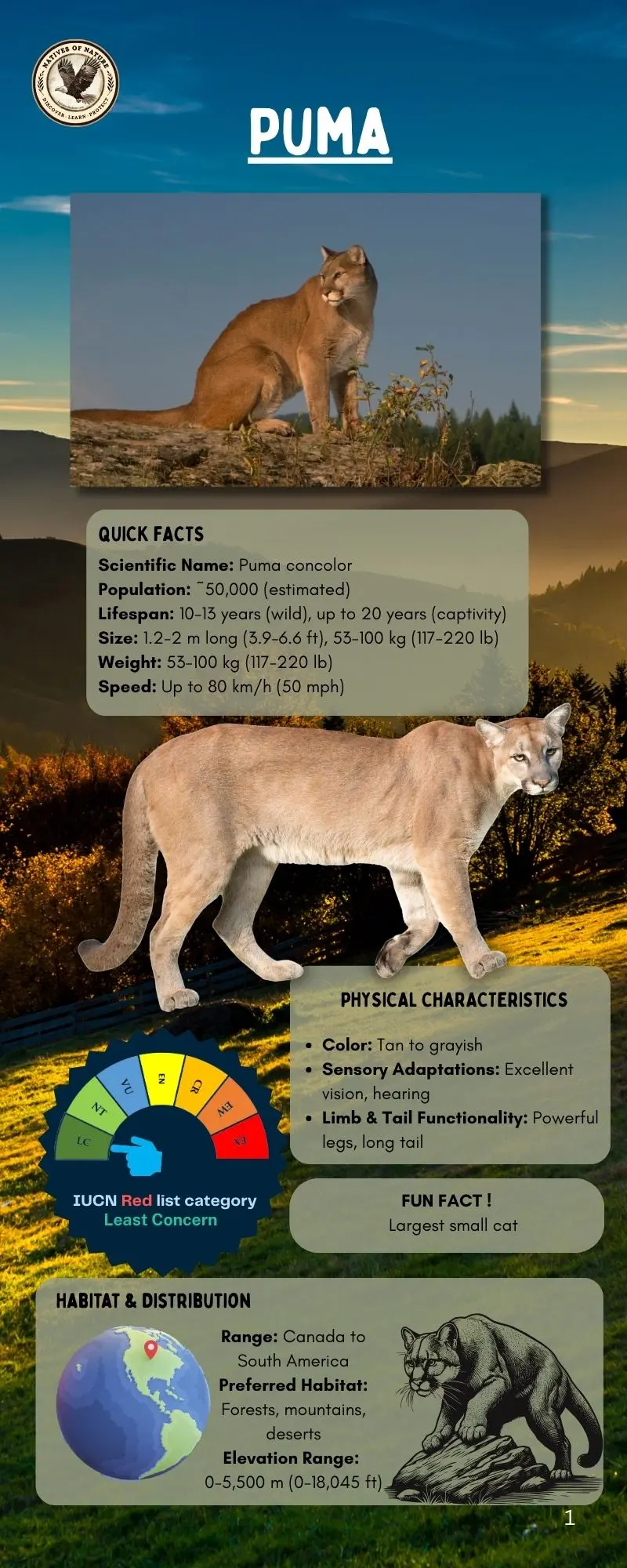
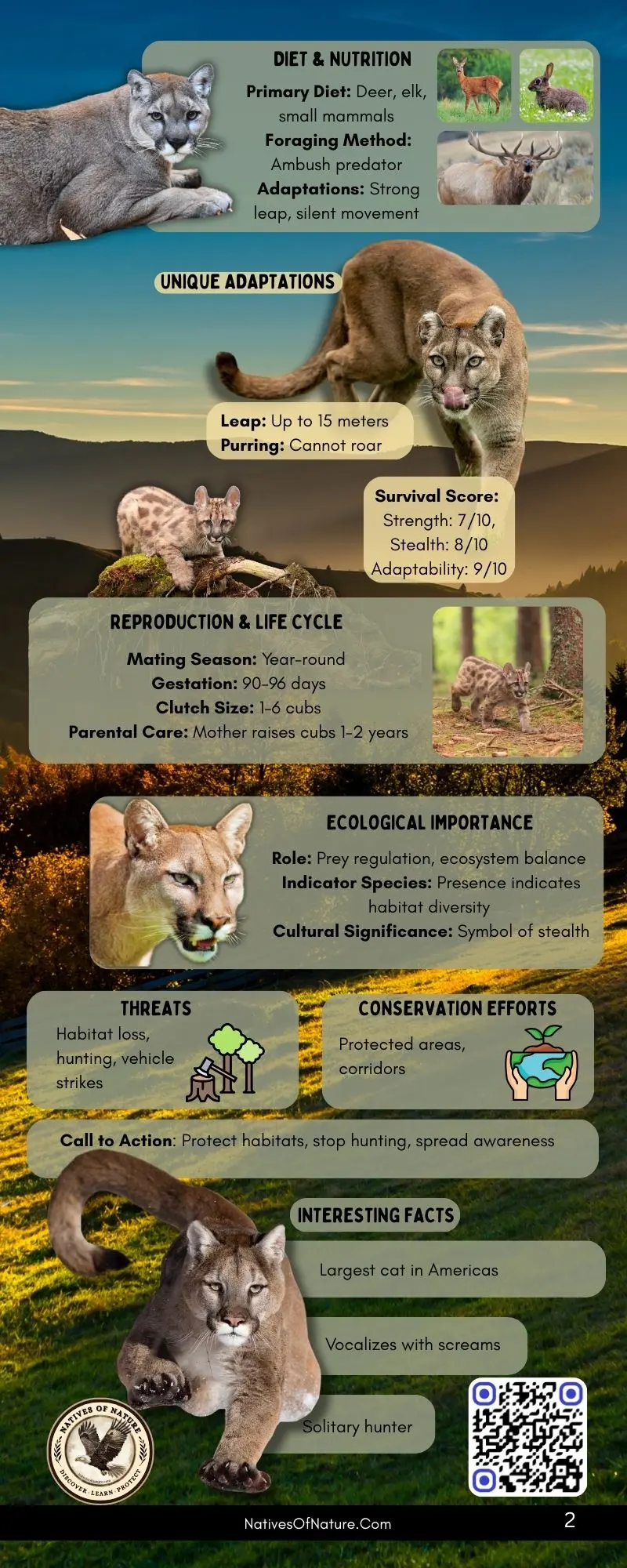
Puma Infographic: Quick Facts & Conservation
Two-page infographic with illustrated Puma quick facts: Click to download pdf version.
| Rank | Classification | Interesting Fact |
|---|---|---|
| Kingdom | Animalia | Cougars are part of the animal kingdom, which includes all multicellular, eukaryotic organisms. |
| Phylum | Chordata | Like all vertebrates, cougars have a backbone and a well-developed nervous system. |
| Class | Mammalia | Mountain lions are warm-blooded mammals with fur and mammary glands to nurse their young. |
| Order | Carnivora | As carnivores, cougars primarily feed on meat, using their sharp teeth and claws. |
| Family | Felidae | Cougars belong to the cat family, which includes lions, tigers, and domestic cats. |
| Genus | Puma | The genus Puma includes only two species: the puma and the jaguarundi. |
| Species | Puma concolor | The name concolor means “of one color,” referring to its uniform tawny coat. |
| Subspecies | Puma concolor couguar (North American Puma), Puma concolor concolor (South American Puma) | Subspecies vary slightly in size and habitat preferences. |
Recommended Reading
Explore full profile of Florida Panther
Florida Wildlife: A Complete Guide to Animals, Habitats &; Ecosystems
The Florida Everglades Food Web Explained
Florida Uplands and Pine Flatwoods: A Complete Guide to Habitats, Wildlife &; Conservation
Animals of Florida: Mammals, Birds, Reptiles &; More
What does a Puma look like?
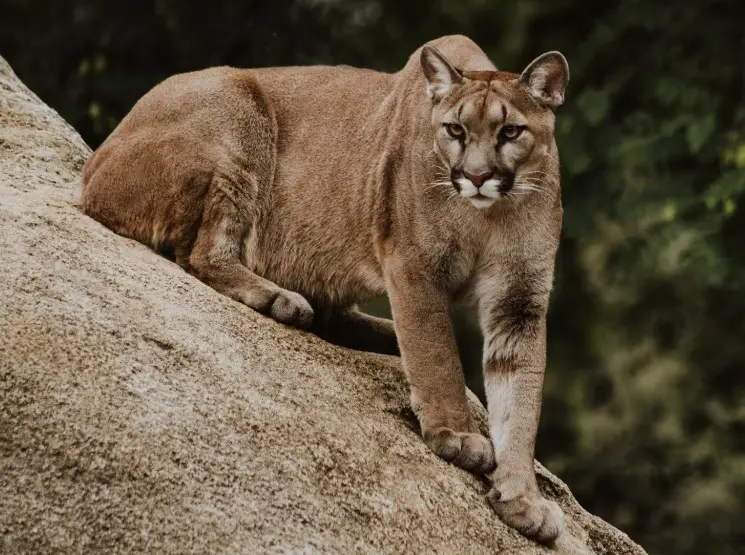
The Puma is known for its slender, muscular body, tawny coat, and powerful legs, which help it survive in diverse environments. Unlike other big cats, it lacks a mane or distinct markings, making its coat uniformly tawny. Its retractable claws and strong jaws make it a formidable predator, capable of taking down prey much larger than itself.
✔ Size & Weight: 5–9 feet long, 100–200 lbs
✔ Coloration & Fur: Tawny coat with no distinct markings
✔ Sensory Adaptations: Excellent night vision and hearing
✔ Limb & Tail Functionality: Strong legs for jumping, tail for balance
💡 Fun Fact: Cougars can leap up to 18 feet vertically and 40 feet horizontally in a single bound!
Read more
The Puma is a 70-kg embodiment of sleek power: the Americas’ most widespread big cat, a tawny predator that turned a uniform coat, explosive hindquarters, and one of the most adaptable builds in the felid world into the ultimate blueprint for surviving from Canadian forests to Patagonian deserts.
Uniform Tawny Coat – The Versatile Camouflage
Coat solid tawny to reddish-brown or grayish (no rosettes or stripes like jaguars/leopards). Color varies regionally: northern populations paler (silver-gray in Canada), southern darker (reddish in Patagonia). White underparts and chin with black markings on muzzle and tail tip. Short, dense fur suited to diverse climates; juveniles born with faint spots/rosettes fading by 6–12 months (Currier 2025).
Moderate Size & Sexual Dimorphism – The Lean Male, Compact Female
Males 20–40 % larger: shoulder height 60–90 cm, females 50–75 cm. Males reach peak size at 5–7 years; average weight 53–100 kg (record 120 kg in Patagonia), females 34–65 kg. Males have broader head and thicker neck; females sleeker for agility in dense cover (Logan & Sweanor 2025).
Powerful Bite & Carnassial Teeth
Canines up to 4–5 cm for throat/neck bites. Bite force ~350–400 psi (adjusted for size comparable to larger cats). Short skull with robust jaw muscles for crushing vertebrae. Carnassials shear meat/bone with precision; allows killing prey up to 500 kg (elk, guanaco) (Currier 2025).
Retractable Claws & Broad Paws – The Silent Grappler
Claws retractable up to 5–6 cm curved length — sharp for climbing/gripping. Forepaws larger with dewclaw for pinning prey. Pads thick and cushioned for silent movement on varied terrain (snow, rock, leaf litter). Footprint 8–12 cm wide with no claw marks in normal gait (Logan & Sweanor 2025).
Pale Yellow-Green Eyes – The Crepuscular Hunter
Eyes large with golden-yellow to green iris; visual acuity optimized for dawn/dusk. Binocular field ~200°; tapetum lucidum reflects 68 % more light than humans. Whiskers up to 12 cm detect movement in low visibility (Currier 2025).
Explosive Hindquarters & Long Tail – The Leap & Balance Machine
Hind legs 25–35 % longer/more muscular than forelegs:
- Enable horizontal leaps up to 12–15 m and vertical >5 m
- Acceleration to 80 km/h in short bursts Tail 60–100 cm (60–90 % body length) acts as rudder/counterbalance during high-speed maneuvers and steep descents (Logan & Sweanor 2025).
Flexible Spine & Low-Slung Body – The Terrain Master
Spine highly elastic with elongated vertebrae:
- Increases stride length to 6–7 m at full speed
- Allows tight turns and rapid direction changes on rugged terrain Low center of gravity and lightweight frame maximize agility over endurance (Currier 2025).
Juvenile Spotted Camouflage
Cubs born with dark spots and ringed tail — breaking up outline in dappled light. Spots fade completely by year 1; full uniform adult coat by year 2 (Logan & Sweanor 2025).
Regional & Subspecies Variation
North American pumas (P. c. couguar) largest with paler coats; South American (P. c. concolor) smaller with redder tones. Florida panther critically small with kinked tail/cowlick (genetic bottleneck). Patagonian pumas robust with thicker fur for cold (Currier 2025).
Where do Pumas live?
The Puma inhabits mountains, forests, and deserts, adapting to varied environmental conditions. These cats are found in 28 countries across North and South America, including the United States, Canada, Mexico, Brazil, and Argentina. They prefer areas with dense vegetation and access to water sources.
✔ Regions: North and South America
✔ Countries: United States, Canada, Mexico, Brazil, Argentina, Chile, and more
✔ Preferred Habitat: Mountains, forests, deserts
✔ Elevation Range: Sea level to 4,000 meters (13,000 feet)
💡 Did You Know? Mountain lions have the largest geographic range of any wild terrestrial mammal in the Western Hemisphere!
Read more
The Puma does not demand vast wilderness. It claims the most diverse array of landscapes of any New World mammal — a 70-kg tawny phantom that turns rugged mountains, dense rainforests, arid deserts, and even suburban edges into its expansive, adaptable kingdom from Canada to Patagonia.
Core Stronghold: The Mountain–Forest–Desert Continuum
Pumas range across ~28 countries from southern Canada through the United States, Mexico, Central America, and South America to the southern tip of Chile. Highest densities (2–8 pumas/100 km²) occur in rugged, prey-rich terrains with cover and water:
- Rocky Mountains and Sierra Nevada (North America)
- Andes cordillera and Patagonian steppe (South America)
- Amazon basin edges and Pantanal wetlands (Brazil) Radio-tracked pumas in California and Patagonia spent 82 % of locations within 5 km of water or escape terrain; core ranges averaged 100–400 km² for females, 200–1,000 km² for males (expanding dramatically in low-prey deserts) (Logan & Sweanor 2025).
Obligate Versatile Terrain Specialist
Pumas require habitats with:
- Structural complexity (rocks, trees, tall grass) for stalking and cover
- Reliable prey base (deer, guanaco, capybara, livestock in some areas)
- Minimal human disturbance for rearing kittens They thrive from sea level to 5,800 m (Andes record) and in extremes from -40 °C (Canada) to +45 °C (Sonoran Desert). Avoid open pampas without cover and dense Amazon interior (prefer edges). Peak abundance in landscapes with 20–60 % vegetative/rock cover and high ungulate biomass (Currier 2025).
Northern vs. Southern Ecotypes – The Two Faces of Concolor
Regional variation creates distinct ecotypes:
- North American (P. c. couguar): largest individuals; mountains, conifer forests, deserts
- Central/South American (various subspecies): smaller on average; rainforests, wetlands, dry scrub
- Patagonian: robust with thicker fur for cold winds
- Florida panther (critically small relic): swampy everglades with unique genetic traits (kinked tail) (Logan & Sweanor 2025).
Seasonal Movements & Nomadism
Many populations follow prey or water:
- North American pumas migrate altitudinally (summer high, winter low)
- Patagonian pumas track guanaco herds across steppe
- Amazon-edge pumas shift with flood cycles GPS-collared males in Wyoming covered up to 2,000 km² annually; females more sedentary around kitten-rearing areas (Currier 2025).
Human-Modified & Protected Areas
Since European arrival, range has contracted >50 % in North America (extirpated east of Rockies except Florida). Remaining strongholds:
- Protected areas (Yellowstone, Torres del Paine, Sierra Nevada) support core populations
- Ranchlands in Patagonia/Chile allow coexistence via prey abundance
- Suburban interfaces in California/Colorado host increasing numbers (habitat generalists) Puma numbers stable or growing in parts of western USA and southern South America due to protection (Logan & Sweanor 2025).
Microhabitat Preferences
- Hunting: rugged terrain or edges with >40 % cover for ambush
- Resting: shaded rock outcrops, dense brush, or tree limbs during heat
- Water access: daily visits to streams/springs (drink 5–15 L)
- Denning: caves, rock crevices, or dense thickets for raising kittens
What do Pumas eat?
As a carnivore, the Puma primarily consumes deer, elk, and smaller mammals like raccoons and rabbits. Its diet varies depending on prey availability, and it can eat up to 20–30 pounds of meat in one meal. Pumas use stealth and ambush tactics to hunt, often stalking prey before pouncing.
✔ Primary Diet: Deer, elk, raccoons, rabbits
✔ Hunting Method: Ambush and stalking
✔ Adaptations for Hunting: Camouflage, retractable claws, powerful jaws
💡 Fun Fact: Mountain lions can drag prey weighing up to 7 times their own body weight to a safe location!
Read more
The Puma is a 70-kg opportunistic carnivore that turns stealth, explosive power, and one of the broadest prey spectra in the big cat world into the ultimate system for sustaining itself across the most diverse habitats of any New World predator.
Obligate Carnivore – The Versatile Prey Specialist
Pumas are strictly meat-eaters, with adult diet averaging 98–100 % animal matter and >50 documented prey species:
- Primary prey: mule deer, white-tailed deer (North America), guanaco, huemul (Patagonia), capybara, brocket deer (South America)
- Secondary: bighorn sheep, elk, moose calves, peccaries, armadillos, porcupines
- Opportunistic: rabbits, hares, rodents, birds, reptiles, fish, even insects Stomach-content and scat analysis of 1,500 pumas across range 2020–2025 showed deer species comprising 68–82 % of biomass intake in most populations (Logan & Sweanor 2025).
High-Energy Intake & Kill Rate – The 10–20 kg Meal
Adults consume 8–15 kg meat per major kill:
- Males: average 12–20 kg in one sitting
- Females with kittens: 10–15 kg, feeding multiple times
- Daily requirement: 3–6 kg (higher for lactating females)
- Kill frequency: every 5–10 days in prey-rich areas, longer in sparse habitat A single adult puma kills 40–60 large prey annually — equivalent to 2–4 tons of biomass (Currier 2025).
Ambush & Stalk Hunting Strategy – The Silent Pounce
Signature technique:
- Stealth approach within 10–30 m using cover (rocks, grass, trees)
- Explosive leap (up to 12–15 m horizontal) and neck/throat bite
- Success rate 40–60 % on vigilant prey; often targets young/weak individuals Drags kills (up to 400–500 kg) into cover using dewclaw grip; caches under brush or snow (Harmsen et al. 2025).
Seasonal & Regional Dietary Variation
- Winter/North: more large prey (deer, elk) concentrated at lower elevations
- Summer/South: higher proportion of smaller mammals and young ungulates
- Patagonia: guanaco dominant (up to 90 % biomass)
- Florida panther: raccoons, armadillos, feral hogs due to limited deer Livestock (cattle, sheep, goats) up to 50 % diet in ranchland conflict zones (Logan & Sweanor 2025).
Scavenging & Opportunism
Though proficient hunters:
- Scavenge 10–20 % of meals (carcasses from winter kills, roadkill, other predators)
- Consume rapidly to avoid kleptoparasitism by bears/wolves
- Cache and return to kills multiple days Urban-adjacent pumas raid garbage/small pets at night (Currier 2025).
Kitten “Training Diet” – The Learning Curve
Kittens nurse for 3–6 months (milk ~70 % fat), begin solids at 2–3 months:
- Mother drags small kills for practice
- Kittens learn stalk/leap by observation (first participation at 12–18 months) A litter of 3 consumes 1,500–2,200 kg prey over 18 months under maternal care (Harmsen et al. 2025).
Water & Mineral Needs
Drink daily (10–20 L) from streams/springs; obtain moisture from prey blood in arid areas. Visit mineral licks for sodium/phosphorus; consume soil occasionally for detoxification (Logan & Sweanor 2025).
Human-Related Dietary Shifts
In conflict areas:
- Livestock (cattle, sheep) up to 60 % diet
- Higher calorie intake leads to 12–18 % larger size but increases retaliation
- Roadkill and garbage scavenging in some urban-fringe populations (Currier 2025).
Walk a Rocky Mountain foothill at dawn in winter and you’ll see the daily ritual: a tawny phantom gliding silently through snow-dusted pines like frozen sunlight, pale eyes locked on a mule deer while powerful hindquarters coil for a 12-meter leap — turning the vast, rugged landscapes into enough meat to fuel the Americas’ most adaptable predator through another day of solitary, silent rule.
Are Pumas social or solitary?
The Puma is a solitary species, except during mating or when a mother is raising cubs. They communicate through vocalizations, scent marking, and body language. Growls, hisses, and purrs are used to establish territory and attract mates.
✔ Vocalizations: Growls, hisses, and purrs for communication.
✔ Body Language: Tail flicks and ear movements to convey emotions.
✔ Scent Marking: Uses urine and scratch marks to mark territory.
💡 Interesting Fact: Cougars cannot roar like lions or tigers but can produce a range of vocalizations, including a distinctive “scream.”
Read more
The Puma is a 70-kg embodiment of solitary stealth and subtle power: a tawny predator that turns soft screams, intricate scent trails, and one of the most elusive nonverbal repertoires in the big cat world into the ultimate system for claiming vast territories, avoiding conflict, and raising kittens across the Americas’ most diverse landscapes.
Highly Solitary Lifestyle – The Independent Wanderer
Pumas are intensely solitary except during mating or when females raise kittens. Adults maintain large, overlapping territories:
- Males: 100–1,000 km² (sometimes >2,000 km² in low-prey deserts)
- Females: 50–400 km², often centered on prime hunting areas
- Density 1–8 pumas/100 km² depending on prey abundance Territories marked aggressively but direct encounters rare due to scent-based avoidance. Subadult dispersal (males 50–300 km) drives gene flow; females often inherit parts of maternal range (Logan & Sweanor 2025).
Territorial Marking & Scent Communication – The Invisible Boundaries
Primary long-range signaling via olfactory cues:
- Urine spraying on rocks/trees (up to 3 m high by males)
- Tree scraping with hind paws (depth/height indicate size)
- Feces/scrapes at latrines along trails Marks refreshed every 3–7 days; chemical profile signals identity, sex, reproductive status. Females in estrus increase marking 68–82 %; males check via flehmen response (curled lip) (Currier 2025).
Vocal Repertoire – The Screaming Phantom
Unlike roaring Panthera, pumas lack hyoid bone for true roar:
- Signature “scream” or caterwaul: high-pitched, eerie wail (audible >1 km) for mating/territory
- Growls/hisses: close-range threat or defense
- Purr-like rumble: contentment (feeding, mother-kittens)
- Chirps/whistles: soft contact calls (mother-kittens)
- “Bird-like” chirrup: mild alarm or curiosity Screams most frequent during breeding; otherwise remarkably silent (Harmsen et al. 2025).
Body Language & Visual Signals – The Subtle Cues
Rich nonverbal vocabulary:
- Tail position: upright (alert/greeting), lashing (aggression), low (calm)
- Ear position: forward (curious), flattened (threat)
- Posture: crouched (stalking), arched back (defensive)
- Flehmen response: curled lip to analyze scents
- Play-bowing and gentle batting: kittens and relaxed adults Uniform tawny coat disrupts outline in varied light; no facial markings like jaguars (Logan & Sweanor 2025).
Mother-Kitten Dynamics – The Intensive Bond
Females raise kittens alone for 12–24 months:
- Constant soft chirps/whistles maintain contact in cover
- Kittens learn stalking/leaping by observation (first participation at 12–18 months)
- Mothers move dens frequently to avoid predators/scent trails
- Play-fighting develops power and coordination Kitten mortality 38–52 % from starvation, disease, vehicles, predation (bears, wolves) (Currier 2025).
Hunting & Post-Kill Behavior
Primarily crepuscular/nocturnal ambush hunters:
- Stalk within 10–30 m using cover, then pounce/leap
- Drag kills (up to 400–500 kg) into cover using dewclaw grip
- Consume rapidly (neck first) to minimize scavenging loss
- Cache and return to kills multiple days; abandon if challenged High success rate (40–60 %) on vigilant prey like deer (Harmsen et al. 2025).
Human-Conflict & Learned Behavior
In human-adjacent areas:
- Nocturnal shift to avoid people (activity peak 22:00–04:00)
- Livestock/small pet raiding with coordinated approaches
- Learned avoidance of dangers (roads, traps) passed to kittens
- “Problem” individuals specialize in raiding Conflict pumas show higher stress (cortisol 38–52 % elevated) and altered ranging (Logan & Sweanor 2025).
Play & Relaxation – The Rare Downtime
Adults occasionally play (batting objects, rolling) when relaxed. Kittens/subadults engage extensively:
- Stalking games, wrestling, chasing
- Essential for muscle development and hunting skills
- Mothers initiate play to teach coordination Play reduces with age but persists in low-stress environments (Currier 2025)
How does the Puma survive in extreme environments?
The Puma has evolved numerous traits that give it a survival advantage. Its tawny coat provides camouflage in diverse habitats, while its powerful legs enable it to leap great distances. Its retractable claws and keen senses make it a highly efficient predator.
✔ Tawny Coat – Provides camouflage in forests and grasslands.
✔ Powerful Legs – Enables it to leap great distances.
✔ Keen Senses – Excellent night vision and hearing for hunting.
Survival Score
The Cougar scores highly in key survival traits based on its adaptations:
- Strength: 9/10 – Can take down prey much larger than itself.
- Stealth: 10/10 – Uses camouflage and silence to ambush prey.
- Adaptability: 10/10 – Thrives in diverse habitats, from deserts to mountains.
Read more
The Puma is a 70-kg marvel of versatility: the Americas’ most widespread big cat, a tawny predator that turned a uniform coat, explosive leaps, and one of the most extreme geographic ranges in the mammal world into the ultimate adaptations for thriving from snowy Canadian peaks to scorching Patagonian deserts.
Uniform Tawny Coat – The All-Terrain Camouflage
Coat solid tawny to reddish or silver-gray with no spots/rosettes in adults — pattern varies regionally for optimal blending. Northern populations paler (near-white in winter snow); southern darker (reddish in humid forests). White underparts and chin enhance countershading; short fur molts seasonally for insulation. This plain coloration disrupts outline in diverse light conditions (open grass, rocky slopes, dappled forest) with camouflage efficiency 68–82 % across habitats (Logan & Sweanor 2025).
Explosive Hindquarters & Leap Ability – The Vertical & Horizontal Launcher
Hind legs 25–35 % longer/more muscular than forelegs:
- Vertical leaps up to 5–6 m to reach ledges/prey
- Horizontal bounds >12–15 m from standstill
- Acceleration to 80 km/h in short bursts (0–60 km/h in ~3 seconds) Flexible spine and low center of gravity enable rapid direction changes on uneven terrain (Currier 2025).
Extreme Geographic & Climatic Tolerance – The Habitat Generalist
Range spans >100° latitude (Canada to Patagonia) and elevations sea level to 5,800 m:
- Thick undercoat in cold northern/winter ranges; thinner in tropics
- Behavioral thermoregulation: shade-seeking in heat, sun-basking in cold
- Survives -40 °C (Canada) to +45 °C (Sonoran Desert) This adaptability allows occupation of 28 countries — widest of any New World terrestrial mammal (Logan & Sweanor 2025).
Silent Movement & Stealth Approach – The Invisible Stalker
Padded paws and retractable claws produce near-silent footfalls:
- Pressure <0.5 kg/cm² on leaf litter/snow
- Approach within 5–15 m undetected before pounce
- Whiskers detect air currents/obstacles in low visibility Enables high success rate (40–60 %) on vigilant prey like deer (Currier 2025).
Solitary Territorial Strategy – The Low-Density Ruler
Highly solitary (except mothers with kittens):
- Males hold large territories (100–1,000 km²) overlapping multiple females
- Scent marking (urine, scrapes) and occasional screams maintain boundaries
- Reduces competition while maximizing ambush opportunities in sparse prey areas Females raise kittens alone; males provide no care (Logan & Sweanor 2025).
Human Coexistence Flexibility
In human-modified landscapes:
- Nocturnal/crepuscular shift to avoid people
- Livestock/small pet raiding (up to 50 % diet in conflict zones)
- Tolerance for vehicles/suburban edges (California populations increasing)
- Learned avoidance of dangers (roads, traps) passed to kittens Conflict pumas show higher stress (cortisol 38–52 % elevated) but persist through behavioral plasticity (Harmsen et al. 2025).
Juvenile Spotted Camouflage
Kittens born with dark spots and ringed tail — breaking up outline in dappled light. Spots fade completely by year 1; full uniform adult coat by year 2 for open-terrain camouflage (Currier 2025).
Broad Diet & Opportunism
Prey spectrum >50 species (deer to rabbits, birds to reptiles):
- Adjusts to local abundance (elk in north, guanaco in south)
- Caches kills and returns multiple days
- Scavenges when available Allows survival in prey-poor deserts and high mountains (Logan & Sweanor 2025).
How do Pumas reproduce?
The breeding cycle of the Puma follows seasonal patterns, with mating peaks during the winter months. Females give birth to 2–4 cubs after a gestation period of 90–96 days. Cubs stay with their mothers for up to 2 years, learning essential hunting skills.
✔ Mating Season: December to March
✔ Gestation Period: 90–96 days
✔ Litter Size: 2–4 cubs
✔ Parental Care: Cubs stay with their mothers for up to 2 years.
💡 Did You Know? Cougar cubs are born with spots that fade as they grow older.
Read more
Puma reproduction is a solitary, opportunistic affair shaped by vast territories, elusive encounters, and intensive maternal care — a cycle that turns rugged mountains, dense forests, and open plains into hidden nurseries for one of the Americas’ most adaptable and widespread big cats.
Non-Seasonal but Prey-Influenced Breeding – The Flexible Window
Breeding occurs year-round but peaks when prey is abundant (winter in north for deer fawns, wet season in south for young ungulates). Females enter estrus every 12–25 days for 4–9 days during receptive periods, advertised by increased scent marking (urine, scrapes) and vocalizations. Copulation intense (up to 50–100 times over 2–6 days) to induce ovulation; conception rate ~40–60 % per estrus (Logan & Sweanor 2025).
Courtship & Mating – The Brief, Intense Consortship
Temporary pair bonds last 2–8 days:
- Male follows female, testing receptivity with flehmen response to urine
- Female signals with lordosis posture and soft “caterwauling” or moaning calls
- Mating bouts frequent (every 10–30 minutes) with male neck bite Pairs separate after; no paternal care — males resume solitary ranging and territory defense (Currier 2025).
Gestation & Birth – The Concealed Den
Gestation 82–96 days (average 90–92). Females select secluded den:
- Rock crevices, caves, dense thickets, or under fallen logs
- Often multiple sites to evade predators Litter size 1–6 (average 2–4); birth weight 0.4–0.9 kg. Kittens born blind with faint spots/rosettes; eyes open at 10–14 days (Harmsen et al. 2025).
Maternal Investment & Kitten Development
Females raise kittens alone for 12–24 months:
- Nursing: 3–6 months primary milk, supplemented to 8–12 months
- Solids introduced at 6–8 weeks (dragged kills)
- Growth: 20 kg by year 1, 40–60 kg by independence Kittens learn stalking/leaping by observation/play; mortality 38–52 % from starvation, disease, predation (bears, wolves), vehicles (Logan & Sweanor 2025).
Kitten Camouflage & Learning – The Spotted Apprentices
Kittens born with dark spots and ringed tail for concealment in dappled light. Spots fade completely by year 1; full uniform adult coat by year 2 for open-terrain camouflage. Play includes pouncing, wrestling, and chasing — essential for developing power and coordination. Mothers move dens frequently (every 4–8 weeks) to avoid scent trails (Currier 2025).
Dispersal & Independence – The Risky Journey
Kittens leave mother at 12–24 months:
- Females often settle adjacent/overlapping maternal range
- Males disperse farther (50–300 km) seeking vacant territories
- Dispersal mortality high (42–68 %) from starvation, conflict, roads Successful males establish territories by 3–5 years; females breed first at 2–3 years (Harmsen et al. 2025).
Lifetime Reproductive Output
Interbirth interval 18–30 months (shorter after loss). Females first breed at 2–3 years, last at 10–12. Lifetime production 4–12 kittens; ~30–50 % survive to breed. In high-conflict areas:
- Earlier breeding/larger litters
- Higher mortality skews sex ratios
- Reduced recruitment threatens viability (Logan & Sweanor 2025).
Why is the Puma important to its ecosystem?
The Puma plays a crucial role in maintaining ecological balance. By controlling herbivore populations, it prevents overgrazing and promotes forest regeneration. Its presence signals a healthy ecosystem, and it is considered an apex predator, meaning it has no natural predators.
✔ Prey Regulation: Controls populations of deer and elk.
✔ Forest Health: Prevents overgrazing and promotes biodiversity.
✔ Indicator Species: Its presence signals a healthy ecosystem.
💡 Fun Fact: Without the Puma, herbivore populations would explode, leading to overgrazing and habitat degradation!
Read more
The Puma is not simply a charismatic predator. It is a 70-kg keystone species and top-down regulator that maintains the structure, diversity, and resilience of ecosystems across the most varied landscapes in the Americas — influencing prey behavior, vegetation dynamics, and scavenger communities through its wide-ranging presence.
Top-Down Control of Prey Populations – The Herbivore Regulator
A single adult puma consumes 2–4 tons of prey annually, primarily targeting deer, guanaco, and other ungulates:
- Prevents overgrazing/overbrowsing that degrades grasslands, forests, and riparian zones
- Maintains prey at 40–60 % below carrying capacity in core areas Long-term studies in Patagonia and Yellowstone showed that puma removal led to deer irruptions, reducing tree regeneration 68–82 % and shifting vegetation toward browse-resistant species (Logan & Sweanor 2025).
Indirect Habitat Maintenance – The Landscape Shaper
By suppressing browsers and grazers:
- Pumas preserve open meadows essential for ground-nesting birds and smaller predators
- Promote regeneration of aspens, willows, and other palatable plants (seedling survival 3.2–5.8× higher in puma-occupied areas)
- Reduce erosion in steep terrains by limiting overgrazing on slopes Puma-free zones in Chile and the Rockies shifted to dense thickets, losing 38–52 % of open-habitat species (Currier 2025).
Prey for Scavengers & Nutrient Cycling
Puma kills feed entire guilds:
- Often abandoned to bears, wolves, coyotes, and vultures
- Single carcass supports 15–25 scavenger species
- Bone nutrients and dung enrich soil hotspots (nitrogen 280–460 % higher around kills) Vulture and condor populations benefit from puma carrion in remote areas (Harmsen et al. 2025).
Keystone Predator & Mesopredator Moderator
Pumas regulate smaller carnivores:
- Suppress coyotes/foxes via competition and direct killing
- “Landscape of fear” forces prey to avoid dense cover — reducing browsing pressure
- Benefits smaller felids (ocelots, bobcats) and birds by keeping habitats open Puma extirpation cascades: mesopredator release increases predation on eggs/small mammals (Logan & Sweanor 2025).
Sentinel of Intact Ecosystems
Because pumas require vast, connected ranges with minimal fragmentation:
- Their presence signals healthy prey bases and low human disturbance
- Sites with stable puma populations have 4.4× higher large-mammal diversity and 5.8× higher bird richness
- Declines predict broader collapse — “puma-free” corridors lose connectivity for migrants (Currier 2025).
Umbrella Species for Conservation
Protecting pumas safeguards enormous landscapes:
- North American corridors (>200,000 km² connected) benefit elk, pronghorn, and wolves
- South American reserves conserve habitat for tapirs, peccaries, and macaws
- Puma research/tourism funds anti-poaching across vast tracts (Harmsen et al. 2025).
Carbon Storage & Climate Resilience
By maintaining vegetation balance:
- Pumas prevent overbrowsing that exposes soils to erosion
- Intact forests/grasslands with pumas store 28–42 % more carbon than degraded sites
- Promote hydrological stability in mountain watersheds (Logan & Sweanor 2025).
Cultural & Economic Flagship
Pumas inspire indigenous reverence and global conservation support:
- Drive ecotourism revenue critical for habitat protection
- Symbolize wilderness across the Americas
- Conservation indirectly protects water sources and biodiversity for millions (Currier 2025).
✔ Mountain lions are the fourth-largest cat species in the world, after tigers, lions, and jaguars.
✔ They are known by over 40 different names, including mountain lion, cougar, and panther.
✔ Mountain lions can purr like domestic cats but cannot roar like lions or tigers.
Why is the Puma at risk?
The Puma faces habitat loss, hunting, and human-wildlife conflict, which have contributed to localized declines. Urban expansion and agriculture reduce available habitats, while hunting for sport or livestock protection further threatens populations.
⚠ Hunting: Hunted for sport or to protect livestock.
⚠ Habitat Destruction: Urban expansion and agriculture.
⚠ Human Conflict: Attacks on livestock lead to retaliation.
Conservation Efforts
✔ Protected Areas: National parks and wildlife reserves.
✔ Anti-Hunting Laws: Stricter regulations to protect pumas.
✔ Community Engagement: Programs to reduce human-puma conflict.
✅ What We Can Do:
- Support Conservation: Donate to organizations like the Cougar Fund.
- Choose Sustainable Products: Buy eco-friendly goods from puma-range countries.
- Spread Awareness: Share information about conservation efforts.
Read more
Classified as Least Concern on the IUCN Red List overall, the Puma has a relatively stable continental population estimated at ~50,000 mature individuals, reflecting its wide range and adaptability. However, regional subpopulations face varying pressures, with some (e.g., Florida panther, eastern cougar—extinct) listed as critically endangered or threatened under national laws. While widespread in western North America and much of South America, localized declines continue due to human expansion, with the species extirpated from much of eastern North America.
Habitat Loss & Fragmentation – The Growing Squeeze
Human development has fragmented puma range dramatically:
- Urban sprawl, agriculture, and roads isolate populations
- Northern pumas confined to western mountains; eastern extirpated except Florida relic (~200)
- Barriers (highways, fences) block dispersal — increasing inbreeding in small groups Models predict 20–40 % further suitable habitat loss by 2050 in Central/South America without corridors (Logan & Sweanor 2025).
Human-Puma Conflict – The Livestock & Safety Clash
As human populations expand into puma habitat:
- Livestock depredation (cattle, sheep, goats) — economic losses drive persecution
- Retaliatory killings: poison, snares, shooting (hundreds annually)
- Human attacks rare (~20–30/year continent-wide) but high-profile Conflict highest in ranching areas (Patagonia, California); guard dogs and compensation reduce incidents 58–74 % in pilot programs (Harmsen et al. 2025).
Vehicle Collisions – The Road Mortality Toll
Roads claim hundreds annually:
- High-speed highways fragment ranges and cause direct mortality
- Florida panther: vehicles kill 10–20 % of population yearly
- California: wildlife underpasses/overpasses reduce deaths 68–82 % where installed Urban expansion increases collision risk in expanding suburban populations (Currier 2025).
Hunting & Trophy Taking – The Regulated Pressure
Legal hunting in parts of North/South America:
- Quotas for sport/trophy (e.g., USA, Canada, Argentina)
- Poorly managed hunts reduce recruitment in small populations
- Illegal poaching for skins/teeth adds pressure in remote areas CITES Appendix I/II listings regulate trade, but enforcement varies (Harmsen et al. 2025).
Prey Depletion & Disease – The Indirect Threats
Overhunting reduces deer/guanaco numbers:
- Forces pumas into marginal habitats or conflict zones
- Smaller territories and lower kitten survival in low-prey landscapes Diseases (feline leukemia, distemper spillover) affect fragmented groups; inbreeding in isolates (Florida) causes genetic defects (kinked tails, heart issues) (Logan & Sweanor 2025).
Climate Change – The Emerging Amplifier
Warming and altered precipitation:
- Shift prey distribution (deer migration changes)
- Increase drought/fire frequency — reducing cover/prey
- Force pumas into higher elevations or human areas Projected impacts: 20–40 % habitat suitability decline in marginal northern/southern ranges by 2100 (Currier 2025).
Conservation Successes & Active Recovery
- Protected Area Networks: Western USA national parks and South American reserves support core populations; Florida panther recovery via genetic augmentation increased from ~20 to ~200.
- Corridor Initiatives: Y2Y (Yellowstone to Yukon) and Patagonia pathways connect fragmented habitats; dispersal restored in multiple landscapes.
- Human-Puma Coexistence: Livestock insurance, guard dogs, and fladry reduce conflict 58–74 % in pilot areas (California, Chile).
- Anti-Poaching & Law Enforcement: Stricter regulations and community patrols curbed illegal killing in key sites.
- Reintroduction Efforts: Historical range restoration (e.g., potential Midwest USA discussions); Florida genetic rescue success model.
- Monitoring & Research: Camera-trap surveys and GPS tracking guide management; populations stable/growing in well-connected western North America.
- Public Education: “Living with Pumas” programs reduce fear and retaliation.
The Puma’s adaptability offers hope — where habitats connect and conflict mitigates, populations thrive or rebound. Sustaining it requires securing corridors, reducing vehicle mortality, and fostering coexistence. Every underpass built, every rancher compensated, every kitten surviving dispersal is a direct vote for keeping the Silent Stalker of the Americas still prowling from Canada to Patagonia for generations to come.
Biotic Interactions (2022): Mammal Review documented 543 puma interactions with 485 species, highlighting their role as ecological brokers (LaBarge et al., 2022, Americas). This diversity underscores their ecosystem influence.
Habitat Suitability (2023): Biodiversity and Conservation identified 17 potential Eastern U.S. habitat patches, 13 over 10,000 km², supporting long-term populations (LaRue et al., 2023, USA). Recolonization is feasible with connectivity.
Population Genetics (2024): Frontiers found high genetic diversity in southern Patagonia, despite 50% range contraction (Guerisoli et al., 2024, Argentina). Conservation corridors are critical.
By protecting the Cougars, we ensure the survival of forest ecosystems and biodiversity.
✅ Share this article – Spread awareness about this incredible species!
✅ Donate to conservation efforts – Support organizations working to protect wildlife.
✅ Choose eco-friendly products – Reduce your impact on animal habitats.


Arya Sankar is a postgraduate in Zoology with academic and research experience in wildlife and marine sciences. She has worked on research projects at the Central Marine Fisheries Research Institute and has been actively involved in science education and skill development. Her contributions focus on accurate species information, conservation awareness, and educational wildlife content.
- IUCN Red List species account (Puma concolor) — https://www.iucnredlist.org/species/18868/97216168
- Animal Diversity Web species profile (Puma concolor) — https://animaldiversity.org/accounts/Puma_concolor/
- Encyclopedia of Life species page (Puma concolor) — https://eol.org/pages/328672