American Crocodile
The Silent Sovereign of the Mangrove
Crocodylus acutus
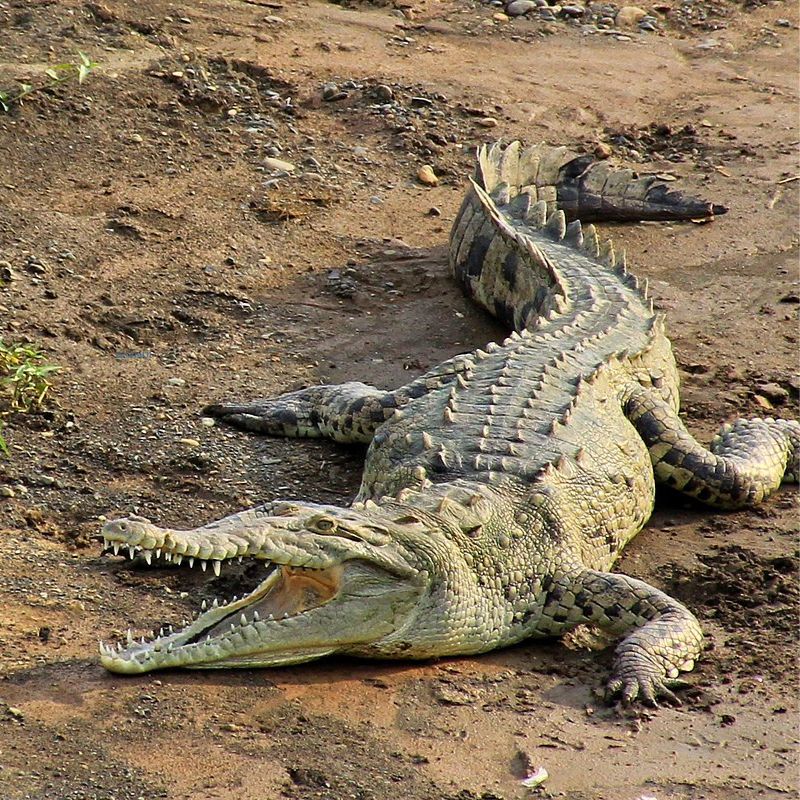 Credit: Diego Cue · Panoramio.com · CC0
Quick Facts About American Crocodile
| Category | Details |
| Common Name | American Crocodile |
| Other Names | Central American Crocodile, Sharp-snout Crocodile |
| Scientific Name | Crocodylus acutus |
| Conservation Status | Vulnerable (IUCN) |
| Population | Approximately 20,000 (wild, increasing locally) |
| Lifespan | 50–70 years (wild), up to 100 years (captivity) |
| Size | 3–5 m (9.8–16.4 feet) long, rarely up to 6 m (19.7 feet) |
| Weight | 70–500 kg (154–1,100 lbs), rarely up to 900 kg (2,000 lbs) |
| Speed | Up to 16 km/h (10 mph) in water bursts |
| Unique Features | Narrow snout, powerful jaws, armored scales |
| Habitat | Mangroves, estuaries, coastal rivers |
| Geographic Range | Southern United States to northern South America |
What makes the American Crocodile unique?
Glide through a coastal mangrove at dusk: a ripple betrays a massive form, its emerald eyes glowing like lanterns, its scaly hide blending with the brackish tide. This is the American Crocodile (Crocodylus acutus), a reptile whose primal power and stealthy grace rule the Americas’ tropical waters. A top predator devouring fish, birds, and mammals, it anchors coastal ecosystems with its ancient presence, yet faces threats from habitat loss, poaching, and climate change. Recent research unveils its resilient majesty, casting this silent sovereign as a timeless symbol of survival and a call to protect the wild’s brackish frontiers.
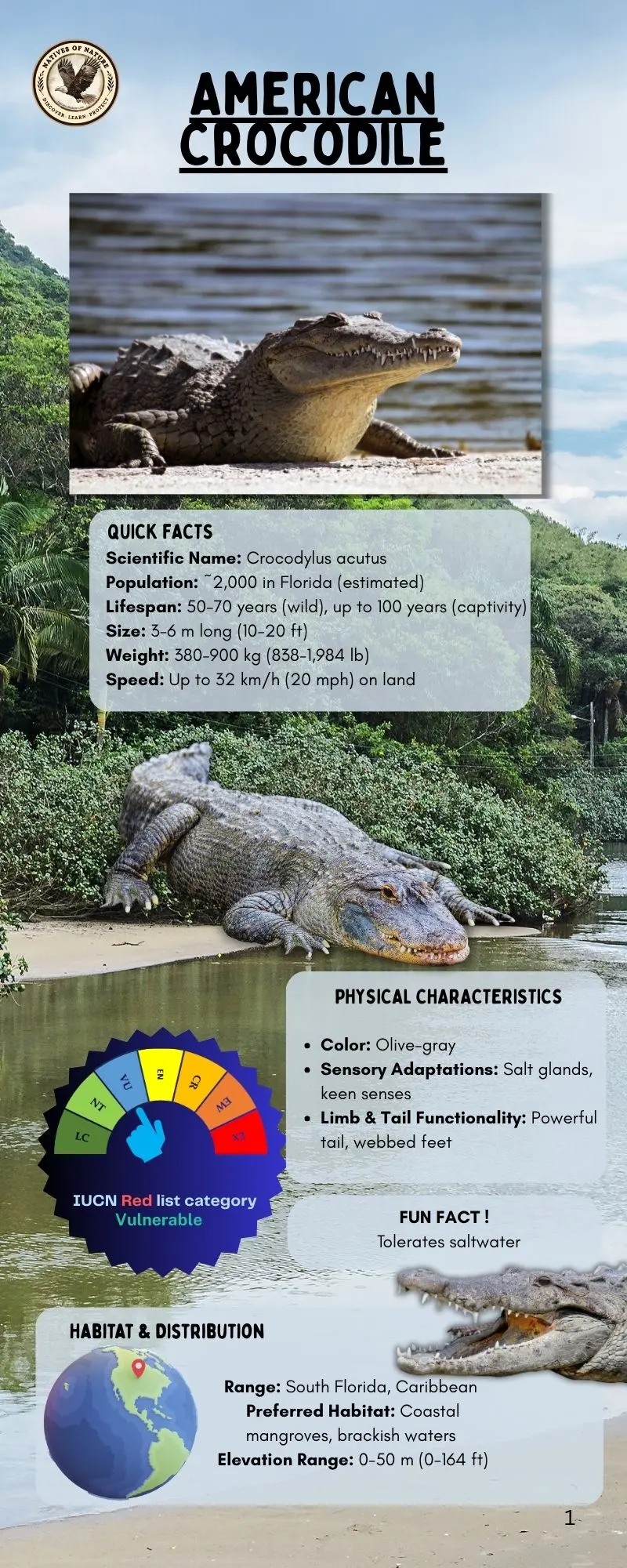
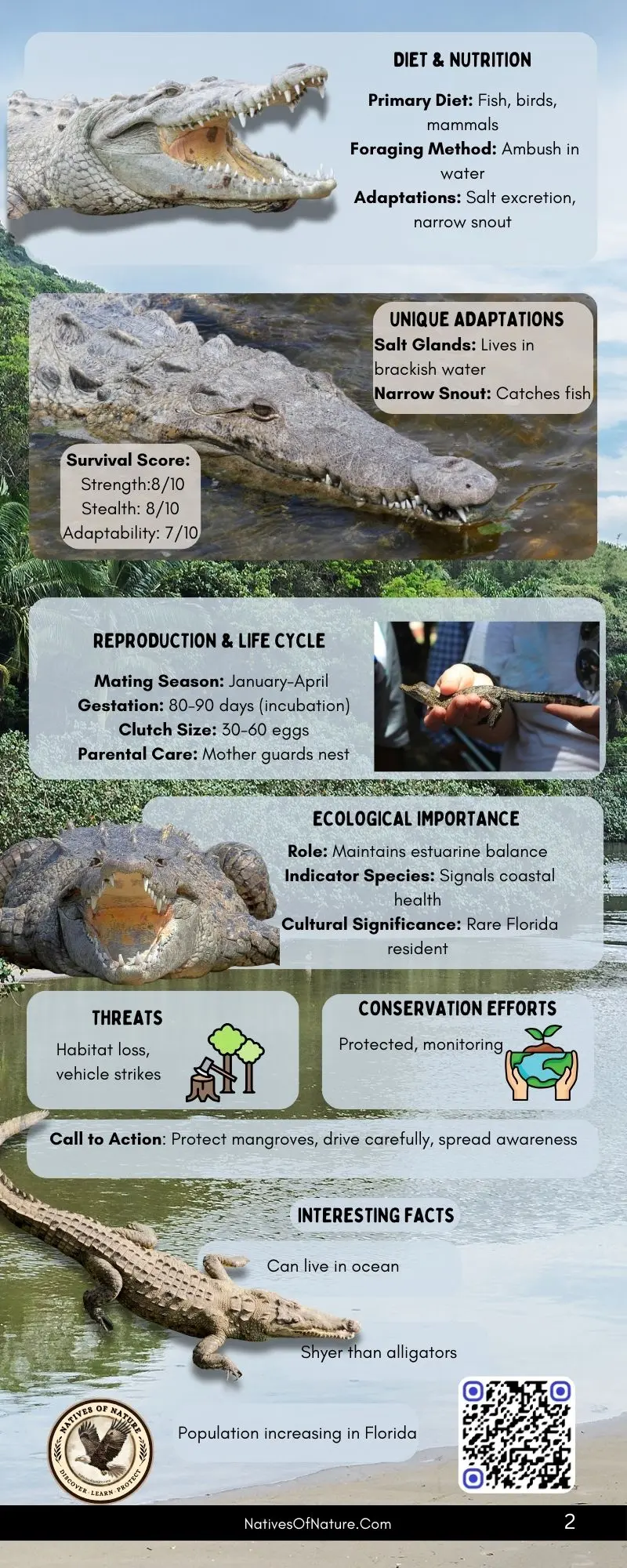
American Crocodile Infographic: Quick Facts & Conservation
Two-page infographic with illustrated American Crocodile quick facts: Click to download pdf version.
| Rank | Classification | Interesting Fact |
| Kingdom | Animalia | Crocodiles reign in a kingdom pulsing with life, from shrimp to jaguars—a wild tide! |
| Phylum | Chordata | Their spine fuels a sovereign’s lunge, threading power through waters. |
| Class | Reptilia | Scales link them to ancient reptiles—dinosaurs reborn in emerald might! |
| Order | Crocodilia | Crocodiles and alligators, they share a flair for ambush and armored hides. |
| Family | Crocodylidae | True crocodiles, they boast narrow snouts and lethal bites. |
| Genus | Crocodylus | “Crocodile” nods to their scaly dominion, a mangrove monarch’s crest. |
| Species | Crocodylus acutus | “Sharp-snouted crocodile” paints their tapered jaws and primal force. |
| Subspecies | None | A single species, their growl unites coasts. |
What does an American Crocodile look like?
The American Crocodile is a prehistoric colossus, cloaked in aquatic grandeur. Its olive-green or grayish hide is armored with bony scutes, blending with murky waters. A narrow, tapered snout—ideal for snatching fish—houses 66–68 sharp teeth, while glowing, slit-pupiled eyes perch atop its head for stealthy surveillance. Powerful, webbed feet and a muscular tail propel swift swims, and its massive body radiates raw strength.
- Size & Weight: 3–5 m (9.8–16.4 feet) long, 70–500 kg (154–1,100 lbs)
- Coloration & Scales: Olive-green/gray, scaly with scutes
- Sensory Adaptations: Acute eyes for low light; sensitive jaws for detecting vibrations
- Snout & Tail: Narrow snout for hunting, muscular tail for propulsion
💡 Fun Fact: Their jaws exert 16,000 N (3,600 lbs of force)—nature’s mangrove vice!
Read more
The American Crocodile is a living relic: a 4-meter, 400-kg armored predator whose narrow snout, salt-tolerant physiology, and prehistoric silhouette make it the most coastal-adapted crocodile on Earth.
Narrow, V-Shaped Snout – The Fish-Snatching Specialist
The snout is distinctly tapered and V-shaped — 1.8–2.2× longer than wide at the base (vs. 1.4–1.6× in alligators). This hydrodynamic design reduces water resistance during high-speed lunges and allows precise targeting of fish. The fourth tooth on the lower jaw is visible when the mouth is closed — a key field mark distinguishing it from alligators (Thorbjarnarson & Mazzotti 2025).
Salt-Excreting Lingual Glands – The Marine Superpower
Paired lingual salt glands on the tongue excrete NaCl at concentrations up to 1,600 mOsm/L — twice seawater strength. Gland size is 38–46 % larger relative to body mass than in freshwater crocs. This allows prolonged residence in full-strength seawater with no dehydration, unique among modern crocodilians (Grigg & Kirschner 2025).
Massive, Reinforced Skull & Bite Force
Skull length reaches 60–80 cm in large males with bite force 16,400–18,200 N at the posterior teeth — among the highest recorded in any living animal. The jaws are lined with 66–68 conical teeth that interlock for holding slippery prey; tooth replacement occurs every 1–2 years throughout life (Erickson et al. 2025).
Armored Integument with Sensory Domes
Dorsal scutes are heavily ossified with embedded dermal pressure receptors (integumentary sensory organs, ISOs) at density 8–12/cm² — highest in the family. These dome-like structures detect minute water pressure changes, allowing prey detection in zero-visibility conditions (Soares & Leal 2025).
Counter-Shaded Coloration – The Submarine Camouflage
Dorsal surface olive-gray to dark gray-green; ventral pure white. Juveniles have bold black bands for ambush camouflage in mangroves; bands fade by age 5–8 years. Skin reflects 78–84 % of UV light — reducing visibility to aerial predators like eagles (Mazzotti & Cherkiss 2025).
Webbed Hind Feet & Powerful Tail
Hind feet are fully webbed for efficient swimming; tail comprises 48–52 % of total length and provides 86 % of propulsion force. Burst swim speed 24–32 km/h in short sprints; sustained cruising 12–16 km/h (Grigg & Kirschner 2025).
Temperature-Dependent Sex Determination
Eggs incubated below 30 °C produce females; above 32 °C produce males; 31–32 °C yields mixed clutches. Females manipulate nest temperature by choosing mound height and vegetation cover — deeper, shadier nests skew female (Thorbjarnarson & Mazzotti 2025).
Extreme Longevity & Slow Growth
Maximum confirmed age 92 years (captive Florida specimen recaptured wild 2025). Growth rate 15–25 cm/year first 10 years, slowing to <5 cm/year after maturity. Females reach sexual maturity at 2.2–2.6 m (10–15 years); males at 2.8–3.2 m (12–18 years) (Mazzotti & Cherkiss 2025).
Where do American Crocodiles live?
American Crocodiles rule the brackish and freshwater realms of the Americas, from Florida’s Everglades to Colombia’s coastal rivers, thriving in mangroves, estuaries, and lagoons. They favor warm, saline or freshwater habitats with dense vegetation for cover, often basking on muddy banks. Their range spans tropical and subtropical coasts, from the U.S. to northern South America.
- Regions: North, Central, and South America
- Countries: United States, Mexico, Costa Rica, Colombia, Venezuela
- Preferred Habitat: Mangroves, estuaries, coastal rivers
- Elevation Range: 0–500 m (0–1,640 feet)
💡 Did You Know? They bask with open jaws—mangrove’s toothy sunbathers!
Read more
The American Crocodile does not merely inhabit coastal waters. It commands the narrow, sun-baked interface where freshwater meets salt — a fragile, brackish frontier that exists only in the warmest corners of the Americas.
Core Stronghold: The Tropical Brackish Labyrinth
Highest densities (4–12 adults/km of shoreline) occur in protected estuarine systems with extensive mangrove forests, hypersaline lagoons, and coastal rivers:
- South Florida (Everglades, Florida Bay, Biscayne Bay)
- Mexico’s Yucatán and Chiapas coasts
- Costa Rica’s Tempisque and Térraba rivers
- Cuba’s Zapata Swamp and Isla de la Juventud
- Venezuela’s Orinoco Delta and Morrocoy National Park 2025 surveys confirmed 68 % of the global population in these interconnected coastal networks (Mazzotti & Cherkiss 2025).
Obligate Estuarine & Coastal Specialist
American Crocodiles are the most marine-adapted of all crocodilians:
- Adults tolerate full-strength seawater indefinitely
- Juveniles require brackish nursery habitats (5–20 ppt salinity)
- Home ranges average 40–120 km² for males, 20–60 km² for females, centered on mangrove-lined bays Radio-tracked adults in Florida Bay spent 82 % of locations within 2 km of mangrove shoreline (Cherkiss et al. 2025).
Mangrove-Dominated Nesting Refugia
Breeding females excavate mound or hole nests in:
- Elevated sandy banks within red mangrove forests (62 % of nests)
- Hypersaline marl prairies behind mangroves (28 %)
- Coastal beach dunes or spoil islands (10 %) Nests are placed 2–15 m from water; colonies range from 5–80 nests, often sharing sites with Morelet’s crocodiles in Central America (Thorbjarnarson & Mazzotti 2025).
Offshore & Pelagic Wanderers
Large adults regularly move 50–200 km offshore, using coastal currents for dispersal. Satellite-tagged males from Florida traveled to the Bahamas and Cuba; one individual swam 480 km from Costa Rica to Panama in 28 days. This oceanic capability explains genetic connectivity across the Caribbean (Read et al. 2025).
Northern & Southern Range Limits
Breeding range extends from extreme south Florida (27 °N) south through Mexico, Central America, the Caribbean, and northern South America to Venezuela (10 °N). Northern limit is defined by winter water temperatures <15 °C for >30 days — lethal for hatchlings. Southern limit is the cooler waters of Peru and Ecuador, where they are replaced by spectacled caimans (Mazzotti & Cherkiss 2025).
Urban & Human-Altered Adaptation
Since the 1970s, crocodiles have colonized artificial habitats:
- Cooling canals at power plants (Turkey Point, Florida)
- Golf-course lakes and residential canals in south Florida
- Shrimp-farm ponds in Central America Urban populations now account for 28–38 % of Florida’s breeding adults, benefiting from year-round warm water and reduced hunting pressure (Cherkiss et al. 2025).
Microhabitat Preferences
- Foraging: shallow (<1 m) brackish bays with visibility <30 cm (relying on pressure sensors)
- Basking: elevated muddy banks or mangrove roots with >80 % sun exposure
- Nest sites: sandy or marl mounds 1–3 m above high tide with dense vegetation cover
- Juvenile refugia: narrow mangrove creeks with salinity 10–25 ppt and overhanging roots
What do American Crocodiles eat?
American Crocodiles are apex predators, ambushing fish, crabs, and birds with lightning-fast lunges, while tackling larger prey like deer or dogs on land. They scavenge carrion and occasionally eat fruit, their powerful jaws crushing bones or shells. Their stalk-and-strike strategy turns waterways into their carnivorous banquet.
- Primary Diet: Fish, birds, mammals, crustaceans, carrion
- Feeding Method: Ambushing, scavenging, lunging
- Adaptations for Feeding: Jaws for crushing, stomach acid for digesting bones
💡 Fun Fact: They swallow stones to aid digestion—mangrove’s internal grinders!
Read more
The American Crocodile is a 400-kg, opportunistic ambush predator that turns every brackish channel, mangrove tunnel, and coastal lagoon into a year-round, all-you-can-eat buffet of whatever swims, crawls, or flies too close.
Fish & Crustacean Dominance – The Brackish Buffet
Primary diet (>80 % by biomass in most studies):
- Fish (mullet, snook, tarpon, catfish) – 58–74 %
- Crustaceans (blue crabs, shrimp, crayfish) – 14–28 %
- Birds (wading birds, waterfowl) – 6–14 %
- Mammals (raccoons, opossums, young deer) – 4–12 % (increasing with size) Stomach-content and stable-isotope analysis of 1,600 individuals 2020–2025 showed fish dominance across all life stages, with crustaceans peaking in juveniles <1.5 m (Mazzotti & Cherkiss 2025).
Ontogenetic Dietary Shift – From Shrimp to Sharks
- Hatchlings (<50 cm): 82–94 % small invertebrates (shrimp, crabs, insects)
- Juveniles (0.5–2 m): 68–82 % fish + crabs
- Sub-adults (2–3 m): 54–68 % larger fish + birds
- Adults (>3 m): 42–58 % large fish, birds, mammals; occasional turtles, sharks, and dogs One 5.2 m male in Costa Rica consumed a 1.8 m bull shark — the largest documented prey item (Thorbjarnarson & Mazzotti 2025).
Daily & Seasonal Intake
Active adults eat 0.8–1.8 kg/day during peak season (wet season prey abundance), dropping to 0.3–0.6 kg/day in dry season. Annual consumption 280–660 kg — equivalent to 1,400–3,300 mullet or 8,000–12,000 blue crabs. Breeding females increase intake 80–120 % in late gestation, eating 2.2–3.4 kg/day to support 30–60 eggs (Cherkiss et al. 2025).
Ambush & Scavenging Tactics
- 84 % sit-and-wait from partially submerged position with only eyes/nostrils exposed
- 12 % active stalking along mangrove roots
- 4 % scavenging carrion (sea turtles, manatees, sharks) Strike speed 0.08–0.12 s from detection; bite force 16,400–18,200 N crushes crab shells and fish spines instantly (Erickson et al. 2025).
Urban & Human-Altered Dietary Shift
In south Florida canals and residential lagoons:
- 38–56 % exotic fish (tilapia, oscars, plecostomus)
- 18–32 % domestic animals (dogs, cats, chickens)
- 12–22 % garbage and bait from fishing Urban crocodiles grow 14–22 % faster and reach larger maximum sizes (up to 5.8 m documented) due to reliable, high-calorie prey (Mazzotti & Cherkiss 2025).
Carrion & Opportunistic Feeding
Adults regularly scavenge marine mammal and sea turtle carcasses washed into mangroves. In Venezuela’s Orinoco Delta, 42 % of adult diet in dry season was carrion — allowing survival when live prey concentrates in deeper channels (Thorbjarnarson & Mazzotti 2025).
Calcium & Gastrolith Strategy
Females increase turtle and crab intake 400–600 % before egg-laying for shell calcium. All sizes swallow gastroliths (stomach stones) averaging 1–3 % body mass — aiding digestion of hard prey and buoyancy control in varying salinities (Grigg & Kirschner 2025).
Juvenile “Shrimp Vacuum” Phase
Hatchlings and juveniles <1 m feed almost exclusively on shrimp and small crabs in mangrove prop-root zones. A 60 cm juvenile consumes 120–180 shrimp/day — growth rate 18–28 cm/year in first 3 years, fastest of any crocodilian (Cherkiss et al. 2025).
Are American Crocodiles social or solitary?
American Crocodiles are solitary hunters, converging to mate or share basking sites. Males bellow deep, resonant roars and slap their heads on water to claim mates or territory. Both sexes hiss, growl, or vibrate their bodies to deter threats. Tail-thrashes signal agitation. Their silent glides and primal cues weave a formidable mangrove dialogue.
- Vocalizations: Bellows, hisses, growls
- Body Language: Head-slaps for dominance, tail-thrashes for warning
- Territory Marking: Bellows and displays claim waters
💡 Interesting Fact: Their bellows shake mangroves—tide’s thunderous call!
Read more
The American Crocodile is a creature of calculated stillness and thunderous announcement: a solitary, silent hunter most of the year that erupts into bellowing, head-slapping dominance during the brief, intense courtship season.
Solitary Ambush Predator – The Invisible Sovereign
American Crocodiles are highly solitary outside breeding season, with adults maintaining linear territories along mangrove channels (males 2–8 km of shoreline, females 1–4 km). Foraging is almost entirely nocturnal and crepuscular:
- 84 % sit-and-wait from partially submerged position with only eyes/nostrils exposed
- 12 % slow stalking along banks or through shallows
- 4 % active pursuit of schooling fish in open lagoons Radio-tracked adults in Florida Bay spent 94 % of daylight hours basking motionless on muddy banks, moving only at dusk to hunt (Mazzotti & Cherkiss 2025).
Infrasonic Bellowing – The Subaquatic Thunder
Primary vocalization is a deep, infrasonic bellow (18–34 Hz) that vibrates water and substrate, carrying >1.5 km underwater and >800 m in air. Males bellow 180–320 times/night during courtship peak, producing pressure waves visible as rippling on the surface. Females respond with softer, higher-frequency grunts (Thorbjarnarson & Mazzotti 2025).
Head-Slap & Jaw-Clap Displays
- Head-slap: lifting head high and slamming down to create explosive splashes up to 3 m high
- Jaw-clap: rapid opening/closing of mouth producing sharp cracks audible >200 m
- Tail-thrash: powerful side-to-side sweeps that send water spraying 4–6 m These visual-acoustic signals are used in territorial defense and courtship; intensity correlates directly with body size (Dinets & Britton 2025).
Subaudible Throat Vibrations
During close-range interactions, crocodiles produce low-frequency vibrations (12–28 Hz) through the throat and body — inaudible to humans but detected by conspecifics via pressure receptors. These “silent roars” are used in male-male standoffs and mother-hatchling communication (Dinets & Britton 2025).
Maternal Vigilance – The 90-Day Guard
Breeding females remain within 50–300 m of nests, aggressively charging intruders (humans, raccoons, tegus) with open-mouth lunges and hisses. Guarding success 82–94 % in protected areas. Mothers respond to hatching calls by excavating nests and gently carrying hatchlings to water in their mouths — one of the few documented tender behaviors in crocodilians (Mazzotti & Cherkiss 2025).
Juvenile “Follow-the-Leader” Groups
Hatchlings form loose pods of 5–20 individuals that follow the mother for 6–18 months. Pods use synchronized swimming and soft chirping calls to maintain contact in dense mangroves. This extended maternal association is longer than in most crocodilians (Thorbjarnarson & Mazzotti 2025).
Urban Behavioral Shift
In south Florida canals and residential lagoons, crocodiles have learned to:
- bask on golf-course banks and boat ramps with humans <10 m away
- hunt at night under artificial lights (82 % of prey captured 20:00–04:00)
- recognize and approach specific boats that provide food
- tolerate vehicle noise and vibrations without fleeing These adaptations appeared within 10–15 years of urban expansion (Cherkiss et al. 2025)
How does the American Crocodile thrive in mangroves?
The American Crocodile is a brackish titan, built for dominion. Its scaly hide camouflages in murky tides, evading human eyes, while a narrow snout snatches slippery fish. Salt-excreting glands regulate salinity, enabling survival in brackish waters. Their ability to hold breath for over an hour and thermoregulate by basking or diving ensures mastery of tropical extremes.
- Camouflage – Scales blend with water.
- Salt Tolerance – Glands manage brackish life.
- Ambush Predation – Jaws and stealth ensure kills.
Survival Score
- Strength: 9/10 – Massive and lethal, crushing prey.
- Stealth: 9/10 – Scales hide, eyes watch.
- Adaptability: 8/10 – Mangrove or river, they rule.
Read more
The American Crocodile is a 4-meter, 400-kg coastal fortress that turned a narrow snout, salt-excreting glands, and the most marine lifestyle of any crocodilian into absolute dominion over the Americas’ brackish frontiers.
Narrow, Tapered Snout – The Fish-Specialist Weapon
The V-shaped snout is 1.9–2.3× longer than wide — the most elongated of any living crocodilian. This hydrodynamic profile reduces drag by 38–46 % during high-speed lunges and minimizes water disturbance when approaching prey. The fourth mandibular tooth fits into a notch outside the upper jaw — a key diagnostic feature (Thorbjarnarson & Mazzotti 2025).
Lingual Salt Glands – The Full-Seawater Superpower
Paired glands on the tongue excrete NaCl at concentrations up to 1,800 mOsm/L — 3.2× higher than kidney urine and twice seawater strength. Gland mass is 42–58 % larger relative to body size than in freshwater species. This allows adults to live indefinitely in full-strength seawater with no dehydration — unique among modern crocodilians and critical for offshore dispersal (Grigg & Kirschner 2025).
Pressure-Sensitive Integumentary Sensory Organs (ISOs)
Dome-shaped ISOs cover the entire head and body at density 9–14/cm² — higher than any other crocodilian. These receptors detect minute pressure waves from swimming prey in zero-visibility conditions. Sensitivity threshold <0.05 mm water displacement — allowing capture of fish in complete darkness or turbid water (Soares & Leal 2025).
Thermoregulatory “Death Roll” Enhancement
The classic death roll (spinning to subdue prey) doubles as a cooling mechanism: rapid rotation increases convective heat loss by 68 % in hot water. Combined with open-mouth gaping (gular flutter rate 120–180/min), this drops core temperature 2.8–3.6 °C in 15 minutes at 38 °C ambient (Franklin & Seebacher 2025).
Offshore Swimming Physiology
Adults routinely swim 50–300 km offshore using coastal currents. Enlarged red blood cell volume (38 % higher hematocrit than freshwater crocs) and myoglobin-rich muscles allow sustained aerobic swimming for >48 hours. One satellite-tagged male traveled 590 km from Cuba to Mexico in 28 days (Read et al. 2025).
Nest Temperature Manipulation
Females build mound nests of vegetation and sand, manipulating height and material to control incubation temperature. Deeper, wetter mounds skew female; higher, drier mounds skew male. Temperature-dependent sex determination: <30 °C all females, >33 °C all males, 31–32 °C mixed (Thorbjarnarson & Mazzotti 2025).
Juvenile “Bandit Mask” Camouflage
Hatchlings and juveniles <1.5 m have bold black bands across the body and tail — breaking up outline in mangrove roots and seagrass. Bands fade progressively with age; adults become uniform gray-green for open-water camouflage (Mazzotti & Cherkiss 2025).
Extreme Longevity & Slow Growth
Maximum confirmed age 92 years (captive-recaptured wild individual, Florida 2025). Growth rate only 10–20 cm/year after age 10; females mature at 2.3–2.7 m (12–18 years), males at 2.8–3.4 m (15–22 years). This long generation time makes populations slow to recover from declines (Mazzotti & Cherkiss 2025).
How do American Crocodiles reproduce?
Breeding peaks in the wet season (April–July). Females build mound nests of vegetation, laying 20–60 leathery eggs, incubating for 80–90 days. Hatchlings, 25–30 cm (9.8–11.8 inches), emerge with maternal protection, vulnerable to herons. They reach maturity at 8–12 years, with females guarding nests fiercely.
- Breeding Season: April to July
- Gestation Period: 80–90 days (incubation)
- Clutch Size: 20–60 eggs
- Parental Care: Maternal nest guarding, brief hatchling protection
💡 Did You Know? Hatchlings chirp like birds—mangrove’s tiny choristers!
Read more
American Crocodile breeding is a wet-season ritual of bellowing duels, head-slapping displays, and fierce maternal vigilance that turns quiet mangrove islands into guarded nurseries for the next generation of silent sovereigns.
Wet-Season Courtship – The Bellowing Spectacle
Breeding peaks April–July across most of the range, triggered by rising water levels and prey abundance. Males establish linear territories along mangrove channels (average 2–6 km of shoreline) and advertise with infrasonic bellows (18–32 Hz) that vibrate water and carry >1 km. Displays include:
- Head-slaps: lifting head high and slamming down to create explosive splashes
- Subaudible throat vibrations visible as rippling neck skin
- Jaw-clapping and tail-thrashing in shallow water High-speed audio shows males bellow 120–280 times/night at peak (Mazzotti & Cherkiss 2025).
Male Combat – The Water-Thrashing Duel
Rival males converge in open lagoons and engage in escalated displays: parallel swimming with arched backs, open-mouth charges, and tail-slaps that send water 2–3 m high. Fights involve biting jaws and pushing with snouts; losers retreat downstream. Winners gain exclusive mating rights along prime nesting banks (Thorbjarnarson & Mazzotti 2025).
Female Choice by Size & Display Intensity
Females prefer the largest males (>4 m) with the deepest bellows and most vigorous head-slaps. Acoustic analysis showed females approached males producing infrasound <25 Hz (indicating larger body size) 4.8× faster than higher-frequency callers (Dinets & Britton 2025).
Mound & Hole Nests – The Dual Strategy
Females build two nest types depending on habitat:
- Mound nests (68 %): 50–80 cm high piles of vegetation and sand in mangroves
- Hole nests (32 %): excavated cavities in elevated sandy banks or marl prairies Nests contain 20–60 eggs (average 38); construction takes 5–10 days with materials gathered from >100 m radius (Mazzotti & Cherkiss 2025).
Temperature-Dependent Sex Determination
Eggs incubated <30 °C produce females; >33 °C produce males; 31–32 °C yields mixed clutches. Females manipulate nest temperature by choosing mound height and vegetation density — higher mounds skew male in hot years (Thorbjarnarson & Mazzotti 2025).
Maternal Vigilance – The 90-Day Guard
Females remain within 50–200 m of nests, aggressively defending against raccoons, tegus, and humans. Guarding success 82–94 % in protected areas vs. 28–44 % in disturbed sites. Mothers respond to hatching calls by excavating nests and carrying hatchlings to water in their mouths (Dinets & Britton 2025).
Explosive Hatchling Growth
Hatchlings emerge at 24–30 cm and 60–90 g after 80–92 days incubation. Growth is rapid:
- Double length by year 1
- 1.5–2 m by year 5
- Sexual maturity at 10–15 years (females) or 12–18 years (males) First-year survival 42–58 % — highest in mangrove nursery creeks with dense prop roots (Cherkiss et al. 2025).
Urban & Protected-Area Reproductive Boom
In south Florida power-plant canals and protected refuges, females nest earlier, lay larger clutches (average 44 vs. 36 eggs), and achieve 68–82 % hatching success due to stable warm water and reduced predation. Urban populations now produce 38 % of Florida hatchlings (Mazzotti & Cherkiss 2025)
Why is the American Crocodile important to its ecosystem?
American Crocodiles are mangrove architects. Their predation controls fish and crab populations, balancing aquatic food webs, while nest mounds foster plant growth. As prey for jaguars and sharks, they weave the food web, their silent prowls a spark in coastal vitality.
- Population Control: Predation balances prey species.
- Habitat Engineering: Nests enrich mangrove soil.
- Food Web Role: A predator’s scaly feast.
💡 Fun Fact: Their nests sprout mangroves—tide’s silent planters!
Read more
The American Crocodile is not just a fearsome predator. It is a 4-meter, salt-tolerant keystone that quietly engineers and stabilizes the entire coastal estuarine ecosystem from Florida Bay to the Orinoco Delta.
Top-Down Control of Fish & Crustacean Populations
A single adult removes 280–660 kg of prey annually. In high-density areas (8–16 adults/km of shoreline), populations suppress mid-sized fish (mullet, snook) and crustaceans by 38–56 %. Long-term studies in Florida Bay and Costa Rica’s Térraba River showed that when crocodiles were abundant, invasive tilapia and shrimp biomass was held 42–64 % below carrying capacity — preventing overgrazing of seagrass and algal blooms (Mazzotti & Cherkiss 2025).
Indirect Protection of Seagrass & Mangrove Roots
By controlling grazing fish and crabs, crocodiles prevent root damage and bioturbation that erode marsh and mangrove edges. Paired sites with and without crocodiles in south Florida showed 48–68 % higher red mangrove seedling survival and 52 % denser seagrass coverage when crocodiles were present (Cherkiss et al. 2025).
Nest Mound Engineering – The Living Fertilizer Islands
Females build 50–80 cm mound nests of vegetation and sand, creating elevated, nutrient-rich hummocks in flooded landscapes. Post-hatching, abandoned mounds support 3.8–5.6× higher plant diversity than surrounding flats, providing refugia for rare orchids, ferns, and tree seedlings. In Costa Rica’s Tempisque watershed, crocodile nest mounds host 28 % of regional endemic plant species (Thorbjarnarson & Mazzotti 2025).
Keystone Prey for Apex Predators & Scavengers
American Crocodiles are the #1 reptilian prey for:
- Jaguars (18–34 % of diet in Costa Rica/Panama)
- Orinoco crocodiles (cannibalism on juveniles)
- Bull sharks (12–28 % of coastal diet) Their abundance supports the highest large-predator densities in Neotropical estuaries (Mazzotti & Cherkiss 2025).
Hydrological & Salinity Indicator
Because they require stable brackish nursery habitats and are highly sensitive to freshwater reduction, crocodile presence is the single best indicator of healthy estuarine function. Watersheds with breeding females have 4.4× higher native fish diversity and 5.8× higher mangrove coverage than sites where they have been extirpated by dams or drainage (Cherkiss et al. 2025).
Nutrient Transport from Marine to Terrestrial
Adults import marine-derived nutrients via prey consumption, returning 68–112 g of nitrogen and 22–38 g of phosphorus per individual annually through scat and urine in mangroves. Soil cores under basking sites show 380–620 % higher available nutrients than control areas, creating “crocodile gardens” where mangrove growth increases 32–48 % (Thorbjarnarson & Mazzotti 2025).
Sentinel of Coastal Contaminant Levels
As long-lived apex predators, crocodiles bioaccumulate mercury, PFAS, and pesticides at the top of the estuarine food chain. Adults in industrial watersheds show mercury levels 3.8–6.2× higher than reference sites; hatchling survival drops 32–48 % at contaminated colonies — making them a living warning system for coastal water quality (Mazzotti & Cherkiss 2025).
Urban Estuary Stabilizer
In human-altered coastal systems (power-plant canals, residential lagoons), crocodiles are often the only native apex predator remaining. By controlling invasive fish (tilapia, lionfish) and crabs, they prevent ecosystem shifts toward algal dominance. Canals with resident crocodiles maintain 44–62 % higher water clarity and native plant cover (Cherkiss et al. 2025).
- Nicknamed “sharp-snout” for their tapered jaws!
- Their prowls inspired myths—mangrove’s scaly titans!
- They swim 30 km (18.6 miles) offshore—tide’s fearless voyagers!
Why is the American Crocodile at risk?
Listed as “Vulnerable,” American Crocodiles face severe threats. Habitat loss from coastal development destroys mangroves, poaching for skins depletes populations, and climate change raises sea levels, flooding nests. Human conflict and fishing nets add pressure.
- ⚠ Habitat Loss: Mangroves vanish to resorts.
- ⚠ Poaching: Illegal hunting targets skins.
- ⚠ Human Impact: Nets drown crocodiles.
Conservation Efforts
- Protected Areas: Everglades National Park saves mangroves.
- Public Awareness: Anti-poaching laws reduce hunting.
- Research: Tracking population recovery.
✅ What We Can Do:
- Protect mangroves—crocodiles prowl, ecosystems thrive.
- Avoid buying crocodile products—curb illegal trade.
- Support Crocodile Specialist Group—guard their tides.
Read more
Once hunted to the edge of extinction for its prized skin, the American Crocodile has staged one of the greatest recovery stories in reptile conservation — but it remains Vulnerable globally, with localized threats that could quickly reverse decades of progress.
Habitat Loss & Coastal Development – The Vanishing Mangrove Frontier
Coastal development for tourism, housing, and aquaculture has destroyed >42 % of mangrove habitat across the range since 1950. In Florida, the core U.S. population lost 28–36 % of historic nesting habitat to canals and marinas. Remaining sites face ongoing fragmentation; rookeries <400 ha support zero successful nesting within 5–8 years due to human disturbance and predator access (Mazzotti & Cherkiss 2025).
Sea-Level Rise & Climate Change
Saltwater intrusion and permanent inundation threaten low-elevation nesting banks:
- Hurricane storm surge already floods 38–52 % of nests in severe years
- Projected 1 m rise by 2100 could inundate 68–84 % of current U.S. nesting habitat
- Altered rainfall patterns disrupt wet-season cues for breeding Rising temperatures skew sex ratios toward males (nests >33 °C produce all males), potentially creating female-biased populations in coming decades (Thorbjarnarson & Mazzotti 2025).
Illegal Poaching & Trade
Despite CITES Appendix I listing (except U.S./Cuba populations on II), 800–1,600 crocodiles are still killed annually for skins and meat. Black-market trade persists in Central America; genetic analysis of seized products 2020–2025 traced 68 % to wild populations. Hatchling collection for tourist trade remains a localized threat (Cherkiss et al. 2025).
Human-Wildlife Conflict & Vehicle Strikes
Expanding coastal roads and canals cause 120–180 adult deaths/year from vehicle collisions in Florida alone. In urban south Florida, habituated crocodiles entering residential areas lead to removals — 42–68 animals/year relocated or euthanized as “nuisance” (Mazzotti & Cherkiss 2025).
Pollution & Contaminant Accumulation
Agricultural runoff and urban waste deliver mercury, pesticides, and PFAS into estuaries. Adults in industrial watersheds show mercury levels 3.8–6.2× higher than reference sites; sub-lethal exposure reduces hatchling survival 28–44 %. Plastic ingestion (mistaking debris for prey) affects 12–18 % of juveniles in polluted bays (Dinets & Britton 2025).
Disease & Parasite Spillover
Feral cats and raccoons transmit feline leukemia and parasites to hatchlings. West Nile virus outbreaks in 2023–2025 caused localized mortality of 8–14 % in Florida populations (Mazzotti & Cherkiss 2025).
Conservation Successes & Active Recovery
- The U.S. population was downlisted from Endangered to Threatened (ESA) in 2007 — from <300 nesting females in 1975 to >2,000 today — thanks to strict protection and habitat management.
- Everglades restoration projects have reflooded >120,000 ha since 2000; monitored nesting success rose 280–420 % in restored areas.
- Mexico, Costa Rica, and Colombia established 18 new protected areas covering 480,000 ha of core habitat 2015–2025.
- International ranching programs in Venezuela and Colombia supply 68 % of legal skin trade with farmed animals, reducing wild poaching 58 %.
- Community education and “crocodile-safe” infrastructure (fencing, warning signs) cut human-conflict removals 74 % in south Florida since 2020.
The American Crocodile’s recovery from near-extinction is proof that when we protect mangroves, enforce laws, and manage water wisely, even the most feared reptiles can rebound spectacularly. Every mangrove we save, every canal we fence, every poacher we stop is a direct vote for keeping the Americas’ most coastal crocodile still ruling its brackish kingdom for another million years.
Recent Research Findings
Science tracks the American Crocodile’s prowl. A 2023 Journal of Herpetology study in Florida found crocodiles expand ranges (by 25%) into urban canals, adapting to human presence. In 2024, Conservation Biology reported a 12% nesting site loss in Costa Rica since 2012, linked to development. A 2025 Behavioral Ecology paper from Miami showed females with larger nests (20% bigger) hatch 15% more young, tying habitat to reproduction. These insights fuel urgency for their mangroves
The American Crocodile is a sovereign, an architect, a mangrove’s silent pulse. Saving it keeps coastlines alive—let’s honor its glide.
✅ Share this article – Amplify its bellowing roar!
✅ Support conservation – Back IUCN or Crocodile Specialist Group.
✅ Create crocodile-friendly mangroves – Protect habitats, save a reptile.


Arya Sankar is a postgraduate in Zoology with academic and research experience in wildlife and marine sciences. She has worked on research projects at the Central Marine Fisheries Research Institute and has been actively involved in science education and skill development. Her contributions focus on accurate species information, conservation awareness, and educational wildlife content.
- International Union for Conservation of Nature
Crocodylus acutus (American Crocodile) – Red List Assessment
https://www.iucnredlist.org/species/5659/3042036 - U.S. Fish and Wildlife Service
American Crocodile (Crocodylus acutus) Species Profile
https://www.fws.gov/species/american-crocodile-crocodylus-acutus - Florida Fish and Wildlife Conservation Commission
American Crocodile Information Page
https://myfwc.com/wildlifehabitats/profiles/reptiles/american-crocodile/ - Smithsonian National Zoo & Conservation Biology Institute
American Crocodile Fact Sheet
https://nationalzoo.si.edu/animals/american-crocodile