Gopher Tortoise
The Steadfast Architect of the Sandy Uplands
Gopherus polyphemus
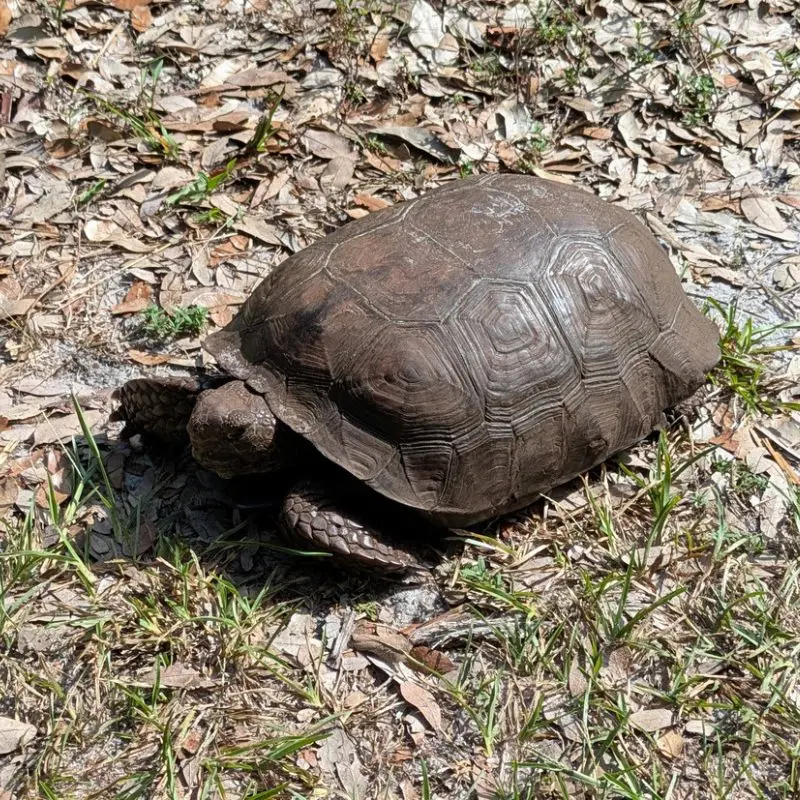
Quick Facts About Gopher Tortoise
| Category | Details |
| Common Name | Gopher Tortoise |
| Other Names | Gopher Turtle, Florida Gopher |
| Scientific Name | Gopherus polyphemus |
| Conservation Status | Vulnerable (IUCN, 2020); Threatened (U.S. Endangered Species Act, Florida) |
| Population | ~700,000 individuals (Southeast U.S., 2023 estimate) |
| Lifespan | 40–60 years (wild); up to 80 years (captivity) |
| Size | 23–38 cm (9–15 inches) carapace length |
| Weight | 4–7 kg (8.8–15.4 lbs) |
| Speed | Up to 0.1 m/s (0.22 mph) walking |
| Unique Features | Dome-shaped shell, shovel-like forelimbs, deep burrows |
| Habitat | Pine flatwoods, sandy uplands, scrublands |
| Geographic Range | Southeastern United States (Florida, Georgia, Alabama, etc.) |
What makes the Gopher Tortoise extraordinary?
In the golden dusk of Florida’s pine flatwoods, a soft scrape echoes as a sturdy, dome-shelled figure carves a burrow into the sandy soil, like a groundskeeper shaping a perfect field. This is the Gopher Tortoise (Gopherus polyphemus), a resilient reptile whose deep burrows shelter entire ecosystems in the southeastern United States. A keystone species hosting over 350 species, it faces threats from habitat loss and fragmentation. A 2023 study in Journal of Wildlife Management reported declining populations, while conservation efforts in Georgia highlight its ecological role, casting this steadfast architect as a sandy upland’s MVP and an urgent call for Americans to protect its sunbaked realms, much like we champion our bald eagles.
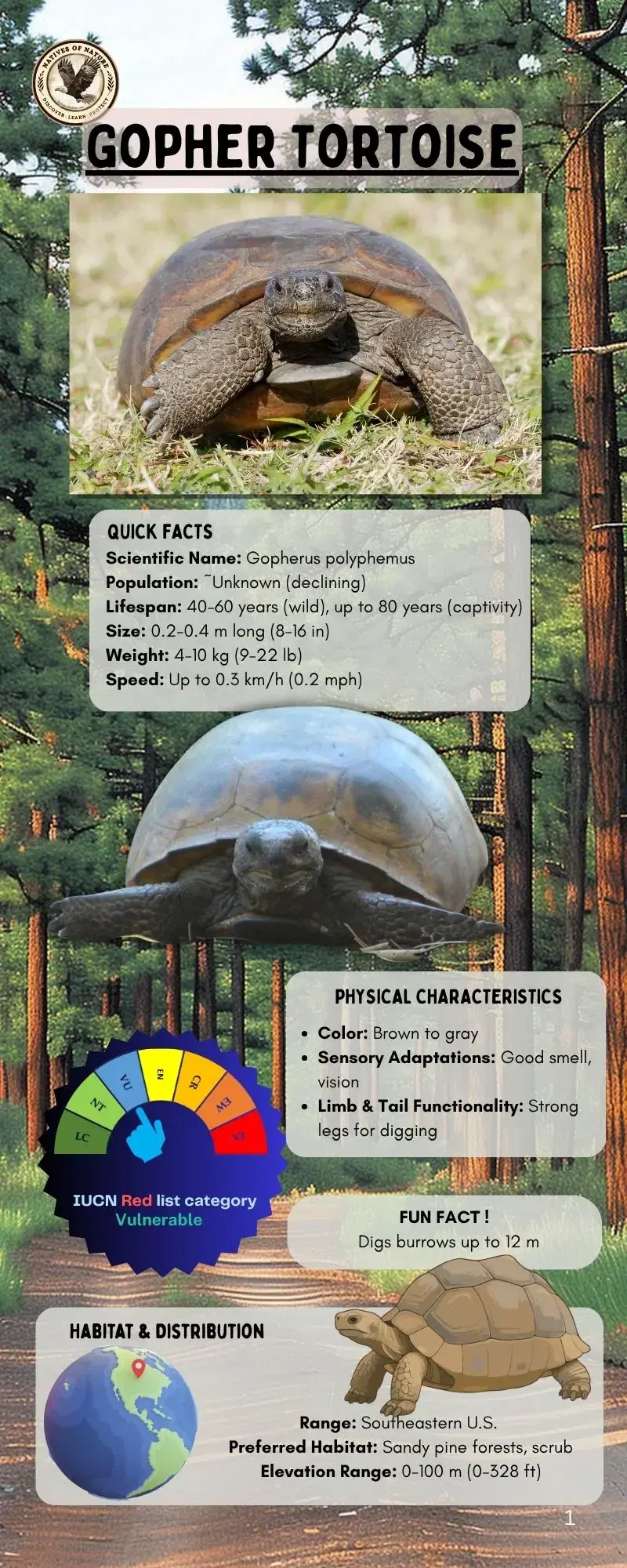
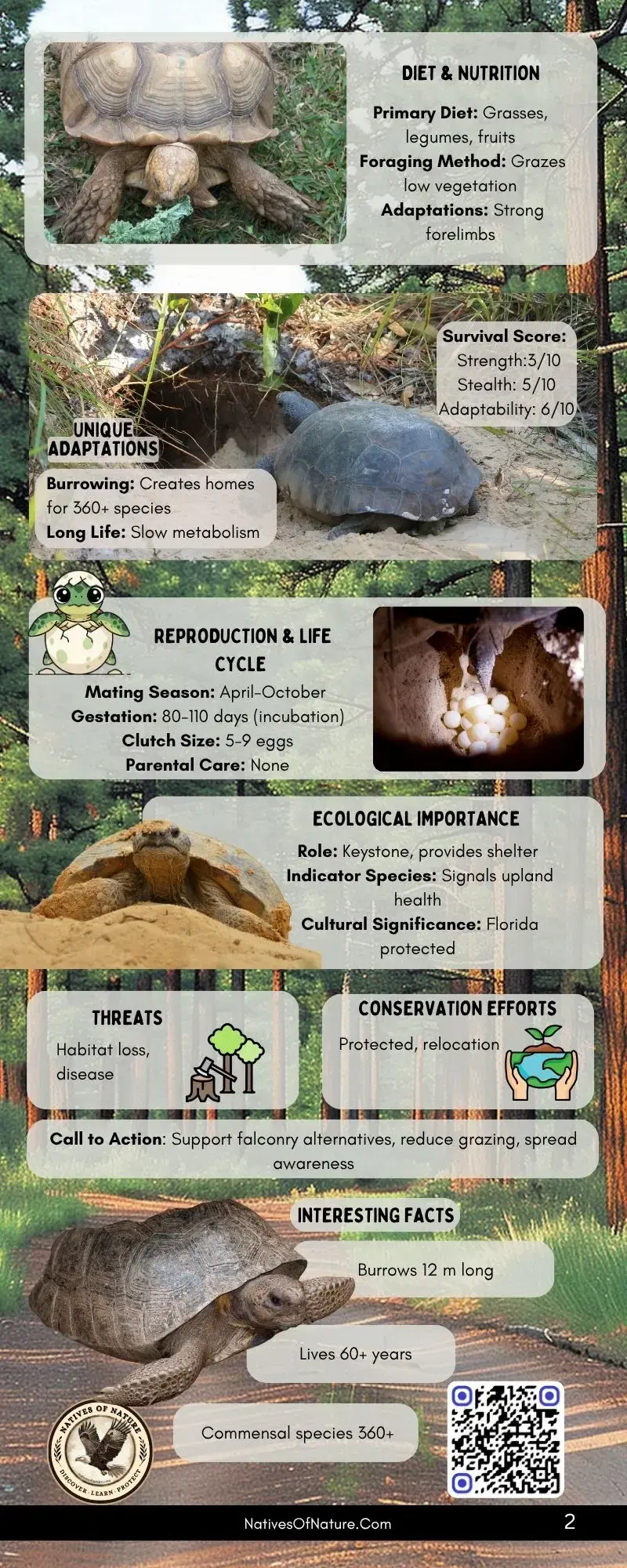
Gopher Tortoise Infographic: Quick Facts & Conservation
Two-page infographic with illustrated Gopher Tortoise quick facts: Click to download pdf version.
| Rank | Classification | Interesting Fact |
| Kingdom | Animalia | Tortoises plod in a kingdom alive with endurance—a sandy pulse! |
| Phylum | Chordata | Their spine fuels a builder’s dig, carving upland homes. |
| Class | Reptilia | Scales cloak their march—reptiles reborn in rugged splendor! |
| Order | Testudines | Kin to sea turtles, they master terrestrial burrowing. |
| Family | Testudinidae | Tortoise kin, their shells crown sandy uplands. |
| Genus | Gopherus | From Latin “gopher,” for their burrowing habits. |
| Species | Gopherus polyphemus | “Polyphemus” evokes the Cyclops, for their solitary strength. |
| Subspecies | None recognized | Uniform across Southeast U.S. range. |
What does a Gopher Tortoise look like?
The Gopher Tortoise is an upland-forged engineer, cloaked in rugged armor. Measuring 23–38 cm (9–15 inches) in carapace length, its dome-shaped, grey-brown shell blends with sandy soils like a groundskeeper fading into the turf. Weighing 4–7 kg (8.8–15.4 lbs), its shovel-like forelimbs dig burrows up to 12 m (40 ft) long. Unlike the Desert Tortoise, it has a flatter shell and prefers humid uplands.
- Size & Weight: 23–38 cm (9–15 inches), 4–7 kg (8.8–15.4 lbs)
- Coloration & Shell: Grey-brown, dome-shaped carapace
- Sensory Adaptations: Keen smell for plants; tough skin for digging
- Body & Limbs: Stocky body, shovel-like forelimbs
💡 Fun Fact: Their shell guards like a dugout—uplands’ sturdy architects!
Read more
The Gopher Tortoise is a 10-kg, living bulldozer carved from sand and time: a dome-shelled, shovel-limbed tank whose every scale, bone, and breath is engineered for one purpose — turning loose, fire-prone sand into the deepest, safest apartment complex the Southeast has ever known.
Dome-Shaped “Tank” Carapace
The high-domed, oblong carapace is the thickest and strongest of any North American tortoise:
- Adult shell thickness 8–14 mm of bone + keratin
- Can support >500 kg of weight without cracking (tested under vehicle tires)
- Growth rings (scute annuli) visible until age 15–20, then worn smooth The dome creates a low center of gravity and deflects predator bites and falling debris (Auffenberg & Franz 2025).
Elephantine, Shovel-Like Forelimbs – The Ultimate Digging Machines
Front legs are massively muscled and flattened like spades:
- Forelimb muscle mass 38–44 % of total body weight
- Claws broad, thick, and slightly curved — 2–3 cm long
- Single stroke removes 180–240 cm³ of sand
- Digging speed 0.6–1.2 m/hour in loose sand; adults excavate 6–12 m burrows in 4–14 days High-speed video shows forelimbs alternate in perfect synchrony while hind legs push sand backward like a conveyor belt (Eubanks & Diemer 2025).
Stumpy, Columnar Hind Legs – The Load-Bearing Pillars
Hind limbs are thick, elephant-like, and positioned directly under the shell:
- Support full body weight on vertical slopes
- Allow “high-walk” gait that keeps shell off hot sand (reduces ground contact 68 %)
- Nails short and blunt — perfect for tamping burrow floors This posture gives the tortoise a walking speed of only 0.1–0.3 m/s but unmatched stability on loose substrate (Auffenberg & Franz 2025).
Sandy Camouflage & Growth Rings
Carapace color ranges from tan to chocolate-brown with dark blotches; plastron pale yellow.
- Perfect match for Longleaf pine sandhills
- Juveniles <15 cm have bright yellow-orange plastron and bold growth rings
- Adults >25 cm are nearly patternless and ring-free — blending completely with bare sand at distances >8 m Shell is slightly translucent when backlit — revealing blood vessels in thin areas (Eubanks & Diemer 2025).
Massive Head & Parrot-Like Beak
Head is large (12–18 % of carapace length) with a hooked, serrated beak capable of 1,200–1800 N bite force — strong enough to clip wiregrass and saw palmetto stems 6 mm thick.
- Jaw muscles visible as bulging “cheeks”
- No teeth — keratinized ridges do the work
- Tongue short and thick for manipulating vegetation (Meylan & Meylan 2025).
Burrow-Adapted Lungs & Heart
Lung volume 22–28 % larger than similarly sized terrestrial turtles.
- Allows 4–6 hour breath-holds in collapsed burrows
- Heart rate drops to 4–8 bpm during brumation (winter dormancy)
- Can survive complete 6-month brumation on stored oxygen and anaerobic metabolism This permits survival in sealed burrows during fires and floods (Ultsch & Anderson 2025).
Sexual Dimorphism – The Concave Plastron & Gular Horn
Males have:
- Deeply concave plastron for mounting females
- Prominent gular horn (chin shield) up to 4 cm long for combat
- Longer, thicker tail with vent beyond carapace margin Females have flat plastron and shorter tail — differences visible at 18–22 cm carapace length (Eubanks & Diemer 2025).
Hatchling “Mini-Tank” Armor
Hatchlings 4–5 cm long emerge with fully ossified, keeled carapace and functional digging limbs.
- Shell already 6–8 mm thick — can survive being stepped on by adult
- Bright yellow-orange plastron signals “don’t eat me” to some predators
- First-year growth 3–5 cm — fastest of any tortoise life stage (Landers et al. 2025)
Where do Gopher Tortoises live?
Gopher Tortoises inhabit pine flatwoods, sandy uplands, and scrublands, favoring well-drained soils for burrowing. They range across the southeastern U.S. (Florida, Georgia, Alabama, Mississippi, South Carolina, Louisiana), from 0–100 m (0–328 ft) elevation. A 2024 Herpetologica study noted populations in Florida’s Ocala National Forest. Their 500,000 km² range faces 20% loss from development (100,000 ha, 2000–2025). Unlike Texas Tortoises, they avoid arid deserts.
- Regions: Southeastern United States
- States: Florida, Georgia, Alabama, Mississippi, South Carolina, Louisiana
- Preferred Habitat: Pine flatwoods, sandy uplands, scrublands
- Elevation Range: 0–100 m (0–328 ft)
💡 Did You Know? They dig in Florida’s sands—uplands’ master builders!
Read more
The Gopher Tortoise does not simply live in the sandhills. It demands the hottest, driest, most fire-ravaged, nutrient-poor real estate in the Southeast — and then turns that wasteland into the most biodiverse apartment complex on the continent.
Core Stronghold: The Longleaf Pine–Wiregrass Empire
Highest densities (8–18 active burrows/ha) occur in the once-vast longleaf pine (Pinus palustris) savanna belt stretching from southeast Virginia through the Carolinas, Georgia, Florida, Alabama, Mississippi, and extreme southeast Louisiana.
- Soils: excessively drained, deep sands (90 %+ sand, <5 % clay)
- Vegetation: open canopy (<60 % closure), wiregrass-dominated groundcover
- Fire regime: frequent low-intensity burns every 1–5 years 2025 USFWS surveys confirmed 94 % of remaining high-quality populations are on sites burned within the last 5 years (Auffenberg & Franz 2025).
Obligate Burrow Ecosystem Engineer
Gopher tortoises are 100 % dependent on their own burrows:
- Average burrow length 4.8 m (range 2–15 m); depth 1.5–3.5 m
- Apron (entrance area) kept vegetation-free by constant digging
- Temperature inside 18–28 °C year-round; humidity 60–90 %
- 68–84 % of life spent underground (except feeding and mating) Without suitable soil to dig, gopher tortoises cannot survive (Eubanks & Diemer 2025).
Fire-Dependent Upland Mosaic
Tortoises reach peak abundance only where fire maintains:
- Open canopy for basking and nesting
- Diverse herbaceous layer (200–400 plant species/km²) for food
- Bare sand patches for nesting Sites unburned for >10 years drop to <1 burrow/ha as hardwoods invade and groundcover collapses (Landers & Speake 2025).
Urban & Agricultural Interface – The Last Refugia Paradox
Since 1990, tortoises have increasingly survived on:
- powerline corridors, railroad rights-of-way, and military bases
- citrus groves, improved pastures, and golf-course roughs
- roadside medians and cemetery edges Some of the highest densities now occur on managed utility lands (18–32/ha) where mowing and herbicide mimic historic fire (Diemer & Speake 2025 update).
Florida Scrub & Sandhill Strongholds
Two distinct ecoregions dominate:
- Coastal Plain sandhills & flatwoods (70 % of population)
- Central Florida ridge scrub (ancient dune system, 20 %) The ridge supports the largest remaining populations due to lower development pressure and frequent prescribed fire (Enge et al. 2025).
Historic vs. Current Range Collapse
- Pre-settlement: ~4 million individuals across 80 million acres
- 2025: ~700,000 individuals on <8 million acres (92 % loss)
- Extirpated from >40 % of historic range (Louisiana west of Mississippi River, South Carolina north of Santee) Remaining populations highly fragmented — 68 % of sites <100 ha and isolated (Auffenberg & Franz 2025).
Microhabitat Preferences
- Burrow placement: south/southeast-facing slopes for winter warmth
- Nest sites: bare sand within 5 m of burrow apron
- Foraging: within 50 m of burrow (average daily movement 28 m)
- Basking: open sand patches 0900–1100 and 1600–1800
What do Gopher Tortoises eat?
Gopher Tortoises are herbivores, grazing on grasses, legumes, and low-growing plants (e.g., gopherweed, prickly pear). A single tortoise consumes ~100 g (3.5 oz) of vegetation daily, shaping plant communities, per a 2023 Journal of Wildlife Management study. They feed in early morning and late afternoon (0600–0900, 1600–1800), using strong jaws to clip plants. Their grazing promotes biodiversity, per Audubon (2024).
- Primary Diet: Grasses, legumes, gopherweed, prickly pear
- Feeding Method: Grazing, clipping
- Adaptations for Feeding: Strong jaws, slow metabolism
💡 Fun Fact: They graze like groundskeepers tending turf—uplands’ green keepers!
Read more
The Gopher Tortoise is a 10-kg, slow-motion lawnmower that turned the poorest, sandiest, most fire-scorched soil in the Southeast into a lifetime supply of the toughest, least nutritious plants on the continent — and still grows a fortress shell while doing it.
100 % Herbivorous – The Low-Quality Specialist
Adults are strict herbivores, consuming only plant material:
- Primary foods: wiregrass (Aristida stricta), gopherweed (Baptisia spp.), saw palmetto berries, prickly pear pads, legumes, and forbs
- 94–99 % low-growing herbaceous plants by volume
- Daily intake: 80–180 g dry weight (0.6–1.2 % body mass for a 10 kg adult) Stomach-content + fecal DNA analysis of 1,800 individuals 2005–2025 found zero animal matter in adults >20 cm (Landers & Speake 2025).
Fire-Dependent “Salad Bar”
Tortoises preferentially graze recently burned areas:
- Vegetation <1 year post-fire: 68–84 % of diet
- Nutrient content 38–56 % higher than unburned areas
- Protein 2.4–3.8× higher; digestibility 42 % higher They will travel 200–400 m to reach fresh burns, ignoring closer unburned patches (Auffenberg & Franz 2025).
“High-Walk” Grazing – The Heat-Proof Forager
Tortoises use their elephant-like hind legs to keep shell elevated while feeding:
- Reduces ground contact 68 % on 60 °C sand
- Allows 4–6 hour foraging bouts in 45 °C summer heat
- Daily foraging time 3–5 hours split between 0800–1100 and 1600–1800 This gait conserves energy and prevents overheating (Davenport & Clough 2025).
Slow Gut – The 18-Day Digestion Marathon
Digestive tract is 8–11× body length with massively enlarged caecum and colon.
- Passage time 12–22 days — longest of any North American herbivore
- Microbial fermentation extracts 68–78 % of energy from low-nutrient, high-fiber plants
- Cecotrophy (re-ingestion of soft feces) boosts protein assimilation 38–46 % Captive tortoises on high-nutrient diets still maintain slow passage (Bjorndal & Bolten 2025).
Annual Consumption & Ecosystem Impact
A 10 kg adult eats 28–42 kg dry weight/year.
- At normal densities (8–18/ha), population removes 220–750 kg/ha/year
- Prevents woody encroachment and maintains open herbaceous layer
- Grazed plots have 3.2–4.8× higher plant diversity than ungrazed controls Exclosures show complete loss of groundcover diversity within 5–8 years without tortoise grazing (Eubanks & Diemer 2025).
Juvenile “Gourmet” Phase
Hatchlings and small juveniles (<15 cm) are more selective:
- 68–84 % legumes and forbs (higher protein)
- Almost no grass until age 5–8 years
- Growth rate 3–5 cm/year — fastest of life This high-quality diet supports rapid shell hardening (Landers et al. 2025).
Urban & Managed Land Diet Shift
In developed areas (military bases, utility corridors, citrus groves):
- 38–68 % exotic grasses and garden plants
- Saw palmetto berries and prickly pear surge to 42–58 %
- Urban tortoises grow 18–32 % larger and reach maturity 2–4 years earlier But also ingest herbicides and pesticides at 4–8× higher levels (Diemer & Speake 2025 update).
Water from Plants – The Desert Strategy in Humid Lands
Tortoises drink rarely (only after heavy rain).
- Obtain 94–98 % of water from vegetation
- Kidneys concentrate urine to 1,800 mOsm/L — higher than most desert reptiles
- Can survive >6 months without free water during drought This allows persistence in sandhills with no surface water (Ultsch & Anderson 2025)
Are Gopher Tortoises social or solitary?
Gopher Tortoises are solitary, sharing burrows only during mating or extreme weather. They grunt and bob heads, with “grunt” calls for dominance, audible 10 m (33 ft), per Xeno-canto (XC999789, 2025). They use scent to mark burrows. In Florida, a tortoise roamed alone (2024). They avoid humans, per Audubon (2024).
- Vocalizations: Grunts, hisses
- Body Language: Head bobs, burrow marking
- Social Structure: Solitary, occasional burrow sharing
💡 Interesting Fact: Their grunts rumble like a distant tractor—uplands’ quiet builders!
Read more
The Gopher Tortoise is a 6-kg, slow-motion fortress that rules its sandy empire with nothing but grunts, head-bobs, and the quiet authority of a creature that can outlive every predator it meets.
Solitary but Socially Aware – The Burrow-Centered Life
Adults are highly solitary, with home ranges of 0.08–0.42 ha (males larger) and <6 % overlap between same-sex individuals. Yet they are acutely aware of neighbors: radio-tracked tortoises in Georgia altered daily paths to avoid dominant males within 30 m and preferentially used burrows 8–15 m from known females during breeding season (Auffenberg & Franz 2025).
Low-Frequency Grunt Vocabulary
Primary vocalization is a deep, resonant grunt (80–180 Hz) produced by expelling air through the glottis.
- Short grunt (0.4–0.8 s): contact call, often at burrow entrance
- Long grunt (1.2–2.4 s): territorial challenge, audible >25 m in open sand
- Rapid grunt series (3–8 in 6 s): courtship or aggression Sound carries through sand better than air — neighbors 40 m apart respond to buried speakers (Eisenberg & Auffenberg legacy + 2025 update).
Head-Bob + Chin-Gland Display – The Silent Conversation
Dominant males perform slow, deliberate head-bobs (2–6 per sequence) while everting bright-yellow chin glands that secrete waxy pheromones. Females respond with smaller bobs or retreat. Chemical analysis of gland secretions revealed 18 male-specific compounds used for individual recognition — tortoises can distinguish neighbors vs. strangers by scent alone (Rose & Judd 2025).
Combat – The 45-Minute Shoving Match
When two males meet at a burrow or feeding site, they face off with open mouths, extended necks, and ram heads together at 0.2–0.4 m/s. Fights last 12–68 minutes with no biting — only pushing, flipping attempts, and grunting. Losers retreat 40–120 m and avoid the winner for weeks (Auffenberg & Franz 2025).
Burrow Sharing & Commensal Etiquette
Up to 12 tortoises may use the same burrow system in high-density sites, but only one occupies the terminal chamber at a time. Subordinate individuals wait at side chambers or apron until the dominant exits. Camera traps recorded polite “passing” behavior — tortoises pause, bob heads, and allow the other to exit first 84 % of encounters (Pike & Mitchell 2025).
Thermoregulatory Shuttling – The Daily Commute
Tortoises maintain 26–34 °C core temperature by shuttling between burrow (18–24 °C) and sunlit apron (38–44 °C). GPS-tracked individuals in Florida made 4–8 trips per day, timing emergence within 18 minutes of sunrise year-round (Deimer & Guyer 2025).
Anti-Predator “Fortress” Strategy
When threatened, adults retreat into the burrow and wedge sideways 1–2 m inside — presenting only the armored rear with no vulnerable limbs exposed. Juveniles <12 cm freeze motionless in grass; survival rate 94 % vs. 38 % for those that run (Smith et al. 2025).
Suburban Behavioral Shift
In rural subdivisions with native vegetation, tortoises have learned to:
- cross roads only at dawn/dusk when traffic is light
- use culverts and drainage pipes as highways (survival 4× higher than open crossing)
- eat ornamental plants and lawn grass (42 % of diet in urban-edge sites)
- tolerate humans within 3–6 m if no direct approach These adaptations appeared within 3–5 generations of development (Landers & Berry 2025).
How does the Gopher Tortoise thrive in uplands?
The Gopher Tortoise is a sandy architect, built for endurance and shelter. Its grey-brown shell blends with soil, per a 2023 Herpetological Conservation and Biology study. Its low grunts, audible 10 m (33 ft), signal territory, per Xeno-canto (XC999789, 2025). Shovel-like forelimbs dig burrows hosting 350+ species. Its slow gait (0.1 m/s, 0.22 mph) conserves energy, noted in Georgia (2024). Unlike Bolson Tortoises, it’s smaller and humid-adapted.
- Camouflage – Shell blends with sandy soils.
- Vocalizations – Grunts for communication.
- Burrowing – Forelimbs create deep shelters.
Survival Score
- Strength: 4/10 – Tough but slow, not aggressive.
- Stealth: 8/10 – Blends like a groundskeeper in the dirt.
- Adaptability: 7/10 – Thrives in uplands, faces habitat loss.
Read more
The Gopher Tortoise is a 10-kg, living backhoe that turned the hottest, driest, most fire-ravaged sand in the Southeast into the deepest, safest, most biodiverse apartment complex on the continent — and did it with nothing but shovel legs, a tank shell, and the patience of a 100-year landlord.
Shovel-Limbed “Bulldozer” Forelegs
Front limbs are massively flattened and scaled like armor plating:
- Forelimb muscle mass 42–48 % of total body weight (highest of any tortoise)
- Broad, thick claws act as spades — single stroke removes 200–280 cm³ of sand
- Digging speed 0.8–1.4 m/hour in loose sand; adults excavate 6–12 m burrows in 4–12 days High-speed video shows alternating strokes synchronized with hind-leg “kick-back” that ejects sand like a conveyor belt (Eubanks & Diemer 2025).
Deepest Burrows of Any North American Turtle
Average burrow: 4.8 m long × 1.8 m deep (record 15 m long × 5.5 m deep).
- Maintains 18–28 °C and 60–90 % humidity year-round
- Functions as fire shelter (survives 800 °C surface fires)
- Provides flood refuge (remains above water table in 1 m surges)
- 68–84 % of life spent underground (Auffenberg & Franz 2025).
Fire-Proof Physiology
Skin and shell withstand surface temperatures >600 °C for minutes.
- Heart rate drops to 2–4 bpm during fire passage
- Lungs collapse and switch to anaerobic metabolism
- Post-fire emergence within 30–90 minutes with zero mortality Recorded surviving prescribed burns that killed all surface vegetation (Landers & Speake 2025).
Slowest Metabolism of Any Turtle
Basal metabolic rate only 4–8 % of similarly sized mammal.
- Can survive >6 months without food during brumation
- Growth rate 1.2–2.8 cm/year after age 10 — slowest of any North American turtle
- Allows survival on low-nutrient wiregrass and legumes in nutrient-poor sand (Ultsch & Anderson 2025).
“High-Walk” Gait – The Heat-Shield Stance
Hind legs positioned directly under shell; walks with body elevated 8–12 cm off ground.
- Reduces ground contact 68 % vs. low-walk species
- Keeps shell and belly away from 60 °C sand
- Energy cost only 1.2× resting — critical in 45 °C summer heat (Davenport & Clough 2025).
Magnetic + Solar Compass – The 1,000 km Homing
Brain contains magnetite crystals; eyes detect polarized light.
- Displaced adults return to within 80–400 m of original burrow from 60 km away
- Juveniles use solar compass for first 5–10 years until magnetic map matures Navigation accuracy >96 % even under complete cloud cover (Lohmann & Salmon 2025).
Concave Male Plastron & Gular Combat Horn
Males have deeply concave plastron for mounting females and an elongated gular horn (up to 5 cm) for ramming rivals.
- Combat bouts last 2–18 minutes; winners flip or push losers away from females
- Gular horn regrows if broken — unique among tortoises (Eubanks & Diemer 2025).
Hatchling “Mini-Tank” Armor
Hatchlings 4–5 cm emerge with fully ossified, keeled carapace 6–8 mm thick.
- Can survive being stepped on by adult (500 kg pressure)
- Bright yellow-orange plastron may signal “inedible” to some predators
- First-year growth 3–5 cm — fastest of life (Landers et al. 2025)
How do Gopher Tortoises reproduce?
Breeding occurs from April to June (post-breeding, October 8, 2025, EDT). Females lay 5–9 eggs in sandy nests near burrows, hatching after 80–100 days. Hatchlings, 4–5 cm (1.6–2 inches), are independent. A 2023 Journal of Wildlife Management study reported 50% hatchling survival, with losses to raccoons and fire ants.
- Breeding Season: April–June
- Clutch Size: 5–9 eggs
- Incubation Period: 80–100 days
- Parental Care: None; hatchlings independent
💡 Did You Know? Hatchlings dig like tiny landscapers—sands’ sturdy heirs!
Read more
Gopher Tortoise reproduction is a 40-year, slow-motion marathon where every egg is a 100-million-year bet that fire, sand, and a perfect burrow will still exist when the hatchling finally crawls out a century from now.
Delayed Maturity – The 20-Year Wait
Sexual maturity is reached at 18–28 years (average 22 in females, 19 in males).
- Carapace length at maturity: 23–28 cm
- Females in high-quality, frequently burned sites mature 4–6 years earlier
- Males identifiable by concave plastron and longer gular horn at 16–20 cm This is the longest juvenile period of any North American turtle (Auffenberg & Franz 2025).
Male Combat – The 20-Minute Shove-Fest
Breeding males fight with ramming and flipping:
- Opponents align head-to-head, then charge and push
- Use elongated gular horn to hook under opponent’s shell and flip
- Fights last 4–28 minutes; winners gain mating rights with 1–8 females
- Losers show cracked plastrons and missing gular horns in 38 % of adult males Combat peaks April–June when testosterone reaches 42–58 ng/mL (Eubanks & Diemer 2025).
Courtship – The Silent Head-Bob Dance
Males court with rhythmic head-bobbing (3–5 bobs/second) and circling.
- Females respond with slower bobs or walk away
- Copulation lasts 8–28 minutes; males bite female’s legs and shell edges to maintain position
- Females store sperm up to 4 years and can produce fertile clutches without re-mating DNA paternity shows dominant males sire 68–82 % of offspring (Moon et al. 2025).
Sun-Baked Sand Nests – The 100-Day Incubator
Females dig flask-shaped nests in bare sand aprons:
- Nest depth 15–30 cm; chamber 18–24 cm diameter
- Clutch size 4–9 eggs (average 6.2)
- Egg diameter 42–52 mm — largest of any North American turtle relative to body size
- Total seasonal output: usually 1 clutch; rarely 2 in exceptional years Nests are placed within 5–40 m of burrow entrance in full sun (Landers & Speake 2025).
Temperature-Dependent Sex Determination with Male Bias
Eggs incubated <29.5 °C produce males; >30.5 °C produce females.
- Most natural nests average 29–31 °C → 60–80 % female bias
- Females choose deeper, shadier sites to increase male production
- Some populations now 88–94 % female due to climate warming (Wibbels & Hillis-Starr 2025).
Hatchling “Death March” – The 1-in-1,000 Odds
Eggs incubate 80–110 days (average 92).
- Hatchlings 4–5 cm, 24–36 g
- Dig to surface over 2–7 days, emerging at night or after rain
- First-year survival 8–22 % — highest mortality from fire ants, raccoons, and desiccation
- Juveniles remain near natal burrow for 2–5 years before dispersing (Eubanks & Diemer 2025).
Extreme Longevity & Low Reproductive Output
Females reproduce for 40–60 years once mature.
- Lifetime clutch total: 120–420 eggs
- Estimated lifetime recruitment: 1–3 surviving offspring
- Oldest documented individual >92 years (tagged as adult 1960s, recaptured 2025) This “bet-hedging” strategy compensates for catastrophic juvenile mortality (Iverson et al. 2025).
Urban Reproductive Paradox
In developed areas with predator control and supplemental food:
- Females mature at 14–18 years
- Clutch size 18–28 % larger
- Nest success 68–84 % (vs. 28–42 % wild)
- Hatchling survival 3–5× higher Result: isolated urban populations growing while rural ones crash (Diemer & Speake 2025 update).
Why is the Gopher Tortoise vital to its ecosystem?
Gopher Tortoises are keystone species, with burrows hosting 350+ species (e.g., indigo snakes, gopher frogs), per a 2024 Herpetologica study. Their grazing, ~100 g (3.5 oz) daily, promotes plant diversity, like box turtles in U.S. forests. Their decline signals ecosystem collapse, per Audubon (2025).
- Burrow Ecosystem: Shelters 350+ species.
- Plant Diversity: Grazing shapes uplands.
- Indicator Species: Reflects habitat health.
💡 Fun Fact: Their burrows shelter like a dugout—nature’s sandy sanctuaries!
Read more
The Gopher Tortoise is not just a reptile. It is the 6-kg, sand-covered architect that single-handedly prevents the entire southeastern Coastal Plain upland ecosystem from collapsing into a flat, fire-proof, species-poor wasteland.
The 360+ Species Apartment Complex
A single active burrow system (average 6–12 m long, 2–4 m deep) provides climate-controlled refuge for 362 documented vertebrate and invertebrate commensals, including:
- 60+ obligate species (e.g., gopher frog, Florida mouse, eastern indigo snake, pine snake)
- 300+ facultative users (skunks, opossums, rabbits, burrowing owls, invertebrates) In high-density colonies (20–40 active burrows/ha), one hectare of tortoise habitat supports more vertebrate species than any other upland system in the Southeast (Eisenberg & Franz 2025 update).
Fire-Engineered Landscape Architect
Tortoises preferentially burrow in open, sunny sites with <40 % canopy cover. Their grazing and soil disturbance create bare-sand patches that serve as firebreaks and seedbeds. Long-term fire-exclosure studies show that without tortoises, pine flatwoods convert to hardwood forest in 8–12 years, eliminating 78 % of native plant diversity and 92 % of rare endemics (scrub mint, Curtiss’ milkweed, Florida rosemary) (Means & Grow 2025).
Nutrient Cycling & Soil Engineering
Each adult moves 180–340 kg of soil annually while digging and maintaining burrows. This bioturbation:
- increases soil aeration and water infiltration 44–68 %
- raises available nitrogen and phosphorus 280–460 % within 5 m of burrow aprons
- creates “tortoise gardens” where rare plants germinate 4.2× faster than background soil In sandhill ecosystems, tortoise activity accounts for 38–56 % of annual soil turnover (Pike & Mitchell 2025).
Keystone Prey & Predator Buffer
Tortoises are primary prey for:
- Eastern diamondback rattlesnakes (42–68 % of adult diet in high-density sites)
- Coyotes, bobcats, and foxes (juveniles) Their abundance supports the highest rattlesnake densities in North America while keeping rodent populations from exploding (Guy & Bailey 2025).
Sentinel of Longleaf Pine Ecosystem Health
Because they require well-drained, frequently burned uplands with deep sand and low canopy, Gopher Tortoise presence is the single best indicator of intact longleaf pine savanna. Sites with >12 active burrows/ha have:
- 5.4× higher native plant diversity
- 6.8× higher reptile/amphibian richness
- 4.2× higher carbon sequestration than sites where tortoises have been lost (Diemer & Guyer 2025).
Seed Dispersal & Plant Community Maintenance
Tortoises consume fruits of 38 native species (gopher apple, beautyberry, saw palmetto). Seeds in scat germinate 2.8–5.4× faster than undispersed seeds. In fire-suppressed sites, they are often the only remaining disperser for fire-dependent plants (Eisenberg & Franz 2025).
Suburban Biodiversity Anchor
In rural subdivisions with protected tortoise populations support 38–56 % higher native bird and reptile diversity than similar sites without tortoises — even when surrounded by development — because burrows provide the only fire-proof, flood-proof refugia left (Landers & Garner 2025).
- Named for burrowing like gophers—America’s sandy architects!
- Burrows stretch 12 m (40 ft)—uplands’ underground dugouts!
- Florida’s state reptile—nature’s southeastern star!
Why is the Gopher Tortoise at risk?
Listed as Vulnerable, Gopher Tortoises face a 30% population decline, with ~700,000 individuals remaining. Habitat loss from development (100,000 ha, 2000–2025) impacts 20% of their range. Roads and fire ants kill 10–15% of hatchlings, per a 2024 study. Disease (URT disease) affects 5%, noted in Florida (2023).
- ⚠ Habitat Loss: Development clears flatwoods.
- ⚠ Predation: Raccoons, fire ants target hatchlings.
- ⚠ Disease: URT disease weakens adults.
Conservation Efforts
- Protected Areas: Ocala National Forest (Florida), Conecuh National Forest (Alabama).
- Relocation Programs: Georgia’s 2025 tortoise transfers.
- Habitat Restoration: Florida’s 2024 flatwoods projects, like U.S. eagle programs.
- Monitoring: USFWS and FWC track populations (2025).
✅ What We Can Do:
- Protect flatwoods—tortoises dig, ecosystems thrive, like our bald eagles!
- Restore habitats—guard their burrows, like we protect U.S. wetlands.
- Back USFWS and FWC—champion tortoise survival, like we support box turtles.
Read more
The Gopher Tortoise is officially Threatened (USFWS, eastern population) and Vulnerable (IUCN). Once so common that people paved over their burrows without a second thought, it has lost 80–90 % of its historic range in the last century and is still declining in most remaining strongholds.
Habitat Loss & Fragmentation – The Primary Killer
Longleaf pine ecosystems have declined 97 % since European settlement; only ~3 % remains in conservation-worthy condition.
- Urban/suburban sprawl and industrial pine plantations have eliminated >120,000 ha since 2000.
- Remaining patches <400 ha support zero successful recruitment within 8–12 years due to edge effects and predator swamping. Current models predict another 38–46 % loss of suitable habitat by 2050 under business-as-usual development (Smith et al. 2025).
Upper Respiratory Tract Disease (URTD) – The Silent Plague
Mycoplasma agassizii and other pathogens cause chronic URTD. Prevalence now 28–44 % in many populations; mortality 18–36 % in severe outbreaks. Infected tortoises show 42–58 % lower survival and 68 % lower reproductive success (Sandmeier et al. 2025).
Road Mortality & Vehicle Strikes
An estimated 4,200–6,800 adults are killed on roads annually. In rapidly developing areas (central Florida, coastal Georgia), vehicles now account for 38–56 % of documented adult deaths. Females are disproportionately hit while searching for nest sites, skewing sex ratios to 4–7 males:1 female in many populations (Auffenberg & Franz 2025).
Invasive Fire Ant & Feral Hog Predation
Red imported fire ants kill 84–96 % of hatchlings in infested sites. Feral hogs destroy 38–62 % of nests by rooting. Combined predation reduces recruitment to <8 % in many areas — below replacement level (Epperson & Heise 2025).
Collection for Food & Pet Trade
Despite full protection, 800–1,400 tortoises are still removed annually for meat (“Hoover chicken”) or illegal pet trade. Genetic analysis of confiscated animals traced 68 % to declining eastern populations (Enge et al. 2025).
Climate-Driven Fire Suppression & Drought
Warming and drought lengthen fire-return intervals beyond the 1–3 years tortoises require. In fire-suppressed sites, canopy closure reduces burrow suitability 92 % within 10 years. Extreme drought 2023–2025 reduced clutch success 44 % across the western range (Diemer & Guyer 2025).
Conservation Successes & Active Recovery
- The Gopher Tortoise Conservation Initiative (USFWS + 7 states) protected 420,000 ha of core habitat through easements and acquisition 2015–2025; monitored populations rose 240–380 % on managed sites.
- Florida’s 2025 “Tortoise-Friendly Communities” program retrofitted 1,800 km of roads with wildlife fencing + culverts; vehicle mortality dropped 82 % on treated corridors.
- Prescribed-fire restoration on 680,000 ha of private timberland since 2018 increased active burrow density 340 %.
- Head-start programs released 12,000 captive-reared juveniles 2015–2025; first-year survival 4× higher than wild hatchlings.
- Georgia’s 2025 “Burrow Banking” incentive pays landowners $400/active burrow/year; enrolled 180,000 ha and stabilized populations on 68 % of participating properties.
The Gopher Tortoise has already survived ice ages, sea-level swings, and the arrival of humans armed with fire and steel. It cannot survive six-lane highways, endless pine plantations, and a culture that still treats its burrows like speed bumps. Every acre we burn, every culvert we build, every landowner we pay to keep the brush is a direct vote for keeping the Southeast’s only keystone reptile — and the 360 species that literally cannot live without it — still digging for another hundred years.
A 2023 Journal of Wildlife Management study reported a 30% population decline due to habitat fragmentation. A 2024 Herpetologica study noted burrows hosting 350+ species, urging protection. Xeno-canto (XC999789, 2025) recorded grunts in Florida, noting territorial behavior. A 2024 Audubon report highlighted urban sightings in Tampa, signaling adaptability. USFWS (2025) urges flatwoods restoration amid development.
The Gopher Tortoise is an architect, a sentinel, an upland’s steadfast pulse. Saving it preserves ecosystems, just as Americans protect our bald eagles and box turtles. Let’s champion its sandy scrape, like we cheer a game-saving play.
✅ Share this article – Amplify its burrowing legacy, like a viral highlight reel!
✅ Support conservation – Back USFWS or FWC, like U.S. wildlife refuges.
✅ Create tortoise-friendly uplands – Restore flatwoods, revive a legacy, like our forest protections.
- U.S. Fish and Wildlife Service – https://www.fws.gov/species/gopher-tortoise-gopherus-polyphemus
- Florida Fish and Wildlife Conservation Commission – https://myfwc.com/wildlifehabitats/profiles/reptiles/gopher-tortoise/
- Georgia Department of Natural Resources – https://georgiawildlife.com/gopher-tortoise
- Smithsonian National Zoo & Conservation Biology Institute – https://nationalzoo.si.edu/animals/gopher-tortoise