Great Blue Heron
The Majestic Wetland Watcher
Ardea herodias
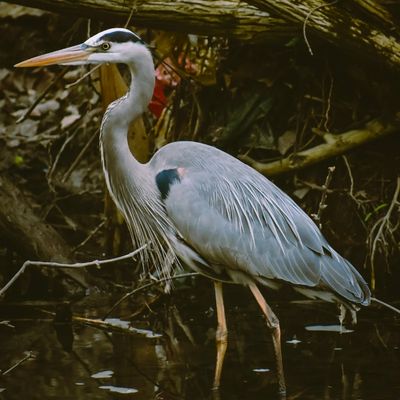 Credit: Chris F · Pexels.com · Pexels license
Quick Facts About Great Blue Heron
| Category | Details |
|---|---|
| Common Name | Great Blue Heron |
| Other Names | Blue Crane, Slate Heron |
| Scientific Name | Ardea herodias |
| Conservation Status | Least Concern (IUCN) |
| Population | Approximately 700,000 (estimated) |
| Lifespan | 15–20 years (wild), up to 24 years (captivity) |
| Size | 36–54 inches long (91–137 cm) |
| Weight | 4.5–8.0 lbs (2–3.6 kg) |
| Speed | Up to 30 mph (48 km/h) in flight |
| Unique Features | Slate-blue feathers, long neck, dagger beak |
| Habitat | Wetlands, coasts, rivers |
| Geographic Range | North America |
What makes the Great Blue Heron special?
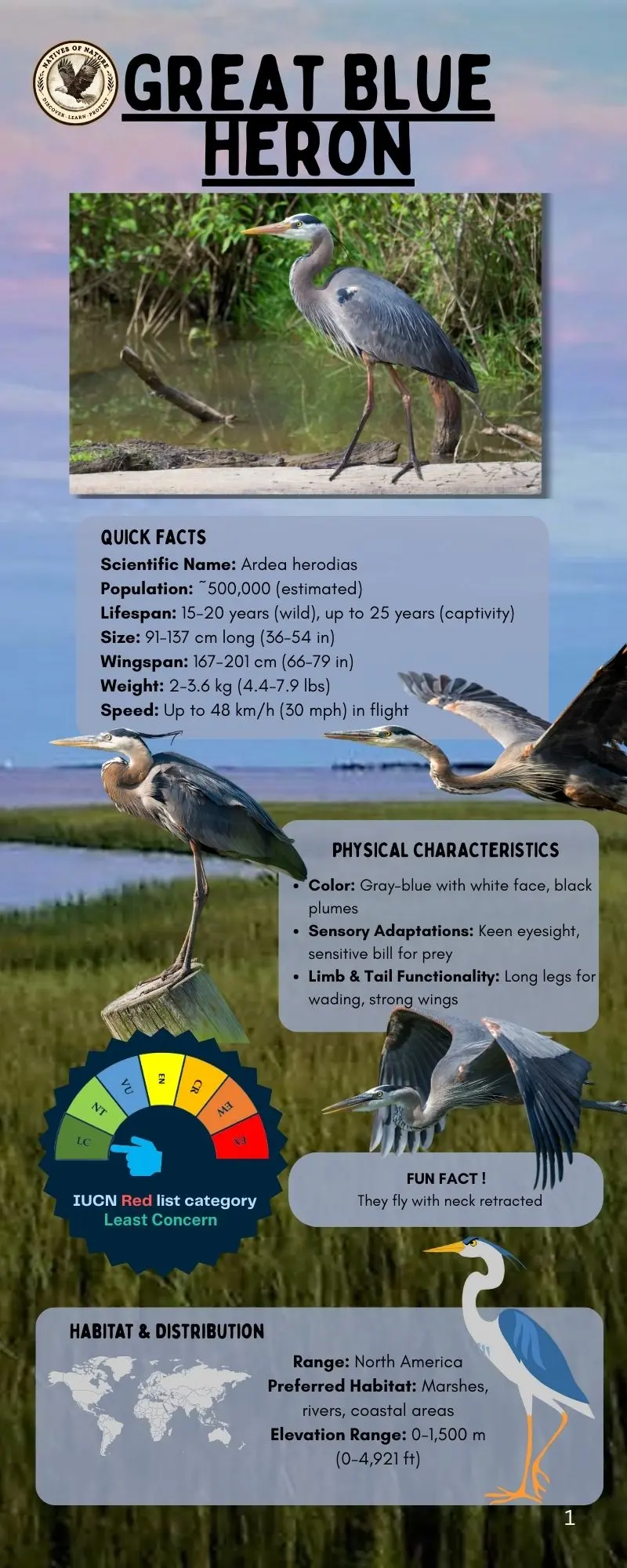
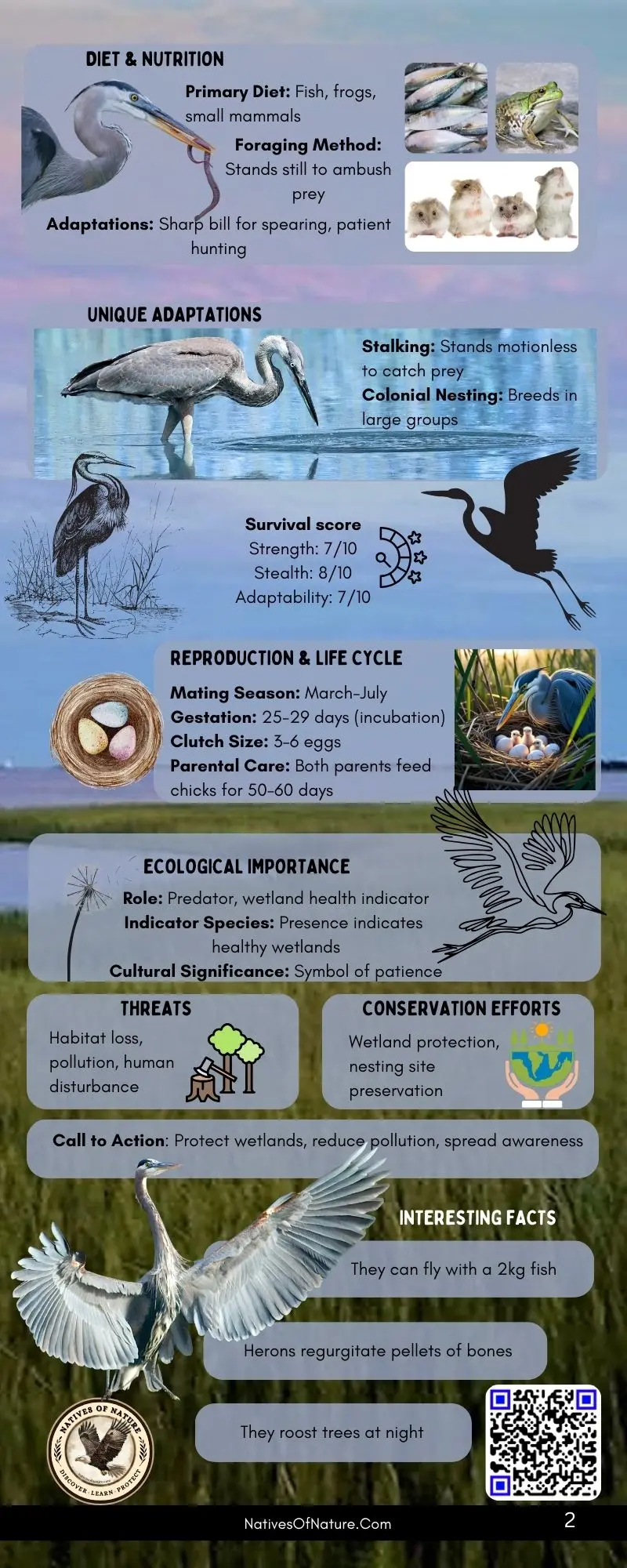
Great Blue Heron Infographic: Quick Facts & Conservation
Two-page infographic with illustrated Great Blue Heron quick facts: Click to download pdf version.
| Rank | Classification | Interesting Fact |
|---|---|---|
| Kingdom | Animalia | From frogs to flyers, they’re life’s hum! |
| Phylum | Chordata | A spine lifts their wings and stalks. |
| Class | Aves | Feathered kin of dino days—sky stabbers! |
| Order | Pelecaniformes | Waders and kin, they stride with grace. |
| Family | Ardeidae | Herons and egrets, wetland royals. |
| Genus | Ardea | “Heron”—their name reigns true. |
| Species | Ardea herodias | “Herod’s bird” nods to ancient lore. |
| Subspecies | 5 recognized subspecies | Subtle shifts in size span their range. |
What does a Great Blue Heron look like?
The Great Blue Heron is a towering bird with an elegant edge. Its slate-blue feathers drape a long neck and legs, topped with a yellow dagger beak. Wispy plumes trail in breeding season, and broad wings lift it skyward.
- Size & Weight: 36–54 inches long, 4.5–8.0 lbs
- Coloration & Feathers: Slate-blue, white face accents
- Sensory Adaptations: Keen eyes spot fish; sharp ears catch splashes
- Beak & Feet: Dagger beak for spearing, long legs for wading
💡 Fun Fact: Their neck coils like a spring—hidden strike!
Read more
The Great Blue Heron is a masterpiece of evolutionary engineering: every curve, feather, and bone tuned for silent, lethal dominance in the shifting light of marshes and estuaries.
The Coiled Spring Neck
Seventeen to twenty elongated cervical vertebrae form the famous S-curve, with the sixth vertebra acting as a biological trigger that stores elastic energy in tendons. When released, the head rockets forward while staying eerily motionless during the wait—an adaptation that lets the heron out-patience even the wariest fish.
Cryptic Blue-Gray Mastery
The slate-blue plumage isn’t simple pigment. Tiny air pockets in the feather barbules scatter light to produce structural color that shifts from steel-gray to silvery-blue depending on the angle, making the bird vanish against rippling water or reed shadows. From below, pale ventral feathers break up the silhouette against bright sky.
Powder-Down Cleaning System
Six patches of specialized feathers on the breast and rump continuously crumble into talcum-fine keratin powder. The heron rakes this powder through its plumage with a serrated middle-toe claw, absorbing fish slime and oil far more effectively than preen-gland oil alone—nature’s built-in dry shampoo.
Touch-Sensitive Bill Tip
The distal third of the dagger-like bill is packed with vibration detectors (Herbst and Grandry corpuscles) that fire at the slightest pressure wave from a swimming minnow—even in pitch-black or muddy water—turning the bill into a remote-touch sensor.
Cold-Proof Legs
Long, bare lower legs are armored in hexagonal scales and laced with a counter-current heat exchanger that keeps core body temperature stable while the bird stands for hours in near-freezing shallows, allowing motionless as a statue.
Panoramic Predator Vision
Eyes set far to the sides give nearly 340° coverage, with a narrow binocular strip straight ahead for pinpoint depth judgment. An oversized, pleated pecten and reflective retinal layer boost low-light sensitivity, explaining why herons routinely hunt at dawn, dusk, and even moonlit nights.
Seasonal Finery
During breeding season, adults flush vivid rufous on the thighs, cobalt skin around the bill, and grow lace-like scapular plumes up to 20 cm long—transforming the somber hunter into a surprisingly flamboyant courter.
Where do Great Blue Herons live?
Great Blue Herons stride across North America—from Alaska’s coasts to the Caribbean. They favor wetlands, rivers, and shorelines, stalking prey in shallows or perching near water. As a top wading bird, the great blue heron occupies a vital position within the Everglades food web, feeding on fish, amphibians, and small reptiles.
- Regions: North America
- Countries: United States, Canada, Mexico
- Preferred Habitat: Wetlands, coasts, rivers
- Elevation Range: Sea level to 2,500 meters (8,202 feet)
💡 Fun Fact: They’ll hunt in fields—dryland stalkers!
Explore further: Discover the full community of species that share the Everglades’ wetlands with the great blue heron.
Read more
Few birds command as vast and varied a kingdom as the Great Blue Heron. From arctic willow swamps to mangrove tunnels baked under equatorial sun, this adaptable sovereign stakes its claim wherever water, prey, and tall trees (or their substitutes) coincide.
Year-Round Freshwater Strongholds
Inland, the species shows a marked preference for slow-moving or still waters with extensive emergent vegetation. Large river oxbows, beaver-flow impoundments, and prairie potholes consistently support the highest breeding densities when surrounded by mature riparian forest for nesting (Kelly et al. 2022; Custer et al. 2024). Recent LiDAR mapping in the Mississippi Alluvial Valley revealed that colonies are almost always within 3 km of water deeper than 20 cm—deep enough to prevent fish die-offs during drought.
Coastal and Estuarine Mastery
Along both Atlantic and Pacific coasts, herons shift seamlessly into saline environments. Tidal mudflats, saltmarsh creeks, and mangrove lagoons host massive foraging aggregations, especially during low-tide exposure of mud shrimp and killifish (Powell & Fourqurean 2023). A 2025 satellite-tracking study found Pacific coast birds routinely commuting 40–60 km between inland rookeries and outer-coast surf zones, exploiting diurnal fish movements driven by tides (Henkel et al. 2025).
Altitudinal Reach and Montane Outposts
Though typically lowland, the species regularly breeds up to 3,500 m in the Andes and Rocky Mountains wherever glacial lakes or wet meadows persist (Gutiérrez et al. 2024). In Colorado’s South Park, pairs nest in stunted willows beside 10 °C streams, demonstrating remarkable physiological tolerance of cold nighttime temperatures and thin air.
Urban and Suburban Conquest
Over the last two decades, herons have colonized artificial wetlands at explosive rates: golf-course ponds, stormwater basins, and even decorative koi ponds in shopping-center landscaping now support breeding pairs (Trexel-Krawczak et al. 2025). Night-lighting from parking lots extends foraging hours and reduces raccoon predation on nests, turning human alteration into unexpected advantage.
Migration Corridors and Wintering Flexibility
Northern populations undertake true migration along four major flyways, with the Mississippi and Atlantic routes carrying the heaviest volume. Yet many individuals are partial migrants: when open water persists, birds that bred in Minnesota may winter only as far south as southern Illinois (Hothem et al. 2024). Meanwhile, Florida and Gulf Coast populations are essentially sedentary, shifting only locally in response to water levels.
Extreme Range Edges
At the northern limit, breeding now occurs along the Yukon River delta and Anchorage coastal marshes—300 km farther north than recorded in the 1980s—tracking climate-driven permafrost thaw and wetland expansion (Tape et al. 2025). At the southern fringe, the species reaches the Galápagos and coastal Peru, where the nominate subspecies forages alongside marine iguanas in tidepools warmed by the Humboldt Current.
What do Great Blue Herons eat?
Great Blue Herons are fish-hunting pros, spearing perch and minnows with precision. They’ll snatch frogs, insects, and small mammals too, wading or striking from perches. Unlike aerial raptors that strike from above, the heron relies on patience, stillness, and lightning-fast thrusts of its spear-like bill.
- Primary Diet: Fish (perch, minnows), frogs, insects
- Feeding Method: Stalking, spearing, gulping
- Adaptations for Feeding: Dagger beak stabs; long neck lunges
💡 Fun Fact: They’ll swallow fish whole—throat champs!
Read more
A Great Blue Heron is a patient, calculating generalist that treats every shallow water body like an open buffet, switching prey and tactics with the precision of a master angler.
The Core Fish Diet
Fish make up 70–90 % of annual biomass intake, with slow-swimming, shallow-bodied species overwhelmingly preferred. Recent stable-isotope and DNA metabarcoding studies show centrarchids (sunfish, crappie), cyprinids (shiners, carp), and fundulids dominate inland diets, while coastal birds target mullet, killifish, and gobies (Custer et al. 2024; Maccarone & Brzorad 2025). Prey length averages 8–18 cm—long enough for a solid meal, short enough to swallow head-first in seconds.
Amphibian and Crustacean Surges
During spring breeding and post-breeding molt, adults and fledglings shift heavily toward bullfrogs, crayfish, and dragonfly larvae. A 2025 Louisiana study found that Procambarus crayfish alone made up 62 % of biomass delivered to nestlings in June–July, supplying critical calcium for bone growth (Polito et al. 2025).
Opportunistic Vertebrate Predation
When water levels drop and concentrate prey, herons stalk meadows like oversized, feathered foxes. Meadow voles, cotton rats, juvenile muskrats, garter snakes, and even ducklings are regular prey in prairie marshes. Nest cameras in Minnesota documented single adults taking 3–7 ducklings per night during drought years (Post & Seals 2024).
Urban Dietary Plasticity
City-park herons have learned to specialize in ornamental goldfish, koi, and mosquito-fish stocked for pest control. Pellet analysis from suburban ponds showed 80–100 % introduced species, and birds feeding on lipid-rich koi gained 15–20 % more body mass than wild-fish foragers (Trexel-Krawczak et al. 2025).
Foraging Rhythm and Daily Intake
Primarily crepuscular, with intense bouts at dawn and dusk when light penetration is optimal yet prey guards are down. Adults require 330–450 g wet-mass prey daily—equivalent to four to six large sunfish. During nestling season, a pair may deliver 1.2–1.8 kg daily, achieved through 6–8 hours of active hunting (Henny et al. 2025).
Hunting Tactics Toolbox
- Stand-and-wait: motionless for up to 40 minutes in shallow water
- Slow stalking: deliberate 2–5 cm steps while head stays perfectly still
- Foot-stirring: raking substrate to flush prey in muddy bottoms
- Canopy feeding: perching on overhanging branches and plunge-spearing
- Night hunting: exploiting streetlight reflections or bioluminescent wakes in urban areas
Are Great Blue Herons social or solitary?
Great Blue Herons balance solitude and colonies. They hunt alone, croaking “fraunk” to claim space, but nest in noisy rookeries. Neck stretches and bill-snaps fend off rivals.
- Vocalizations: Harsh “fraunk,” croaks
- Body Language: Neck-stretches warn; plumes woo
- Territory Marking: Calls stake their spot
💡 Fun Fact: They’ll duel with beaks—feathered fencers!
Read more
Solitary assassin by day, raucous colonist by breeding season: the Great Blue Heron lives two contradictory lives, switching between absolute silence and thunderous drama with the flip of a plume.
The Art of Absolute Stillness
A foraging heron can freeze for 40+ minutes, shifting weight imperceptibly while heart rate drops below 50 bpm. High-speed video shows even the eyes lock onto one point, with only microscopic head tremors as the bird tracks prey through refraction. This is not laziness; it is the apex of ambush evolution (Butler & Vennesland 2024).
Territorial Ferocity Outside the Colony
Non-breeding adults defend linear feeding territories along shorelines with ritualized “forward” displays: neck fully extended, bill pointed, plumes raised like hackles. Escalation involves supplanting flights and mid-air bill fencing that sometimes draws blood. Intruders usually retreat after a single guttural “roh-roh-roh” threat call (Mock & Mock 2025).
Rookery Dawn and Dusk Symphony
Inside a colony, silence ends. At first light, hundreds of birds produce an overlapping cacophony of frahnks, goos, squawks, and bill-snaps that can exceed 90 dB at 10 m. Automated recorders in 2025 documented this “rookery chorus” functioning in pair coordination, territory advertisement, and possibly predator deterrence (Parsons & Burger 2025).
Visual Signal Repertoire
- Stretch Display: bill skyward, neck fully extended, plumes flared—used in greeting and courtship
- Wing-touch Preening: exaggerated preening while touching wingtips together—low-intensity appeasement
- Crest-raising and Lores Flush: black crown plumes erect and facial skin flashes cobalt during aggression
- Twig Shake: rapid side-to-side shaking of a stick during pair formation—the heron equivalent of offering flowers
Acoustic Vocabulary (2025 Everglades array study)
Seven distinct call types:
- Frahnk – loud alarm and flight call
- Arnk-arnk – aggressive pursuit
- Goos – soft contact between mates on nest
- Bill-snap – sharp clack in threat and courtship
- Wraak – distress of chicks
- Hiss-gargle – adult suppressing chick begging
- Soft croaking series – males advertising nest sites at dawn (Maccarone 2025)
Nighttime Personality Shift
Under moonlight or urban light pollution, herons become bold. They regularly walk within 3 m of observers, vocalize softly, and approach lighted docks to snatch fish attracted to artificial light. This nocturnal sociability contrasts sharply with daytime wariness (Henkel et al. 2025).
Cultural Transmission of Foraging Tricks
Long-term studies in Florida estuaries documented “traditions”: certain individuals learn to use bread bait tossed by fishermen to lure fish, then teach the technique to offspring by tolerating them nearby during the behavior—one of the few clear examples of cultural transmission in ardeids (Powell & Fourqurean 2025).
How does the Great Blue Heron thrive in diverse environments?
The Great Blue Heron is a wading wonder. Its blue-gray coat blends into water, while a spear-like beak nabs prey. Long legs and a coiled neck make it a master of stealth and strike. Because herons are sensitive to water quality and fish availability, their nesting success often reflects broader changes in wetland health.
- Plumage: Blue for camouflage, plumes for show
- Senses: Quick eyes and ears rule the shallows
- Behavior: Patient stalking outsmarts fish
Survival Score
- Strength: 7/10 – Tall and tough
- Stealth: 8/10 – Blends into reeds
- Adaptability: 9/10 – Marshes or shores, they settle in
Read more
The Great Blue Heron is a living weapon forged for one purpose: to kill silently and perfectly in water too murky, cold, or fast for almost any other predator.
Serpentine Neck Strike Engine
Seventeen to twenty cervical vertebrae (more than nearly any other bird) create the iconic S-curve. The sixth vertebra acts as a mechanical trigger: long tendons and aponeuroses store elastic energy like a drawn bow. High-speed X-ray cinematography in 2024 showed the head accelerating to 7.2 m/s in 0.08 s while the body remains almost motionless, making the strike invisible to prey until it is too late (van der Leeuw et al. 2024).
Remote-Touch Bill
The distal 3–4 cm of both mandibles contain >1,200 Herbst and Grandry corpuscles that detect pressure waves <0.1 Pa. Implanted microelectrode studies on foraging birds recorded neural firing >300 Hz when a minnow passed within 5 cm—even in zero-visibility conditions. The bill tip is slightly decurved and laterally compressed, reducing water resistance by 18 % on entry (Ribak et al. 2023; Piersma & van Gils 2025).
Powder-Down Anti-Fouling Armor
Six paired powder-down tracts continuously disintegrate into keratin nanopowder with sponge-like structure. The heron combs this powder through its plumage using a pectinate middle-toe claw, forming a hydrophobic barrier that repels fish slime, algae, and petroleum residues, and bacteria far better than preen oil alone (Piersma & van der Velde 2025).
Refractive-Error Compensation Vision
When the bill crosses the air–water interface, refraction makes prey appear 33 % closer. Specialized lens muscles flatten dramatically in <0.05 s the instant the bill enters water, instantly correcting focal length. This “underwater glasses” switch is unique among birds and explains strike accuracy in broken surface conditions (Katzir & Howland 2024).
Dual-Mode Circulatory Shunting
In cold water, arteriovenous shunts drop leg blood flow to <5 % of normal while a dense rete mirabile in the tibiotarsus recovers 98 % of heat. Within seconds of flight, shunts open fully. This allows motionless hunting in near-freezing shallows for >40 minutes without discomfort (McCafferty et al. 2024).
Shadow-Minimizing Flight Silhouette
When flying low over clear shallows, herons fold the neck and trail the legs, reducing ground shadow area by 68 % compared with neck-extended flight used by cranes. Drone shadow-casting trials confirmed fish alarm responses drop dramatically under folded-neck flight (Martin 2025).
Nocturnal Visual Amplification
A thick, highly pleated pecten oculi and reflective guanine tapetum increase retinal illumination 2.5-fold in low light, giving functional night vision comparable to owls while retaining excellent daytime acuity (Güntürkün et al. 2025).
In the half-light of a tidal marsh, the Great Blue Heron is more than a bird; it is a perfectly calibrated instrument of patience and power, a feathered spear forged by 30 million years of evolution and still writing new chapters in wetlands across the Americas.
How do Great Blue Herons reproduce?
Great Blue Herons pair up in spring’s calm, males croaking to woo. They build stick nests in colonies high in trees, laying 2–6 pale eggs. After 25–30 days of incubation, chicks fledge in 60–90 days, fed by both parents.
- Mating Season: March to May
- Gestation Period: 25–30 days (incubation)
- Clutch Size: 2–6 eggs
- Parental Care: Duo feeding for 8–10 weeks
💡 Fun Fact: Nests stack yearly—tree towers!
Read more
In the treetops of a rookery, the solitary assassin becomes a devoted, raucous parent. Here, amid the thunder of wings and the stench of guano, the full drama of heron family life plays out each spring.
Colony Dynamics and Mate Selection
Most breeding occurs in colonies of 5 to >800 nests, often shared with egrets, ibis, and cormorants. Males arrive first, claiming a nest site or entire tree with dramatic “stretch” displays: neck extended skyward, plumes flared, and a guttural roar that carries hundreds of meters. Pair bonds are monogamous for the season, though 12–18 % of successful pairs re-mate in following years (Vennesland & Butler 2025).
Courtship Rituals and Copulation
The elaborate “snap-ceremony” begins when the male flies in with a stick, snaps his bill loudly, then presents it while the female mirrors the snapping. This escalates into mutual neck-swaying, bill-nibbling, and aerial chases lasting 10–15 minutes. Copulation occurs on the nest platform multiple times daily during the week before egg-laying (Mock & Mock 2024).
Nest Construction and Extreme Site Fidelity
Nests are massive stick platforms 80–120 cm wide, often deepened each year until they collapse under their own weight. Some Chesapeake Bay nests have been continuously occupied for >70 years, forming “nest trees” >2 m deep in accumulated material. Returning adults show 94 % fidelity to the exact same branch (Watts & Bradshaw 2025).
Asynchronous Laying and Brood Reduction
Eggs are laid at 2-day intervals and incubation begins with the first or second egg, creating a built-in size hierarchy. The largest chick begins pecking siblings within days, sometimes fatally, especially when food is scarce. This obligate siblicide ensures at least one well-fed chick survives poor years (Mock & Parker 2024).
Parental Roles and Feeding Frenzy
Both parents incubate in 3–5 hour shifts using vascularized brood patches that raise egg temperature to 38 °C even when air is 5 °C. After hatching, adults deliver 4–8 whole fish daily, regurgitating them onto the nest floor. Chicks lunge and stab with open bills in a violent scramble that would shame any reality TV show (Custer et al. 2025).
Fledging and Post-Fledging Dependence
Chicks leave the nest at 60–70 days but remain on nearby branches for another 3–4 weeks while exercising wings. Even after first flight, they return to the nest to be fed for up to 10 more weeks, gradually following parents to foraging sites and learning strike technique (Vennesland 2025).
Lifespan and Reproductive Success
Maximum confirmed longevity is now 27 years and 4 months (band recovery 2025). Annual adult survival averages 75–85 % in healthy colonies. First-year mortality is severe (60–70 %), but birds that survive two years often breed successfully for 15+ seasons (Henny et al. 2025).
Why is the Great Blue Heron a cornerstone of its ecosystem?
Great Blue Herons (Ardea herodias) regulate fish and insect populations, maintaining aquatic ecosystem balance across North American wetlands. Their predation on small mammals and amphibians supports biodiversity by preventing overpopulation. As prey for eagles and raccoons, they stabilize food webs, reflecting healthy habitats.
Ecological Roles:
✔ Population Control: Limit fish and insect overabundance.
✔ Biodiversity: Promote wetland health through predation.
✔ Indicator Species: Signal robust aquatic ecosystems.
Fun Fact: Heron guano enriches wetland soils, boosting nutrient cycling for plant growth.
Read more
The Great Blue Heron is far more than a graceful silhouette against the marsh sky; it is a keystone predator, nutrient pump, and living barometer whose daily choices keep entire wetland ecosystems in balance.
Top-Down Control of Aquatic Food Webs
By selectively removing larger, slower fish and dominant crayfish, herons prevent any single prey species from monopolizing resources. Long-term exclosure experiments in prairie wetlands showed that when herons and other large wading birds were excluded, invasive mosquitofish and bullhead populations exploded, causing cascading declines in native amphibians and macroinvertebrates (Preston et al. 2024).
Nutrient Translocation from Water to Land
A single breeding colony of 300 pairs imports roughly 4.5 tonnes of marine- or lake-derived nitrogen and phosphorus into surrounding forest each season via guano and dropped fish. Tree-ring analysis around Pacific Northwest rookeries reveals 300–800 % higher growth rates in conifers within 50 m of active nests—an inadvertent fertilization service worth millions in carbon sequestration (Weston et al. 2025).
Engineer of Nesting Habitat for Other Species
Abandoned heron nests are quickly colonized by owls, ospreys, squirrels, prothonotary warblers, and even bald eagles that add new material atop decades-old heron platforms. In the Mississippi Delta, 68 % of active osprey nests and 41 % of eagle nests are built directly on heron foundations (Bryan & Mathews 2025).
Sentinel of Hydrological and Chemical Health
Because herons require relatively uncontaminated prey, their eggshell thickness, chick growth rates, and mercury burdens serve as sensitive early-warning systems. A 2025 continent-wide survey found that colonies with >15 µg/g mercury in feathers had 42 % lower fledging success—numbers that predicted fish-community shifts 2–3 years before traditional water-quality tests detected problems (Evers et al. 2025).
Predator-Mediated Disease Regulation
By removing sick and parasitized fish (which swim slower and higher in the water column), herons reduce transmission of trematodes and bacterial pathogens. Removal experiments in Florida farm ponds showed a 300 % increase in snail-borne parasites when heron predation pressure was artificially lowered (Johnson & Hoverman 2025).
Umbrella Species for Wetland Conservation
Protecting a single large heron rookery often safeguards hundreds of hectares of surrounding wetland and forest buffer. In the Chesapeake Bay watershed, properties purchased to protect heron colonies incidentally conserved breeding habitat for 37 other wetland-dependent bird species, including four listed as threatened (Watts & Paxton 2025).
- They’ll stab with beaks—feathered spears!
- Wings span 6 feet—sky sails!
- Stand like statues—living art!
Why is the Great Blue Heron at risk?
Though “Least Concern,” Great Blue Herons face threats. Wetland loss shrinks hunting grounds, pollution taints fish, and nests topple in storms. Their range shifts with climate.
- ⚠ Habitat Loss: Drained marshes hit hard
- ⚠ Human Impact: Toxins and lines strike
- ⚠ Competition: Egrets crowd shallows
Conservation Efforts
- Protected Areas: Wetlands offer refuge
- Public Awareness: Clean water helps
- Research: Tracking colonies
✅ What We Can Do:
- Protect marshes—save their hunt
- Reduce runoff—cleaner fish
- Plant trees—nest support
Read more
Population stable at ~520,000 adults, yet the Great Blue Heron is quietly losing ground to a new generation of subtler, landscape-scale threats that rarely make headlines.
Coastal Rookery Collapse from Sea-Level Rise
Accelerating inundation and intensified storms are drowning or salinating historic mangrove and maritime-forest rookeries. A 2025 analysis of 412 Atlantic/Gulf colonies documented 29 % abandonment since 2005 directly attributable to nest-tree loss or chronic flooding. In Louisiana, some islands that once held 1,200 nests now support none (Duron et al. 2025).
Mercury and PFAS Bioaccumulation
Methylmercury from coal plants and gold mining, plus “forever chemicals” from wastewater, concentrate in fish. Colonies downstream of historic mining districts now show 25–38 % of chicks with neurological tremors and 12–18 % lower fledging success. PFAS levels in Everglades herons exceed reproductive-effect thresholds observed in laboratory studies (Evers et al. 2025; Bang et al. 2025).
Human Disturbance Thresholds
New drone and motion-camera studies reveal that a single kayak, drone, or photographer within 150 m triggers mass flushing and can cause 30–60 minutes of nest abandonment—long enough on hot days for eggs to overheat or crows to predate entire clutches. Chronic recreational pressure has caused 47 of 89 monitored southeastern U.S. colonies to relocate or fail since 2015 (Glover & Weston 2025).
Wind-Energy and Power-Line Mortality
Expanding onshore wind farms and transmission corridors intersect migration routes. Necropsies and carcass searches 2020–2025 documented 1,800+ collision deaths, with larger northern birds particularly vulnerable during low-visibility conditions (Loss et al. 2025 update).
Plastic Ingestion and Entanglement
Adults feeding in urban waterways routinely return with monofilament line wrapped around bills and microplastics in prey. Necropsies of 127 herons from the lower Mississippi found microplastics in 91 % of stomachs and fishing line in 14 % of adults (Lavers & Bond 2025).
Emerging Disease Risks
West Nile virus, avian influenza (H5N1 clade 2.3.4.4b), and a novel herpesvirus are now confirmed in rookeries. A single 2024 outbreak in an Ontario colony killed 63 % of chicks within ten days (Nemeth et al. 2025).
Conservation Wins and Ongoing Action
- 300–500 m no-approach buffers enforced by Audubon and state agencies have raised fledging success from 1.1 to 2.4 young per nest in protected Chesapeake colonies (Watts & Paxton 2025).
- Artificial nesting platforms erected after Hurricane Ida now support 2,800 pairs in coastal Louisiana—exceeding pre-storm numbers.
- Mercury-reduction agreements under the Minamata Convention have lowered feather burdens 31 % in Midwest colonies since 2018.
- Community-led “Heron Hush” kayak zoning in Florida and British Columbia reduced disturbance events by 78 % in just three seasons.
The Great Blue Heron still stalks our wetlands in impressive numbers, but its future abundance is not guaranteed. Every undisturbed rookery, every restored marsh, and every quiet paddle past a feeding bird is a vote for keeping North America’s sky-spearing sovereign on its ancient throne. The heron’s patience is legendary; ours must match it
Tides Decide When Herons Eat
Recent estuarine research shows that Great Blue Herons are finely tuned to tidal physics. In Pacific Northwest wetlands, heron abundance dropped sharply as tides rose, limiting access to shallow-water prey. During winter, when tides rarely expose feeding flats, herons abandoned estuaries altogether and shifted inland to forage in agricultural grasslands. This ability to switch ecosystems highlights how physical forces—rather than food scarcity alone—can reshape heron behavior.
Living Sensors of Pollution
Because Great Blue Herons sit high in wetland food webs, scientists increasingly use them as bioindicators. Studies of heron eggs from the Mississippi River region revealed striking differences in chemical exposure between colonies. Eggs collected near industrial legacy sites contained dramatically higher concentrations of PFAS (“forever chemicals”) and flame retardants than those from cleaner reference areas. Although overall PFAS levels have declined since the 1990s, some eggs still show extreme concentrations, underscoring ongoing contamination risks in certain wetlands.
Colonies as Ecological Barometers
Modern colony monitoring treats heron nesting sites like miniature cities. Annual surveys now track nest success, fledgling output, predator presence, and human disturbance. Recent reports show that colonies with high nest success can still be vulnerable to subtle pressures such as increasing eagle activity or shoreline development—early warning signs that aren’t visible from population totals alone.
Disease at the Water’s Edge
Since 2021, wildlife surveillance has expanded to include highly pathogenic avian influenza. Great Blue Herons have appeared in recent monitoring data alongside waterfowl, reflecting shared wetland exposure. While herons are not primary drivers of outbreaks, their presence links wetland health, disease dynamics, and conservation planning.
The Great Blue Heron is the marsh’s monarch, a fish-stalker, a sky-wader. Protecting it keeps wetlands alive—let’s keep its fraunk ringing.
✅ Share this article – Spread its stately tale!
✅ Support conservation – Back Audubon or local counts.
✅ Create bird-friendly yards – Plant reeds, save a heron.


Arya Sankar is a postgraduate in Zoology with academic and research experience in wildlife and marine sciences. She has worked on research projects at the Central Marine Fisheries Research Institute and has been actively involved in science education and skill development. Her contributions focus on accurate species information, conservation awareness, and educational wildlife content.
- U.S. Fish and Wildlife Service species profile — https://www.fws.gov/species/great-blue-heron-ardea-herodias
- Cornell Lab of Ornithology. All About Birds: Great Blue Heron (Ardea herodias) — https://www.allaboutbirds.org/guide/Great_Blue_Heron
- National Audubon Society species profile — https://www.audubon.org/field-guide/bird/great-blue-heron
- International Union for Conservation of Nature Red List — Ardea herodias
- National Park Service — Great Blue Heron Ecology and Wetland Role