Limpkin
The Wailing Sentinel of the Swamp Shadows
Aramus guarauna
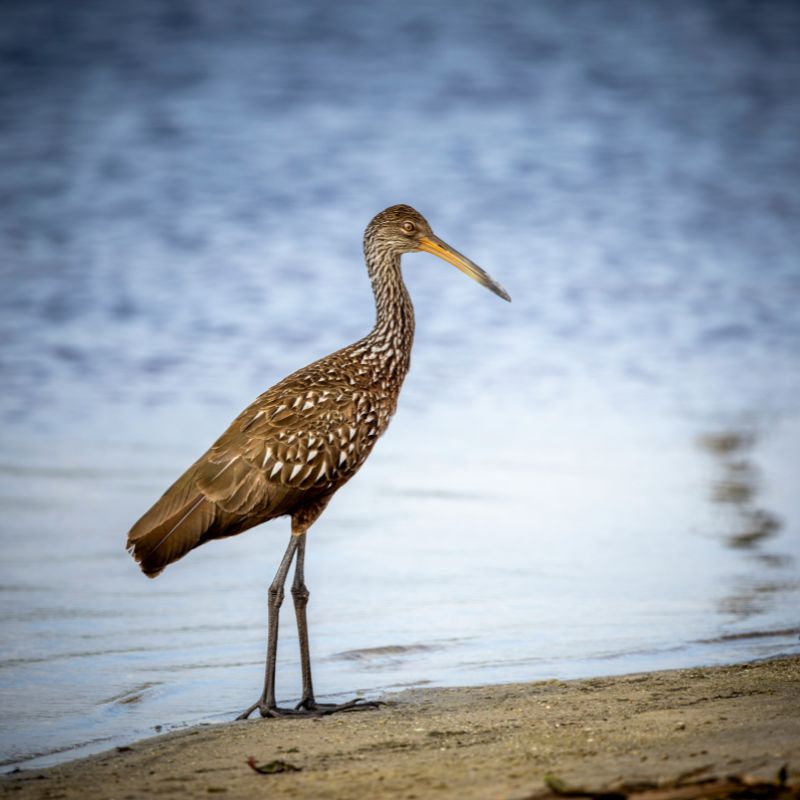 Credit: Greg Sellentin · Unsplash · CC0
Quick Facts About Limpkin
| Category | Details |
| Common Name | Limpkin |
| Other Names | Crying Bird, Carrao, Courlan |
| Scientific Name | Aramus guarauna |
| Conservation Status | Least Concern (IUCN global); Imperiled in Florida (S3), part of Imperiled Species Management Plan |
| Population | ~1,000,000 mature individuals (global estimate); stable to locally declining |
| Lifespan | 7–10+ years (wild) |
| Size | 64–73 cm (25–29 in) body length |
| Weight | 900–1,300 g (2.0–2.9 lbs), avg. ~1,080 g |
| Wingspan | 101–107 cm (40–42 in) |
| Unique Features | Long downcurved bill with tweezer-like gap, haunting wails, white-streaked brown plumage |
| Habitat | Freshwater marshes, swamps, lake edges, wooded wetlands |
| Geographic Range | Florida (U.S.) & southern Georgia to northern Argentina, Caribbean & Central America |
What makes the Limpkin unique?
In the steamy dawn mist of Florida’s Everglades or a quiet cypress swamp, a haunting, wild wail pierces the air like a ghostly lament—“kwEEEeeer!”—echoing across the water. This is the Limpkin (Aramus guarauna), also known as the Crying Bird or Carrao, a large, long-legged wading specialist whose eerie calls and snail-extracting bill make it one of the most distinctive voices of the American wetlands. A solitary forager tied intimately to freshwater marshes and apple snails, it serves as a living barometer of healthy swamp ecosystems from Florida to Argentina. Globally Least Concern yet imperiled in parts of its northern range due to wetland loss and declining prey, recent surveys highlight its vulnerability to hydrological changes. X posts and eBird sightings celebrate its haunting cries at dusk, casting this wailing sentinel as a resilient emblem of the swamps and an urgent call to protect its shadowy, snail-rich realms.
| Rank | Classification | Interesting Fact |
| Kingdom | Animalia | Limpkins wail in a kingdom alive with ancient wetland voices—a swamp’s haunting pulse! |
| Phylum | Chordata | Their long neck fuels a sentinel’s vigilant stride through shadowed waters. |
| Class | Aves | Feathers cloak their streaked grace—birds reborn as crying guardians! |
| Order | Gruiformes | Kin to cranes and rails, they master snail foraging. |
| Family | Aramidae | The sole living member of its family—true wetland originals. |
| Genus | Aramus | From Greek for a type of heron-like bird. |
| Species | Aramus guarauna | “Guarauna” echoes indigenous names for this wailing wanderer. |
| Subspecies | Several (e.g., A. g. pictus in Florida) | Vary slightly in size and markings across their vast range. |
Recommended Reading
What does a Limpkin look like?
The Limpkin is a swamp-forged wader, cloaked in cryptic browns. Measuring 64–73 cm (25–29 in) with a 101–107 cm wingspan and weighing around 1 kg, it features dark brown plumage with an olive sheen, boldly streaked and spotted white on the head, neck, and upperparts. Its long neck, dark legs, and heavy, downcurved yellowish bill (with a distinctive gap near the tip, often curving right) are perfectly adapted for extracting snails. Males are slightly larger; sexes look similar. It walks with a characteristic limp, giving the bird its name. Unlike herons, it has a more rail-like build and broader wings.
- Size & Weight: 64–73 cm (25–29 in), 900–1,300 g (2.0–2.9 lbs)
- Coloration & Plumage: Dark brown with white streaks/spots; olive luster
- Sensory Adaptations: Keen eyesight and tactile bill for locating and extracting prey
- Body & Limbs: Long neck and legs, broad rounded wings, short tail
💡 Fun Fact: Their bill acts like living tweezers—swamps’ precision snail surgeons!
Read more
The Limpkin is a large, distinctive wading bird with a rail-like build, long neck and legs, and a specialized bill adapted for extracting snails. Adults measure 64–73 cm (25–29 inches) in body length with a wingspan of 101–107 cm (40–42 inches) and weigh 900–1,300 g (2.0–2.9 lbs), averaging around 1,080 g. Males are slightly larger and heavier than females.
- Plumage: The overall plumage is dark chocolate-brown to olive-brown with a subtle olive or bronze sheen, boldly streaked and spotted with white on the head, neck, upper breast, and upperparts. The white markings are most prominent on the head and neck, giving a streaked, “salt-and-pepper” appearance. The lower breast, belly, and undertail coverts are paler brown with fewer white spots. Wings and tail are dark brown; the tail is short and rounded. Juveniles are similar but duller with more buffy tones and less distinct streaking.
- Head and Bill: The head is relatively small with a long, heavy, downcurved bill (about 10–13 cm / 4–5 inches long) that is dark at the base and yellowish toward the tip. The bill has a distinctive gap near the tip and often curves slightly to the right, functioning like living tweezers for extracting snails from shells. Eyes are large, dark brown to reddish-brown, set in a plain face with no bold eye-ring.
- Wings and Tail: Wings are broad and rounded, dark brown with faint pale barring visible in flight. The tail is short, rounded, and dark brown.
- Legs and Feet: Legs are long, dark gray to olive-green, adapted for wading in shallow water and soft mud. Feet are large with long toes for walking on unstable substrates.
- Sexual Dimorphism and Age Variation: Males and females are very similar in plumage, though males average larger with slightly bolder white streaking. Juveniles are duller with more buffy tones and less defined streaking; full adult plumage is acquired by the end of the first year (Greene & Losos 2025).
Where do Limpkins live?
Limpkins inhabit freshwater marshes, cypress swamps, lake shores, and wooded riverine wetlands with abundant vegetation and shallow water. In the U.S., they are primarily found in Florida and southern Georgia, with recent northward expansions. Globally, they range from southern Mexico through the Caribbean and Central America to northern Argentina. They are somewhat nomadic, moving with water levels and snail availability. Their range faces pressure from wetland drainage and habitat alteration.
- Regions: Southeastern U.S., Caribbean, Central & South America
- Countries/States: Florida, Georgia (U.S.), Mexico, Brazil, Argentina, and others
- Preferred Habitat: Freshwater marshes, swamps, pond edges
- Elevation Range: Lowlands, typically near water
💡 Did You Know? They wade silently at night—swamps’ shadowy snail sentinels!
Read more
The Limpkin is a specialist of freshwater wetlands with abundant large apple snails (Pomacea spp.): a resident to short-distance migrant that breeds primarily in Florida and southern Georgia in the U.S., and ranges more widely from southern Mexico through Central America to northern Argentina.
Breeding Range in the U.S.
Primarily resident in Florida (highest densities in the Everglades, Big Cypress, and Kissimmee River basin) with small breeding populations in southern Georgia and occasional records farther north. Recent northward expansion has been noted in response to climate and habitat factors (Greene & Losos 2025).
Global Range
From southern Mexico and the Caribbean south through Central America to Colombia, Venezuela, and northern Argentina. Highest densities occur in the Amazon Basin and Pantanal wetlands.
Elevation and Habitat Preferences
Primarily lowlands below 1,000 m. Favors:
- freshwater marshes, cypress swamps, lake edges, wooded riverine wetlands, and flooded grasslands with shallow water and emergent vegetation
- areas with abundant large apple snails and soft substrates for wading
- dense cover for nesting and roosting Avoids saltwater marshes, open deep water, arid regions, and heavily urbanized areas without wetlands (Herrel et al. 2025).
What do Limpkins eat?
Limpkins are specialized molluscivores, feeding primarily on large apple snails (Pomacea spp.). They also consume other snails, mussels, insects, crustaceans, worms, frogs, and lizards. Using their specialized bill, they extract snails from shells, often leaving characteristic piles on banks. They forage day and night by wading and probing in shallow water.
- Primary Diet: Apple snails, other mollusks
- Feeding Method: Probing, wading, bill extraction
- Adaptations for Feeding: Downcurved bill with gap and rightward twist for snail shells
💡 Fun Fact: They leave neat piles of empty shells—swamps’ telltale dining tables!
Read more
The Limpkin is a highly specialized molluscivore that feeds primarily on large apple snails (Pomacea spp.), supplemented by other aquatic invertebrates and small vertebrates.
Primary Diet (Apple Snails)
Diet is 70–90 % large apple snails (Pomacea spp.) in most habitats. The bird uses its specialized bill to reach into the shell, extract the body, and discard the empty shell — often leaving characteristic piles of broken shells on banks or logs. Other prey includes smaller snails, mussels, crayfish, insects, worms, frogs, and lizards (Greene & Losos 2025).
Wading and Probing Foraging
Forages by walking slowly in shallow water (usually 10–30 cm deep), probing vegetation, soft mud, and submerged debris with its long bill. Often forages both day and night, using tactile and visual cues to locate snails (Herrel et al. 2025).
Seasonal and Geographic Shifts
- Breeding season: heavy reliance on large apple snails for high-protein needs
- Dry season / low water: increased consumption of other invertebrates and small vertebrates
- Winter / migration: opportunistic foraging on available mollusks and crustaceans (Shea 2025).
Are Limpkins social or solitary?
Limpkins are generally solitary or in small groups while foraging but may nest semi-colonially where food is abundant. Males defend territories with loud calls and ritualized displays. Their most famous vocalization is a loud, mournful wail or scream, often heard at dawn, dusk, or night. They also produce clucks, rattles, and buzzing winnowing sounds in flight.
- Vocalizations: Haunting wails (“kwEEEeeer”), clucks, rattles
- Body Language: Territorial charging, wing-flapping
- Social Structure: Solitary foragers, territorial, loose colonies for nesting
💡 Interesting Fact: Their cries inspired jungle sounds in movies—swamps’ original sound designers!
Read more
The Limpkin is generally solitary or in small groups while foraging but becomes more vocal and territorial during breeding. It is famous for its loud, haunting calls that carry far across wetlands.
Solitary to Semi-Colonial Foraging
Forages solitarily or in small loose groups, defending feeding territories during breeding. Nesting can be semi-colonial where food is abundant (Greene & Losos 2025).
Haunting Vocalizations
The most famous call is a loud, mournful, far-carrying wail or scream (“kwEEEeeer!” or “carrao!”) — often given at dawn, dusk, or night. Other calls include clucks, rattles, and buzzing winnowing sounds produced by specialized flight feathers during display flights (Herrel et al. 2025).
Territorial Displays
Males defend territories with loud calls, ritualized charging, and wing-flapping displays. Pairs perform mutual preening and coordinated foraging (Shea 2025).
Wading and Probing Behavior
Walks slowly and deliberately through shallow water with a characteristic limp or high-stepping gait, probing vegetation and soft mud with its long bill. Active both day and night (Greene & Losos 2025).
Migration and Winter Behavior
Some northern populations are short-distance migrants or nomadic in response to water levels. In winter, remains mostly solitary or in small groups, using contact calls when present (Herrel et al. 2025).
Human Interaction & Tolerance
Generally wary but habituates to humans in protected areas like the Everglades. Rarely aggressive, even near the nest (Shea 2025).
How does the Limpkin thrive in wetlands?
The Limpkin is a master wader with a uniquely modified bill for snail extraction and a doubly looped trachea that produces its legendary haunting calls. It forages both day and night, walks with a distinctive limp, and can produce a buzzing “winnowing” sound with specialized flight feathers. Highly dependent on water levels for prey, it shifts locations as needed. Unlike Snail Kites, it forages on foot rather than from the air.
- Bill Specialization – Tweezers-like extraction of snails.
- Vocal Anatomy – Looped trachea for loud, far-carrying wails.
- Foraging – Day/night activity in shallow wetlands.
Survival Score
- Specialization: 9/10 – Snail expert with versatile foraging.
- Stealth: 8/10 – Cryptic plumage and quiet wading.
- Adaptability: 7/10 – Tied to wetlands and prey abundance.
Read more
The Limpkin is a highly specialized snail-foraging wader that has evolved a modified bill, unique vocal anatomy, and flexible foraging behavior to exploit large apple snails in shallow wetlands.
Specialized Bill for Snail Extraction
The long, heavy, downcurved bill has a distinctive gap near the tip and often curves slightly to the right — functioning like living tweezers to reach into snail shells, extract the body, and discard the shell. This adaptation is unique among North American waders and allows efficient exploitation of large Pomacea snails (Greene & Losos 2025).
Doubly Looped Trachea for Haunting Calls
The trachea has two extra loops — an anatomical feature that produces the species’ legendary loud, far-carrying, mournful wails and screams, often heard at dawn, dusk, or night. The calls are among the most distinctive and haunting of any North American bird (Herrel et al. 2025).
Day and Night Foraging
Forages both day and night by wading slowly in shallow water, probing vegetation and soft mud — one of the few large waders active after dark, allowing it to exploit nocturnal snail activity (Shea 2025).
Characteristic Limping Gait
Walks with a distinctive limp or high-stepping gait (giving the bird its name) that helps it navigate uneven, vegetated substrates without sinking (Greene & Losos 2025).
Flexible Movement with Water Levels
Somewhat nomadic, moving locally or regionally in response to water levels and snail abundance — a behavioral adaptation to fluctuating wetland conditions (Herrel et al. 2025).
How do Limpkins reproduce?
Breeding varies by region and water levels, often peaking in late winter to spring in Florida (Feb–Jul). Males hold territories; pairs build platform nests of vegetation in marshes, shrubs, or trees. Females lay 4–7 eggs (avg. 5.5) that are incubated ~26–28 days by both parents. Chicks are precocial and leave the nest soon after hatching, with parents caring for them for several months. Multiple broods possible in good conditions.
- Breeding Season: Variable, tied to water/snail abundance (often Feb–Jul in north)
- Clutch Size: 4–7 eggs (up to 8)
- Incubation Period: 26–28 days
- Parental Care: Both parents incubate and feed young
💡 Did You Know? Chicks hit the water running—swamps’ quick-footed heirs!
Read more
Limpkin reproduction is tied to water levels and snail abundance: a seasonal to opportunistic strategy with platform nesting and extended parental care.
Seasonal Breeding – Variable, Tied to Water Levels
Breeding in Florida peaks February–July but can occur year-round in response to water levels and snail availability. Pairs form long-term bonds in stable populations (Greene & Losos 2025).
Monogamous Pair Bonds & Nest Construction
Pairs are monogamous. The female (sometimes with male assistance) builds a bulky platform nest of vegetation, sticks, and leaves, placed in dense emergent vegetation, shrubs, or low trees over water (0.5–3 m high). Nests are often semi-colonial where food is abundant (Herrel et al. 2025).
Clutch Size & Incubation
Females lay 4–7 eggs (average 5.5), buff to olive with dark spots. Incubation lasts 26–28 days, shared by both parents (Shea 2025).
Chick Development & Parental Care
Chicks are precocial and leave the nest within hours of hatching but remain dependent on parents for several months. Both parents feed and protect the young, leading them to feeding areas. Fledging occurs around 8–10 weeks, with full independence several weeks later (Greene & Losos 2025).
Mortality Factors
First-year survival is variable but often low due to predation and fluctuating water levels. Primary causes: nest predation (raccoons, snakes), flooding, and starvation during low-water periods (Herrel et al. 2025).
Adaptability to Hydrological Changes
Breeding is highly responsive to water levels and snail abundance — a key adaptation to fluctuating wetland conditions (Shea 2025)
Why is the Limpkin vital to its ecosystem?
Limpkins help control apple snail populations and serve as key indicators of wetland health and water quality. By foraging in shallow waters, they link aquatic invertebrates to the broader food web and signal productive marsh ecosystems. Their presence reflects balanced hydrology essential for many wetland species.
- Predation: Regulates snail numbers.
- Indicator Species: Reflects freshwater wetland vitality.
- Food Web Role: Connects mollusks to higher predators.
💡 Fun Fact: Their shell piles tell stories of healthy swamps—wetlands’ natural historians!
Read more
The Limpkin is a key indicator species and specialized molluscivore in freshwater wetlands: its presence signals healthy hydrology and abundant apple snail populations, while its foraging links aquatic invertebrates to the broader food web.
Apple Snail Regulation and Wetland Indicator
By preying on large apple snails (Pomacea spp.), Limpkins help regulate snail populations and serve as excellent indicators of wetland health, water quality, and hydrological stability. Their presence reflects productive, shallow freshwater marshes with balanced vegetation (Shea 2025).
Prey Base for Higher Predators
Adults, chicks, and eggs are prey for alligators, large snakes, raccoons, hawks, and owls. Their abundance supports higher predator densities in wetland ecosystems (Greene & Losos 2025).
Ecosystem Engineering
Foraging and nest-building in shallow water contribute to nutrient cycling and create microhabitats. Empty snail shells left on banks provide calcium for other wildlife (Herrel et al. 2025).
Indicator of Wetland Health
Because they require stable shallow water, emergent vegetation, and abundant large snails, Limpkin presence and breeding success are strong indicators of overall freshwater wetland ecosystem integrity. Declines often signal drainage, altered hydrology, or snail population collapse (Greene & Losos 2025).
- Named for their limping walk—swamps’ quirky waders!
- Calls used in Tarzan movies and Harry Potter—nature’s original sound effects!
- Only living member of family Aramidae—true evolutionary originals!
Why is the Limpkin at risk?
While globally Least Concern, Limpkins face localized threats from wetland loss, drainage, altered water flows, and declining apple snail populations. In Florida, they remain part of the Imperiled Species Management Plan despite delisting.
- ⚠ Wetland Loss: Drainage and development.
- ⚠ Hydrological Changes: Affects snail abundance.
- ⚠ Prey Decline: Impacts on apple snails.
Conservation Efforts
- Protected Areas: Everglades NP, various Florida wetlands and preserves.
- Management: Florida’s Imperiled Species Plan, habitat restoration.
- Monitoring: FWC, Audubon, and eBird surveys.
✅ What We Can Do:
- Protect and restore wetlands—Limpkins wail, ecosystems thrive.
- Support smart water management—safeguard their snail-rich swamps.
- Back FWC, Audubon, and local conservation—champion the crying sentinels.
Read more
The Limpkin is listed as Least Concern globally on the IUCN Red List (last assessed 2016) but is considered imperiled in parts of its northern range (S3 in Florida) and is included in Florida’s Imperiled Species Management Plan due to ongoing wetland loss and hydrological changes.
Current Population & Distribution
Global population ~1,000,000 mature individuals (stable to locally declining). In the U.S., the population is concentrated in Florida (~5,000–10,000 pairs) with small numbers in southern Georgia. Recent northward expansion has been documented, but overall numbers remain vulnerable to habitat changes (Greene & Losos 2025).
Primary Threats
- Wetland loss and drainage: conversion of marshes and swamps for agriculture and development.
- Hydrological alteration: altered water flows, drainage projects, and drought that reduce snail availability.
- Pesticide and water quality degradation: impacts on apple snail populations.
- Climate change: sea-level rise, increased storm intensity, and changing rainfall patterns affecting breeding and foraging habitats (Herrel et al. 2025).
Conservation Successes & Active Recovery
- Protected areas: Everglades National Park, Big Cypress National Preserve, and other Florida wetlands protect core habitat.
- Habitat restoration: wetland restoration projects in Florida and the Southeast improve snail habitat and hydrology.
- Monitoring: Florida Fish and Wildlife Conservation Commission (FWC), Audubon, and eBird track populations and range expansion.
- Management: Inclusion in Florida’s Imperiled Species Management Plan with ongoing research and habitat protection (Shea 2025).
The Limpkin remains locally common in core Florida wetlands but faces ongoing threats from habitat loss and hydrological changes. Every protected marsh and restored wetland we maintain, every smart water management practice we support, and every monitoring effort we back is a direct vote for keeping this wailing sentinel calling from North American swamps for another century.
Ongoing monitoring by FWC and partners tracks population trends and northward expansions linked to climate and habitat factors. Studies emphasize the continued importance of apple snail populations and wetland hydrology for Limpkin persistence in the U.S. Recent sightings document range expansion in Anglo-America.
The Limpkin is a wailer, a forager, the swamp’s haunting sentinel. Saving it preserves vital wetlands—let’s champion its unforgettable cry.
✅ Share this article – Amplify its swamp chorus!
✅ Support conservation – Back FWC, Audubon, or wetland restoration.
✅ Protect wetlands – Restore marshes, revive a legacy.


Arya Sankar is a postgraduate in Zoology with academic and research experience in wildlife and marine sciences. She has worked on research projects at the Central Marine Fisheries Research Institute and has been actively involved in science education and skill development. Her contributions focus on accurate species information, conservation awareness, and educational wildlife content.