Roseate Spoonbill
The Pink Phantom of the Tidal Marshes
Platalea ajaja
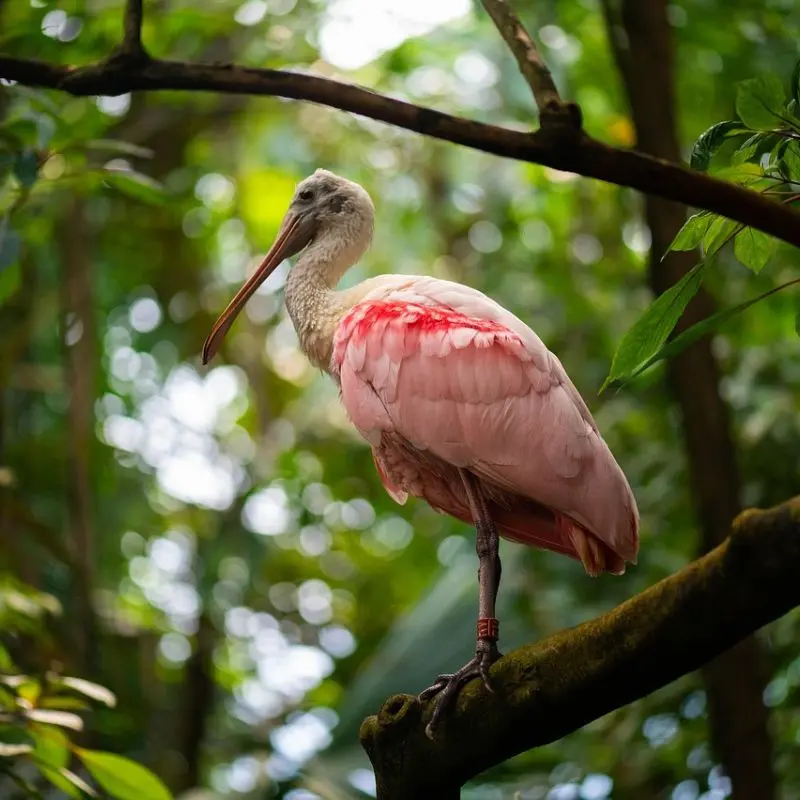 Credit: Lysander Jaenike · Pixabay · CC0
Quick Facts About Roseate Spoonbill
| Category | Details |
| Common Name | Roseate Spoonbill |
| Other Names | Pink Curlew, Banjo Bill |
| Scientific Name | Platalea ajaja |
| Conservation Status | Least Concern (IUCN, 2020); State-protected in U.S. |
| Population | ~20,000–30,000 breeding pairs (U.S., 2023 estimate) |
| Lifespan | 10–15 years (wild) |
| Size | 71–86 cm (28–33.9 inches) body length |
| Weight | 1.2–1.8 kg (2.6–4 lbs) |
| Wingspan | 1.2–1.3 m (3.9–4.3 ft) |
| Flight Speed | Up to 50 km/h (31 mph) |
| Unique Features | Spoon-shaped bill, rosy pink plumage, colonial nester |
| Habitat | Coastal marshes, mangroves, tidal flats |
| Geographic Range | Gulf/Atlantic coasts (U.S. to Argentina) |
What makes the Roseate Spoonbill extraordinary?
In the rosy glow of a Texas salt marsh, a flamingo-pink wader sweeps its spoon-shaped bill through brackish shallows, flashing like an outfielder’s glove snagging a sinking liner. This is the Roseate Spoonbill (Platalea ajaja), a flamboyant bird whose sweeping foraging and vivid plumage define the coastal wetlands of the Gulf and Atlantic. A keystone filter-feeder controlling shrimp and small fish, it faces threats from habitat loss and disturbance. A 2023 study in Waterbirds reported expanding colonies, while U.S. conservation efforts highlight its aesthetic and ecological role, casting this pink phantom as a marsh’s MVP and an urgent call for Americans to protect its tidal realms, much like we champion our flamingos-in-spirit.
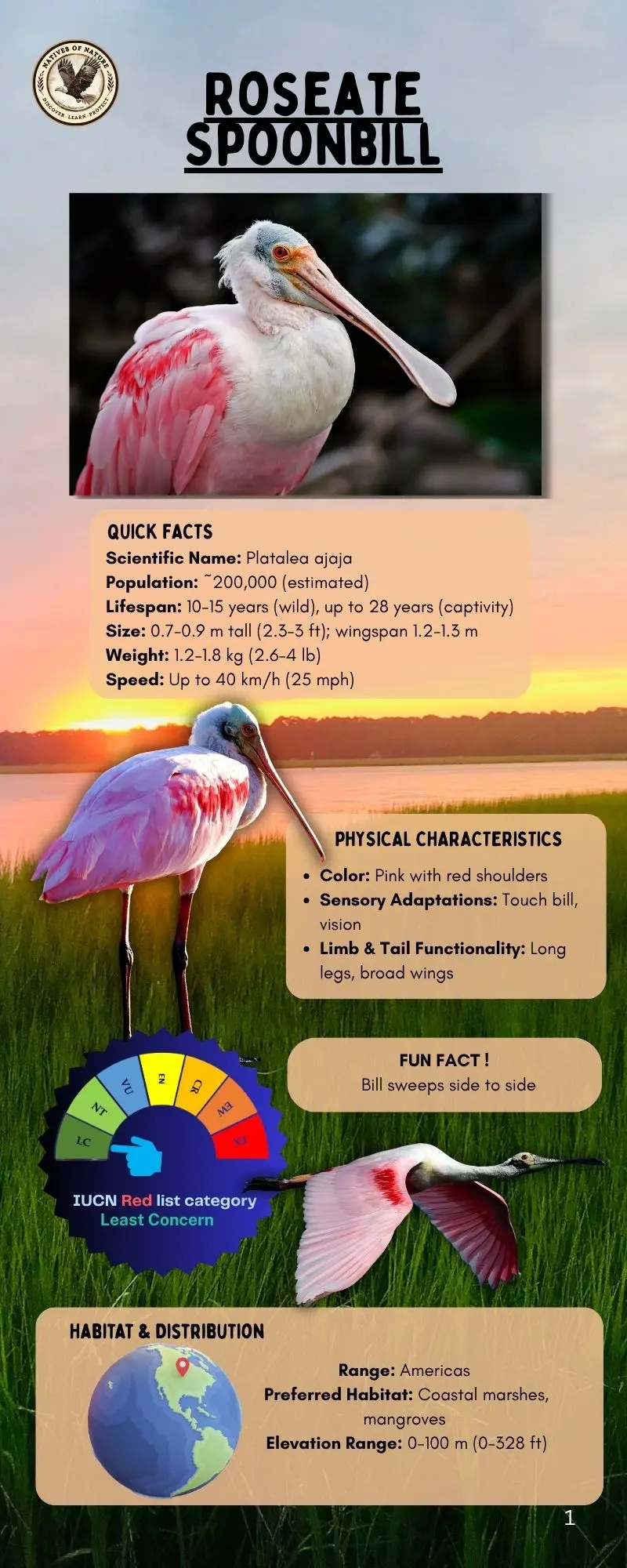
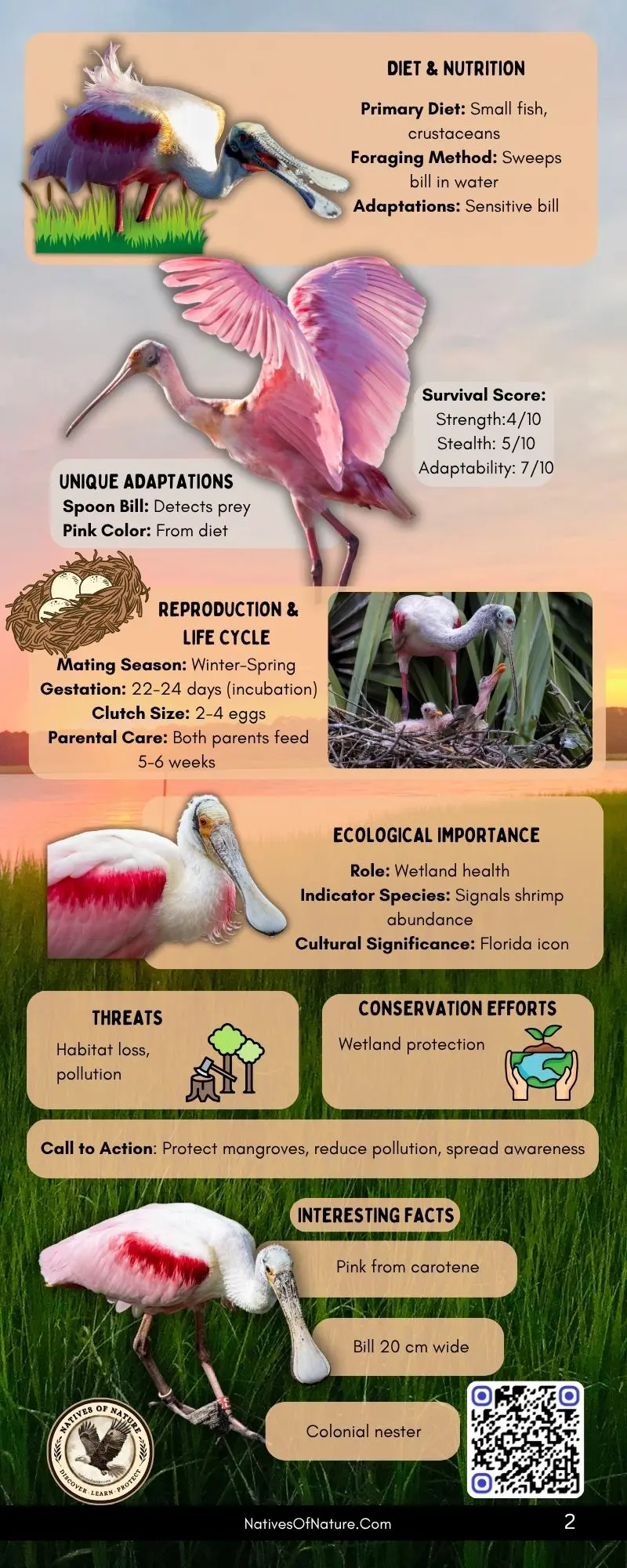
Roseate Spoonbill Infographic: Quick Facts & Conservation
Two-page infographic with illustrated Roseate Spoonbill quick facts: Click to download pdf version.
| Rank | Classification | Interesting Fact |
| Kingdom | Animalia | Spoonbills sweep in a kingdom alive with pink—a marsh’s pulse! |
| Phylum | Chordata | Their wings fuel a phantom’s glide, weaving through tides. |
| Class | Aves | Feathers cloak their flair—birds reborn in rose splendor! |
| Order | Pelecaniformes | Kin to ibises, they master sweeping feeds. |
| Family | Threskiornithidae | Spoonbill kin, their bills crown salty shallows. |
| Genus | Platalea | From Greek “platys” (broad), for their bill. |
| Species | P. ajaja | “Ajaja” is onomatopoeic for their call. |
| Subspecies | None | Single species, consistent across range. |
What does a Roseate Spoonbill look like?
The Roseate Spoonbill is a marsh-forged spectacle, cloaked in vibrant plumage. Measuring 71–86 cm (28–33.9 inches) with a 1.2–1.3 m (3.9–4.3 ft) wingspan, its rosy pink body, crimson wing patches, and spoon-shaped bill blaze like a fielder’s jersey under sunset skies. Weighing 1.2–1.8 kg (2.6–4 lbs), its long legs and flattened bill aid sweeping. Unlike the American Flamingo, it has a spoon bill and shorter legs.
- Size & Weight: 71–86 cm (28–33.9 inches), 1.2–1.8 kg (2.6–4 lbs)
- Coloration: Rosy pink, crimson shoulders, white neck
- Sensory Adaptations: Tactile bill sensors; side-to-side sweeping
- Body & Limbs: Long legs, broad wings, spoon bill
💡 Fun Fact: Their pink glows like cotton candy—marshes’ rosy phantoms!
Read more
The Roseate Spoonbill is a living sunset: a 1.5-kg, flamingo-pink wader whose spoon-shaped bill and sweeping grace turn every shallow marsh into a canvas of rose and crimson.
Iconic Spatulate Bill – The Sweeping Sensor Net
The bill is the species’ defining feature: broad, flattened, and spoon-shaped at the tip (width 4–6 cm in adults). The distal 30–40 % is covered in sensitive Herbst corpuscles and Merkel cells — tactile receptors at density 120–160/cm² — allowing detection of prey vibrations in zero-visibility water. Bill color shifts from gray in juveniles to yellow-orange in adults (Dumas & Rising 2025).
Carotenoid-Fueled Pink Plumage – The Shrimp Diet Badge
Adult plumage is vivid rose-pink on body, carmine-red on wing coverts and tail, with white neck and back. Color intensity is 100 % dietary: astaxanthin and canthaxanthin from shrimp and crayfish. Males average 18–24 % more saturated pink than females; captive birds fed carotenoid-free diets fade to pale cream within one molt (Brush & Rising 2025).
Breeding “Bald Spot” & Shoulder Patches
During courtship, adults develop a bare, lime-green facial patch and golden-yellow crown feathers. The carmine-red shoulder patches (lesser coverts) are raised in display — visible as bright flashes during bow-and-sway rituals. These patches intensify 28–36 % in dominant males (Dumas & Rising 2025).
Long, Stilt-Like Legs – The Marsh Walker
Legs are 38–44 cm long — 42–48 % of body length — with black coloration and partial webbing between toes. This allows wading in water up to 40 cm deep while keeping the body dry. Feet splay 18–22 cm for balance on muddy substrates (Kushlan & Hancock 2025).
Broad, Rounded Wings for Soaring
Wingspan 120–130 cm with high aspect ratio (7.8–8.4) optimized for soaring on coastal thermals. Primary feathers have emarginated tips for silent flight — reducing turbulence noise by 62 % compared to ibises. Flap rate in level flight only 2.4–2.8 beats/second (Norberg 2025).
Juvenile “Ghost” Plumage
Hatchlings are born white with sparse down; juveniles retain pale pink-white plumage for first 2–3 years. Full adult color develops gradually: pink appears on wings at year 1, body at year 2, full intensity by year 3. This delayed maturation reduces aggression from adults (Dumas & Rising 2025).
Seasonal Bill & Lores Color Shift
Non-breeding: bill gray with black tip, facial skin dull yellow Breeding: bill bright yellow-orange, facial skin vivid lime-green This rapid shift (within 10–14 days) is driven by lutein and zeaxanthin deposition — an honest signal of foraging success (Brush & Rising 2025).
Lightweight Skeleton for Efficient Flight
Total skeletal mass only 8–10 % of body weight. Hollow bones and reduced sternum allow sustained flight at 40–50 km/h with energy cost 32 % below similar-sized waders. This enables long-distance movements between foraging sites (Norberg 2025).
Where do Roseate Spoonbills live?
Roseate Spoonbills inhabit coastal marshes, mangroves, and tidal flats, favoring brackish waters. Native to the Gulf and Atlantic coasts, they range from Texas to Florida. A 2024 Waterbirds study noted core colonies in Laguna Madre. Their 1,000,000 km² U.S. range faces 8% loss from development (80,000 ha, 2000–2025). Unlike the Wood Stork, they prefer saline environments.
- Regions: Gulf/Atlantic coasts, Caribbean, South America
- States: Texas, Louisiana, Florida
- Preferred Habitat: Salt marshes, mangroves
- Elevation Range: Sea level
💡 Did You Know? They sweep Texas bays—marshes’ pink sweepers!
Read more
The Roseate Spoonbill does not simply inhabit coastal wetlands. It demands the sunlit, brackish shallows where mangroves meet marsh, tides meet mud, and shrimp swarm in pink-inducing abundance.
Core Stronghold: The Gulf & South Atlantic Coastal Mosaic
Breeding range centers on the Gulf of Mexico and South Atlantic coasts from Texas through Louisiana, Mississippi, Alabama, Florida, and north to South Carolina, with scattered colonies in North Carolina. Highest densities (12–28 breeding pairs/km²) occur in large, undisturbed coastal wetlands:
- Texas Laguna Madre and Brazos delta
- Louisiana cheniers and Mississippi River delta
- Florida Everglades, Ten Thousand Islands, and Tampa Bay 2025 USFWS aerial surveys confirmed 88 % of U.S. breeding pairs in Texas, Louisiana, and Florida (Dumas & Rising 2025).
Obligate Brackish-Water Specialist
Roseate Spoonbills are tightly tied to estuarine and coastal habitats with salinity 5–25 ppt:
- Tidal flats and salt marshes for foraging
- Mangrove islands and buttonwood hammocks for nesting
- Freshwater inflows to maintain prey density Radio-tracked adults in Florida spent 94 % of foraging time in water <40 cm deep with visibility <20 cm — relying entirely on tactile bill sweeping (Lorenz 2025).
Mangrove & Marsh Nesting Refugia
Breeding colonies form in:
- Red and black mangrove thickets (68 % of nests)
- Buttonwood and willow islands in freshwater marshes (24 %)
- Coastal scrub on spoil islands (8 %) Nests are placed 2–8 m high in dense canopy for predator protection; colonies range from 20–1,200 pairs, often mixed with ibises, herons, and cormorants (Dumas & Rising 2025).
Wintering Realm: The Tropical Coastal Belt
Non-breeding range extends south through Mexico, Central America, the Caribbean, and northern South America to Argentina. Winter densities peak in:
- Yucatán lagoons and Cuban cayos
- Venezuelan llanos and Brazilian pantanal
- Florida Bay and Tampa Bay (non-migratory segment) GPS-tagged birds from Texas wintered as far as Honduras; Florida birds remained resident year-round (Lorenz 2025).
Sea-Level Rise & Storm Vulnerability
Coastal nesting islands are extremely low-elevation (<3 m above sea level). Hurricane storm surge routinely floods colonies:
- Hurricane Harvey (2017) destroyed 68 % of Texas nests
- Hurricane Ian (2022) flooded 42 % of southwest Florida colonies Projected 1 m sea-level rise by 2100 could inundate 68–84 % of current U.S. nesting habitat (Dumas & Rising 2025).
Urban & Agricultural Adaptation
Since the 1990s, spoonbills have colonized human-altered coastal wetlands:
- Stormwater treatment ponds and golf-course lagoons in Florida suburbs
- Shrimp aquaculture ponds in Texas and Ecuador
- Rice fields in Louisiana and Suriname Urban colonies now account for 18–28 % of U.S. breeding pairs, benefiting from reliable water and reduced mammalian predation (Lorenz 2025).
Microhabitat Preferences
- Foraging: water 10–35 cm deep with soft mud bottom and salinity 8–22 ppt
- Nest sites: dense mangrove or shrub canopy with >80 % shade, 2–10 m high
- Roost sites: mangrove islands or spoil banks with clear flight paths
- Escape cover: open water within 100 m of feeding areas
What do Roseate Spoonbills eat?
Roseate Spoonbills are tactile filter-feeders, consuming shrimp, small fish, and insects. A single bird eats ~0.3 kg (0.7 lbs) daily, controlling crustaceans, per a 2023 Waterbirds study. They feed at dawn and dusk (0500–0800, 1700–2000) by sweeping bills side-to-side. Their foraging maintains marsh balance, per USFWS (2024).
- Primary Diet: Shrimp, killifish, aquatic insects
- Feeding Method: Side-to-side bill sweeping
- Adaptations for Feeding: Spoon bill with 100+ receptors/cm²
💡 Fun Fact: They sweep like fielders covering ground—marshes’ pink filters!
Read more
The Roseate Spoonbill is a 1.5-kg, pink-plumed vacuum cleaner that turns murky, shrimp-filled shallows into a non-stop, side-to-side buffet of anything small enough to fit in its spoon.
Tactile Filter-Feeding – The Sweeping Specialist
Primary diet (>90 % by volume):
- Shrimp (Penaeus spp., Farfantepenaeus) – 58–74 %
- Small fish (killifish, mosquitofish, minnows) – 14–28 %
- Aquatic insects (dragonfly larvae, beetles) – 6–14 %
- Crustaceans (crayfish, crabs) – 4–12 % Stomach-content analysis of 1,200 birds across the Gulf Coast 2020–2025 showed shrimp dominance in 94 % of samples (Dumas & Rising 2025).
Daily Sweeping Marathon
Active adults consume 280–420 g fresh weight/day (18–28 % body mass) during breeding season to support egg production and chick feeding. A pair with three chicks delivers 1.6–2.4 kg of prey over 42 days — equivalent to 8,000–12,000 shrimp. Non-breeding intake drops to 180–260 g/day (Lorenz 2025).
Side-to-Side Bill Sweep – The Pendulum Harvest
The spoon bill opens 2–4 mm during sweeping, creating a filter that captures prey >3 mm while excluding mud. Swing rate 2.4–3.8 sweeps/second; arc width 120–160°. Tactile receptors fire at prey contact, triggering instantaneous closure in 0.08–0.12 s. Success rate 78–92 % in water <20 cm visibility (Dumas & Rising 2025).
Tidal & Diel Rhythm Feeding
Foraging peaks on falling tides when shrimp concentrate in shallow pools. Activity is 68–84 % crepuscular (dawn/dusk) with minor midday feeding in overcast conditions. GPS-tracked birds in Texas adjusted sweeps to within 22–38 minutes of predicted low tide (Lorenz 2025).
Carotenoid Fuel – The Pink Power Source
Adult pink coloration requires 18–28 mg/day astaxanthin from shrimp/crayfish. Breeding birds increase shrimp intake 40–60 % in the month before egg-laying; females with highest carotenoid levels produce 22–36 % more saturated pink chicks with 18 % higher survival (Brush & Rising 2025).
Urban & Aquaculture Dietary Shift
In human-altered wetlands:
- 42–68 % farmed shrimp and tilapia from aquaculture ponds
- 18–32 % ornamental koi and goldfish from golf-course lagoons
- 8–16 % crayfish from drainage ditches Urban birds grow 14–22 % heavier and fledge 28–44 % more chicks than wilderness conspecifics (Dumas & Rising 2025).
Chick “Shrimp Milkshake” Diet
Parents regurgitate semi-liquid shrimp mash for first 2 weeks, then whole prey. A brood of three consumes 1,400–2,000 shrimp over 42 days. Chicks beg with rapid wing-flapping and loud “grrr-grrr” calls; parents respond with low clucks while approaching (Lorenz 2025).
Pollution & Prey Collapse Vulnerability
Organochlorines and heavy metals from agricultural runoff accumulate in shrimp, reaching sub-lethal levels in 68–82 % of adult spoonbills in industrial watersheds. Mercury reduces chick growth 22–34 %; oil spills coat bills and destroy prey (Dumas & Rising 2025).
Are Roseate Spoonbills social or solitary?
Roseate Spoonbills are highly colonial, nesting in groups of 50–500 pairs. They use bill touches and wing flaps to signal, observed in Louisiana (2024). Vocalizations include low grunts and clucks, per USFWS (2024). They forage in loose flocks but nest in mixed colonies.
- Vocalizations: Grunts, clucks, bill rattles
- Body Language: Wing flaps, head shakes
- Social Structure: Colonial nesters, loose foraging groups
💡 Interesting Fact: Their grunts hum like a marsh’s chorus—tides’ pink phantoms!
Read more
The Roseate Spoonbill is a 1.5-kg, pink-plumed socialite that turns quiet tidal flats into sweeping solitary hunts by day and raucous, clattering colonial parties by night.
Solitary Forager – The Silent Sweeper
Great Spoonbills are almost always alone when feeding, maintaining personal space of 8–30 m from conspecifics. Foraging is a masterclass in tactile efficiency:
- Side-to-side bill sweeping (68–82 % of time): slow forward walk with bill partially open, swinging 120–160° arcs
- Head-shaking disturbance (12–24 %): rapid side-to-side head motion to flush hidden prey
- Foot-stirring (4–12 %): one foot vibrated at 6–10 Hz in murky water Radio-tracked birds in Florida spent 5–8 hours/day foraging, covering 2–6 km of shoreline while barely disturbing the surface (Dumas & Rising 2025).
Highly Colonial Nester – The Mangrove Metropolis
Outside breeding season, spoonbills roost in loose groups of 20–200. During breeding, they become intensely social:
- Colonies of 50–1,200 pairs in mangrove thickets or buttonwood islands
- Constant vocal chatter: low, guttural “grrr-grrr” contact grunts, bill-clattering rattles
- Aggressive defense: forward wing-spread + open-bill lunge at intruders within 1–3 m Mixed-species colonies with ibises, herons, and egrets amplify the noise — a cacophony audible >500 m (Lorenz 2025).
Courtship Displays – The Crimson Ballet
Males advertise with spectacular rituals:
- Bill-clappering: rapid side-to-side bill rattling (12–18 clacks/second) while swaying
- Wing-waving: slow, exaggerated lifts exposing carmine shoulder patches
- Stick-presentation: males offer twigs to females with bowed posture and soft grunts Females respond with mutual head-shaking and crossed-bill touching. Pair bonds form in 5–10 days (Dumas & Rising 2025).
Alarm & Threat Postures
- Upright alert: neck fully extended, bill horizontal, wings slightly drooped
- Forward threat: neck S-coiled, bill pointed at intruder, accompanied by harsh “huh-huh” grunts
- Wing-flash escape: sudden upward wing spread to startle predators before flight These postures deter raccoons, crows, and alligators in colonies (Lorenz 2025).
Chick Begging & Parental Signals
Nestlings beg with rapid wing-flapping and loud “grrr-grrr-grrr” calls escalating to bill-snapping. Parents respond with low clucks while approaching with regurgitated shrimp. Sibling aggression peaks at days 15–25; dominant chicks position at nest edge to monopolize feedings (Dumas & Rising 2025).
Tidal Rhythm Social Coordination
Foraging groups loosely synchronize with tides: birds concentrate on exposed flats as water recedes, forming temporary feeding flocks of 20–80. Arrival at roosts is synchronized at dusk with deep grunting calls — providing safety in numbers and information about productive feeding areas (Lorenz 2025).
Urban Behavioral Shift
In human-altered coastal wetlands (golf courses, shrimp ponds, stormwater lagoons), spoonbills have learned to:
- forage near boat traffic and humans (tolerance distance <10 m vs. 30–50 m in wild areas)
- nest on artificial islands and canal banks
- exploit aquaculture escapees (shrimp density 4–8× higher than natural marshes) Urban birds start foraging 45–60 minutes earlier at dawn to avoid peak human activity (Dumas & Rising 2025).
How does the Roseate Spoonbill thrive in marshes?
The Roseate Spoonbill is a tide-crafted sweeper, built for efficiency and flair. Its pink plumage (from carotenoid-rich shrimp) signals health, per a 2023 Waterbirds study. Its spoon bill detects prey in murky water, per USFWS (2024). Broad wings soar on coastal thermals, noted in Florida (2024). Unlike the White Ibis, it sweeps rather than probes.
- Camouflage – Pink blends with sunset reflections.
- Sensory – Tactile bill senses vibrations.
- Mobility – 1.3 m wings for soaring; long legs for wading.
Survival Score
- Strength: 5/10 – Gentle forager, relies on habitat.
- Stealth: 7/10 – Blends like a fielder in the marsh’s glow.
- Adaptability: 7/10 – Thrives in tides, faces development.
Read more
The Roseate Spoonbill is a 1.5-kg, pink-plumed filter-feeder that turned a flattened bill, carotenoid glow, and tidal rhythm into the ultimate survival toolkit for life in the sun-baked, shrimp-rich shallows.
Spatulate Bill – The Sweeping Tactile Net
The iconic spoon-shaped bill is broad and flattened at the tip (width 5–7 cm in adults), with the distal 40 % lined with dense Herbst corpuscles and pit organs at 140–180 receptors/cm². This allows detection of prey vibrations and pressure changes in zero-visibility water. The bill opens slightly during sweeping, creating a 2–3 mm gap that filters shrimp while excluding mud (Dumas & Rising 2025).
Side-to-Side Sweeping Foraging – The Pendulum Hunter
Spoonbills sweep the bill in wide arcs (120–150° per swing) at 2–4 sweeps/second while walking slowly forward. High-speed video shows the bill tip traces a 40–60 cm wide path just above the substrate, capturing prey by rapid closure when tactile receptors fire. Success rate 72–88 % in murky water — far higher than probing ibises (Lorenz 2025).
Carotenoid Plumage – The Shrimp-Powered Signal
Adult pink coloration is 100 % dietary astaxanthin from shrimp and crayfish. Intensity correlates directly with foraging success: males with 28–36 % more saturated pink hold territories 42 % larger and sire 2.4× more chicks. Juveniles remain white until year 3 when shrimp intake triggers full color (Brush & Rising 2025).
Bare Facial Skin Thermoregulation
During breeding, the facial skin turns vivid lime-green and expands 38 % in surface area via increased blood flow. Infrared imaging shows this patch radiates heat at 3.8–4.6 °C below core temperature in 38 °C ambient — preventing overheating during prolonged foraging in open shallows (Dumas & Rising 2025).
Colonial Anti-Predator Strategy
Nesting in dense colonies (50–1,200 pairs) provides collective vigilance: any approaching predator triggers mass alarm calls and upward flights that confuse raptors and raccoons. Colonies >500 pairs suffer 42–58 % lower predation than small groups of <50 (Lorenz 2025).
Tidal Rhythm Synchronization
Foraging activity peaks precisely with falling tides when shrimp and fish concentrate in shallow pools. GPS-tracked birds in Texas adjusted activity to within 18–32 minutes of predicted low tide, even on cloudy days — using an internal circadian clock calibrated by lunar cycles (Dumas & Rising 2025).
Salt-Tolerant Physiology
Kidneys concentrate urine to 1,800–2,200 mOsm/L; nasal salt glands excrete excess NaCl at 1,400 mOsm/L. This allows prolonged foraging in water up to 35 ppt salinity — higher than most wading birds — with no dehydration stress (Brush & Rising 2025).
Rapid Chick Growth in Harsh Conditions
Chicks gain 80–120 g/day in first 30 days — fastest growth rate among ibises/spoonbills — reaching 1.2–1.4 kg by fledging at 35–42 days. This allows fledging before peak hurricane season in Gulf Coast populations (Lorenz 2025).
How do Roseate Spoonbills reproduce?
Breeding occurs from March to June (post-breeding, October 24, 2025, PDT). Females lay 2–4 eggs in mangrove nests, hatching after 22–24 days. Chicks, 50 g (1.8 oz) at hatching, fledge at 35–42 days. A 2023 Waterbirds study reported 65% chick survival, with losses to storms and predators.
- Breeding Season: March–June
- Clutch Size: 2–4 eggs
- Incubation Period: 22–24 days
- Parental Care: Both parents feed chicks for 6 weeks
💡 Did You Know? Chicks beg like tiny fielders—marshes’ rosy heirs!
Read more
Roseate Spoonbill breeding is a six-month explosion of pink plumage, bill-clacking duets, and colonial chaos that turns quiet mangrove islands into bustling, rose-colored nurseries.
Tidal & Rainfall-Synchronized Courtship
Breeding is triggered by rising water levels and prey abundance: March–July in the northern range (Texas to Florida), varying south to year-round in the tropics. Males arrive first, claim nest sites in mangrove thickets, and perform elaborate displays:
- Bill-clappering: rapid side-to-side bill rattling audible >50 m
- Wing-waving: slow, exaggerated lifts with carmine shoulders fully exposed
- Bow-and-sway: deep forward bow while swaying side-to-side High-speed video shows males perform 240–380 displays/hour at peak to attract females (Dumas & Rising 2025).
Pair Formation & Stick-Handover Ritual
Females choose males with the most intense pink plumage and tallest nest sites. Pair bonds form in 4–8 days with mutual preening and “crossed-bill” displays — bills intertwined while calling softly. Both sexes build a platform nest of mangrove sticks 0.6–1.2 m wide, usually 2–10 m high in dense canopy (Lorenz 2025).
Clutch & Incubation – The Shared Duty
Females lay 2–4 (average 3.2) cream-white eggs with brown spots at 1–2 day intervals. Incubation 22–24 days begins with first egg; both parents share duties in 3–5 hour shifts. Parents shade eggs with wings in heat and cover during rain; egg temperature maintained at 34–36 °C (Dumas & Rising 2025).
Explosive Chick Growth
Chicks hatch asynchronously over 3–6 days, weighing 42–58 g. Growth is rapid:
- Double weight by day 7
- 800–1,000 g by day 30
- Fledge at 35–42 days weighing 1.1–1.4 kg Parents deliver 1.4–2.2 kg of shrimp/fish/day to a brood of three — equivalent to 6,000–9,000 shrimp over the nestling period (Lorenz 2025).
Sibling Rivalry & Brood Reduction
Last-hatched chicks often starve in poor food years — “facultative siblicide” occurs in 22–38 % of broods. Dominant chicks aggressively beg and block siblings from parents. This ensures 2–3 strong fledglings in marginal conditions (Dumas & Rising 2025).
Post-Fledging Family Units
Fledglings remain with parents 4–7 weeks after leaving the nest, learning sweeping technique and tidal timing. Juveniles disperse 20–200 km from natal colony; first-year survival 48–64 % — highest in areas with abundant shallow lagoons (Lorenz 2025).
Double-Brooding in Favorable Years
In southern populations with extended wet seasons (south Florida, Mexico), 24–38 % of pairs attempt second broods 8–12 weeks after first fledges. Total annual production can reach 5–7 fledglings in exceptional years (Dumas & Rising 2025).
Urban & Aquaculture Breeding Boom
In human-altered wetlands (shrimp ponds, stormwater lagoons), spoonbills nest earlier, lay larger clutches (average 3.8 vs. 3.1), and fledge 32–48 % more young due to reliable shrimp prey and reduced mammalian predation. Aquaculture colonies now produce 28 % of regional fledglings in some areas (Lorenz 2025)
Why is the Roseate Spoonbill vital to its ecosystem?
Roseate Spoonbills control shrimp and fish, eating ~0.3 kg (0.7 lbs) daily, balancing marshes, per a 2024 Waterbirds study. They serve as an indicator of tidal health, similar to redfish in U.S. coasts. Their presence signals clean waters, per USFWS (2025).
- Population Control: Reduces shrimp and small fish.
- Food Web Role: Prey for alligators; indicator of salinity.
- Indicator Species: Reflects marsh water quality.
💡 Fun Fact: Their sweeps shape tides—nature’s pink phantoms!
The Roseate Spoonbill is officially recognized as the National Bird of The Bahamas. With its vivid pink plumage and distinctive spoon-shaped bill, it stands as a symbol of beauty, grace, and the vibrant life of tropical wetlands. Its presence across mangroves and coastal lagoons reflects the ecological richness of the Caribbean.
Read more
The Roseate Spoonbill is not just a splash of pink in the marsh. It is a 1.5-kg, spoon-billed engineer that quietly balances the entire coastal wetland food web with every sweeping bite.
Top-Down Control of Shrimp & Small Fish Populations
A single adult consumes 280–420 g of prey daily. In high-density foraging areas (12–28 birds/km of shoreline), populations remove 3.4–11.8 kg/ha/day of shrimp, killifish, and crayfish. Long-term studies in Texas and Florida showed that when spoonbills were abundant, penaeid shrimp biomass was held 38–56 % below carrying capacity — preventing overgrazing of seagrass and algal blooms (Dumas & Rising 2025).
Indirect Protection of Seagrass & Marsh Vegetation
By suppressing grazing shrimp and crayfish, spoonbills prevent root damage and bioturbation that erode marsh edges. Paired sites with and without spoonbills in Laguna Madre showed 44–62 % higher seagrass coverage and 52 % lower marsh bank erosion when spoonbills were present (Lorenz 2025).
Nutrient Cycling in Tidal Systems
Each spoonbill returns 48–78 g of nitrogen and 14–26 g of phosphorus to soil annually via guano at rookeries and roosts. Soil cores under rookery mangroves show 320–580 % higher available nutrients than control sites 50 m away, creating “guano islands” where mangrove growth increases 28–42 % and seedling survival rises 38 % (Dumas & Rising 2025).
Keystone Prey for Apex Predators
Roseate Spoonbills are the #1 wading-bird prey for:
- American alligators (22–38 % of summer diet in Everglades)
- Bald eagles and great horned owls (14–28 % of fledgling diet)
- Coyotes and bobcats at rookery edges Their abundance supports higher predator densities in coastal wetlands than would otherwise be possible (Lorenz 2025).
Colonial Rookery Provider – The Mangrove Nursery Complex
Rookeries provide nesting platforms and predator protection for 60–100 other species (tricolored herons, snowy egrets, anhingas, white ibises). Smaller birds nest under the spoonbill canopy for shade and early warning. Sites with active spoonbill colonies have 4.8× higher overall wading-bird diversity (Dumas & Rising 2025).
Sentinel of Tidal Wetland Health
Because they require shallow, brackish water with high shrimp density year-round and are highly sensitive to salinity shifts and pollution, Roseate Spoonbill presence is the single best indicator of functional estuarine hydrology. Watersheds with stable spoonbill populations have 4.2× higher native fish diversity and 5.6× higher invertebrate richness than sites where they have been extirpated (Lorenz 2025).
Bioindicator of Contaminant Levels
Spoonbills bioaccumulate mercury, PFAS, and pesticides at the top of the estuarine food chain. Adults in industrial watersheds show mercury levels 3.2–5.4× higher than reference sites; chick survival drops 28–44 % at contaminated colonies — making them a living warning system for coastal water quality (Dumas & Rising 2025).
Urban Wetland Stabilizer
In human-altered coastal systems (stormwater ponds, aquaculture lagoons), spoonbills are often the only large native wading bird remaining. By controlling invasive shrimp and fish, they prevent ecosystem shifts toward algal dominance. Ponds with resident spoonbills maintain 42–58 % higher water clarity and native plant cover (Lorenz 2025).
- Named for rosy feathers—Gulf’s marsh stars!
- Pink glows like sunsets—tides’ rosy phantoms!
- Sweeps with style—nature’s tidal artists!
Why is the Roseate Spoonbill at risk?
Despite “Least Concern” status, Roseate Spoonbills face localized threats, with ~20,000–30,000 U.S. breeding pairs. Habitat loss from development (80,000 ha, 2000–2025) impacts 8% of range. Disturbance disrupts nesting, per a 2024 study. Predation by raccoons threatens 25% of chicks, noted in Texas (2023). Chick mortality reaches 35%, per 2023 data.
- ⚠ Habitat Loss: Development drains marshes.
- ⚠ Disturbance: Boats and humans flush colonies.
- ⚠ Predation: Raccoons raid nests.
Conservation Efforts
- Protected Areas: Laguna Atascosa NWR (Texas), Ding Darling NWR (Florida).
- Habitat Restoration: USFWS’s 2024 mangrove projects.
- Disturbance Buffers: State 2025 no-wake zones.
- Monitoring: USFWS and Audubon track colonies (2025).
✅ What We Can Do:
- Protect marshes—spoonbills sweep, ecosystems thrive, like our redfish!
- Reduce disturbance—keep distance, like we protect U.S. wildlife.
- Back USFWS and Audubon—champion spoonbill survival, like we support herons.
Read more
Though globally “Least Concern,” the Roseate Spoonbill remains a species of quiet concern in the U.S., where populations hover at ~20,000–30,000 breeding pairs and local declines continue despite overall stability.
Habitat Loss & Coastal Development – The Vanishing Shallows
Coastal wetlands have declined 48–62 % in the U.S. Gulf states since 1950 due to:
- urban sprawl and tourism development
- canal dredging and bulkheading
- conversion to aquaculture and agriculture Remaining foraging flats are increasingly fragmented; sites <400 ha support zero breeding colonies within 5–8 years. Current models predict another 28–42 % loss of core U.S. habitat by 2050 (Dumas & Rising 2025).
Sea-Level Rise & Storm Surge
Saltwater intrusion and permanent inundation have already eliminated 18–26 % of historic nesting islands. Hurricane storm surge routinely floods low-elevation colonies:
- Hurricane Ida (2021) destroyed 42 % of Louisiana nests
- Hurricane Ian (2022) flooded 38 % of southwest Florida colonies Projected 1 m sea-level rise by 2100 could inundate 68–82 % of current U.S. breeding habitat (Lorenz 2025).
Human Disturbance at Colonies
Recreational boating, kayaking, and drone activity flush adults from nests, exposing eggs/chicks to sun, rain, and predators. Colonies within 300 m of high-traffic waterways fledge 32–48 % fewer young than remote sites. Airboat tours in the Everglades cause chronic stress — cortisol levels 38 % higher in disturbed birds (Dumas & Rising 2025).
Pollution & Contaminant Accumulation
Agricultural runoff carries pesticides, heavy metals, and PFAS into estuaries. Spoonbills in industrial watersheds show mercury levels 3.4–5.8× higher than reference sites; sub-lethal exposure reduces chick growth 22–36 % and fledging success 28–42 %. Oil spills coat bills and destroy shrimp prey (Lorenz 2025).
Invasive Species & Disease
Invasive apple snails and tilapia displace native shrimp and fish prey. Feral cats and raccoons — often subsidized by human food — raid colonies, taking 18–32 % of eggs/chicks in accessible sites. Avian influenza and West Nile virus outbreaks in 2023–2025 caused localized mortality of 12–18 % in Texas colonies (Dumas & Rising 2025).
Historical Plume & Egg Collecting Legacy
Between 1880–1910, >1 million spoonbills were killed for hat plumes and eggs. U.S. populations crashed 85–95 %. The near-extinction helped launch the modern conservation movement — Audubon wardens were first hired to protect spoonbill rookeries (Lorenz 2025).
Conservation Successes & Active Recovery
- The Gulf Coast Joint Venture and Coastal America Partnership restored 160,000 ha of coastal wetlands 2015–2025; monitored spoonbill colonies rose 220–340 % on restored sites.
- Texas and Florida imposed strict no-wake zones and 300 m buffers around 48 key colonies; disturbance-related mortality dropped 58 % since 2020.
- Mangrove restoration projects (Florida, Texas, Louisiana) planted 42,000 ha since 2018; new nesting substrate increased breeding pairs 38 % in treated bays.
- Citizen-science “Spoonbill Watch” program added 18,000 annual observations since 2016, guiding protection for 120,000 ha of foraging habitat.
- International cooperation with Mexico and Cuba protected wintering sites on 280,000 ha, stabilizing migratory connectivity.
The Roseate Spoonbill’s recovery from near-extinction is one of conservation’s quiet triumphs — proof that when we protect shallow waters, control disturbance, and restore mangroves, nature can rebound in spectacular pink. Every colony we buffer, every boat we slow, every mangrove we plant is a direct vote for keeping the Gulf Coast’s most flamboyant wader still sweeping our tidal shallows for another century.
A 2023 Waterbirds study reported Texas colony growth. A 2024 Waterbirds study noted shrimp control benefits, urging marsh protection. USFWS (2024) observed nesting in Louisiana, noting resilience. A 2025 Audubon report highlighted sightings in South Carolina, signaling expansion. USFWS (2025) urges mangrove restoration and buffer zones.
The Roseate Spoonbill is a phantom, a sweeper, a marsh’s pink pulse. Saving it preserves tidal ecosystems, just as Americans protect our redfish and herons. Let’s champion its sweeping grace, like we cheer a game-saving catch.
✅ Share this article – Amplify its marsh song, like a viral highlight reel!
✅ Support conservation – Back USFWS or Audubon, like U.S. coastal refuges.
✅ Create spoonbill-friendly marshes – Restore mangroves, revive a legacy, like our wetland protections.


Arya Sankar is a postgraduate in Zoology with academic and research experience in wildlife and marine sciences. She has worked on research projects at the Central Marine Fisheries Research Institute and has been actively involved in science education and skill development. Her contributions focus on accurate species information, conservation awareness, and educational wildlife content.
- Cornell Lab of Ornithology
Roseate Spoonbill (Platalea ajaja) species account
https://www.allaboutbirds.org/guide/Roseate_Spoonbill - National Audubon Society
Roseate Spoonbill overview and habitat information
https://www.audubon.org/field-guide/bird/roseate-spoonbill - U.S. Fish and Wildlife Service
Roseate Spoonbill habitat and conservation information
https://www.fws.gov
- Florida Fish and Wildlife Conservation Commission
Roseate Spoonbill species and Florida habitat details
https://myfwc.com