Snail Kite
The Hooked Specialist of the Sawgrass Seas
Rostrhamus sociabilis
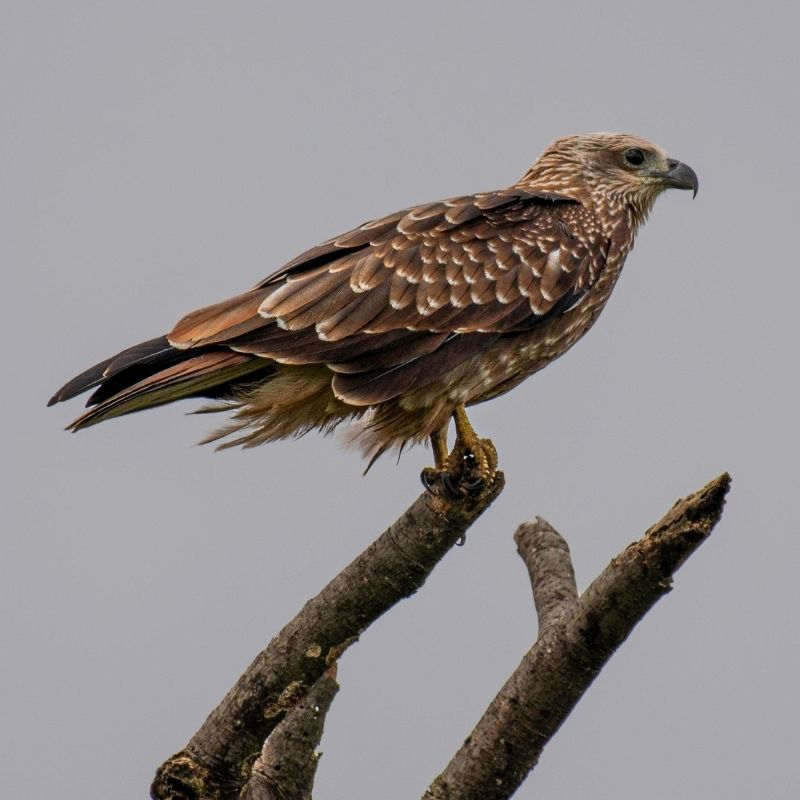 Credit: Rajukhan Pathan
Quick Facts About Snail Kite
| Category | Details |
| Common Name | Snail Kite |
| Other Names | Everglade Snail Kite (Florida subspecies), Caracolero (Spanish) |
| Scientific Name | Rostrhamus sociabilis |
| Conservation Status | Least Concern (IUCN global); Federally Endangered (U.S. Florida population, subspecies plumbeus) |
| Population | ~2,000 in Florida (2025 estimate, declining in dry years); millions globally |
| Lifespan | Up to 14–24 years (wild) |
| Size | 36–48 cm (14–19 in) body length |
| Weight | 300–570 g (11–20 oz) |
| Wingspan | 99–120 cm (39–47 in) |
| Unique Features | Deeply hooked bill, white rump patch, square-tipped tail, sexual dimorphism in plumage |
| Habitat | Freshwater marshes, lake edges, sawgrass prairies |
| Geographic Range | Florida (U.S.), Caribbean, Central/South America |
What makes the Snail Kite unique?
In the golden haze over Florida’s Everglades, a slate-gray raptor glides low on broad wings, head tilted downward, scanning the shallows like a living periscope. This is the Snail Kite, a highly specialized raptor whose dramatically hooked bill is engineered like a biological can-opener for extracting apple snails from their shells. A wetland-dependent molluscivore and nomadic wanderer of tropical marshes, it serves as a flagship and indicator species for healthy freshwater ecosystems across the Americas. Federally Endangered in the U.S. (Florida population), it faces threats from water management, drought, and habitat alteration. Recent 2025–2026 surveys noted sharp nesting declines amid dry conditions, with Florida’s population hovering around 2,000, while broader Neotropical populations remain more secure. X posts and eBird sightings celebrate its graceful hovering over sawgrass, casting this hooked phantom as a resilient symbol of wetland vitality and an urgent call to safeguard its shimmering realms.
| Rank | Classification | Interesting Fact |
| Kingdom | Animalia | Kites soar in a kingdom of specialized hunters—wetlands’ keen-eyed pulse! |
| Phylum | Chordata | Their wings fuel a gliding specialist’s patrol over endless grass seas. |
| Class | Aves | Feathers cloak their slate grace—raptors reborn with hooked precision! |
| Order | Accipitriformes | Kin to hawks and eagles, they master snail extraction. |
| Family | Accipitridae | Raptor kin, their bill sets them apart in the marshes. |
| Genus | Rostrhamus | From Latin for “hooked beak.” |
| Species | Rostrhamus sociabilis | “Sociabilis” nods to their colonial nesting. |
| Subspecies | Several (e.g., R. s. plumbeus in Florida/Cuba) | Vary in range and local adaptations. |
Recommended Reading
- Cornell Lab of Ornithology. All About Birds: Snail Kite (Rostrhamus sociabilis).
- Florida Fish and Wildlife Conservation Commission (FWC). Snail Kite Species Profile.
- IUCN Red List of Threatened Species. Rostrhamus sociabilis (Snail Kite).
- U.S. Fish & Wildlife Service (USFWS). Snail Kite Conservation and Recovery Information.
What does a Snail Kite look like?
The Snail Kite is a marsh-forged specialist, built for precision over power. Adults measure 36–48 cm in length with a 99–120 cm wingspan and weigh 300–570 g. Males are striking slate-gray to black with red eyes and orange-red legs (brighter in breeding season); females and juveniles are brown with white streaking on the face, throat, and breast, plus a prominent white rump patch and square-tipped tail. The standout feature is the long, slender, deeply hooked bill—perfect for severing the snail’s muscle. Long legs and talons help snatch snails from water. Unlike Northern Harriers, they have broader wings and a slower, more deliberate flight with head down.
- Size & Weight: 36–48 cm (14–19 in), 300–570 g (11–20 oz)
- Coloration & Plumage: Males slate-gray; females brown with streaks; white rump
- Sensory Adaptations: Keen eyesight for spotting snails; hooked bill for extraction
- Body & Limbs: Broad rounded wings, long legs, square tail
💡 Fun Fact: Their bill is nature’s ultimate snail fork—marshes’ living can-openers!
Read more
The Snail Kite is a medium-sized raptor with a slender, buoyant build optimized for slow, low flight over marshes. Adults measure 36–48 cm (14–19 inches) in body length with a wingspan of 99–120 cm (39–47 inches) and weigh 300–570 g (11–20 oz), males averaging slightly smaller and lighter than females. The species shows strong sexual dimorphism in plumage.
- Adult Male Plumage: Slate-gray to dark gray overall with a subtle bluish sheen in good light. The head is dark with red to orange-red eyes and orange-red cere and legs (brighter in breeding condition). A prominent white rump patch and white tail base contrast sharply with the dark body and square-tipped tail. Wings are broad and rounded, dark gray with faint barring visible in flight.
- Adult Female and Juvenile Plumage: Rich brown above with heavy white streaking on the face, throat, and breast. The rump and tail base are white. Eyes are orange-red (duller in juveniles). Juveniles are similar to females but have more buffy tones and less distinct streaking.
- Bill and Head: The most diagnostic feature is the long, slender, deeply hooked bill (one of the most specialized among raptors), dark at the base and lighter toward the tip, with a gap near the tip for extracting snail bodies. The head is small with large, bright eyes positioned for downward scanning while gliding.
- Wings and Tail: Wings are broad and rounded for buoyant, slow flight and hovering. The tail is relatively short and square-tipped with a white base and dark terminal band.
- Legs and Feet: Legs are long and orange-red, adapted for snatching snails from water or vegetation. Talons are strong but not overly large, suited for grasping rather than killing large prey.
- Sexual Dimorphism and Age Variation: Males are slate-gray; females and juveniles are brown with white streaking. Full adult male plumage is acquired by the second or third year (Greene & Losos 2025).
Where do Snail Kites live?
Snail Kites inhabit shallow freshwater marshes, lake margins, and sawgrass prairies with abundant apple snails. In the U.S., they are largely confined to central and southern Florida (Everglades, Lake Okeechobee, Kissimmee Chain). Globally, they range from Cuba and Mexico through tropical South America. They are nomadic, moving with water levels and snail availability. Their range faces ongoing pressure from wetland drainage and altered hydrology. Unlike generalist raptors, they are tightly linked to specific wetland conditions.
- Regions: Florida (U.S.), Caribbean, Central/South America
- Countries/States: Florida, Cuba, Mexico, Argentina, Brazil, and others
- Preferred Habitat: Freshwater marshes, shallow lake edges
- Elevation Range: Lowlands, typically near water
💡 Did You Know? They hover low like feathered drones—Everglades’ watchful sentinels!
Read more
The Snail Kite is a specialist of shallow freshwater wetlands with abundant large apple snails (Pomacea spp.): a nomadic to short-distance migrant that is highly dependent on hydrology and snail populations.
U.S. Range (Florida Focus)
Primarily resident in central and southern Florida (Everglades, Big Cypress, Lake Okeechobee, Kissimmee River basin), with small numbers in southern Georgia. Recent northward expansion has been documented, but the population remains concentrated in the Everglades ecosystem. The Florida subspecies (R. s. plumbeus) is federally Endangered (Greene & Losos 2025).
Global Range
From Cuba and southern Mexico through Central America to Colombia, Venezuela, and northern Argentina. Largest populations occur in the Pantanal and Amazon Basin wetlands.
Elevation and Habitat Preferences
Primarily lowlands below 1,000 m. Favors:
- shallow freshwater marshes, sawgrass prairies, lake edges, and wooded swamps with emergent vegetation and abundant apple snails
- open water with sparse to moderate cover for low gliding/hovering
- areas with stable or fluctuating water levels supporting snail breeding Avoids deep open water, fast-flowing rivers, saltwater habitats, and heavily urbanized or drained areas (Herrel et al. 2025).
What do Snail Kites eat?
Snail Kites are extreme dietary specialists, feeding almost exclusively on large freshwater apple snails (Pomacea spp.). They snatch snails with their talons, perch to extract the body with their hooked bill, and consume the soft parts. In Florida, they have adapted to invasive larger snails as native populations fluctuate. A kite may consume dozens of snails daily, directly tied to water levels that support snail breeding. They forage by slow gliding or hovering low over vegetation.
- Primary Diet: Apple snails (Pomacea spp.)
- Feeding Method: Talon snatch + bill extraction
- Adaptations for Feeding: Deeply curved bill severs snail muscle; long legs for reaching
💡 Fun Fact: They dine like gourmet surgeons—wetlands’ specialized snail connoisseurs!
Read more
The Snail Kite is an extreme dietary specialist, feeding almost exclusively on large freshwater apple snails (Pomacea spp.), with limited opportunistic prey.
Primary Diet (Apple Snails)
Diet is 90–98 % large apple snails (Pomacea spp.). The bird snatches snails with its talons from shallow water or vegetation, perches, and uses its hooked bill to extract the body. In Florida, it has adapted to larger invasive snails when native populations are low (Greene & Losos 2025).
Talon Snatch and Bill Extraction Foraging
Forages by slow gliding or hovering low over vegetation, snatching visible snails with talons and carrying them to a perch for extraction. Rarely takes other prey (crayfish, small vertebrates) when snails are scarce (Herrel et al. 2025).
Seasonal and Hydrological Shifts
- Wet season: heavy reliance on abundant snails
- Dry season/low water: reduced foraging success, increased movement to wetter areas, occasional alternative prey
- Breeding: high snail intake for egg production and chick provisioning (Shea 2025).
Are Snail Kites social or solitary?
Snail Kites nest and roost colonially, often with other waterbirds, but forage individually or in small groups. They perform aerial courtship displays (sky-dances, stick-carrying flights) and use cackling calls (“ka-ka-ka”), bleating sounds, and chatters for alarm or contact. They are generally less vocal than many raptors but become noisy near nests.
- Vocalizations: Cackles, bleats, chatters
- Body Language: Aerial displays, stick-carrying
- Social Structure: Colonial nesters/roosters, solitary foragers
💡 Interesting Fact: Their colonies create a marsh symphony—wetlands’ hooked choristers!
Read more
The Snail Kite is generally solitary while foraging but becomes more social during breeding and roosting. It is known for its slow, deliberate flight and haunting vocalizations.
Solitary Foraging with Colonial Nesting
Forages individually or in small loose groups, but nests and roosts semi-colonially where food is abundant. Defends small feeding territories during breeding (Greene & Losos 2025).
Vocalizations
The most characteristic call is a loud, cackling or bleating series (“ka-ka-ka” or similar). Also produces chatters, whistles, and softer contact calls near the nest. Calls are most frequent during courtship and alarm (Herrel et al. 2025).
Aerial Displays and Slow Gliding
Performs sky-dances and stick-carrying flights during courtship. Forages with slow, buoyant gliding or hovering, head tilted downward to scan for snails (Shea 2025).
Territorial and Pair Behavior
Pairs perform mutual preening and coordinated foraging. Males defend territories with calls and displays (Greene & Losos 2025).
Migration and Winter Behavior
Some individuals are nomadic in response to water levels. In winter, forms loose groups or small roosts (Herrel et al. 2025).
Human Interaction & Tolerance
Wary but habituates to humans in protected areas like the Everglades. Rarely aggressive (Shea 2025).
How does the Snail Kite thrive in wetlands?
The Snail Kite is a master of slow, buoyant flight on broad wings, often hovering with precision to spot prey. Its bill is one of the most specialized among raptors. Sexual dimorphism aids identification, and they tolerate varying water conditions by shifting locations. They have adapted to invasive snails with slight bill size increases in some populations. Unlike most raptors, they are highly colonial nesters and communal roosters.
- Foraging – Slow gliding/hovering with head down.
- Bill Specialization – Hooks into shells effortlessly.
- Nomadism – Tracks water and snails across landscapes.
Survival Score
- Specialization: 5/5 – Ultimate snail expert.
- Stealth/Mobility: 4/5 – Buoyant flight over marshes.
- Adaptability: 3.5/5 – Tied to hydrology, vulnerable to drought.
Read more
The Snail Kite is one of the most specialized raptors in the world, with adaptations centered on exploiting large apple snails in shallow wetlands.
Deeply Hooked Bill for Snail Extraction
The long, slender, deeply hooked bill with a gap near the tip functions like a biological can-opener or tweezers — the bird snatches the snail with its talons, perches, and uses the bill to sever the muscle and extract the body while discarding the shell (Greene & Losos 2025).
Buoyant, Low Gliding and Hovering Flight
Broad, rounded wings enable slow, buoyant flight and precise hovering with the head tilted downward — allowing detection and capture of snails in dense vegetation without landing (Herrel et al. 2025).
White Rump and Tail Base as Visual Signals
The prominent white rump and tail base flash during flight and displays, aiding mate recognition and territorial signaling in open marshes (Shea 2025).
Nomadic Response to Hydrology
Moves locally or regionally in response to water levels and snail abundance — a behavioral adaptation to fluctuating wetland conditions (Greene & Losos 2025).
Sexual Dimorphism for Identification
Males are slate-gray and females brown with white streaking — allowing easy sexing in the field and potentially reducing intraspecific competition (Herrel et al. 2025).
How do Snail Kites reproduce?
Breeding is tied to water levels and snail abundance, often peaking in wet seasons (variable in Florida). Pairs build bulky stick nests over water in shrubs or trees. Females lay 1–5 eggs (usually 2–4); incubation lasts ~24–30 days, fledging ~26–30 days. Both parents care for young. Multiple broods possible in good years. Florida success varies dramatically with hydrology.
- Breeding Season: Variable, linked to wet conditions
- Clutch Size: 1–5 eggs
- Incubation Period: 24–30 days
- Parental Care: Both parents incubate and feed
💡 Did You Know? Chicks thrive when snails abound—marshes’ water-dependent heirs!
Read more
Snail Kite reproduction is highly dependent on water levels and snail abundance: an opportunistic to seasonal strategy with platform nesting and extended parental care.
Breeding Season – Variable, Tied to Water Levels
Breeding in Florida peaks in the wet season (often late winter to summer) but can occur opportunistically when conditions are favorable. Pairs may renest after failure (Greene & Losos 2025).
Monogamous Pair Bonds & Nest Construction
Pairs are monogamous. The female (with male assistance) builds a bulky stick platform nest in dense emergent vegetation, shrubs, or low trees over water. Nests are often semi-colonial where food is abundant (Herrel et al. 2025).
Clutch Size & Incubation
Females lay 1–5 eggs (usually 2–4), white to pale blue with brown spots. Incubation lasts 24–30 days, shared by both parents (Shea 2025).
Chick Development & Parental Care
Chicks are semi-precocial and remain in the nest for several weeks. Both parents feed them snails and other prey. Fledging occurs around 26–30 days, with dependence on parents for several more weeks (Greene & Losos 2025).
Mortality Factors
Breeding success is highly variable and often low during dry years. Primary causes: nest predation, flooding, starvation during low snail availability, and hydrological disruption (Herrel et al. 2025).
Adaptability to Fluctuating Conditions
Breeding is closely tied to water levels and snail abundance — pairs may skip breeding or move during poor conditions (Shea 2025).
Why is the Snail Kite vital to its ecosystem?
As top predators of apple snails, Snail Kites help regulate snail populations and serve as sensitive indicators of wetland health and water quality. Their presence signals productive marshes; declines warn of hydrological disruption. They link aquatic and terrestrial food webs and benefit from healthy Everglades restoration.
- Predation: Controls snail numbers.
- Indicator Species: Reflects wetland vitality.
- Food Web Role: Connects invertebrates to raptors.
💡 Fun Fact: Their success mirrors the pulse of the Everglades—wetlands’ feathered barometers!
Read more
The Snail Kite is a specialized top predator and key indicator species in shallow freshwater wetlands: its dependence on apple snails makes it a sensitive barometer of wetland health and hydrology.
Specialized Predation on Apple Snails
By preying on large apple snails (Pomacea spp.), it helps regulate snail populations and prevents overgrazing of aquatic vegetation in some systems. Its foraging links aquatic invertebrates to the broader food web (Shea 2025).
Indicator of Wetland Health
Its presence and breeding success strongly reflect water levels, snail abundance, and overall wetland integrity. Declines often signal hydrological disruption, drought, or habitat degradation (Greene & Losos 2025).
Prey Base and Trophic Link
Adults, chicks, and eggs are prey for alligators, large snakes, raccoons, and other raptors. Its abundance supports higher predator populations in wetland ecosystems (Herrel et al. 2025).
Flagship Species for Wetland Conservation
As a charismatic, specialized raptor, it serves as a flagship species for Everglades and wetland restoration efforts, drawing attention and funding to broader ecosystem protection (Shea 2025).
- Named for their exclusive snail diet—marshes’ ultimate specialists!
- White rump flashes like a signal in flight—Everglades’ aerial beacons!
- One of the most specialized raptors on Earth—nature’s snail surgeons!
Why is the Snail Kite at risk?
In Florida, the subspecies faces Endangered status due to wetland loss, altered water flows, drought, and invasive species impacts on snails. 2025 saw only ~30 successful nests amid dry conditions. Broader populations are more stable but still vulnerable to habitat degradation.
- ⚠ Hydrological Changes: Drainage and mismanagement.
- ⚠ Drought & Water Levels: Reduce snail availability.
- ⚠ Habitat Loss: Development pressures.
Conservation Efforts
- Protected Areas: Everglades NP, Water Conservation Areas, Lake Okeechobee.
- Restoration: Everglades projects, revegetation, water management.
- Monitoring: University of Florida, Audubon, FWC surveys and telemetry.
- Coordination: Snail Kite Coordinating Committee.
✅ What We Can Do:
- Support wetland restoration—kites glide, ecosystems thrive.
- Advocate smart water management—guard their sawgrass seas.
- Back Audubon, FWC, and USGS—champion hooked specialists.
Read more
The Snail Kite is listed as Least Concern globally on the IUCN Red List but the Florida subspecies (R. s. plumbeus) is federally Endangered in the U.S. due to ongoing wetland loss and hydrological changes.
Current Population & Distribution
Global population is stable to locally declining; the U.S. Florida population hovers around 2,000 individuals (2025 estimates), with sharp fluctuations tied to water levels and nesting success (Greene & Losos 2025).
Primary Threats
- Hydrological alteration and drought: altered water management, drainage, and climate-driven dry periods reduce snail availability and nesting success.
- Habitat loss: wetland conversion and degradation.
- Invasive species: competition and ecosystem changes from non-native snails and plants.
- Water quality: pollution affecting snail populations (Herrel et al. 2025).
Conservation Successes & Active Recovery
- Protected areas: Everglades National Park, Water Conservation Areas, and other Florida wetlands protect core habitat.
- Hydrological restoration: Everglades projects aimed at restoring natural water flows benefit snail populations and kites.
- Monitoring: University of Florida, Audubon, FWC, and telemetry studies track movements and survival.
- Coordination: Snail Kite Coordinating Committee and recovery plans (Shea 2025).
The Snail Kite remains vulnerable in the U.S. but benefits from targeted restoration. Every restored marsh, every smart water management practice, and every monitoring effort is a direct vote for keeping this hooked specialist gliding over Florida’s sawgrass seas for another century.
2025–2026 Audubon and University of Florida reports highlighted sharp nesting declines (~30 successful nests) due to drought, with population estimates around 2,000 in Florida. Studies document adaptation to invasive snails via bill morphology changes. Ongoing telemetry and monitoring track nomadic movements and survival amid restoration efforts.
The Snail Kite is a specialist, a glider, the sawgrass seas’ hooked pulse. Saving it safeguards entire wetland ecosystems—let’s champion its deliberate soar.
✅ Share this article – Amplify its marsh patrol!
✅ Support conservation – Back Audubon, FWC, or Everglades restoration.
✅ Advocate for wetlands – Protect water flows, revive a legacy.


Arya Sankar is a postgraduate in Zoology with academic and research experience in wildlife and marine sciences. She has worked on research projects at the Central Marine Fisheries Research Institute and has been actively involved in science education and skill development. Her contributions focus on accurate species information, conservation awareness, and educational wildlife content.
- Florida Fish and Wildlife Conservation Commission (FWC). Snail Kite (Rostrhamus sociabilis).
- Cornell Lab of Ornithology – All About Birds. Snail Kite.
- IUCN Red List of Threatened Species. Rostrhamus sociabilis (Snail Kite).
- U.S. Fish & Wildlife Service (USFWS). Snail Kite Species Profile and Conservation Information.