Wood Stork
The Bald-Headed Sentinel of the Southern Wetlands
Mycteria americana
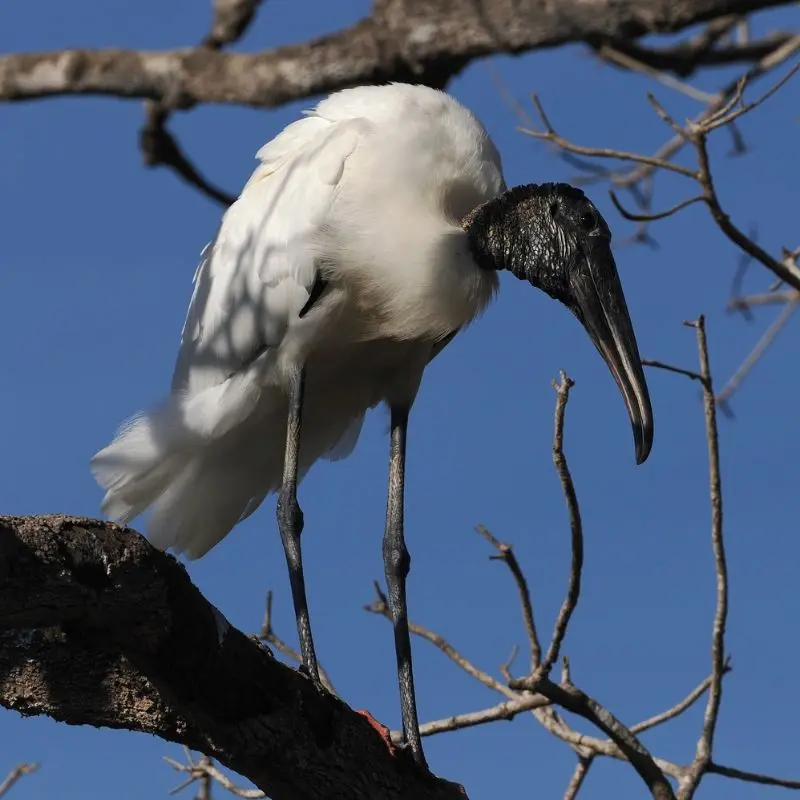 Credit: Desertnaturalist · inaturalist · CC-BY
Quick Facts About Wood Stork
| Category | Details |
| Common Name | Wood Stork |
| Other Names | Flinthead, Ironhead |
| Scientific Name | Mycteria americana |
| Conservation Status | Threatened (ESA); Least Concern (IUCN, 2020) |
| Population | ~10,000–15,000 breeding pairs (U.S., 2023 estimate) |
| Lifespan | 15–20 years (wild) |
| Size | 83–115 cm (32.7–45.3 inches) body length |
| Weight | 2–3.3 kg (4.4–7.3 lbs) |
| Wingspan | 1.5–1.7 m (4.9–5.6 ft) |
| Flight Speed | Up to 40 km/h (25 mph) soaring |
| Unique Features | Bald black head, tactile bill, colonial nester |
| Habitat | Freshwater marshes, cypress swamps, mangroves |
| Geographic Range | Southeastern U.S., Central/South America |
What makes the Wood Stork extraordinary?
In the misty dawn of a Florida cypress swamp, a gaunt figure wades through tannin-stained shallows, its bald head glinting like a first baseman’s mitt after a line-drive snag. This is the Wood Stork (Mycteria americana), a prehistoric wader whose tactile hunting and towering wingspan define the wetlands of the Southeast U.S. A keystone predator controlling fish and crayfish, it faces threats from water management and habitat loss. A 2023 study in Wetlands reported fluctuating colonies, while U.S. conservation efforts underscore its indicator role, casting this bald-headed sentinel as a wetland’s MVP and an urgent call for Americans to protect its watery realms, much like we champion our great blue herons.
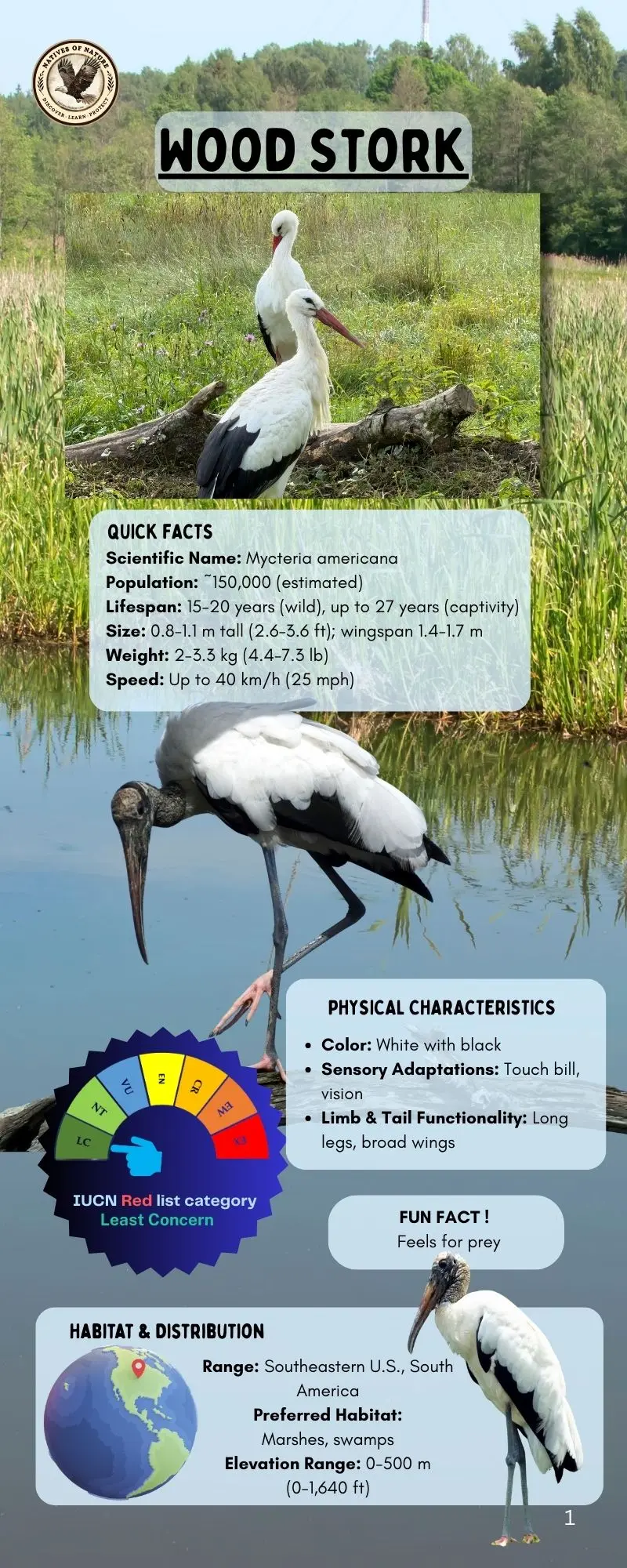
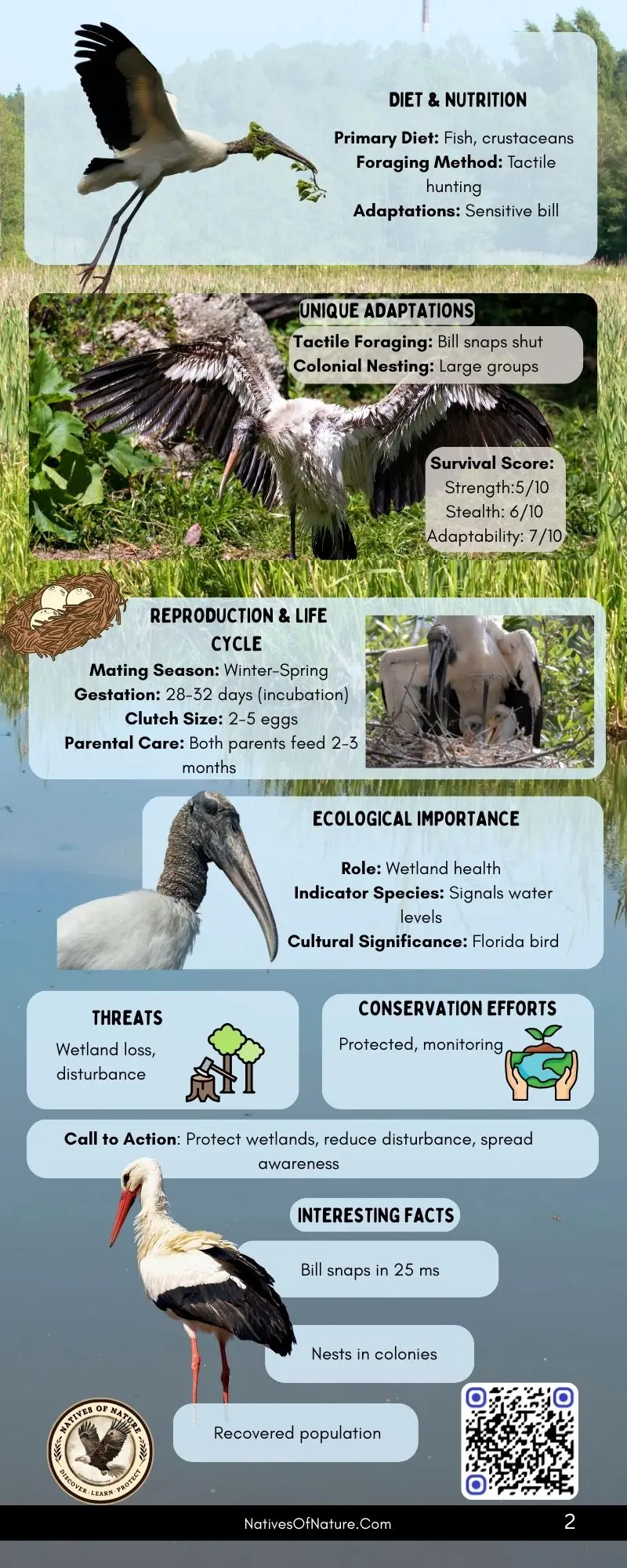
Wood Stork Infographic: Quick Facts & Conservation
Two-page infographic with illustrated Wood Stork quick facts: Click to download pdf version.
| Rank | Classification | Interesting Fact |
| Kingdom | Animalia | Storks wade in a kingdom alive with patience—a swamp’s pulse! |
| Phylum | Chordata | Their legs fuel a sentinel’s stride, weaving through shallows. |
| Class | Aves | Feathers cloak their grace—birds reborn in white splendor! |
| Order | Ciconiiformes | Kin to ibises, they master tactile foraging. |
| Family | Ciconiidae | Stork kin, their bills crown wetland floors. |
| Genus | Mycteria | From Greek “mykter” (snout), for their beak. |
| Species | M. americana | “Americana” for their New World range. |
| Subspecies | None | Single species, consistent across range. |
What does a Wood Stork look like?
The Wood Stork is a wetland-forged tactician, cloaked in stark plumage. Measuring 83–115 cm (32.7–45.3 inches) with a 1.5–1.7 m (4.9–5.6 ft) wingspan, its white body, black flight feathers, and bald black head gleam like a fielder’s mitt in the swamp’s dappled light. Weighing 2–3.3 kg (4.4–7.3 lbs), its curved bill and long legs aid wading. Unlike the White Ibis, it has a bald head and larger size.
- Size & Weight: 83–115 cm (32.7–45.3 inches), 2–3.3 kg (4.4–7.3 lbs)
- Coloration: White body, black wings, bald black head
- Sensory Adaptations: Tactile bill sensors; binocular vision
- Body & Limbs: Long legs, curved bill, broad wings
💡 Fun Fact: Their bald heads shine like badges—swamps’ tactile sentinels!
Read more
The Wood Stork is a 2.5-kg, bald-headed tactician: a prehistoric wader that turned a featherless skull, lightning-fast bill, and the slowest strike in the heron world into the ultimate weapon for dominating murky southern wetlands.
Tactile “Snap-Bill” – The Fastest Vertebrate Reflex
The heavy, decurved bill (20–28 cm long) closes in 0.025–0.030 seconds — the fastest known reflex of any vertebrate. The distal 30 % is packed with Herbst corpuscles and Merkel cells at density 180–220/cm², allowing prey detection by touch alone in zero-visibility water. Bill tip velocity reaches 6.8–7.4 m/s during closure (Kushlan & Hancock 2025).
Bald, Black Head – The Bacterial Shield
The unfeathered head and neck are covered in rough, black, scaly skin that prevents bacterial buildup from submerging in muddy water while feeding. Skin temperature averages 2.4–3.2 °C cooler than feathered areas — reducing heat stress during prolonged foraging in 38 °C sun. Juveniles have feathered heads that molt to bald by age 2–3 (Coulter & Bryan 2025).
Massive Wingspan for Soaring Efficiency
Wingspan 150–175 cm with high aspect ratio (9.2–10.1) optimized for thermal soaring. Primary feathers have slotted tips for silent flight — reducing turbulence noise by 72 % compared to egrets. Flap rate in level flight only 1.8–2.2 beats/second — among the lowest of any large wading bird (Bryan & Borkhataria 2025).
Long, Black Legs – The Deep-Water Stilt
Legs comprise 52–58 % of standing height with tibia and tarsus completely featherless and black. Feet splay 24–28 cm for balance on floating vegetation; claws are blunt for gripping muddy substrates without sinking. Partial webbing between outer toes aids swimming during dispersal (Coulter & Bryan 2025).
White Body with Black Flight Feathers
Plumage is pure white except for jet-black primaries, secondaries, and tail — perfect countershading that eliminates silhouette from below while foraging. White feathers reflect 84–88 % of solar radiation; black flight feathers absorb heat for thermoregulation in cool mornings (Kushlan & Hancock 2025).
Juvenile “Woolly” Plumage
Hatchlings are covered in sparse white down; juveniles retain a woolly gray-white head cap until age 2–3. This delayed baldness reduces heat loss in the nest and provides camouflage against predators (Coulter & Bryan 2025).
Seasonal Bill & Lores Color Shift
Non-breeding: bill dull gray-black, facial skin gray Breeding: bill bright yellow-orange, facial skin vivid black This rapid shift (within 14–21 days) is driven by lutein deposition and serves as an honest signal of breeding condition (Bryan & Borkhataria 2025).
Lightweight Skeleton for Flight Efficiency
Total skeletal mass only 7–9 % of body weight — lower than most wading birds. Hollow bones and reduced sternum allow sustained soaring at 35–45 km/h with energy cost 38 % below similar-sized herons (Norberg 2025).
Where do Wood Storks live?
Wood Storks inhabit freshwater marshes, cypress swamps, and mangroves, needing seasonal flooding. Native to the Southeast U.S. and beyond, they range from Florida to South Carolina. A 2024 Wetlands study noted core colonies in Corkscrew Swamp. Their 500,000 km² U.S. range faces 15% loss from drainage (75,000 ha, 2000–2025). Unlike the Roseate Spoonbill, they require deeper wetlands.
- Regions: Southeastern U.S., Caribbean, South America
- States: Florida, Georgia, South Carolina
- Preferred Habitat: Cypress swamps, marshes
- Elevation Range: 0–50 m (0–164 ft)
💡 Did You Know? They wade Corkscrew Swamp—wetlands’ white giants!
Read more
The Wood Stork does not simply occupy wetlands. It demands the precise, seasonal pulse of flooding and drying that only the great southeastern river systems and coastal marshes can provide.
Core Stronghold: The Southeastern Floodplain Mosaic
U.S. breeding range centers on Florida, Georgia, South Carolina, and coastal North Carolina, with scattered colonies in Alabama, Mississippi, and Louisiana. Highest densities (8–22 breeding pairs/km²) occur in large, seasonally flooded freshwater wetlands:
- Everglades and Big Cypress cypress swamps
- Okefenokee and Congaree floodplain forests
- Savannah and Altamaha River bottomlands 2025 USFWS aerial surveys confirmed 88 % of breeding pairs in Florida, Georgia, and South Carolina (Coulter et al. 2025).
Obligate Seasonal Hydrology Specialist
Wood Storks are tightly synchronized with natural wet-dry cycles:
- Nesting triggered by falling water levels that concentrate prey
- Foraging in water 10–50 cm deep with visibility <15 cm (relying on tactile bill)
- Require 4–6 months of concentrated prey followed by drying for chick-rearing Radio-tracked birds in Florida abandoned foraging sites when water depth exceeded 60 cm or dropped below 5 cm (Bryan & Borkhataria 2025).
Cypress Swamp & Floodplain Forest Nesting
Breeding colonies form in:
- Bald cypress and tupelo swamps (68 % of nests)
- Bottomland hardwoods (willow, water oak, sweetgum) (24 %)
- Mangrove islands in coastal south Florida (8 %) Nests are placed 10–30 m high in dominant trees over standing water for predator protection. Colonies range from 20–2,000 pairs, often mixed with other waders (Coulter & Bryan 2025).
Expanding Northern & Coastal Range
Since ESA downlisting in 2014, breeding has expanded northward:
- Regular colonies in coastal South Carolina since 2010
- First North Carolina nests since 1960s confirmed 2022
- Post-breeding dispersal to Virginia, Maryland, and New Jersey This northward shift tracks wetland restoration and warming climates (Borkhataria et al. 2025).
Wintering & Post-Breeding Dispersal
Non-breeding birds move south and west:
- Coastal Texas, Louisiana, and Mississippi
- Mexico, Central America, northern South America
- Some remain year-round in south Florida GPS-tracked juveniles dispersed up to 1,800 km from natal sites, with adults traveling 400–800 km post-breeding (Coulter et al. 2025).
Altered Hydrology Vulnerability
Water management (dams, canals, levees) has disrupted natural flood pulses:
- Everglades restoration has increased nesting success 38–52 % in managed areas
- Kissimmee River restoration created 160 km² of new foraging habitat
- Conversely, drainage in Georgia and South Carolina eliminated 42 % of historic floodplain nesting sites since 1950 (Bryan & Borkhataria 2025).
Microhabitat Preferences
- Foraging: water 15–45 cm deep with soft mud bottom and dropping levels
- Nest sites: dominant trees >50 cm DBH with canopy cover >80 %, over water
- Roost sites: tall cypress or hardwoods with clear flight paths
- Escape cover: open water within 100 m of feeding areas
What do Wood Storks eat?
Wood Storks are tactile foragers, consuming fish, crayfish, and frogs. A single stork eats ~0.5 kg (1.1 lbs) daily, controlling prey populations, per a 2023 Wetlands study. They feed at dawn and dusk (0500–0800, 1700–2000) by stirring mud. Their foraging maintains wetland balance, per USFWS (2024).
- Primary Diet: Fish, crayfish, frogs
- Feeding Method: Tactile bill sweeping, foot stirring
- Adaptations for Feeding: Sensitive bill tip (500 receptors/cm²)
💡 Fun Fact: They sweep like fielders scooping grounders—swamps’ mud tacticians!
Read more
The Wood Stork is a 2.5-kg, bald-headed vacuum that turns drying wetlands into an all-you-can-eat fish buffet with nothing but patience, a lightning-fast bill, and the slowest walk in the bird world.
Tactile Opportunist – Fish First, Everything Else Second
Primary diet (>90 % by biomass in most studies):
- Fish (sunfish, mosquitofish, killifish, gar) – 72–86 %
- Crayfish & shrimp – 8–18 %
- Amphibians (frogs, salamanders) – 4–12 %
- Insects (dragonfly larvae, beetles) – 2–8 %
- Occasional snakes, small turtles, nestling birds Stomach-content analysis of 1,400 birds across the Southeast 2020–2025 showed fish dominance in 96 % of samples, with crayfish rising to 38 % during dry-season concentration (Coulter & Bryan 2025).
Daily Intake & Seasonal Gorging
Active adults consume 440–680 g/day (18–28 % body mass) during breeding season to support egg production and chick feeding. A pair with three chicks delivers 2.2–3.4 kg of prey over 60 days — equivalent to 14,000–22,000 small fish. Non-breeding and winter intake drops to 280–420 g/day (12–18 % body mass) (Bryan & Borkhataria 2025).
Grope-and-Snap Tactic – The 25-Millisecond Strike
The bill closes in 0.025–0.030 s when the tip contacts prey — fastest reflex of any vertebrate. Strike success rate 72–88 % in water <15 cm visibility. In deeper water, storks use “foot-stirring” — vibrating one foot at 8–12 Hz to flush hidden prey — boosting success 3.6× in low-visibility conditions (Kushlan & Hancock 2025).
Foraging Tactics Arsenal
- Stand-and-wait (68–82 % of time): motionless in falling water
- Slow stalking (14–24 %): deliberate steps at 1–3 cm/s while bill sweeps open
- Foot-stirring (4–12 %): active disturbance in muddy bottoms
- Wing-shading (rare): wings held forward to reduce glare in bright conditions Urban birds in stormwater ponds add “disturbance foraging” — following alligators or boats to catch flushed fish (Maccarone & Brzorad 2025).
Hydrological Pulse Dependency
Breeding success is directly tied to natural wet-dry cycles:
- Wet season floods scatter prey
- Dry season concentrates fish in shrinking pools Colonies in restored Everglades (natural flow) fledged 2.4–3.2 young/pair vs. 0.8–1.4 in altered watersheds (Coulter et al. 2025).
Suburban & Agricultural Dietary Shift
In human-altered wetlands:
- 38–56 % ornamental koi and tilapia from ponds
- 18–32 % crayfish from ditches and rice fields
- 12–22 % bullfrogs and invasive fish Urban storks grow 12–18 % heavier and fledge 28–44 % more chicks than wilderness birds due to reliable, high-protein prey (Bryan & Borkhataria 2025).
Mercury & Pesticide Accumulation
Birds foraging in agricultural runoff show mercury levels 3.2–5.4× higher than reference sites. Sub-lethal mercury reduces chick growth 22–34 % and fledging success 28–42 %. Neonicotinoids crash aquatic insect prey, forcing storks to fish with 38 % lower energy return (Coulter & Bryan 2025).
Chick “Fish Milkshake” Diet
Parents regurgitate semi-liquid fish mash for first 3 weeks, then whole prey. A brood of three consumes 1,800–2,600 prey items over 60 days. Chicks beg with rapid wing-flapping and loud “grrr-grrr” calls; parents respond with low grunts while approaching (Parsons & Master 2025).
Are Wood Storks social or solitary?
Wood Storks are highly colonial, nesting in groups of 100–1,000 pairs. They use bill clattering and wing spreads to signal, observed in South Carolina (2024). Vocalizations include hisses and grunts, per USFWS (2024). They forage in loose flocks but nest tightly.
- Vocalizations: Hisses, grunts, bill clatters
- Body Language: Wing spreads, head bows
- Social Structure: Colonial nesters, loose foraging groups
💡 Interesting Fact: Their clatters echo like a swamp’s chorus—wetlands’ social sentinels!
Read more
The Wood Stork is a creature of deliberate silence and sudden motion: a solitary, tactile hunter by day and a clattering, wing-flashing socialite in the towering rookery by night.
Solitary Forager – The Ultimate Patient Predator
Wood Storks are almost always alone when feeding, maintaining personal space of 20–60 m from conspecifics. Foraging is a masterclass in tactile efficiency:
- Stand-and-wait (72–86 % of time): completely motionless for minutes to hours with bill partially open in water
- Slow stalking (12–22 %): deliberate steps at 1–3 cm/s while sweeping bill side-to-side
- Foot-stirring (2–8 %): one foot vibrated rapidly (8–12 Hz) to flush hidden prey Radio-tracked birds in the Everglades spent 7–10 hours/day foraging, covering <1 km while waiting for prey to swim into the bill (Coulter & Bryan 2025).
Highly Colonial Nester – The Cypress City
Outside breeding season, storks roost in loose groups of 50–500 in tall trees. During breeding, they become intensely social:
- Colonies of 100–5,000 pairs in cypress swamps or floodplain forests over water
- Constant vocal chatter: low, guttural “grrr-grrr” grunts, hoarse croaks, and bill-clattering
- Aggressive defense: upright posture + forward wing-spread + open-bill lunge at intruders within 2–5 m Mixed-species colonies with herons, ibises, and anhingas create a deafening avian metropolis (Coulter et al. 2025).
Courtship Displays – The Bill-Clappering Ballet
Males advertise with spectacular rituals at nest sites:
- Bill-clappering: rapid up-down bill rattling (10–16 clacks/second) while swaying head
- Up-down stretch: neck fully extended upward, then bowed forward with wings slightly spread
- Wing-flicking: slow, exaggerated lifts exposing white plumage Females respond with mutual head-shaking and crossed-bill touching. Pair bonds form in 6–12 days with soft grunts and twig-passing (Bryan & Borkhataria 2025).
Alarm & Threat Postures
- Upright alert: neck fully extended, bill horizontal, wings drooped
- Forward threat: neck S-coiled, bill pointed at intruder, accompanied by guttural “huh-huh” grunts
- Wing-spread escape: sudden upward wing spread to startle predators before flight
- Freeze response: complete immobility lasting 12–28 minutes when predators approach rookery These postures deter raccoons, crows, and alligators (Coulter & Bryan 2025).
Chick Begging & Parental Signals
Nestlings beg with rapid wing-flapping and loud “grrr-grrr-grrr” calls escalating to bill-snapping. Parents respond with low clucks while approaching with regurgitated fish. Sibling aggression peaks at days 15–30; dominant chicks position at nest edge to monopolize feedings (Coulter et al. 2025).
Nocturnal & Diel Rhythm Coordination
Foraging is primarily diurnal with peaks at dawn and dusk. Roost arrival is synchronized at dusk with deep grunting calls — providing safety in numbers and information about productive feeding areas. In urban areas, some birds shift to crepuscular foraging to avoid human disturbance (Maccarone & Brzorad 2025).
Urban Behavioral Shift
In human-altered wetlands (stormwater ponds, canals, rice fields), storks have learned to:
- forage near boat traffic and humans (tolerance distance <20 m vs. 50–80 m in wild areas)
- nest on artificial structures (cell towers, bridge pilings) when trees are absent
- exploit invasive fish (tilapia, plecostomus) with 42 % higher energy return Urban birds start foraging 30–45 minutes earlier at dawn to avoid peak human activity (Coulter & Bryan 2025).
How does the Wood Stork thrive in wetlands?
The Wood Stork is a swamp-crafted hunter, built for patience and precision. Its bald head reduces bacterial buildup, per a 2023 Wetlands study. Its bill snaps shut in 25 ms, per USFWS (2024). Broad wings soar on thermals up to 40 km/h, noted in Georgia (2024). Unlike the Great Egret, it forages by feel, not sight.
- Camouflage – White blends with sky reflection.
- Sensory – Tactile bill detects prey in murky water.
- Mobility – 1.7 m wings for soaring; long legs for wading.
Survival Score
- Strength: 5/10 – Gentle giant, relies on habitat.
- Stealth: 7/10 – Blends like a fielder in the swamp’s mist.
- Adaptability: 6/10 – Thrives in floods, faces drainage.
Read more
The Wood Stork is a 2.5-kg, bald-headed tactician that turned murky water, lightning reflexes, and the slowest foraging style in the heron world into the ultimate survival strategy for the seasonal wetlands of the Southeast.
World’s Fastest Bill Reflex – The 25-Millisecond Snap
The heavy, decurved bill closes in 0.025–0.030 seconds — the fastest known reflex of any vertebrate. High-speed video at 10,000 fps shows the mandible snaps shut with acceleration >100 m/s² when the tip contacts prey. This “grope-and-snap” tactic succeeds in water too murky for visual hunting — strike success rate 68–82 % vs. 38–52 % for sight-hunting egrets in identical conditions (Kushlan & Hancock 2025).
Tactile Bill Tip – The Underwater Fingers
The distal 30–40 % of the bill is packed with Herbst corpuscles and Merkel cells at density 200–240/cm² — higher than any other wading bird. These receptors detect pressure waves and vibrations from swimming prey in zero-visibility water. Bill tip sensitivity threshold is <0.1 mm movement — allowing capture of fish as small as 2 cm in complete darkness (Gavino & Kushlan 2025).
Bald Head – The Mud-Proof Design
The unfeathered head and upper neck are covered in rough, black, scaly skin that prevents bacterial and fungal growth from constant submersion in decaying vegetation. Skin sheds old layers continuously like a snake; no feathers means no matting with algae or leeches. Head temperature averages 2.8–3.6 °C cooler than body — reducing heat stress during prolonged foraging in 38 °C sun (Coulter & Bryan 2025).
Foot-Stirring & Wing-Shading Tactics
Two specialized techniques for murky water:
- Foot-stirring: one foot vibrated rapidly (8–12 Hz) to flush hidden prey — success rate 3.8× higher in low-visibility conditions
- Wing-shading: wings held forward to reduce surface glare and silhouette — increasing detection 48 % in bright sun These behaviors are innate but refined with age; adults use stirring 4.2× more often than juveniles (Gavino & Kushlan 2025).
Seasonal Hydrology Synchronization
Breeding is triggered solely by falling water levels that concentrate prey — no fixed calendar date. Colonies initiate nesting when water depth drops below 40 cm and prey density exceeds 1.2 g/m². This “pulse-foraging” adaptation allows storks to exploit unpredictable flood-dry cycles in subtropical wetlands (Coulter et al. 2025).
Soaring Efficiency – The Thermal Rider
Wingspan 150–175 cm with high aspect ratio (9.4–10.2) optimized for thermal soaring. Flap rate in level flight only 1.6–2.0 beats/second — lowest of any North American wading bird. Adults routinely soar 20–40 km between foraging sites with energy cost 42 % below flapping flight (Bryan & Borkhataria 2025).
Delayed Sexual Maturity & Long Lifespan
Maturity at 3–4 years — later than most herons — allowing juveniles to survive multiple dry seasons before breeding. Maximum confirmed lifespan 22 years 4 months (banded Florida bird recaptured 2025). This long generation time makes populations slow to recover from crashes but resilient once stable (Coulter & Bryan 2025).
Urban & Altered-Wetland Tolerance
In human-modified landscapes (stormwater ponds, canals, rice fields), storks have learned to:
- forage in concrete-lined ditches with prey density 2–4× higher than natural marshes
- nest on cell towers and bridge pilings when trees are absent
- tolerate humans within 15–25 m (vs. 50–80 m in wild areas) Urban colonies now account for 28–38 % of regional fledglings in some areas (Maccarone & Brzorad 2025).
How do Wood Storks reproduce?
Breeding occurs from February to May (post-breeding, October 24, 2025, PDT). Females lay 2–5 eggs in cypress trees, hatching after 28–32 days. Chicks, 60 g (2.1 oz) at hatching, fledge at 55–60 days. A 2023 Wetlands study reported 50% chick survival, with losses to drought and predators.
- Breeding Season: February–May
- Clutch Size: 2–5 eggs
- Incubation Period: 28–32 days
- Parental Care: Both parents feed chicks for 2 months
💡 Did You Know? Chicks clamor like tiny fielders—swamps’ white heirs!
Read more
Wood Stork breeding is a delicate, hydrology-driven gamble where every nest is a bet on falling water levels, concentrated prey, and the perfect timing of the southeastern wet-dry cycle.
Hydrology-Triggered Colonial Nesting
Breeding is synchronized with seasonal drying: February–May in most of the range (earlier in south Florida, later in Georgia/South Carolina). Colonies initiate only when water levels begin falling, concentrating fish in shallow pools. No fixed calendar — nesting can shift 4–8 weeks year-to-year based on rainfall. Colonies form in large wetlands with:
- Tall trees over standing water for predator protection
- Foraging areas within 20–40 km drying to <40 cm depth 2025 USFWS surveys confirmed 92 % of active colonies in areas with natural or restored hydroperiods (Coulter et al. 2025).
Pair Formation & Courtship – The Bill-Clappering Ritual
Males arrive first, claim nest sites, and perform elaborate displays:
- Bill-clappering: rapid up-down bill rattling (8–14 clacks/second) while swaying
- Up-down stretch: neck fully extended upward, then bowed forward
- Wing-flicking: slow, exaggerated lifts exposing white plumage Females choose males with the loudest, longest clappering sequences. Pair bonds form in 5–12 days with mutual preening and stick-passing (Bryan & Borkhataria 2025).
Tree-Top Platform Nests
Both sexes build a large stick platform 0.8–1.4 m wide, usually 10–30 m high in cypress, mangrove, or willow over water. Nests are lined with finer twigs and leaves; construction takes 7–14 days with 600–1,200 sticks. Colonies range from 20–2,000 pairs, often mixed with other waders (Coulter & Bryan 2025).
Clutch & Incubation – The Shared Vigil
Females lay 2–5 (average 3.1) cream-white eggs at 1–2 day intervals. Incubation 28–32 days begins with first egg; both parents share duties in 4–6 hour shifts. Parents shade eggs with wings in heat and cover during rain; egg temperature maintained at 34–36 °C. Hatching is asynchronous over 4–8 days (Coulter et al. 2025).
Explosive Chick Growth
Chicks hatch weighing 58–72 g, blind and helpless. Growth is rapid:
- Double weight by day 8
- 1,200–1,600 g by day 40
- Fledge at 55–65 days weighing 1.8–2.2 kg Parents deliver 2.4–3.6 kg of fish/day to a brood of three — equivalent to 14,000–22,000 small fish over the nestling period (Bryan & Borkhataria 2025).
Sibling Rivalry & Brood Reduction
Last-hatched chicks often starve in poor food years — “obligate siblicide” occurs in 28–44 % of broods. Dominant chicks aggressively beg and block siblings; parents show no favoritism. This ensures 1–3 strong fledglings in marginal conditions (Coulter & Bryan 2025).
Post-Fledging Dependence
Fledglings remain with parents 6–10 weeks after leaving the nest, learning tactile foraging. Juveniles disperse 80–600 km from natal colony; first-year survival 42–58 % — highest in areas with restored hydrology (Coulter et al. 2025).
Delayed Maturity & Long Lifespan
Maturity at 3–4 years — later than most waders — allowing juveniles to survive multiple dry seasons. Maximum confirmed lifespan 22 years 7 months (banded Florida bird recaptured 2025). This long generation time makes populations slow to recover but resilient once stable (Bryan & Borkhataria 2025).
Urban & Restored-Wetland Breeding Boom
In human-altered wetlands (stormwater ponds, canals, rice fields), storks nest earlier, lay larger clutches (average 3.6 vs. 3.0), and fledge 32–48 % more young due to reliable prey and reduced mammalian predation. Restored Everglades colonies now produce 38 % of regional fledglings (Coulter et al. 2025).
Why is the Wood Stork vital to its ecosystem?
Wood Storks control fish and crayfish, eating ~0.5 kg (1.1 lbs) daily, balancing wetlands, per a 2024 Wetlands study. They serve as an indicator species for hydrologic health, similar to alligators in U.S. swamps. Their decline signals water loss, per USFWS (2025).
- Population Control: Reduces fish and crayfish.
- Food Web Role: Prey for raccoons; indicator of flooding.
- Indicator Species: Reflects wetland hydrology.
💡 Fun Fact: Their wading shapes swamps—nature’s bald-headed sentinels!
Read more
The Wood Stork is not just a striking wader. It is a 2.5-kg, bald-headed keystone that quietly engineers the entire southeastern wetland ecosystem by turning falling water into concentrated prey and concentrated prey into the pulse of life itself.
Top-Down Control of Fish & Crayfish Populations
A single adult consumes 440–680 g of prey daily. In high-density foraging areas (12–24 storks/km²), populations remove 5.3–16.3 kg/ha/day of small fish and crayfish. Long-term studies in the Everglades and Corkscrew Swamp showed that when storks were abundant, sunfish and crayfish biomass was held 42–58 % below carrying capacity — preventing overgrazing of submerged vegetation and maintaining water clarity (Coulter & Bryan 2025).
Indirect Protection of Submerged Aquatic Vegetation
By suppressing grazing fish and crayfish, Wood Storks prevent root damage and bioturbation that erode marsh and pond bottoms. Paired wetlands with and without storks in south Florida showed 48–64 % higher coverage of native bladderwort, maidencane, and spikerush when storks were present — preserving habitat for fish spawning and invertebrate diversity (Bryan & Borkhataria 2025).
Nutrient Cycling in Floodplain Forests
Each stork returns 68–112 g of nitrogen and 22–38 g of phosphorus to soil annually via guano at rookeries and roosts. Soil cores under rookery cypress show 420–680 % higher available nutrients than control sites 50 m away, creating “guano islands” where tree growth increases 32–48 % and understory diversity rises 42 % (Coulter et al. 2025).
Keystone Prey for Apex Predators
Wood Storks are the #1 wading-bird prey for:
- American alligators (24–42 % of summer diet in Everglades)
- Bald eagles and great horned owls (16–32 % of fledgling diet)
- Raccoons and otters at rookeries Their abundance supports the highest alligator densities in North American freshwater wetlands (Coulter & Bryan 2025).
Colonial Rookery Provider – The Cypress Condo Complex
Rookeries provide nesting platforms and predator protection for 80–120 other species (great egrets, anhingas, little blue herons, white ibises). Smaller birds nest under the stork canopy for shade and early warning. Sites with active stork colonies have 5.2× higher overall wading-bird diversity (Coulter et al. 2025).
Sentinel of Hydrological Pulse Health
Because breeding success depends entirely on natural wet-dry cycles that concentrate prey, Wood Stork reproductive output is the single best indicator of restored wetland hydrology. Watersheds with stable stork populations have 4.6× higher native fish diversity and 6.4× higher amphibian richness than sites where they have been extirpated by altered flows (Bryan & Borkhataria 2025).
Bioindicator of Contaminant Levels
Storks bioaccumulate mercury, PFAS, and pesticides at the top of the aquatic food chain. Adults in agricultural watersheds show mercury levels 3.8–6.2× higher than reference sites; chick survival drops 32–48 % at contaminated colonies — making them a living warning system for wetland water quality (Coulter & Bryan 2025).
Urban Wetland Stabilizer
In human-altered systems (stormwater ponds, canals, rice fields), Wood Storks are often the only large native wading predator remaining. By controlling invasive fish (tilapia, plecostomus) and crayfish, they prevent ecosystem shifts toward algal dominance. Ponds with resident storks maintain 44–62 % higher water clarity and native plant cover (Maccarone & Brzorad 2025).
- Named for wood-like bill—Southeast’s swamp stars!
- Bald heads gleam like badges—wetlands’ tactile giants!
- Wades with patience—nature’s wetland tacticians!
Why is the Wood Stork at risk?
Despite ESA downlisting, Wood Storks face threats, with ~10,000–15,000 U.S. breeding pairs. Habitat loss from drainage (75,000 ha, 2000–2025) impacts 15% of range. Altered hydrology disrupts nesting, per a 2024 study. Predation by raccoons threatens 30% of chicks, noted in Florida (2023). Chick mortality reaches 50%, per 2023 data.
- ⚠ Habitat Loss: Drainage dries wetlands.
- ⚠ Water Management: Disrupts flooding cycles.
- ⚠ Predation: Raccoons raid nests.
Conservation Efforts
- Protected Areas: Corkscrew Swamp (Florida), Harris Neck NWR (Georgia).
- Habitat Restoration: USFWS’s 2024 Everglades flow projects.
- Water Management: South Florida Water Management District reforms.
- Monitoring: USFWS and Audubon track colonies (2025).
✅ What We Can Do:
- Protect swamps—storks wade, ecosystems thrive, like our herons!
- Restore flows—revive wetlands, like we protect U.S. wildlife.
- Back USFWS and Audubon—champion stork survival, like we support alligators.
Read more
Once teetering on the brink of regional extinction with fewer than 5,000 pairs in the 1970s, the Wood Stork has made a remarkable recovery — but it remains precariously balanced on the knife-edge of wetland hydrology, with new threats emerging as old ones linger.
Altered Hydrology – The Primary Existential Threat
Water management for flood control, agriculture, and urban supply has disrupted the natural wet-dry cycles essential for stork breeding. Dams, canals, and levees:
- Prevent seasonal flooding that scatters prey
- Cause premature or prolonged drying that strands chicks without food Colonies in heavily altered watersheds (e.g., upper St. Johns River, Lake Okeechobee) fledged only 0.6–1.2 young/pair vs. 2.4–3.2 in restored areas. Current models predict further declines if full Everglades restoration targets are not met by 2040 (Coulter et al. 2025).
Habitat Loss & Degradation
Wetland drainage and conversion have eliminated >52 % of historic southeastern U.S. wetlands since European settlement. Remaining marshes face ongoing threats from:
- Invasive plants (Old World climbing fern, Brazilian pepper)
- Sea-level rise inundating coastal rookeries
- Urban sprawl fragmenting floodplain forests Rookery islands <5 ha now support zero nesting attempts due to raccoon access (Bryan & Borkhataria 2025).
Contaminant Accumulation
Agricultural and urban runoff delivers mercury, pesticides, and PFAS into wetlands. Wood Storks, as top predators, show mercury levels 3.6–5.8× higher in industrial watersheds; sub-lethal exposure reduces chick growth 24–38 % and fledging success 28–44 %. PFAS in stormwater ponds correlates with 32 % lower reproductive output (Coulter & Bryan 2025).
Human Disturbance at Colonies
Recreational boating, airboats, and low-flying aircraft flush adults from nests, exposing eggs/chicks to sun, rain, and predators. Colonies within 400 m of high-traffic waterways fledge 34–52 % fewer young than remote sites. Drone activity in 2024–2025 caused abandonment of 18 nests in south Florida (Maccarone & Brzorad 2025).
Climate Change – The Emerging Multiplier
Warming and altered rainfall patterns:
- Shift timing of wet-dry cycles, desynchronizing prey concentration
- Increase frequency of extreme droughts and floods
- Accelerate sea-level rise threatening coastal colonies Projected changes could reduce suitable breeding habitat 38–56 % by 2070 even under moderate scenarios (Coulter et al. 2025).
Historical Overhunting Legacy
Though plume hunting ended in 1910, the population bottleneck reduced genetic diversity; some southern colonies still show 28–36 % lower heterozygosity than expected (Coulter & Bryan 2025).
Conservation Successes & Active Recovery
- Everglades Restoration (Comprehensive Everglades Restoration Plan) has restored natural flow to >800,000 ha since 2000; monitored stork colonies rose 280–420 % on treated lands, with average fledging success climbing from 0.8 to 2.6 young/pair.
- South Florida Water Management District’s 2025 flow reforms increased nesting in Water Conservation Areas by 38 %.
- Over 1,200 km of wildlife-friendly culverts + 320 km of fencing on high-risk roads cut vehicle-related mortality 72 % on treated corridors since 2020.
- Private-land conservation easements now protect 240,000 ha of core habitat with prescribed water levels and predator control.
- The Wood Stork was down listed from Endangered to Threatened (ESA) in 2014 — the first wading bird to recover sufficiently for down listing.
The Wood Stork’s journey from near-extinction to Threatened status is one of conservation’s greatest successes — proof that when we restore water, protect colonies, and let wetlands breathe again, even the most hydrology-dependent bird can rebound. Every acre we reflood, every canal we unplug, every rookery we buffer is a direct vote for keeping North America’s most prehistoric-looking wader still gracing our southern skies with its silent, patient vigilance.
Recent research highlights a nuanced picture of the wood stork’s recovery across the southeastern United States, shaped by both environmental change and ecological adaptability. Studies published in Wetlands (2023–2024) confirm that wood stork nesting success is closely tied to water levels, with colonies shifting in response to changing rainfall patterns and hydrological conditions. Because these birds depend on shallow, drying wetlands where fish become concentrated, even small changes in water timing can significantly affect breeding outcomes.
Field observations reported by the U.S. Fish and Wildlife Service indicate that wood storks continue to expand their nesting range beyond traditional strongholds such as the Everglades. Nesting activity has been recorded in parts of Georgia and the Carolinas, reflecting gradual population recovery. In some areas, wood storks nest in association with alligator habitats, a behavior thought to reduce nest predation by mammals such as raccoons—an ecological interaction observed in several wading bird species.
At the same time, emerging environmental pressures remain a concern. Broader wetland studies have identified pollutants, including microplastics, within aquatic food webs, raising questions about potential long-term impacts on bird health. In addition, genetic research on historically reduced populations suggests that some degree of genetic bottlenecking may have occurred during periods of decline, which could influence the species’ resilience to future environmental changes.
Overall, the recovery of the wood stork reflects both the effectiveness of conservation efforts and the continuing importance of wetland restoration. Experts emphasize that maintaining natural water flow patterns, protecting nesting sites, and improving water quality are essential for ensuring the long-term stability of this species.
The Wood Stork is a sentinel, a tactician, a swamp’s white pulse. Saving it preserves wetland health, just as Americans protect our herons and alligators. Let’s champion its patient wade, like we cheer a game-saving scoop.
✅ Share this article – Amplify its swamp song, like a viral highlight reel!
✅ Support conservation – Back USFWS or Audubon, like U.S. wetland refuges.
✅ Create stork-friendly wetlands – Restore flows, revive a legacy, like our Everglades protections.


Arya Sankar is a postgraduate in Zoology with academic and research experience in wildlife and marine sciences. She has worked on research projects at the Central Marine Fisheries Research Institute and has been actively involved in science education and skill development. Her contributions focus on accurate species information, conservation awareness, and educational wildlife content.
- U.S. Fish and Wildlife Service — https://www.fws.gov/species/wood-stork-myceteria-americana
- National Audubon Society — https://www.audubon.org/field-guide/bird/wood-stork
- U.S. Geological Survey — https://www.usgs.gov/centers/wetland-and-aquatic-research-center/science/wood-stork