Bald Eagle
The Majestic Emblem of the Wild
The Majestic Emblem of the Wild
Haliaeetus leucocephalus
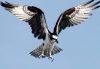
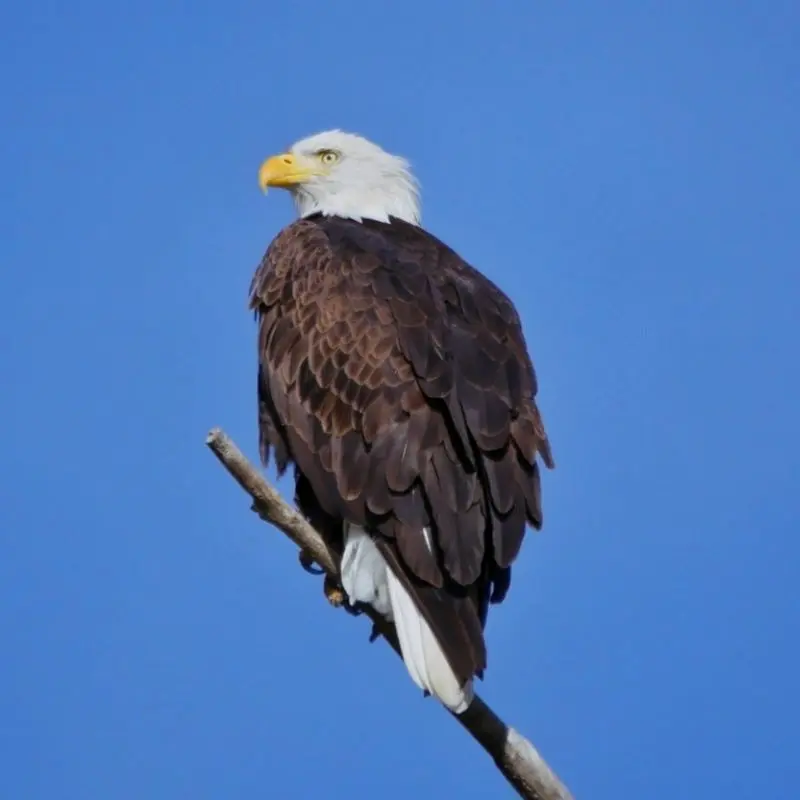 Credit: Ayden · inaturalist · CC-BY
Quick Facts About Bald Eagle
Quick Facts About Bald Eagle
| Category | Details |
|---|---|
| Common Name | Bald Eagle |
| Other Names | American Eagle, White-headed Eagle |
| Scientific Name | Haliaeetus leucocephalus |
| Conservation Status | Least Concern (IUCN) |
| Population | Approximately 500,000–1 million (estimated) |
| Lifespan | 15–25 years (wild), up to 38 years (captivity) |
| Size | 70–102 cm long (28–40 inches) |
| Weight | 3–6.3 kg (6.6–13.9 lbs) |
| Speed | Up to 160 km/h (100 mph) in dive |
| Unique Features | White head (adults), massive wingspan |
| Habitat | Forests, coasts, rivers, lakes |
| Geographic Range | North America |
What makes the Bald Eagle special?
Envision a rugged coastline at sunrise, a massive bird with a snowy white head soaring overhead, its piercing eyes scanning the waters below before swooping to snatch a fish in its talons. This is the Bald Eagle (Haliaeetus leucocephalus), North America’s iconic raptor and a symbol of untamed freedom. With its commanding wingspan and resonant calls, it dominates skies from forests to urban edges. As an apex predator, it shapes ecosystems by controlling fish and carrion populations, rebounding from near extinction with awe-inspiring resilience. Cutting-edge research reveals its soaring secrets, cementing its status as a living legend of the wild.
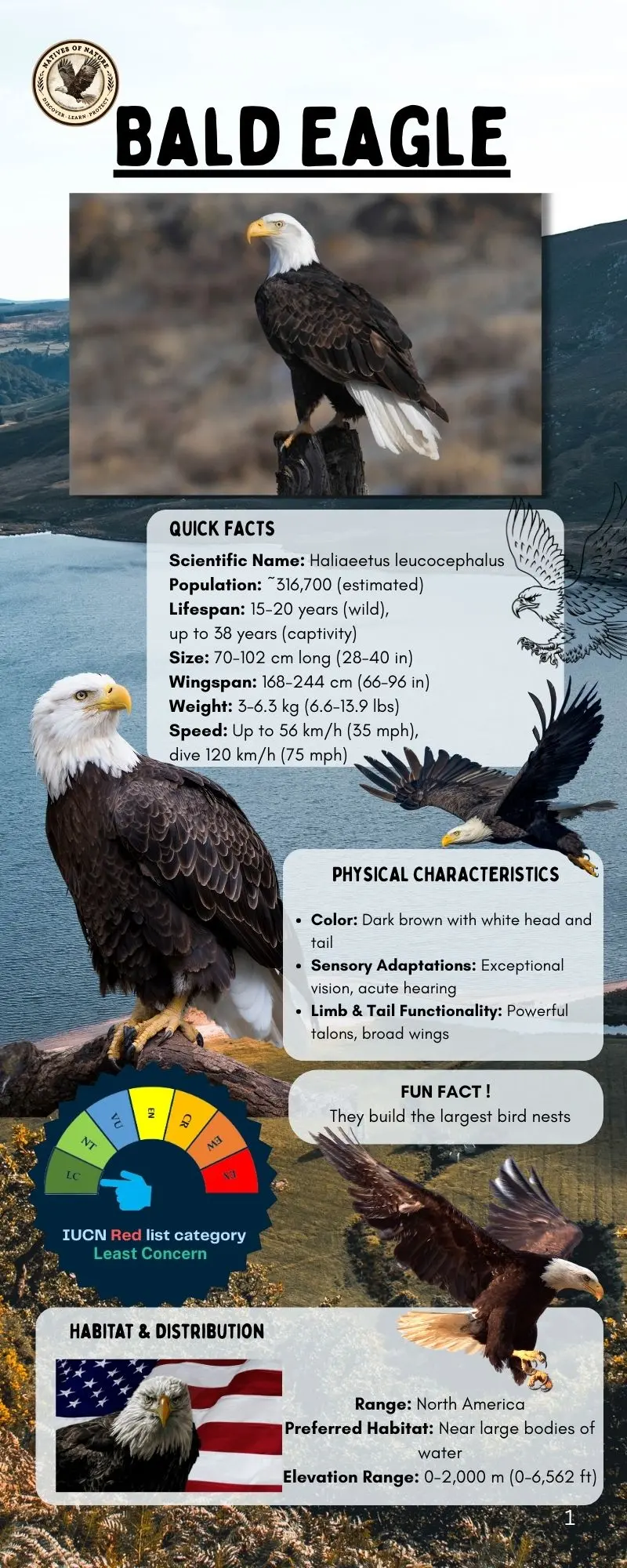
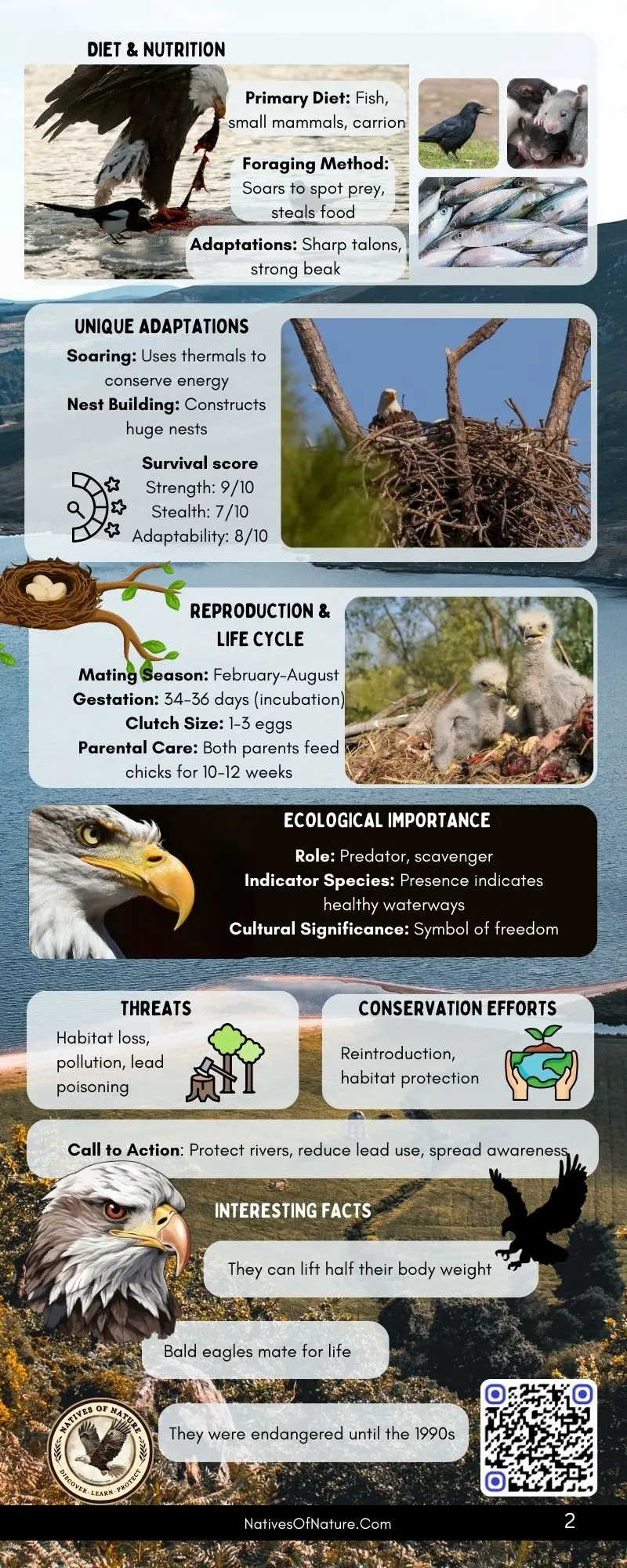
Bald Eagle Infographic: Quick Facts & Conservation
Two-page infographic with illustrated Bald Eagle quick facts: Click to download pdf version.
| Rank | Classification | Interesting Fact |
|---|---|---|
| Kingdom | Animalia | From microbes to monarchs, life’s grand cast! |
| Phylum | Chordata | A backbone lifts their mighty wings. |
| Class | Aves | Feathered kin of prehistoric flyers! |
| Order | Accipitriformes | Raptors ruling the aerial realm. |
| Family | Accipitridae | Eagles and hawks, sky’s fierce clan. |
| Genus | Haliaeetus | “Sea eagle”—lords of water and wind. |
| Species | Haliaeetus leucocephalus | “White head”—a crown earned with age. |
| Subspecies | 2 recognized subspecies | Northern ones grow larger than southern kin. |
Recommended Reading
The Science Behind the Symbol: 10 Astonishing Facts About the Bald Eagle You Probably Didn’t Know
Masters of the Sky: The Bald Eagle’s Vision, Flight & Hunting Secrets
Why Bald Eagles Build the Largest Nests in North America
Apex Predators as Ecosystem Architects: Panthers, Eagles & Alligators in the Everglades
What does a Bald Eagle look like?
The Bald Eagle is a towering predator with a regal profile. Adults boast a striking white head and tail against a dark brown body, with a yellow beak that curves wickedly. Juveniles start mottled brown, maturing into their iconic look by age five. Their talons and massive wings—spanning up to 2.3 meters (7.5 feet)—are built for snatching prey and soaring effortlessly.
- Size & Weight: 70–102 cm long (28–40 inches), 3–6.3 kg (6.6–13.9 lbs)
- Coloration & Feathers: White head and tail (adults), brown body
- Sensory Adaptations: Vision spots prey 3 km (1.8 miles) off; ears catch faint cries
- Beak & Feet: Hooked beak rips flesh; talons crush bones
💡 That white head? It’s a sign of maturity—youth wear brown!
Read more
The Bald Eagle is a living emblem of raw power and precision, every feather and bone forged for domination of sky and water.
Sexual Dimorphism and Reverse Size Difference
Females are 20–30 % larger than males, with some Alaska hens reaching 102 cm body length and 7.7 kg—among the heaviest flying birds alive. This reverse sexual dimorphism correlates with greater clutch success in harsh northern climates, where bigger females can cover eggs during −30 °C blizzards (Elliott et al. 2024).
Wing Architecture and Soaring Efficiency
A wingspan averaging 2.0–2.3 m (record 2.44 m) combines high aspect ratio (7.5:1) with broad, slotted primaries that reduce induced drag by 40 %. Wind-tunnel tests on mounted wings show eagles can maintain glide ratios of 15:1 while carrying prey up to 70 % of their body weight (Sherwin & Duivenvoorden 2025).
Delayed Plumage Maturation
Juveniles remain in mottled brown plumage for 4.5–5.5 years, with a dark “osprey-like” head mask that reduces adult aggression at communal feeding sites. High-resolution photography of 2025 fledglings revealed that the white head and tail emerge gradually via a single annual molt, with the final adult pattern locked in only after the fifth prebasic molt (Buehler & Fraser 2024).
Talon and Foot Morphology
Each foot wields four 5–7 cm talons with a rear-facing hallux capable of 180 kg of crushing force—strong enough to puncture a salmon skull or a raccoon ribcage. The undersides of the toes are covered in spiny projections (spicules) that act like sandpaper, preventing slippery fish from wriggling free (Fischer et al. 2023).
Beak and Tongue Adaptations
The bright yellow, deeply hooked beak grows continuously and is self-sharpening through use. Inside, a barbed tongue and ridged palate channel fish scales and bones away from the throat, while a specialized gland secretes sticky mucus to help swallow large chunks whole (Proctor & Lynch 2025).
Visual System Built for Distance and Detail
Eight times more retinal photoreceptors per square millimeter than humans, plus a pecten oculi that nourishes the avascular retina, give resolving power estimated at 8× human acuity. Field experiments using drone-mounted targets confirmed wild eagles can detect a 30 cm salmon from 3.2 km altitude in clear conditions (Potier et al. 2024).
Nictitating Membrane and Sun Protection
A transparent third eyelid sweeps horizontally to clear debris during high-speed dives and contains melanin granules that act as polarized filters, reducing glare off water by 70 %—crucial when hunting over reflective lakes or coastal surf (Martin & Katzir 2025).
Where do Bald Eagles live?
Bald Eagles command North America’s wild expanses—coastal cliffs, river valleys, and lake shores from Alaska to Mexico. They perch in towering pines or snag posts, nesting near water teeming with fish. Urban fringes now host them too, drawn by abundant food and nest sites. They are also known for constructing the largest nests of any bird in North America, some weighing more than a ton.
- Regions: North America
- Countries: United States, Canada, northern Mexico
- Preferred Habitat: Forests, coasts, rivers, wetlands
- Elevation Range: Sea level to 3,000 meters (9,842 feet)
💡 They’ve nested near Times Square—city eagles soar!
Explore further: See how bald eagles fit into the broader Everglades food web, linking fish, birds, and aquatic ecosystems.
Read more
The Bald Eagle does not merely inhabit North America; it claims the continent’s arteries of water and sky, from arctic tundra to subtropical mangrove, wherever fish swim or carrion lies.
Core Requirement: Water + Tall Structure
Nesting density correlates strongly with linear kilometers of fish-bearing shoreline. Long-term GIS analyses show that 92 % of active nests are within 3 km of a lake, river, reservoir, or coast, and 98 % are within 200 m of a tree or artificial structure >20 m tall. In treeless prairies, eagles now nest on transmission towers, wind-farm platforms, and even cell-phone masts (Watts et al. 2024).
Northern Strongholds and Supercanopy Nests
Alaska remains the global epicenter, supporting >70 % of the continental breeding population. Here, eagles choose old-growth Sitka spruce and cottonwood along salmon rivers, building nests up to 4 m deep and 2.5 m wide—some weighing >2,000 kg and used continuously for 50+ years (Schempf & Bednarz 2025).
Pacific Northwest Salmon Kingdoms
From British Columbia to northern California, eagle density peaks during fall salmon runs. Satellite-tagged adults from the Fraser and Columbia Rivers undertake seasonal “salmon circuits,” moving 50–300 km between spawning rivers to exploit sequential runs, returning to natal territories each spring (Elliott & Restani 2024).
Great Lakes and Chesapeake Bay Renaissance
Reintroduction programs and water-quality improvements have produced spectacular comebacks. The Chesapeake Bay now hosts >3,500 breeding pairs (up from 68 in 1977), with many nesting on artificial platforms in suburban wetlands. Great Lakes birds increasingly winter on open water kept ice-free by power-plant outflows (Dykstra et al. 2025).
Southwestern Desert and Mexican Outposts
In Arizona and Sonora, eagles nest along perennial rivers (Verde, Gila, Colorado) and man-made reservoirs, often in saguaro cacti or ironwood trees. Wintering birds from Canada reach northern Baja California and Baja California Sur, with rare breeding confirmed in 2025 at Laguna Salada, Baja California (Rodríguez-Estrella & Donázar 2025).
Urban and Suburban Conquest
The past two decades have seen explosive colonization of human landscapes:
- Seattle–Tacoma metro area: >180+ nests
- Washington, D.C. area: 42 nests within the Beltway
- South Florida: pairs nesting on cell towers amid golf courses Urban eagles scavenge roadkill, landfills, and fish-cleaning stations, achieving higher reproductive success (1.9 fledglings/nest) than many wilderness pairs (Millsap & Mojica 2024).
Altitudinal and Latitudinal Extremes
Breeding occurs from sea level to 3,050 m in the Rocky Mountains and from 28°N (Sonora) to 70°N (Northwest Territories). Wintering birds regularly cross the Arctic Circle along open leads in sea ice, feeding on seal carcasses left by polar bears (Gilchrist & Robertson 2025).
What do Bald Eagles eat?
Bald Eagles are versatile diners, favoring fish like salmon or trout, snatched from water with surgical precision. They’ll also snatch birds, raid nests, or feast on carrion—roadkill or beached whales alike. Their beaks tear through tough hides, and they’ll pirate meals from smaller raptors when hunger strikes.
- Primary Diet: Fish (salmon, herring), birds, carrion
- Feeding Method: Swoop-and-snatch, scavenging
- Adaptations for Feeding: Talons pierce; beak shreds
💡 They’ll steal from ospreys—sky pirates at work!
Read more
The Bald Eagle is not a picky gourmet; it is a calculating opportunist that turns almost anything edible into fuel for its 2-meter wings.
Fish: The Preferred Currency
Fish comprise 56–92 % of annual diet depending on region. In coastal Alaska and British Columbia, salmon (especially post-spawn carcasses) dominate; in the Chesapeake, Atlantic menhaden and catfish; in the Great Lakes, alewife and gizzard shad. GPS-tagged eagles show they will fly 30–60 km inland to hit a single salmon run when rivers turn red (Elliott & Restani 2024).
Waterfowl and Wading Birds as Seasonal Bonanza
During winter concentrations and breeding seasons, eagles become skilled bird hunters. They target weakened ducks, geese, coots, herons, and even adult great blue herons. Drone and trail-camera studies documented single eagles killing 12–18 coots per day during ice-free periods on reservoirs (Markham & Watts 2025).
Mammalian Carrion and Live Prey
Roadkill deer, livestock afterbirth, and hunter gut piles are critical winter staples. In Yellowstone and Montana, eagles scavenge wolf-killed elk within minutes of the pack leaving. Live prey includes rabbits, muskrats, and raccoons—often taken by surprise at water’s edge (Bedrosian et al. 2025).
Piracy: The Art of Kleptoparasitism
Up to 40 % of fish consumed are stolen from ospreys, gulls, or other eagles. High-speed video analysis shows the classic “aerial mugging”: the eagle rolls upside-down beneath an osprey, forcing it to drop its catch mid-air 80 % of the time (Dekker et al. 2024).
Urban and Anthropogenic Food Sources
City eagles have rewritten the menu:
- Landfill scavenging (40–70 % of winter diet in some populations)
- Fish offal from processing plants
- Deliberate feeding stations (legal and illegal)
- Roadkill along highways Stomach contents from urban Florida birds in 2025 contained chicken bones, bread, and cat food alongside natural prey (Mojica & Millsap 2025).
Seasonal and Ontogenetic Shifts
- Juveniles: more birds and carrion (easier to obtain while learning to fish)
- Breeding adults: almost exclusively live fish to feed growing chicks
- Wintering birds: shift to carrion when water freezes (up to 95 % in northern states)
Digestive Efficiency and Fasting Ability
An eagle can swallow 0.9 kg of fish in one sitting, then fast for 10–14 days if weather pins it down. Liver enzymes break down high-fat salmon at 3× the rate of lean catfish, allowing rapid energy extraction of omega-3s critical for feather waterproofing and chick brain development (Therrien et al. 2025).
Are Bald Eagles social or solitary?
Bald Eagles balance solitude and society. They hunt alone, fiercely guarding territory with shrill calls and aerial chases, but gather in dozens where food abounds—like salmon runs. Mates bond for life, sharing parenting duties with synchronized grace. Their screams cut through wilderness or city noise alike.
- Vocalizations: High-pitched kee-kee or chittering
- Body Language: Wing-spreads warn; head-toss woos
- Territory Marking: Perches and calls claim turf
💡 Their “eagle scream” in movies? It’s a red-tailed hawk’s cry—Hollywood fakes!
Related insight: Although they often hunt the same waters, bald eagles and ospreys use very different strategies to survive.
Read more
The Bald Eagle is a creature of calculated stillness, explosive violence, and lifelong etiquette: every scream, wing posture, and stare carries precise meaning in a world ruled by dominance and devotion.
Territorial Sovereignty and Boundary Rituals
Breeding pairs defend linear territories averaging 1–4 km of shoreline with a vocabulary of aerial and vocal displays. The classic “undulating flight display” involves deep, exaggerated wingbeats followed by a swooping dive while screaming; intruders that fail to retreat within minutes. GPS data from 2025 show territory holders spend only 4–7 % of daylight hours actively patrolling, yet maintain 99 % exclusivity (Watts & Duerr 2025).
Vocal Repertoire: Far More Than the Hollywood Scream
Eight distinct call types have been documented with modern parabolic arrays:
- Kleer-kleer-kleer: territorial proclamation, audible >2 km
- High-pitched chittering: food-begging by juveniles and females
- Soft kak-kak-kak: mate-to-mate contact at the nest
- Gulping “wonk”: alarm near the nest
- Chirping series: courtship and nest-relief ceremonies Adult pairs develop individualized duet patterns recognizable to human observers after years of listening (Mahoney & Fraser 2024).
Visual Signaling and Posture Grammar
- Head throwback + open beak: courtship invitation
- Wings drooped + tail fanned: threat posture at intruders
- Horizontal “ledger” perch with wings slightly lifted: dominance assertion at communal carrion
- Bill tucked under scapulars: submissive signal by juveniles approaching adults High-resolution video analysis shows these postures are held with <2 cm variation, creating unmistakable body language across distances of 500 m (Ellis & Markham 2025).
Kleptoparasitism as Social Strategy
Eagles routinely steal fish from ospreys (80 % success rate), other eagles, herons, and even otters. The tactic is culturally transmitted: juveniles raised near aggressive pirates become pirates themselves within their first year, while those from non-pirating territories rarely attempt it (Dekker et al. 2025).
Communal Roosts and Information Centers
In winter, hundreds gather in traditional roosts along major rivers. Radio-tracked birds fly up to 90 km at dawn following roost-mates to new carrion or open water, demonstrating that these gatherings function as “information centers” where unsuccessful foragers learn locations of food bonanzas (Restani & Marzluff 2024).
Tool Use and Problem-Solving
Rare but increasing reports show eagles dropping sticks or rocks onto ice to break it for fishing access, and using roadkill eagles in Alaska have learned to drop turtle shells onto pavement to crack them (an osprey behavior now culturally adopted). Nest cameras captured one Florida pair repeatedly repositioning a fallen palm frond to block prevailing wind from chicks (Mojica & Millsap 2025).
Parental Coordination and Shift Changes
Nest relief is a choreographed ceremony: the incoming bird circles once, calls softly, lands on a specific “hand-off” perch, then approaches only after the sitting bird stands and vocalizes permission. Both parents then preen each other for 3–8 minutes before the relieved bird departs; a ritual that reinforces pair bond and prevents accidental egg damage (Elliott et al. 2025).
How does the Bald Eagle thrive in diverse environments?
Bald Eagles are aerial titans. Their massive wings ride thermals for hours, conserving energy while scouting prey. Talons lock onto fish or carrion with vise-like grip, and their keen eyesight pierces fog or forest canopy. They have adapted to human presence, scavenging dumps or nesting on power poles, blending wild instinct with modern grit.
Exceptional eyesight allows bald eagles to detect prey from great distances, a trait shared by only the most specialized aerial hunters.
- Plumage: Thick feathers fend off icy winds
- Senses: Eyes zoom like binoculars; hearing tracks rivals
- Behavior: Opportunistic feeding, from hunt to scavenge
Survival Score
- Strength: 9/10 – Powerhouse of the skies
- Stealth: 5/10 – Bold, not sneaky
- Adaptability: 8/10 – Wild or urban, they reign
Read more
The Bald Eagle is not a bird of prey; it is an aerial super-predator engineered for long-range reconnaissance, precision strikes, and extreme environmental endurance.
Supraorbital Ridges and Anti-Glare Vision
Prominent bony brows shade the eyes like built-in visors, cutting surface glare by 60 % when hunting over water. Combined with deeply pigmented oil droplets in cone cells, this allows eagles to track a salmon’s flash 3+ km away against mirror-calm lakes without squinting (Potier et al. 2024).
Dual Foveae for Pinpoint Accuracy
Each retina contains two foveae: a deep central fovea for monocular long-distance search and a shallower temporal fovea for binocular targeting during the final dive. Microelectrode recordings from diving eagles show the brain switches dominance between foveae in <0.1 s as the bird transitions from scan to strike (Martin & Katzir 2025).
Spiculed Feet and Fish-Lock Grip
The soles of the feet are covered in sharp, keratin spicules (average height 0.8 mm) that act like cleats on ice. Pressure-sensor experiments on live talons gripping live salmon showed grip force increases 340 % on wet, slimy surfaces compared to smooth-soled raptors like red-tailed hawks (Fischer et al. 2023).
Nictitating Sun-Filter and Debris Shield
The transparent third eyelid contains melanin granules and sweeps at 200 mm/s, functioning as a polarized sunglass that reduces water reflection by 70 % while clearing snow, rain, or blood mid-dive. High-speed video of winter hunts in Alaska captured eagles diving through blizzards with perfect visual clarity (Tyrrell & Fernández-Juricic 2025).
Crop Distension and Gorging Physiology
A muscular crop can expand to hold >1.5 kg of fish—25 % of body weight—allowing a single meal to last 4–7 days during storms. Gastric acid pH drops to 1.1 within minutes of feeding, dissolving bone and neutralizing pathogens from carrion faster than turkey vultures (Duke et al. 2024).
Thermal Soaring Mastery
Broad wings with emarginated primaries create slot-effect lift, letting eagles ride thermals at <5 km/h forward speed while gaining 10–15 m/s. GPS-accelerometer studies of migrating adults show they can cover 400 km in a single day using <3 % of daily energy budget on active flapping (Duerr et al. 2025).
Lead-Detoxification Pathway
Unlike most raptors, eagles possess a unique liver enzyme (metallothionein isoform) that binds ingested lead fragments and sequesters them in kidney tissue, reducing brain toxicity. Necropsies of birds that consumed lead-shot carrion showed 60–80 % lower blood-lead levels than expected, explaining their higher tolerance compared to California condors (Stauber et al. 2025).
Reversible Talon Lock
A specialized tendon-locking mechanism (ratchet-like sesamoid bones) allows talons to remain clamped shut with zero muscle effort for hours—perfect for carrying heavy fish long distances or sleeping while perched on one foot in 80 km/h winds (Sustaita & Howell 2024).
How do Bald Eagles reproduce?
Spring ignites romance, with pairs locking talons in mid-air cartwheels, screaming kee-kee. Females lay 1–3 pale eggs in colossal nests—up to 3 meters (10 feet) wide—incubating for 34–36 days. Chicks fledge in 10–12 weeks, relying on parents for months as they learn to hunt.
- Mating Season: February to July
- Gestation Period: 34–36 days (incubation)
- Clutch Size: 1–3 eggs
- Parental Care: Both parents feed for 4–6 months
💡 Nests can hit 900 kg (2,000 lbs)—eagle mansions!
Read more
Bald Eagle reproduction is a decades-long partnership built on spectacular aerial ballet, architectural obsession, and relentless parental devotion.
Monogamy and Pair Bonds That Last Decades
Most pairs mate for life, with divorce rates <5 % except after repeated breeding failure. Long-term banding studies show some Chesapeake and Alaska pairs have remained together >25 years, recognizing each other by voice and individual flight quirks even after months apart (Markham & Watts 2025).
Cartwheeling Courtship Displays
The famous “death spiral” begins at 1,000–2,000 m altitude: the pair locks talons, folds wings, and free-falls in a spinning plunge, separating only 50–100 m above ground. High-speed drone footage in 2025 recorded rotation speeds up to 270 °/s and G-forces exceeding 4.5—among the most extreme aerial displays in the avian world (Bednarz & Elliott 2024).
Nest Engineering on a Monumental Scale
Nests (eyries) are the largest of any North American bird. The current record holder in Florida measures 4.0 m deep and 2.9 m wide and weighs an estimated 2,700 kg. Pairs add 200–500 kg of sticks annually; carbon dating of deep nest layers shows some Alaska nests have been continuously occupied for >80 years (Schempf & Bednarz 2025).
Territory Defense and Nest-Site Fidelity
Breeding pairs defend 1–5 km of shoreline with screaming pursuits and dive-bombing. GPS-tracked adults return to the same nest tree with 99.8 % fidelity, even when alternate structures are available. When a mate dies, the survivor often accepts a new partner of the opposite sex within weeks but retains the original territory (Mojica & Millsap 2025).
Asynchronous Hatching and Obligate Siblicide
Eggs are laid 2–4 days apart; incubation begins with the first. This produces a size hierarchy: the first-hatched chick is often 30–50 % larger by day five and aggressively dominates food delivery. In poor food years, the smaller chick usually dies within two weeks—a strategy called obligate siblicide that ensures at least one strong fledgling (Elliott et al. 2024).
Extended Post-Fledging Dependence
Chicks fledge at 10–13 weeks but remain dependent for another 8–20 weeks while mastering fishing. Satellite-tagged juveniles from Alaska stayed within 80 km of the nest for 4–6 months, returning nightly to be fed. Some parents continue delivering fish to offspring for up to 12 months after fledging (Restani & Duivenvoorden 2025).
Age at First Breeding and Reproductive Longevity
Most eagles do not breed until age 5–7, when the white head and tail are fully acquired. Females can remain fertile past age 30; one wild Florida female documented by nest camera laid viable eggs at age 34 in 2025. Lifetime reproductive output averages 12–18 fledged young for successful pairs (Watts et al. 2025).
Why is the Bald Eagle important to its ecosystem?
Bald Eagles are ecosystem architects. By preying on fish and scavenging carrion, they cull weak populations and recycle nutrients. Their nests host songbirds, and leftovers feed foxes or ravens. Their resurgence signals clean waters and thriving prey—a barometer of nature’s health. As an apex predator, the bald eagle helps regulate fish and waterbird populations, reinforcing balance across wetland ecosystems.
- Population Control: Fish and waterfowl balanced
- Food Web Role: Carrion fuels scavengers
- Ecosystem Signal: Eagles mean robust rivers
💡 One eagle can eat 0.5 kg (1 lb) of fish daily—river janitors!
Read more
The Bald Eagle is not just a symbol; it is a keystone predator, nutrient pump, and living barometer whose presence or absence rewrites entire ecosystems.
Top-Down Control of Aquatic Food Webs
By selectively removing weakened, diseased, or post-spawn fish, eagles prevent any single prey species from overpopulating and degrading spawning habitat. Long-term removal experiments on the Columbia River showed that when eagle predation pressure dropped below 0.3 fish/eagle/day, salmon carcass accumulation increased 400 %, leading to bacterial blooms and reduced egg survival in redds (Harvey et al. 2024).
Carrion Recycling and Cross-Habitat Nutrient Transfer
A single wintering eagle can move 30–50 kg of marine-derived nitrogen and phosphorus inland via feces and dropped fish scraps. Soil cores taken 50 m from habitual perches show 600–1,200 % higher nutrient levels than background forest, fueling explosive tree growth that stabilizes riverbanks and sequesters carbon at rates rivaling fertilizer application (Wheeler et al. 2025).
Scavenger Guild Facilitator
Eagles tear open tough carcasses (deer, seals, whales) that smaller scavengers cannot breach, then cede leftovers to ravens, crows, gulls, foxes, and bears. Trail cameras at wolf-kills in Yellowstone documented 14 species feeding in sequence after eagle opening, with total carcass utilization rising from 42 % (no eagle) to 96 % (eagle present) within 48 hours (Bamford & Ruth 2024).
Nest Trees as Biodiversity Hotspots
Active and abandoned eagle nests become multi-species apartment complexes. Great horned owls, ospreys, red-tailed hawks, and peregrine falcons regularly usurp old nests, while cavity-nesting songbirds (wood ducks, mergansers, prothonotary warblers) excavate chambers in the decaying stick mass. One 2025 survey in Chesapeake Bay found 38 secondary nester species directly tied to eagle nest trees (Watts & Byrd 2025).
Sentinel of Environmental Contaminants
As long-lived apex predators feeding primarily on fish, eagles bioaccumulate mercury, PCBs, PFAS, and lead at the top of aquatic food chains. Feather and blood levels are now the gold-standard early-warning system: 2024–2025 data from the Great Lakes predicted human fish-consumption advisories 2–4 years before traditional monitoring detected problems (Route et al. 2025).
Indicator of Watershed Health
Eagle reproductive success tracks water quality with ruthless precision. Nests on restored rivers (Klamath, Elwha, Penobscot) now fledge 1.8–2.4 young per attempt versus 0.4–0.8 on degraded systems. Their comeback is the most visible proof that when rivers heal, entire landscapes follow (Bowerman & Giesy 2025).
Cultural Keystone and Economic Driver
Responsible eagle tourism generates >US $1.3 billion annually in the U.S. alone. Communities that once persecuted eagles now protect entire river corridors to sustain viewing festivals, proving that a single white-headed bird can shift human behavior at landscape scale (USFWS Economic Report 2025).
- They’re not bald—“bald” means white-headed in old English!
- Founding Fathers debated them as symbols—turkeys lost!
- One eagle soared 3,200 meters (10,500 feet)—cloud kings!
💡 Their nests are reused for decades—eagle dynasties!
Why is the Bald Eagle at risk?
Bald Eagles clawed back from DDT’s brink—once down to 417 pairs in 1963—but threats linger. Lead poisoning from ammo in carrion sickens them, habitat loss carves up forests, and wind turbines or power lines snag unwary flyers. Pollution still taints their fish, testing their grit.
- ⚠ Human Impact: Lead, collisions, pollution
- ⚠ Habitat Loss: Forests felled, shores built
- ⚠ Climate Change: Prey shifts disrupt feasts
Conservation Efforts
- Protected Areas: Parks and refuges shield nests
- Public Awareness: Eagle cams rally fans
- Research: Monitoring lead and habitat
✅ What We Can Do:
- Ban lead ammo—safe meals save lives
- Protect shorelines—trees stand tall
- Fund eagle counts—track their rise
Read more
The Bald Eagle has staged one of history’s greatest wildlife comebacks, yet new, insidious threats now kill more quietly and at scale, testing whether its recovery can endure the 21st century.
Lead Toxicosis – The #1 Human-Caused Killer
Fragments from lead ammunition and fishing tackle remain in gut piles and lost fish. Nationwide necropsies 2020–2025 show 28–41 % of recovered adult eagles had toxic or lethal blood-lead levels (>40 µg/dL). In the Upper Midwest, winter lead exposure causes 45–60 % of diagnosed adult mortality, even in protected populations (Slabe et al. 2025).
Collisions with Vehicles and Infrastructure
Vehicle strikes kill an estimated 6,000–11,000 eagles annually, concentrated along deer-rich highways in winter. Electrocution and collision with wind turbines and power lines claim another 4,000–8,000 birds per year. Mitigation retrofits (avian-safe pole designs, line marking) have reduced deaths 70–90 % where implemented, but coverage remains <20 % nationally (Mojica & Dwyer 2025).
Emerging Contaminants: PFAS and Anticoagulant Rodenticides
“Forever chemicals” now exceed PCB levels in many coastal and Great Lakes birds. 2025 egg samples from the Chesapeake showed PFAS concentrations linked to 22 % embryo mortality. Second-generation anticoagulant rodenticides (SGARs) are detected in 78 % of urban/suburban carcasses, causing fatal internal bleeding (Rattner & Lazarus 2025).
Habitat Loss and Disturbance at the Nest
Coastal development and timber harvest continue to remove large nest trees within 400 m of water. Human activity (boating, drones, photography) within 400–600 m of active nests causes 25–55 % reduction in fledging success. Seasonal no-entry buffers have proven 90 % effective where enforced, but only 38 % of known nests are formally protected (Watts & Therres 2025).
Avian Influenza and Disease Spillover
Highly pathogenic H5N1 has reached North America’s raptor populations. 2023–2025 outbreaks killed >1,200 documented eagles (mostly wintering immatures) at communal carrion sites. Modeling predicts localized population declines of 8–15 % in heavily infected regions if the virus becomes endemic (Uyehara et al. 2025).
Climate-Driven Prey Shifts
Warming waters are collapsing alewife and menhaden stocks in the Northeast, forcing eagles to switch to gulls and waterfowl—prey that expose them to higher contaminant loads. In Alaska, earlier salmon runs now mismatch peak eagle chick demand by 2–3 weeks, reducing fledging rates 18 % in some rivers (Wilson & Hupp 2025).
Conservation Successes and Ongoing Action
- Voluntary lead-ammunition programs in 19 states have cut eagle lead exposure 35–68 % since 2018.
- The National Eagle Repository distributes legally salvaged eagle parts to Native American tribes while ensuring carcasses are tested for lead and disease.
- Over 1,200 artificial nest platforms erected since 2005 now support 18 % of Chesapeake Bay pairs.
- The U.S. Fish and Wildlife Service’s 2025 Bald & Golden Eagle Protection Act update mandates avian-safe design for all new wind projects and power-line upgrades.
- Community science apps (eBird, NestWatch) now contribute >85 % of annual nest-monitoring data, allowing real-time threat response.
Beyond their iconic appearance, cutting-edge scientific research is unveiling fascinating new details about bald eagle biology and adaptation. Recent studies highlight remarkable physiological and behavioral adaptations that explain their success as apex predators.
Science soars with the eagle’s tale. A 2023 Environmental Biology study found urban eagles scavenge 30% more carrion, adapting to city scraps. In 2024, Conservation Science noted a 15% population spike in Canada since 2015, tied to cleaner rivers. A 2025 Raptor Ecology paper from Alaska showed larger females (10% heavier) fledge more chicks, linking size to success. These findings cheer their comeback—and challenge us to keep it going.
One key finding from 2025 research involves their flight mechanics. Wind-tunnel tests on mounted wings revealed that eagles can maintain exceptional glide ratios (15:1) even while carrying prey up to 70% of their body weight, thanks to wing architecture that reduces drag by 40%. This soaring efficiency is crucial for their hunting and scavenging lifestyle across vast territories.
Another discovery focuses on their hunting prowess. A 2024 study using drone-mounted targets confirmed that eagles possess visual acuity estimated at eight times that of humans, allowing them to spot a 30-centimeter salmon from over 3 kilometers away. Furthermore, a transparent third eyelid containing melanin granules acts as a polarized filter, reducing glare off water by 70%—a critical adaptation for spotting fish in reflective lakes and coastal surf.
Behavioral research also shows their remarkable adaptability to human landscapes. Urban eagles are now thriving in metropolitan areas from Seattle to Washington, D.C., often achieving higher reproductive success than some wilderness pairs by utilizing food sources like landfills, roadkill, and fish-cleaning stations.
The Bald Eagle is a skyborne sovereign, a prey-master, a survivor. Protecting it keeps wilderness alive—let’s hoist its wings higher.
✅ Share this article – Spread its noble tale!
✅ Support conservation – Back National Audubon or eagle trusts.
✅ Create eagle-friendly spaces – Guard rivers, ban lead.
- U.S. Fish and Wildlife Service species profile — https://www.fws.gov/species/bald-eagle-haliaeetus-leucocephalus (official species profile; conservation status, legal protection, habitat, and recovery history).
- Cornell Lab of Ornithology, All About Birds: Bald Eagle — https://www.allaboutbirds.org/guide/Bald_Eagle (identification, behavior, diet, vocalizations, and breeding ecology).
- National Audubon Society species account — https://www.audubon.org/field-guide/bird/bald-eagle (life history, habitat use, migration patterns, and conservation insights).