Common Dolphin
The Agile Acrobat of the Oceans
Delphinus delphis
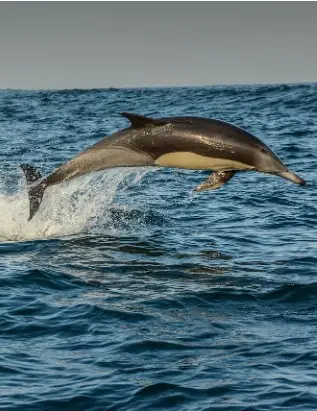
Quick Facts About Common Dolphin
| Category | Details |
|---|---|
| Common Name | Common Dolphin |
| Other Names | Short-Beaked Common Dolphin, Saddleback Dolphin |
| Scientific Name | Delphinus delphis |
| Conservation Status | Least Concern (population trends vary by region) |
| Population | Estimated 2–4 million worldwide |
| Lifespan | 20–30 years (average), up to 40 years in some cases |
| Size | 6–8.5 feet long (1.8–2.6 m) |
| Weight | 150–300 lbs (70–135 kg) |
| Speed | Up to 37 mph (60 km/h) |
| Unique Features | Hourglass pattern on sides, sleek body, acrobatic behavior |
| Habitat | Warm and temperate oceanic waters |
| Geographic Range | Worldwide, particularly in the Atlantic, Pacific, and Mediterranean regions |
What makes the Common Dolphin unique?
The Common Dolphin (Delphinus delphis) is a highly intelligent and social marine mammal known for its agility, speed, and playful behavior. Found in warm and temperate waters worldwide, these dolphins are easily recognizable by their striking hourglass pattern and sleek, streamlined bodies. Common Dolphins are highly vocal, using a complex system of clicks, whistles, and body language to communicate and navigate their environment. They are also known for their acrobatic displays, often leaping out of the water and riding the bow waves of boats. Despite their name, Common Dolphins face threats from habitat degradation, pollution, and bycatch, making their conservation a priority.
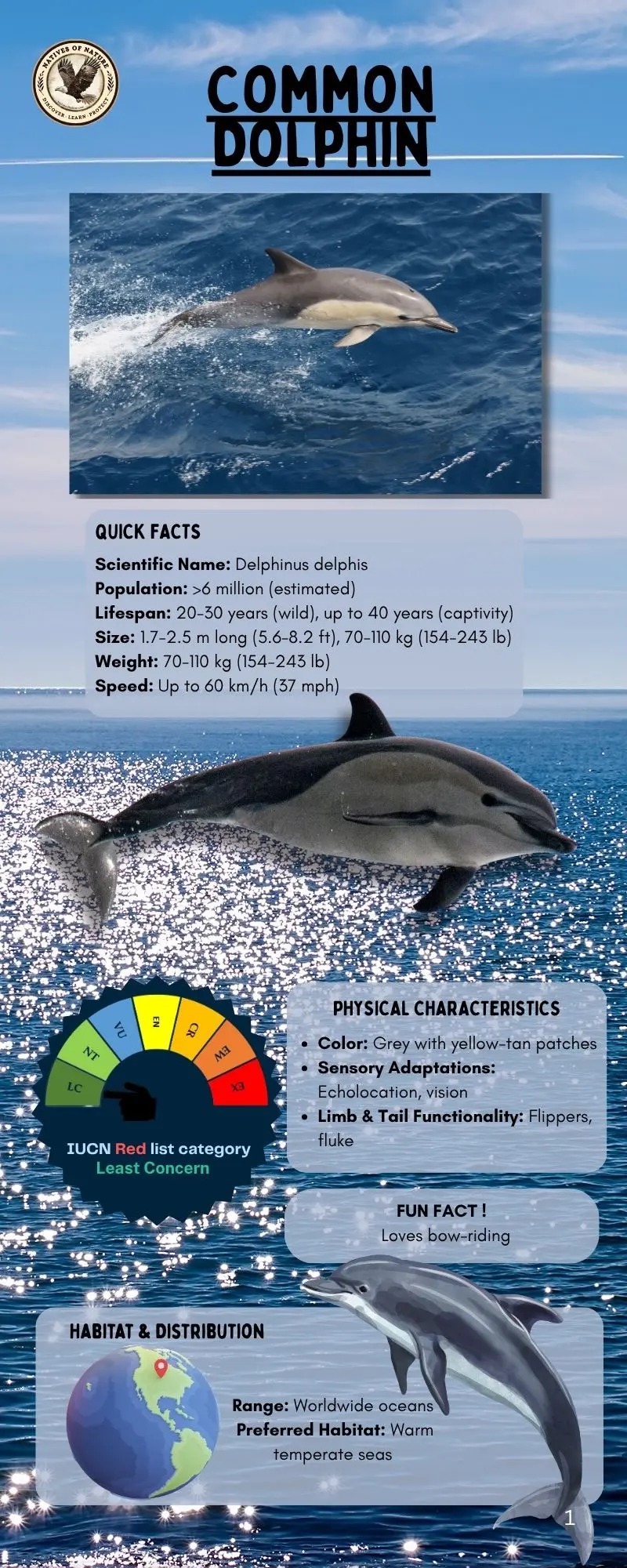
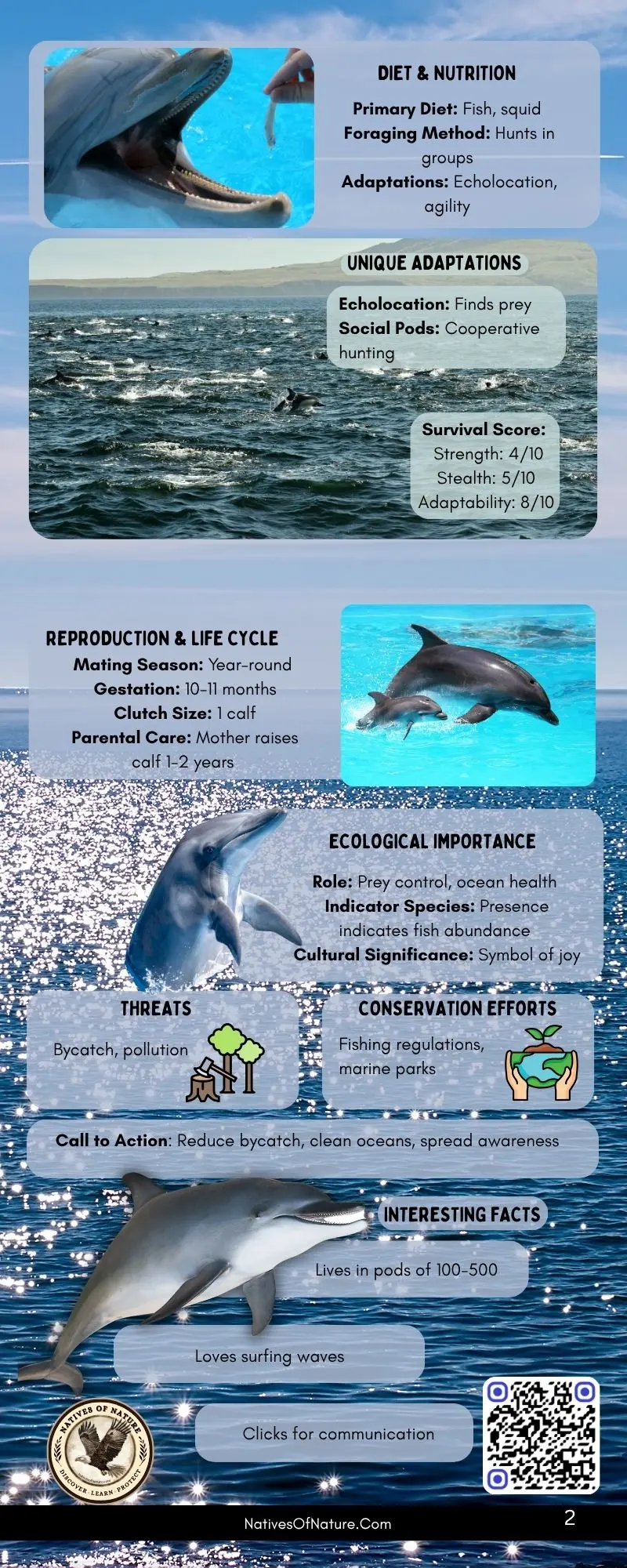
Common Dolphin Infographic: Quick Facts & Conservation
Two-page infographic with illustrated Common Dolphin quick facts: Click to download pdf version.
| Rank | Classification | Interesting Fact |
|---|---|---|
| Kingdom | Animalia | Dolphins are part of the animal kingdom, which includes all animals. |
| Phylum | Chordata | Like all vertebrates, they have a backbone and a well-developed nervous system. |
| Class | Mammalia | They are warm-blooded mammals with lungs and mammary glands to nurse their young. |
| Order | Cetacea | They belong to the order Cetacea, which includes whales, dolphins, and porpoises. |
| Family | Delphinidae | The family Delphinidae includes all oceanic dolphins. |
| Genus | Delphinus | The genus Delphinus includes the Common Dolphin and its close relatives. |
| Species | Delphinus delphis | The species name “delphis” comes from the Greek word for dolphin. |
What does a Common Dolphin look like?
Common Dolphins are easily identified by their sleek, streamlined bodies and distinctive coloration. They have a dark gray or black back, a light gray or white underbelly, and a unique hourglass pattern on their sides, which is yellow or tan near the front and gray toward the tail. Their long, slender beaks are filled with sharp teeth, and their dorsal fins are tall and curved. These dolphins are built for speed, with powerful tails and flippers that allow them to swim swiftly and perform impressive acrobatics.
- Size & Weight: 6–8.5 feet long, 150–300 lbs
- Coloration: Dark gray back, light underbelly, hourglass pattern on sides
- Sensory Adaptations: Excellent echolocation and hearing, sharp eyesight
- Limb & Tail Functionality: Powerful flippers and tail for swimming
💡 Fun Fact: Common Dolphins can leap up to 20 feet (6 meters) out of the water!
Read more
The Common Dolphin is a 150-kg embodiment of oceanic agility: the world’s most abundant cetacean, a sleek predator that turned an hourglass pattern, a long beak, and one of the most acrobatic builds in the delphinidae world into the ultimate blueprint for herding prey and leaping through waves in warm-temperate seas globally.
Striking Hourglass Coloration – The Criss-Cross Signal
Coat dark gray-black cape on back with creamy-white belly; distinctive hourglass pattern (yellow-tan thoracic patch, light gray caudal). Fur absent (skin smooth); pattern unique to individuals. Beak long/black-tipped. Dorsal fin tall/falcate dark with lighter center. Males slightly larger with taller fin (Jefferson & Archer 2025).
Sleek Build with Long Beak – The Speed Machine
Body length 1.8–2.6 m with no pronounced shoulder height. Weight 70–135 kg (males average heavier). Torso streamlined/torpedo-shaped; beak long/slender. Moderate sexual dimorphism: males bulkier. Flukes broad/notched; flippers curved/pointed (Jefferson & Archer 2025).
Tall Dorsal Fin & Sharp Teeth – The Hunting Tool
Mouth long:
- 40–60 sharp interlocking teeth per jaw row
- Used in schooling fish capture
- Skull elongated with strong jaw Enables coordinated herding (Jefferson & Archer 2025).
Lateral Eyes & Sensory Array – The Ocean Sentinel
Eyes medium/lateral:
- Wide field vision detects prey/threats
- Echolocation clicks for navigation/hunting
- Hearing excellent (high-frequency)
- Smell minimal Supports pod coordination (Jefferson & Archer 2025).
Fluked Tail & Powerful Flippers – The Wave Rider
Tail flukes broad:
- Strong bursts to 60 km/h
- High leaps (up to 6 m)
- Bow-riding agility Allows acrobatics/herding (Jefferson & Archer 2025).
Juvenile Pale & Tiny – The Calf Phase
Calves born (~80 cm, 10–15 kg):
- Stand/swim immediately; precocial
- Pattern muted
- Full independence by 2–3 years Calves remain with mother ~1–2 years; play develops skills (Jefferson & Archer 2025).
Regional & Population Variation
Short-beaked global; long-beaked coastal variants sometimes separate (Jefferson & Archer 2025).
Where do Common Dolphins live?
Common Dolphins are found in warm and temperate waters worldwide, particularly in the Atlantic, Pacific, and Mediterranean regions. They prefer open oceanic waters but can also be found near coastal areas, especially where food is abundant. These dolphins are highly adaptable and can thrive in a variety of marine environments.
- Regions: Worldwide, especially in the Atlantic, Pacific, and Mediterranean
- Preferred Habitat: Open oceanic waters, coastal areas
- Elevation Range: Surface waters to depths of 600 feet (180 meters)
💡 Did You Know? Common Dolphins often travel in large groups called pods, which can number in the hundreds or even thousands!
Read more
The Common Dolphin does not seek polar seas or deep trenches. It races through warm-temperate oceans worldwide — a 150-kg social predator that turns pelagic waters and coastal upwellings into its bow-riding, fish-rich domain.
Core Stronghold: The Pelagic–Coastal Mosaic
Common Dolphins range worldwide temperate/tropical oceans. Highest densities (10–100/km²) in productive upwelling/offshore:
- California Current (Pacific)
- Canary Current (Atlantic)
- Mediterranean/Alborán
- Benguela Current (South Africa) Satellite-tagged dolphins spent 82 % in open ocean; home ranges 100–1,000 km² (Jefferson & Archer 2025).
Obligate Oceanic & Schooling Specialist
Common Dolphins require habitats with:
- Abundant schooling fish/squid
- Warm-temperate waters (10–30°C)
- Upwelling productivity They thrive surface to 200 m in pelagic zones. Avoid polar/extreme cold. Peak abundance productive shelves/slope (Jefferson & Archer 2025).
Atlantic vs. Pacific Populations – The Global Variation
No subspecies; regional ecotypes:
- Eastern Pacific: larger pods
- Mediterranean: smaller/isolated Divergence tied to prey/oceanography (Jefferson & Archer 2025).
Seasonal Movements & Range Fidelity
Semi-migratory/follow prey:
- Inshore summer breeding
- Offshore winter
- Large pods track sardines Tagged dolphins seasonal shifts 100–500 km (Jefferson & Archer 2025).
Human-Modified & Protected Areas
Range wide but bycatch-impacted:
- Protected (Pelagos Sanctuary Mediterranean) core
- MPAs upwelling zones
- Fisheries overlap declining Protected areas vital (Jefferson & Archer 2025).
Microhabitat Preferences
- Foraging: fish schools surface
- Resting: loose groups
- Water: warm/open
- Calving: coastal bays
What do Common Dolphins eat?
Common Dolphins are carnivores, primarily feeding on small fish, squid, and crustaceans. They are skilled hunters, often working together in pods to herd and catch their prey. These dolphins consume about 10–15 pounds (4.5–7 kg) of food per day, depending on their size and activity level.
- Primary Diet: Small fish, squid, and crustaceans
- Foraging Method: Cooperative hunting in pods
- Adaptations for Feeding: Sharp teeth and echolocation
💡 Fun Fact: Common Dolphins can eat up to 20% of their body weight in food each day!
Read more
The Common Dolphin is a 150-kg schooling predator that turns echolocation, pod herding, and one of the most cooperative hunts in the delphinidae world into the ultimate engine for capturing fish and squid in open oceans.
Schooling Fish/Squid Specialist – The Herd Hunter
Common Dolphins carnivorous (95–99 % animal):
- Primary: small pelagic fish (sardines, anchovies, mackerel), squid
- Secondary: crustaceans rare
- Opportunistic: deep-scattering layer night Stomach-content analysis showed fish/squid 95 %; cooperative (Jefferson & Archer 2025).
Moderate Intake & Fast Digestion – The Energy Processor
Adults consume 4–10 kg/day:
- ~5–10 % body weight
- Simple stomach/hindgut
- Fast passage
- High activity needs Processes daily fresh (Jefferson & Archer 2025).
Cooperative Herding Strategy – The Pod Tactician
Technique:
- Echolocation locate schools
- Pod encircles/herds surface
- Night DSL migration
- Mixed tuna/birds High coordination abundance (Jefferson & Archer 2025).
Seasonal & Regional Variation
- Summer: surface fish
- Winter: deeper squid
- Upwelling: dense prey
- Mediterranean: varied Depletion: wider search (Jefferson & Archer 2025).
Opportunism & Supplementation
Low:
- Rare crustaceans
- No caching; hunt daily Prey availability key (Jefferson & Archer 2025).
Calf “High-Fat Milk” Diet – The Rapid Growth
Calves nurse 6–18 months:
- Begin hunting months
- Full adult 2 years
- Mothers protect feed Consumes growing first years (Jefferson & Archer 2025).
Water & Needs
Drink minimal (moisture prey). Minerals prey (Jefferson & Archer 2025).
Human-Related Shifts
Bycatch/prey competition:
- Overfishing reduces
- Pollution contaminants Protected natural (Jefferson & Archer 2025).
Are Common Dolphins social or solitary?
Common Dolphins are highly social animals, living in large pods that can consist of hundreds or even thousands of individuals. They communicate through a variety of vocalizations, including clicks, whistles, and body language. These dolphins are known for their playful behavior, often leaping out of the water and riding waves.
- Vocalizations: Clicks, whistles, and squeaks
- Body Language: Leaping, tail slapping, and bow riding
- Social Structure: Large pods with complex social hierarchies
💡 Interesting Fact: Common Dolphins have been observed helping injured or sick pod members, demonstrating their strong social bonds.
Read more
The Common Dolphin 150-kg whirlwind oceanic play social coordination: world’s most abundant dolphin, sleek predator turned whistling superpods, breaching displays, most acrobatic behaviors delphinidae world ultimate system herding prey, protecting calves, thriving open seas.
Superpods & Fission-Fusion – Structure
Common Dolphins highly social superpods (hundreds-thousands):
- Fluid subgroups
- Mixed tuna/birds
- Loose hierarchy whistles/leaps Enhances hunting/protection (Jefferson & Archer 2025).
Diurnal/Nocturnal Activity – Ocean Forager
Primarily diurnal/crepuscular:
- Hunt day; rest loose
- Night DSL prey
- Bow-riding play Energy variable seas (Jefferson & Archer 2025).
Whistling & Click Repertoire – Pod Communicator
Rich signals:
- Signature whistles identity
- Clicks echolocation/hunting
- Bursts excitement
- Barks alarm Carries open water (Jefferson & Archer 2025).
Body Language & Visual – Acrobatic Display
Nonverbal:
- Breaches/leaps social
- Tail slaps irritation
- Bow-riding energy
- Synchronized swims Pattern enhances dazzle (Jefferson & Archer 2025).
Mother-Calf Dynamics – Pod Bond
Females raise superpod:
- Whistles contact
- Calf leaps immediately
- Pod protects
- Play-acrobatics skills Mortality predators/bycatch (Jefferson & Archer 2025).
Foraging & Social Behavior
Superpod cooperative:
- Herding fish surface
- Mixed species mutualism
- Altruism injured Protected natural (Jefferson & Archer 2025).
Human-Impact Tolerance
Variable:
- Boat attraction
- Bycatch/noise high risk
- Pollution Protected reduces (Jefferson & Archer 2025).
How does the Common Dolphin survive in its environment?
Common Dolphins have evolved several adaptations that make them highly efficient predators and social animals. Their streamlined bodies and powerful tails allow them to swim at high speeds, while their echolocation abilities help them locate prey and navigate their environment. They are also highly social, using complex vocalizations and body language to communicate and coordinate hunting strategies.
- Echolocation: Used to locate prey and navigate
- Speed: Can swim up to 37 mph (60 km/h)
- Social Behavior: Lives in large pods for protection and hunting
Survival Score
The Common Dolphin scores highly in key survival traits based on its adaptations:
- Speed: 9/10 – One of the fastest marine mammals.
- Intelligence: 10/10 – Highly intelligent and social.
- Adaptability: 8/10 – Thrives in a variety of marine environments.
💡 Fun Fact: Common Dolphins can dive to depths of up to 600 feet (180 meters) in search of food!
Read more
The Common Dolphin is a 150-kg marvel of oceanic acrobatics: the world’s most abundant dolphin, a sleek predator that turned echolocation, superpods, and one of the highest speeds in the delphinidae world into the ultimate adaptations for herding prey and evading threats.
Hourglass Pattern & Stripes – The Dazzle Deterrent
Complex coloration:
- Confuses predators (motion dazzle)
- Possible fly deterrence
- Individual recognition Enables large pod cohesion (Jefferson & Archer 2025).
Speed & Leaps – The Acrobatic Escaper
Streamlined body:
- Bursts to 60 km/h
- Leaps 6 m high
- Bow-riding energy save Allows prey herding/escape (Jefferson & Archer 2025).
Echolocation & Clicks – The Prey Locator
Sophisticated sonar:
- High-frequency clicks locate fish
- Cooperative herding
- Navigation low visibility Enables night/deep hunting (Jefferson & Archer 2025).
Superpods & Cooperation – The Group Hunter
Large aggregations:
- Thousands coordinate
- Mixed species (tuna, birds)
- Alarm/protection Buffers predation (Jefferson & Archer 2025).
Vocal Complexity & Whistles – The Social Coordinator
Rich repertoire:
- Signature whistles identity
- Clicks/bursts hunting
- Infrasound possible Allows pod communication (Jefferson & Archer 2025).
Calf Precociality & Learning – The Quick Swimmer
Calves advanced:
- Swim/leap soon birth
- Rapid social learning
- Pod protection Enables large group survival (Jefferson & Archer 2025).
Bow-Riding & Play – The Energy Saver
Behavioral:
- Ride waves conserve energy
- Acrobatics social/practice
- High intelligence Enables long migrations (Jefferson & Archer 2025).
Human-Impact Vulnerability
Sensitive:
- Bycatch major
- Pollution/noise
- Prey depletion Protected efforts key (Jefferson & Archer 2025).
How do Common Dolphins reproduce?
Common Dolphins mate throughout the year, with a gestation period of about 10–11 months. Females give birth to a single calf, which is nursed for up to 18 months. Calves are born tail-first and can swim immediately. They reach sexual maturity at around 5–7 years of age.
- Mating Season: Year-round
- Gestation Period: 10–11 months
- Litter Size: 1 calf
- Parental Care: Calves stay with their mothers for up to 3 years
💡 Did You Know? Common Dolphin calves are born with a lighter coloration that darkens as they age.
Read more
Common Dolphin reproduction year-round peaks, single calves, extended care — turns protected pods into playful nurseries for the world’s most abundant dolphin.
Year-Round Mating with Peaks – The Pod Cycle
Mating year-round (regional peaks). Females estrus ~2–4 weeks cycle, ~2 days, scent. Males compete whistles, leaps, herding; no strong pairs. Water copulation; loose (Jefferson & Archer 2025).
Moderate Gestation & Single Calf – The Ocean Strategy
Gestation ~10–11 months; single calf (rare twins):
- Calves (~80 cm, 10–15 kg)
- Swim/leap hours; precocial
- Birth surface Single high survival (Jefferson & Archer 2025).
Maternal Investment & Calf Development
Females raise pod:
- Nursing 6–18 months
- Calf follows immediately; independence 2–3 years
- Growth: adult size 5–7 years Mothers teach hunting; pod protects. Mortality predators/bycatch (Jefferson & Archer 2025).
Calf Muted & Precocial – The Quick Leaper
Calves born muted pattern:
- Leap/play soon
- Rapid learning
- Pod integration Enables group survival (Jefferson & Archer 2025).
Dispersal & Independence – The Fluid Path
Calves independent 2–3 years:
- Mix pods
- Fluid fission-fusion
- High mobility (Jefferson & Archer 2025).
Lifetime Output
Interbirth ~2–3 years. Females mature 5–7 years, last 30. Production 8–12 calves; variable survival. Good conditions:
- Regular calving
- Growth pods
- Threats suppress Investment per calf (Jefferson & Archer 2025).
Why is the Common Dolphin important to its ecosystem?
Common Dolphins play a vital role in maintaining the balance of marine ecosystems. As top predators, they help regulate fish and squid populations, ensuring the health of the oceanic food web. Their presence also indicates a healthy marine environment, making them important indicators of ocean health.
- Predator Role: Regulates fish and squid populations
- Indicator Species: Reflects the health of marine ecosystems
- Economic Role: Supports ecotourism and marine research
💡 Fun Fact: Common Dolphins are often featured in marine ecotourism, attracting visitors eager to see their acrobatic displays.
Read more
The Common Dolphin not ocean acrobat. 150-kg mid-trophic predator ecosystem driver exerts influence marine food webs — herding prey, indicating health, facilitating migrants, prey driving biodiversity abundant presence.
Cooperative Herding & Prey Control – Shaper
Single pod consumes tons fish/day:
- Herds schools surface
- Regulates small pelagic
- Succession birds/tuna Studies Pacific common herding increased predator diversity (Jefferson & Archer 2025).
Indicator & Mixed Associations – Health Sentinel
Presence:
- Productive upwelling
- Healthy fish stocks
- Mixed tuna/sharks Modified higher diversity (Jefferson & Archer 2025).
Nutrient Cycling & Pathways – Distributor
Dung/defecation:
- Nutrients surface
- Algal support
- Trails access Fertile zones regeneration (Jefferson & Archer 2025).
Prey for Predators & Food Web – Meal
Prey sharks, orcas:
- Pod supports apex
- Turnover populations Declines top-down stress (Jefferson & Archer 2025).
Sentinel of Ocean Health
Require productive waters:
- Presence intact webs
- Stable higher diversity
- Declines overfishing Flagship marine integrity (Jefferson & Archer 2025).
Umbrella for Conservation
Protecting safeguards pelagics:
- MPAs upwelling habitat tuna, birds
- Bycatch reduction
- Research funds management Ecotourism livelihoods (Jefferson & Archer 2025).
Pollution & Resilience
Indicators:
- Bioaccumulate toxins
- Noise disruption
- Intact higher recovery Resilience change (Jefferson & Archer 2025).
Tourism & Awareness
Acrobatics:
- Ecotourism value
- Public engagement
- Conservation support Human connection (Jefferson & Archer 2025).
✔ Common Dolphins can swim at speeds of up to 37 mph (60 km/h), making them one of the fastest marine mammals.
✔ They are known for their acrobatic displays, often leaping out of the water and riding boat waves.
✔ Common Dolphins have up to 240 sharp teeth, which they use to catch and hold onto slippery prey.
Why are Common Dolphins threatened?
While Common Dolphins are currently listed as Least Concern, they face threats from habitat degradation, pollution, and bycatch in fishing nets. Climate change and overfishing also impact their food sources, making their conservation a priority.
- Habitat Degradation: Pollution and coastal development
- Bycatch: Accidental capture in fishing nets
- Climate Change: Impacts food availability
Conservation Efforts
- Protected Areas: Establishing marine protected areas
- Sustainable Fishing: Reducing bycatch through better practices
- Research & Monitoring: Studying populations to inform conservation strategies
✅ What We Can Do:
- Support organizations working to protect dolphins and their habitats.
- Advocate for sustainable fishing practices.
- Reduce plastic use to prevent ocean pollution.
Read more
Classified Least Concern globally IUCN Red List (~6 million), Common Dolphin stable overall but regional declines (Mediterranean Endangered). “Abundant but vulnerable” bycatch. Overall monitoring needed.
Bycatch & Fisheries – Primary Threat
Entanglement:
- Gillnets, trawls, purseseines
- Thousands annually (Europe, tuna)
- Regional high mortality Major worldwide (Jefferson & Archer 2025).
Pollution & Noise – Secondary Pressure
Contaminants:
- Plastics ingestion
- Chemicals accumulate
- Noise sonar/shipping disrupt Mortality sublethal (Jefferson & Archer 2025).
Prey Depletion & Overfishing – Indirect Stress
Fisheries:
- Compete sardines/anchovies
- Reduced stocks
- Climate shifts Mortality starvation (Jefferson & Archer 2025).
Climate Change – Emerging Amplifier
Warming:
- Prey distribution
- Ocean acidification
- Extreme events Projected regional shifts (Jefferson & Archer 2025).
Vessel Strikes & Tourism
Human:
- Boat collisions
- Disturbance ecotourism
- Harassment Mortality coastal (Jefferson & Archer 2025).
Conservation Successes & Active Management
- Monitoring: Surveys/acoustics
- Bycatch Reduction: Gear mods, observers
- Protected Areas: Pelagos Mediterranean
- International Agreements: CMS Appendix II
- Research & Awareness: Drives mitigation
Common Dolphin abundance conservation mixed — global LC, regional threats. Reversible bycatch/fisheries action. Every MPA established, gear improved, fishery sustainable direct vote keeping Agile Acrobat Oceans leaping waves generations come.
• Population Structure (2024): Marine Biology found Australia’s southern coast hosts three genetically distinct common dolphin populations, with 15% genetic divergence. This diversity aids resilience against environmental shifts (Möller et al., 2024, Australia).
• Climate Adaptation (2021): ScienceDirect noted a 20% poleward shift in common dolphin ranges due to warming sea temperatures. This migration risks increased competition in new habitats (Lambert et al., 2021, North Atlantic).
• Foraging Behavior (2019): Journal of Animal Ecology revealed common dolphins in the Mediterranean increased dive depths by 30% to access prey. This adaptation counters declining fish stocks due to overfishing (Giménez et al., 2019, Mediterranean Sea).
By protecting Common Dolphins, we ensure the survival of a species that plays a vital role in maintaining the health of our oceans.
✅ Share this article – Spread awareness about this incredible species!
✅ Support Conservation Efforts – Help protect dolphins and their habitats.
✅ Choose Sustainable Practices – Advocate for ocean-friendly policies and reduce plastic use.


Arya Sankar is a postgraduate in Zoology with academic and research experience in wildlife and marine sciences. She has worked on research projects at the Central Marine Fisheries Research Institute and has been actively involved in science education and skill development. Her contributions focus on accurate species information, conservation awareness, and educational wildlife content.
- NOAA Fisheries — Short-beaked Common Dolphin (Delphinus delphis) Species Profile
- IUCN Red List — Delphinus delphis Assessment
- Animal Diversity Web (University of Michigan) — Delphinus delphis Species Account
- Encyclopedia of Life (EOL) — Common Dolphin (Delphinus delphis)