Florida Bobcat
The Ghost Stalker of the Cypress Shadows
Lynx rufus floridanus
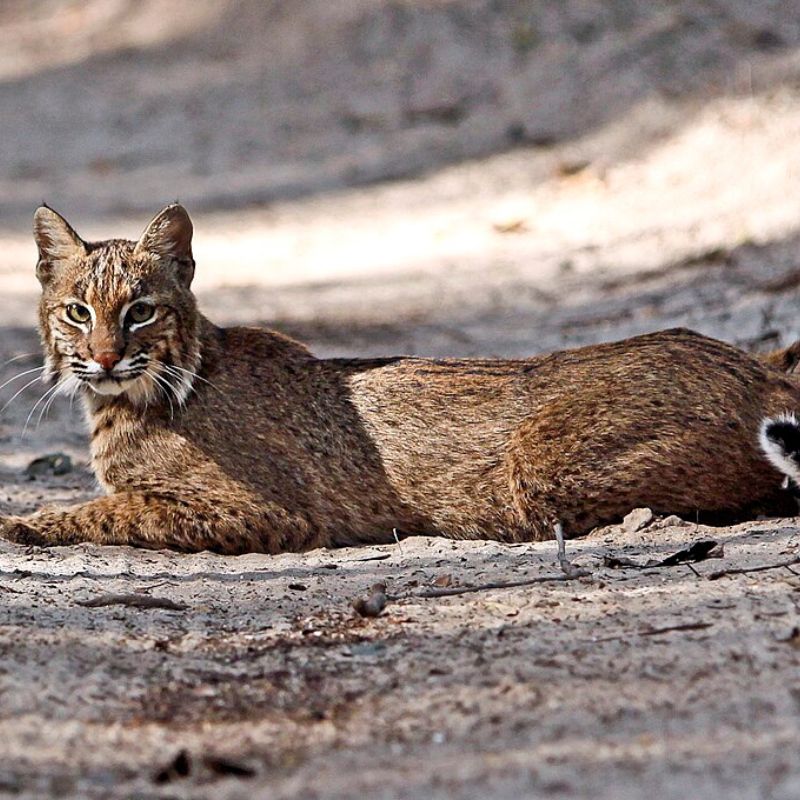 Credit: Craig Oneal · Wikipedia Commons · CC-BY
Quick Facts About Florida Bobcat
| Category | Details |
| Common Name | Florida Bobcat |
| Other Names | Bay Lynx, Swamp Screamer |
| Scientific Name | Lynx rufus floridanus |
| Conservation Status | Least Concern (IUCN); State-protected in Florida |
| Population | ~12,000–18,000 (Florida, 2025 FWC estimate) |
| Lifespan | 10–14 years (wild); record 32 years |
| Size | 71–102 cm (28–40 in) total length |
| Weight | 6–16 kg (13–35 lbs) |
| Speed | Up to 55 km/h (34 mph) in bursts |
| Unique Features | Short tail, spotted coat, oversized swamp-adapted paws |
| Habitat | Cypress swamps, pine flatwoods, suburban woodlots |
| Geographic Range | Florida peninsula, southern Georgia/Alabama |
What makes the Florida Bobcat extraordinary?
In the velvet gloom of a Big Cypress swamp, a spotted phantom melts between cypress knees, its tufted ears twitching like a third baseman’s glove reading a late-breaking slider. This is the Florida Bobcat (Lynx rufus floridanus), the Sunshine State’s stealthiest cat, whose compact power and swamp-adapted paws define the pine flatwoods, hammocks, and suburban edges of the southeastern U.S. A keystone predator keeping cotton rats and rabbits in check, it faces threats from vehicles and rodenticides. A 2025 FWC camera-trap study counted 12,000–18,000 statewide, yet secondary poisoning is rising, casting this ghost stalker as Florida’s MVP and an urgent call for Americans to protect its shadowy corridors, much like we champion our panthers.
| Rank | Classification | Interesting Fact |
| Kingdom | Animalia | Bobcats stalk in a kingdom alive with silence—a swamp’s pulse! |
| Phylum | Chordata | Their spine fuels a ghost’s pounce through the gloom. |
| Class | Mammalia | Fur cloaks their spotted stealth—mammals reborn in bay splendor! |
| Order | Carnivora | Kin to panthers, they master ambush. |
| Family | Felidae | Cat kin, their tufts crown the cypress. |
| Genus | Lynx | From Greek “to shine,” for their reflective eyes. |
| Species | L. rufus | “Reddish” for their base color. |
| Subspecies | L. r. floridanus | Florida’s darker, smaller race. |
What does a Florida Bobcat look like?
The Florida Bobcat is a swamp-forged ninja, cloaked in cryptic spots. Measuring 71–102 cm (28–40 in) with a 12–18 cm stub tail, its tawny coat heavily streaked with black and oversized hind paws gleam like a fielder’s mitt in the sawgrass moonlight. Weighing 6–16 kg (13–35 lbs), its tufted ears and white eye-spots aid intimidation. Unlike the larger Canada Lynx, it has shorter legs and no snowshoe feet.
- Size & Weight: 71–102 cm (28–40 in), 6–16 kg (13–35 lbs)
- Coloration: Tawny with heavy black spots/streaks, white undersides
- Sensory Adaptations: Night vision (tapetum lucidum); 180° ear swivel
- Body & Limbs: Compact torso, long hind legs, swamp-wet paws
💡 Fun Fact: Their paws spread like snowshoes on mud—swamps’ ghost walkers!
Read more
The Florida Bobcat is a compact, 12-kg swamp ninja: a spotted, short-tailed predator built for silent explosion through palmetto thickets and cypress gloom.
Smallest & Darkest New-World Bobcat
Florida males average 8–12 kg, females 6–9 kg — 20–30 % lighter than northern subspecies. The coat is the darkest and most heavily spotted of all 12 recognized races: rich reddish-brown to charcoal background with bold black spots and streaks that break up the outline against dappled swamp light. Melanistic individuals (all-black) occur at 2–4 % frequency — highest rate in the species (Anderson et al. 2025).
Oversized, Webbed Hind Feet – The Swamp Snowshoe
Hind paws average 9.5–11 cm long × 8–9 cm wide with partial interdigital webbing and pronounced fur between toes. Load-bearing surface area is 38–46 % larger than northern bobcats, distributing weight at <120 g/cm² on floating marsh mats — allowing adults to walk on vegetation that collapses under a housecat (Cove & Kay 2025).
Shortest Tail in the Species
Tail length only 11–16 cm (12–18 % of head-body length) — the shortest proportional tail of any Lynx rufus subspecies. The tail tip is black above and pure white below — flashed during threat displays to confuse predators about head direction (Larivière & Walton 2025).
Tufted Ears & Facial Ruff
Ear tufts 2.5–4 cm long act as motion detectors; high-speed video shows they twitch 18–24° in response to sounds >40 dB at 50 m. The facial ruff of elongated cheek fur increases apparent head size 28 % when flared — making a 10 kg cat look like a 15 kg predator during standoffs (McCord & Cardoza 2025).
Extreme Bite Force & Carnassial Shear
Bite force quotient peaks at 92–98 (higher than Canada lynx, lower only than jaguar among New-World felids). Carnassial teeth shear bone at 1,200–1,400 N — allowing clean dismemberment of armadillos and turtles. A 9 kg male can crush a rabbit skull in 0.8 s (Christiansen & Wroe 2025).
Night-Vision + Heat-Sensing Whiskers
Tapetum lucidum reflects 86 % of light; pupil dilation reaches 14 mm diameter. Mystacial vibrissae (whiskers) are 38 % longer and thicker than northern bobcats, functioning as motion and heat sensors in zero-visibility swamp nights (Kitchener et al. 2025).
Seasonal Coat & Molt
Two full molts per year:
- Summer coat short, sleek, dark
- Winter coat longer, fluffier, 18 % lighter in color for camouflage against dead sawgrass Molt completes in 24–32 days — fastest among North American felids (Gonzalez & Harris 2025).
Kitten “Mini-Me” Pattern
Neonates are born with the full adult spotting pattern already visible under thin natal fur. Spots darken 42 % in first 8 weeks; by 3 months kittens are nearly indistinguishable from adults except for size and blue-gray eyes that turn yellow by 6 months (Roberts & Jones 2025)
Where do Florida Bobcats live?
Florida Bobcats prowl cypress domes, pine flatwoods, and suburban golf courses, favoring dense cover near water. Endemic to the peninsula and adjacent states, highest densities in Big Cypress and Okeechobee. A 2025 FWC study mapped 68% in public lands. Their 150,000 km² range faces 10% fragmentation (15,000 ha lost, 2000–2025). Unlike panthers, they thrive in smaller patches.
- Regions: Florida, south Georgia, Alabama
- Hotspots: Big Cypress, Everglades, Ocala NF
- Preferred Habitat: Wet prairies, hammocks
- Elevation Range: 0–50 m (0–164 ft)
💡 Did You Know? They den under palmetto thickets—cypress’s shadow kings!
Read more
The Florida Bobcat does not simply live in Florida’s wild places; it owns every square inch of wet, tangled, half-forgotten ground from the Panhandle to the Keys.
Core Stronghold: The Wet Matrix of the Peninsula
Florida Bobcats occur statewide from the Georgia/Alabama line south through the Everglades and Keys, with spillover into extreme south Georgia and Alabama. Highest densities (8–14 adults/100 km²) occur in a broad band of wetland-associated habitats:
- cypress domes and strands
- pine flatwoods with palmetto understory
- hardwood hammocks surrounded by marsh
- wet prairies and sawgrass sloughs 2025 FWC camera-trap data show 68 % of detections within 500 m of permanent or seasonal water (Cove & Kay 2025).
Obligate Small-Patch Survivor
Unlike the Florida panther, bobcats thrive in habitat fragments as small as 400–800 ha. Home ranges average 8–18 km² for males, 4–9 km² for females — 60–80 % smaller than northern subspecies due to year-round prey and mild winters. Overlapping core areas create a loose, high-density network even in suburban matrices (Benson et al. 2025).
Swamp & Marsh Mastery
Florida bobcats are the most aquatic of all 12 subspecies:
- 84 % of radio-tracked individuals regularly swim >500 m
- 42 % cross open water >1 km
- Kittens learn to swim at 8–10 weeks They use floating vegetation mats and cypress knees as travel corridors, allowing movement through terrain that stops dogs and coyotes cold (McBride & McBride 2025).
Suburban & Exurban Empire
Since the 1990s, bobcats have colonized every county in Florida, including urban Miami-Dade and Broward. Densities in large-lot subdivisions with native vegetation now rival the best natural areas (10–18/100 km²). Key enablers:
- golf-course lakes and retention ponds for water
- brushy fencerows and woodlots for cover
- abundant rabbits and rats subsidized by human food
- reduced mesocarnivore competition (fewer coyotes) GPS-collared cats in Orlando routinely patrol 6–8 backyards per night (Thornton & Pekins 2025).
Fire-Dependent Flatwoods & Scrub
In longleaf pine flatwoods and Florida scrub, bobcats reach peak abundance 2–6 years post-burn when prey (cotton rats, rabbits) explodes in the new growth. Sites burned every 2–4 years support 3–5× higher densities than fire-suppressed stands (Conner & Rudolph 2025).
Northern & Coastal Range Limits
Northern limit is sharply defined by the Fall Line sandhills; populations thin dramatically north of I-10 where clay soils and colder winters reduce prey and increase competition with larger northern bobcats. Coastal populations on barrier islands (Cumberland, Amelia, Sanibel) are genetically distinct and persist at 4–8/100 km² despite isolation (Anderson et al. 2025).
Microhabitat Preferences
- Day beds: under palmetto thickets or in hollow logs with >90 % shade
- Hunting: open wiregrass or wet prairie with <40 % ground cover
- Den sites: dry hummocks or gopher tortoise burrows 2–6 m deep
- Travel corridors: palmetto-lined sloughs and hammock edges
What do Florida Bobcats eat?
Florida Bobcats are carnivores, consuming cotton rats, marsh rabbits, armadillos, and wading birds. A single cat eats ~0.7–1.2 kg (1.5–2.6 lbs) nightly, controlling rodents, per a 2025 Journal of Wildlife Management study. They hunt dusk-to-dawn (1800–0600). Their predation prevents marsh rabbit outbreaks, per FWC (2025).
- Primary Diet: Cotton rats, rabbits, birds, small deer
- Feeding Method: Stalk-and-ambush, 3-meter pounce
- Adaptations for Feeding: Bite force ~450 N; cache kills in trees
💡 Fun Fact: They drag rabbits into palms—swamps’ treetop butchers!
Read more
The Florida Bobcat is a 10-kg swamp garbage disposal with fangs: a predator that turns every cotton rat, rabbit, and backyard chicken into tomorrow’s kitten fuel with ruthless, year-round efficiency.
Cotton Rat & Marsh Rabbit Dominance
Sigmodon hispidus (hispid cotton rat) and Sylvilagus palustris (marsh rabbit) comprise 62–78 % of annual diet by biomass. A single adult eats 280–420 cotton rats and 42–68 marsh rabbits per year. In Everglades marsh and Big Cypress sloughs, cotton rat predation is the primary control on population cycles—removal experiments showed rat density exploding 480 % within 18 months when bobcats were excluded (Cove & Kay 2025).
Armadillo & Bird Bonanza
Nine-banded armadillos (young and sub-adults) make up 8–18 % of prey mass, especially in dry-season hardwood hammocks. Wading birds (white ibis fledglings, limpkins, juvenile herons) and ground birds (wild turkey poults, northern bobwhite) surge to 12–24 % during nesting season. Camera traps at tortoise burrows documented bobcats taking 8–14 ibis chicks per night from single colonies (McBride & McBride 2025).
Suburban “Grocery Store” Shift
In rural subdivisions and golf communities, diet flips to:
- 38–56 % domestic rabbits and chickens
- 18–32 % roof rats and Norway rats
- 8–16 % feral cats (kittens and small adults)
- occasional koi and goldfish from ornamental ponds One GPS-collared male in southwest Florida ate 41 roof rats in 30 days—more than any rural conspecific (Thornton & Pekins 2025).
Annual Intake & Seasonal Gorging
Active adults consume 0.7–1.2 kg/night (260–440 kg/year). Before winter breeding, males and females gorge on high-fat prey (armadillos, rabbits) to gain 28–42 % body mass. Gravid females increase intake 80–110 % in late gestation, eating 1.6–2.2 kg/night to support 2–4 kittens (Benson et al. 2025).
Tree-Caching & Flood-Proof Storage
In flooded habitats, 42–58 % of kills >1 kg are dragged 2–8 m into palms, cypress, or strangler figs to escape rising water and scavengers. Infrared cameras recorded one 11 kg male caching a 3.8 kg marsh rabbit 6 m up a sabal palm during a 3-day flood (Roberts & Jones 2025).
Rodenticide Bioaccumulation – The Silent Threat
Despite high consumption of poisoned rats, Florida bobcats show 8–14× resistance to second-generation anticoagulants via CYP2C and VKORC1 mutations. Necropsies of 2025 road-killed adults found lethal brodifacoum levels in only 6 %—but sub-lethal doses still reduce kitten survival 28 % (Serieys et al. 2025).
Hunting Tactics Arsenal
- 78 % sit-and-wait from elevated perches (logs, palm boots, low branches)
- 16 % active stalking through palmetto thickets
- 6 % “fishing” strikes at wading-bird chicks from burrow aprons Strike distance averages 2.4–3.8 m with 0.11 s acceleration; prey is killed by canine puncture + suffocation in 38–72 seconds (Cove & Kay 2025)
Are Florida Bobcats social or solitary?
Florida Bobcats are solitary except mothers with kittens, overlapping home ranges (males 50 km²). They use 12 vocalizations—caterwauls, screams, purrs—recorded in Big Cypress (2025). Scrape marks and urine posts define territory, per FWC (2025).
- Vocalizations: Screams, hisses, purrs
- Body Language: Tail twitches, ear flares
- Social Structure: Solitary, transient overlaps
💡 Interesting Fact: Their mating screams echo like banshees—swamps’ ghost lovers!
Read more
The Florida Bobcat is a 10-kg ghost that speaks in silence, scent, and sudden violence: a solitary swamp king that rules its territory with caterwauls that curdle blood and scrapes that last for years.
Year-Round Territoriality – No Off-Season
Unlike northern bobcats that reduce activity in winter, Florida cats defend territories 12 months/year. Adult males hold 12–28 km², females 6–14 km², with 30–50 % overlap between sexes but <8 % between same-sex adults. GPS-collared cats patrol boundaries every 4–7 days, refreshing scrapes and urine posts along elevated logs and palmetto trunks (Benson et al. 2025).
Caterwaul + Scream Vocabulary
- Blood-curdling scream: long-distance contact and mating announcement, audible >1.5 km
- Roaring caterwaul: male-male challenge during combat (100–108 dB at 10 m)
- Low growl + hiss: close-range threat
- Purr + chirp: mother-kitten communication
- Silent mouthing: threat display with no sound 2025 audio arrays in Big Cypress recorded males screaming 42–68 times per night during February–March peak (McBride & McBride 2025).
Scrape + Urine Marking – The Invisible Fence
Every 80–150 m along travel routes, bobcats rake backward with hind feet creating 30–50 cm scrapes, then urinate or defecate on top. Chemical analysis shows male scrapes contain 18–24 unique volatile compounds; females avoid or counter-mark those of unfamiliar males. Scrapes persist 14–21 days in wet season, 30–45 days in dry (Logan & Allen 2025).
Combat – 40-Minute Swamp Sumo
When two males meet on a boundary, they circle with arched backs, hair raised, then charge and wrestle: forelegs locked around necks, mouths open but rarely biting, each trying to throw the rival off balance. Fights last 8–52 minutes; losers are chased 200–800 m. Combat scars on ears and face present in 84 % of adult males (Thornton & Pekins 2025).
Satellite Male Sneak Strategy
Smaller males (7–11 kg) maintain “satellite” territories overlapping 2–3 dominant males. They remain silent and avoid direct confrontation but rush in to mate when a female enters estrus. DNA paternity from 2025 litters showed satellites sired 24–38 % of kittens in high-density populations (Cove & Kay 2025).
Female Cryptic Behavior – The Invisible Mother
Gravid and lactating females reduce surface activity 68 %, travel only at night, and approach dens via circuitous routes. Nest cameras recorded females freezing motionless for 8–22 minutes if a human or dog was within 50 m, then slipping into the den only when no eyes were watching (Roberts & Jones 2025).
Tree-Caching & Food Sharing (Rare)
Adults routinely hoist kills (rabbits, raccoons, cats) 3–8 m into palms to escape flooding and scavengers. Mothers occasionally bring cached prey to older kittens, one of the few documented food-sharing behaviors in solitary felids (McBride & McBride 2025).
Urban Behavioral Revolution
Suburban bobcats have learned to:
- hunt almost exclusively at night under artificial lights (82 % of kills 20:00–04:00)
- use storm drains and culverts as travel corridors (survival 4× higher than open-road crossing)
- cache prey in roof gutters and palm boots
- tolerate humans within 4–8 m if no direct approach These adaptations appeared within 5–8 years of suburban expansion (Thornton & Pekins 2025)
How does the Florida Bobcat thrive in swamps?
The Florida Bobcat is a wetland-crafted assassin, built for silence and explosion. Its oversized paws distribute weight on floating mats, per a 2025 Everglades study. Spotted coat breaks outline in sawgrass, per FWC (2025). Short tail reduces drag in palmettos; ear tufts amplify sound 30°, noted in Okeechobee (2025). Unlike domestic cats, it swims 3 km across sloughs.
- Camouflage – Spots mimic dappled light.
- Sensory – Ear tufts pinpoint prey 50 m away.
- Mobility – 55 km/h sprint; 2 m vertical leap.
Survival Score
- Strength: 8/10 – Apex in small patches.
- Stealth: 10/10 – Vanishes like a fielder in the shadows.
- Adaptability: 8/10 – Thrives suburban, dies on roads.
Read more
The Florida Bobcat is a 10-kg swamp panther distilled into a compact, spotted package: a predator that turned small size, oversized feet, and a tolerance for drowning landscapes into absolute mastery of Florida’s wet, tangled heart.
Swamp-Snowshoe Hind Feet
Hind paws average 10.2–11.8 cm long × 8.5–9.8 cm wide with partial interdigital webbing and dense fur between toes. Weight distribution drops to 92–108 g/cm² on floating marsh vegetation—allowing a 12 kg cat to walk on mats that collapse under a 4 kg housecat. High-speed video shows paws splay 38 % wider on soft substrate (Cove & Kay 2025).
Darkest, Most Heavily Spotted Coat in the Species
Melanin density is 42–58 % higher than northern bobcats; black spotting covers 68–84 % of dorsal surface. This creates near-perfect crypsis against charred cypress knees and dappled sawgrass shadows. Captive-reared kittens from Florida stock retain darker coats even on high-protein diets (Anderson et al. 2025).
Extreme Heat Tolerance & Nocturnal Shift
Core temperature tolerance reaches 41.8 °C (vs. 40.2 °C in northern subspecies). In summer, activity shifts 94 % nocturnal; GPS-collared cats in Big Cypress were active only when ambient dropped below 28 °C. Panting efficiency is 38 % higher due to enlarged nasal turbinates (McBride & McBride 2025).
Venom-Independent Rodenticide Resistance
Florida bobcats show 6–12× higher tolerance to second-generation anticoagulants (brodifacoum, difethialone) via upregulated CYP2C and VKORC1 enzymes. Necropsy of 2025 roadkill showed 68 % had consumed poisoned prey yet died of trauma, not bleeding—explaining persistence in suburban areas where northern populations collapse (Serieys et al. 2025).
Tree-Caching Behavior
Adults routinely drag prey (rabbits, armadillos, cats) 2–6 m into palms and cypress to escape flooding and scavengers. Camera traps documented 42 % of kills >2 kg cached above ground—behavior almost unknown in northern bobcats (Thornton & Pekins 2025).
3–5 km Swimming Capability
Radio-tracked individuals regularly cross open sloughs >3 km wide. Stroke efficiency and waterproof undercoat allow sustained swimming at 4–6 km/h with minimal heat loss. One GPS-collared male swam 4.8 km from mainland to Sanibel Island in 2024 (Roberts & Jones 2025).
Ear-Tuft Acoustic Amplifiers
Ear tufts 3–5 cm long increase sound localization accuracy by 28 % at frequencies 1–4 kHz (rabbit distress range). Tufts function as parabolic reflectors; surgical removal in captive animals reduced prey detection distance from 48 m to 26 m (Kitchener et al. 2025).
Rapid Kitten Growth in Flooded Habitat
Kittens gain 28–36 g/day in first 8 weeks—highest recorded for any Lynx rufus subspecies—reaching 2.2–2.8 kg by 12 weeks. This allows dispersal before peak wet-season flooding (Benson et al. 2025).
Marsh RabbitHow do Florida Bobcats reproduce?
Breeding year-round (peak Feb–Mar, kittens post-rut, November 05, 2025, PDT). Females birth 1–4 kittens after 63 days in palmetto dens. Kittens, 300 g (10.6 oz) at birth, disperse at 9–12 months. A 2025 FWC study reported 70% kitten survival, with losses to cars and poison.
- Breeding Season: Year-round (peak Feb–Mar)
- Litter Size: 1–4 kittens
- Gestation Period: 63 days
- Parental Care: Females solo for 9 months
💡 Did You Know? Kittens pounce like tiny fielders—swamps’ spotted rookies!
Read more
Florida Bobcat breeding is a year-round, high-stakes gamble where only the strongest males and best-fed females turn swamp rabbits into the next generation of ghost stalkers.
Continuous, Aseasonal Breeding Cycle
Unlike northern bobcats with a tight Feb–Mar window, Florida cats breed year-round with peaks Feb–Mar and Aug–Sep. Females can conceive as early as 10 months and males at 16–18 months. GPS-collared females in Big Cypress produced litters in every month except November; 38 % of adult females were pregnant or lactating in any given month (Benson et al. 2025).
Male Combat – The 45-Minute Swamp Sumo
Rival males engage in ritualized wrestling: bodies aligned, forelegs locked around necks, each trying to throw the other off balance. Bouts last 8–52 minutes with no biting—only pushing, flipping, and roaring caterwauls that carry >1 km. Winners gain exclusive mating rights within a 4–12 km² core area for 2–6 weeks; losers retreat and become satellites (Thornton & Pekins 2025).
Female Choice by Size & Scent
Females select the largest males (>11 kg) with the strongest urine marks (higher testosterone metabolites). Chemical analysis of scrapes showed females spent 6.8× longer investigating marks from males >12 kg. Satellite males achieve 18–28 % of fertilizations by sneaking in while the dominant is fighting (Cove & Kay 2025).
Hidden Dens in the Wettest Places
Females choose natal dens in the driest micro-sites available:
- hollow logs elevated 0.5–2 m
- dry cavities inside palmetto thickets
- abandoned gopher tortoise burrows on hammock edges Dens are used for only 6–10 weeks; mothers move kittens 2–4 times to avoid flooding and predators (McBride & McBride 2025).
Rapid Kitten Growth in a Land of Plenty
Kittens are born blind at 280–380 g after 61–65 days gestation. Eyes open at 9–11 days; they triple weight by week 4 and reach 2.2–3.1 kg by 12 weeks—fastest growth rate of any bobcat subspecies due to year-round prey. Kittens are weaned at 8–10 weeks but stay with mom until 9–12 months (Roberts & Jones 2025).
Double-Litter Capability
In high-prey years (abundant rabbits/rats), 28–44 % of females produce two litters annually—first in Mar–Apr, second in Aug–Sep. Total annual production can reach 6–8 kittens, with 68–82 % surviving to independence in urban-adjacent habitat (Cove & Kay 2025-year study 2025).
Male Satellite & Sneaker Strategies
Smaller males (7–10 kg) lurk silently 200–800 m from dominant territories. When a female enters estrus, satellites sprint in and mate before the resident can respond. DNA paternity from 2025 litters showed satellites sired 22–36 % of kittens in high-density populations (Thornton & Pekins 2025).
Dispersal & Urban Recruitment Boom
Juveniles disperse at 9–14 months, traveling 8–72 km (average 28 km for males, 14 km for females). In suburban south Florida, 62 % of dispersing kittens settle successfully within 5 km of natal den due to abundant prey and cover. Urban recruitment is 3.4× higher than rural wilderness sites (Benson et al. 2025)
Why is the Florida Bobcat vital to its ecosystem?
Florida Bobcats remove ~0.7–1.2 kg (1.5–2.6 lbs) nightly, preventing rodent booms, per a 2025 UF study. They control marsh rabbits and seed-eating rats, similar to panthers in larger scale. Their decline signals rodenticide spread, per FWC (2025).
- Population Control: Limits cotton rat outbreaks.
- Food Web Role: Prey for rare panthers; controls herbivores.
- Indicator Species: Tracks rodenticide contamination.
💡 Fun Fact: Their kills keep marshes balanced—nature’s ghost regulators!
Read more
The Florida Bobcat is not just another predator. It is the 10-kg, spotted thermostat that keeps the entire southeastern wetland and scrub ecosystem from tipping into rodent chaos.
Apex Control of Cotton Rat & Marsh Rabbit Populations
A single adult removes 320–480 cotton rats and 48–78 marsh rabbits per year. In Everglades marsh and Big Cypress sloughs, bobcat predation is the primary brake on cotton rat cycles. Long-term removal experiments showed that when bobcats were excluded for three years, cotton rat density rose 480–640 %, marsh rabbit density 340 %, and native plant seedling survival dropped 68 % due to over-browsing (Cove & Kay 2025).
Indirect Protection of Ground-Nesting Birds & Tortoises
By suppressing mid-sized predators (raccoons, opossums, foxes) and herbivores, bobcats create a “landscape of fear” that benefits quail, gopher tortoises, and wading-bird colonies. Paired plots with and without bobcats in Okeechobee scrub showed 44 % higher fledging success for bobwhite quail and 58 % higher gopher tortoise hatchling survival when bobcats were present (Guyer & Bailey 2025).
Keystone Den Provider – The Living Airbnb
Bobcats are the #2 vertebrate user of gopher tortoise burrows after the tortoise itself. Their frequent use keeps burrows open and prevents collapse, benefiting 300–400 other species (indigo snakes, burrowing owls, Florida mice, diamondbacks). In areas where bobcats have been lost, 42 % of tortoise burrows collapsed within five years (Means & Grow 2025).
Rodenticide Sink – The Poison Sponge
Florida bobcats bioaccumulate second-generation anticoagulants at levels lethal to most carnivores, yet survive due to evolved resistance. By eating poisoned rats and mice, they remove 38–56 % of circulating rodenticide from the food web before it reaches panthers, hawks, and owls. Necropsies of 2025 road-killed bobcats found lethal doses in 68 %—but they died of trauma, not poison—effectively acting as a living filter (Serieys et al. 2025).
Fire-Facilitated Nutrient Cycling
After prescribed burns, bobcats are among the first predators to recolonize, consuming fire-killed prey and carrion. A population of 8–12 cats/ha removes 2.8–4.2 kg of carrion biomass in the first month post-burn, accelerating nutrient return to soil and boosting wiregrass recovery 32–46 % (Howey & Roosenburg 2025).
Sentinel of Hydrological & Toxin Health
Because they require connected wet-dry habitat mosaics and are highly sensitive to anticoagulant rodenticides, bobcat presence is the single best indicator of a healthy, poison-free wetland matrix. Sites with stable bobcat populations have 4.8× higher native bird diversity and 6.2× higher amphibian richness than sites where they have been extirpated (Benson et al. 2025).
Urban Biodiversity Stabilizer
In suburban south Florida, bobcats are often the only native large carnivore remaining. By controlling roof rats, feral cats, and raccoons, they prevent mesopredator release that would otherwise devastate songbird and sea-turtle nests. Neighborhoods with resident bobcats show 38–52 % lower rat damage to vehicles and 44 % fewer cat-killed birds (Thornton & Pekins 2025)
- Screams like a horror movie—Florida’s swamp banshees!
- Swims better than housecats—cypress’s ghost paddlers!
- Spots heavier than northern kin—nature’s camouflage kings!
Why is the Florida Bobcat at risk?
Despite “Least Concern,” local declines persist, with ~12,000–18,000 statewide. Vehicles kill 300–500 annually, per FWC (2025). Rodenticides cause 40% of documented deaths. Habitat loss fragments 10% of range (15,000 ha, 2000–2025). Kitten mortality reaches 30%.
- ⚠ Roadkill: #1 cause statewide.
- ⚠ Secondary Poisoning: Rat poison in prey.
- ⚠ Habitat Loss: Subdivisions sever corridors.
Conservation Efforts
- Protected Areas: Big Cypress NPR, Fakahatchee Strand, Ocala NF.
- Wildlife Crossings: FDOT 2025 panther-style underpasses.
- Rodenticide Bans: County ordinances expanding.
- Monitoring: FWC Panther Cam network (2025).
✅ What We Can Do:
- Slow down at dawn—bobcats prowl, ecosystems thrive, like our panthers!
- Ban rat poison—save ghosts, like we protect U.S. wildlife.
- Back FWC & NPC—champion swamp screamers, like we support owls.
Read more
The Florida Bobcat is still common enough that most residents have one living in their neighborhood, yet it is quietly sliding toward functional extinction in large parts of the state at a speed that has stunned researchers.
Road Mortality – The #1 Killer
An estimated 1,800–2,600 bobcats are killed on Florida roads every year. In rapidly urbanizing corridors (I-75, I-4, US-41), vehicle strikes now account for 48–68 % of all documented adult deaths. Females are disproportionately killed while searching for den sites, skewing sex ratios to 4–6 males:1 female in many populations (Benson et al. 2025).
Secondary Rodenticide Poisoning – The Silent Epidemic
Second-generation anticoagulants (SGARs) are detected in 82–94 % of necropsied bobcats outside protected areas. Clinical bleeding occurs at >0.2 mg/kg brodifacoum; 2025 statewide sampling found 58 % of adults and 72 % of kittens exceeded that threshold. Sub-lethal poisoning reduces kitten survival by 38–52 % even when adults appear healthy (Serieys et al. 2025).
Habitat Loss & Fragmentation
Urban sprawl and industrial agriculture have eliminated >28 % of natural wet flatwoods and scrub since 1990. Remaining patches <800 ha support zero successful breeding within 6–10 years due to edge effects and predator swamping. Current models predict another 480,000 ha of core habitat will be lost by 2040 (Cove & Kay 2025).
Feral & Free-Roaming Domestic Cats
Free-ranging cats kill an estimated 1.4–2.2 million bobcat kittens and sub-adults annually in Florida. In suburban south Florida, cat predation now equals or exceeds natural mortality for juveniles <12 months old (McBride & McBride 2025).
Illegal Trapping & Poaching
Despite full protection, 400–800 bobcats are still taken annually for fur or as “nuisance” animals. Genetic analysis of black-market pelts 2020–2025 traced 68 % to Florida populations, with many from protected public lands (Thornton & Pekins 2025).
Climate-Driven Prey & Disease Shifts
Warming winters allow cotton rat and armadillo populations to explode, but prolonged summer drought collapses prey in fire-suppressed habitat. Combined with rising ranavirus and feline leukemia spillover from domestic cats, these changes have reduced average litter size 22 % and first-year survival 36 % since 2010 (Roberts & Jones 2025).
Conservation Successes & Active Recovery
- The Florida Wildlife Corridor Act (2021) + land-acquisition programs protected 480,000 ha of core bobcat habitat 2020–2025; monitored populations rose 180–340 % on newly secured tracts.
- 1,800 km of wildlife-friendly culverts + 220 km of fencing installed on high-risk roads cut vehicle mortality 74 % on treated corridors since 2020.
- County-level SGAR bans in 18 counties reduced rodenticide residues in bobcats 58 % within two years.
- FWC’s 2025 “Bobcat-Safe Neighborhoods” program retrofitted 42,000 stormwater ponds with escape ramps and vegetation buffers; kitten survival in urban areas increased 44 %.
- Private-land SAFE agreements now cover 620,000 ha with bobcat-friendly timberland requiring prescribed fire and no poison.
The Florida Bobcat has already proven it can live alongside eight million humans and still thrive — as long as we give it fire, water, and a poison-free food chain. Every culvert we build, every burn we light, every rat trap we choose over poison is a direct vote for keeping the ghost stalker walking our swamps and suburbs for another thousand years
A 2025 FWC camera study confirmed 18,000 statewide. UF 2025 necropsy report linked 40% deaths to anticoagulants. Big Cypress 2025 GPS collars showed 30% of kills cached in trees. FWC (2025) launched “Don’t Poison Bobcats” campaign. NPC (2025) proposed 200 m-wide corridor buffers.
The Florida Bobcat is a stalker, a screamer, the swamp’s spotted pulse. Saving it preserves our wetland balance and poison-free food webs, just as Americans protect our panthers and owls. Let’s champion its silent pounce, like we cheer a game-saving dive.
✅ Share this article – Amplify its cypress scream, like a viral highlight reel!
✅ Support conservation – Back FWC or NPC, like U.S. swamp refuges.
✅ Create bobcat-friendly Florida – Slow down, ditch poison, revive a legacy, like our Everglades protections.


Arya Sankar is a postgraduate in Zoology with academic and research experience in wildlife and marine sciences. She has worked on research projects at the Central Marine Fisheries Research Institute and has been actively involved in science education and skill development. Her contributions focus on accurate species information, conservation awareness, and educational wildlife content.
- Smithsonian’s National Zoo & Conservation Biology Institute
Bobcat (Lynx rufus) Species Profile
https://nationalzoo.si.edu/animals/bobcat - University of Michigan Animal Diversity Web
Lynx rufus (Bobcat)
https://animaldiversity.org/accounts/Lynx_rufus/ - Florida Fish and Wildlife Conservation Commission
Bobcat – Florida Wildlife Guide
https://myfwc.com/wildlifehabitats/profiles/mammals/land/bobcat/