Introduction
The Florida panther (Puma concolor coryi) and the bobcat (Lynx rufus) are the only native wild cats found in Florida, yet they differ significantly in size, morphology, ecology, and conservation status. Importantly, the Florida panther is not a separate species but a subspecies of the cougar (Puma concolor), whereas the bobcat belongs to a different genus (Lynx), reflecting a deeper evolutionary divergence within the family Felidae.
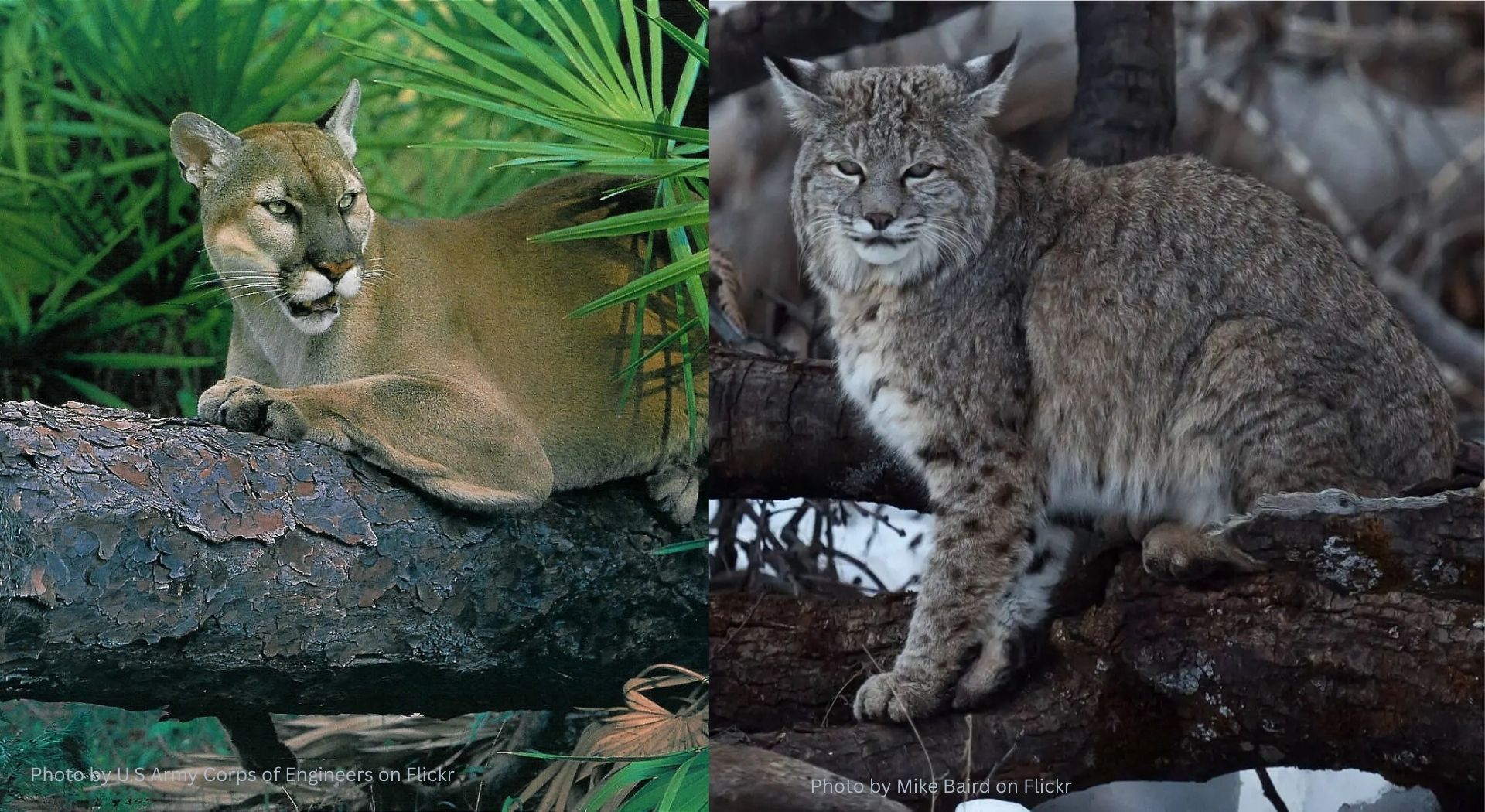
Confusion between the two often arises because both species share overlapping habitats and can appear similar at a distance, particularly in low light. However, measurable differences in body size, tail structure, coat pattern, and behavior allow for clear identification in both field observations and camera-trap studies.
This article compares these two felids across key biological and ecological parameters, including morphology, geographic distribution, prey selection, and conservation status, providing a structured, evidence-based distinction between them.
Quick Comparison Table
| Feature | Florida Panther | Bobcat |
| Scientific Name | Puma concolor coryi | Lynx rufus |
| Taxonomic Classification | Felidae, genus Puma (subspecies of cougar) | Felidae, genus Lynx (distinct species) |
| Geographic Range | South Florida (primarily south of Lake Okeechobee) | Throughout Florida and North America |
| Habitat Preference | Forested wetlands, pinelands, swamps | Forests, scrublands, urban edges |
| Average Size | 45–72 kg (100–160 lb); 2.1–2.4 m (7–8 ft total length) | 9–16 kg (20–35 lb); ~0.9–1.2 m (3 ft) |
| Key Physical Difference | Long tail, uniform coat | Short “bobbed” tail, spotted coat |
| Behavioral Difference | Hunts large ungulates | Hunts small mammals and birds |
| Conservation Status | Endangered (U.S. federal listing) | Least Concern (IUCN) |
1. Size and Body Mass
The most immediate difference between the Florida panther and bobcat is overall size. Adult Florida panthers typically weigh between 45 and 72 kg (100–160 lb), with males often at the upper end of this range, whereas bobcats average only 9–16 kg (20–35 lb). This makes panthers approximately 3–4 times heavier, with a substantially greater shoulder height and muscle mass.
This disparity reflects distinct ecological roles. Panthers are biomechanically adapted to subdue large prey such as white-tailed deer and feral hogs, requiring strong forelimbs, a powerful bite force, and greater energy reserves. Bobcats, by contrast, specialize in smaller prey and therefore maintain a lighter, more agile body structure optimized for rapid ambush over short distances.
The difference matters ecologically because body mass determines trophic position. Panthers function as apex predators capable of regulating ungulate populations, while bobcats occupy a mesopredator niche, primarily influencing small mammal communities.
2. Tail Length and Function
Florida panthers possess a long tail measuring roughly 60–90 cm (about one-third to one-half of total body length), whereas bobcats have a short “bobbed” tail averaging 10–15 cm (~4–6 inches).
Functionally, the long tail in panthers acts as a dynamic counterbalance during high-speed pursuits and directional changes. This is particularly important when pursuing large prey through dense vegetation, where stability during rapid turns is critical.
Bobcats rely more on short-distance ambushes rather than extended chases. Their reduced tail length reflects this hunting strategy and is characteristic of the Lynx lineage.
This difference is one of the most reliable field identification features and directly reflects contrasting locomotor biomechanics between the two species.
3. Total Body Length
Adult Florida panthers reach total lengths of 2.1–2.4 meters (7–8 feet), including the tail, while bobcats typically measure around 0.9–1.2 meters (3 feet).
This difference is functionally significant rather than purely proportional. Larger body length in panthers supports longer stride length and more efficient long-distance movement. Male panthers can maintain home ranges exceeding 500 km² in some landscapes, reflecting high energetic demands.
Bobcats, with smaller body size, maintain much smaller home ranges, often between 5 and 50 km² depending on habitat productivity.
Thus, body length directly influences spatial ecology: panthers require extensive, contiguous habitats, whereas bobcats can persist in fragmented or human-modified environments.
4. Coat Color and Markings
Florida panthers have a relatively uniform coat ranging from tawny to grayish-brown, with minimal visible markings in adults. In contrast, bobcats display distinct dark spots, bars, and streaks on a yellowish to reddish-brown background.
This difference reflects divergent camouflage strategies shaped by habitat use. Panthers rely on uniform coloration to blend into shadowed understories and open vegetation, minimizing detection by large prey.
Bobcats benefit from disruptive patterning, which breaks up their outline in patchy light environments such as brush and woodland edges. This patterning is especially effective for ambush hunting at close range.
The contrast in coat pattern is therefore a direct evolutionary response to different hunting environments and prey detection dynamics.
5. Tail Markings
The tail of a Florida panther is generally uniform in color with a black tip, whereas bobcats have a distinctive bicolored pattern: black on the upper surface and white underneath.
This marking difference is taxonomically consistent and widely used in field identification. The white underside of the bobcat’s tail can be visible at distance, particularly when raised.
From a functional perspective, this contrast may play a role in visual signaling between individuals, especially in mother–offspring interactions. Panthers rely more heavily on scent marking and vocal communication, making visual tail signals less prominent.
This feature provides a rapid and reliable diagnostic cue, even when only part of the animal is visible.
6. Ear Structure and Markings
Florida panthers have rounded ears with minimal external markings, whereas bobcats possess pointed ears often tipped with short black tufts and marked with conspicuous white patches on the back.
These white ear patches (ocelli) in bobcats are believed to function in visual communication, particularly in low-light conditions, helping maintain contact between individuals.
Panthers, being more reliant on stealth and less on visual signaling, lack these features. Their ear morphology is more typical of larger felids that depend on silent stalking rather than visual cues.
This difference highlights how morphological traits reflect communication strategies and behavioral ecology.
7. Footprint Size and Track Identification
Panther tracks are substantially larger, typically measuring 7–9 cm across (comparable to a human palm), while bobcat tracks measure approximately 3–5 cm (golf ball-sized).
Both species produce round tracks with four toes and no visible claw marks due to retractable claws. However, the size difference is consistent and diagnostic.
Track size correlates directly with body mass and stride length. Panthers also tend to exhibit longer stride distances, often exceeding 50 cm during walking, compared to shorter bobcat strides.
Accurate track identification is critical for wildlife monitoring, especially for Florida panthers, whose populations are assessed through indirect methods such as track surveys and camera trapping.
8. Population Size and Conservation Status
The Florida panther is federally listed as Endangered, with an estimated population of approximately 120–230 adults based on monitoring by the U.S. Fish and Wildlife Service.
In contrast, the bobcat is widespread and classified as Least Concern by the International Union for Conservation of Nature (IUCN), with stable populations across North America.
This disparity reflects differences in habitat specialization, reproductive rates, and historical pressures such as habitat loss and genetic bottlenecks in panthers. Bobcats demonstrate high ecological plasticity, allowing them to thrive in diverse environments.
Conservation status is therefore a major distinguishing factor influencing management, legal protection, and long-term population viability.
9. Geographic Range
Florida panthers are largely confined to South Florida, particularly south of Lake Okeechobee, due to habitat fragmentation and historical range contraction.
Bobcats, by contrast, are distributed across all of Florida and throughout most of North America.
This difference reflects ecological flexibility. Bobcats tolerate a wide range of habitats, including suburban and fragmented landscapes, while panthers require large, contiguous territories with sufficient prey density.
Restricted range significantly increases extinction risk for panthers and underscores the importance of habitat connectivity for their survival.
10. Prey Selection and Hunting Strategy
Florida panthers primarily hunt large prey such as deer and feral hogs, typically weighing 30–100 kg. They rely on stealth, short pursuit bursts, and a suffocating bite to subdue prey.
Bobcats focus on smaller prey, including rabbits, rodents, birds, and reptiles, usually under 5 kg. Their hunting strategy involves short ambush pounces rather than overpowering large animals.
This difference in prey size is directly linked to body size, metabolic demands, and biomechanical capability.
Ecologically, this separation reduces direct competition between the two species, allowing coexistence within overlapping habitats through niche partitioning.
Key Takeaways
• Florida panthers are significantly larger and function as apex predators, while bobcats are smaller mesopredators.
• Tail length is the clearest visual distinction: long in panthers, short and bicolored in bobcats.
• Coat pattern differs completely: panthers are uniform; bobcats are spotted.
• Panthers are restricted to South Florida; bobcats are widespread across North America.
• Panthers are endangered (~120–230 adults), whereas bobcats are abundant and stable.
• Both species coexist by targeting different prey sizes, reducing ecological competition.