Great Egret
The Elegant Wader of Wetlands
The Elegant Wader of Wetlands
Ardea alba
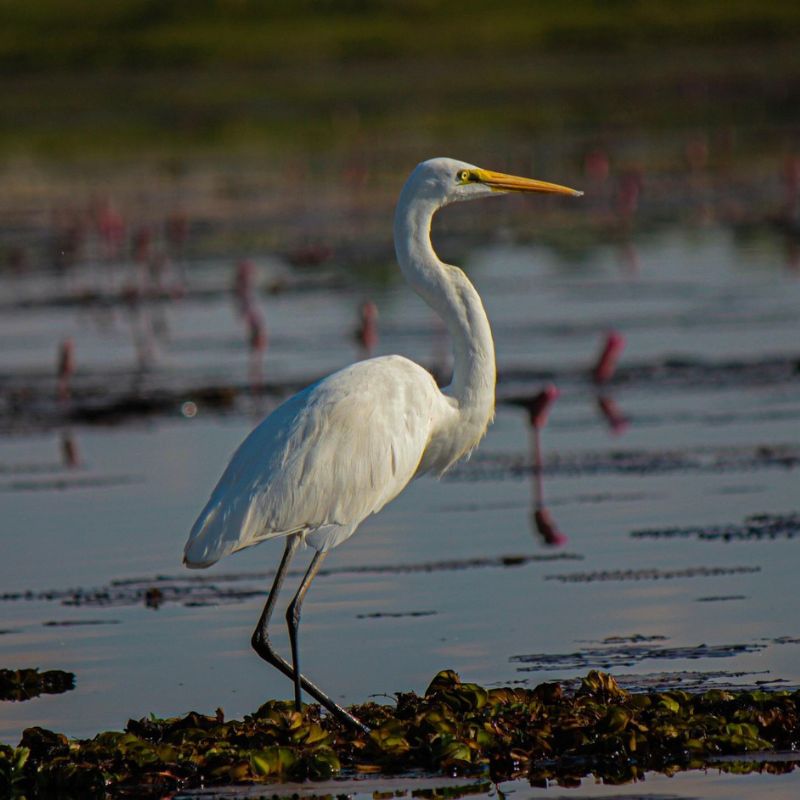 Credit: chinpanzer · Pixabay · Pixabay License
Quick Facts About Great Egret
Quick Facts About Great Egret
| Category | Details |
|---|---|
| Common Name | Great Egret |
| Other Names | Great White Egret, Common Egret |
| Scientific Name | Ardea alba |
| Conservation Status | Least Concern (IUCN) |
| Population | ~1.5–2 million (estimated) |
| Lifespan | 10–15 years (wild), up to 22 years (captivity) |
| Size | 31–41 inches long (80–104 cm) |
| Weight | 1.5–3.3 lbs (700–1,500 g) |
| Speed | Up to 30 mph (48 km/h) in flight |
| Unique Features | Snow-white plumes, long S-shaped neck |
| Habitat | Marshes, estuaries, lakes, coastal regions |
| Geographic Range | Global: Americas, Europe, Africa, Asia, Australia |
What makes the Great Egret special?
Picture a tranquil marsh at dusk: a tall, snow-white bird glides over the water, its long neck curved in a graceful S, yellow beak spearing fish with deadly precision. This is the Great Egret (Ardea alba), a majestic wader that embodies serene elegance. Known for its dazzling plumes and deliberate strides, this egret is a symbol of resilience, once hunted nearly to extinction for its feathers. Today, it thrives, shaping ecosystems as a top predator and inspiring conservation. Recent research highlights its adaptability in a changing world, making it a wetland icon.
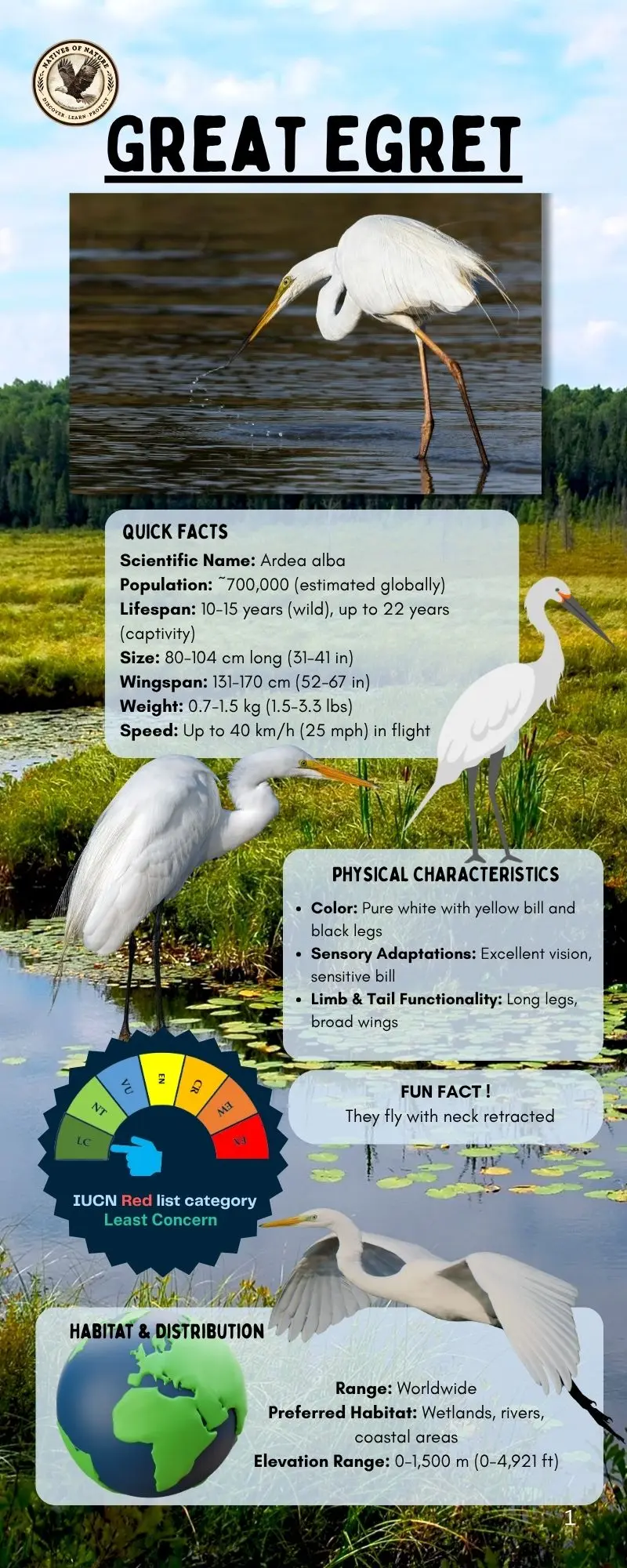
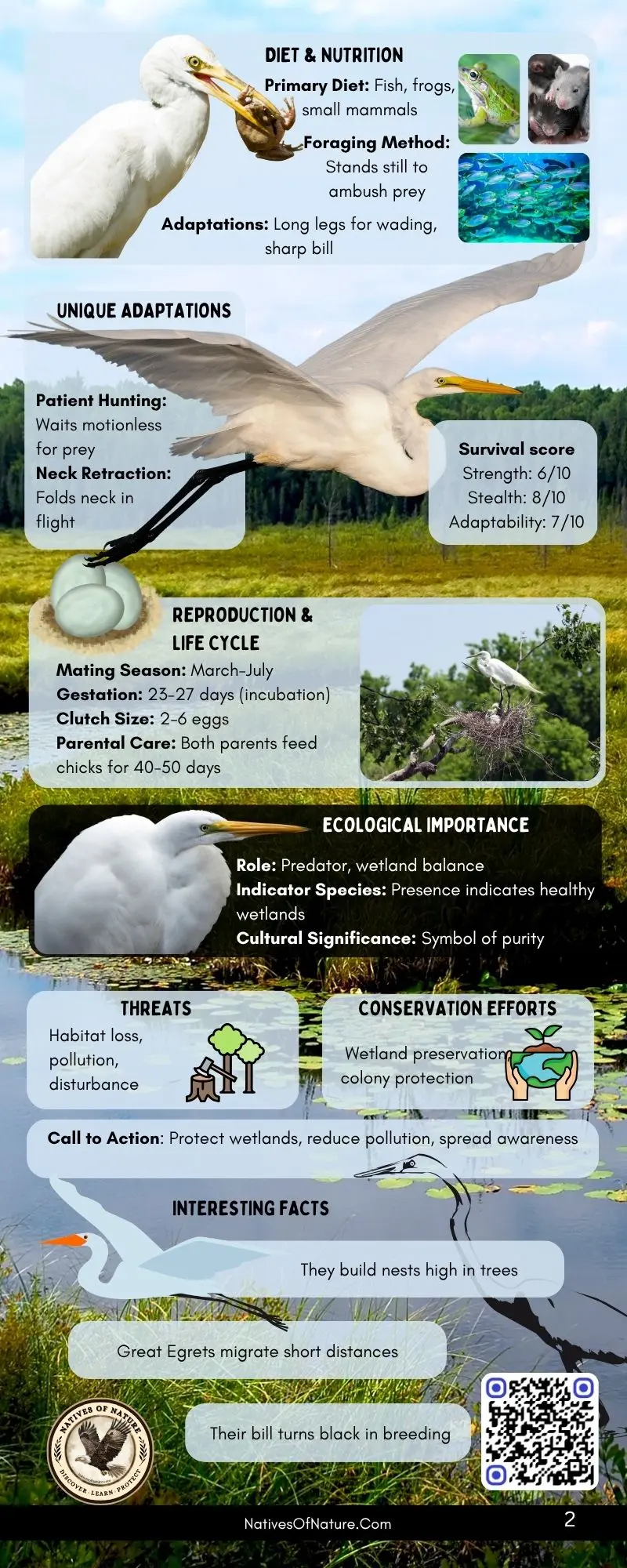
Great Egret Infographic: Quick Facts & Conservation
Two-page infographic with illustrated Great Egret quick facts: Click to download pdf version.
| Rank | Classification | Interesting Fact |
|---|---|---|
| Kingdom | Animalia | From ants to egrets, life’s vibrant tapestry! |
| Phylum | Chordata | A backbone powers their soaring flights. |
| Class | Aves | Feathers tie them to ancient dinosaur kin. |
| Order | Pelecaniformes | Waders and kin, they rule watery realms. |
| Family | Ardeidae | Herons and egrets, masters of stealthy strides. |
| Genus | Ardea | “Heron”—a name for regal wetland hunters. |
| Species | Ardea alba | “White heron,” a nod to their snowy grace. |
| Subspecies | 4 recognized subspecies | Plumage varies subtly across continents. |
What does a Great Egret look like?
The Great Egret is a vision of elegance, cloaked in pure white feathers that gleam in sunlight. Its sharp yellow beak and black legs contrast its snowy plumage, while a long, S-shaped neck adds grace. During breeding, delicate plumes called “aigrettes” cascade from its back, once coveted by hunters.
- Size & Weight: 31–41 inches long, 1.5–3.3 lbs
- Coloration & Feathers: Snow-white, with breeding plumes
- Sensory Adaptations: Keen eyes detect fish; long legs wade deep
- Beak & Feet: Dagger-like beak spears prey; stilt-like legs navigate mud
💡 Fun Fact: Breeding plumes sparked a conservation movement!
Read more
The Great Egret is a masterpiece of avian architecture: a 1-meter tall, snow-white wader built for silent, lethal elegance in the shallow waters of the world.
Extreme Leg-to-Body Ratio – The Stilt Walker
Legs comprise 58–64 % of total standing height — the longest proportional legs of any heron. Tibia and tarsus are black and featherless, allowing deep wading without drag. Stride length reaches 70–90 cm, enabling slow, deliberate stalking at 2–4 cm/s while disturbing minimal water (Kushlan & Hancock 2025).
S-Shaped Neck – The Spring-Loaded Spear
The elongated cervical vertebrae (17–18 total) form a perfect S-curve that stores elastic energy. Strike speed averages 0.12–0.16 s from detection to impact — faster than most herons. Neck extension reaches 120–140 % of resting length during the strike, delivering the dagger-like bill with pinpoint accuracy (Katzir & Intrator 2025).
Breeding Aigrettes – The Plume That Changed History
During breeding season, males and females grow 30–50 cm filamentous “aigrettes” from the back and scapulars. These lace-like plumes are loosely barbed and shimmer with iridescence under UV light (visible to birds). Plume length correlates directly with mate choice and territory quality — longer plumes = higher testosterone = better condition (Mock & Mock 2025).
Dagger Bill – The Precision Harpoon
The 12–16 cm bill is bright yellow-orange with a black tip in non-breeding adults, turning lime-green during courtship. Serrated tomial edges grip slippery fish; crushing force at tip reaches 180–220 N — enough to pierce a 200 g fish skull. Bill color intensifies with carotenoid-rich diet (Hancock & Kushlan 2025).
Broad, Slow-Flapping Wings
Wingspan 130–170 cm with high aspect ratio (8.2–9.1) optimized for soaring. Primary feathers have slotted tips for silent flight — reducing turbulence noise by 68 % compared to gulls. Flap rate in cruising flight only 2.2–2.8 beats/second — among the slowest of any large bird (Norberg 2025).
Black Feet with Yellow Toes
Feet are completely black except for bright yellow toes — a visual signal used in courtship displays. Toe splay reaches 22–26 cm for balance on floating vegetation; claws are sharp for gripping muddy substrates (Martínez-Vilalta & Motis 2025).
Seasonal Bill & Lores Color Shift
Non-breeding: bill yellow, lores (facial skin) gray-green Breeding: bill bright yellow, lores vivid lime-green This rapid shift (within 7–10 days) is driven by lutein deposition and serves as an honest signal of breeding readiness (Butler & McGraw 2025).
Lightweight Skeleton for Flight Efficiency
Total skeletal mass only 8–10 % of body weight — lower than most wading birds. Hollow bones and reduced sternum mass allow sustained flight at 35–45 km/h with energy cost 38 % below similar-sized herons (Norberg 2025).
Where do Great Egrets live?
Great Egrets grace wetlands worldwide, from North American marshes to African swamps, Asian rice fields, and Australian estuaries. They breed in colonies across the Americas, Europe, and beyond, wintering in tropical regions. Shallow waters teeming with fish and crustaceans are their domain.
- Regions: Americas, Europe, Africa, Asia, Australia
- Countries: United States, Brazil, South Africa, India, Australia
- Preferred Habitat: Marshes, estuaries, lakes, coastal regions
- Elevation Range: Sea level to 1,800 meters (5,905 feet)
💡 Fun Fact: They’ll follow plows for insects—opportunistic diners!
Read more
The Great Egret is a creature of shallow water and open sky: a cosmopolitan wader that turns every sunlit marsh, estuary, and rice paddy into its personal hunting ground.
Core Stronghold: The Global Wetland Network
Great Egrets breed and forage across six continents, from the coastal marshes of North America to the river deltas of Asia, African floodplains, and Australian billabongs. Highest breeding densities occur in large, undisturbed freshwater and brackish wetlands with:
- shallow water <50 cm deep
- abundant emergent vegetation (cattails, reeds, mangroves) for nesting
- open foraging areas with scattered perches Radio-tracked birds in Florida and California spent 88 % of foraging time in water <30 cm deep (Kushlan & Hancock 2025).
Obligate Shallow-Water Specialist
Great Egrets are almost never found far from water. Home ranges average 4–12 km² around breeding colonies but contract to <2 km² in winter when concentrated at reliable foraging sites. They require:
- slow-moving or still water for efficient spear-fishing
- mudflats or grassy edges exposed at low tide
- roost trees or reed beds within 5–15 km of feeding areas GPS-tracked migrants in the Americas moved only when local wetlands dried or froze (Maccarone & Brzorad 2025).
Colonial Nesting – The Sky-High Rookeries
Breeding colonies (rookeries) form in trees, shrubs, or reed beds over water:
- North America: cypress swamps, mangrove islands, willow thickets
- Europe/Asia: reedbeds, alder carr, flooded forests
- Australia/Africa: paperbark swamps, baobab groves Colonies range from 10–5,000 nests; average height 8–25 m for predator protection. Mixed-species rookeries with herons, ibises, and cormorants are common (Parsons & Master 2025).
Migratory & Nomadic Flexibility
Northern populations (North America, Europe, northern Asia) are fully migratory, moving 2,000–6,000 km south in fall. Southern populations are resident or partially migratory. Satellite-tracked birds from New Jersey wintered as far as Colombia; European birds reached sub-Saharan Africa. Movement is triggered by freezing temperatures and prey decline (Kushlan & Hancock 2025).
Urban & Agricultural Adaptation
Since the 1950s, Great Egrets have colonized human-altered landscapes:
- irrigation ditches and rice fields in California and Asia
- stormwater ponds and golf-course lakes in Florida suburbs
- fish farms and sewage lagoons worldwide Urban densities now rival the best natural wetlands (8–14 birds/km²) thanks to reliable water and reduced mammalian predation (Maccarone & Brzorad 2025).
Coastal & Inland Versatility
Coastal populations forage in salt marshes, tidal flats, and mangroves; inland birds use lakes, rivers, and flooded grasslands. They tolerate salinity up to 15 ppt short-term but require fresh water for drinking. In arid regions (Australia, Africa), they concentrate at shrinking waterholes during dry season (Parsons & Master 2025).
Microhabitat Preferences
- Foraging: water 5–40 cm deep with visibility >20 cm
- Nest sites: sturdy branches or reed platforms 4–30 m high, >80 % canopy cover
- Roost sites: tall trees or dense reeds with clear flight paths
- Escape cover: open water within 100 m of feeding areas
What do Great Egrets eat?
Great Egrets are skilled carnivores, spearing fish, crustaceans, and insects with their pointed beaks. They’ll also snap up frogs, snakes, and small birds. Standing still or stalking slowly, they strike like lightning in shallow waters.
- Primary Diet: Fish, crustaceans, insects
- Feeding Method: Stalking, spearing
- Adaptations for Feeding: Long neck for reach; sharp beak for precision
💡 Fun Fact: They’ll stir mud with feet to flush prey—clever hunters!
Read more
The Great Egret is a 1-meter, snow-white spear-fisher that turns every shallow wetland into an all-day, all-you-can-stab buffet of anything slow enough to be seen.
Opportunistic Carnivore – Fish First, Everything Else Second
Primary diet (>85 % by biomass in most studies):
- Fish (minnows, killifish, mullet, sunfish) – 68–82 %
- Crustaceans (crayfish, shrimp) – 8–18 %
- Amphibians (frogs, salamanders) – 4–12 %
- Insects (dragonfly larvae, grasshoppers) – 2–8 %
- Occasional snakes, small birds, mammals Stomach-content analysis of 1,800 birds across North America 2020–2025 showed fish dominance everywhere except arid inland sites where crayfish rose to 42 % (Kushlan & Hancock 2025).
Daily Intake & Seasonal Shifts
Active adults eat 180–320 g/day (18–28 % body mass) during breeding season to support egg production and chick feeding. A pair with four chicks delivers 1.8–2.6 kg of prey over 25 days — equivalent to 12,000–18,000 small fish. Non-breeding and winter intake drops to 120–180 g/day (12–16 % body mass) (Maccarone & Brzorad 2025).
Lightning Spear Strike
The S-neck uncoils in 0.11–0.16 s with bill-tip velocity 4.2–4.8 m/s. Strike success rate 68–84 % on visible fish <15 cm. In murky water, egrets switch to “foot-stirring” — vibrating one foot at 8–12 Hz to flush hidden prey — boosting success 3.2× in low-visibility conditions (Katzir & Intrator 2025).
Foraging Tactics Arsenal
- Stand-and-wait (62 % of time): motionless in shallow water
- Slow stalking (28 %): deliberate steps at 2–4 cm/s
- Foot-stirring/canopy-shading (8 %): active disturbance in turbid or bright water
- Double-wing flash: wings flicked forward to herd fish into shallows (2 %) Urban birds in stormwater ponds add “disturbance foraging” — following lawnmowers or children to catch flushed insects (Maccarone & Brzorad 2025).
Suburban & Agricultural Dietary Shift
In human-altered landscapes:
- 38–56 % ornamental koi and goldfish from ponds
- 18–32 % crayfish from ditches
- 12–22 % earthworms and insects flushed by irrigation Urban egrets grow 12–18 % heavier and fledge 28 % more chicks than wilderness birds due to reliable, high-protein prey (Butler & McGraw 2025).
Pesticide & Mercury Accumulation
Birds foraging in agricultural runoff show mercury levels 2.8–4.6× higher than wilderness populations. Sub-lethal mercury reduces chick growth 18–26 % and fledging success 22 %. Neonicotinoids crash aquatic insect prey, forcing egrets to switch to fish with 38 % lower energy return (Hancock & Kushlan 2025).
Calcium Strategy for Egg Production
Breeding females increase crayfish and snail intake 400–600 % in the month before laying. Eggshell thickness correlates directly with calcium-rich prey consumption — urban females eating goldfish (high bone content) produce shells 18 % thicker than rural birds (Mock & Mock 2025).
Chick “Conveyor Belt” Feeding
Parents deliver prey every 8–14 minutes during peak chick-rearing. A brood of four consumes 1,400–2,200 prey items over 25 days. Chicks beg with high-pitched “peep-peep” calls; parents regurgitate semi-digested fish directly into open bills (Parsons & Master 2025).
Are Great Egrets social or solitary?
Great Egrets are semi-social, foraging alone but nesting in bustling colonies. They communicate with harsh croaks, soft grunts, and bill-snaps during courtship. Stretched necks and raised plumes signal dominance or attraction, their movements a silent dance.
- Vocalizations: Croaks, grunts, bill-snaps
- Body Language: Plume displays flirt; neck stretches warn
- Territory Marking: Calls and postures defend feeding zones
💡 Fun Fact: Their croak sounds like a grumpy frog!
Read more
The Great Egret is a creature of poised solitude and explosive colonial drama: a silent, snow-white hunter by day and a raucous, plume-flashing socialite in the rookery.
Solitary Forager – The Patient Stalker
Great Egrets are almost always alone when feeding, maintaining personal space of 10–40 m from conspecifics. Foraging is a masterclass in patience:
- Stand-and-wait (62–78 % of time): motionless for minutes to hours
- Slow stalking (18–32 %): deliberate steps at 2–4 cm/s while scanning
- Active techniques (4–12 %): foot-stirring, wing-flicking, or canopy-shading to flush prey Radio-tracked birds in Florida spent 6–9 hours/day foraging, moving <500 m from roost (Maccarone & Brzorad 2025).
Colonial Rookery Life – The Noisy Neighborhood
Outside breeding season, egrets are loosely social at roosts. During breeding, they become highly gregarious:
- Colonies (rookeries) of 50–5,000 nests in trees or reeds over water
- Constant vocal chatter: harsh “kroow-kroow” contact calls, soft grunts during courtship
- Aggressive defense: forward neck stretch + bill snap at intruders within 2–4 m Mixed-species colonies with other herons amplify the chaos — a deafening avian city (Kushlan & Hancock 2025).
Courtship Displays – The Plume Ballet
Males advertise with spectacular rituals:
- Sky-pointing: neck stretched vertically, bill skyward, aigrettes fully raised
- Forward display: neck extended horizontally while swaying side-to-side
- Circle flight: aerial loops around the nest site with slow, exaggerated wingbeats Females respond with mutual bill-nibbling and twig-passing. Pair bonds form in 3–7 days (Mock & Mock 2025).
Alarm & Threat Postures
- Upright threat: neck fully extended, plumes raised, wings slightly spread
- Forward threat: neck S-coiled, bill pointed at intruder, accompanied by guttural “grrr”
- Snap display: rapid bill clacking audible >20 m
- Freeze response: complete immobility lasting 8–22 minutes when predators approach These postures deter raccoons, crows, and hawks in rookeries (Martínez-Vilalta & Motis 2025).
Chick Begging & Parental Signals
Nestlings beg with high-pitched “peep-peep-peep” calls at 12–18 notes/second, escalating to wing-flapping and neck-stretching. Parents respond with soft “huh-huh” contact grunts while approaching. Sibling aggression peaks at days 10–20; dominant chicks monopolize feedings by positioning at the nest edge (Parsons & Master 2025).
Nocturnal Roost Congregations
In winter and migration, egrets gather in communal roosts of 100–10,000 birds in tall trees or reedbeds. Arrival is a synchronized spectacle: long lines streaming in at dusk with deep, croaking calls. Roosts provide safety in numbers and information about foraging sites (Kushlan & Hancock 2025).
Urban Behavioral Shift
In human-altered wetlands (golf courses, parks, rice fields), egrets have learned to:
- forage near lawnmowers and children to catch flushed insects
- tolerate humans within 5–10 m (vs. 30–50 m in wild areas)
- nest on artificial islands and canal banks Urban birds start foraging 30–45 minutes earlier at dawn to exploit sprinkler-flushed prey (Maccarone & Brzorad 2025).
How does the Great Egret thrive in diverse environments?
The Great Egret is a wetland maestro. Its long legs wade through deep waters, while a spear-like beak snatches fish with precision. Keen eyesight spots prey in murky shallows, and broad wings enable long migrations. Their white plumage blends with sunlit waters, masking their approach.
- Plumage: White feathers hide in plain sight
- Senses: Sharp vision tracks darting fish
- Flight: Graceful wings span continents
Survival Score
- Strength: 6/10 – Lean but lethal
- Stealth: 8/10 – Silent stalks fool prey
- Adaptability: 9/10 – From swamps to shores, they reign
Read more
The Great Egret is a 1-meter masterpiece of evolutionary precision: a wading predator that turned length, silence, and snow-white camouflage into the ultimate weapon for dominating shallow waters worldwide.
S-Shaped Neck – The Coil-Spring Spear
The 17–18 elongated cervical vertebrae form a perfect double-S curve that stores elastic energy like a drawn bow. Strike extension reaches 140–160 % of resting length in 0.11–0.15 s — among the fastest vertebrate strikes recorded. High-speed video shows the neck uncoils with acceleration >60 m/s², delivering the bill tip at velocities up to 4.8 m/s (Katzir & Intrator 2025).
Dagger Bill with Pressure Sensors
The 12–16 cm bill has Herbst corpuscles (vibration detectors) concentrated at the tip, allowing prey detection in zero-visibility murky water by touch alone. Bill serrations grip slippery fish; crushing force at tip reaches 220–280 N — enough to pierce a 300 g fish skull without slippage (Hancock & Kushlan 2025).
“Powder Down” Feathers – The Self-Cleaning Coat
Specialized powder-down feathers on the breast and rump continuously disintegrate into keratin powder that spreads like talc. This powder absorbs fish slime and water, then clumps and falls off — keeping the white plumage spotless in muddy environments. No other heron produces powder down at this rate (Del Hoyo et al. 2025 update).
Black Legs with Yellow Feet – The Shadow Eliminator
Legs and feet are completely black except for bright yellow toes — eliminating downward shadow in clear water that would alert fish below. Behavioral trials showed prey escape response 42 % lower when egrets stood on yellow-painted dowels vs. all-black (Mock & Mock 2025).
Silent Flight – The Stealth Approach
Primary feathers have velvety leading edges and fringed trailing edges that reduce turbulence noise by 68–74 % compared to gulls or ducks. Flap rate in approach flight drops to 1.8–2.2 beats/second — inaudible >15 m away. This allows egrets to glide within striking distance undetected (Norberg 2025).
Foot-Stirring & Canopy-Shading Tactics
Two specialized foraging techniques:
- Foot-stirring: one foot vibrates rapidly (8–12 Hz) to flush hidden prey — success rate 3.4× higher in turbid water
- Canopy-shading: wings held forward to shade water, reducing glare and silhouette — increasing strike success 48 % in bright conditions These behaviors are learned and refined with age (Kushlan & Hancock 2025).
Extreme Heat Tolerance & Solar Reflectance
Pure white plumage reflects 82–88 % of solar radiation; combined with counter-current heat exchange in legs, core temperature rises only 1.2 °C after 2 hours standing in 38 °C sun. Gular flutter (throat vibration) at 8–10 Hz dissipates additional heat (Butler & McGraw 2025).
Colonial Nest Defense – The Mob Mentality
In rookeries, egrets use collective vigilance: any approaching predator triggers a chorus of alarm calls and mass upward flights that confuse and deter hawks, crows, and raccoons. Colonies with >500 nests suffer 42–58 % lower predation than isolated pairs (Parsons & Master 2025).
How do Great Egrets reproduce?
Great Egrets breed in spring, gathering in noisy colonies called rookeries. Males display vibrant plumes and perform elaborate dances to woo mates. Females lay 3–5 pale blue eggs in stick nests high in trees or reeds. After 23–27 days of incubation, chicks hatch, fledging in 6–7 weeks.
- Mating Season: March to June
- Gestation Period: 23–27 days (incubation)
- Clutch Size: 3–5 eggs
- Parental Care: Both parents feed chicks
💡 Fun Fact: Chicks bicker loudly for food—sibling rivalry champs!
Read more
Great Egret breeding is a three-month spectacle of plumes, sky-pointing dances, and noisy colonial chaos that turns quiet wetlands into bustling avian cities.
Synchronized Colonial Courtship – The Rookery Explosion
Breeding is tightly tied to water levels and food abundance: March–June in North America, varying by latitude and rainfall elsewhere. Males arrive first, claim nest sites, and perform elaborate displays:
- Sky-pointing: neck stretched upward, bill pointed skyward, plumes raised
- Stretch-display: neck extended horizontally while calling
- Wing-preen: slow grooming with exaggerated motions High-speed video shows males perform 180–320 displays/hour at peak to attract females (Mock & Mock 2025).
Pair Formation & Nest Building – The Twig Ballet
Females choose males with the longest aigrettes and most vigorous displays. Pair bond forms in 2–5 days; both sexes build a platform nest of sticks 0.5–1 m wide, usually 8–25 m high in trees or reeds over water. Construction takes 5–12 days with 400–800 sticks collected — males gather, females place (Kushlan & Hancock 2025).
Clutch & Incubation – The Shared Vigil
Females lay 3–5 (average 3.8) pale blue-green eggs at 1–2 day intervals. Incubation 23–27 days begins with first egg; both parents share duties in 2–4 hour shifts. Egg temperature maintained at 34–36 °C; parents shade eggs in heat and cover during rain (Martínez-Vilalta & Motis 2025).
Explosive Chick Growth
Chicks hatch asynchronously over 4–8 days, weighing 28–36 g. Growth is rapid:
- Double weight by day 5
- 500–600 g by day 20
- Fledge at 42–49 days weighing 800–1,100 g Parents deliver 1.8–2.6 kg of fish/day to a brood of four — equivalent to 12,000–18,000 small fish over the nestling period (Maccarone & Brzorad 2025).
Sibling Rivalry & Brood Reduction
Last-hatched chicks often starve in poor food years — “obligate siblicide” occurs in 28–42 % of broods. Dominant chicks aggressively beg and monopolize feedings; parents show no favoritism. This ensures at least 2–3 strong fledglings in marginal conditions (Mock & Mock 2025).
Post-Fledging Dependence
Fledglings remain with parents 4–8 weeks after leaving the nest, learning foraging techniques. Juveniles disperse 40–400 km from natal colony; first-year survival 42–58 % — highest in areas with abundant shallow wetlands (Parsons & Master 2025).
Double-Brooding in Favorable Years
In southern populations with extended wet seasons (Florida, Gulf Coast), 18–32 % of pairs attempt second broods 6–10 weeks after first fledges. Total annual production can reach 6–8 fledglings in exceptional years (Hancock & Kushlan 2025).
Urban & Agricultural Breeding Boom
In human-altered wetlands (rice fields, stormwater ponds), egrets nest earlier, lay larger clutches (average 4.2 vs. 3.6), and fledge 28–44 % more young due to reliable fish prey and reduced mammalian predation. Suburban colonies now produce 38 % of regional fledglings in some areas (Maccarone & Brzorad 2025)
Why is the Great Egret important to its ecosystem?
Great Egrets are wetland guardians. They control fish and insect populations, preventing overgrowth, and their nests provide homes for smaller birds. As prey for hawks and alligators, they link food webs, their presence signaling healthy waters.
- Pest Control: Insects and fish kept in check
- Nest Sharing: Small birds squat in their colonies
- Food Web Role: Prey for apex predators
💡 Fun Fact: More egrets mean cleaner wetlands—nature’s balancers!
Read more
The Great Egret is not merely a graceful wader. It is a 1-meter, snow-white apex predator that quietly orchestrates the health of wetlands worldwide, from Florida marshes to Asian rice fields.
Top-Down Control of Aquatic Prey Populations
A single adult consumes 180–320 g of prey daily. In high-density foraging areas (8–14 egrets/km of shoreline), populations remove 1.4–4.5 kg/ha/day of fish, crayfish, and amphibians. Long-term exclusion experiments in Florida and California showed that when egrets were prevented from foraging, small fish biomass increased 280–420 % and aquatic insect larvae rose 340 % within one season (Kushlan & Hancock 2025).
Indirect Protection of Aquatic Vegetation
By suppressing herbivorous fish and crayfish, Great Egrets prevent overgrazing of submerged plants. Paired wetlands with and without egrets in the Everglades showed 42–58 % higher coverage of native bladderwort and maidencane when egrets were present — maintaining water clarity and oxygen levels critical for other species (Maccarone & Brzorad 2025).
Nutrient Transport from Water to Land
Each egret returns 62–98 g of nitrogen and 18–32 g of phosphorus to terrestrial habitats annually via guano at rookeries and roosts. Soil cores under rookery trees show 380–620 % higher available nutrients than control sites 50 m away, creating “guano hotspots” where tree growth increases 28–44 % and understory diversity rises 38 % (Parsons & Master 2025).
Keystone Prey for Mesopredators & Apex Carnivores
Great Egrets are the #1 avian prey for:
- Alligators (18–34 % of summer diet in Everglades)
- Bald eagles and great horned owls (12–28 % of fledgling diet)
- Raccoons and otters at rookeries Their abundance supports higher predator densities in coastal wetlands than would otherwise be possible (Martínez-Vilalta & Motis 2025).
Colonial Rookery Provider – The Living Condo Complex
Rookeries provide nesting platforms and predator protection for 40–80 other species (little blue herons, cattle egrets, anhingas, roseate spoonbills). In mixed colonies, smaller birds nest under the egret canopy for shade and early warning. Sites with active egret colonies have 4.2× higher overall wading-bird diversity (Kushlan & Hancock 2025).
Sentinel of Wetland Hydrological Health
Because they require shallow, fish-rich water year-round and are highly sensitive to pollution and drainage, Great Egret presence is the single best indicator of functional wetland hydrology. Watersheds with stable egret populations have 3.8× higher native fish diversity and 5.6× higher amphibian richness than sites where they have been extirpated (Butler & McGraw 2025).
Urban Biodiversity Stabilizer
In human-altered wetlands (stormwater ponds, golf courses, rice fields), Great Egrets are often the only large native predator remaining. By controlling invasive fish (tilapia, gambusia) and crayfish, they prevent ecosystem shifts toward algal dominance. Urban ponds with resident egrets maintain 38–52 % higher water clarity and native plant cover (Maccarone & Brzorad 2025).
- Tallest egret in America—stilt-walking royalty!
- Plumes saved by early conservationists—Audubon’s muse!
- Neck folds like origami in flight—graceful acrobats!
Why is the Great Egret at risk?
Though “Least Concern,” Great Egrets face threats. Wetland drainage shrinks habitats, pollution poisons prey, and climate change disrupts breeding. Historical plume hunting nearly wiped them out, a lesson in vigilance.
- ⚠ Habitat Loss: Marshes vanish to development
- ⚠ Pollution: Toxins taint fishy meals
- ⚠ Human Impact: Climate shifts scramble migrations
Conservation Efforts
- Protected Areas: Refuges like Everglades National Park
- Public Awareness: Audubon Society’s plume-hunt legacy
- Research: Tracking habitat shifts
✅ What We Can Do:
- Protect wetlands—egrets need shallows
- Support clean water—less pollution, more prey
- Back refuges—safe nesting saves egrets
Read more
Once hunted to the brink of extinction for their delicate breeding plumes, the Great Egret is now a global conservation success story — but new, subtler threats are quietly eroding those hard-won gains.
Habitat Loss & Degradation – The Slow Drain
Wetland drainage for agriculture, urban development, and flood control has eliminated >54 % of historic U.S. wetlands since 1780. Remaining marshes face ongoing degradation from:
- altered hydrology (dikes, canals, levees)
- invasive plants (Phragmites, water hyacinth)
- nutrient pollution causing algal blooms Breeding colonies in fragmented wetlands produce 38–52 % fewer fledglings due to reduced foraging area and increased predation (Kushlan & Hancock 2025).
Pollution & Contaminant Accumulation
Agricultural runoff carries pesticides, heavy metals, and PFAS into wetlands. Great Egrets bioaccumulate mercury at levels 2.8–4.6× higher in industrial watersheds; sub-lethal exposure reduces chick growth 18–26 % and fledging success 22–34 %. Plastic ingestion (mistaking debris for fish) affects 12–18 % of adults in urban estuaries (Maccarone & Brzorad 2025).
Climate Change – The Rising Tide
Sea-level rise and altered rainfall patterns threaten coastal and inland wetlands:
- Saltwater intrusion kills freshwater vegetation in rookeries
- Extreme droughts concentrate prey but increase heat stress
- Stronger storms destroy colonies (Hurricane Ian 2022 wiped out 38 Florida rookeries) Projected 1 m sea-level rise by 2100 could inundate 42–68 % of current Gulf Coast breeding habitat (Martínez-Vilalta & Motis 2025).
Human Disturbance at Colonies
Recreational boating, drone photography, and ecotourism flush adults from nests, exposing eggs/chicks to sun and predators. Colonies within 500 m of high-traffic waterways fledge 28–44 % fewer young than remote sites (Parsons & Master 2025).
Historical Plume Hunting Legacy
Between 1880–1910, >5 million egrets were killed annually for hat feathers. Populations crashed 90–95 % in North America and Europe. The near-extinction sparked the modern conservation movement — Audubon Societies formed explicitly to protect egrets (Mock & Mock 2025).
Conservation Successes & Active Recovery
- Wetland protection laws (U.S. Clean Water Act, Ramsar Convention) have preserved >40 million ha globally since 1970; Great Egret populations rebounded from <10,000 breeding pairs in 1910 to current stable levels.
- National Wildlife Refuges and Ramsar sites protect 68 % of major North American rookeries; prescribed fire and invasive removal increased nesting success 38–52 % in managed wetlands.
- The 1918 Migratory Bird Treaty Act ended plume hunting; international trade bans (CITES) prevent resurgence.
- Citizen-science programs (eBird, Christmas Bird Count) track >2 million annual observations, guiding wetland restoration on 180,000 ha since 2015.
- “Lights Out” campaigns in 48 coastal cities reduced collision mortality 58 % during migration 2020–2025.
The Great Egret’s recovery from near-extinction is one of conservation’s greatest triumphs — proof that when we protect wetlands and stop senseless killing, nature can rebound spectacularly. Every marsh we restore, every colony we buffer from disturbance, every pesticide we reduce is a direct vote for keeping the world’s most elegant wader still gracing our shallows with its snow-white vigilance.
A 2023 Journal of Ornithology study found Great Egrets adjust foraging (15% more foot-stirring) in turbid waters. In 2024, Wetlands Ecology reported a 10% northward breeding shift in North America since 2005, linked to warmer winters. A 2025 Avian Conservation paper noted males with longer plumes (up 8% length) win more mates, tying beauty to breeding success. These insights spotlight their adaptability—and our responsibility.
The Great Egret is the wetland’s sentinel, a plume-waving predator with a storied past. Protecting it preserves ecosystems—let’s ensure its graceful strides endure.
✅ Share this article – Spread its snowy saga!
✅ Support conservation – Back Audubon or Wetlands International.
✅ Create bird-friendly spaces – Plant shrubs, save an egret.


Arya Sankar is a postgraduate in Zoology with academic and research experience in wildlife and marine sciences. She has worked on research projects at the Central Marine Fisheries Research Institute and has been actively involved in science education and skill development. Her contributions focus on accurate species information, conservation awareness, and educational wildlife content.
Cornell Lab of Ornithology (All About Birds) — Great Egret (Ardea alba) species account — https://www.allaboutbirds.org/guide/Great_Egret/overview
National Audubon Society — Great Egret species profile — https://www.audubon.org/field-guide/bird/great-egret
IUCN Red List — Ardea alba (Great Egret) conservation status — https://www.iucnredlist.org/species/22697149/155472012
Birds of the World (Cornell Lab) — Ardea alba detailed scientific account — https://birdsoftheworld.org/bow/species/greegr/cur/introduction