Osprey
The Fish-Hunting Monarch of the Waters
The Fish-Hunting Monarch of the Waters
Pandion haliaetus
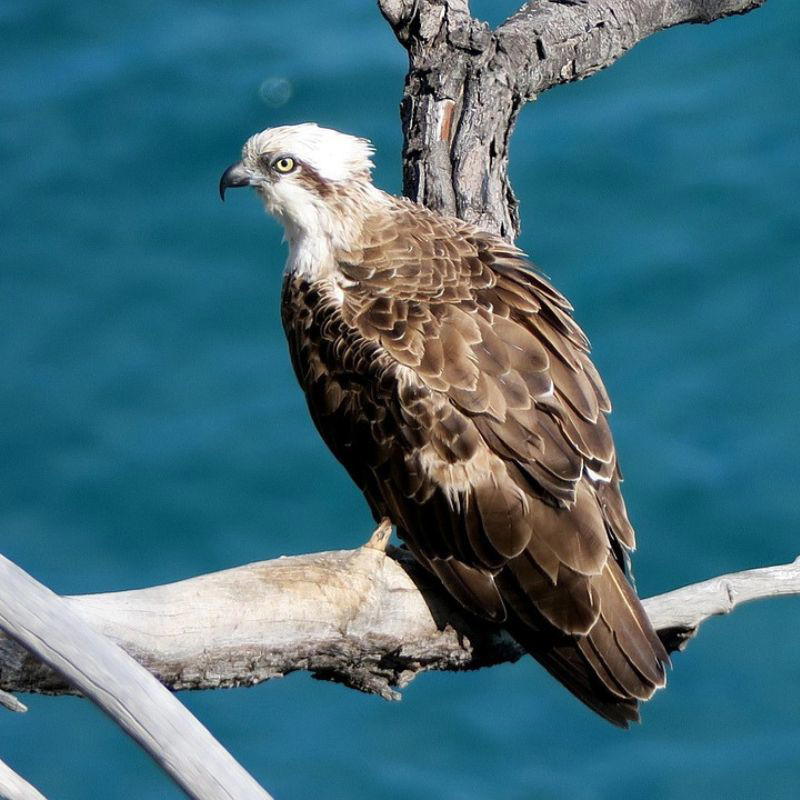 Credit: Tim Lin · Pixabay · Pixabay License
Quick Facts About Osprey
Quick Facts About Osprey
| Category | Details |
|---|---|
| Common Name | Osprey |
| Other Names | Fish Hawk, Sea Hawk |
| Scientific Name | Pandion haliaetus |
| Conservation Status | Least Concern (IUCN) |
| Population | Approximately 500,000–1 million (estimated) |
| Lifespan | 7–10 years (wild), up to 25 years (captivity) |
| Size | 50–66 cm long (19.7–26 inches) |
| Weight | 0.9–2.1 kg (2–4.6 lbs) |
| Speed | Up to 129 km/h (80 mph) in dive |
| Unique Features | Reversible talons, fish-spotting vision |
| Habitat | Coastlines, rivers, lakes, wetlands |
| Geographic Range | Worldwide (except Antarctica) |
What makes the Osprey special?
Imagine a serene lakeside at dawn, a broad-winged bird circling high, then plunging feet-first into the water with a splash, emerging with a fish in its talons. This is the Osprey (Pandion haliaetus), a global raptor renowned for its fishing prowess and majestic presence. With reversible toes and a piercing cry, it reigns over rivers, coasts, and wetlands worldwide. As a master predator of aquatic ecosystems, it regulates fish populations, thriving near human shores with remarkable resilience. Recent research dives into its watery world, hailing it as a feathered fisherman extraordinaire.
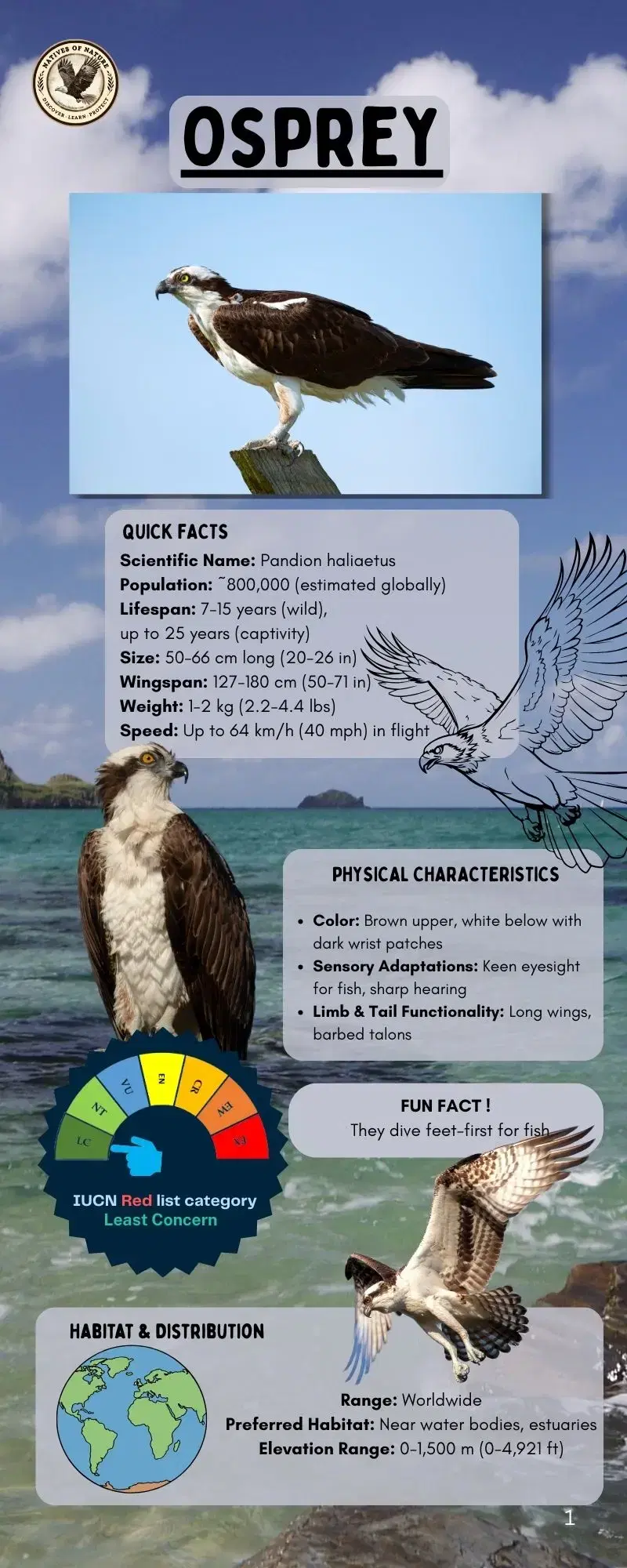
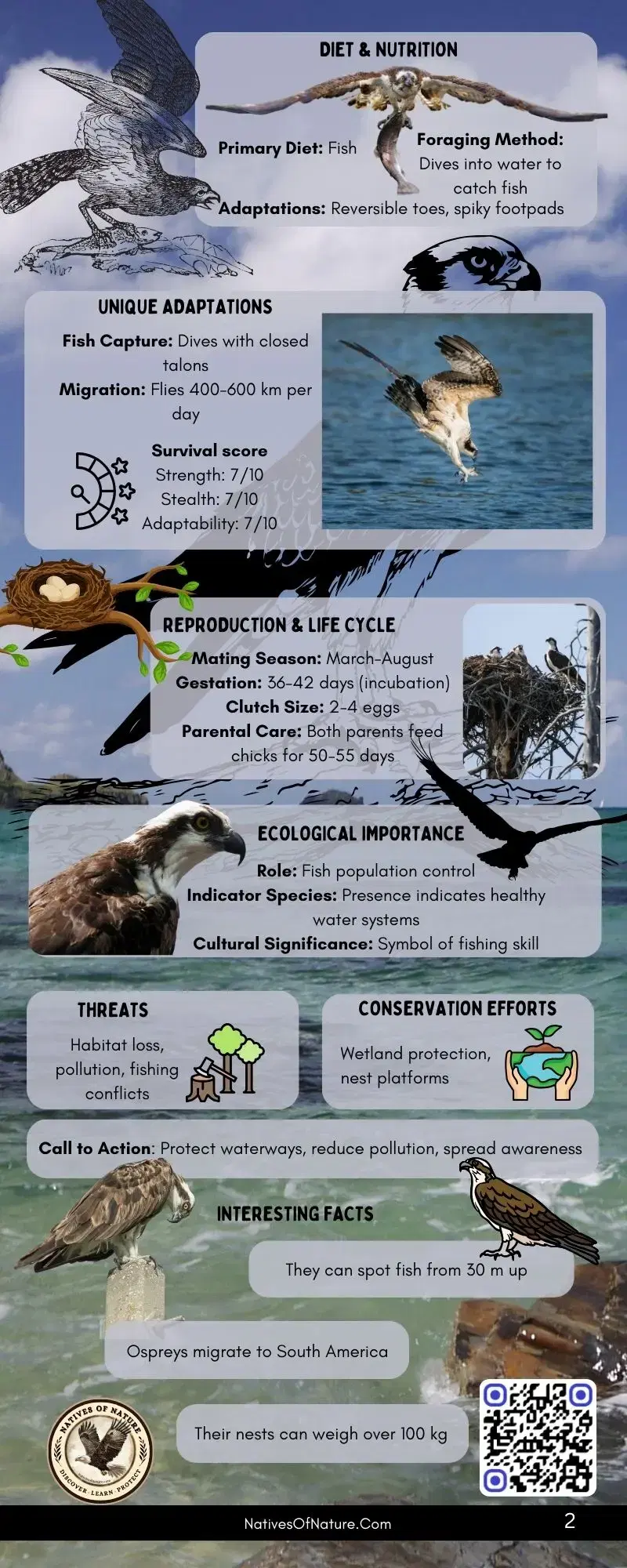
Osprey Infographic: Quick Facts & Conservation
Two-page infographic with illustrated Osprey quick facts: Click to download pdf version.
| Rank | Classification | Interesting Fact |
|---|---|---|
| Kingdom | Animalia | From plankton to predators, life’s tapestry! |
| Phylum | Chordata | A spine steadies their watery dives. |
| Class | Aves | Birds born from dinosaur dreams! |
| Order | Accipitriformes | Hawks and kin, sky’s sharp-eyed rulers. |
| Family | Pandionidae | Lone family—just ospreys, fish kings! |
| Genus | Pandion | “Pandion”—mythic king turned bird. |
| Species | Pandion haliaetus | “Sea eagle”—masters of the wet hunt. |
| Subspecies | 4 recognized subspecies | Sizes shift from tropics to poles. |
What does an Osprey look like?
The Osprey is a sleek, fish-hunting machine. Its brown upperparts contrast a white belly and head, accented by a dark eye-stripe like a bandit’s mask. Long wings bend mid-flight, and spiky talons grip slippery prey with ease.
- Size & Weight: 50–66 cm long (19.7–26 inches), 0.9–2.1 kg (2–4.6 lbs)
- Coloration & Feathers: Brown back, white below, dark eye-stripe
- Sensory Adaptations: Polarized vision cuts water glare; ears catch splashes
- Beak & Feet: Hooked beak rips fish; reversible toes lock prey
💡 Their oily feathers repel water—built-in wetsuits!
Read more
The Osprey, often called the fish hawk or sea hawk, is a bird engineered for one purpose: to hunt fish in open water with lethal precision. Every detail of its body screams specialization, from its reversible toe to its shutter-like nictitating membrane.
Size and Wingspan
Adults measure 52–60 cm (20–24 in) in body length and weigh 1.2–2.1 kg (2.6–4.6 lb), with females noticeably larger than males (up to 20 % heavier). The wingspan stretches an impressive 1.5–1.8 m (4.9–5.9 ft), giving the bird a distinctive cruciform silhouette when soaring.
Reversible Outer Toe and Spiny Foot Pads
The osprey’s most famous adaptation is its reversible outer toe (the only raptor with this trait). This allows two toes forward and two back, creating a perfect vise grip around slippery fish. The soles of the feet are covered in sharp, spiny scales called spicules that act like sandpaper, preventing prey from wriggling free even when the bird is flying at 80 km/h (50 mph).
Nictitating Membrane “Goggles”
A translucent third eyelid closes just before impact with the water, protecting the eye while maintaining vision underwater (like built-in diving goggles). Combined with closable nostrils that seal during the plunge, the osprey can strike the surface at high speed without injury.
Oily, Water-Repellent Feathers
Feathers are denser and coated with more preen oil than most raptors, allowing the bird to shake off water like a wet dog after every dive and remain airborne immediately. This is critical: an osprey that stays waterlogged is an osprey that starves.
Dramatic Black-and-White Plumage
Adults are unmistakable: dark chocolate-brown upperparts contrast sharply with pure white underparts, crown, and breast. A bold black eye-stripe runs through the eye to the nape, giving the bird a masked, fierce appearance. Juveniles show buffy edges to the back feathers and a streaked breast band for their first year.
Wing Shape and Flight Adaptations
Long, narrow, angled wings with a distinctive “M” or gull-like crook when soaring allow incredible maneuverability and slow-speed hovering (kiting) 10–40 m (30–130 ft) above the water while scanning for fish. The wing loading is low, letting them rise vertically from the surface even with a heavy fish clutched below.
Talons and Bill
The talons are long, strongly curved, and among the sharpest of any raptor (perfect for penetrating slippery scales). The bill is black, strongly hooked, and has a sharp cutting edge on the upper mandible for tearing fish flesh.
Eyes and Vision
Large, forward-facing yellow eyes with dense retinal packing give binocular vision and exceptional underwater acuity. They can spot a 30 cm (12 in) fish from 40 m (130 ft) up, even when it’s 1–2 m (3–6 ft) below the surface.
These traits (reversible toe, spiny pads, diving goggles, oil-slick feathers, and a body that looks like a flying black-and-white X) make the osprey the most perfectly adapted fish-eating raptor on Earth. No other bird of prey can hover over open water, smash in at 120 km/h (75 mph), and rise again with a mullet locked in its talons as effortlessly as an osprey does every single day of its life.
Where do Ospreys live?
Ospreys haunt watery realms—coasts, rivers, and lakes from Arctic shores to Australian outbacks. They perch on dead trees or poles, nesting high near fish-rich waters, often embracing human-made platforms.
- Regions: Worldwide (except Antarctica)
- Countries: Canada, Brazil, Japan, South Africa, and more
- Preferred Habitat: Coastlines, rivers, lakes, marshes
- Elevation Range: Sea level to 2,000 meters (6,562 feet)
💡 They migrate 260,000 km (160,000 miles) in a lifetime—globe-trotters!
Explore further: Discover the diverse animals that share wetlands and waterways with the osprey across the Everglades ecosystem.
Read more
The Osprey is one of the most widely distributed birds of prey on Earth: found on every continent except Antarctica and breeding closer to both the Arctic Circle and the equator than almost any other raptor. Its only non-negotiable requirement is clear, fish-rich water within gliding distance of a tall nest site.
Cosmopolitan Coastal and Inland Waters
Ospreys occupy an astonishing range of aquatic habitats:
- Tropical and temperate coastlines (mangroves, coral cays, barrier islands)
- Temperate lakes, reservoirs, and wide rivers
- Sub-arctic tundra lakes and salmon rivers
- Desert oases and saline lagoons
- Urban harbors, golf-course ponds, and power-line structures near water
As long as the water is unpolluted, relatively shallow (rarely dives deeper than 1 m / 3 ft), and supports fish, an osprey pair will eventually find it.
Near-Global Breeding Range
Four loosely defined subspecies circle the planet:
- P. h. haliaetus: Europe, Asia, North Africa, and migrates to sub-Saharan Africa and South Asia
- P. h. carolinensis: North America (Canada to Mexico and the Caribbean); northern populations migrate to South America
- P. h. ridgwayi: Caribbean year-round resident (Bahamas, Cuba, Belize)
- P. h. cristatus: Australia, Indonesia, New Guinea, and the southwest Pacific (including New Caledonia and Fiji)
Breeding occurs from 70°N in Scandinavia and Alaska to 34°S in Tasmania and New Zealand’s South Island — a latitudinal span matched by few other birds.
Migration Corridors and Wintering Grounds
North American and Eurasian ospreys are long-distance migrants. Major flyways include:
- Eastern U.S.: down the Atlantic coast or over Cuba to Venezuela, Colombia, and Brazil
- Western U.S.: along the Pacific coast or through Mexico to Central America
- Europe: across Gibraltar or the Bosporus to West Africa or the Nile Valley
Many winter on South American rivers (Amazon, Orinoco), African lakes (Victoria, Chad), or Southeast Asian reservoirs. Satellite-tracked birds regularly log 4,000–7,000 km (2,500–4,350 mi) one-way journeys twice a year.
Nest-Site Flexibility
Ospreys will nest on almost anything tall and safe near water:
- Dead snags and live pines in natural settings
- Channel markers, buoys, and duck blinds
- Cell-phone towers, power poles, and stadium lights (now the majority in many U.S. states)
- Purpose-built nesting platforms (over 20,000 erected in North America alone)
Nests are enormous stick structures, often 1–2 m (3–6 ft) across and weighing hundreds of kilograms, added to year after year until they collapse or the pole burns.
Current Population and Recovery
Thanks to the 1972 DDT ban and widespread erection of artificial platforms, the osprey has made one of the most successful raptor comebacks in history:
- North America: ~100,000–150,000 breeding pairs (from a low of <8,000 in the 1960s)
- Europe: >20,000 pairs and increasing
- Australia: ~15,000–20,000 pairs
Only a handful of regions still show decline (parts of the Baltic coast, Indonesia due to deforestation of nest trees).
From Arctic tundra lakes to equatorial mangroves, from downtown Baltimore to remote Fijian atolls, the osprey’s piercing yellow eye and unmistakable “cheereek!” call have become the universal soundtrack of healthy fish-filled waters. Few birds have turned a single dietary obsession — fish — into such a spectacularly successful global conquest.
What do Ospreys eat?
Ospreys are fish fanatics, snagging trout, perch, and mullet—99% of their diet. They dive from heights, talons outstretched, occasionally grabbing frogs or snakes. Their grip turns prey head-first for flight. The osprey is uniquely adapted for catching live fish, using specialized talons, reversible toes, and precise plunge-diving techniques.
- Primary Diet: Fish (trout, carp), rarely small vertebrates
- Feeding Method: Aerial dive, talon snatch
- Adaptations for Feeding: Barbed talons hook; beak tears flesh
💡 They’ll carry fish up to 1 kg (2.2 lbs)—flying fishmongers!
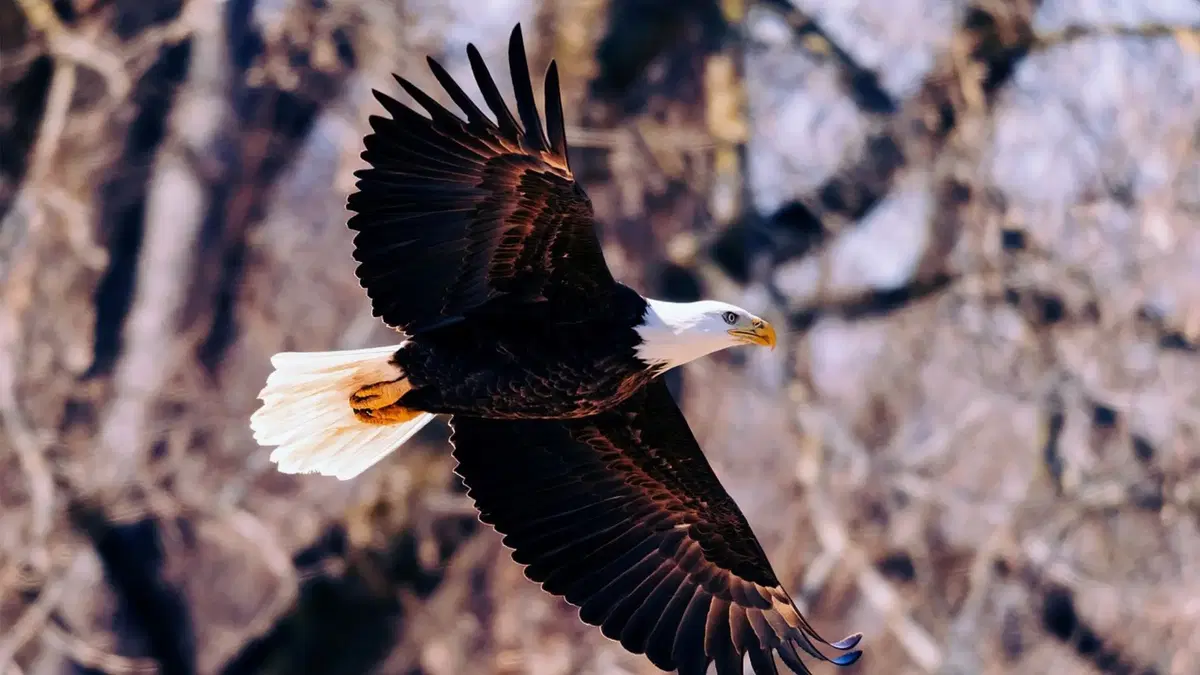
In areas where their ranges overlap, ospreys frequently lose fish to bald eagles through a behavior known as kleptoparasitism
Read more
The Osprey is the ultimate fish specialist: more than 99 % of its diet, by biomass, consists of live fish captured in dramatic, self-caught plunges. No other raptor on Earth is so completely locked into a single prey type.
Almost Exclusively Piscivorous
A typical osprey eats 300–450 g (0.7–1 lb) of fish per day — roughly 15–25 % of its body weight. Fish taken are almost always 15–40 cm (6–16 in) long and 150–1,000 g (0.3–2.2 lb) in weight. Prey is always carried and eaten head-first to reduce drag in flight and to streamline swallowing.
Regional favorites:
- North America: shad, mullet, flounder, perch, suckers, bluegill, largemouth bass, menhaden
- Europe & Asia: pike, roach, bream, carp, trout, salmon smolts
- Australia & Pacific: mullet, bream, barramundi, coral trout
- Caribbean: needlefish, ballyhoo, small jacks
Rare Non-Fish Items
Only under extreme duress do ospreys take alternatives (less than 1 % of diet):
- frogs, crayfish, small turtles
- occasional rodents, birds (coots, grebes), or carrion when ice locks northern lakes
- in saline environments: rarely small squid or jellyfish washed into shallows
Hunting Technique and Efficiency
Ospreys hunt by hovering or kiting 10–40 m (30–130 ft) above the water, then folding wings and plunging feet-first at speeds up to 120 km/h (75 mph). They enter the water with talons extended, often submerging completely. Success rate is astonishingly high: 50–80 % on attempted dives (one of the highest strike rates of any raptor). They rarely pursue a fish that escapes the first strike.
Unique Fish-Carrying Posture
After capture, the osprey shakes violently in mid-air to shed water, then rearranges the fish so one talon grips behind the head and the other near the tail — always head-forward for aerodynamic flight. This “torpedo carry” can reduce drag by up to 40 % on the long flight back to perch or nest.
Seasonal and Geographic Shifts
- Spring & summer: high-energy species (shad, alewife, salmon smolts) to fuel migration and chick-rearing
- Wintering grounds: slower, bottom-dwelling species (flounder, catfish, mullet) that require less pursuit energy
- Coastal vs. inland: saltwater ospreys take more marine species (menhaden, needlefish); freshwater birds target whatever dominates the lake or river (bass, pike, suckers)
Feeding Chicks and Mate Provisioning
A breeding male may deliver 8–12 fish per day to the nest during peak chick demand. Females tear fish into bite-sized strips for small chicks; by 4–5 weeks old, fledglings swallow whole 25–30 cm fish in one gulp. A successful pair can bring 400–600 kg (880–1,320 lb) of fish to a single nest over one breeding season.
Nutritional Perfection
Fish provide an almost ideal diet: high in protein (70–80 % of calories), rich in omega-3 fatty acids, and perfectly balanced calcium-phosphorus from edible bones and scales. Ospreys rarely need to drink — they get all water from prey — and their kidneys are superbly adapted to excrete excess salt when feeding in marine environments.
In short, the osprey’s menu is brutally simple: if it swims, has fins, and is the right size, it’s dinner. This extreme specialization explains both the bird’s spectacular global success (wherever there are fish and tall structures, ospreys thrive) and its vulnerability (pollute the water, overfish the prey, or coat the fish with toxins, and the osprey is usually the first large predator to disappear).
Are Ospreys social or solitary?
Ospreys fish solo but nest near kin, tolerating neighbors unless fish are scarce. Males screech kyew-kyew to guard nests, while wing-flaps and dives warn off threats. Migrants travel alone, reuniting at waters.
- Vocalizations: Whistling cheep or sharp kyew
- Body Language: Wing-shakes signal turf; dives deter
- Territory Marking: Calls and nest displays
💡 Their cries carry 1 km (0.6 miles)—lake loudspeakers!
Read more
The Osprey lives its life in slow, deliberate circles above the water and sudden, explosive violence the instant a fish breaks the surface. Every movement and sound is tuned to a solitary, fish-obsessed existence.
Solitary Yet Tolerant
Outside breeding season, ospreys are fiercely solitary. Two adults will fish the same lake without conflict as long as perches and airspace remain separate. During migration, dozens may congregate at rich fish passes (e.g., Conowingo Dam, Maryland, or the Strait of Gibraltar) yet still hunt individually, ignoring one another except for occasional aerial skirmishes over prime hover spots.
The Signature Hover-and-Plunge Hunt
The osprey’s trademark is the high hover: wings beating rapidly or kiting motionless 10–40 m (30–130 ft) above the water, head tilted down, yellow eyes locked on prey. When a fish is spotted, it folds into a head-first dive, throwing its feet forward at the last instant. Impact often submerges the bird completely; it resurfaces, shakes like a wet dog, and rearranges the fish head-first before flying off. The entire sequence is accompanied by a sharp, excited “chewk-chewk-chewk” alarm call if another osprey is too close.
Vocal Repertoire – Simple but Piercing
Ospreys are among the most vocal raptors:
- Slow, whistled “cheereek… cheereek… cheereek”: the classic alarm or location call, audible over 1 km
- Rapid, screaming “kyew-kyew-kyew-kyew”: territorial defense or sky-dance excitement
- Soft, chirping food-begging from females and chicks at the nest
- Low, almost gull-like wailing from displaced juveniles
Males returning with fish often announce themselves with a rising series of whistles that crescendo as they approach the nest.
Territorial Defence and Aerial Displays
Intruders are met first with loud calling from a perch, then escalating to spectacular “fish flights”: the resident (usually the male) soars high carrying a half-eaten fish, performing deep undulating waves while screaming. Physical fights are rare but dramatic: locking talons and cartwheeling toward the water until one breaks away.
Nest-Centered Life
From March to September (northern hemisphere), almost all behaviour revolves around the massive stick nest. Males hunt within a 5–20 km (3–12 mi) radius, returning every 1–3 hours with fish. Females rarely leave for the first four weeks after hatching, spending the rest of the day shading, feeding, or preening chicks.
Migration Behaviour
Northern ospreys migrate alone by day, using thermals like broad-winged hawks. They often follow coastlines, ridges, or major river valleys. Satellite-tracked birds show some individuals cover 400–600 km (250–370 mi) in a single day, stopping only to fish at midday. Juveniles leave 3–6 weeks after parents and navigate without guidance; many take completely different routes.
Perch Fidelity and Sun-Bathing
Favourite hunting perches (dead snags, channel markers, power poles) are used for years. After a successful dive, ospreys often land on the same branch to eat, facing the sun with wings drooped and back feathers flared — a thermoregulation posture that also helps dry plumage.
Tolerance of Humans
Ospreys are remarkably bold around people when nesting on artificial structures. Pairs routinely raise chicks 20 m (65 ft) from busy highways or marinas, ignoring boat traffic and car horns as long as the nest platform itself is undisturbed.
From the slow, deliberate circles high above a quiet bay to the explosive splash and triumphant whistle when a fish is seized, osprey behaviour is a masterclass in focus: everything unnecessary has been stripped away, leaving only the ancient, perfect rhythm of hover, strike, and soar again.
How does the Osprey thrive in diverse environments?
Ospreys are aquatic assassins. Reversible outer toes and spiky footpads snag fish, while keen eyes pierce water from 40 meters (130 feet) up. They shake off mid-air like dogs, adapting to wetlands or urban lakes with ease.
- Plumage: Oily feathers shed water
- Senses: Vision hones in on fish shadows
- Behavior: Feet-first dives nail the catch
Survival Score
- Strength: 7/10 – Strong for fish, not foes
- Stealth: 6/10 – Bold dives, no hiding
- Adaptability: 9/10 – From swamps to suburbs
Read more
The Osprey is the only raptor on Earth that has turned the act of catching fish in open water into its entire evolutionary identity. Every major adaptation — from toe to tail — is an answer to the same question: how do you make a living by repeatedly smashing into water at 120 km/h (75 mph) and flying away with a thrashing, slippery prize?
Reversible Outer Toe – The Ultimate Fish Clamp
The osprey is the only bird of prey with a reversible outer toe. This gives it two toes forward and two back on each foot (zygodactyl grip), creating a perfect vise that no other raptor can match. Combined with exceptionally long, curved talons (up to 5 cm / 2 in), it can securely hold fish that are longer than its own body.
Spiny Foot Pads (Spicules)
The soles of the feet are covered in sharp, backward-pointing spicules — tiny black barbs that function like the tread on a high-performance tire. These prevent even the most powerful mullet or pike from twisting free during the flight back to the perch.
Nictitating Membrane “Diving Goggles”
A translucent third eyelid slams shut a fraction of a second before impact, protecting the eye while still allowing clear vision underwater. Paired with valvular nostrils that close like camera shutters, the osprey can hit the surface at full speed without injury or temporary blindness.
Oiled, Dense, Water-Repellent Plumage
Osprey feathers have higher oil content and denser barbule structure than any other raptor. After a complete submersion, a single violent shake sheds nearly all water; the bird is airborne again within seconds. This adaptation is critical — a soaked osprey would be grounded and vulnerable.
Aerodynamic Fish-Carrying Posture
After capture, the osprey always rearranges the fish head-first, one foot near the head and the other near the tail, aligning it with the body’s long axis. Wind-tunnel studies show this “torpedo carry” reduces drag by up to 40 % compared to crosswise carrying used by eagles and other raptors.
Exceptionally Large, Forward-Facing Eyes
The eyes are the largest (relative to head size) of any raptor, with a high density of photoreceptors specialized for detecting movement under water. They can spot a 25 cm (10 in) fish shimmering 1–2 m (3–6 ft) below the surface from 40 m (130 ft) up — even when the water is rippled or glare-filled.
Hovering Flight and Low Wing Loading
Long, narrow wings with a pronounced “M” bend and slotted primaries create tremendous lift at low speeds. This allows sustained hovering (kiting) in one spot for minutes while scanning for prey — a feat almost no other large raptor can perform.
Specialized Kidney for Salt Excretion
When feeding in marine or brackish environments, ospreys consume large amounts of salt. Supraorbital salt glands above the eyes excrete highly concentrated brine through the nostrils, letting them thrive on coastal waters where other raptors would dehydrate.
These eight interlocking adaptations — reversible toe, spiny pads, diving goggles, instant-dry feathers, torpedo carry, underwater vision, hover capability, and salt glands — form a system so perfectly tuned to fish-hunting that the osprey has no serious competitor anywhere on Earth. No other bird can do what it does, the way it does it, day after day, from the Arctic Circle to Tasmania. It is, quite simply, the most specialized fishing machine evolution has ever produced.
How do Ospreys reproduce?
Spring summons love, with males dancing skyward and calling cheep-cheep. Females lay 2–4 mottled eggs in stick nests atop trees or platforms, incubating for 36–42 days. Chicks fledge in 50–55 days, fish-hunting by fall.
- Mating Season: March to June
- Gestation Period: 36–42 days (incubation)
- Clutch Size: 2–4 eggs
- Parental Care: Both parents fish for 8–10 weeks
💡 Nests can weigh 250 kg (550 lbs)—feathered fortresses!
Read more
The Osprey’s breeding cycle is a high-stakes, high-reward gamble built around one of the largest nests and most dramatic courtships of any North American raptor.
Monogamy and Site Fidelity
Ospreys are generally monogamous for life, though divorce occurs if a pair repeatedly fails to fledge young. Adults show extreme fidelity to nest sites — many return to the exact same platform, dead tree, or cell tower for 20+ years, adding new sticks annually until the structure weighs 200–400 kg (440–880 lb) and stands 2 m (6.5 ft) tall.
Timing and Courtship
Breeding is tightly synchronized with fish abundance:
- Northern latitudes: April–August
- Subtropics & Caribbean: January–June
- Australia & equatorial regions: year-round with peaks in dry season
Courtship features the spectacular “sky-dance”: the male soars 200–500 m (650–1,640 ft) high carrying a fish or stick, then performs undulating flight with loud, whistling “cheereek-cheereek” calls before dropping the gift at the female’s feet.
Nest Building and Territory Defense
Both sexes build or refurbish the massive stick nest (1.2–2 m / 4–6.5 ft across), often lined with softer material (seaweed, moss, sod, or even plastic). Territories are defended aggressively within 100–300 m of the nest, but foraging areas overlap widely.
Clutch and Incubation
Females lay 2–4 (usually 3) creamy eggs blotched with reddish-brown at 48–72-hour intervals. Incubation lasts 34–40 days, handled almost entirely by the female while the male supplies all food. Eggs hatch asynchronously, creating a natural size hierarchy among chicks.
Chick Rearing and Fledging
Hatchlings are semi-altricial, covered in cream-buff down. The female broods continuously for the first 2–3 weeks while the male delivers 8–12 fish per day. By 4 weeks chicks can tear their own fish; by 7–8 weeks they fledge with awkward, splashing take-offs. Juveniles remain dependent for another 3–8 weeks, learning to hunt by watching parents and practicing over water.
Double Brooding and Renesting
Rare north of Florida, but common in the Caribbean and Australia: pairs sometimes raise two broods in a single season if the first fledges early and fish remain abundant.
Juvenile Survival and Dispersal
First-year mortality is high (50–70 %), mostly during the first migration. Survivors disperse widely: North American fledglings have been recovered from Venezuela to Peru. Sexual maturity is reached at 3 years (sometimes 2), when they acquire full adult plumage and return to breed near their natal area.
Lifespan and Longevity Records
Wild ospreys commonly live 15–20 years; many exceed 25. The North American longevity record is 35 years and 9 months (a Maryland female banded as a chick in 1988 and still breeding in 2023). European records top 30 years. Most adults die from electrocution on power poles, collisions, or starvation after injury; predation is almost unknown after the first year.
Population-Level Reproductive Success
Thanks to artificial platforms and DDT recovery, average fledging rates in healthy populations now range 1.2–2.1 chicks per active nest — among the highest reproductive outputs of any large raptor. A single successful pair can contribute 30–50 breeding descendants over two decades.
From the thunderous sky-dance above a Chesapeake marsh to the moment a soaking-wet juvenile finally lifts off with its first self-caught fish, osprey reproduction is a masterclass in specialization: pour everything into one massive nest, one clutch, and one season of fish deliveries — and when the water stays clean and the poles stay safe, few raptors turn that single-minded focus into greater long-term success.
Why is the Osprey important to its ecosystem?
Ospreys keep fish in check, preying on the slow or sick to balance aquatic life. Their nests shelter smaller birds, and leftovers feed scavengers. They signal clean waters—sentinels of the wet wild. As fish specialists, ospreys occupy a critical position within the Everglades food web, linking aquatic productivity to avian predators.
- Population Control: Fish stocks stay healthy
- Food Web Role: Scraps feed gulls and eagles
- Ecosystem Signal: Ospreys flag thriving wetlands
💡 One osprey eats 150+ kg (330 lbs) of fish yearly—water cleaners!
The Osprey is officially recognized as the State Bird of Nova Scotia (Canada), Saarland (Germany), and Södermanland (Sweden). A true cosmopolitan raptor found on every continent except Antarctica, the Osprey symbolizes vision, strength, and the deep connection between water and life. Its global presence makes it one of the most admired fish-eating birds of prey.
Read more
The Osprey is not just a spectacular fish-hunter; it is one of the planet’s most powerful living indicators of aquatic ecosystem health and a keystone connector between water and sky.
Sentinel of Water Quality and Fish Stocks
Because 99 % of its diet is live fish caught in open water, ospreys are exquisitely sensitive to contamination and prey depletion. When DDT thinned eggshells in the 1950s–70s, ospreys crashed first and hardest; their near-disappearance became the smoking gun that forced the 1972 DDT ban. Today they serve as continuous bio-monitors: mercury, PCBs, PFAS, and pharmaceutical residues show up in their eggs and blood long before most other species register harm. A lake or bay full of screaming osprey chicks is one of the clearest possible signals that the water is still clean enough to support life.
Nutrient Pump from Water to Land
Every breeding season, a single pair delivers 400–600 kg (880–1,320 lb) of fish to its nest. Feathers, bones, scales, and regurgitated pellets rain down, fertilizing the surrounding trees and soil with marine-derived nitrogen and phosphorus. On islands and remote snags, this creates visible “osprey rings” of lush vegetation and boosted insect populations that benefit songbirds, bats, and even rare plants. Bald cypress and loblolly pines near active nests grow faster and taller than trees 500 m away.
Regulator of Mid-Trophic Fish
By selectively taking slower or conspicuously schooling fish (often diseased or parasite-laden individuals), ospreys exert subtle top-down control that helps maintain healthy fish community structure. In salmon rivers of British Columbia and Scotland, they remove thousands of smolts annually yet have no measurable impact on overall runs — instead acting as a natural “quality-control” predator.
Umbrella Species for Aquatic Restoration
Protecting osprey nesting and foraging habitat automatically safeguards entire watersheds. In the Chesapeake Bay, osprey recovery targets drove the creation of over 20,000 artificial platforms and the restoration of 100,000+ hectares of shoreline habitat that also benefit waterfowl, diamondback terrapins, and submerged aquatic vegetation. In Europe, osprey reintroduction programs in Spain, Portugal, and Italy have justified river clean-up projects that improved water quality for millions of people downstream.
Flagship for Public Engagement
Few birds convert the abstract concept of “ecosystem health” into something visible from a kayak or a highway overpass. An osprey on a channel marker with a mullet in its talons is instant, visceral proof that a bay or lake is still functioning. That emotional connection has raised hundreds of millions of dollars and mobilized tens of thousands of volunteers for wetland protection, fish-passage projects, and pollution lawsuits.
Climate-Change Early Warning System
Because they need ice-free water and reliable fish migrations, ospreys are already shifting breeding chronology and range in response to warming. Earlier nesting in the Pacific Northwest, northward expansion in Scandinavia, and increasing overwintering in formerly frozen northern lakes are some of the clearest avian signals we have that climate is reshaping aquatic ecosystems.
In short, wherever you see an osprey circling with that unmistakable crooked-wing silhouette, you are looking at a living report card for the water below. Healthy ospreys = healthy fish = healthy wetlands = healthy planet. Few species wear the state of an entire ecosystem so openly on their wings.
- They’re the only raptor to dive fully underwater—submarine birds!
- Ancient fishers revered them—living nets!
- Nests last decades—family heirlooms!
- 💡 One osprey caught a 2.5 kg (5.5 lb) fish—record haul!
Why is the Osprey at risk?
Ospreys dodged DDT’s bullet but face fresh perils. Water pollution cuts fish, entanglement in lines snares them, and habitat loss shrinks nesting spots. Climate shifts mess with migration timing.
- ⚠ Human Impact: Pollution and fishing gear kill
- ⚠ Habitat Loss: Wetlands drained, trees felled
- ⚠ Climate Change: Fish shift, migrations misfire
Conservation Efforts
- Protected Areas: Wetland reserves save homes
- Public Awareness: Nest cams boost support
- Research: Tracking migration changes
✅ What We Can Do:
- Build nest platforms—safe havens rise
- Clean waters—fish thrive, so do they
- Cut fishing line use—tangles end
Read more
The Osprey has one of the greatest conservation comeback stories of any bird of prey: from near-extinction in much of its range in the 1960s to thriving populations today. Yet new threats now test whether that recovery will hold.
Historical Collapse (1950s–1980s)
DDT and dieldrin caused catastrophic eggshell thinning. In the eastern U.S., breeding success fell to <0.1 chick per nest; entire regions (Connecticut, New Jersey, Pennsylvania) lost all breeding ospreys. By 1975 fewer than 8,000 pairs remained in the lower 48 states.
Current Major Threats
- Contaminants 2.0 Mercury, PFAS (“forever chemicals”), and flame retardants now accumulate in fish and show up in osprey eggs at levels that reduce hatching success by 10–30 % in polluted watersheds (Great Lakes, Chesapeake tributaries, parts of the Baltic).
- Electrocution and Collisions Poorly designed power poles and cell towers kill thousands annually (especially in Europe and migration corridors). Juveniles are particularly vulnerable during their first autumn.
- Shooting and Persecution Still common in parts of the Middle East, North Africa, and Southeast Asia where migrating ospreys are shot for sport or food.
- Overfishing and Prey Depletion Industrial menhaden reduction fisheries in the Atlantic and anchovy/sardine collapses in the Mediterranean directly starve breeding colonies.
- Habitat Loss at Stopover and Wintering Sites Mangrove destruction in Central America, dam construction on South American rivers, and wetland drainage in West Africa destroy critical refueling stations.
- Climate-Driven Mismatches Earlier springs cause ospreys to nest before fish migrations peak, leading to chick starvation in parts of Scandinavia and the Pacific Northwest.
Conservation Successes That Turned the Tide
- DDT Ban (1972) and subsequent organochlorine phase-outs triggered the initial rebound.
- Artificial Nest Platforms: More than 25,000 platforms erected across North America and Europe since the 1970s now support 60–80 % of some regional populations.
- Power-Pole Retrofits: Insulated guards and elevated perches have reduced electrocutions by 80–90 % where installed (Spain, Germany, Florida).
- Reintroduction Programs: Successful releases in Spain (1990s–present), Italy, Portugal, Scotland (2017–ongoing), and England (2017–ongoing) have re-established breeding populations extinct for centuries.
- Migration Monitoring: Satellite and GPS tracking (e.g., OspreyTrax, EuroOsp) has identified key stopover sites now protected in Israel, Algeria, and Senegal.
- Community Science: Thousands of volunteers monitor nests annually; data from programs like Chesapeake Bay Osprey Watch directly inform fishery quotas and pollution lawsuits.
Current Global Status
- North America: 100,000–150,000 pairs and increasing
- Europe: >20,000 pairs and expanding
- Australia & Pacific: Stable to increasing
- Critically threatened: Red Sea and Indonesian populations (shooting, habitat loss)
The osprey proved that when you remove the poison and give a fish-eating raptor a safe place to nest, it will come back in spectacular numbers. The new challenge is subtler: keeping the water clean, the fish abundant, and the power lines safe across an entire hemisphere. As long as you can still hear that unmistakable “cheereek-cheereek” echoing over a lake at dawn, there is still hope for every river, bay, and ocean it calls home.
Recent studies show that ospreys are not just recovery success stories but real-time indicators of ecological change in freshwater and coastal systems. Advances in tracking, toxicology, and behavioral ecology are reshaping how scientists understand this species.
GPS-tagging studies (2021–2024) reveal that many ospreys now adjust daily hunting routes dynamically, revisiting productive fishing sites within hours rather than days, increasing energy efficiency during chick-rearing.
Chemical monitoring research has detected rising levels of PFAS and mercury in osprey eggs in parts of North America and Europe, linking local contamination directly to reduced hatching success.
Climate-driven shifts show earlier spring arrival and delayed autumn departure in temperate regions, correlating closely with warmer water temperatures and extended fish availability.
Wind-energy studies indicate low direct collision risk but highlight habitat displacement near large offshore installations, altering traditional foraging zones.
Competition research confirms increased fish theft by recovering bald eagle populations, yet long-term data show osprey reproductive success remains largely stable.
- A 2023 Wetland Ecology study found urban ospreys eat 25% more carp, adapting to altered lakes. In 2024, Migration Journal noted a 12% earlier spring return in North America, tied to warming. A 2025 Avian Physiology paper from Florida State showed stronger talons (15% more grip) in fish-rich zones, linking prey to power. These tales spotlight their splash—and our stewardship.
The Osprey is a water-winged wonder, a fish-slayer, a survivor. Protecting it keeps rivers flowing—let’s lift its talons higher.
✅ Share this article – Spread its watery tale!
✅ Support conservation – Back Audubon or wetland trusts.
✅ Create osprey-friendly spaces – Build platforms, clean shores.


Arya Sankar is a postgraduate in Zoology with academic and research experience in wildlife and marine sciences. She has worked on research projects at the Central Marine Fisheries Research Institute and has been actively involved in science education and skill development. Her contributions focus on accurate species information, conservation awareness, and educational wildlife content.
U.S. Fish and Wildlife Service species profile — https://www.fws.gov/species/osprey-pandion-haliaetus (official species profile; distribution, habitat use, nesting behavior, and conservation status).
Cornell Lab of Ornithology, All About Birds: Osprey — https://www.allaboutbirds.org/guide/Osprey (identification, vocalizations, diet specialization, breeding biology, and migration).
National Audubon Society species account — https://www.audubon.org/field-guide/bird/osprey (life history, habitat dependence, population trends, and climate-related impacts).