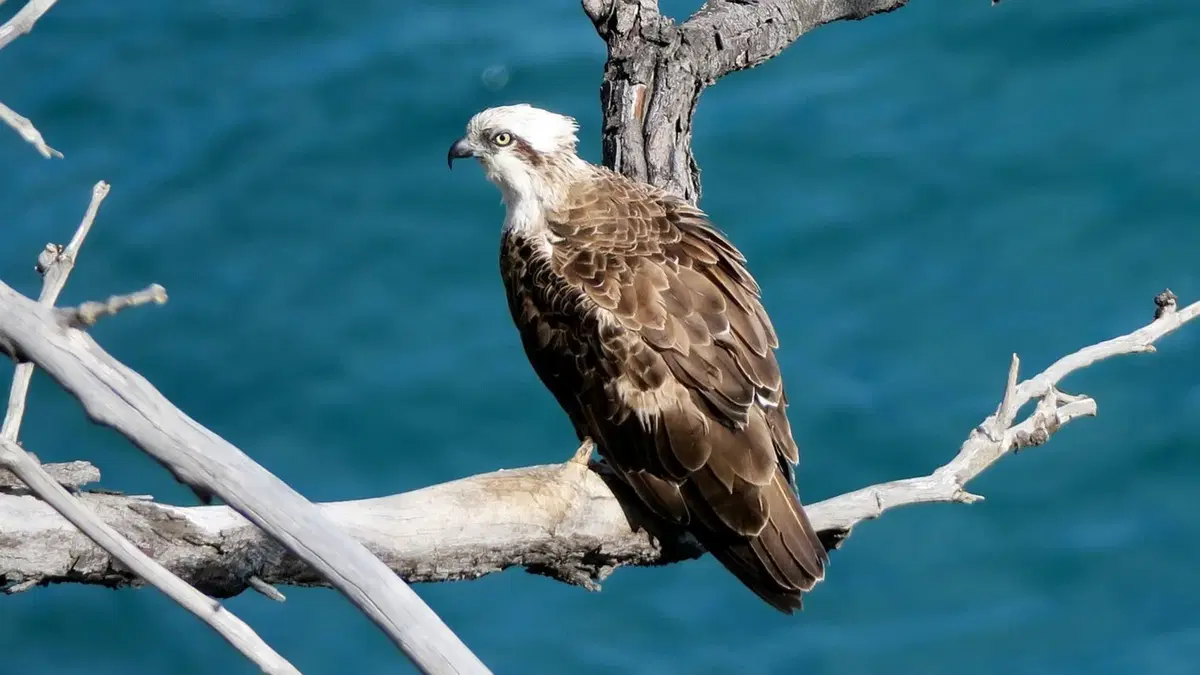
An osprey hovers high above a glassy bay, wings trembling in perfect suspension. In a heartbeat, the form folds into a living spear, slicing through the surface in a flash of spray. Seconds later, it rises—fish glittering in its talons, sunlight streaming from the droplets that trail behind.
No other raptor unites air, water, and land with such effortless command.
This is the osprey (Pandion haliaetus)—a hunter so specialized that its entire anatomy revolves around one pursuit: catching fish. Osprey fishing adaptations make this raptor one of the most specialized fish hunters on Earth.
Citizen of Every Shore
Ospreys occupy every continent except Antarctica, nesting from Florida’s mangroves to Scotland’s lochs and Australia’s coral bays.
Satellite-tracked individuals migrate more than 8,000 km (5,000 mi) each year, yet many return to the same perch within a few hundred meters of where they were born.
“Everything about an osprey—its eyes, its feet, even the way it carries a fish—is an evolutionary statement,” says Dr. Alan Poole of the Cornell Lab of Ornithology.
Their near-global presence makes them one of the most successful raptors ever to exist—and a living barometer of aquatic health.
Eyes for the Shimmer Below
Finding prey through moving, reflective water demands optical wizardry. Ospreys meet that challenge with:
- Binocular vision angled downward for perfect depth judgment.
- Nictitating membranes—clear eyelids acting as natural dive goggles.
- Retinal polarization filters that cut glare and correct for refraction.
Tests at the Smithsonian Migratory Bird Center show that ospreys can pinpoint fish up to 40 m (130 ft) away even under bright glare—an extraordinary feat for any bird.
Hovercraft of the Skies
Long, narrow wings (span 1.5–1.8 m / 5–6 ft) and a unique shoulder joint that flexes 180° allow ospreys to hover mid-air like a helicopter, head fixed while wings tremble in micro-adjustments.
High-speed filming at Cornell reveals up to 12 wing-camber corrections per second—precision control that costs energy but yields unmatched accuracy.
A 10-minute hover consumes roughly 15 % of daily caloric intake, yet few hunts last longer than that.
The Dive: Precision in Motion
Every plunge is a masterclass in timing and aerodynamics.
- Hover & Lock-On: The osprey faces the wind, judging fish position through refracted light.
- The Plunge: Folding wings into a sharp “V,” it descends feet-first at 64–80 km/h (40–50 mph).
- Impact & Grip: Just before entry, it thrusts talons forward; nostrils close automatically. Reversible outer toes and barbed pads (spicules) ensure a two-forward, two-back hold.
- The Rise: With explosive wingbeats, it bursts from the surface, rotating its catch head-first to reduce drag.
Average success rate: 25–30 %—but for practiced adults in clear shallows, rates soar above 70 %, unmatched among raptors.
Comparison: Osprey vs Bald Eagle
| Feature | Osprey (Pandion haliaetus) | Bald Eagle (Haliaeetus leucocephalus) |
| Length | 50–66 cm (20–26 in) | 70–102 cm (28–40 in) |
| Wingspan | 150–180 cm (5–6 ft) | 180–230 cm (6–7.5 ft) |
| Weight | 1–2 kg (2.2–4.4 lb) | 3–6.3 kg (6.6–14 lb) |
| Diet | 99 % fish | Mixed; fish + birds + carrion |
| Hunting Style | Full plunge dive | Surface snatch / theft |
| Grip Strength | ~400 psi | ~300 psi |
| Range | Global (except Antarctica) | North America only |
💡 Insight: Eagles are powerful generalists; ospreys are pure specialists—engineered for the single act of fishing.
The Platform Architects
Osprey nests—called aeries—are engineering feats in their own right. Constructed from sticks, seaweed, and bark, these structures grow heavier each season. A 20-year-old nest in Florida weighed 680 kg (1,500 lb) and stood 3 m (10 ft) deep.
They nest atop trees, cliffs, buoys, and even cell towers. Conservationists have learned to partner with that adaptability:
“Artificial platforms now host nearly 40 % of osprey pairs in the U.S.,” notes the U.S. Fish and Wildlife Service.
The result—a rare case where human engineering helps a wild species thrive.
Migration Marathoners
Ospreys are long-distance athletes. Northern breeders migrate 4,000–8,000 km (2,500–5,000 mi) to reach tropical wintering grounds, following coastlines and rivers.
A tagged Scottish bird once wintered in Guinea-Bissau and returned the next spring to within 3 km (2 mi) of its natal nest.
At sea, they glide between thermals, sometimes flying 20 hours without rest—a testament to endurance and instinct.
The Coastal Canary
Because they feed exclusively on fish, ospreys mirror the quality of aquatic ecosystems. Declining fish stocks, heavy-metal runoff, or pesticide residues all echo in their breeding success.
After the DDT crisis of the mid-20th century, which caused catastrophic eggshell thinning, global bans triggered a spectacular rebound. Populations in North America have surged 400 % since 1966 (National Audubon Society).
Feather mercury in Chesapeake Bay fledglings has dropped 70 % since industrial emission controls in 2015. Yet localized pollution hotspots still shape reproduction—proof that ospreys are nature’s frontline sensors.
Quick Facts
| Trait | Measurement |
| Scientific Name | Pandion haliaetus |
| Wingspan | 1.5–1.8 m (5–6 ft) |
| Weight | 1–2 kg (2.2–4.4 lb) |
| Dive Speed | 64–80 km/h (40–50 mph) |
| Diet | ≈ 99 % fish |
| Success Rate | 25–70 % (dep. on clarity) |
| Migration Range | Up to 8,000 km (5,000 mi) |
| Nest Lifespan | 10–20 + years |
| IUCN Status | Least Concern (Stable) |
Conclusion: A Mirror of the Wild
The osprey is more than a bird—it is a reflection of balance itself.
Each dive charts the invisible line between abundance and decline; each successful lift-off testifies to clear water and thriving fish.
When an osprey rises from the sea, droplets sparkling like scattered stars, it carries a message older than words: where nature is healthy, life ascends.
References
- Cornell Lab of Ornithology (2024) – All About Birds: Osprey
- U.S. Fish & Wildlife Service (2023) – Osprey Monitoring Protocol
- Smithsonian Migratory Bird Center (2024) – Telemetry and Contaminants Research
- National Audubon Society (2024) – Population Trends Report
FAQs
1. Why do ospreys carry fish head-first?
It reduces drag by aligning the fish’s body with flight airflow—improving efficiency ≈ 30 %.
2. How deep can ospreys dive?
Usually 0.5–1 m (1.5–3 ft); deeper dives reduce success and risk injury.
3. Can they hunt in both saltwater and freshwater?
Yes. Kidney glands excrete excess salt, allowing seamless habitat shifts.
4. How long do young ospreys take to learn fishing?
Juveniles succeed in only 10–20 % of dives; mastery takes 2–3 months post-fledge.
5. What makes ospreys unique among raptors?
They’re the only species family (Pandionidae) adapted exclusively for plunge-diving fish capture.
6. Do they mate for life?
Pairs often reunite yearly; if one fails to return, the survivor quickly bonds anew.
7. How do nesting platforms aid conservation?
They replace lost snags and prevent electrocution on power poles—boosting fledgling success by >50 %.
8. What threats remain today?
Plastic entanglement, heavy-metal contamination, and habitat loss at migration stopovers.
9. What is the osprey’s hunting success rate?
Ospreys catch fish in about 1 of every 3 dives on average, with experienced adults succeeding up to 70% of the time in clear water.
10. How far do ospreys migrate each year?
Some populations travel over 8,000 kilometers (5,000 miles) between breeding and wintering grounds, crossing oceans and continents annually.