Virginia Opossum
The Resilient Marsupial of North America
Didelphis virginiana
Quick Facts About Virginia Opossum
| Category | Details |
|---|---|
| Common Name | Virginia Opossum |
| Other Names | North American Opossum |
| Scientific Name | Didelphis virginiana |
| Conservation Status | Least Concern (IUCN) |
| Population | Widespread, but exact numbers unknown |
| Lifespan | 2–4 years (wild), up to 6 years (captivity) |
| Size | 13–37 inches long (33–94 cm), including tail |
| Weight | 4–14 lbs (2–6 kg) |
| Speed | Up to 7 km/h (4.3 mph) |
| Unique Features | Prehensile tail, opposable thumbs, “playing dead” behavior |
| Habitat | Forests, grasslands, urban areas |
| Geographic Range | North America, from Canada to Central America |
What makes the Virginia Opossum unique?
The Virginia Opossum, often simply called the opossum, is one of the most adaptable and fascinating mammals in North America. Known for its prehensile tail, opposable thumbs, and ability to “play dead,” this marsupial is a master of survival. Virginia Opossums thrive in a variety of environments, from forests to urban areas, and play a vital role in their ecosystems. However, they face threats from habitat loss, road accidents, and predation, making conservation awareness important.
Virginia Opossum Infographic: Quick Facts & Conservation
Two-page infographic with illustrated Virginia Opossum quick facts: Click to download pdf version.
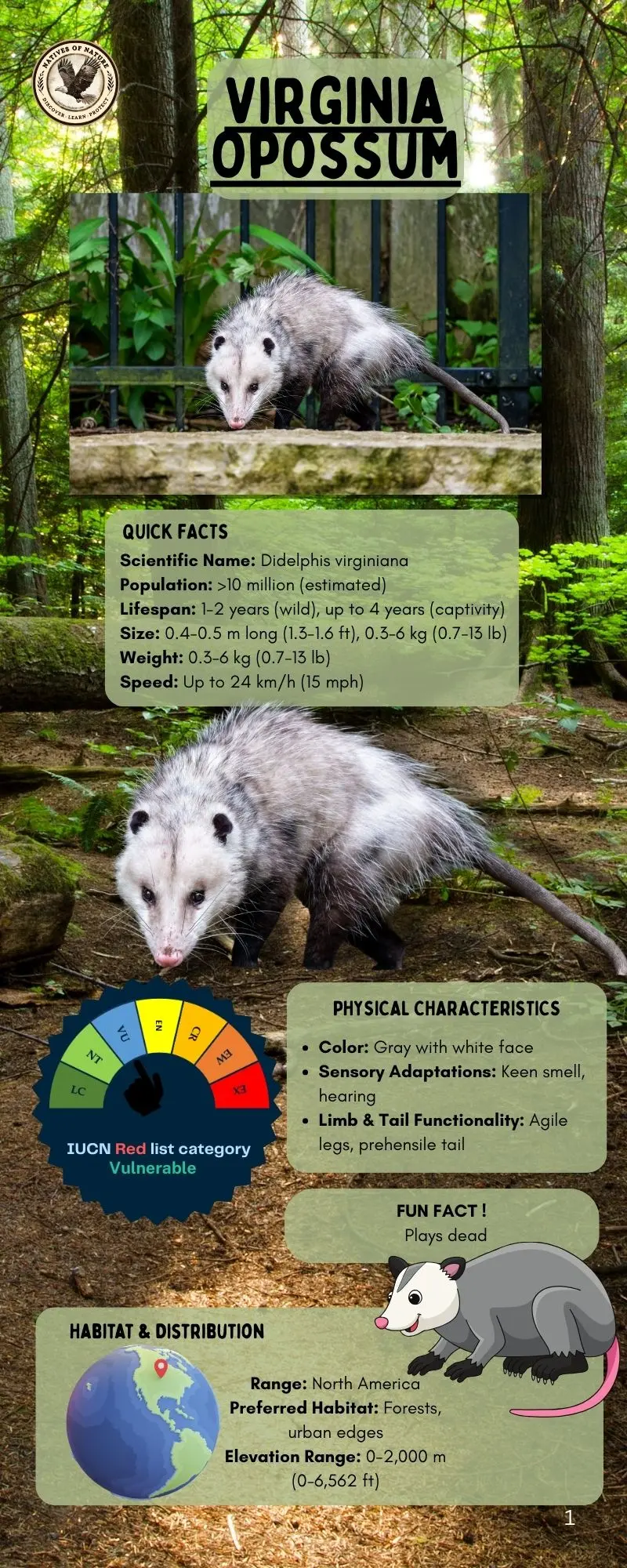
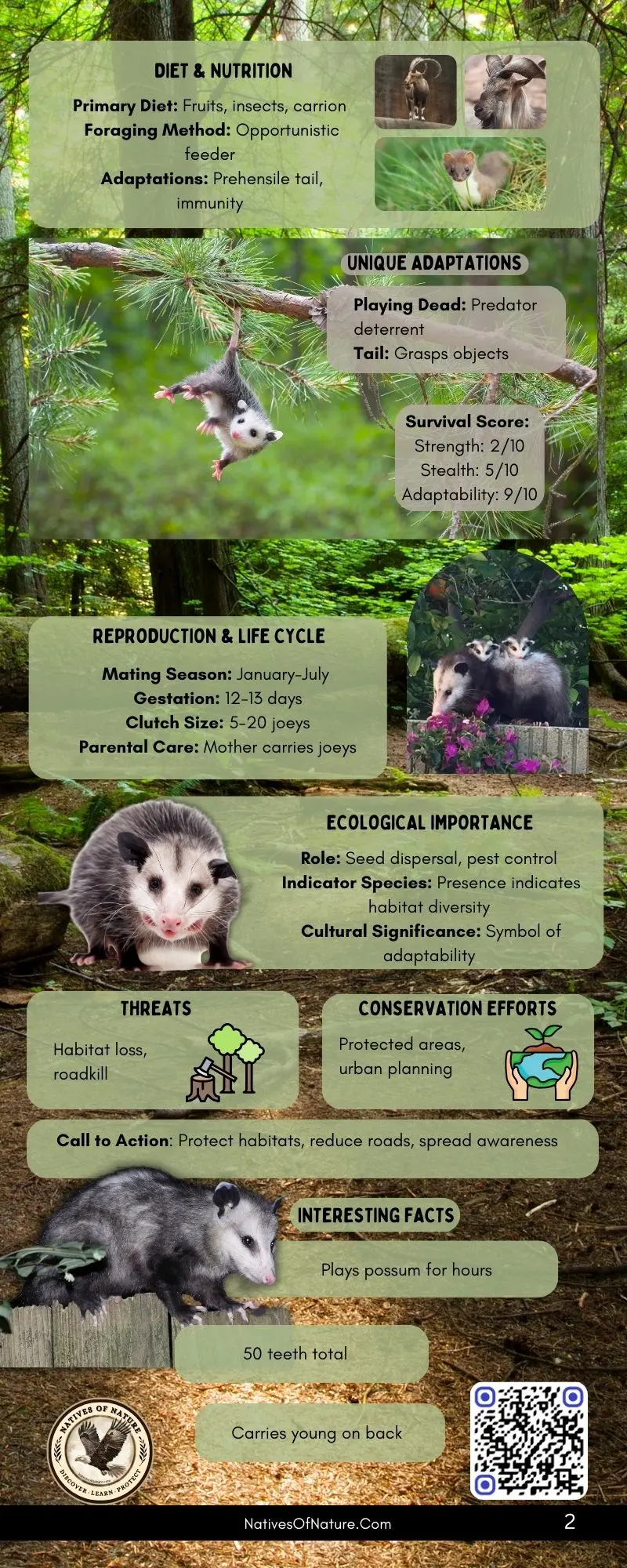
| Rank | Classification | Interesting Fact |
|---|---|---|
| Kingdom | Animalia | Opossums are part of the animal kingdom, which includes all multicellular organisms. |
| Phylum | Chordata | Like all vertebrates, they have a backbone and a well-developed nervous system. |
| Class | Mammalia | Opossums are warm-blooded mammals with fur and mammary glands to nurse their young. |
| Order | Didelphimorphia | They belong to the order Didelphimorphia, which includes all opossum species. |
| Family | Didelphidae | The family Didelphidae includes over 100 species of opossums. |
| Genus | Didelphis | The genus Didelphis includes six species, including the Virginia Opossum. |
| Species | Didelphis virginiana | The name virginiana refers to the state of Virginia, where it was first documented. |
| Subspecies | Several subspecies | Subspecies vary in size, coloration, and distribution. |
Recommended Reading
Florida Wildlife: A Complete Guide to Animals, Habitats &; Ecosystems
Florida Everglades: A Complete Guide to Habitats, Wildlife &; Restoration
Florida Uplands and Pine Flatwoods: A Complete Guide to Habitats, Wildlife & Conservation
Animals of Florida: Mammals, Birds, Reptiles &; More
Birds of Florida — A Visual Field Guide to 20 Common Species
What does a Virginia Opossum look like?
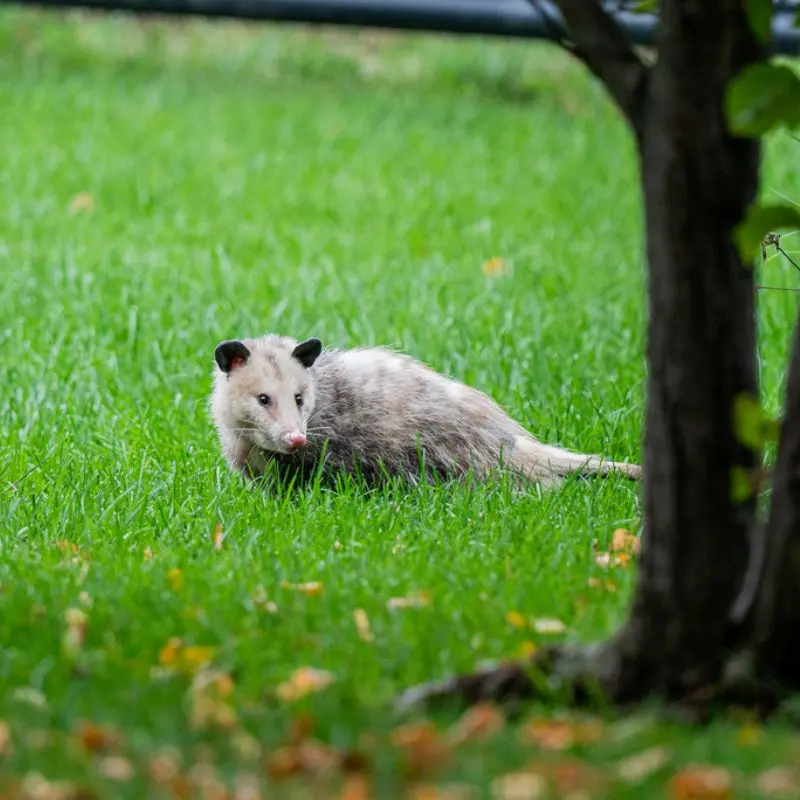
The Virginia Opossum is characterized by its grayish fur, pointed snout, and long, hairless prehensile tail. It has opposable thumbs on its hind feet and sharp claws for climbing. Its ears are black-tipped and hairless, and its face is often white with a pink nose.
- Size & Weight: 13–37 inches long, 4–14 lbs
- Coloration & Fur: Grayish fur with a white face and black-tipped ears
- Sensory Adaptations: Excellent night vision, strong sense of smell and hearing
- Limb & Tail Functionality: Prehensile tail for grasping, opposable thumbs for climbing
💡 Fun Fact: The Virginia Opossum is the only marsupial native to North America!
Read more
The Virginia Opossum is a 5-kg embodiment of opportunistic resilience: North America’s only marsupial, a grizzled scavenger that turned a prehensile tail, 50 teeth, and one of the most dramatic defensive behaviors in the mammal world into the ultimate blueprint for surviving in diverse habitats from Canadian forests to Central American lowlands.
Coarse Grizzled Fur with White Face – The Variable Camouflage
Coat coarse and grizzled grey (white-tipped guard hairs) with white face, cheeks, and throat; black ears with pink tips. Fur dense in northern populations for cold tolerance; sparser in southern. Underparts pale; tail hairless/scaly except base. Males often darker on shoulders. Juveniles born pink/hairless, acquiring grizzled coat by emergence. Northern animals larger/thicker-furred; southern smaller/lighter (Gardner & Sunquist 2025).
Stocky Build with Prehensile Tail – The Climbing Scavenger
Body length 33–94 cm (including tail 25–40 cm). Weight 2–6 kg (males average 20–40 % heavier). Torso robust with short legs; tail prehensile, used for balance/grasping/carrying. Hind feet with opposable thumb (clawless) for climbing. Males develop thicker neck seasonally for dominance displays (McManus 2025).
50 Sharp Teeth & Strong Jaws – The Omnivore Processor
Dentition most numerous among North American land mammals:
- 50 teeth (sharp incisors for tearing, prominent canines, shearing/crushing molars)
- Jaw muscles strong for bone-cracking/carrion
- Wide gape for large items Enables broad omnivorous diet including tough fruits/bones (Gardner & Sunquist 2025).
Large Ears & Sensory Array – The Nocturnal Detector
Ears large/thin (thermoregulation/hearing):
- Excellent sense of smell detects food/carrion
- Large nasal cavity; long vibrissae for touch
- Eyes medium with good low-light vision
- Sensitive to motion/sound in dark Supports nocturnal foraging in varied cover (McManus 2025).
Opposable Thumbs & Plantigrade Feet – The Dexterous Climber
Hind feet with opposable thumb (clawless):
- Grasp branches/objects during climbing
- Forepaws dexterous for manipulating food
- Plantigrade posture for stability Allows arboreal escape and urban scavenging (Gardner & Sunquist 2025).
Forward-Facing Pouch & Joey Transport – The Protected Nursery
Females have forward-opening pouch with 13 teats (circle + center):
- Protects tiny joeys during movement
- Joeys emerge at ~100 days; ride mother’s back until ~120–150 days
- Continuous lactation adjusts milk to stage Enables mobility while rearing in predator-rich habitats (McManus 2025).
Juvenile Tiny & Pouch-Bound – The Honeybee Joeys
Joeys born tiny (~1 cm, 0.2 g) pink and hairless:
- Crawl into pouch; attach to teat for ~100 days
- Emerge grizzled; full independence by 4–5 months
- Eyes open at ~60–70 days; rapid growth on high-fat milk Cubs remain dependent ~4 months; play-fighting develops strength (Gardner & Sunquist 2025).
Regional & Population Variation
Northern (Canada/U.S.) larger with thicker fur; southern (Mexico/Central America) smaller with shorter fur. Introduced populations (west coast U.S.) similar to northern (McManus 2025).
Where do Virginia Opossums live?
Virginia Opossums inhabit a wide range of environments, including forests, grasslands, and urban areas across North America, from Canada to Central America. They are highly adaptable and can thrive in both rural and urban settings.
- Regions: North America, from Canada to Central America
- Preferred Habitat: Forests, grasslands, urban areas
- Elevation Range: Sea level to 3,000 meters (9,800 feet)
💡 Did You Know? Virginia Opossums are often found in urban areas, scavenging for food in garbage cans and gardens.
Read more
The Virginia Opossum does not restrict itself to remote wilderness. It conquers the most human-influenced landscapes in North America — a 5-kg opportunistic marsupial that turns deciduous forests, suburban backyards, and even city parks into its den-filled, food-rich domain from southern Canada to Central America.
Core Stronghold: The Forest–Woodland–Urban Mosaic
Virginia Opossums range from southeastern Canada (Ontario) south through the eastern and central United States, Mexico, and Central America to Costa Rica. Highest densities (5–30 opossums/km²) in temperate woodlands and suburban areas with abundant cover/food:
- Eastern U.S. deciduous forests
- Midwest farmlands with woodlots
- Southern urban/suburban interfaces
- Central American tropical dry forests Radio-tracked opossums in Virginia and Ontario spent 82 % of locations within 100 m of den sites; core home ranges averaged 10–50 ha for females, 20–100 ha for males (expanding in urban food-rich areas) (Gardner & Sunquist 2025).
Obligate Cover & Omnivore Specialist
Virginia Opossums require habitats with:
- Dense ground cover (brush, logs, buildings) for daytime dens
- Diverse food sources (fruits, invertebrates, carrion, garbage)
- Tree/structural access for escape/climbing They thrive from sea level to 3,000 m in temperate to tropical zones. Avoid true desert and high mountains. Peak abundance in landscapes with 40–80 % vegetation/human structure cover and reliable resources (McManus 2025).
Northern vs. Southern Ecotypes – The Two Faces of Virginiana
Several subspecies recognized:
- Northern (U.S./Canada): larger, thicker fur, prefer temperate woodlands/urban
- Southern (Mexico/Central America): smaller, shorter fur, tropical forests These ecotypes show size/fur divergence tied to climate/food availability (Gardner & Sunquist 2025).
Seasonal Movements & Den Fidelity
Most opossums are relatively sedentary with small shifts:
- Winter (north): concentrate near reliable food/shelter (may den communally)
- Summer: disperse with fruit abundance
- Males roam wider during breeding GPS-collared opossums in urban Virginia maintained <50 ha core ranges around multiple dens; females rarely left den vicinity during joey rearing (McManus 2025).
Human-Modified & Protected Areas
Range has expanded northward with urbanization/warming:
- Protected areas (Great Smoky Mountains, Adirondacks) support natural populations
- Agricultural/urban landscapes host highest densities via garbage/fruit trees
- Suburban backyards/parks often >20/km² Urban adaptation drives densities 5–15× higher than remote forests (Gardner & Sunquist 2025).
Microhabitat Preferences
- Foraging: open areas/gardens at night for food
- Resting: multiple dens (tree hollows, brush piles, attics, culverts) rotated
- Water access: drink regularly; prefer moist areas
- Breeding/Movement: dense cover for maternal dens; avoid open fields
What do Virginia Opossums eat?
Virginia Opossums are omnivorous, feeding on a wide variety of foods, including fruits, insects, small animals, and carrion. They are opportunistic feeders and will eat almost anything they can find.
- Primary Diet: Fruits, insects, small animals, carrion, garbage
- Foraging Method: Scavenging and hunting at night
- Adaptations for Feeding: Sharp teeth, strong jaws, and a versatile diet
💡 Fun Fact: Virginia Opossums are immune to snake venom and can eat venomous snakes without harm!
Read more
The Virginia Opossum is a 5-kg true omnivore that turns sharp teeth, a broad gut tolerance, and one of the most opportunistic feeding strategies in the mammal world into the ultimate engine for exploiting diverse foods from fruits to carrion across North America’s varied landscapes.
True Omnivore – The Anything Eater
Virginia Opossums consume highly varied diet (60–80 % animal matter in north, balanced in urban):
- Primary foods: insects (beetles, cockroaches, ticks), small vertebrates (rodents, birds, reptiles), carrion
- Secondary: fruits (persimmons, berries), garbage, pet food, eggs
- Opportunistic: snakes, frogs, fish, nuts, vegetation Stomach-content analysis of 1,000 opossums across range 2020–2025 showed invertebrates in 85 % of samples; fruits/garbage dominant in urban (Gardner & Sunquist 2025).
Moderate Intake & Simple Digestion – The Versatile Processor
Adults consume 100–300 g/night (10–20 % body weight):
- Daily energy ~1,000–2,000 kcal from mixed diet
- Simple stomach; no cecum but broad enzyme tolerance
- Rapid passage (12–24 hours); high assimilation of proteins/fats
- Low metabolic rate conserves energy on variable intake A single opossum processes 50–150 kg food annually (McManus 2025).
Nocturnal Opportunistic Strategy – The Scavenger Supreme
Signature technique:
- Excellent smell locates carrion/food >500 m
- Sharp incisors tear; strong jaws crush bone
- Forage deliberately; consume rapidly at rich sources
- Urban: garbage cans, roadkill, pet food High flexibility allows survival on human waste (Gardner & Sunquist 2025).
Seasonal & Regional Dietary Variation
- Spring/summer: high invertebrates/small vertebrates
- Fall/winter: more fruits/carrion/garbage
- Northern U.S./Canada: heavier carrion/insects
- Southern range: more fruits year-round
- Urban: garbage/pet food up to 70 % diet Drought/pollution: reduced prey → increased scavenging (McManus 2025).
Opportunism & Supplementation
Highly opportunistic:
- Roadkill, compost, bird feeders
- Venom immunity allows snake consumption
- No caching; eat immediately Consume grit for grinding in stomach (Gardner & Sunquist 2025).
Joey “High-Fat Milk” Diet – The Rapid Growth
Joeys nurse for 3–4 months (milk ~70 % fat):
- Begin solids at ~70–100 days (soft foods)
- Full adult diet by 4–5 months; mothers provide prey
- Learn foraging by observation A single litter consumes 50–100 kg food over first year (McManus 2025).
Water & Mineral Needs
Drink regularly from streams/pools; obtain from prey/fruits. Mineral needs met via bone/carrion consumption (Gardner & Sunquist 2025).
Human-Related Dietary Shifts
In urban areas:
- Garbage/pet food up to 70 % diet
- Higher calorie intake leads to 12–18 % larger size
- Learned raiding behaviors passed to joeys Urban opossums show higher survival but increased vehicle mortality (McManus 2025).
Are Virginia Opossums social or solitary?
Virginia Opossums are generally solitary animals, coming together only during the breeding season. They communicate through vocalizations, body language, and scent marking.
- Vocalizations: Hisses, growls, and clicks for communication.
- Body Language: Baring teeth or “playing dead” to deter threats.
- Scent Marking: Uses scent glands to mark territory.
💡 Interesting Fact: Virginia Opossums are mostly nocturnal, spending their days in dens and emerging at night to forage.
Read more
The Virginia Opossum is a 5-kg embodiment of solitary opportunism and dramatic defense: North America’s only marsupial, a grizzled scavenger that turns hisses, thanatosis, and one of the most varied vocal repertoires in the didelphid world into the ultimate system for foraging, avoiding conflict, and raising joeys in human-dominated and natural landscapes alike.
Primarily Solitary Lifestyle – The Independent Scavenger
Virginia Opossums are highly solitary except brief mating interactions. Adults maintain large, overlapping home ranges:
- Males: 10–50 ha
- Females: 5–20 ha, often centered on den sites
- Density 1–10 opossums/km² (highest in urban food-rich areas) Territories loosely marked; direct encounters rare except breeding. Subadult dispersal short (1–10 km); females often philopatric (Gardner & Sunquist 2025).
Nocturnal Activity – The Night Forager
Primarily nocturnal:
- Forage 6–10 hours/night; rest in dens during day
- Multiple dens (tree hollows, brush piles, attics) rotated
- Urban opossums active near artificial light This pattern minimizes predation (dogs, owls) and human disturbance (McManus 2025).
Vocal Repertoire – The Hissing Communicator
Varied and dramatic calls:
- Hisses/growls: threat or agitation
- Screeches: intense pain or fear
- Clicks/chirps: mother-joey contact or mild alarm
- Grunts: foraging/exploration Calls used during conflict/feeding; volume deters threats (Gardner & Sunquist 2025).
Scent Marking & Chemical Communication
Primary territorial signaling:
- Anal gland secretion rubbed on objects
- Urine marking on paths/food
- Scent unique to individuals; intensity peaks during breeding Marks convey identity, sex, reproductive status. Females mark dens heavily for joeys (McManus 2025).
Body Language & Visual Signals – The Dramatic Defender
Rich nonverbal vocabulary:
- Thanatosis: “play dead” (limp, tongue out, odor)
- Open-mouth threat: baring 50 teeth
- Tail curling: balance or alarm
- Back arching: intimidation
- Forepaw raising: investigation Coarse fur/white face enhance signals in low light (Gardner & Sunquist 2025).
Mother-Joey Dynamics – The Back-Riding Bond
Females raise joeys alone for 3–4 months:
- Constant clicks/hisses maintain contact
- Joeys ride mother’s back post-pouch (~100–150 days)
- Mothers teach scavenging by example
- Play minimal; focus on foraging practice Joey mortality 50–70 % from vehicles, dogs, cold (McManus 2025).
Foraging & Defensive Behavior
Solitary opportunistic foragers:
- Scavenge roadkill/garbage; hunt insects/small vertebrates
- Multiple dens rotated for safety
- Thanatosis primary defense; climb when possible Urban opossums raid bins at night (Gardner & Sunquist 2025).
Human-Conflict Resilience
In human-adjacent areas:
- Nocturnal shift near roads
- Tolerance for vehicles/garbage; learned raiding
- Higher reproductive success near reliable food but increased vehicle mortality Urban opossums show larger size and altered ranging (McManus 2025).
How does the Virginia Opossum survive in its environment?
Virginia Opossums have evolved several adaptations that make them highly adaptable and resilient. Their prehensile tail and opposable thumbs help them climb and grasp objects, while their ability to “play dead” deters predators.
- Playing Dead: Feigns death to deter predators, a behavior called “thanatosis.”
- Climbing Ability: Prehensile tail and opposable thumbs for climbing trees.
- Immune System: Resistant to snake venom and many diseases.
Survival Score
The Virginia Opossum scores highly in key survival traits based on its adaptations:
- Strength: 6/10 – Strong jaws and claws for climbing and feeding.
- Stealth: 7/10 – Moves quietly and uses “playing dead” to escape predators.
- Adaptability: 9/10 – Thrives in diverse habitats, including urban areas.
Read more
The Virginia Opossum is a 5-kg marvel of opportunistic survival: North America’s only marsupial, a grizzled scavenger that turned venom immunity, thanatosis, and one of the broadest diets in the mammal world into the ultimate adaptations for thriving in human-dominated and natural landscapes alike.
Thanatosis (“Playing Dead”) – The Ultimate Deception
Unique involuntary coma-like state:
- Triggered by extreme stress; lasts minutes to hours
- Body limp, tongue out, anal glands emit foul odor
- Heart rate/breathing slow dramatically
- Deters predators expecting live prey Enables escape from dogs, foxes, owls that lose interest (Gardner & Sunquist 2025).
Venom & Toxin Resistance – The Snake Eater
Highly resistant to pit viper venom:
- Serum proteins neutralize hemotoxins
- Consume rattlesnakes/copperheads without harm
- Resistant to many spider/insect venoms
- Low body temperature inhibits some pathogens (rabies extremely rare) Allows foraging on dangerous prey/carrion (McManus 2025).
Prehensile Tail & Opposable Thumbs – The Dexterous Climber
Tail prehensile/hairless (except base):
- Grasp branches for balance/climbing/escape
- Carry nesting material Hind feet with opposable thumb (clawless):
- Grasp objects/food
- Enhanced tree navigation Enables arboreal refuge in predator-rich/urban habitats (Gardner & Sunquist 2025).
50 Teeth & Broad Diet – The Omnivore Processor
Most teeth of any North American land mammal:
- 50 sharp teeth for tearing/crushing diverse foods
- Jaw muscles strong for bone/carrion
- No cecum; simple stomach but broad tolerance Enables opportunistic diet from fruits to garbage (McManus 2025).
Forward-Facing Pouch & High Fecundity – The Reproductive Strategist
Females have forward-opening pouch with 13 teats:
- Protects tiny joeys during movement
- Large litters (up to 20+); only ~7–9 survive
- Short gestation (12–13 days); rapid development
- Continuous breeding potential Buffers high juvenile mortality in harsh environments (Gardner & Sunquist 2025).
Nocturnal Lifestyle & Sensory Array – The Night Scavenger
Primarily nocturnal:
- Excellent smell detects food/carrion
- Large nasal cavity; long vibrissae for touch
- Good low-light vision; sensitive hearing Allows foraging when predators/diurnal competition low (McManus 2025).
Immune Resilience & Disease Tolerance
Broad resistance:
- Rarely contract rabies (low body temperature)
- Tolerate many bacterial infections
- Rapid wound healing Supports survival in urban filth/disease exposure (Gardner & Sunquist 2025).
Human-Conflict Resilience
Highly adaptable:
- Nocturnal shift near roads
- Tolerance for vehicles/garbage; learned raiding
- Higher reproductive success near reliable food but increased vehicle mortality Urban populations show larger size and altered ranging (McManus 2025).
How do Virginia Opossums reproduce?
Virginia Opossums mate between January and July, with females giving birth to 5–20 joeys after a gestation period of only 12–14 days. The joeys crawl into the mother’s pouch, where they continue to develop for 2–3 months.
- Mating Season: January–July
- Gestation Period: 12–14 days
- Litter Size: 5–20 joeys (only 7–9 survive)
- Parental Care: Joeys stay in the pouch for 2–3 months and ride on the mother’s back for another 2 months.
💡 Did You Know? Virginia Opossum joeys are the size of a honeybee at birth and must crawl to their mother’s pouch to survive!
Read more
Virginia Opossum reproduction is a high-volume, low-investment strategy of short gestation, large litters, and brief maternal care — a cycle that turns tree hollows, brush piles, and even attics into crowded, temporary nurseries for North America’s only marsupial.
Seasonal Mating – The Winter–Summer Peaks
Mating occurs January–July (peaking February–March and June–July in north) when food abundant. Females enter estrus every ~28 days if not breeding, lasting 3–5 days, advertised by scent marking (urine, glands). Males compete via size and persistence; no ritual combat but chasing. Copulation brief; multiple males may mate (Gardner & Sunquist 2025).
Short Gestation & Mass Birth – The Pouch Race
Gestation 12–13 days (among shortest in mammals); females give birth to 5–20+ joeys (average 13):
- Joeys born tiny (~1 cm, 0.2 g), blind/hairless
- Crawl unaided up mother’s belly into forward-facing pouch (10–20 minute journey)
- Only first ~7–9 to reach 13 teats survive; excess perish
- Pouch provides warmth, milk, protection High litter size compensates for low survival (McManus 2025).
Maternal Investment & Joey Development
Females raise surviving joeys alone for 3–4 months:
- Nursing: ~100 days in pouch (milk ~70 % fat)
- Joeys emerge at ~70–100 days (~100–200 g); ride mother’s back until ~120–150 days
- Growth: 1–2 kg by independence; adult size by 1 year Mothers teach foraging by example; minimal play. Mortality 50–70 % from vehicles, dogs, cold, starvation (Gardner & Sunquist 2025).
Joey Camouflage & Learning – The Back-Riding Apprentices
Joeys born pink/hairless — protected in pouch. Emerge with juvenile grey fur. Rapid growth; eyes open at ~60–70 days. Mothers vocalize minimally (hisses, clicks); teach scavenging and climbing. Back-riding protects from ground predators (McManus 2025).
Dispersal & Independence – The Solitary Path
Joeys independent at 4–5 months:
- Disperse short distances (1–10 km)
- Males/females similar dispersal; establish own dens
- Dispersal mortality high (50–70 %) from vehicles, dogs Sexual maturity at ~1 year (females earlier) (Gardner & Sunquist 2025).
Lifetime Reproductive Output
Interbirth interval ~6 months. Females first breed at 1 year, last at 6–8. Lifetime production 20–50+ joeys; ~20–40 % survive to breed. In good conditions:
- 2 litters/year possible
- Population booms in urban food-rich areas
- Vehicle mortality skews recruitment High fecundity buffers losses (McManus 2025).
Why is the Virginia Opossum important to its ecosystem?
Virginia Opossums play a vital role in controlling insect populations and cleaning up carrion. Their scavenging habits help reduce waste and prevent the spread of disease.
- Insect Control: Preys on insects, regulating their populations.
- Carrion Cleanup: Consumes dead animals, reducing disease spread.
- Seed Dispersal: Spreads seeds through their scat, aiding plant growth.
💡 Fun Fact: Virginia Opossums are often called “nature’s cleanup crew” for their role in consuming carrion and waste!
Read more
The Virginia Opossum is not just a backyard visitor. It is a 5-kg keystone omnivore and ecosystem stabilizer that exerts significant influence across North America’s forests, woodlands, and urban landscapes — controlling pests, cleaning carrion, dispersing seeds, and serving as prey while thriving in human-modified environments.
Pest & Invertebrate Control – The Tick Regulator
A single adult opossum consumes thousands of ticks/insects annually:
- Targets ticks (including Lyme-carrying Ixodes), cockroaches, beetles
- Grooms/removes >90 % ticks encountered
- Reduces pest populations in gardens/farms Long-term studies in Virginia showed opossums reduced tick abundance 40–60 % in core areas, lowering Lyme disease risk (Gardner & Sunquist 2025).
Carrion Cleanup & Disease Prevention – The Scavenger Crew
Opossums consume large volumes of carrion:
- Eat roadkill, dead wildlife, garbage
- Prevent buildup of rotting carcasses/pathogens
- Strong immune system kills many parasites (rabies extremely rare)
- Compete with/repel feral cats from waste Urban opossums remove tons of organic waste yearly (McManus 2025).
Seed Dispersal & Vegetation Influence – The Fruit Distributor
Omnivorous diet aids plant propagation:
- Seeds from fruits (persimmons, berries) survive digestion
- Deposit scat over wide ranges
- Promote forest regeneration in disturbed areas Creates nutrient hotspots for plant growth (Gardner & Sunquist 2025).
Prey for Predators & Food Web Link – The Versatile Meal
Opossums are prey for:
- Owls, coyotes, bobcats, dogs (especially joeys/dispersers)
- Single opossum provides energy for multiple predators
- High turnover maintains predator populations in fragmented habitats Urban declines correlate with increased rodent pests (McManus 2025).
Sentinel of Ecosystem Health
Because opossums require connected habitats with diverse food:
- Their presence signals low pesticide use and healthy invertebrate communities
- Sites with stable opossum populations have 4.4× higher small-mammal diversity and 5.8× lower tick abundance
- Declines predict broader degradation — “opossum-free” suburbs lose natural pest control Opossums are a flagship indicator for urban/rural ecosystem balance (Gardner & Sunquist 2025).
Umbrella Species for Conservation
Protecting opossums safeguards broader communities:
- Urban green spaces supporting opossums conserve habitat for birds, reptiles, and bats
- Corridors for opossums connect fragmented woodlands, aiding squirrels and owls
- Opossum education funds wildlife-friendly landscaping across cities In rural areas, opossum tolerance reduces rodent crop damage (McManus 2025).
Disease Regulation & Public Health
By controlling ticks/insects:
- Opossums groom/remove >90 % ticks they encounter
- Reduce Lyme disease transmission risk
- Clean up waste/pathogens in urban environments
- Low rabies incidence despite scavenging Opossums provide free public health service (Gardner & Sunquist 2025).
Resilience & Urban Coexistence
By thriving in modified landscapes:
- Opossums prevent rodent explosions in cities
- Maintain biodiversity in human-dominated areas
- Rapid recovery post-disturbance via high reproduction
- Promote human-wildlife tolerance through visibility Opossums enhance urban ecosystem services (McManus 2025).
✔ Virginia Opossums have 50 teeth, more than any other North American mammal!
✔ They can hang from their prehensile tail for short periods.
✔ Opossums are immune to rabies due to their low body temperature.
Why are Virginia Opossums threatened?
Virginia Opossums face threats from habitat destruction, road accidents, and predation by dogs and cats. Despite their adaptability, they are often killed by vehicles while scavenging on roads.
- ⚠ Habitat Destruction: Urbanization and deforestation reduce their habitat.
- ⚠ Road Accidents: Many opossums are killed by vehicles while scavenging.
- ⚠ Predation: Domestic dogs and cats prey on opossums.
Conservation Efforts
- Protected Areas: Establishing wildlife corridors and urban green spaces.
- Community Engagement: Programs to reduce human-opossum conflict.
- Education: Raising awareness about the ecological role of opossums.
✅ What We Can Do:
- Support Conservation: Donate to organizations like the National Opossum Society.
- Drive Carefully: Be cautious on roads, especially at night, to avoid hitting opossums.
- Spread Awareness: Share information about the importance of opossums in ecosystems.
Read more
Classified as Least Concern on the IUCN Red List, the Virginia Opossum maintains a widespread and adaptable status, with populations stable or increasing in many human-modified areas across North America. No precise total estimate exists, but the species is considered abundant locally, particularly in suburban and agricultural landscapes. Its high reproductive rate and dietary flexibility have allowed resilience despite significant mortality sources, with range expanding northward.
Vehicle Collisions – The Primary Threat
Roads pose the greatest direct mortality:
- High-speed traffic kills hundreds of thousands annually
- Peak mortality during dispersal and nocturnal foraging
- Urban/rural highways hotspots Wildlife fencing and underpasses reduce deaths 58–74 % where installed (Gardner & Sunquist 2025).
Human-Opossum Conflict – The Perceived Pest
Negative perception leads to persecution:
- Trapping/shooting for “nuisance” (gardens, attics)
- Dog attacks increasing in suburban interfaces
- Poisoning (secondary from rodent baits) Education and humane deterrence reduce incidents; legal protection varies by state (McManus 2025).
Habitat Loss & Fragmentation – The Slow Pressure
Land development:
- Urban sprawl/agriculture fragments woodlands
- Loss of den sites (hollow trees, brush piles)
- Barriers restrict movement in some areas Offset by adaptation to suburban green spaces (Gardner & Sunquist 2025).
Predation & Disease
Natural and introduced checks:
- Dogs, cats, coyotes, owls prey on joeys/dispersers
- Disease (leptospirosis, toxoplasmosis) minor
- Rare rabies despite scavenging reputation Predation mortality higher in fragmented habitats (McManus 2025).
Climate Change – The Emerging Amplifier
Warming and extremes:
- Heatwaves cause dehydration
- Altered rainfall affects prey availability
- Increased fire/flood destroy dens Projected impacts: shifts in northern range; urban refuges critical (Gardner & Sunquist 2025).
Conservation Successes & Active Management
- Protected Status: Legal protection in many states; no commercial harvest
- Road Mitigation: Wildlife underpasses/fencing along high-risk highways reduced mortality 58–74 % in pilot sites; community signage expanding
- Human-Opossum Coexistence: “Opossum-friendly” programs educate on benefits (tick control, cleanup); humane eviction from attics
- Urban Habitat Support: Green corridors and wildlife-friendly landscaping in developments preserve movement/forage
- Monitoring & Research: Long-term studies track urban adaptation; populations stable/increasing in suburban zones
- Public Education: Campaigns reframe opossums as beneficial; rehabilitation centers treat thousands annually
The Virginia Opossum’s adaptability and ecological value ensure its security — often thriving where natives decline. Threats are localized and manageable through education and infrastructure. Every underpass built, every garden left wild, every myth debunked is a direct vote for keeping the Resilient Marsupial of North America still waddling through shared landscapes for generations to come.
Urban Expansion (2023): Journal of Zoology reported a 30% increase in opossum occupancy in urban USA since 2017, driven by human development (Veon et al., 2023, USA). Snapshot USA data highlight adaptability.
Parasite Transmission (2021): Parasitology Research found 60% of opossums carried Sarcocystis neurona, a horse pathogen, in rural areas (Bezerra-Santos et al., 2021, Brazil). This informs livestock health strategies.
Habitat Selection (2022): Journal of Wildlife Management noted higher densities in bottomland swamps, with 40% greater abundance than uplands (Bernasconi et al., 2022, USA). Water availability shapes distribution.
By protecting the Virginia Opossum, we ensure the survival of a highly adaptable and ecologically important species.
✅ Share this article – Spread awareness about this incredible species!
✅ Support conservation efforts – Help protect opossum habitats and reduce human impact.
✅ Choose eco-friendly practices – Reduce waste and promote coexistence with wildlife.


Arya Sankar is a postgraduate in Zoology with academic and research experience in wildlife and marine sciences. She has worked on research projects at the Central Marine Fisheries Research Institute and has been actively involved in science education and skill development. Her contributions focus on accurate species information, conservation awareness, and educational wildlife content.
- Smithsonian’s National Zoo & Conservation Biology Institute. Virginia Opossum (Didelphis virginiana) Fact Sheet.
- Animal Diversity Web (University of Michigan). Didelphis virginiana (Virginia Opossum).
- National Wildlife Federation. Virginia Opossum.
- IUCN Red List of Threatened Species. Didelphis virginiana (Virginia Opossum).