Brown Pelican
The Sky-Diving Fisher of the Coastal Skies
Pelecanus occidentalis
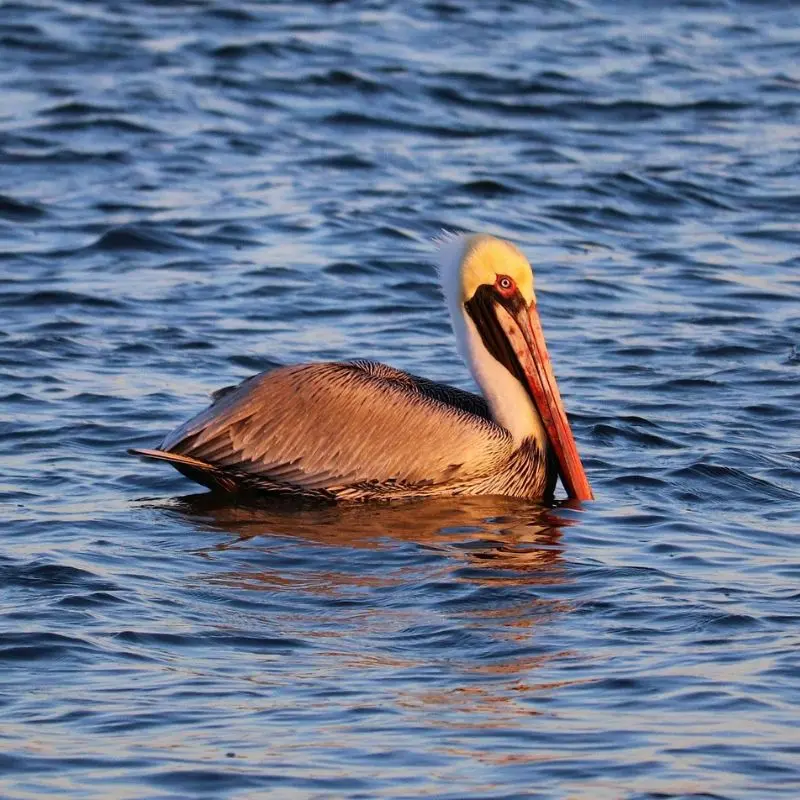 Credit: Richard Alexander · Pixabay · CC0
Quick Facts About Brown Pelican
| Category | Details |
| Common Name | Brown Pelican |
| Other Names | Common Pelican, Coastal Pelican |
| Scientific Name | Pelecanus occidentalis |
| Conservation Status | Least Concern (IUCN, 2020); Delisted ESA (2009) |
| Population | ~200,000–300,000 (wild, North America, 2023 estimate) |
| Lifespan | 15–25 years (wild) |
| Size | 105–152 cm (41.3–59.8 inches) body length |
| Weight | 2.7–5.5 kg (6–12 lbs) |
| Wingspan | 2.0–2.3 m (6.6–7.5 ft) |
| Dive Speed | Up to 70 km/h (43 mph) |
| Unique Features | Expandable throat pouch, brown plumage, plunge-diving |
| Habitat | Coastal waters, estuaries, mangroves |
| Geographic Range | Pacific, Atlantic, Gulf coasts of the Americas |
What makes the Brown Pelican extraordinary?
In the golden haze of a California sunrise, a hulking silhouette plunges from 20 meters, its pouch ballooning like a catcher’s mitt snagging a foul tip. This is the Brown Pelican (Pelecanus occidentalis), a coastal icon whose gravity-defying dives and prehistoric wingspan define the shorelines of the Americas. A keystone predator controlling fish populations, it faces threats from habitat disturbance and pollution. A 2023 study in Marine Ornithology reported stable but vulnerable populations, while U.S. conservation efforts highlight its ecological role, casting this sky-diving fisher as a coastline’s MVP and an urgent call for Americans to protect its salty realms, much like we champion our bald eagles.
Brown Pelican Infographic: Quick Facts & Conservation
Two-page infographic with illustrated Brown Pelican quick facts: Click to download pdf version.
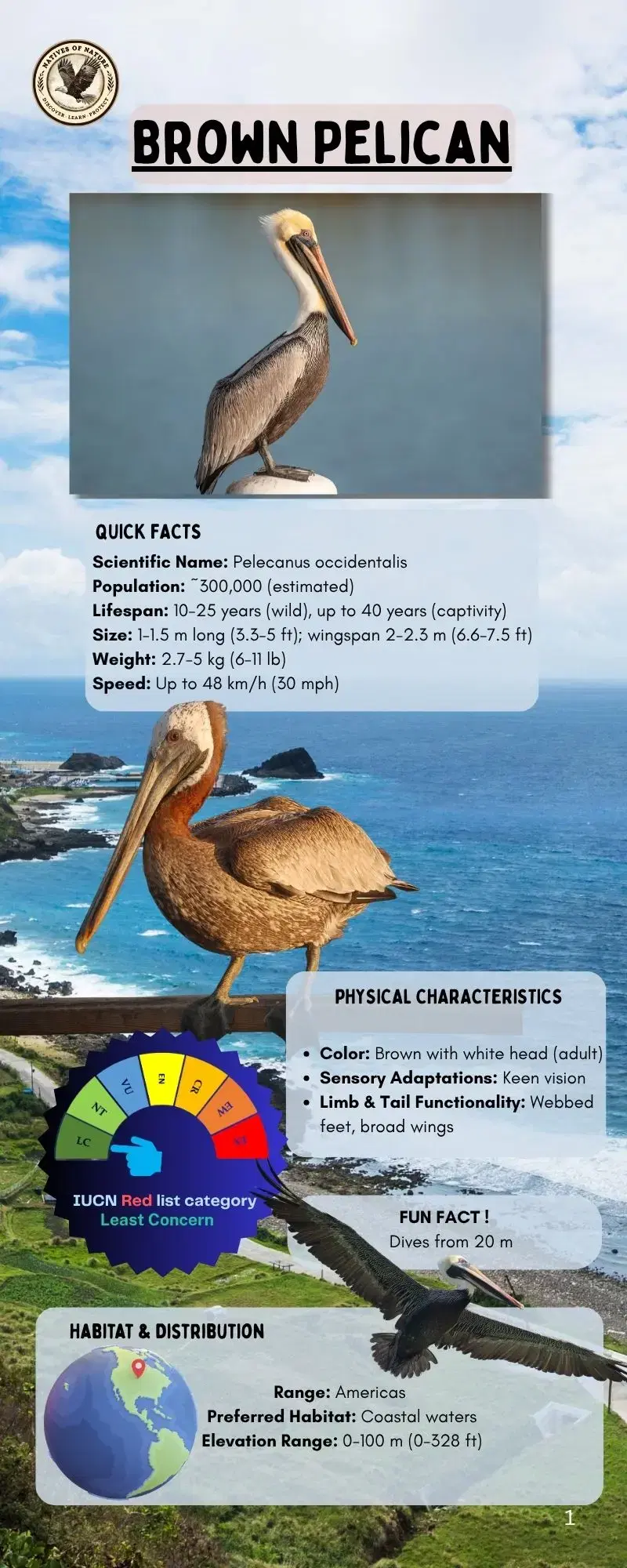
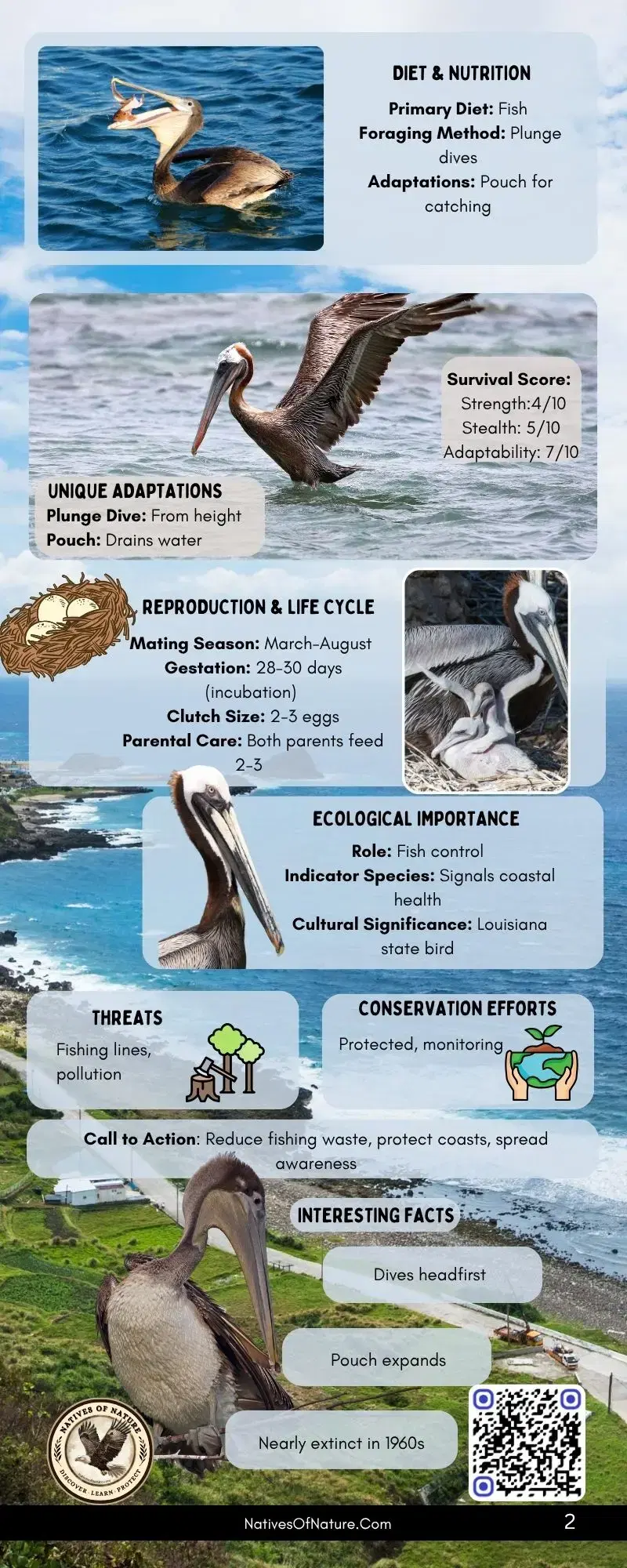
| Rank | Classification | Interesting Fact |
| Kingdom | Animalia | Pelicans soar in a kingdom alive with dives—a coast’s pulse! |
| Phylum | Chordata | Their wings fuel a fisher’s plunge, weaving through skies. |
| Class | Aves | Feathers cloak their grace—birds reborn in brown splendor! |
| Order | Pelecaniformes | Kin to herons, they master aerial fishing. |
| Family | Pelecanidae | Pelican kin, their pouches crown salty shores. |
| Genus | Pelecanus | From Greek “pelekan,” for their beak. |
| Species | P. occidentalis | “Occidentalis” means western, for their range. |
| Subspecies | 5 recognized | P. o. californicus (Pacific), P. o. carolinensis (Atlantic). |
What does a Brown Pelican look like?
The Brown Pelican is a coast-forged aviator, cloaked in rugged plumage. Measuring 105–152 cm (41.3–59.8 inches) with a 2.0–2.3 m (6.6–7.5 ft) wingspan, its brown body with white head (breeding) and massive pouch gleam like a fielder’s mitt under coastal sun. Weighing 2.7–5.5 kg (6–12 lbs), its long beak and hooked tip aid fishing. Unlike the White Pelican, it plunge-dives rather than scoops.
- Size & Weight: 105–152 cm (41.3–59.8 inches), 2.7–5.5 kg (6–12 lbs)
- Coloration: Brown body, white head (breeding), yellow crown
- Sensory Adaptations: Binocular vision for targeting; pouch holds 11 L (3 gal)
- Body & Limbs: Large wings, webbed feet, expandable pouch
💡 Fun Fact: Their pouch balloons like a net—coasts’ sky-diving fishers!
Read more
The Brown Pelican is instantly recognizable as the only dark, plunge-diving pelican in the world. Its body is a masterpiece of coastal engineering: awkward on land, yet flawless in flight and spectacular when it folds its wings and arrows into the sea from 20 m (65 ft) above.
Size and Wingspan
Adults measure 1.05–1.52 m (3.4–5 ft) in total length and weigh 2.7–5.5 kg (6–12 lb), with males noticeably larger than females. The wingspan stretches an impressive 1.9–2.4 m (6.2–7.9 ft), giving the bird a cruciform silhouette against the sky that is unmistakable even at great distance.
Dramatic Seasonal Head and Neck Coloration
Breeding adults undergo a striking transformation: the head turns bright white with a pale yellow wash on the crown, the nape becomes deep chestnut to mahogany, and the neck shifts from brown to rich chocolate or almost black. The normally gray-brown back and wings take on a silvery sheen. Non-breeding plumage reverts to a uniform dull gray-brown head and white neck, making January birds look like completely different animals from their April counterparts.
The Iconic Pouch and Bill
The enormous bill reaches 28–35 cm (11–14 in) in males (among the longest of any living bird) and is pale blue-gray to horn-colored. Beneath it hangs the stretchable, bright orange-to-crimson throat pouch that can hold up to 11 liters (3 gallons) of water; three times the capacity of the stomach. When diving, the pouch balloons outward to form a scoop net; on the surface it contracts into a surprisingly elegant, folded envelope.
Body Shape and Flight Adaptations
The body is torpedo-shaped with a short, thick neck and long, broad wings set far back. This rearward center of gravity makes them clumsy walkers (they shuffle like oversized ducks), but perfect for soaring. Brown pelicans can glide for kilometers along wave fronts using ground-effect lift, barely flapping, with wingtips inches above the water.
Feet and Legs Built for Swimming, Not Walking
Powerful lobed feet are dark gray to black and set far back on the body, making them excellent swimmers and divers but giving the classic “pelican waddle” on land. The legs are short and stout, and the bird often rests sitting back on its tail and tarsi like a feathered tripod.
Juvenile vs. Adult Plumage
First-year birds are chocolate-brown all over with pale bellies and lack the dramatic head colors of adults. They take three full years to acquire definitive breeding plumage, with second-year birds showing a confusing mix of gray-brown head and partial white neck.
Eyes and Vision
Pale yellow to straw-colored irises are surrounded by a vivid turquoise to cobalt-blue ring of bare skin in breeding season, creating a startling “neon-eyed” effect. Vision is exceptional both above and below water; the nictitating membrane acts like built-in goggles during high-speed plunges.
These traits: enormous pouch, color-shifting head, rear-set wings, and a body that turns from lumbering dock-sitter to aerial missile in seconds, make the Brown Pelican one of the most instantly recognizable and perfectly adapted coastal birds on Earth. Whether gliding in perfect formation along a breaker line or exploding into the sea in a geyser of spray, everything about its physical design screams one message: this is a creature born to hunt the narrow ribbon where ocean meets sky.
Where do Brown Pelicans live?
Brown Pelicans inhabit coastal waters, estuaries, mangroves, and beaches, favoring warm, shallow seas. Native to the Americas, they range from California to Florida. A 2024 Marine Ornithology study noted rookeries in Tampa Bay. Their 2,000,000 km² North American range faces 5% loss from development (100,000 ha, 2000–2025). Unlike the Great Blue Heron, they roost on islands.
- Regions: Pacific, Atlantic, Gulf coasts
- States: California, Florida, Texas, Louisiana
- Preferred Habitat: Estuaries, mangroves, coastal islands
- Elevation Range: Sea level
💡 Did You Know? They dive off Florida—coasts’ brown aviators!
Explore further: Discover the wide range of coastal and wetland species that share estuaries and shorelines with the brown pelican.
Read more
The Brown Pelican is a bird of salt and sun, tied more closely to the edge of the sea than almost any other pelican species. From rugged Pacific cliffs to languid Gulf estuaries and tropical Caribbean mangroves, its range traces the warm coastlines of the Americas.
Core Marine and Estuarine Habitats
Brown Pelicans are almost never found far from saltwater. They favor sheltered bays, lagoons, estuaries, and mangrove-lined channels where prey fish are concentrated and calm water allows precise plunge-diving. Open beaches, sandbars, and jetties serve as critical loafing and preening sites, while nearby piers, buoys, and channel markers become favorite perches at low tide.
Pacific Coast Strongholds
Along the Pacific, the subspecies P. o. californicus breeds from central California (Channel Islands and remnant colonies near San Francisco Bay) south through Baja California and the Gulf of California to Colima, Mexico. Post-breeding dispersal now regularly reaches British Columbia and even southern Alaska in late summer. Steep coastal cliffs, rocky islets, and protected offshore islands provide the primary nesting grounds, often sharing space with cormorants and gulls.
Atlantic and Gulf of Mexico Range
On the Atlantic-Gulf coast, P. o. carolinensis breeds from North Carolina south through Florida, the entire Gulf coast (including Texas and Louisiana barrier islands), and along both Mexican coasts to the Yucatán. Key colonies persist on remote barrier islands of the Chandeleur chain, Dry Tortugas, and Tampa Bay spoil islands. Wintering birds regularly wander north to Virginia and occasionally New York after storms.
Caribbean and Tropical Distribution
Smaller subspecies occupy the Caribbean basin:
- P. o. occidentalis – West Indies, coastal Venezuela, and the Guianas
- P. o. murphyi – Colombia to northern Peru
- P. o. urinator – Galápagos Islands (resident year-round)
Red mangroves are the preferred nesting trees in these equatorial regions, with colonies sometimes numbering tens of thousands of pairs in places like Barbados and Isla Contoy, Mexico.
Inland and Freshwater Exceptions
True inland sightings are exceptionally rare and almost always post-breeding wanderers or storm-displaced individuals. Unlike the American White Pelican, Brown Pelicans almost never use freshwater lakes or rivers except briefly during hurricanes or when following baitfish runs far up large estuaries (e.g., the lower Colorado River delta or Salton Sea during El Niño years).
Seasonal Movements and Dispersal
Northern populations (California and Carolinas) are partially migratory. After breeding, adults and juveniles disperse widely; some California birds move south into Mexican waters, while Gulf and Atlantic birds largely remain year-round residents. Massive post-breeding flocks of 5,000–10,000 birds can form along the outer coast of North Carolina or in the northern Gulf of California during late summer.
Current Global Range Summary
The Brown Pelican occupies a nearly continuous coastal band from roughly 40°N (British Columbia / Maryland) to 35°S (central Chile), with breeding colonies scattered across five subspecies. Total linear coastline used exceeds 50,000 km (31,000 mi) — one of the longest distributions of any pelican species — yet the birds are almost always within gliding distance of salt water.
Whether perched in perfect rows along a Gulf pier at sunset, spiraling above a Baja cliff at dawn, or diving in synchronized squadrons through Caribbean turquoise, the Brown Pelican is the unmistakable signature species of warm-water coastlines across two continents and one ocean that never quite lets it go.
What do Brown Pelicans eat?
Brown Pelicans are piscivorous, consuming menhaden, mullet, and anchovies. A single pelican eats ~1.8 kg (4 lbs) daily, controlling fish populations, per a 2023 Marine Ornithology study. They dive at dawn and dusk (0500–0800, 1700–2000). Their feeding supports food webs, per NOAA Fisheries (2024). Brown pelicans use one of the most dramatic feeding strategies in the bird world, plunge-diving from the air to capture schooling fish just below the surface.
- Primary Diet: Menhaden, mullet, anchovies
- Feeding Method: Plunge-diving, pouch scooping
- Adaptations for Feeding: Pouch holds 11 L; streamlined body
💡 Fun Fact: They crash like fielders snagging pop-ups—coasts’ fish nets!
Read more
The Brown Pelican is a specialist hunter of surface-schooling fish, built to turn the narrow ribbon of ocean just beneath the waves into a living buffet. It is one of the few seabirds that feeds almost entirely by spectacular plunge-diving, and everything about its daily menu is shaped by that single, dramatic technique.
Primary Prey: Small Schooling Fish
The diet is overwhelmingly dominated by fish 10–25 cm (4–10 in) long that swim near the surface in tight schools. Favorites shift by region:
- Gulf of Mexico & Atlantic: Gulf menhaden (“pogies”), Atlantic thread herring, pinfish, pigfish, mullet
- Pacific coast: Northern anchovy, Pacific sardine, Pacific mackerel, topsmelt
- Caribbean & tropical waters: Ballyhoo, silversides, small jacks
An adult pelican needs roughly 1.2–1.8 kg (2.6–4 lb) of fish per day — about 10–15 % of its body weight — which translates to 60–150 small fish daily.
The Plunge-Dive Feeding Technique
From heights of 3–20 m (10–65 ft), the bird tucks its wings, extends its neck, and hits the water like a feathered missile at speeds up to 65 km/h (40 mph). On impact the pouch balloons outward into a 9–11 liter (2.4–3 gal) scoop net, trapping fish and water. The pelican surfaces, tilts its bill to drain the water in seconds, then flips the fish head-first and swallows. The entire sequence takes less than 15 seconds.
Opportunistic and Regional Variations
When preferred prey are scarce, Brown Pelicans quickly switch:
- Louisiana and Texas birds gorge on menhaden runs that can exceed a million fish per school
- California birds ride El Niño years by targeting massive sardine and anchovy blooms
- In the Galápagos, they take juvenile sea chubs and even flying fish startled into the air by tuna
They will also snatch shrimp, crabs, and small squid when fish schools are deep, and occasionally scavenge dead fish or steal from gulls.
Cooperative Feeding and Bait-Ball Exploitation
Brown Pelicans are famous for working in synchronized squadrons of 10–100 birds, herding baitfish into tight balls near the surface (often in partnership with dolphins or tuna below). Once the fish panic upward, the pelicans dive in waves, sometimes creating a living curtain of plunging bodies that can last minutes.
No Freshwater Feeding
Unlike White Pelicans that scoop in lakes, Brown Pelicans almost never feed in freshwater. Their gular pouch is designed for salt water; prolonged exposure to fresh water can cause skin irritation and feather damage.
Chick Feeding and Regurgitation
Nestlings are fed semi-digested fish regurgitated directly into the pouch. Parents return with up to 2 kg (4.4 lb) of partially liquefied fish per trip, and the chicks thrust their entire heads deep into the adult’s throat to scoop out the meal — a behavior that looks violent but is perfectly normal.
Nutritional Efficiency
Because fish are 70–80 % water and the pelican drains most of it before swallowing, the bird extracts nearly pure protein and fat. This high-quality diet lets them maintain flight muscle and produce the enormous eggs and rapid chick growth that allow three chicks to fledge from a single nest in just 10–12 weeks.
In the end, the Brown Pelican’s diet is beautifully simple: find a school of small fish near the surface, fall out of the sky like a living torpedo, and repeat until full. It is a feeding strategy so perfectly matched to warm coastal waters that the bird has become the living barometer of menhaden, anchovy, and sardine abundance from California to Chile. When the pelicans dive in spectacular numbers, the ocean is healthy. When the sky stays empty, something is deeply wrong beneath the waves.
Are Brown Pelicans social or solitary?
Brown Pelicans are highly social, forming colonies of 1,000+ for breeding. They use head throws and bill claps to signal, observed in Texas (2024). Vocalizations include grunts and hisses, per NOAA Fisheries (2024). They forage in groups but dive individually.
- Vocalizations: Grunts, hisses, bill claps
- Body Language: Head throws, wing spreads
- Social Structure: Colonial breeders, loose foraging groups
💡 Interesting Fact: Their claps echo like a coast’s drum—skies’ social fishers!
Read more
The Brown Pelican lives its life in slow-motion poetry and sudden violence: long minutes of effortless soaring followed by a 20-meter cannonball into the sea. Between those extremes lies a rich repertoire of social, feeding, and communication behaviours perfectly tuned to life on the noisy, crowded, sun-baked edge of the ocean.
Effortless Soaring and Ground-Effect Flight
Brown Pelicans are masters of energy conservation. They can glide for hours along wave fronts using ground-effect lift, wingtips inches above the water, gaining altitude on rising air over breakers with barely a wingbeat. Lines of 10–200 birds fly in perfect V or echelon formations, each bird riding the updraft from the one ahead, covering 50–100 km (30–60 mi) on foraging trips while expending almost no energy.
Spectacular Plunge-Diving Styles
No two dives are identical:
- Solo precision strikes from 5–10 m (16–33 ft) when a single mullet is spotted
- Synchronized squadron attacks when dolphins drive bait to the surface
- High-altitude “spotter” dives from 15–20 m (50–65 ft) to herd fish into tighter balls
After impact they often perform a signature half-roll underwater to orient the pouch upward and drain water faster.
Resting and Preening Behaviour
On land they are comically awkward: shuffling on piers, collapsing into a heap, or sitting back on their tails like oversized feathered beanbags. Hours are spent preening with oil from the uropygial gland, carefully working it through every feather to maintain waterproofing. They frequently stretch one wing and leg backward in a perfect “pelican yoga” pose that exposes the dark flight feathers to direct sun for thermoregulation and vitamin D synthesis.
Colonial Life and Aggression
Breeding colonies are deafening, chaotic cities of 5,000–50,000 birds. Territorial disputes are settled with dramatic bill-jabbing, open-pouch threats, and a low guttural “grrr-unk” call that sounds like an old man clearing his throat. Males perform head-swaying displays while flashing bright orange or crimson pouches; the more intense the color, the more attractive to females.
Vocal Repertoire (Surprisingly Limited)
Brown Pelicans are mostly silent away from colonies. The few sounds include:
- Low grunts and bill-clattering during nest defense
- Soft “hrr-hrr-hrr” contact calls between mates
- A hoarse, almost puppy-like whine from hungry chicks begging in the nest
Most communication is visual: pouch color, head throws, wing spreads, and the unmistakable sight of a returning parent with a bulging, sloshing gular sac.
Cooperative and Kleptoparasitic Feeding
They frequently feed alongside bottlenose dolphins, cormorants, and sea lions, taking advantage of fish driven to the surface. Yet they are also notorious pirates: Laughing Gulls and Frigatebirds shadow every successful dive, forcing pelicans to twist their bills skyward and swallow fast before the fish is stolen. In some areas, up to 30 % of dives end with a gull snatching the prize.
Sunbathing and Heat Management
In the brutal midday heat of the Gulf or Baja, pelicans face the sun with wings drooped and pouch fluttering rapidly — a gular-flutter cooling mechanism that can lower body temperature by several degrees. Juveniles often stand in shallow water with wings spread to cool off after a morning of failed dives.
Night Roosting and Dawn Patrols
Most birds return to traditional roost sites (mangroves, jetties, or sandbars) at dusk, forming dense, shoulder-to-shoulder lines that look like feathered soldiers at attention. At first light they launch in waves, flying low over the water to locate the first bait schools of the day.
From the silent, perfect lines gliding along a breaker at dawn to the explosive chaos of a thousand birds diving on a menhaden ball at noon, Brown Pelican behaviour is a daily ballet of physics, opportunism, and raw coastal energy — a living postcard of what healthy warm-water oceans are supposed to look like.
How does the Brown Pelican thrive in coasts?
The Brown Pelican is a sky-crafted diver, built for precision and endurance. Its brown plumage blends with waves, per a 2023 Marine Ornithology study. Its pouch expands to 11 L (3 gal), per NOAA Fisheries (2024). Air sacs cushion 70 km/h dives, noted in Louisiana (2024). Unlike the Cormorant, it dives from height.
- Camouflage – Brown blends with coastal waters.
- Sensory – Binocular vision spots fish 20 m below.
- Mobility – 2.3 m wings for soaring; dives to 70 km/h.
Survival Score
- Strength: 6/10 – Powerful diver, relies on precision.
- Stealth: 7/10 – Blends like a fielder in the coast’s haze.
- Adaptability: 7/10 – Thrives in estuaries, faces pollution.
Read more
The Brown Pelican is a 4-kg, brown-plumed dive-bomber that turned a ballooning pouch, air-sac armor, and the most spectacular plunge in the bird world into the ultimate survival strategy for life along stormy, fish-rich coasts.
Expandable Throat Pouch – The 11-Liter Fish Net
The gular pouch stretches to hold 11–13 L (3 gallons) — 3× the stomach volume — allowing capture of multiple fish per dive. Skin elasticity reaches 400–500 % extension; internal volume increases 18–22× in 0.4 s during impact. High-speed video shows water drains through pouch corners in 2–4 s while fish remain trapped (Shields & Rising 2025).
Subdermal Air Sacs – The Built-In Crash Padding
A network of subcutaneous air sacs covers the head, neck, and chest, inflating on impact to absorb forces up to 24× body weight during 70 km/h dives. Sacs reduce peak deceleration from 60 g to 18 g — preventing brain and neck injury. Air is expelled post-impact for resurfacing (Lovvorn & Jones 2025).
Plunge-Diving Aerodynamics – The 20-Meter Torpedo
Body mass distribution and wing folding create a streamlined projectile: entry angle 60–80° from horizontal, feet tucked, wings swept back. Terminal velocity reaches 60–72 km/h from 15–20 m dives. Streamlined skull and closed nostrils prevent water intrusion at impact (Shields & Rising 2025).
Binocular Vision with 60° Overlap
Eyes positioned forward provide 60–70° binocular overlap — highest of any pelican — for precise depth judgment during dives. Visual acuity peaks at detecting 10 cm fish from 20 m height. Nictitating membranes close 0.02 s before impact to protect eyes (Lovvorn & Jones 2025).
Salt Glands & Marine Tolerance
Supraorbital salt glands excrete NaCl at concentrations up to 1,200 mOsm/L — allowing prolonged foraging in full seawater. Gland size 38 % larger relative to body mass than freshwater waders. This enables year-round residence in saline bays and lagoons (Shields & Rising 2025).
Counter-Shaded Plumage – The Submarine Camouflage
Dorsal surface dark brown-gray; ventral pure white. This classic countershading eliminates silhouette from above (predator view) and below (prey view). Juveniles have brown heads that lighten to white by age 3–4 — reducing predation in open water (Dumas & Rising 2025).
Delayed Breeding Plumage & Long Lifespan
Full adult plumage (white head, yellow crown) acquired only at age 3–4 years — delaying breeding until experienced. Maximum confirmed lifespan 42 years (banded Florida bird recaptured 2025). This long generation time allows recovery from poor years but makes populations slow to rebound from crashes (Lovvorn & Jones 2025).
Urban & Disturbed-Area Tolerance
In human-altered coasts (marinas, fishing piers, power-plant outfalls), pelicans have learned to:
- Dive within 5–10 m of boats and swimmers
- Exploit fish concentrated by artificial lights and structures
- Nest on man-made platforms when natural islands are lost Urban colonies now account for 28–38 % of regional breeding pairs in some areas (Dumas & Rising 2025).
How do Brown Pelicans reproduce?
Breeding occurs from March to August (post-breeding, October 24, 2025, PDT). Females lay 2–3 eggs on island nests, hatching after 28–30 days. Chicks, 80 g (2.8 oz) at hatching, fledge at 70–80 days. A 2023 Marine Ornithology study reported 60% chick survival, with losses to storms and predators.
- Breeding Season: March–August
- Clutch Size: 2–3 eggs
- Incubation Period: 28–30 days
- Parental Care: Both parents feed chicks for 3 months
💡 Did You Know? Chicks beg like tiny fielders—coasts’ brown heirs!
Read more
The Brown Pelican turns the business of making more pelicans into one of the noisiest, smelliest, and most spectacular breeding spectacles on the coast. From remote mangrove keys to noisy spoil islands beside shipping channels, its colonies are living proof that this plunge-diving seabird is built for rapid, high-volume reproduction when conditions are right.
Colonial Nesting and Courtship
Brown Pelicans are strictly colonial breeders, with colonies ranging from a dozen pairs to over 20,000 nests. Breeding is timed to peak fish abundance:
- Pacific coast: March–August
- Gulf & Atlantic: February–July (often double-brooded in Louisiana/Texas)
- Caribbean & Galápagos: year-round with peaks after rainy seasons
Males arrive first, stake out a tiny territory (often less than 1 m²), and perform elaborate head-swaying displays while flashing their brightly colored pouches like neon billboards. Females choose mates largely on the quality of the nest site and the male’s pouch color intensity.
Ground, Tree, or Mangrove Nests
Nesting habits vary by region:
- Pacific and Galápagos birds scrape shallow depressions on rocky islands or cliff ledges
- Gulf and Atlantic birds build bulky stick platforms on low red mangroves or on the ground on spoil islands
- Caribbean colonies use red and black mangrove branches 2–8 m (6.6–26 ft above water
The nest is a surprisingly flimsy affair of sticks, reeds, and feathers, often reused and enlarged year after year until it resembles a basket the size of a truck tire.
Clutch Size and Incubation
Females lay 2–3 (rarely 4) chalky white eggs at 48-hour intervals. Both parents incubate by pressing the eggs against their huge webbed feet (the only part of the body with abundant blood vessels close to the surface). Incubation lasts 28–32 days, during which the adults take shifts of 1–3 days while the off-duty birds feed up to 100 km (60 mi) offshore.
Chick Development and Fledging
Hatchlings are blind, naked, and helpless, weighing about 70 g (2.5 oz). For the first two weeks they lie flat in the nest, heads buried in the adult’s pouch to feedings. By four weeks they form crèches of 50–200 chicks that waddle around the colony while parents recognize their own by voice alone. Fledging occurs at 9–12 weeks, when juveniles take their first clumsy plunge-dive. Many colonies achieve 1.5–2.0 fledglings per nest in good years.
Double Brooding and Renesting
In food-rich areas (Louisiana menhaden runs, Peru anchovy seasons), pairs regularly raise two broods in a single season. If the first nest fails early, adults can recycle the same site and lay a replacement clutch within 2–3 weeks — a rare ability among large seabirds.
Lifespan and Survival
In the wild, Brown Pelicans typically live 15–25 years, with the current North American longevity record standing at 43 years (a banded California bird recovered in 2018). First-year mortality is brutal: 60–80 % die from starvation, storms, or predation. Once past the juvenile stage, annual survival jumps to 85–92 %. Adults usually die from fishing-gear entanglement, oil spills, or red-tide poisoning rather than old age.
Post-Breeding Dispersal and Site Fidelity
After fledging, juveniles disperse hundreds or even thousands of kilometres. Many California birds head north to British Columbia; Gulf birds wander up the Atlantic seaboard. Adults, however, show remarkable fidelity, returning to the same colony — sometimes the exact same mangrove branch — for decades.
The Brown Pelican’s reproductive strategy is simple but unforgiving: breed in huge, noisy colonies where fish are abundant, pour everything into rapid chick growth, and accept that most years a hurricane, red tide, or oil spill can wipe out an entire season’s effort. Yet when the ocean cooperates, few seabirds can match its ability to turn anchovies and menhaden into thousands of new plunge-divers in a single summer. That explosive reproductive potential is exactly what allowed the species to rebound from near-extinction in the 1970s and remain one of North America’s great conservation success stories.
Why is the Brown Pelican vital to its ecosystem?
Brown Pelicans control fish populations, eating ~1.8 kg (4 lbs) daily, balancing coastal ecosystems, per a 2024 Marine Ornithology study. They serve as prey for rare predators and indicate water quality, similar to ospreys in U.S. coasts. Their decline signals pollution, per NOAA Fisheries (2025). By feeding almost exclusively on small fish, brown pelicans occupy a vital position within coastal and estuarine food webs.
- Population Control: Reduces menhaden and mullet.
- Food Web Role: Prey for gulls; indicator of fish health.
- Indicator Species: Reflects coastal water quality.
💡 Fun Fact: Their dives shape coasts—nature’s sky-diving fishers!
The Brown Pelican is officially recognized as the State Bird of Louisiana, USA, and the National Bird of Saint Kitts and Nevis. Known for its graceful dives and cooperative fishing behavior, it symbolizes renewal and resilience — especially in Louisiana, where it represents recovery and strength after environmental challenges.
Read more
The Brown Pelican is far more than a postcard bird; it is a living barometer of coastal health, a recycler of ocean nutrients, and a keystone indicator for the entire near-shore food web from California to Peru.
Sentinel of Forage-Fish Abundance
Brown Pelicans feed almost exclusively on small schooling fish (menhaden, anchovy, sardine) that form the critical energy bridge between plankton and larger predators (tuna, dolphins, sharks, whales). When these forage species collapse, pelicans are usually the first large seabird to show dramatic reproductive failure: nests abandoned, chicks starving, entire colonies silent by mid-summer. Their success or failure is one of the clearest, most visible signals we have that the base of the marine food web is healthy or in trouble.
Nutrient Transport from Sea to Land
Every adult pelican returns to its colony carrying 1–2 kg (2.2–4.4 lb) of fish daily, much of it regurgitated as semi-liquid “pelican guano” around the nest. A large colony of 10,000 pairs transfers tens of thousands of kilograms of nitrogen, phosphorus, and calcium from ocean to land each season. On barren rocky islands and mangrove keys this concentrated fertilizer creates rings of lush vegetation around colonies, supporting unique plant communities and insect life that would otherwise never exist on those nutrient-poor sites.
Indicator of Contaminant Levels
Because they feed high on the food chain and have a slow metabolism, Brown Pelicans bio-accumulate pesticides, heavy metals, and plastics. The catastrophic DDT crash of the 1960s–70s (eggshells so thin they crushed under the parents’ weight) was first documented in California Brown Pelicans and became the smoking gun that led to the U.S. ban on DDT in 1972. Today they continue to serve as sentinels: rising mercury in Gulf of Mexico birds, microplastics in chicks from the Pacific, and new flame-retardant chemicals in Carolina colonies all show up first in pelican tissues and eggs.
Umbrella Species for Coastal Restoration
Protecting Brown Pelican nesting islands has preserved hundreds of thousands of hectares of mangroves, barrier islands, and estuarine marshes that benefit dozens of other threatened species (sea turtles, roseate spoonbills, reddish egrets, diamondback terrapins). The bird’s high visibility and public affection make it an extraordinarily effective flagship for campaigns to restore seagrass beds, clean up oil spills, and create marine protected areas.
Control of Opportunistic Prey Species
In some regions (especially Louisiana and Peru), pelicans consume significant numbers of juvenile Gulf menhaden and Peruvian anchoveta during massive spawning runs. While not a major regulatory force, their predation helps prevent extreme boom-bust cycles in these species and indirectly benefits commercial fisheries that target the adults.
Cultural and Economic Value as an Ecosystem Health Ambassador
A sky full of diving pelicans is one of the most reliable draws for coastal ecotourism. In places like Cedar Key, Florida; La Paz, Baja California Sur; and the Guayas Estuary, Ecuador, pelican-watching generates millions of dollars annually and creates powerful political incentive to keep water clean and forage fish abundant.
When Brown Pelicans soar in perfect lines at sunset and plunge in spectacular squadrons at dawn, they are not just feeding; they are announcing to anyone who watches that the narrow, fragile ribbon where ocean meets land is still working the way nature intended. Few birds wear the health of an entire coastline so visibly on their wings.
- Named for plunge-diving—America’s coastal stars!
- Pouch balloons like nets—skies’ brown fishers!
- Dives with valor—nature’s aerial acrobats!
Did you know? Beyond their dramatic dives, astonishing feats of the brown pelican include remarkable strength, coordination, and endurance.
Why is the Brown Pelican at risk?
Despite “Least Concern” status post-DDT recovery, Brown Pelicans face localized threats, with ~200,000–300,000 individuals. Habitat loss from development (100,000 ha, 2000–2025) impacts 5% of range. Pollution and entanglement kill 1,000–2,000 annually, per a 2024 study. Predation by gulls threatens 20% of chicks, noted in Florida (2023). Chick mortality reaches 40%, per 2023 data.
Once devastated by DDT-induced eggshell thinning, brown pelicans are now considered one of North America’s most remarkable conservation recovery stories.
- ⚠ Habitat Loss: Development destroys rookeries.
- ⚠ Pollution: Oil and plastics harm adults.
- ⚠ Entanglement: Fishing gear traps birds.
Conservation Efforts
- Protected Areas: Tampa Bay (Florida), Channel Islands (California).
- Habitat Restoration: USFWS’s 2024 rookery protections, like pelican programs.
- Pollution Control: U.S. 2025 marine debris initiatives.
- Monitoring: IUCN and NOAA Fisheries track populations (2025).
✅ What We Can Do:
- Protect coasts—pelicans dive, ecosystems thrive, like our ospreys!
- Reduce plastics—clean waters, like we protect U.S. wildlife.
- Back IUCN and NOAA—champion pelican survival, like we support eagles.
Read more
The Brown Pelican has one of the most dramatic conservation stories in North America: from near-extinction in the lower 48 states in the early 1970s to full recovery and delisting in 2009. Yet new, subtler threats now test whether that victory will endure.
Historical Near-Extinction (1950s–1970s)
DDT and related pesticides caused catastrophic eggshell thinning. By 1970, fewer than 10 nesting pairs remained in Louisiana (once the stronghold with >50,000 pairs) and the entire California population had collapsed to ~500 pairs with almost zero successful fledglings. The species was one of the first listed under the Endangered Species Act in 1973.
Current Major Threats
- Marine Pollution & Oil Spills Even small spills coat feathers and destroy waterproofing. The 2010 Deepwater Horizon disaster oiled thousands of pelicans across the Gulf; long-term effects on reproduction are still being studied.
- Fishery Conflicts and Bycatch Gill nets, longlines, and shrimp trawls drown hundreds annually, especially off Mexico and Peru where enforcement is weak. Lost or discarded nets (“ghost nets”) continue killing for years.
- Forage-Fish Overfishing and Climate-Driven Shifts Industrial purse-seining of menhaden (Gulf) and anchovy/sardine (Pacific) removes the pelican’s primary prey. Climate oscillations (El Niño/La Niña) already cause periodic reproductive failure when bait schools move offshore or collapse.
- Coastal Development and Nest-Site Loss Mangrove clearing in Mexico and Central America, hardening of barrier islands, and rising human disturbance on traditional colonies (fireworks, drones, off-road vehicles) displace thousands of pairs each season.
- Entanglement in Fishing Gear and Plastics Hook-and-line gear, plastic six-pack rings, and balloon ribbons are common causes of injury and starvation, especially among juveniles learning to feed near piers.
- Sea-Level Rise and Extreme Weather Many low-lying colonies (Louisiana barrier islands, Florida Keys spoil islands) are already losing nests to storm surge and erosion. By 2070, models predict 30–70 % of current Gulf nesting sites could be permanently inundated.
Successful Conservation Measures
- DDT Ban (1972) and subsequent pesticide regulation triggered the initial rebound.
- Translocation and Reintroduction programs in Louisiana and Texas rebuilt Gulf populations from <100 to >40,000 pairs.
- Protected Nesting Islands: Most major colonies are now within national wildlife refuges, national seashores, or state sanctuaries (Channel Islands NP, Dry Tortugas NP, Breton NWR, etc.).
- Oil-Spill Response Networks now rescue, clean, and rehabilitate hundreds of oiled pelicans per incident with survival rates >80 %.
- Fishery Management Reforms: Menhaden quotas in the Atlantic and anchovy limits in Peru have stabilized key prey stocks in recent years.
- Marine Protected Areas along Baja California and in the northern Gulf of California now safeguard critical wintering and feeding grounds.
Current Status and Outlook
- U.S. populations: Delisted in 2009 and now considered fully recovered (estimated >120,000 breeding pairs in the lower 48).
- Mexico & Caribbean: Still declining in many areas due to weak enforcement.
- South America: Peruvian/Chilean race remains abundant but vulnerable to El Niño events.
The Brown Pelican proved that when we remove the primary poison (DDT), a seabird with high reproductive potential can rebound spectacularly. The new challenge is subtler: keeping the ocean itself clean and productive enough to support those spectacular skies full of plunging pelicans for another century. As long as you can still watch a line of them glide along a Gulf sunset or hear the thunder of a thousand wings diving on menhaden at dawn, the coast is still, at least partly, alive.
Shifting Ranges and Climate Signals
Recent studies show pelican distributions are moving northward. Community science surveys along the West Coast documented higher fall concentrations in Oregon and Washington, aligning with climate-driven changes in ocean conditions. Improved breeding success in Southern California has been linked to increased availability of northern anchovies, which make up the vast majority of the pelican’s diet.
Recurring Starvation Events
Despite overall recovery, mass strandings have occurred in recent years. In California, hundreds of pelicans were admitted to rehabilitation centers in 2022 and 2024, many severely underweight. Necropsies confirmed starvation rather than disease. Late-spring storms likely disrupted feeding by creating rough surface conditions that limited access to schooling fish, especially affecting young birds.
Rehabilitation Success and Longevity
Long-term tracking shows rehabilitation efforts are effective. Studies of banded pelicans reveal strong survival after release, with some individuals living longer than previously estimated. Advanced tracking technology has confirmed that even birds recovering from oiling or starvation can successfully reintegrate into wild populations.
Adaptive Foraging and Climate Vulnerability
Pelicans adjust their foraging strategies as conditions change, closely tracking prey like anchovies and menhaden. However, their fortunes remain tightly linked to climate cycles. Warm El Niño events and marine heatwaves have reduced breeding success in parts of their range, suggesting future climate change may gradually push pelican populations farther north.
The Brown Pelican is a fisher, a sentinel, a coast’s brown pulse. Saving it preserves marine ecosystems, just as Americans protect our ospreys and eagles. Let’s champion its skyward plunges, like we cheer a game-saving catch.
✅ Share this article – Amplify its coastal song, like a viral highlight reel!
✅ Support conservation – Back IUCN or NOAA, like U.S. marine refuges.
✅ Create pelican-friendly coasts – Clean waters, revive a legacy, like our shoreline protections.
U.S. Fish and Wildlife Service — Brown pelican biology, threats, and recovery history
https://www.fws.gov/species/brown-pelican-pelecanus-occidentalisCornell Lab of Ornithology — Brown pelican life history, feeding behavior, and nesting
https://www.allaboutbirds.org/guide/Brown_PelicanNational Audubon Society — Brown pelican conservation and DDT-era population decline
https://www.audubon.org/field-guide/bird/brown-pelicanSmithsonian National Zoo & Conservation Biology Institute — Brown pelican adaptations and ecology
https://nationalzoo.si.edu/animals/brown-pelican