Introduction
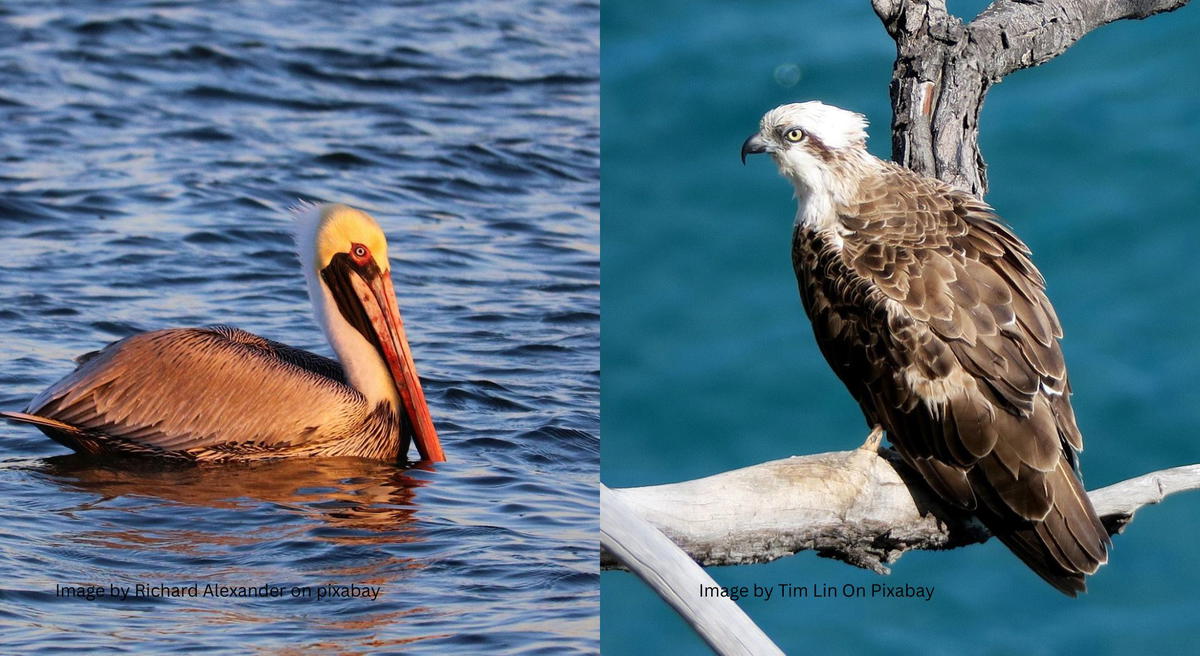
The Brown Pelican (Pelecanus occidentalis) and the Osprey (Pandion haliaetus) are two of the most recognizable fish-eating birds in coastal and freshwater ecosystems. Although they sometimes hunt in the same environments—such as estuaries, coastal bays, and large lakes—they belong to very different evolutionary lineages. The Brown Pelican is a seabird in the family Pelecanidae, whereas the Osprey is a specialized fish-eating raptor and the only living member of the family Pandionidae.
Both species are highly adapted for capturing fish, yet they rely on fundamentally different hunting strategies. Brown Pelicans are plunge-diving seabirds that scoop fish and water using a large expandable throat pouch. Ospreys are aerial predators that seize individual fish with powerful talons. These contrasting techniques reflect differences in anatomy, flight mechanics, prey size, and habitat use.
Because the two birds occasionally forage in the same coastal waters, their fishing ability is often compared. This article examines the scientific differences between their capture techniques, anatomical adaptations, prey handling, and ecological strategies to clarify how each species succeeds as a fish hunter.
Quick Comparison Table
| Feature | Brown Pelican | Osprey |
| Scientific Name | Pelecanus occidentalis | Pandion haliaetus |
| Taxonomic Classification | Family Pelecanidae | Family Pandionidae |
| Geographic Range | Coastal Americas | Worldwide near freshwater and coastal habitats |
| Habitat Preference | Marine coasts, bays, estuaries | Lakes, rivers, reservoirs, coastal waters |
| Average Size | Length: 1–1.52 m (3.3–5 ft); Weight: 2–5 kg (4.4–11 lb) | Length: 0.5–0.6 m (20–24 in); Weight: 1.2–2 kg (2.6–4.4 lb) |
| Key Physical Difference | Large expandable throat pouch | Sharp talons with reversible outer toe |
| Behavioral Difference | Plunge-diving scoop feeder | Talon-based aerial fish hunter |
| Conservation Status | Least Concern (IUCN) | Least Concern (IUCN) |
1. Fishing Technique: Plunge Diving vs Talon Capture
The most fundamental difference between these birds lies in how they capture fish. Brown Pelicans rely on plunge diving, while Ospreys use feet-first talon strikes to seize prey.
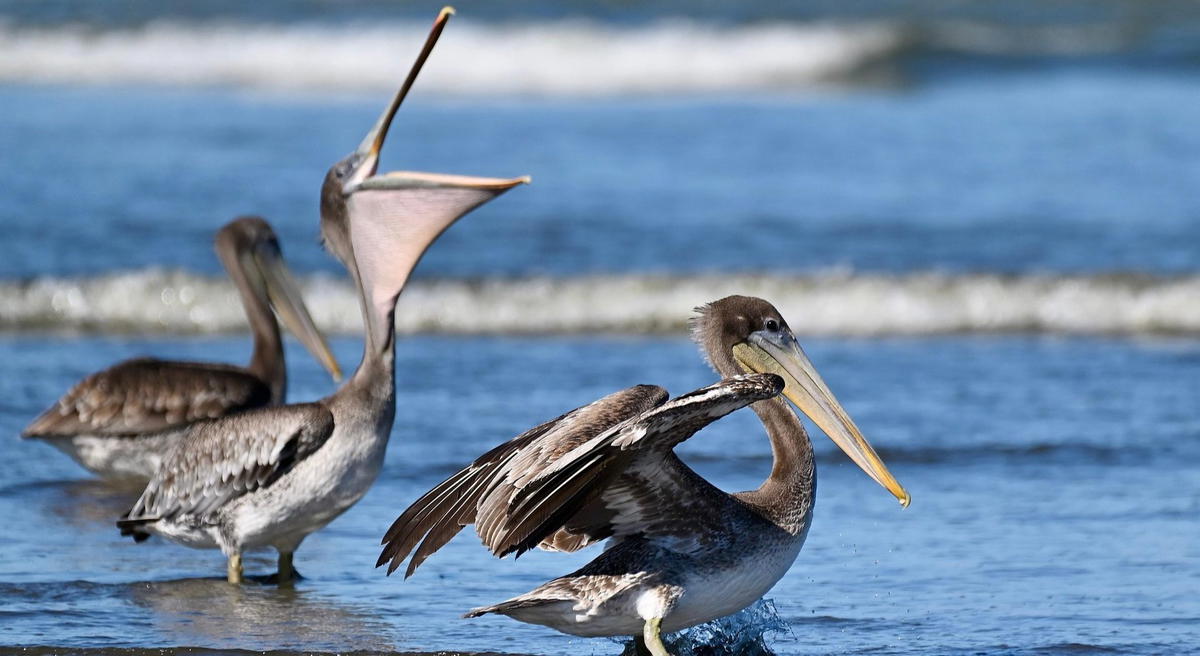
Brown Pelicans search for fish while gliding low over coastal waters. When a school is detected, the bird climbs slightly and dives from heights of roughly 9–18 meters (30–60 feet). Just before impact, the pelican opens its bill and expands the gular pouch, scooping fish and water simultaneously. After resurfacing, it contracts the pouch to expel water before swallowing the prey.
Ospreys employ a more targeted approach. They hover briefly or glide above the water while visually tracking fish and then dive feet-first with their legs extended forward. The bird may submerge partially or completely during the strike before emerging with prey gripped in its talons.
These contrasting techniques represent different ecological solutions. Pelicans maximize efficiency by capturing multiple fish in a single plunge, while Ospreys specialize in precision capture of individual fish.
2. Anatomical Adaptations for Catching Fish
Each species possesses specialized anatomy that reflects its hunting strategy. Brown Pelicans have a large expandable gular pouch, while Ospreys possess highly specialized feet and talons for gripping fish.
The pelican’s pouch can temporarily hold about 11 liters (roughly 3 gallons) of water and fish, functioning like a biological net during dives. Beneath the skin, a network of air sacs helps cushion the impact when the bird strikes the water at speed.
Ospreys rely primarily on their feet. Their talons are sharply curved, and the outer toe is reversible, allowing the bird to grip prey with two toes forward and two backward. The underside of the toes contains rough projections known as spicules, which increase friction and prevent slippery fish from escaping.
These anatomical features illustrate two different evolutionary solutions to fish capture: the pelican’s pouch enables bulk scooping, whereas the osprey’s feet allow precise mechanical grip on individual prey.
3. Hunting Precision and Success Rate
Ospreys are widely recognized for their precision hunting. They typically target individual fish near the water’s surface, requiring accurate visual targeting and precise timing during the dive. Observations summarized by ornithological organizations such as the Cornell Lab of Ornithology suggest that Ospreys successfully capture fish in roughly 25–70% of dives, depending on conditions and experience.
Brown Pelicans rely less on precision because their method targets dense schools of fish rather than individual prey. By plunging into aggregations of small fish, they may capture several prey items in a single dive.
These strategies reflect different foraging dynamics. Ospreys depend on exceptional vision and coordination to capture a specific fish, while Brown Pelicans rely on the probability of encountering large fish schools in productive marine waters.
Consequently, the osprey’s fishing success is tied to individual targeting accuracy, whereas pelicans achieve efficiency through high-volume capture when prey density is high.
4. Prey Size and Handling
The two species also differ in the size and handling of captured fish. Ospreys typically capture individual fish weighing about 150–300 grams, although larger prey can occasionally approach half the bird’s body mass.
After capture, the Osprey adjusts the fish in flight so that it faces head-first, reducing aerodynamic drag while flying back to a perch or nest. This behavior is a distinctive characteristic of osprey hunting.
Brown Pelicans usually capture smaller schooling fish, including anchovies, sardines, and menhaden. Because these species occur in dense surface schools, the pelican’s pouch can collect multiple fish during a single dive.
Handling behavior differs accordingly. Ospreys transport prey in their talons, whereas pelicans typically swallow fish soon after draining water from the pouch at the surface.
These differences demonstrate how prey size influences strategy: Ospreys focus on capturing larger individual fish, while pelicans maximize efficiency by harvesting many small fish simultaneously.
5. Flight and Search Strategy
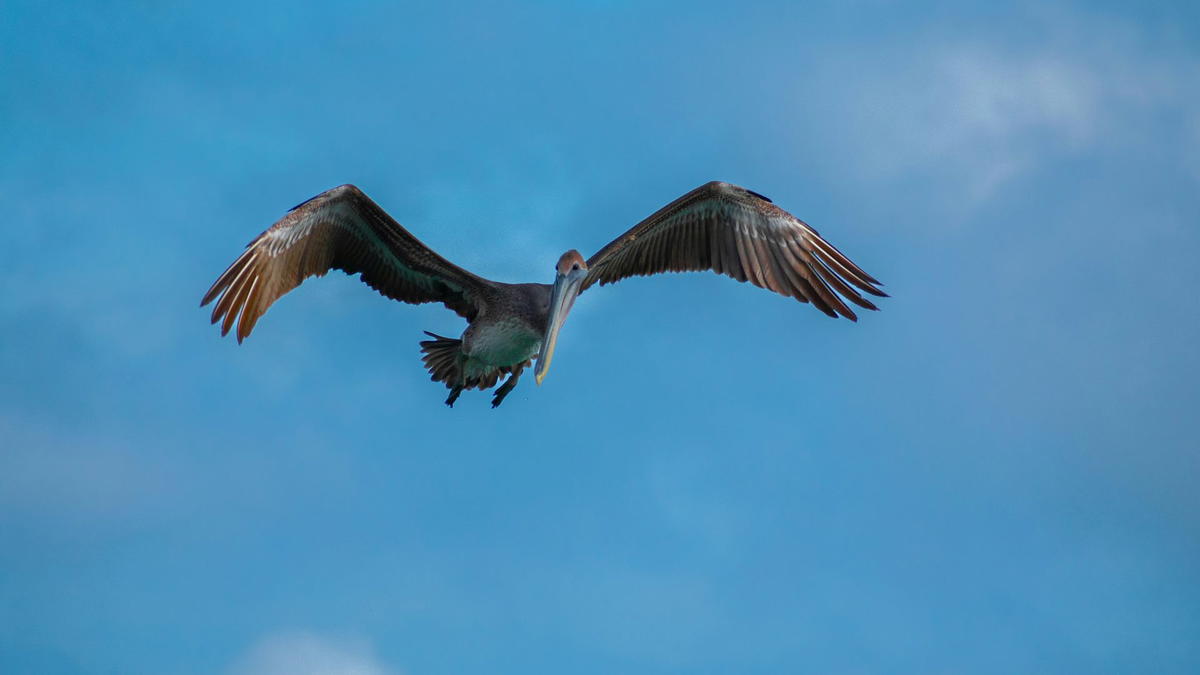
The way each species searches for fish reflects differences in flight behavior. Brown Pelicans typically fly low over the water surface, often gliding just above the waves while scanning for fish activity below.
Flying close to the surface allows pelicans to detect fish schools through cues such as surface disturbances or changes in water color. They frequently travel along coastlines in loose groups where marine fish schools are common.
Ospreys use a higher search pattern. They often circle, glide, or briefly hover above the water while scanning for prey. This elevated vantage point allows them to detect individual fish through the water surface before initiating a dive.
These contrasting search strategies reflect habitat conditions. Coastal marine waters often contain dense schools of fish suitable for pelican dives, whereas inland lakes and rivers contain dispersed fish that require precise visual targeting.
Flight behavior therefore directly supports each species’ fishing technique.
6. Opportunism and Kleptoparasitism
When the two birds forage in the same areas, interactions sometimes occur. Brown Pelicans occasionally engage in kleptoparasitism, a behavior in which one animal attempts to steal prey captured by another.
In coastal environments where both species occur, pelicans may approach an Osprey that has just caught a fish. Because pelicans are considerably larger birds, their presence can sometimes cause the Osprey to drop its catch during flight.
This interaction highlights a difference in feeding strategy. Ospreys depend almost entirely on direct hunting, while pelicans may combine their own fishing with opportunistic attempts to steal prey.
However, kleptoparasitism represents only a small portion of the pelican’s feeding behavior. Most of their diet still comes from successful plunge dives.
These occasional interactions illustrate how differences in body size and opportunistic behavior can influence feeding success when the species share the same fishing grounds.
Key Takeaways
- Brown Pelicans and Ospreys use fundamentally different fishing strategies: plunge-diving scoop feeding versus talon-based capture.
- Ospreys specialize in precise aerial hunting, targeting individual fish using reversible toes and strong gripping talons.
- Brown Pelicans rely on high-volume feeding, capturing multiple small fish from dense schools using their expandable pouch.
- Ospreys typically hunt alone, whereas pelicans often forage in groups along coastlines.
Both species are highly effective fish predators but are optimized for different prey sizes, habitats, and hunting strategies.