Introduction
The Florida manatee (Trichechus manatus latirostris) is widely known by the nickname “sea cow,” a term that reflects both its feeding behavior and overall lifestyle. This name is not merely descriptive—it captures key biological traits that define how this marine mammal interacts with its environment.
Scientists and wildlife agencies, including the Florida Fish and Wildlife Conservation Commission, use the term to communicate the manatee’s role as a large, slow-moving herbivore in aquatic ecosystems. Much like grazing mammals on land, manatees consume substantial amounts of plant material daily, influencing seagrass productivity and nutrient cycling.
Understanding why manatees are called “sea cows” provides insight into their feeding ecology, physiology, and evolutionary classification. The nickname is grounded in observable scientific characteristics—particularly diet, behavior, and morphology—rather than superficial comparison. It also reflects an example of convergent ecological roles between marine and terrestrial herbivores. The following sections explain the biological and historical reasons behind this widely used term.
1. Their Grazing Behavior Closely Resembles Terrestrial Herbivores
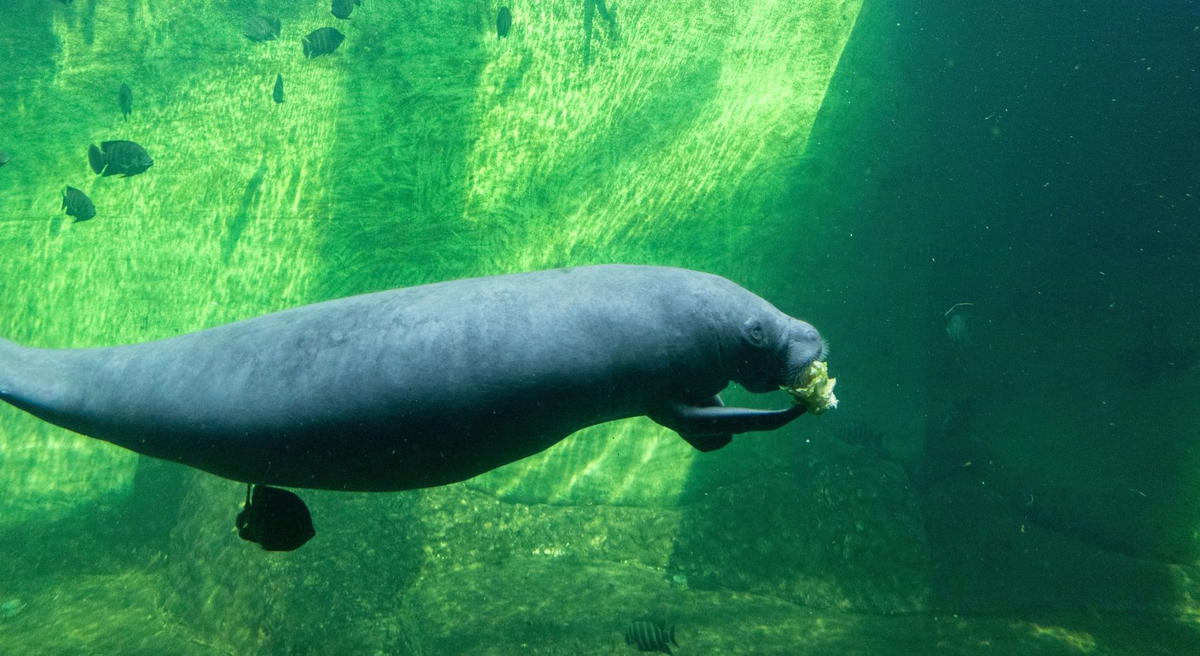
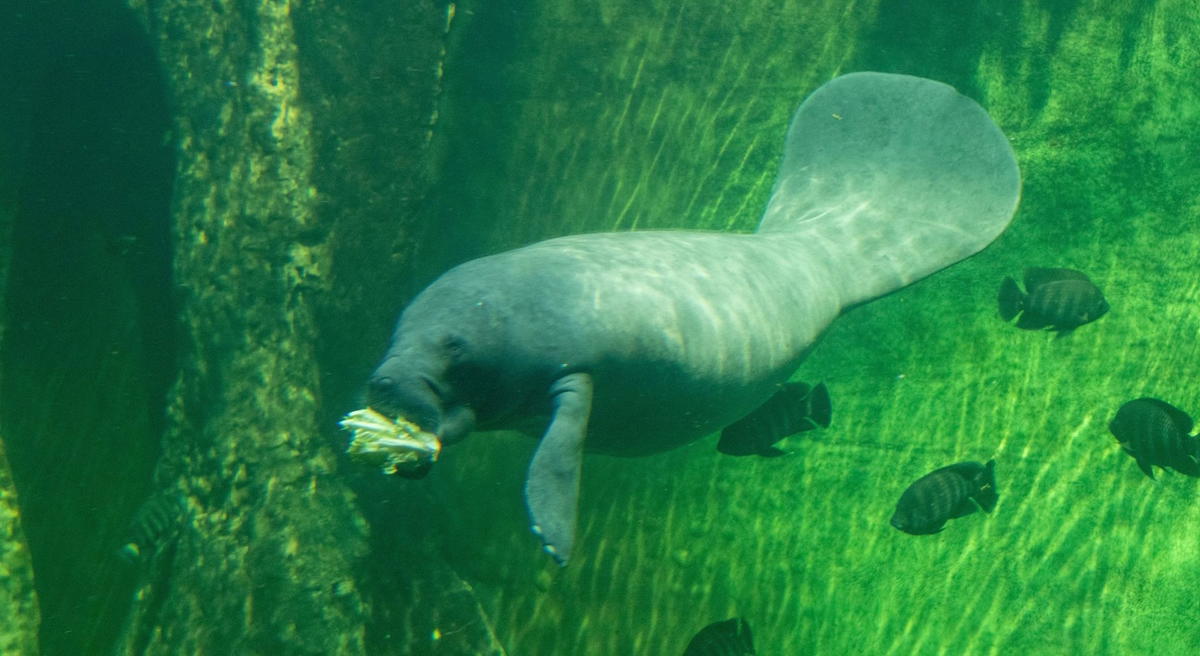
The primary reason Florida manatees are called “sea cows” is their grazing behavior. Like cattle feeding in pastures, manatees feed continuously on aquatic vegetation, particularly seagrasses and freshwater macrophytes.
Field studies indicate that adult manatees spend approximately 6–8 hours per day feeding and consume roughly 5–10% of their body mass daily, often exceeding 30–50 kilograms of vegetation in large individuals. This sustained, bulk-feeding strategy closely parallels terrestrial grazers such as bovines, which rely on high intake of low-energy plant material.
Biologically, this pattern is driven by a relatively low metabolic rate and the need to process fibrous vegetation efficiently. Manatees use prehensile lips to crop plants and continuously replace worn molars in a “marching molar” system. This functional convergence—continuous intake, high volume, and mechanical grinding—is the strongest scientific basis for the nickname “sea cow.”
2. Their Herbivorous Diet Defines Their Ecological Role
Florida manatees are obligate herbivores, feeding exclusively on plant material including seagrasses, algae, and freshwater vegetation. This places them in the same trophic level as grazing mammals on land: primary consumers.
According to NOAA Fisheries, manatee grazing helps regulate seagrass bed structure by removing excess growth and promoting new leaf production. This can improve light penetration and support overall ecosystem productivity.
The comparison to cows is therefore ecological as well as behavioral. Both animals influence plant communities through sustained grazing pressure, shaping habitat structure over time. The term “sea cow” reflects this shared ecological function—large-bodied herbivores that modify vegetation dynamics in their respective environments.
3. Their Slow, Docile Movement Reinforces the Comparison
Another reason for the nickname is the manatee’s slow and calm movement. Florida manatees typically swim at speeds of 3–8 km/h (2–5 mph), using steady propulsion from their paddle-shaped tail.
This slow locomotion is consistent with energy conservation strategies in large herbivores. Because plant-based diets provide relatively low caloric density, manatees minimize energy expenditure by avoiding rapid or unnecessary movement.
Behavioral observations consistently describe manatees as non-aggressive and tolerant, with minimal territoriality. When disturbed, they usually respond by slowly moving away rather than engaging in defensive behavior.
This combination of low-speed movement and passive temperament closely mirrors the behavior of grazing livestock, reinforcing the descriptive accuracy of the term “sea cow” from both behavioral and physiological perspectives.
4. Their Body Shape Resembles Large Grazing Mammals
The physical appearance of Florida manatees also contributes to the nickname. Adults typically measure 3–4 meters in length and weigh between 400 and 600 kilograms, with some individuals exceeding these values.
Their bodies are large, rounded, and cylindrical, with thick, gray, wrinkled skin and a relatively small head. This overall morphology can resemble the bulky form of terrestrial herbivores when viewed at the water’s surface.
Functionally, this body structure supports buoyancy control and stability during feeding. Dense bones (pachyostosis) act as ballast, allowing manatees to remain submerged while grazing along the bottom.
Although the resemblance to cows is superficial, the visual similarity—combined with their feeding posture—has historically reinforced the association and contributed to widespread use of the nickname.
5. The Name Originates From Their Taxonomic Order “Sirenia”
The term “sea cow” is also linked to scientific classification. Florida manatees belong to the order Sirenia, a group of fully aquatic, herbivorous mammals that includes manatees and dugongs.
Members of this order have long been collectively referred to as “sea cows” due to their grazing habits. The term has been used in scientific and descriptive contexts for centuries, predating modern evolutionary understanding.
Despite the name, manatees are not closely related to cattle. Phylogenetic studies show that their closest living relatives are elephants and hyraxes, forming part of the clade Paenungulata. Shared traits include nail-like structures on the flippers and continuous tooth replacement patterns.
Thus, “sea cow” is a functional descriptor based on behavior and ecology, not evolutionary lineage.
6. Their Feeding Mechanics Mirror Grazing Efficiency
Manatee feeding mechanics further justify the comparison. They use a highly flexible, muscular upper lip to grasp vegetation, a feature analogous to cropping behavior in terrestrial grazers.
Inside the mouth, their continuously replacing molars move forward as they wear down, maintaining efficient grinding of fibrous plant material. This adaptation compensates for the abrasive nature of seagrasses, which often contain silica particles.
Unlike ruminant cows, manatees rely on hindgut fermentation to digest cellulose, but both systems achieve the same functional outcome: extracting nutrients from low-quality plant matter.
This convergence in feeding mechanics—grasping, grinding, and processing fibrous vegetation—demonstrates that the “sea cow” label reflects real functional similarities rather than superficial analogy.
7. Historical Observations Reinforced the Name
The widespread use of the term “sea cow” is also rooted in early human observations. European explorers and naturalists described manatees based on visible traits such as grazing behavior, slow movement, and large body size.
Because manatees often feed in shallow coastal waters, their behavior is easily observed from boats or shorelines. Early accounts frequently compared them to livestock grazing in fields, leading to the adoption of terms such as “sea cow.”
Institutions such as the Smithsonian Institution continue to use the term in educational contexts because it provides an accessible and accurate analogy for public understanding.
The persistence of the nickname reflects its descriptive accuracy and its foundation in observable biological traits rather than myth or exaggeration.
🔎 Key Takeaways
• The nickname “sea cow” originates from the manatee’s continuous grazing behavior on aquatic vegetation
• Florida manatees consume approximately 5–10% of their body weight daily, similar to terrestrial herbivores
• Slow movement and a docile temperament reinforce comparisons to grazing mammals
• Large, rounded body shape contributes to the visual association with cattle
• The term is historically linked to the order Sirenia, long referred to as “sea cows”
• Despite the name, manatees are evolutionarily closer to elephants than to cows