Introduction
The bottlenose dolphin (Tursiops truncatus) is a highly specialized marine mammal whose success in coastal and open-ocean environments is driven by a suite of anatomical, physiological, and behavioral adaptations. These traits enable efficient movement, precise navigation, effective hunting, and survival in a three-dimensional aquatic environment where visibility, oxygen availability, and temperature vary widely. Unlike terrestrial mammals, dolphins must continuously regulate respiration, buoyancy, and sensory perception while submerged. Research supported by NOAA Fisheries and long-term field programs such as the Sarasota Dolphin Research Program shows that these adaptations function as integrated systems rather than isolated traits. Understanding these mechanisms is scientifically important because they demonstrate how mammals have evolved convergent solutions—such as echolocation, enhanced oxygen storage, and hydrodynamic efficiency—to exploit marine niches. The following ten adaptations illustrate how bottlenose dolphins function as efficient predators and navigators in ocean systems.
1. Sophisticated Echolocation (Biological Sonar)
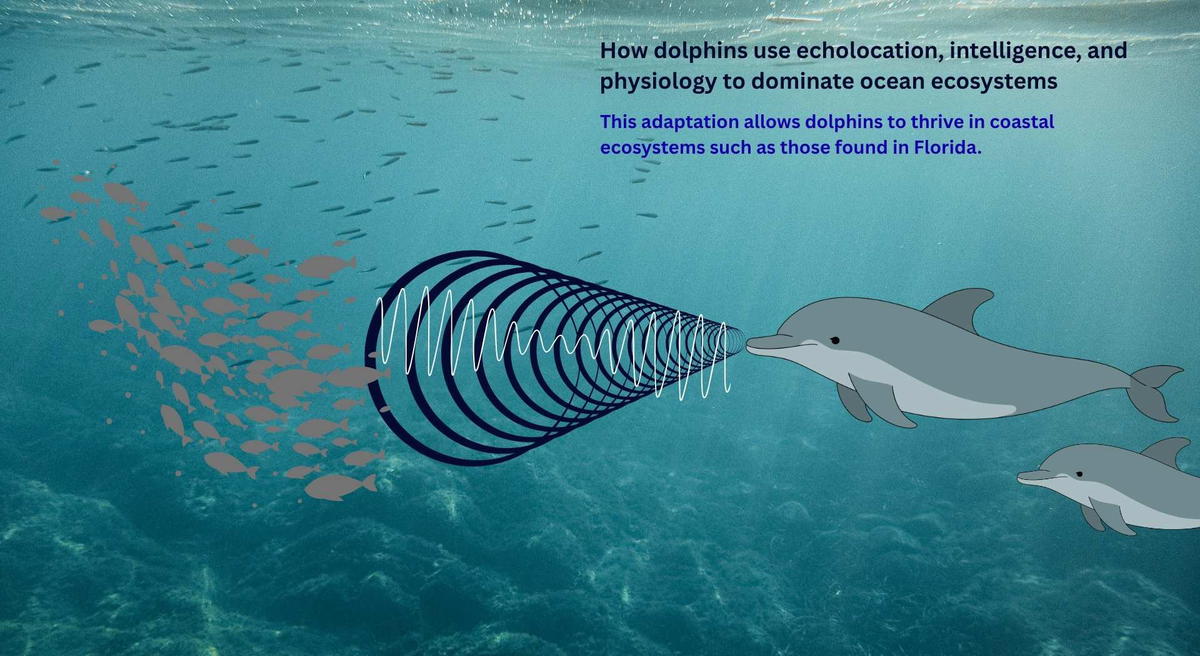
Bottlenose dolphins use echolocation as a primary sensory system in low-visibility environments. They generate broadband clicks (typically 40–150 kHz) in nasal sacs beneath the blowhole, which are focused into a directional beam by the melon, a lipid-rich acoustic structure. Returning echoes are received through the lower jaw and transmitted via specialized fat channels to the middle and inner ear. This system allows discrimination of object size, shape, distance, and internal density, including features such as fish swim bladders. Experimental studies show resolution differences of only a few millimeters. Rapid click emission supports real-time tracking of fast-moving prey at ranges of tens of meters. This adaptation enables effective hunting in turbid water and complements vision, making it a central mechanism for navigation and prey detection in marine environments.
2. Unihemispheric Sleep (Half-Brain Sleep)
Bottlenose dolphins exhibit unihemispheric slow-wave sleep (USWS), where one cerebral hemisphere rests while the other remains active. Electroencephalogram (EEG) data confirm alternating hemispheric cycles lasting several hours. During this state, the eye opposite the active hemisphere remains open, maintaining awareness of the surroundings. This adaptation is essential because dolphins are voluntary breathers and must surface regularly—often every few minutes—to inhale. USWS allows continuous control of respiration, posture, and movement while still providing restorative sleep. Neural control involves asymmetric activation of brainstem arousal systems, enabling partial consciousness. This mechanism ensures that dolphins can rest without compromising breathing or vigilance, a critical requirement for an air-breathing mammal in an aquatic environment.
3. Hydrodynamic Streamlined Body Shape
The fusiform body shape of bottlenose dolphins minimizes drag and enhances swimming efficiency. A tapered rostrum and smooth, compliant skin reduce turbulence and improve laminar flow along the body surface. Dolphins can reach burst speeds of 30–35 km/h and maintain efficient cruising speeds of 5–10 km/h. Propulsion is generated by vertical oscillations of the tail flukes, powered by strong axial muscles, producing lift-based thrust. The dorsal fin stabilizes movement, while pectoral flippers enable precise maneuvering. This hydrodynamic design reduces energy expenditure during long-distance travel and allows rapid acceleration when pursuing prey. Efficient locomotion is essential for both hunting success and energy conservation in marine environments where movement costs are high.
4. Specialized Breathing via the Blowhole
Bottlenose dolphins breathe through a single blowhole positioned on the top of the head, directly connected to the lungs. A muscular valve seals the blowhole during submersion, preventing water entry. Dolphins are conscious breathers, coordinating exhalation and inhalation within approximately 0.2–0.5 seconds at the surface. Each breath can exchange up to 80–90% of lung air, far exceeding the ~10–15% exchange typical in humans. The rib cage is flexible, allowing controlled lung compression at depth, which helps reduce nitrogen absorption. These adaptations support repeated dive cycles with efficient oxygen uptake and minimal interruption to movement. Precise respiratory control is essential for sustaining activity in an oxygen-limited underwater environment.
5. Individualized Signature Whistles for Communication
Bottlenose dolphins produce unique “signature whistles” that function as stable acoustic identifiers. These whistles are learned early in life and remain consistent over decades. Playback experiments demonstrate that dolphins selectively respond to familiar whistles, indicating recognition of individual identity rather than simple sound detection. Individuals can retain these acoustic memories for more than 20 years. Dolphins also imitate the whistles of others in social contexts, suggesting directed communication. Sound production involves controlled airflow through nasal structures, while perception relies on advanced auditory processing. This system supports cohesion in fission–fusion groups, where individuals frequently separate and reunite, and enables coordination during cooperative behaviors such as group foraging.
6. Dual-Environment Vision (Air and Water)
Bottlenose dolphins have visual systems adapted for both underwater and aerial environments. Their laterally positioned eyes provide a wide field of view approaching 300°, and each eye can move independently. The lens is nearly spherical, enhancing refractive power underwater, while a reduced reliance on the cornea compensates for differences between air and water. Dolphins can rapidly adjust focus when transitioning between environments. In bright conditions, the pupil forms a slit-like shape that improves image resolution. A tapetum lucidum enhances sensitivity in low-light conditions. This dual adaptation allows dolphins to detect prey, predators, and surface cues while integrating visual information with echolocation for improved spatial awareness.
7. Insulating and Functional Blubber Layer
Bottlenose dolphins possess a subcutaneous blubber layer typically 2–4 cm thick, composed of lipid-rich tissue with low thermal conductivity. This layer reduces heat loss in water, which conducts heat much faster than air. Blubber also functions as an energy reserve, storing lipids that can be metabolized during periods of high demand or limited food availability. It contributes to buoyancy and helps maintain streamlined body contours. Blood flow within the blubber can be adjusted to regulate heat exchange. This multifunctional adaptation supports thermal stability, energy balance, and efficient movement across varying marine conditions.
8. Tool Use and Cooperative Hunting Strategies
Bottlenose dolphins display behavioral adaptations that enhance foraging efficiency. In Shark Bay, some individuals use marine sponges as tools to protect their rostrum while foraging on the seafloor, a behavior passed through social learning. Dolphins also engage in cooperative hunting strategies such as forming bubble curtains, herding fish into tight groups, and striking prey with their tail flukes (“fish-whacking”). These behaviors require coordination, communication, and role differentiation among individuals. Such strategies increase prey capture success and allow dolphins to exploit a wider range of food sources. The combination of learned behavior and group coordination expands their ecological flexibility.
9. High-Density Oxygen Storage for Diving
Bottlenose dolphins are adapted for repeated diving through enhanced oxygen storage and efficient use. They have high concentrations of hemoglobin in blood and myoglobin in muscles, increasing oxygen availability compared to terrestrial mammals. Typical dive durations range from 7–10 minutes, with routine foraging dives often shorter and deeper dives recorded beyond 150 meters in offshore individuals. During dives, dolphins exhibit bradycardia and redirect blood flow to vital organs such as the brain and heart. Peripheral tissues rely on stored oxygen and, when necessary, anaerobic metabolism. This physiological regulation reduces oxygen consumption and supports sustained activity underwater, enabling access to vertically distributed prey resources.
10. High Cognitive Intelligence and Social Coordination
Bottlenose dolphins possess large, highly folded brains with encephalization quotient values typically between 4.5 and 5.3. Their neocortex supports advanced learning, memory, and problem-solving abilities. Dolphins demonstrate mirror self-recognition and long-term memory of individual identity, including recognition of signature whistles after decades. Social structures are dynamic, with individuals forming long-term alliances and cooperative groups. These cognitive abilities allow flexible responses to changing environmental and social conditions. In an adaptive context, intelligence enhances coordination during hunting, improves decision-making, and supports the transmission of learned behaviors. This integration of cognition with physical and sensory systems contributes to their effectiveness as marine predators.
Relevance to Florida’s Coastal Ecosystems
Bottlenose dolphins are among the most commonly observed marine mammals along Florida’s coasts, where their adaptations can be seen in action across diverse habitats. Populations are well documented in regions such as Tampa Bay, Sarasota Bay, and the Florida Keys, where long-term field studies have provided detailed insights into their behavior and ecology.
In these environments, dolphins regularly use echolocation to hunt fish in shallow, often turbid waters, demonstrating the practical importance of acoustic navigation. Cooperative feeding behaviors—such as herding fish toward shorelines or mud banks—are frequently observed in Florida populations, highlighting the role of social coordination in prey capture.
Florida’s warm coastal waters also illustrate the importance of physiological adaptations such as blubber regulation and efficient respiration, which allow dolphins to maintain energy balance while engaging in repeated dive cycles. Because many of these habitats are influenced by human activity, including boating and coastal development, Florida populations also serve as key indicators of ecosystem health and conservation status.
🔎 Key Takeaways
• Echolocation provides precise acoustic perception, enabling detection and tracking of prey in low-visibility environments.
• Unihemispheric sleep allows continuous breathing and vigilance while maintaining necessary rest.
• Streamlined body design and efficient propulsion reduce energy costs and improve hunting performance.
• Specialized respiration and oxygen storage support repeated dives and efficient gas exchange.
• Communication and cooperative hunting enhance coordination and increase foraging success.
• Integrated physical, sensory, and cognitive adaptations enable dolphins to function as highly efficient marine predators.