Introduction
The bald eagle (Haliaeetus leucocephalus) and the osprey (Pandion haliaetus) are two prominent fish-eating raptors often observed hunting over lakes, rivers, and coastal waters. Despite this similarity, they belong to different taxonomic lineages: bald eagles are part of the family Accipitridae, while ospreys are the sole members of the family Pandionidae, reflecting distinct evolutionary adaptations for feeding.
Confusion between the two often arises because both species are associated with aquatic habitats and are frequently seen capturing fish. However, their hunting strategies, anatomical adaptations, and success rates differ significantly.
This comparison examines fishing efficiency, hunting techniques, anatomical specialization, and ecological roles to determine which species is the more effective fisher. Data from long-term observations by organizations such as the U.S. Fish and Wildlife Service and the Cornell Lab of Ornithology provide measurable insights into their performance.
Quick Comparison Table
| Feature | Bald Eagle | Osprey |
| Scientific Name | Haliaeetus leucocephalus | Pandion haliaetus |
| Taxonomic Classification | Family Accipitridae | Family Pandionidae |
| Geographic Range | North America | Global (except Antarctica) |
| Habitat Preference | Lakes, rivers, coasts | Near water bodies worldwide |
| Average Size | 3–6.3 kg (6.6–14 lbs) | 1.4–2 kg (3–4.4 lbs) |
| Key Physical Difference | Large, powerful build | Slender, specialized feet |
| Behavioral Difference | Opportunistic, often steals prey | Specialized plunge-diver |
| Conservation Status | Least Concern (recovered) | Least Concern |
1. Fishing Success Rate and Efficiency
The most direct measure of fishing ability is success rate, and here the osprey shows a clear advantage. Field observations indicate that ospreys successfully capture fish in approximately 60–70% of hunting attempts, whereas bald eagles succeed in roughly 20–35% of direct fishing attempts.
This difference is primarily due to specialization. Ospreys are obligate piscivores, with fish comprising over 99% of their diet, meaning their hunting behavior is optimized exclusively for aquatic prey. In contrast, bald eagles are generalist predators, feeding on fish, birds, carrion, and stolen prey.
Because eagles divide their foraging strategies across multiple food sources, their direct fishing efficiency is lower. However, they compensate through behavioral flexibility, including scavenging and kleptoparasitism.
Scientifically, this illustrates a classic ecological trade-off: specialists (ospreys) achieve higher efficiency in a narrow niche, while generalists (bald eagles) maintain broader survival strategies with lower task-specific performance.
2. Hunting Technique: Plunge Diving vs Surface Seizing
Ospreys and bald eagles differ fundamentally in how they capture fish. Ospreys hunt using true plunge-diving, hovering 10–40 meters above water before diving feet-first and often becoming fully submerged to capture fish at depths of 30–90 cm (1–3 feet).
In contrast, bald eagles primarily use a surface-snatch technique, flying low and extending their talons to grab fish near the water’s surface without fully submerging. Full plunge-dives are rare because their body structure is not optimized for underwater impact and drag.
The near-vertical dive angle used by ospreys minimizes light refraction distortion, improving targeting accuracy. Additionally, their streamlined entry reduces drag forces during water penetration.
This difference matters because it determines access to prey: ospreys can exploit fish below the surface, while bald eagles are largely limited to surface or near-surface prey, reducing their direct capture opportunities.
In the Everglades ecosystem, interactions between bald eagles and ospreys illustrate how apex predators shape the food web, influencing prey dynamics and overall ecosystem balance.
3. Foot Structure and Grip Adaptations
The osprey’s feet are among the most specialized of any raptor, directly contributing to its superior fishing ability. Ospreys possess reversible outer toes (zygodactyl arrangement), allowing two toes to face forward and two backward, improving grip symmetry on slippery fish.
Their foot pads are covered with spicules (sharp keratinized projections), which increase friction and grip under wet, low-resistance conditions. This adaptation is particularly important because fish generate significant torsional force and drag when struggling.
Bald eagles, in contrast, have strong but typical raptor feet adapted for grasping a wide range of prey, not specifically fish. While their talons are larger and more powerful, they lack the fine-scale friction adaptations seen in ospreys.
Mechanistically, osprey feet function like biological clamps optimized for hydrodynamic resistance, whereas eagle feet prioritize force over precision. This distinction directly improves osprey capture retention rates during and after dives.
4. Flight and Load Carrying vs Capture Precision
Bald eagles and ospreys differ in how they balance capture ability with carrying capacity. Bald eagles are significantly larger, with wingspans up to 2.3 meters (7.5 feet), enabling them to carry heavier prey—sometimes fish weighing over 1–2 kg (2–4 lbs).
Ospreys, by contrast, are lighter and optimized for capture rather than transport. After catching a fish, they align it head-first to reduce aerodynamic drag during flight—an adaptation rarely seen in eagles.
While eagles may have lower capture success, their size allows them to retain and defend larger prey, including stealing fish from other birds. Ospreys rely on speed and precision but are more vulnerable to losing their catch.
This creates a functional distinction: ospreys maximize capture efficiency, while bald eagles maximize resource control and transport capacity, influencing their overall foraging success in different contexts.
5. Kleptoparasitism vs Independent Hunting
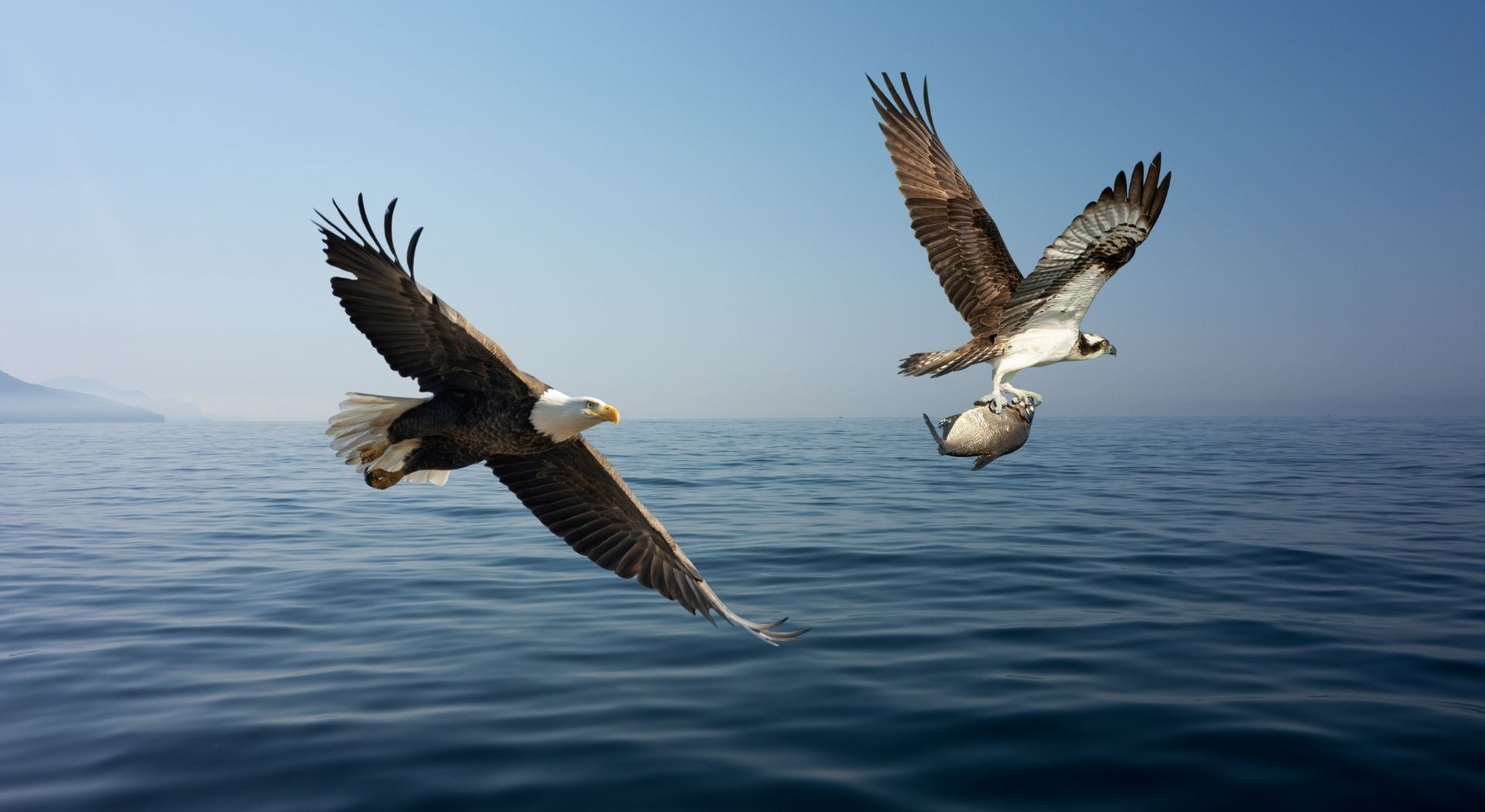
A key behavioral difference is the bald eagle’s frequent use of kleptoparasitism—stealing prey from other birds, especially ospreys. Eagles often chase ospreys in flight until they release their catch, which the eagle then retrieves mid-air.
Ospreys rarely engage in this behavior and instead rely almost entirely on independent hunting. This makes their success rate a direct reflection of their own capture efficiency.
Studies and field observations show that kleptoparasitism can significantly supplement eagle diets, reducing the need for repeated hunting attempts. This behavior effectively offsets their lower fishing success rate.
Who Is the Better Fisher?
The osprey is the more efficient and specialized fisher, with significantly higher success rates and unique anatomical adaptations for capturing fish. However, the bald eagle compensates through strength, size, and opportunistic strategies such as kleptoparasitism, allowing it to dominate in competitive interactions.
From an ecological perspective, this highlights two contrasting strategies:
- Osprey: High-efficiency, self-reliant predator
- Bald eagle: Opportunistic predator combining hunting with resource acquisition from others
This distinction explains why bald eagles can thrive despite lower direct fishing efficiency—they rely on behavioral dominance rather than specialization.
Key Takeaways
• Ospreys have a significantly higher fishing success rate (~60–70%) compared to bald eagles (~20–35%).
• Ospreys are specialized plunge-divers capable of fully submerging, while bald eagles primarily capture fish at the surface.
• Unique adaptations such as reversible toes and spicules give ospreys superior grip on slippery prey.
• Bald eagles compensate for lower fishing efficiency through size, strength, and kleptoparasitic behavior.
• Ospreys excel in precision and efficiency, while bald eagles dominate through versatility and opportunism.