📊 The Everglades by the Numbers
- Original extent: ~11,000 square miles of south Florida (SFWMD)
- Current protected extent: ~1.5 million acres within Everglades National Park
- Bird species: 360+ (NPS)
- Fish species: ~300 (NPS)
- Reptile species: 50+ including 27 snake species within the national park alone (NWF)
- Threatened/endangered species: 36 (NPS)
- Wading bird nesting peak (1930s–40s): 150,000–250,000 nests annually (Audubon Florida)
- CERP original authorization (2000): $8.2 billion; current projection: $23.2 billion FY2020 dollars (Congress.gov CRS, 2024)
The Everglades is not a swamp. It is a river.
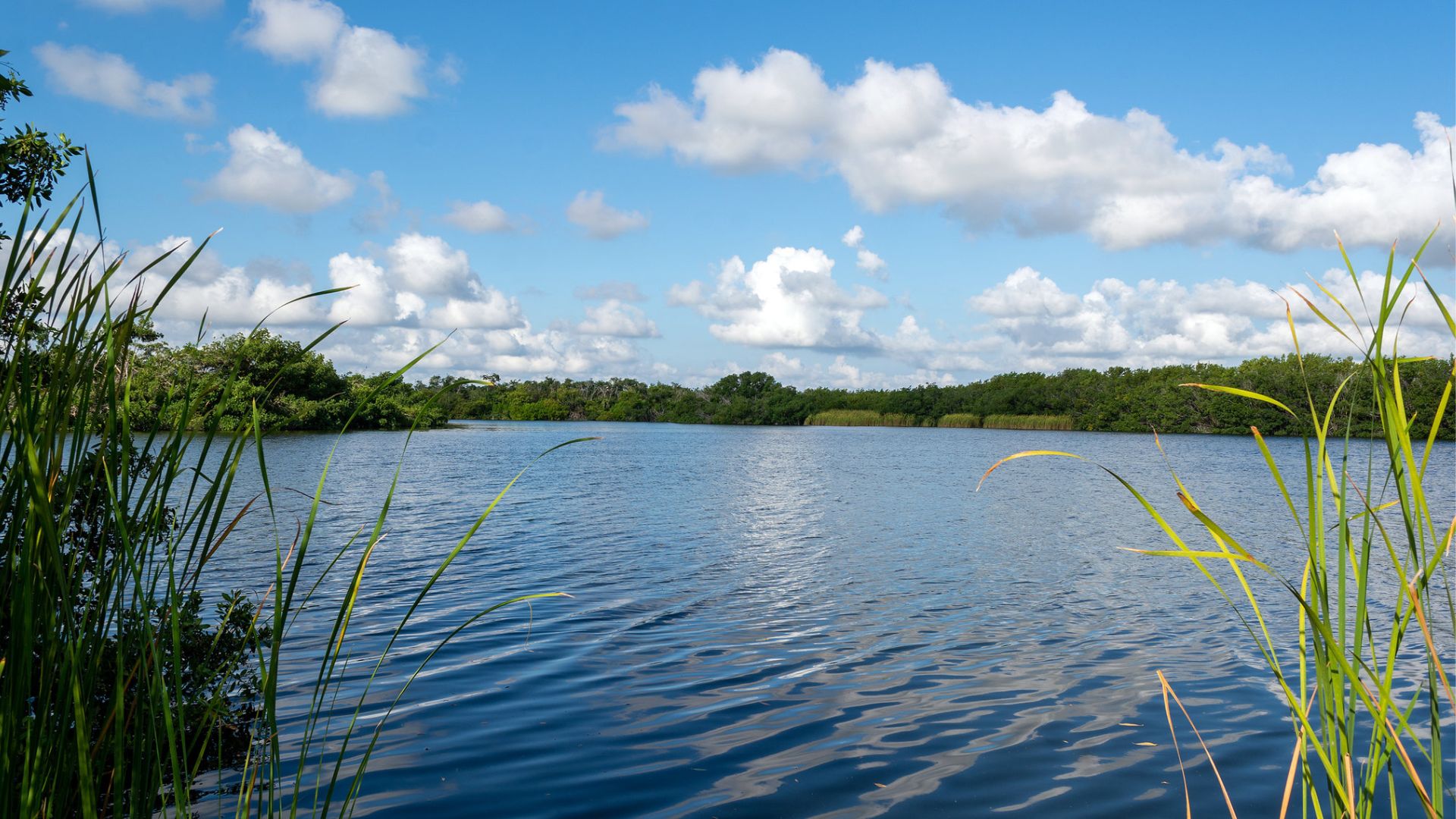
That is the most important thing to understand about this landscape. Marjory Stoneman Douglas established it in her 1947 book and it remains the most useful corrective to the common misconception. The Everglades is a sheet of water, roughly 60 miles wide and inches deep, flowing almost imperceptibly southward from Lake Okeechobee to Florida Bay at roughly a quarter-mile per day. The sawgrass prairies, cypress domes, hardwood hammocks, and mangrove labyrinths that make up the visible landscape are all expressions of this slow, ancient flow.
When that flow is right — the right volume, the right timing, the right seasonal rhythm of wet and dry — the Everglades is one of the most productive subtropical wetland systems on Earth. More than 360 bird species, approximately 300 fish species, 50 reptile species, 17 amphibian species, and 40 mammal species inhabit the system (NPS Everglades). Thirty-six threatened or endangered wildlife species depend on it, including the Florida panther — whose entire global wild population is confined to south Florida — the American crocodile, the West Indian manatee, the snail kite, and the wood stork.
It is also the only place on Earth where American alligators and American crocodiles coexist in the wild (USGS).
The Everglades once covered almost 11,000 square miles of south Florida (SFWMD). Today it covers roughly half that area. The twentieth century drained, canaled, diked, and compartmentalised the system to serve agriculture and development — transforming what Douglas called the River of Grass into a managed water delivery network for a rapidly growing urban population. The ecological consequences have been extensive and are still being documented.
Reversing those consequences is the mission of the Comprehensive Everglades Restoration Plan — a federal-state programme originally authorised at $8.2 billion in 2000 and now projected to cost $23.2 billion (FY2020 dollars) due to scope expansion and inflation (Congress.gov CRS, 2024) — the most ambitious wetland restoration effort in U.S. history. The Everglades is simultaneously a conservation tragedy, a wildlife spectacle, and the site of an ongoing experiment in ecological recovery that scientists worldwide are watching closely.
Water, Flow, and the River of Grass
The Everglades is not a swamp — it is a slow-moving river. Understanding its hydrology is the prerequisite for understanding everything else about it.
Understanding the Everglades: Water, Flow, and the River of Grass
The Everglades originates in the Kissimmee River basin in central Florida. Rainfall over the headwaters drains into the Kissimmee River, which historically meandered south into Lake Okeechobee — the shallow, 730-square-mile lake at the system’s heart. When the lake filled seasonally, water overflowed its southern rim and spread across the limestone platform of south Florida as a wide, shallow sheet.
This sheet flow carried water south and southwest over a very slight gradient — a drop of only a few inches per mile — through the sawgrass prairies and sloughs of the interior Everglades, eventually reaching the mangrove coast of Florida Bay and the Ten Thousand Islands. The journey from the lake to the bay took months. Along the way, the water filtered through limestone, fed aquatic plant communities, sustained the invertebrate base that supported wading birds, and maintained the salinity gradients of the coastal estuaries that served as nursery habitat for marine fish.
The water that enters the Everglades system does not simply flow through it. It makes the system.
The Everglades is what ecologists call a “low-nutrient” system. The native plant and animal communities evolved in water that is extraordinarily dilute in phosphorus — often below 10 parts per billion. This is the ecological paradox of the Everglades: an extraordinarily productive system built on nutrient poverty. Even small additions of phosphorus — from agricultural runoff, from treated wastewater — trigger the growth of cattail (Typha spp.) monocultures that crowd out sawgrass and collapse the diverse native plant community (SFWMD).
Nine habitat types: The National Park Service recognises nine major habitat types within Everglades National Park alone: sawgrass prairies, sloughs, marl prairies, pinelands (pine rocklands), hardwood hammocks, cypress swamps, mangroves, coastal lowlands, and marine/estuarine habitats. Each is shaped by slight differences in water depth, water duration, fire frequency, and substrate — and each supports its own characteristic suite of species.
Nine Ecosystems Within One River
Slight variations in water depth, fire frequency, and limestone substrate create radically different communities across a nearly flat landscape.
Everglades Habitats
Sawgrass Prairie and Sloughs
Sawgrass (Cladium jamaicense) dominates the interior Everglades, forming the vast, sea-like expanse that Marjory Stoneman Douglas described. Growing in water that may be only inches deep, it is a sedge — not a true grass — with razor-edged leaves that make it nearly impenetrable. The sawgrass prairies are maintained by fire and by the periodic drawdown of water in the dry season, which concentrates fish and invertebrates in the remaining pools and sloughs.
Sloughs — the deeper, slower-flowing channels that thread through the sawgrass — are the Everglades’ biological arteries. Shark River Slough, the main drainage channel of the central Everglades, carries water south through the park and is the critical foraging corridor for alligators, otters, and wading birds during the dry season. Taylor Slough, the smaller eastern channel, connects the Everglades interior to Florida Bay. Both are the focus of major restoration investment.
Hardwood Hammocks and Tree Islands
Hardwood hammocks are elevated tree islands — dense, multi-layered forest communities rising just inches above the surrounding sawgrass prairie. Their slight elevation above the flood level is enough to allow accumulation of organic soil and the establishment of trees: live oak, gumbo limbo (Bursera simaruba), strangler fig (Ficus aurea), poisonwood (Metopium toxiferum), and a suite of tropical species with Caribbean affinities found nowhere else in the continental U.S. Hammocks provide critical refuge for the Florida panther during high-water periods, nesting habitat for barred owls and red-shouldered hawks, and foraging areas for white-tailed deer.
Pine Rocklands
Where the limestone substrate rises above the flood level, south Florida pine rocklands (also called pinelands) establish — an open, fire-maintained community of slash pine over a diverse ground layer of palmettos, ferns, and wildflowers.
Pine rocklands are among the rarest habitats in the world. Approximately 2% of their original extent survives.
The largest remaining tract lies within the Long Pine Key area of Everglades National Park. These rocklands support the highly endemic flora and fauna of the Miami Rock Ridge, including the Florida bonneted bat (Eumops floridanus) and multiple state-listed plant species.
Cypress Swamps and Domes
Cypress domes — circular stands of bald cypress (Taxodium distichum) rooted in slightly deeper water than the surrounding prairie — punctuate the Everglades landscape. The trees at the centre grow tallest, where the water is deepest and the soil richest, tapering to shorter individuals at the edges: hence the dome profile visible from above. Cypress swamps provide nesting habitat for wood storks, anhingas, and great blue herons; their deep, permanent water attracts alligators and otters throughout the dry season; and their accumulated peat soils represent significant carbon storage.
Mangroves and Florida Bay
The southern and western edge of the Everglades dissolves into the largest contiguous stand of protected mangroves in the western hemisphere, according to the U.S. Geological Survey, a labyrinth of red, black, and white mangrove extending along over 100 miles of coastline. The Ten Thousand Islands region, on the Gulf side, is one of the most biologically productive coastal systems in North America. Florida Bay, at the southern terminus of the sheet flow, is where the Everglades meets the sea: a shallow, warm embayment that supports seagrass meadows, manatees, and the nursery habitat for the commercial fisheries of the Florida Keys.
The Animals That Define This Landscape
36 threatened or endangered species. The only wild population of Florida panthers on Earth. The only place in the world where alligators and crocodiles coexist.
Wading Birds: The Measure of the Ecosystem
Nothing signals the health of the Everglades more clearly, or more visibly, than wading birds. The connection between water management and bird breeding was understood by Everglades ecologists before most modern ecological frameworks existed for describing it.
The logic is precise. Wading birds feed by concentrating prey — small fish, crayfish, frogs — in shallow water. The Everglades dry season provides this concentration naturally: as water levels drop from November through April, fish and invertebrates become trapped in shrinking pools and sloughs, creating the feeding bonanzas that trigger wading bird breeding. The timing must be right. If water drops too early, the concentration is insufficient. If it does not drop at all — or drops too abruptly due to water control structure operations — the birds lose their foraging grounds at the critical moment when chicks are hatching and food demand is at its peak.
SFWMD avian ecologist Mark Cook put it plainly: “These birds lost their restaurants.”
In the 1930s and 1940s, the Everglades system supported 150,000 to 250,000 wading bird nests annually (Audubon Florida, 2022). By the late twentieth century, following decades of drainage, those numbers had collapsed by an estimated 90%. A partial recovery followed the commencement of CERP restoration projects, with a record-breaking 2018 season producing 138,834 nests — the highest count since comprehensive systemwide surveys began in 1996 (SFWMD/Audubon). But the 2022 and 2023 seasons were both below the 10-year average, a reminder that recovery is neither linear nor guaranteed.
⚠️ Conservation Alert
- Wading bird nesting in 2022 and 2023 was below the 10-year average (55,273 nests); both seasons were 2.6–3x below the 2018 peak (SFWMD/Audubon, 2022–23 report).
- Corkscrew Swamp Sanctuary — historically home to up to 7,000 wood stork nests per year — attracted only 36 nesting wood stork pairs in 2023.
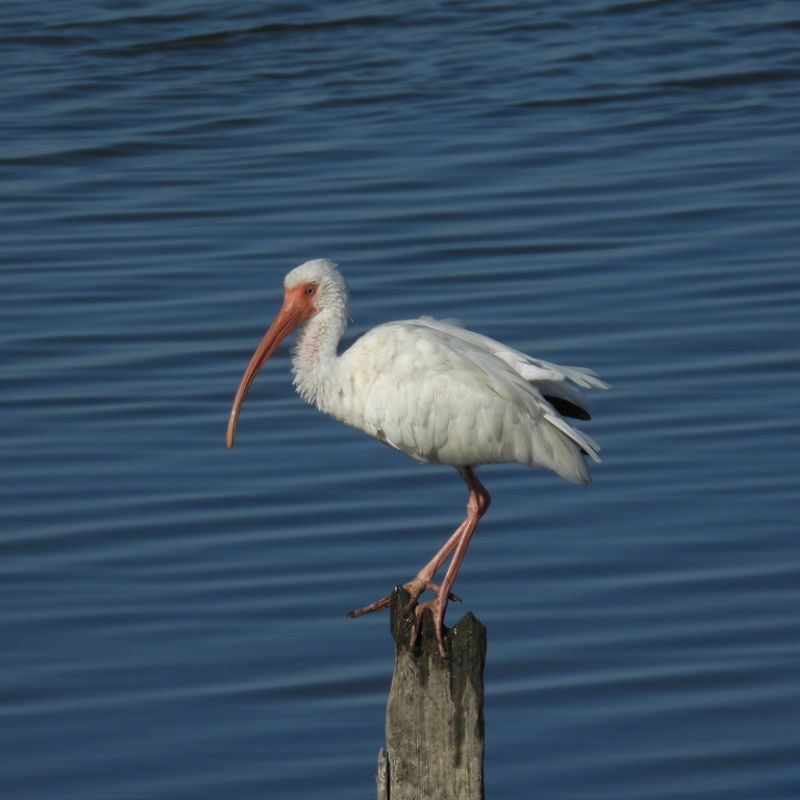
- White ibis, the most abundant wading bird in south Florida, showed significant nesting declines in both 2022 and 2023.
- Increasingly irregular rainfall driven by climate change is disrupting dry-season onset timing — the hydrological trigger for successful breeding.
Roseate Spoonbill
Platalea ajaja
IUCN: Least Concern (LC)
- Pink coloration derived entirely from carotenoids in crustacean prey — fades in captivity without diet maintenance
- Feeds by swinging its spatulate bill side-to-side in shallow water, a technique called “scything”
- Hunted almost to extinction for plume trade by the 1890s; colonies in Florida reduced to a handful of nesting pairs
- Nests in mangrove tree islands of Florida Bay and the Ten Thousand Islands — colony productivity tracks Everglades water management
- Population recovery is tracked as an indicator of Everglades restoration success; range has expanded northward in recent decades
Wood Stork
Mycteria americana
IUCN: Least Concern (LC) — U.S. Threatened
- Federally Threatened in the U.S.; considered a sentinel species for Everglades restoration success
- Feeds by touch (“grope feeding”) — requires high prey density in shallow water; among the most demanding foragers in the system
- Nests in large colonies; foraging range from nesting colonies can extend 50+ miles
- Needs water to drop at the right rate, in the right season, at the right location — more hydrologically sensitive than almost any other wading bird
- Numbers in Florida declined over 75% from 1960s levels; modest recovery in 2000s and 2010s; recent years show renewed decline
Florida Panther: The Everglades’ Apex Predator
The Florida panther is not merely an Everglades species. It is the Everglades’ most complete ecological argument for protection.
A single panther requires between 75 and 200 square miles of territory to sustain itself — a spatial requirement that makes it the ultimate test of landscape connectivity in south Florida. Its continued presence means the mosaic of Big Cypress Swamp, Fakahatchee Strand, Florida Panther National Wildlife Refuge, and the private ranch lands of Hendry and Collier Counties is still sufficiently connected to support a large predator. The day the panther disappears from this landscape, it will be because the landscape has become too fragmented to function as an ecosystem.
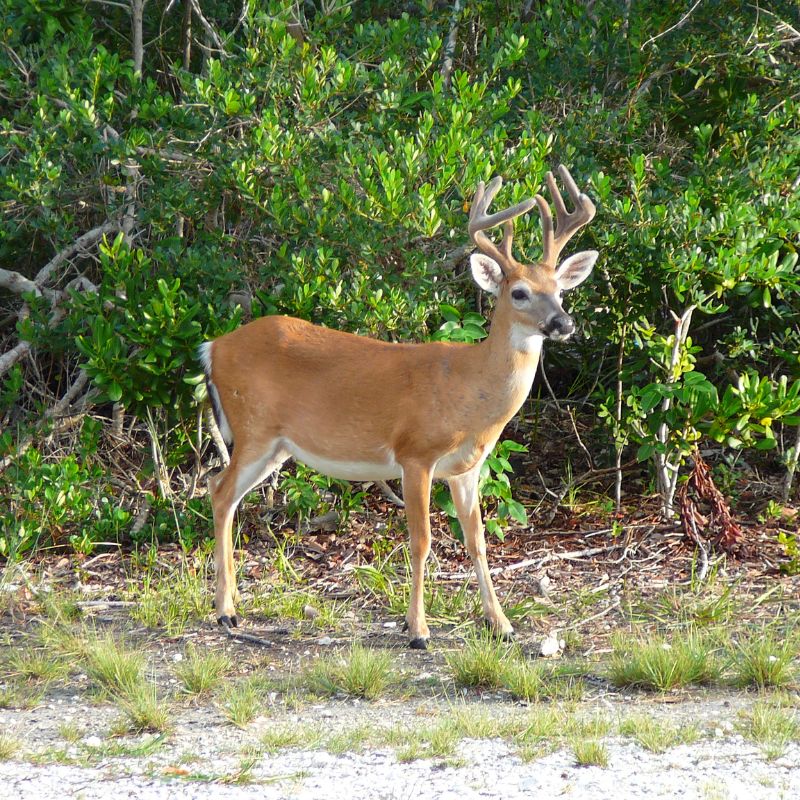
Florida panthers prey primarily on white-tailed deer (Odocoileus virginianus) and feral hog (Sus scrofa), supplemented by raccoon, armadillo, and the occasional alligator or wading bird. Their presence has measurable top-down effects on prey populations — the “landscape of fear” effect that causes deer to avoid certain areas and modify their foraging behaviour even when panthers are not physically present. This behavioural cascade propagates through the vegetation: areas where deer are suppressed by panther predation show measurably different plant community structure from areas without predation pressure.
Florida Panther
Puma concolor coryi
IUCN: Endangered (EN)
- Entire wild global population: ~120–230 adults confined to south Florida (FWC, 2023)
- Male territory: 75–200+ square miles; females maintain smaller, overlapping home ranges
- Prey: primarily white-tailed deer and feral hog; opportunistic predation on alligators and birds
- Road mortality on south Florida highways is the single largest cause of non-natural death
- Inbreeding depression (kinked tails, sperm abnormalities) reversed by 1995 Texas puma genetic rescue
- Wildlife crossings under Alligator Alley (I-75) have measurably reduced road kills since installation
- Listed as Endangered since 1967 — the first species protected under the Endangered Species Preservation Act
The Alligator: Engineer of the Everglades
The American alligator (Alligator mississippiensis) does not merely inhabit the Everglades. It builds it.
During the dry season, as water levels drop and surface water contracts to the deepest sloughs and solution holes, alligators excavate depressions in the marl and peat — the famous “gator holes” that retain water when the surrounding prairie has dried completely. These permanent pools concentrate fish, aquatic invertebrates, turtles, frogs, and waterbirds, functioning as dry-season refugia that sustain populations through the months when survival would otherwise be impossible. The alligator does not create this service intentionally. It simply digs where it needs to dig. The ecological consequence is a network of water retention features distributed across the landscape that no management programme has ever been able to replicate artificially.
Remove the alligator and the Everglades loses its plumbing.
Research coordinated by the National Park Service has documented that areas with active alligator populations support significantly higher species diversity than comparable habitats without them. The alligator is also the only animal in the Everglades large enough to open new channels through dense sawgrass, maintaining the hydrological connectivity between sloughs that the system depends on. And it is a prey base: alligator eggs are consumed by raccoons, skunks, and hogs; alligator hatchlings are eaten by large wading birds, herons, and otters; adult alligators are consumed by Florida panthers.
American Alligator
Alligator mississippiensis
IUCN: Least Concern (LC) — ESA recovery success
- Florida population: ~1.3 million; recovered from Endangered status (1967) to delisted by 1987
- Excavates “gator holes” — the dry-season refugia on which dozens of species depend for survival
- Only place in the world where alligators coexist with American crocodiles in the wild
- Nest mounds of vegetation reach 3 feet high; female guards nest and hatchlings for up to two years
- Digestion rate is temperature-dependent — in cool weather, adults may go months without feeding
- Role as ecosystem engineer is considered ecologically irreplaceable; no management substitute exists
Snail Kite: The Specialist
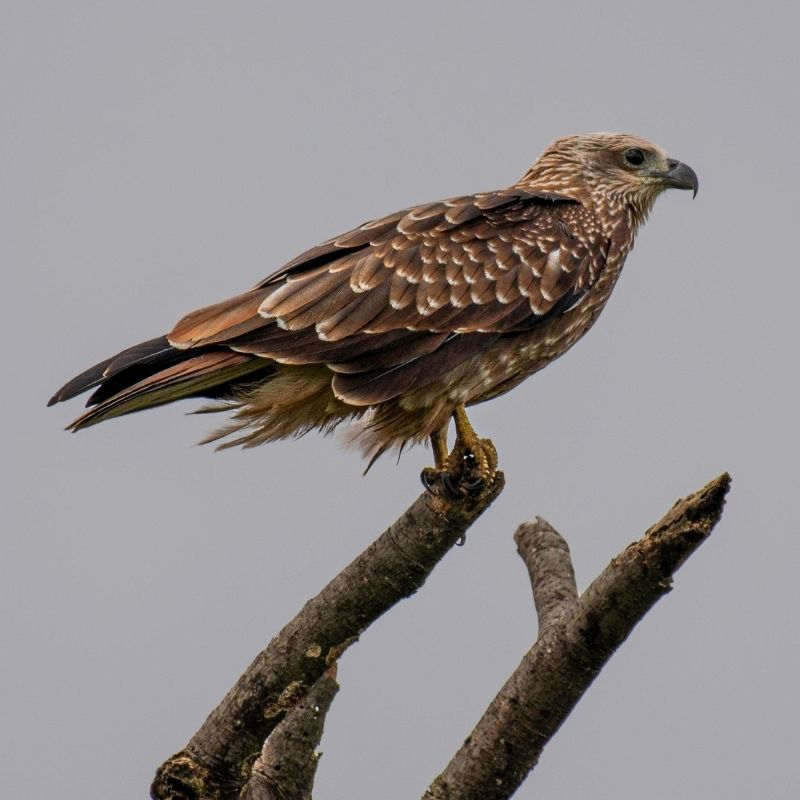
The snail kite (Rostrhamus sociabilis plumbeus) is one of the most ecologically constrained raptors in North America. It eats, in Florida, almost exclusively one prey item: the Florida apple snail (Pomacea paludosa). Its curved, slender bill — anatomically specialised for extracting the snail from its shell without breaking either bill or shell — is the morphological signature of a dietary specialisation so complete that the bird’s entire conservation fate is tied to the population dynamics of a single mollusc.
The snail kite crashed to approximately 700 individuals in the early 2000s, driven by droughts and the degradation of shallow-water aquatic vegetation that the Florida apple snail requires. An unexpected recovery followed. By 2022, the population had expanded to over 4,500 birds, partly driven by the bird’s ability to exploit the larger exotic island apple snail (Pomacea maculata and P. canaliculata) as a supplementary food source (FWC/University of Florida, 2023). The recovery has revised the species’ conservation outlook — though researchers note that reproductive success on exotic snails is lower than on the native species, and the population’s long-term trajectory remains a subject of active study.
From Periphyton to Panther: How Energy Moves Through the System
Every species in the Everglades is connected through a food web that begins in a microscopic algal mat and ends with an apex predator whose entire global population fits in a single Florida county.
The Everglades Food Web: From Periphyton to Panther
The Everglades food web begins not with sawgrass, not with fish, not with birds — but with a living crust on the bottom of the slough.
Periphyton is a mat-forming community of algae, bacteria, cyanobacteria, and associated microorganisms that grows on the limestone substrate and submerged vegetation of the Everglades interior. It is the primary producer of the entire system — the foundation on which every other trophic level is built. Ecologists estimate that periphyton accounts for the majority of primary productivity in the freshwater Everglades, and its density, composition, and spatial distribution are direct indicators of water quality. Elevated phosphorus — even at concentrations as low as 10 parts per billion above the natural background — causes periphyton communities to shift from calcite-precipitating forms to filamentous green algae, collapsing the base of the food web and triggering cascades that reach every level above it.
A healthy Everglades food web begins with clear water, low nutrients, and a living mat of microscopic organisms on the limestone floor.
Trophic Level 1: Primary Producers
Periphyton and aquatic macrophytes — submerged and emergent plants including sawgrass, spikerush (Eleocharis spp.), bladderwort (Utricularia spp.), and aquatic mosses — form the energy base. Periphyton fixes carbon through photosynthesis and also concentrates calcium carbonate, building the characteristic white marl substrate of the Everglades slough bottom. Sawgrass exports enormous quantities of organic matter through leaf litter decomposition, fuelling the detrital food web that underpins the system’s invertebrate diversity.
Trophic Level 2: Primary Consumers
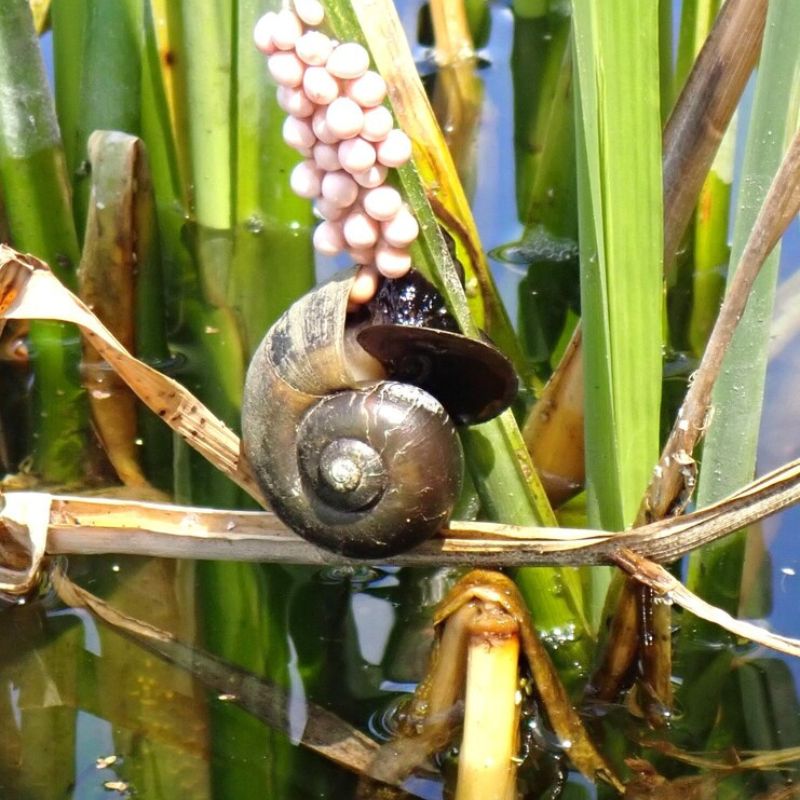
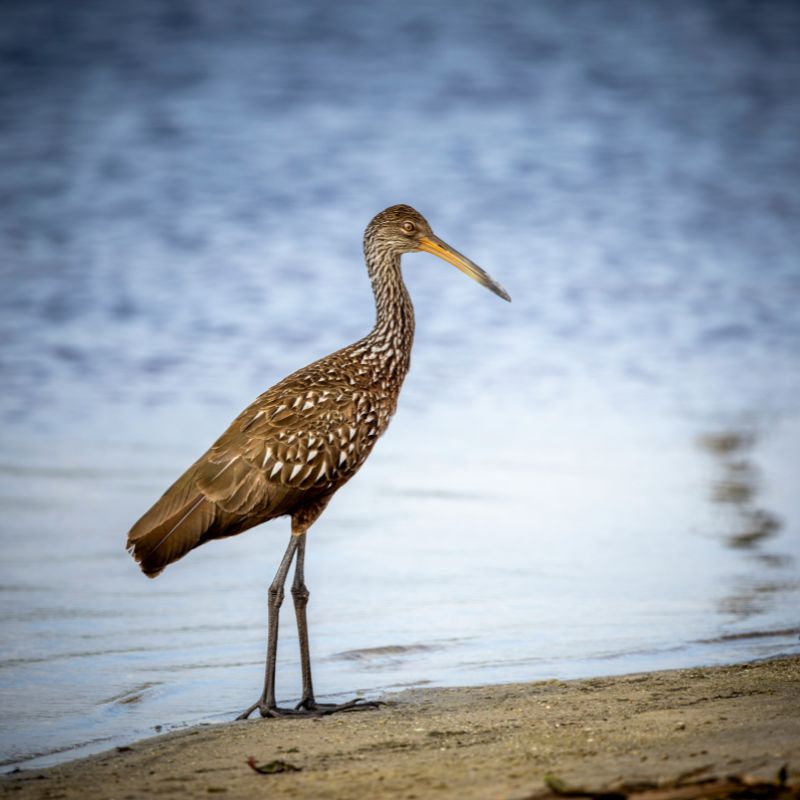
The Florida apple snail (Pomacea paludosa) is the most ecologically significant herbivore in the freshwater Everglades. It grazes periphyton and aquatic macrophytes, growing to a size that makes it the optimal prey for the two species most closely associated with Everglades conservation: the limpkin (Aramus guarauna) and the snail kite. Aquatic insects, amphipods, ostracods, and freshwater crayfish (Procambarus spp.) are the other primary consumers of the periphyton and detrital base. Crayfish are ecologically critical: they are the single most important prey item for many wading birds, and their abundance and accessibility — which tracks water depth and recession rate — is the proximate driver of wading bird breeding success.
Trophic Level 3: Secondary Consumers
Small fish — gambusia (Gambusia holbrooki), killifish (Fundulus spp.), sunfish (Lepomis spp.) — dominate this level in the Everglades slough. They feed on invertebrates and periphyton, and they are in turn the prey of wading birds, turtles, otters, and larger fish. The concentration of small fish in the receding sloughs and gator holes of the dry season is the triggering mechanism for wading bird colony formation — the availability of these prey at high density, in water shallow enough to wade, is what brings roseate spoonbills, wood storks, and white ibis together in the feeding aggregations that define the Everglades wildlife experience.
Trophic Level 4: Tertiary Consumers
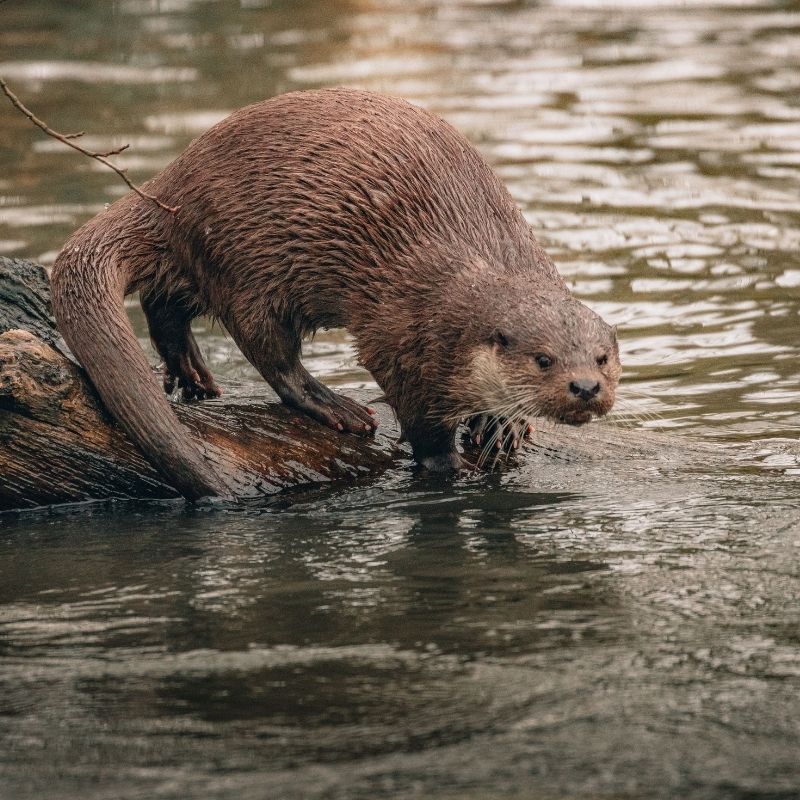
Large fish — Florida largemouth bass (Micropterus salmoides floridanus), bowfin (Amia calva), gar (Lepisosteus spp.) — and the American alligator occupy this level. The alligator is simultaneously a tertiary consumer and an ecosystem engineer: it concentrates prey in the gator holes it excavates, creating feeding stations that benefit every other predator in the system. Otters (Lontra canadensis), raccoons, and large wading birds including great blue herons and great egrets are also tertiary consumers, feeding on the small fish and invertebrate biomass produced at lower trophic levels.
Trophic Level 5: Apex Predators
The Florida panther sits at the apex of the terrestrial food web, preying primarily on white-tailed deer and feral hog. Its position at the top of the system gives it an outsized influence on prey population dynamics — the “landscape of fear” effect that changes deer movement patterns and habitat use even in areas where panthers are not actively hunting. The American alligator also functions as an apex predator in the aquatic system, consuming large fish, turtles, birds, and mammals. The American crocodile occupies the equivalent apex role in the saltwater mangrove fringe.
How the Python Has Disrupted This Web
The Burmese python has inserted itself between trophic levels 3 and 5, consuming medium-sized mammals — raccoons, opossums, marsh rabbits, deer — that were previously unavailable to a predator of its type in the Everglades system. The result is not simply a reduction in mammal populations. It is a restructuring of the food web. Raccoons were major predators of alligator eggs, wading bird eggs, and a wide range of invertebrates; their reduction has altered predation pressure at multiple levels simultaneously. The cascading effects of their removal are still being mapped, but research by Harvey et al. (2023) demonstrating reduced bobcat body condition — a species not directly consumed by pythons — confirms that the disruption extends to levels the python does not directly touch.
| Trophic Level | Key Species | Primary Food Source | Ecological Role |
|---|---|---|---|
| Primary producers | Periphyton, sawgrass, spikerush, aquatic macrophytes | Sunlight, nutrients | Energy base; water quality indicator; marl substrate builder |
| Primary consumers | Florida apple snail, crayfish, aquatic insects, killifish | Periphyton, plant matter, detritus | Link between producers and predators; key prey for snail kite and limpkin |
| Secondary consumers | Small fish (gambusia, sunfish), turtles, frogs | Invertebrates, periphyton, small prey | Dry-season prey concentration triggers wading bird breeding |
| Tertiary consumers | Largemouth bass, alligator, otter, wading birds | Small fish, invertebrates, amphibians | Alligator excavates gator holes; wading birds export nutrients via guano |
| Apex predators | Florida panther, American alligator (dual role), crocodile | Deer, hog, large fish, turtles, birds | Top-down regulation of prey behaviour and population structure |
| Invasive disruptor | Burmese python | Mammals, birds, alligators (subadults) | Removes medium-sized mammals; cascades affect multiple trophic levels |
💡 Key Takeaway
- Periphyton is the foundation of the entire Everglades food web. Phosphorus pollution that destroys periphyton communities ultimately reduces wading bird breeding success, fish populations, and apex predator prey availability.
- Crayfish density and accessibility — determined by water recession rate and timing — is the proximate trigger for wading bird colony formation. This is why water management timing matters as much as water quantity in Everglades restoration.
- The Burmese python has restructured the mammal layer of the food web, with cascading effects extending to species it does not directly consume. This is one of the most consequential invasive species impacts ever documented in a temperate ecosystem.
- Florida Apple Snail (Pomacea paludosa) — the food web keystone
- Limpkin (Aramus guarauna) — the snail specialist
- Snail Kite (Rostrhamus sociabilis plumbeus) — the raptor that eats one thing
- American Alligator (Alligator mississippiensis) — engineer and apex predator
- Florida Panther (Puma concolor coryi) — the landscape-scale apex predator
- Largemouth Bass (Micropterus salmoides floridanus)
The Python and the Collapse of the Mammal Community
The Burmese python is among the most ecologically damaging invasive predators documented in North America. Its effects on the Everglades mammal community are unprecedented.
The Python Invasion
The Burmese python (Python bivittatus) arrived in the Everglades through the pet trade — animals released by owners who underestimated how large they would grow. The first confirmed wild reproduction was documented in the late 1980s. By the 2010s, the population had established across the full extent of Everglades National Park and beyond, numbering in the tens of thousands.
The ecological consequences have been severe and thoroughly documented. Research published in PNAS (Dorcas et al., 2012) documented population declines of 75–99% in medium-sized mammals — raccoons, opossums, marsh rabbits, and bobcats — within the python’s established range, compared to areas outside it. These are not small declines. They represent the effective removal of entire functional groups from the food web, with consequences that cascade through every level of the system.
Few invasive predators in North American history have produced mammal community collapse at this scale or this speed.
The cascade has reached species the python does not even eat.
Research by Harvey et al. (2023, PNAS) documented that surviving bobcats in python-occupied areas show measurably reduced body condition compared to those in python-free areas — an indirect effect operating through prey depletion and the behavioural changes that predation risk induces. The python’s ecological footprint extends far beyond its direct kill rate.
As of 2024, over 21,000 Burmese pythons have been removed from Florida through FWC’s Python Elimination Programme and associated contractor and volunteer removal efforts. Population modelling suggests this represents a fraction of the total. Targeted breeding disruption using surgically implanted radio transmitters in “Judas snakes” — males tracked to locate aggregations of breeding females — has shown some promise as a removal strategy. The ecological damage in the Everglades, however, is established and largely irreversible on any near-term timescale.
⚠️ Conservation Alert
- Burmese python population: tens of thousands in and around Everglades National Park.
- Mammal declines within established range: 75–99% for raccoons, opossums, marsh rabbits, and bobcats (Dorcas et al., 2012, PNAS).
- South Florida supports roughly 200 introduced plant and animal species — one of the highest concentrations in the continental U.S. (SFWMD).
- Argentine tegus are nesting within 6 miles of Everglades National Park (USGS) and are expected to enter the park without sustained removal efforts.
- Over 21,000 pythons removed as of 2024 — estimated to represent a fraction of the total population.
🔬 Recent Research Highlight
Harvey et al. (2023, PNAS): Burmese python predation in the Everglades reduces bobcat body condition through prey depletion — a “fear ecology” cascade in which predator presence alters the physiology of prey species beyond the direct kill rate.
Currylow et al. (SFWMD 2024 Environmental Report): Analysis of python size distribution and reproductive cycles in the Greater Everglades confirms year-round reproduction and continued population growth, underscoring the long-term management challenge.
The Comprehensive Everglades Restoration Plan
Originally authorised at $8.2 billion in 2000, now projected at $23.2 billion (FY2020 dollars) over 50+ years. The most ambitious wetland restoration effort in U.S. history. Early results are measurable. The work is far from complete.
CERP: The Comprehensive Everglades Restoration Plan
The Comprehensive Everglades Restoration Plan (CERP), authorised by Congress in 2000, is the framework for restoring more natural water flows through the Kissimmee-Okeechobee-Everglades system. Its core premise is simple: the Everglades was degraded by mismanagement of water, and restoring the right quantity, quality, timing, and distribution of water to the system is the primary lever for ecological recovery.
Executing that premise is enormously complex.
The same water system that needs to be restored also provides drinking water for 8 million south Floridians, flood protection for a coastal urban corridor from Miami to Fort Lauderdale, and irrigation for one of the most productive agricultural regions in the country. CERP attempts to accomplish all of these simultaneously — storing more water during the wet season, treating it to remove agricultural phosphorus, and releasing it southward at the timing and rate the ecosystem requires.
🔧 Restoration in Progress
- Kissimmee River Restoration: 40+ miles of channelised river restored to meandering channel since late 1990s; wading bird and fish population responses documented.
- Taylor Slough Flow Improvement Project (completed 2023): 18 culverts installed along 3.2 miles of Old Ingraham Highway in Everglades National Park; increased freshwater flow to Florida Bay.
- Caloosahatchee Reservoir (initial operations expected 2025): ~170,000 acre-feet storage capacity; will reduce ecologically damaging Lake Okeechobee discharges to the northern estuaries.
- Stormwater Treatment Areas (STAs): constructed wetlands removing phosphorus from agricultural runoff before it enters the Everglades; over 57,000 acres of STAs operational.
- CERP Water Year 2023: record hydration in southern Everglades reported; Cape Sable seaside sparrow nesting success improved; alligator hole water retention improved during dry season (SFWMD, 2024).
💡 Key Takeaway
- Wading birds are the primary ecological indicator of CERP progress. Increased nesting in Everglades National Park and the southwest coast, driven by improved freshwater flows, is the most direct evidence that restoration is working.
- The 2018 wading bird season — 138,834 nests, the highest count since 1996 comprehensive surveys began — demonstrated what the system can produce when water conditions are right.
- Restoration success depends not only on how much water is delivered, but when. The dry-season drawdown timing that concentrates prey for wading birds is as ecologically critical as the total volume of water restored.
The 2024 SFWMD South Florida Environmental Report noted record hydration in the southern Everglades during Water Year 2023, measurable improvements in Cape Sable seaside sparrow nesting success, and continued progress on multiple CERP construction projects. The restoration is, in the cautious language of its overseers, producing ecological responses at ecosystem scale. Whether those responses will be sufficient, and sufficiently sustained, to return the Everglades to a biologically functional approximation of its pre-drainage state is the defining conservation question of south Florida’s next century.
Where to See the Everglades’ Wildlife
Accessible sites from Royal Palm to Flamingo, with alligators visible year-round and wading bird aggregations among the most spectacular in North America.
Where to See the Everglades’ Wildlife
| Site | Habitat | Key Species | Best Season | Key Feature |
|---|---|---|---|---|
| Anhinga Trail, Royal Palm | Freshwater marsh / slough | Anhinga, alligator, great blue heron, purple gallinule | Nov–Apr | Most productive short wildlife walk in the U.S.; species viewable at arm’s length |
| Mrazek Pond, ENP | Freshwater pond | Roseate spoonbill, wood stork, tricoloured heron, reddish egret | Dec–Apr (dry season) | Spectacular dry-season wading bird concentrations; photographers’ pilgrimage site |
| Shark Valley, ENP | Sawgrass prairie / slough | Alligator, snail kite, white ibis, anhinga, softshell turtle | Nov–Apr | 15-mile tram loop or bicycle path; panoramic tower view across sawgrass |
| Eco Pond, Flamingo | Coastal freshwater pond | Roseate spoonbill, alligator, waterfowl, wading birds | Nov–Apr | South Florida’s most reliable roseate spoonbill viewing site |
| Flamingo / Florida Bay | Mangrove / marine | American crocodile, bottlenose dolphin, manatee, osprey | Year-round | Southern terminus of the park; crocodile most reliably seen at Flamingo Marina |
| Big Cypress NP | Cypress swamp / hammock | Florida panther (rare), black bear, white-tailed deer, barred owl | Nov–Apr | Florida panther core range; best chance of panther sign on Loop Road |
| Ten Thousand Islands NWR | Mangrove / estuary | Bottlenose dolphin, manatee, osprey, bald eagle, shore birds | Year-round | Kayak access to one of the most productive coastal systems in North America |
| Pa-hay-okee Overlook, ENP | Sawgrass prairie | Short-tailed hawk, swallow-tailed kite (spring), raptors | Year-round | Elevated boardwalk over sawgrass; best place in park to see the River of Grass in full |
🗓️ Everglades Wildlife Seasonal Guide
- Nov–Apr (Dry Season): Peak wildlife season. Wading birds concentrate around receding water. Alligators active. Anhinga Trail and Mrazek Pond at their most spectacular. Florida panther activity increases as deer concentrate. Best photography conditions.
- Dec–Mar: Roseate spoonbills at peak numbers in Florida Bay and Ten Thousand Islands. American crocodile most visible at Flamingo. Waterfowl on interior ponds. Cooler temperatures make extended walking comfortable.
- Apr–May: Swallow-tailed kite migration through south Florida. Breeding season begins for many species. Water at seasonal low; maximum prey concentration. Nest activity in heron and ibis colonies.
- Jun–Oct (Wet Season): Summer rains rehydrate the system. Wading birds disperse. Mosquitoes at peak. Water levels rise, reducing terrestrial wildlife access. Alligator nesting. Sea turtles on south Florida beaches. Green anoles and other reptiles highly active.
Recent Research in Everglades Ecology (2020–2025)
The Everglades is one of the most intensively studied wetland ecosystems in the world, with ongoing research programmes at the USGS Wetland and Aquatic Research Center, the University of Florida, Florida International University, the National Park Service, and Audubon Florida. Key findings from the past five years:
- Python-bobcat cascade (Harvey et al., 2023, PNAS): The first documentation of indirect, physiological cascade effects from Burmese python invasion. Surviving bobcats in python-occupied areas show reduced body condition compared to those in python-free areas — evidence that the invasion’s ecological footprint extends well beyond the direct kill rate through prey depletion and fear-mediated behaviour change.
- CERP hydrology and bird response (SFWMD, 2024 SFER): Water Year 2023 delivered record freshwater flows to the southern Everglades. Cape Sable seaside sparrow nesting success improved measurably. Alligator holes in Taylor Slough maintained water through the dry season at higher rates than in previous decades. Early evidence that restoration investment is producing ecosystem-scale biological response.
- Wading bird colony dynamics (Audubon Florida / SFWMD 2022–23 Wading Bird Report): The combined report documented below-average nesting for most species in both 2022 and 2023, with particularly severe declines in wood stork nesting at historic sites including Corkscrew Swamp Sanctuary (36 nesting pairs in 2023, compared to up to 7,000 historically). Climate-driven rainfall irregularity identified as a compounding factor alongside structural water management issues.
- Snail kite population expansion (FWC/University of Florida, 2023): Population grew from ~700 to >4,500 birds between 2007 and 2022, partly driven by exploitation of exotic island apple snails. The study revised the species’ conservation trajectory upward but flagged lower reproductive success on exotic prey as an ongoing monitoring concern.
- Python reproductive biology (Currylow et al., SFWMD 2024 SFER): Analysis of python size distribution and reproductive cycles in the Greater Everglades confirmed year-round breeding activity and continued population growth, complicating removal programme planning and underscoring the long-term management challenge.
Conclusion: A System Worth Fighting For
The Everglades is impaired. It is not broken beyond recovery.
That distinction matters. The system has lost half its original area, a large fraction of its wading birds, and the functional mammal community of its most iconic sector. It is invaded by plants and animals that did not exist here fifty years ago. It is managed by a water delivery infrastructure built for flood control and urban water supply rather than ecological health.
And yet. The sawgrass still stretches to the horizon. The alligators still excavate their gator holes. In a good water year, the roseate spoonbills still work the Florida Bay shallows in numbers that stop visitors cold. The wood storks still nest. The panthers still move through Big Cypress at night, their presence logged by trail cameras and GPS collars, their territory requirements making them the most demanding and most revealing test of landscape connectivity in south Florida.
The Everglades is not a museum. It is an active, dynamic system that responds — measurably, sometimes dramatically — to management decisions made today.
The 2018 wading bird season, with its 138,834 nests, was not an accident. It followed years of improved water deliveries to the southern Everglades under early CERP projects. The Cape Sable seaside sparrow improvement documented in 2023 followed the Taylor Slough Flow Improvement Project. These are not coincidences. They are data points in a long experiment in ecological restoration, and they are among the most important conservation data being generated anywhere on Earth.
What the Everglades requires is what it has always required: the right amount of water, in the right places, at the right time. Achieving that — within a landscape that also needs to serve 8 million people — is the defining ecological engineering challenge of the twenty-first century in the United States. The science is sound. The political will is partial. The work continues.
NativesOfNature’s Everglades coverage is built around the understanding that this ecosystem cannot be understood through any single species, any single habitat, or any single threat. It is a system. Understanding it as a system is the prerequisite for protecting it.
Frequently Asked Questions
Q: What animals live in the Everglades?
The Everglades supports an extraordinary diversity: 360+ bird species, approximately 300 fish species, 50+ reptile species (including 27 snake species within the national park), 17 amphibian species, and 40 mammal species (NPS). Iconic species include the American alligator, American crocodile, Florida panther, West Indian manatee, roseate spoonbill, wood stork, snail kite, and numerous wading birds. The Everglades is the only place on Earth where American alligators and American crocodiles coexist in the wild.
Q: Is the Everglades a swamp?
Not exactly. The Everglades is more accurately described as a very slow-moving river — a wide, shallow sheet of water flowing southward from Lake Okeechobee to Florida Bay, at roughly a quarter-mile per day. Author Marjory Stoneman Douglas memorably called it the “River of Grass” in her landmark 1947 book. The system encompasses multiple distinct habitat types including sawgrass prairies, hardwood hammocks, cypress domes, mangroves, and marine/estuarine habitats — not simply a swamp in the conventional sense.
Q: What is the biggest threat to the Everglades?
The primary structural threat is altered hydrology: the twentieth-century construction of more than 1,700 miles of canals, 720 miles of levees, and 200 water control structures to drain and redirect water for agriculture and urban development fundamentally changed the quantity, timing, and distribution of water through the system. This disruption is the root cause of most ecological problems, including wading bird decline, seagrass loss in Florida Bay, and the degradation of south Florida estuaries. Secondary threats include nutrient pollution (especially phosphorus from agricultural runoff), invasive species (Burmese python, Argentine tegu, exotic plants), sea-level rise, and climate-driven changes to rainfall patterns.
Q: What is CERP and is it working?
The Comprehensive Everglades Restoration Plan (CERP), authorised by Congress in 2000, is a federal-state plan — originally costed at $8.2 billion and now projected at $23.2 billion (FY2020 dollars, Congress.gov CRS, 2024) — to restore more natural water flows through the Kissimmee-Okeechobee-Everglades system. Early results are measurable: a record-high wading bird nesting season in 2018 (138,834 nests); improved freshwater flows to the southern Everglades documented in Water Year 2023; Cape Sable seaside sparrow nesting improvements following the Taylor Slough Flow Improvement Project; and Kissimmee River meander restoration with documented fish and bird community responses. However, construction progress has been slower than originally projected, and climate-driven rainfall variability is adding new complexity to restoration planning.
Q: Can you see Florida panthers in the Everglades?
Confirmed sightings of Florida panthers by park visitors are rare — the animals are crepuscular and largely nocturnal, and their territories encompass enormous areas of mostly inaccessible cypress swamp and sawgrass prairie. The best place to look for panther sign (tracks, scrapes, camera trap images displayed at visitor centres) is along the Loop Road in Big Cypress National Preserve, adjacent to the park. FWC’s GPS-collaring programme tracks known individuals, but real-time location data is not public. Your most reliable encounter is the evidence — a large paw print in the mud of a cypress strand — rather than the animal itself.
Q: What is the best time to visit the Everglades for wildlife?
The dry season, from November through April, is overwhelmingly the best time for wildlife observation. As water levels drop, fish and aquatic invertebrates concentrate in the remaining ponds, sloughs, and gator holes, drawing wading birds in numbers that can be spectacular. The Anhinga Trail at Royal Palm and Mrazek Pond near Flamingo are at their most productive during January through March. Summer (June–October) is the wet season: water levels are high, wildlife disperses across the flooded landscape, and mosquitoes are intense. It is ecologically important — this is when the system recharges — but far less accessible for visitors.
Q: What happened to the Burmese pythons in the Everglades?
Burmese pythons (Python bivittatus), introduced through the pet trade, have established a wild population in and around Everglades National Park estimated in the tens of thousands. Their ecological impact has been severe: research published in PNAS (Dorcas et al., 2012) documented declines of 75–99% in medium-sized mammal populations — raccoons, opossums, marsh rabbits, and bobcats — within the python’s established range. Over 21,000 pythons have been removed as of 2024 through FWC’s Python Elimination Programme and associated efforts. Population modelling suggests this represents a small fraction of the total. No technique has yet been demonstrated to be capable of meaningfully reducing the overall population.
- Audubon Florida / SFWMD. (2022–23). Wading Bird Nesting in the Everglades: 2022–23 Season Overview.
- Dorcas, M.E., et al. (2012). Severe mammal declines coincide with proliferation of invasive Burmese pythons in Everglades National Park. PNAS, 109(7), 2418–2422.
- Douglas, M.S. (1947). The Everglades: River of Grass. Rinehart & Company.
- Harvey, R.G., et al. (2023). Indirect effects of Burmese python invasion on native carnivore body condition. PNAS.
- National Park Service (NPS). Everglades National Park — Wildlife and Ecology. nps.gov/ever.
- National Wildlife Federation (NWF). The Everglades. nwf.org.
- South Florida Water Management District (SFWMD). (2024). 2024 South Florida Environmental Report, Volume I. West Palm Beach, FL.
- South Florida Water Management District (SFWMD). Everglades Overview. sfwmd.gov.
- U.S. Geological Survey (USGS). Ecology of Everglades National Park. usgs.gov.
- Welch, R.A., et al. (2023). Snail kite population expansion and exotic apple snail use in Florida. Biological Conservation, 278, 109871.