Introduction
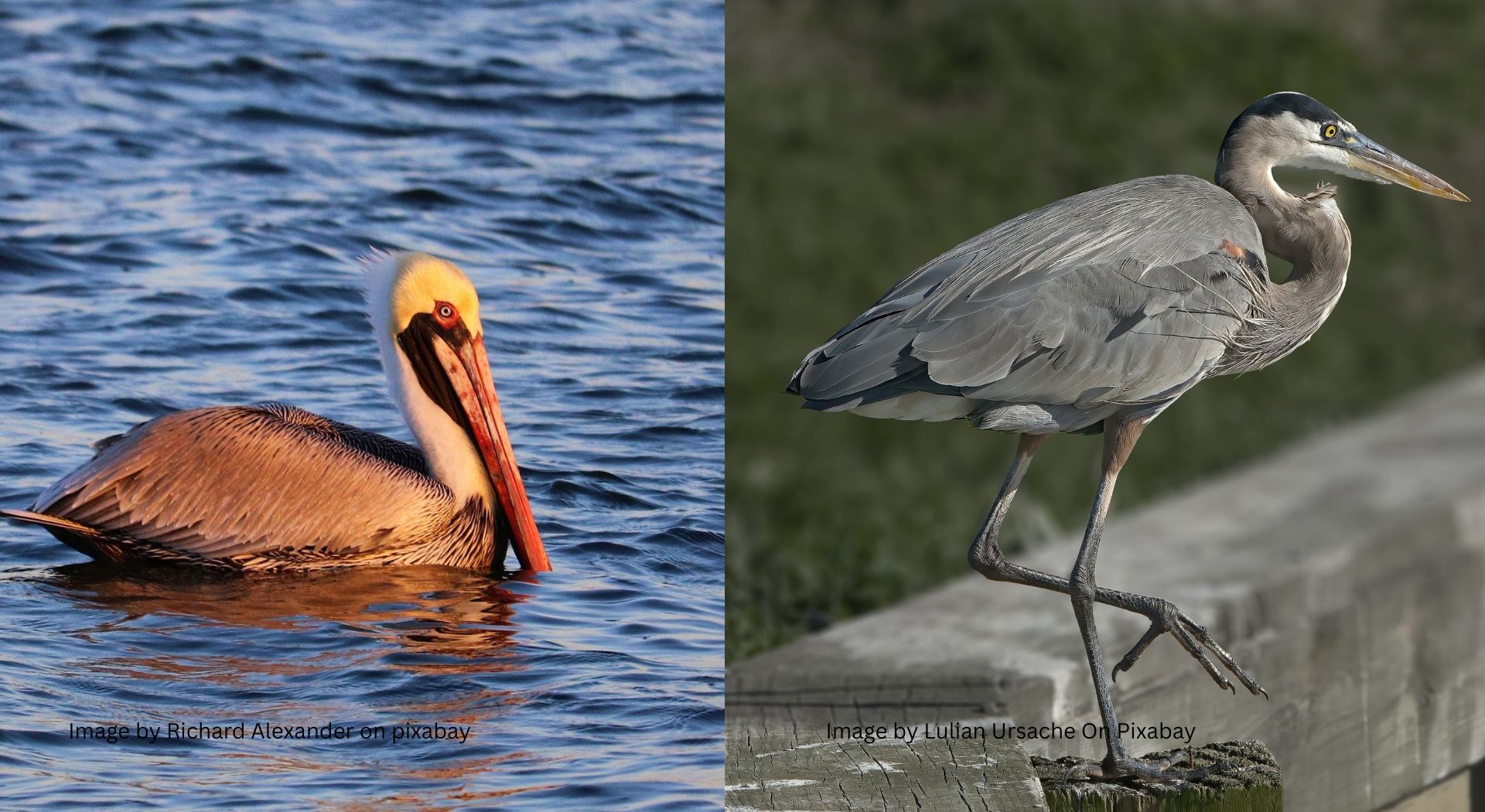
The Brown Pelican (Pelecanus occidentalis) and the Great Blue Heron (Ardea herodias) are two prominent fish-eating birds commonly observed along North American coastlines, estuaries, and wetlands. Despite often feeding in the same coastal ecosystems, they belong to very different bird groups and employ fundamentally different fishing strategies. The Brown Pelican is a seabird in the family Pelecanidae, adapted for plunge-diving in open water, while the Great Blue Heron belongs to the family Ardeidae, a group of long-legged wading birds specialized for hunting in shallow wetlands and shorelines.
Both species are successful predators of fish and other aquatic animals, yet their approaches to capturing prey contrast sharply. Brown Pelicans hunt by diving from the air and scooping fish with a large expandable throat pouch. Great Blue Herons rely on patience and precision, standing or slowly stalking in shallow water before striking prey with a rapid spear-like motion of the bill powered by the neck’s elastic musculature.
Because these birds often forage in overlapping coastal habitats, comparing their fishing methods reveals two contrasting ecological strategies: high-energy aerial plunge-diving versus low-energy wading and ambush predation. Ornithological data summarized by organizations such as the Cornell Lab of Ornithology and the U.S. Fish and Wildlife Service highlight how these specialized approaches allow both birds to exploit coastal fish resources while minimizing direct competition.
Quick Comparison Table
| Feature | Brown Pelican | Great Blue Heron |
| Scientific Name | Pelecanus occidentalis | Ardea herodias |
| Taxonomic Classification | Family Pelecanidae | Family Ardeidae |
| Geographic Range | Coastal Americas | North and Central America |
| Habitat Preference | Marine coasts, bays, estuaries | Shallow wetlands, marshes, estuaries |
| Average Size | Length: 1–1.52 m (3.3–5 ft); Weight: 2–5 kg (4.4–11 lb) | Length: 0.97–1.37 m (3.2–4.5 ft); Weight: 2.1–3.6 kg (4.6–7.9 lb) |
| Key Physical Difference | Expandable throat pouch for scooping fish | Long legs and dagger-like spear bill |
| Behavioral Difference | Aerial plunge-diving hunter | Wading ambush predator |
| Conservation Status | Least Concern (IUCN) | Least Concern (IUCN) |
1. Fishing Method: Plunge-Diving vs Wading Ambush
The most important distinction between these birds is the method used to capture fish. Brown Pelicans rely on aerial plunge-diving, whereas Great Blue Herons hunt by wading and striking prey from shallow water.
Brown Pelicans typically search for prey while flying 18–21 meters (60–70 feet) above coastal waters. When they detect a school of fish near the surface, they fold their wings and dive headfirst into the water at speeds approaching 18 meters per second (about 40 mph). At the moment of impact the pelican opens its bill and expands the gular pouch, trapping fish together with several liters of water before draining the water and swallowing the catch.
Great Blue Herons use a completely different technique. They stand motionless in shallow water or slowly stalk prey while wading through marshes or tidal flats. When a fish comes within reach, the heron extends its neck forward in a rapid strike that can occur in tens of milliseconds, seizing or impaling the prey with its sharp bill.
These strategies reflect contrasting hunting philosophies. Pelicans use high-speed aerial attacks to capture multiple fish, while herons rely on precision ambush strikes on individual prey in shallow habitats.
2. Water Depth and Foraging Habitat
Another key difference between the two species involves the depth of water in which they hunt. Brown Pelicans are adapted to forage in open coastal waters, whereas Great Blue Herons specialize in shallow shoreline environments.
Pelicans dive into water that may be several meters deep, but their prey is typically concentrated within the upper portion of the water column. Their plunge-diving strategy allows them to exploit schooling fish in bays, coastal lagoons, and offshore waters where wading birds cannot hunt effectively.
Great Blue Herons, in contrast, require shallow water where they can stand or walk. Most hunting occurs in depths less than about 50 centimeters (20 inches). Their long legs allow them to wade into tidal flats, marsh edges, mudflats, and riverbanks while keeping the body above the water surface.
These habitat preferences strongly reduce competition between the species. Pelicans dominate open-water feeding zones, while herons excel in nearshore and marsh environments where plunge-diving would be ineffective or dangerous.
3. Capture Tools: Scoop vs Spear
The anatomical tools used by each bird illustrate their contrasting fishing strategies. Brown Pelicans use a scoop-like bill and pouch, while Great Blue Herons rely on a spear-like bill.
The pelican’s bill measures roughly 28–35 cm (11–13.7 inches) and supports a flexible throat pouch capable of holding about 11 liters (roughly 3 gallons) of water and fish. During a dive, the pouch expands dramatically and functions as a net that captures several fish simultaneously before the water is expelled.
Great Blue Herons possess a long, pointed bill designed for stabbing or grasping prey. Their neck contains specialized vertebrae and elastic tendons that store energy as the neck bends, allowing a powerful forward extension during the strike. This mechanism produces extremely rapid bill movement capable of capturing fish before they can escape.
The pelican’s feeding apparatus is therefore optimized for bulk capture of small schooling fish, while the heron’s spear-like bill enables precise capture of individual prey in shallow water.
4. Foraging Behavior: Active vs Patient Hunting
The behavior of these birds while searching for prey also differs dramatically. Brown Pelicans are active hunters, whereas Great Blue Herons rely on stillness and patience.
Pelicans typically patrol coastlines or bays while gliding low over the water, often flying in loose groups. In areas where schooling fish are abundant, several pelicans may dive repeatedly in the same location, creating brief periods of intense feeding activity. Group diving may also help concentrate fish near the surface.
Great Blue Herons adopt a different strategy known as “stand-and-wait” hunting. A heron may remain almost motionless for extended periods, sometimes many minutes, waiting for fish to approach within striking distance. They may also stalk slowly through shallow water with deliberate steps that minimize surface disturbance.
These contrasting strategies reflect energy trade-offs. Pelican fishing requires substantial energy expenditure through flight and diving, whereas heron hunting relies on low-energy patience and stealth.
5. Prey Type and Size
The types of prey targeted by these birds also differ. Brown Pelicans typically capture small schooling fish, while Great Blue Herons consume a broader range of prey species.
Pelicans frequently feed on anchovies, sardines, herring, and menhaden. Because these fish occur in dense surface schools, pelicans can capture several individuals in a single plunge dive.
Great Blue Herons target fish generally 10–20 cm (4–8 inches) long but also consume crustaceans, amphibians, reptiles, and occasionally small mammals. Their hunting method allows them to exploit prey living in shallow wetlands, tidal creeks, and shoreline habitats.
These differences illustrate how prey availability shapes hunting strategy. Pelicans specialize in abundant marine forage fish, whereas herons function as generalist predators capable of exploiting many aquatic prey types.
6. Sensory and Physiological Adaptations
Each species also possesses specialized adaptations that improve fishing success in its respective environment.
Brown Pelicans have subcutaneous air sacs beneath the skin that help absorb the impact of high-speed water entry during dives. These air sacs also contribute to buoyancy, allowing the bird to resurface quickly after striking the water. Their visual system is adapted for detecting fish schools from above the surface while flying.
Great Blue Herons possess different adaptations suited to wading predation. Their feathers include specialized powder down patches, which produce fine keratin particles that help remove fish slime and oils from the plumage during preening. Their eyes contain high densities of rod photoreceptors, enabling effective vision in low-light conditions, which allows hunting at dawn, dusk, and occasionally at night.
These physiological traits support two distinct ecological niches: pelicans are adapted for high-impact aerial fishing, while herons are optimized for visual hunting in shallow wetlands and low-light environments.
Key Takeaways
- Brown Pelicans capture fish by plunge-diving from the air, while Great Blue Herons hunt by wading and striking prey with a spear-like bill.
- Pelicans dominate open coastal waters, whereas herons specialize in shallow marshes, mudflats, and shoreline habitats.
- Pelicans use a large pouch to scoop multiple fish, while herons capture individual prey with rapid stabbing strikes.
- Pelican hunting involves high-energy flight and diving, whereas herons rely on low-energy ambush techniques.
- Both birds are highly effective coastal fishers but occupy different ecological niches that minimize direct competition.