Introduction
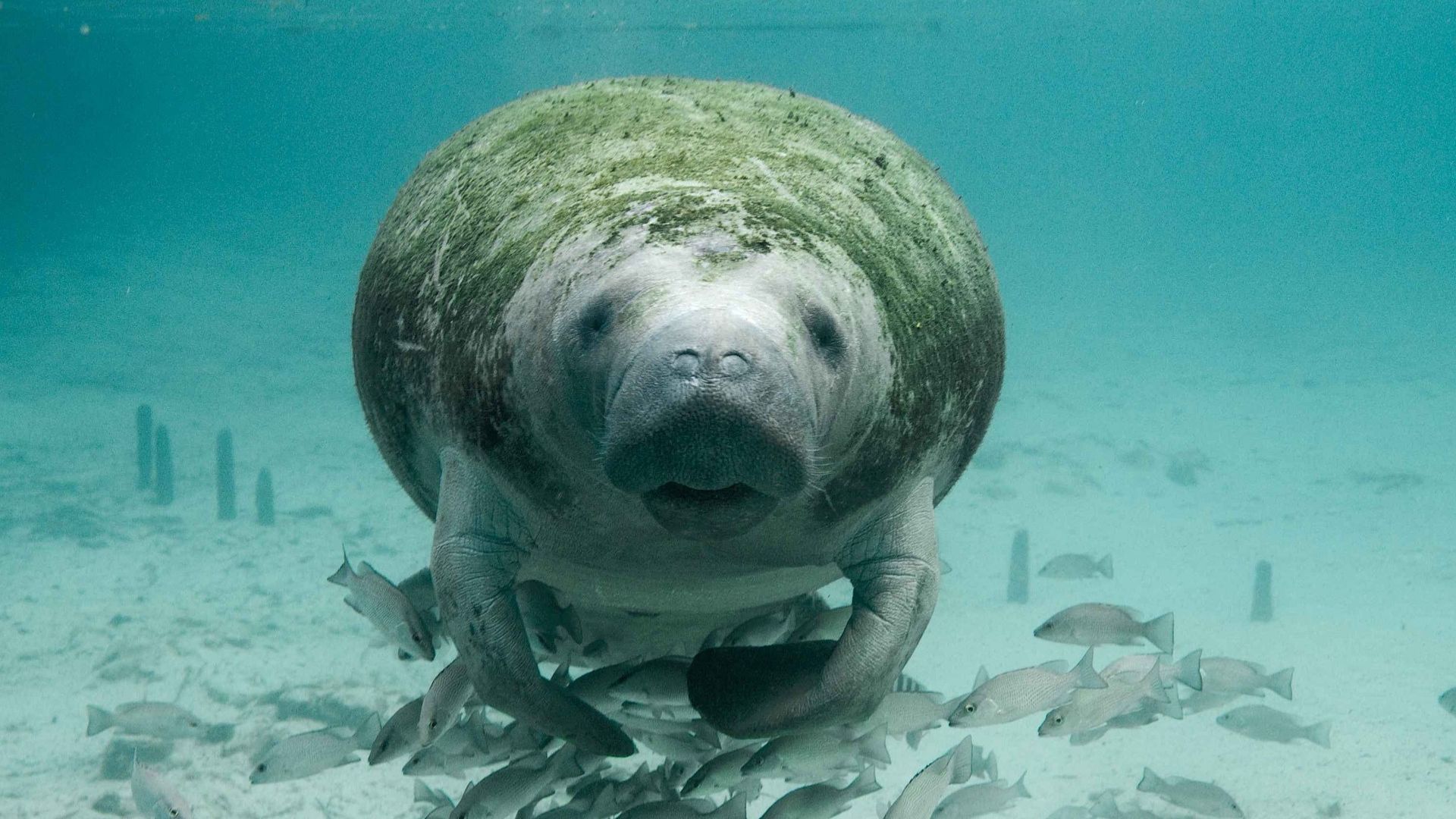
The Florida manatee (Trichechus manatus latirostris) is a large aquatic mammal often described as a slow-moving, gentle herbivore of coastal and freshwater systems. Despite being well-studied by organizations such as NOAA Fisheries and the U.S. Fish and Wildlife Service, manatees remain surrounded by persistent myths. These misconceptions stem from their unusual body shape, slow grazing behavior, and long history in folklore.
Scientific research has clarified many of these misunderstandings, revealing that manatees possess specialized physiology, distinct evolutionary relationships, and tightly constrained environmental tolerances. Misinterpreting these traits can lead to incorrect assumptions about their behavior, biology, and risk factors in human-dominated habitats.
Examining common myths through a scientific lens provides insight into how manatees actually function as herbivorous marine mammals. The following sections debunk nine widespread myths using established biological mechanisms, quantified observations, and long-term monitoring data.
1. Myth: Manatees Have No Natural Threats
It is often claimed that Florida manatees face no real dangers because they lack significant natural predators. While adult manatees experience minimal predation, this does not equate to safety.
Mortality records compiled by the U.S. Fish and Wildlife Service and state agencies consistently show that watercraft collisions are a leading cause of death, often accounting for roughly 20–25% of annual documented mortalities in Florida. Their slow cruising speed and need to surface frequently increase collision risk.
Additional threats include seagrass habitat loss, exposure to brevetoxins during red tide events, and entanglement in fishing gear. These factors reduce survival despite the absence of natural predators.
Scientifically, the myth confuses “lack of predation” with “lack of risk,” ignoring the dominant role of anthropogenic mortality in shaping population dynamics.
2. Myth: Manatees Are Exceptionally Intelligent
Manatees are sometimes described as highly intelligent, but neuroanatomical data show otherwise.
Their brain mass is approximately 300–400 grams in adults weighing several hundred kilograms, resulting in a very low encephalization quotient (EQ), with brain tissue comprising roughly 0.02–0.03% of body mass. This is substantially lower than in dolphins.
However, this does not indicate dysfunction. Manatees demonstrate learning ability, spatial memory (e.g., migration to warm-water refuges), and sensory discrimination. Their brain is adapted for processing tactile and environmental information rather than complex social cognition.
This reflects an energy trade-off: neural tissue is metabolically expensive, and a herbivorous diet with low caloric density favors reduced brain investment.
Thus, manatees exhibit functional, niche-specific cognition rather than advanced intelligence.
3. Myth: Manatees Are Always Slow and Sluggish
Manatees are widely perceived as slow because they typically move at 3–5 km/h (2–3 mph) while grazing.
However, telemetry and field observations show they can reach burst speeds of approximately 25–30 km/h (15–20 mph) for short durations when startled. These bursts are powered by strong dorsoventral movements of the tail fluke, similar to propulsion in whales.
Their usual slow speed is not a limitation but an adaptation. As herbivores consuming low-energy vegetation, manatees conserve energy by minimizing unnecessary movement.
The myth arises from observing routine behavior rather than maximum performance. Scientifically, manatees combine low cruising speeds with the capacity for rapid acceleration when required.
4. Myth: Manatees Can Breathe Underwater
Manatees are sometimes assumed to breathe underwater due to their ability to remain submerged for extended periods.
In reality, they are obligate air-breathing mammals. During active behavior, they surface every 3–5 minutes. When resting, they can extend breath-hold duration to approximately 15–20 minutes due to reduced metabolic demand.
Physiologically, manatees exchange a large proportion of lung air—up to ~90%—with each breath, far exceeding human ventilation efficiency. Their lungs extend along the dorsal body axis, aiding both respiration and buoyancy control.
They also exhibit bradycardia during submergence, reducing oxygen consumption.
Thus, while manatees can remain underwater for significant periods, they cannot extract oxygen from water and must surface regularly to breathe.
5. Myth: Manatees Have Excellent Vision
Manatees are sometimes assumed to rely heavily on vision, but their visual acuity is limited.
Their eyes are small (approximately 1–1.5 cm in diameter) and positioned laterally, providing a wide field of view but relatively low resolution. Studies of retinal structure indicate reduced ganglion cell density, consistent with low-detail vision.
Instead, manatees rely primarily on tactile sensing. Their facial vibrissae act as mechanoreceptors capable of detecting water movement and physical contact with vegetation.
This sensory system is particularly effective in turbid environments where visibility is often less than one meter.
Thus, manatees are not visually oriented animals; their perception is dominated by tactile and environmental cues rather than sharp vision.
6. Myth: Manatees Use Flatulence to Control Buoyancy
A persistent claim suggests that manatees regulate buoyancy using intestinal gas. This is incorrect.
Buoyancy control is primarily achieved through lung volume regulation. By adjusting inhalation and exhalation, manatees alter body density and vertical position in the water column.
Their skeletal structure also contributes: dense, pachyostotic bones act as ballast, countering the natural buoyancy of air-filled lungs.
Although fermentation of plant material produces gas in the digestive tract, this gas is not used as a controlled buoyancy mechanism and is released passively.
Scientifically, buoyancy regulation is a respiratory and structural process, not a digestive one.
7. Myth: Manatees Are Related to Dolphins
Manatees are often assumed to be closely related to dolphins due to their aquatic lifestyle. In reality, they belong to entirely separate evolutionary lineages.
Manatees are members of the order Sirenia, which shares a common ancestor with elephants (order Proboscidea) within the clade Paenungulata. Dolphins belong to the order Cetacea, which evolved from terrestrial hoofed mammals.
This divergence occurred approximately 50–60 million years ago.
The evolutionary distinction explains major anatomical differences: manatees have flat molars for grinding plants and lack a dorsal fin, while dolphins possess conical teeth, streamlined bodies, and echolocation systems.
Thus, their similarity is a result of convergent evolution, not close genetic relationship.
8. Myth: Manatees Can Tolerate Cold Water
Florida manatees are highly sensitive to temperature despite living in coastal environments.
They lack a thick blubber layer, with only minimal subcutaneous fat, and have a relatively low metabolic heat output. Water temperatures below ~20°C (68°F) can induce cold stress.
Prolonged exposure to temperatures below ~18°C (64°F) can lead to cold stress syndrome, characterized by reduced feeding, immune suppression, and increased mortality.
To survive winter conditions, manatees aggregate at warm-water refuges such as natural springs (typically 22–24°C) or power plant discharge sites.
This physiological constraint strongly limits their geographic distribution and seasonal movement patterns.
9. Myth: Manatees Can Be Safely Touched or Fed
Because of their calm behavior, some people assume it is harmless to interact with manatees. In reality, such interactions are both harmful and illegal.
Under the Marine Mammal Protection Act and Florida regulations, it is prohibited to feed, touch, or harass manatees. Violations can result in substantial fines and penalties.
Biologically, human interaction can lead to habituation. Manatees that associate humans with food may approach boats more frequently, increasing the risk of propeller injuries.
Additionally, feeding disrupts natural foraging behavior and can alter migration patterns, particularly movement to warm-water refuges.
Maintaining distance is therefore essential to preserve natural behavior and reduce mortality risk.
Key Takeaways
• Manatees face significant human-related mortality despite minimal natural predation
• Their low brain-to-body ratio reflects energy-efficient neural design, not dysfunction
• They are capable of burst speeds up to ~30 km/h, despite slow routine movement
• Manatees are obligate air-breathers with highly efficient lung ventilation
• Buoyancy is controlled through lung volume and bone density, not digestive gas
• They are evolutionarily closer to elephants than dolphins
• Cold sensitivity below ~20°C strongly restricts survival and distribution