America’s living fighter jet — an apex predator with 20/5 vision, 75 mph (120 km/h) dives, and a 400 psi (2,758 kPa) grip strong enough to crush bone.
The Bald Eagle (Haliaeetus leucocephalus) isn’t just a national symbol — it’s a biological marvel engineered by evolution to rule the skies.
Vision Beyond Imagination
The Bald Eagle sees the world with four to five times the clarity of human vision. Its sight — measured at 20/5 — allows it to spot a fish rippling the water two miles (3.2 km) away.
Each eye contains over one million photoreceptor cells per square millimeter, twice the density of a human retina. It has two foveae — one for razor-sharp forward focus and another for peripheral motion detection — giving both telescopic and panoramic precision.
Bonus features of nature’s best optics:
- 340° field of view ensures no blind spots while soaring.
- UV perception reveals reflective fish scales and mammal urine trails.
- Nictitating membrane (third eyelid) cleans and shields the eyes in mid-dive.
“An eagle’s eye is more telescope than camera.”
— Smithsonian National Zoo
Flight Engineering: The Physics of Power
| Feature | Function | Advantage |
| Wingspan | 6.5–7.5 ft (2–2.3 m) | Massive lift for effortless soaring |
| Wing loading | ~0.7 g/cm² | High lift-to-weight ratio |
| Hollow bones | Reduce mass by ~30% | Strong yet ultra-light frame |
| Feather slots | Channel airflow | Silent, turbulence-free gliding |
Bald Eagles soar for hours without flapping, riding thermals that carry them thousands of feet into the air. Their hollow skeleton (only 5% of body weight) and aerodynamic primaries turn air currents into lift, while the tail acts as a rudder for pinpoint control.
In essence, every flight is a masterclass in energy efficiency — a feat modern aerospace design still strives to imitate.
Precision Predator: The Hunt in Four Steps
Average cruise speed: 30–40 mph (48–64 km/h).
Dive speed (stoop): up to 75 mph (120 km/h).
- Scan: From 300 ft (91 m) above water, the eagle locks onto prey using UV vision.
- Dive: Folds wings tight, diving at 75 mph (120 km/h) in near silence.
- Snatch: Hooks fish with 5 cm (2 in) talons delivering 400 psi (2,758 kPa) grip force.
- Carry: Lifts prey weighing up to half its body mass, repositioning midair for balance.
Bald Eagles use a zygodactyl grip (two toes forward, two back) for maximum hold, and can even adjust talon pressure mid-flight.
Their intelligence adds efficiency — they often pirate fish from ospreys, conserving energy through clever opportunism.
“It’s not brute strength but precision engineering that makes an eagle deadly.”
— Cornell Lab of Ornithology
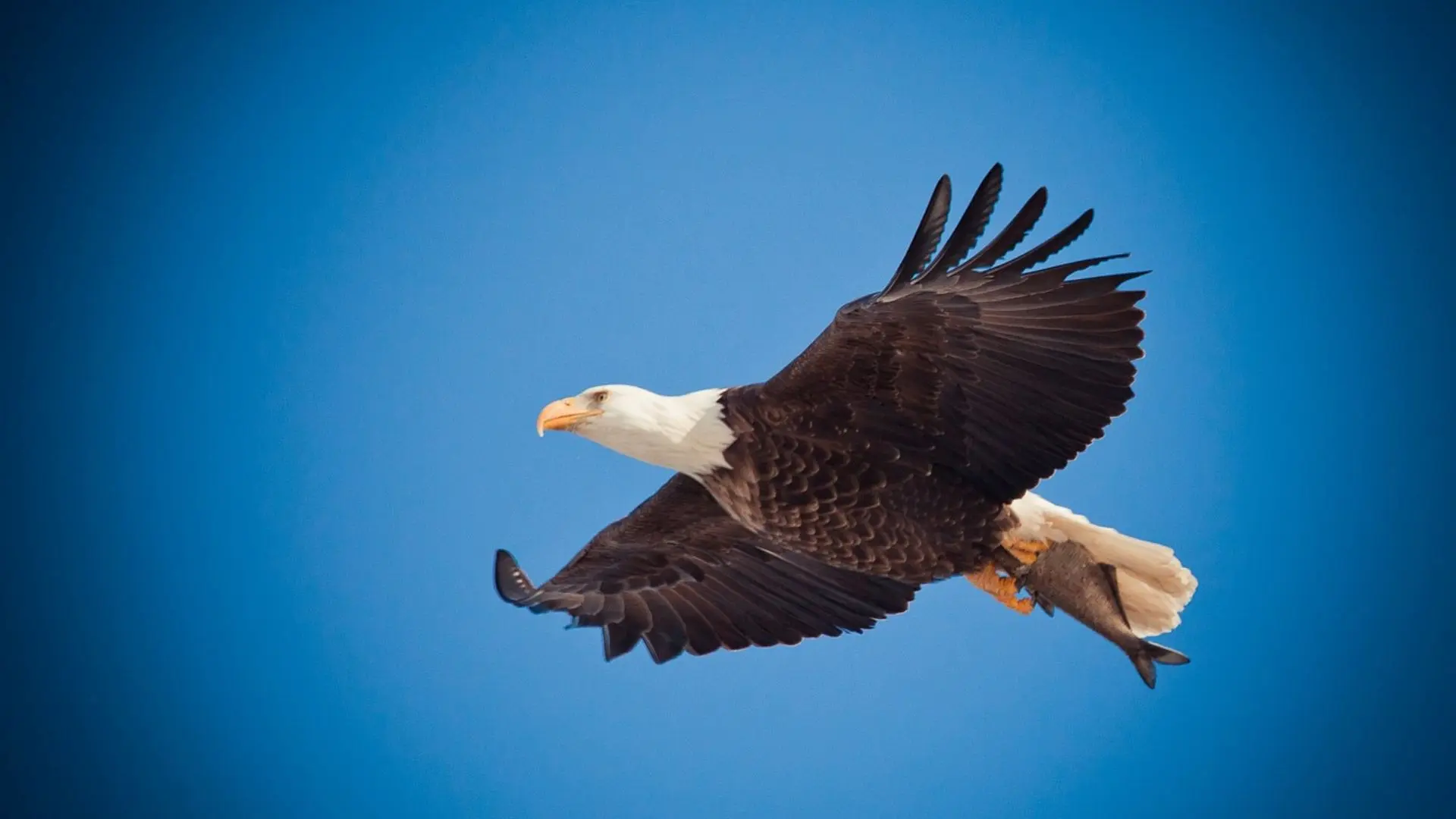
🎥 A Bald Eagle in full flight — precision, power and the perfect catch of a salmon in one breathtaking moment.
Mates for Life: Builders of the Sky
Bald Eagles are monogamous, returning to the same nest year after year — often enlarging it until it becomes a colossal structure.
- Nest dimensions: up to 13 ft (4 m) deep and 2,200 lb (1,000 kg) in weight.
- Both parents share incubation and feeding duties.
- Eaglets fledge at 10–12 weeks but remain under parental care for months.
These massive nests, called aeries, symbolize commitment — both to family and to place. Some have been used for decades, layer upon layer of sticks and devotion.
Bioindicator of Healthy Waters
The Bald Eagle sits at the top of aquatic food chains, making it a bioindicator species for wetland health.
- By scavenging carrion, it reduces disease spread and cleans ecosystems.
- Its diet reflects the purity of its environment — contaminants like mercury and lead are tracked through eagle blood and feathers.
“When bald eagles thrive, the rivers beneath them are healing.”
— U.S. Fish & Wildlife Service
Their rebound from near extinction now mirrors the restoration of America’s lakes and rivers — proof that saving one species can rescue an entire ecosystem.
Modern Threats
- Lead poisoning from bullet fragments and contaminated prey
- Wind turbine collisions in migratory corridors
- Habitat loss along coastal nesting zones
- Climate change shifting fish spawning and water temperatures
Researchers at the University of Florida’s IFAS warn that rising temperatures may alter breeding success, forcing eagles to adapt yet again — as they have for millennia.
Conclusion: Precision, Power, and Grace
The Bald Eagle embodies evolutionary excellence — eyes like telescopes, wings built for endurance, and instincts wired for precision.
Its flight is not brute force but refined physics, its hunt not violence but strategy and mastery.
To see one soar is to witness nature’s ultimate equation: intelligence + aerodynamics + adaptation = survival.
It’s more than a bird — it’s the living heartbeat of the sky.
References
- American Eagle Foundation
- Cornell Lab of Ornithology
- Smithsonian National Zoo
- U.S. Fish & Wildlife Service – Bald Eagle Recovery
- Journal of Experimental Biology – Eagle Vision Study
Frequently Asked Questions about Bald Eagle
1. How far can a Bald Eagle see?
A Bald Eagle’s eyesight is among the sharpest in the animal kingdom — about four to five times better than human vision. They can spot a fish swimming in the water or a small mammal on land from nearly two miles (3.2 kilometers) away. Their vision is measured at 20/5, meaning they see details at 20 feet that humans can only see clearly at five.
2. How fast can a Bald Eagle fly and dive?
Bald Eagles usually cruise at 30–40 miles per hour (48–64 km/h) when soaring but can reach up to 75 miles per hour (120 km/h) during a hunting dive. This combination of speed and maneuverability makes them one of the most efficient aerial predators in North America.
3. How strong is a Bald Eagle’s grip?
The Bald Eagle’s talons exert a crushing pressure of around 400 pounds per square inch (2,758 kilopascals) — nearly ten times stronger than a firm human handshake. This immense grip allows them to capture and carry prey weighing up to half their body weight.
4. Why do Bald Eagles have such sharp eyesight?
Each eye contains over one million photoreceptor cells per square millimeter, double that of humans. They also have two foveae (retinal focus zones): one for forward sight and one for motion detection. This dual system gives them both telescopic focus and panoramic awareness, essential for spotting prey from great distances.
5. How do Bald Eagles hunt their prey?
Their hunting process is a mix of strategy and precision. From high above the water, they lock onto fish using ultraviolet-sensitive vision, dive silently at up to 75 mph, and snatch prey with curved talons about 5 centimeters (2 inches) long. They may also scavenge or steal food from ospreys — a behavior called kleptoparasitism, which conserves energy.
6. How big are Bald Eagles’ nests?
Bald Eagle nests, known as aeries, are the largest of any bird in North America. Some measure up to 13 feet (4 meters) deep and weigh over 2,200 pounds (1,000 kilograms). The same pair often returns to the same nest year after year, adding new material each season until it becomes a massive structure of sticks and branches.
7. Why are Bald Eagles considered bioindicators?
Because they sit at the top of aquatic food chains, Bald Eagles reflect the overall health of their environment. Scientists monitor their blood and feathers for mercury, lead, and pesticide residues. A thriving eagle population usually indicates clean water and healthy ecosystems — which is why their recovery is seen as a conservation success story.
8. What are the main threats facing Bald Eagles today?
Although the species has recovered, modern threats persist:
– Lead poisoning from contaminated prey and bullet fragments
– Collisions with wind turbines and power lines
– Habitat loss near coasts and rivers
– Climate change, which affects fish availability and nesting patterns
Conservation efforts by the U.S. Fish & Wildlife Service (USFWS) continue to protect nesting sites and monitor populations nationwide.