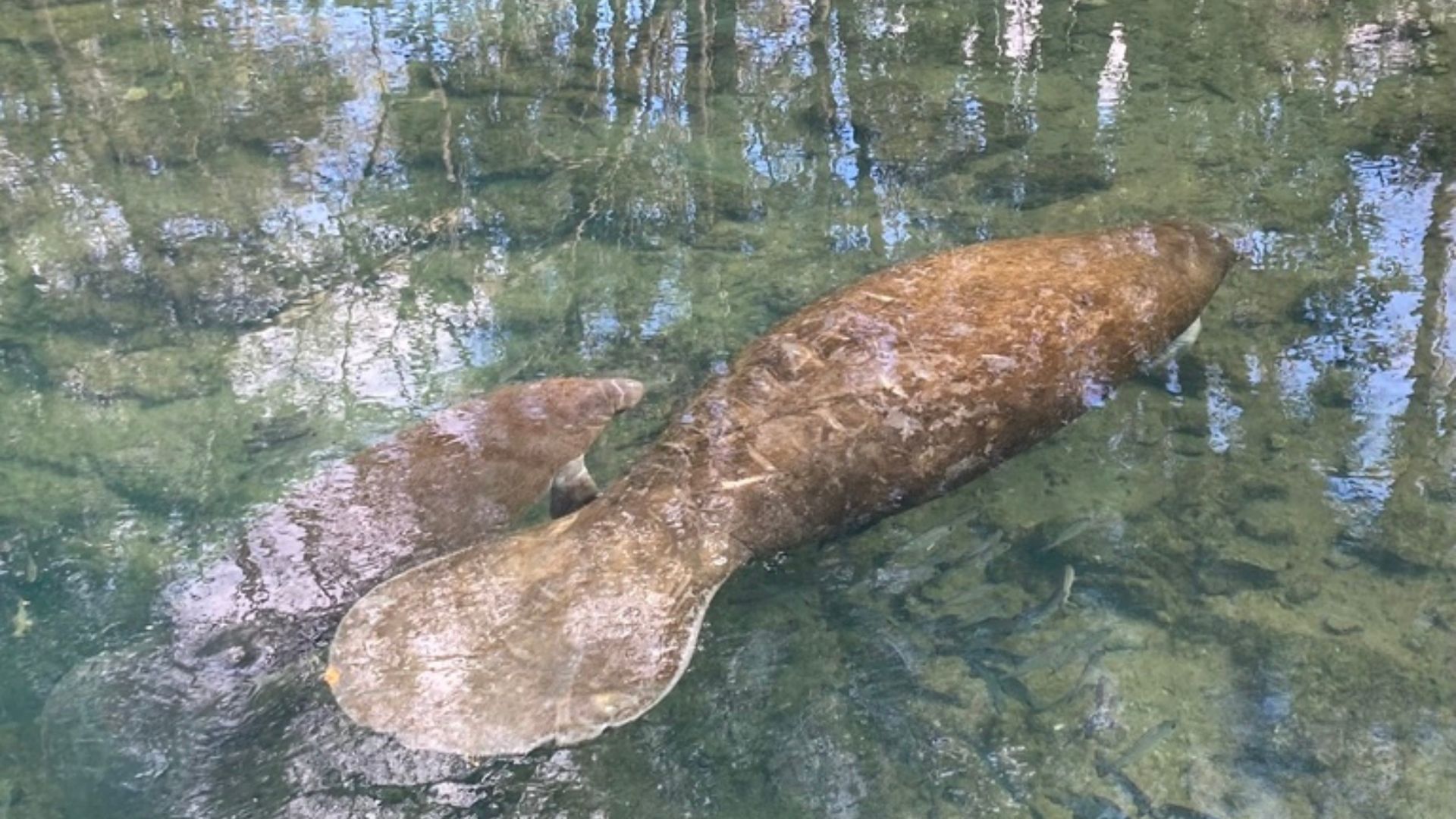
Picture a 1,000-kilogram (2,200-pound) herbivore drifting through a sunlit river like a living submarine—rising, hovering, or descending with barely a flick of its paddle-like tail. How does a manatee, the ocean’s gentlest giant, float so effortlessly? The secret isn’t a thick coat of blubber. It’s an exquisite balance of stone-heavy bones, ribbon-thin lungs, and yes—even digestive gas.
Ballast in the Bones
Manatees carry the densest skeleton of any living mammal. Their ribs are solid marble rods with no marrow cavities, a condition biologists call pachyostosis.
“Those big, dense bones make the manatee buoyancy-neutral in the water,” explains the U.S. Fish & Wildlife Service.
A 3.5 m (11.5 ft) adult weighs as much as a pickup truck—yet the same bones that keep it from bobbing like a cork also make every boat strike potentially lethal.
Lungs Like Air Mattresses
Unroll a manatee and you’ll find two flattened lungs that stretch nearly the entire length of its back, each in its own sealed cavity. Two hemi-diaphragms act like drawstrings.
- To sink: Contract the rib muscles, squash the lungs, density rises.
- To rise: Relax, lungs balloon, the manatee ghosts upward.
One breath swaps 90 % of lung air—nine times the human rate—giving pinpoint control.
The Flatulence Factor
A manatee munches 10–15 % of its body weight daily—up to 150 kg (330 lb) of seagrass. Fermentation in the 45 m (150 ft) intestine brews methane.
Hold it = lighter. Release it = heavier.
Veterinarians at Tampa’s Lowry Park Zoo once treated constipated manatees with laxatives; the patients “expelled substantial volumes of gas” and instantly regained dive control.
Blubber: The Thin Truth
Whales wear blubber jackets 30–50 cm (12–20 in) thick. Seals average 5 cm (2 in). Manatees? 2.5 cm (1 in) at best.
“They’re round and chubby not because they’re fat but because they have such large digestive tracts,” notes National Geographic.
That skimpy layer explains winter gatherings at 22 °C (72 °F) power-plant outflows.
Buoyancy Toolkit Compared
| Feature | Manatee | Harbor Seal | Bottlenose Dolphin |
| Adult length | 3–4 m (10–13 ft) | 1.7–1.9 m (5.5–6.2 ft) | 2.5–3.8 m (8–12.5 ft) |
| Weight | 800–1,200 kg (1,800–2,600 lb) | 100–150 kg (220–330 lb) | 200–650 kg (440–1,400 lb) |
| Blubber thickness | 2.5 cm (1 in) | 4–6 cm (1.5–2.5 in) | 2–3 cm (0.8–1.2 in) |
| Bone density | Pachyostotic (solid) | Normal marrow cavities | Light, hollow in places |
| Lung layout | Two long dorsal sacs | Standard paired lobes | Standard paired lobes |
| Buoyancy tricks | Lungs + gut gas | Blubber + air gulp | Blubber + swim bladder echo |
Grazers of the Grass Flats
Every dawn, manatees descend to “pastures” of turtle grass. Using bristled flippers like garden rakes, they uproot 50 kg (110 lb) of salad. The 7-day digestion marathon fuels not just energy but the tiny methane bubbles that let them hover mid-water, nibbling without wasted motion.
The Sleeping Float
At night, manatees enter a half-sleep called logging. Lungs fully inflated, they bob just below the surface, rising every 3–5 minutes for a silent breath. Relaxed hemi-diaphragms keep them perfectly level—no rolling, no drifting.
When Buoyancy Fails
A constipated manatee floats tail-up like a tipped canoe. Cold-stressed ones shiver in 18 °C (64 °F) shallows. Boat props scar 96 % of Florida adults, and dense bones turn glancing blows into fractures.
Guardians of the Seagrass
Each manatee recycles 30 tons of vegetation yearly, fertilizing meadows that shelter juvenile fish and buffer coastlines against storms. Lose the manatees, lose the meadow—and the carbon sink that sequesters 40,000 tons of CO₂ per square kilometer.
Quick Facts Table
- Top speed: 24 km/h (15 mph) burst; usual cruise 5 km/h (3 mph)
- Daily menu: 10–15 % body weight in plants
- Breath swap: 90 % of lung volume
- Intestine length: 45 m (150 ft)—20× body length
- Lifespan: 60+ years in the wild
A Gentle Giant’s Plea
Next time you spot a whiskered snout nosing above a Florida spring, remember: that effortless glide is hard-won. Dense bones anchor it to the earth it never touches; lungs and farts fine-tune every inch. In a warming, motorized world, the manatee’s buoyancy is both miracle and vulnerability. Protect the seagrass, slow the boats, and this 3-ton ballerina will keep dancing through our waters for centuries to come. However, the stability that buoyancy provides does not shield manatees from broader environmental changes affecting their coastal habitats.
References & Trusted Sources
- U.S. Fish & Wildlife Service – West Indian Manatee Recovery Plan
- National Geographic – “Florida’s Beloved Manatees” (2022)
- Smithsonian Magazine – “14 Fun Facts About Manatees”
- Save the Manatee Club – Manatee Anatomy & FAQ
- NOAA Ocean Today – Manatee Anatomy Video Transcript
- Rommel & Reynolds, Anatomical Record (2000) – Diaphragm function
FAQs
How deep can a manatee dive using only lung control?
Typically 3–10 m (10–33 ft); they rarely exceed 20 m (65 ft) because compressed lungs lose buoyancy fast.
Do baby manatees inherit perfect buoyancy?
Calves are born slightly positive-buoyant and learn fine control within weeks by mimicking mom’s breathing rhythm
Can manatees get “the bends” like human divers?
No—slow ascents and separate pleural cavities prevent nitrogen bubbles.
Why don’t manatees migrate to colder waters like whales?
Their 2.5 cm (1 in) blubber can’t insulate below 20 °C (68 °F); power-plant outflows now double as winter refuges.
Is it true constipation can strand a manatee?
Yes—vets treat “high-tail floaters” with mineral oil; one fart later, they dive normally again.