Introduction
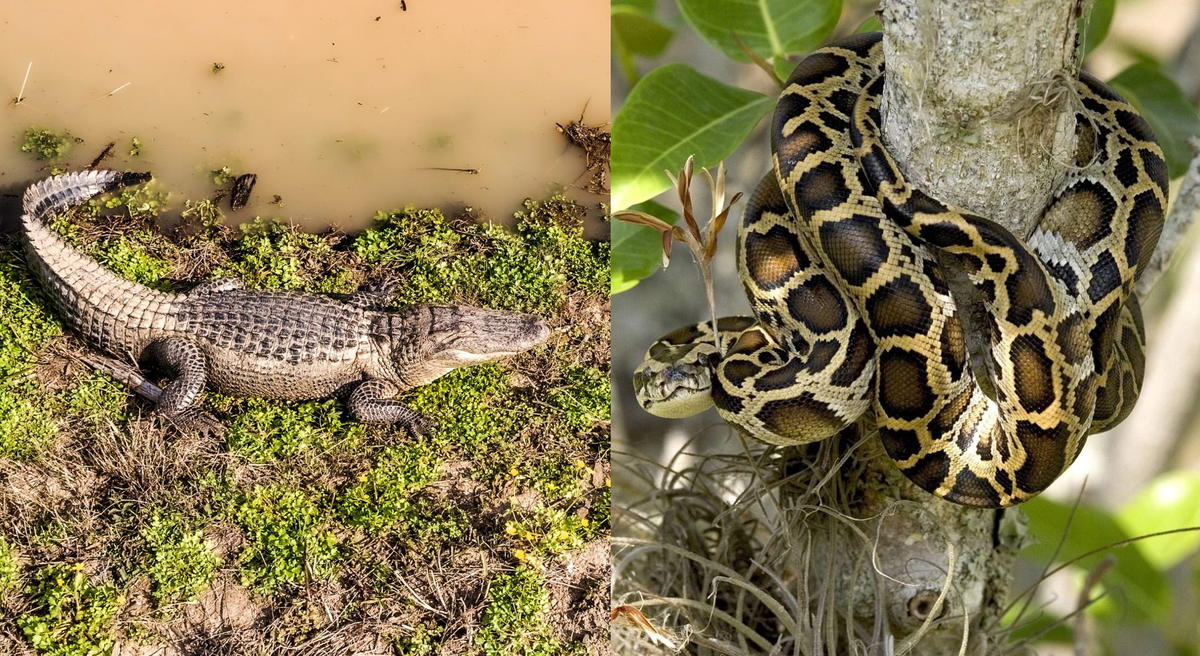
In the wetlands of the Florida Everglades, two massive reptiles sometimes share the same marsh edges, canals, and tree islands: the native American alligator (Alligator mississippiensis) and the invasive Burmese python (Python bivittatus). Encounters between these animals are uncommon, but when they occur they represent one of the most unusual predator interactions in North America.
The American alligator evolved in southeastern United States wetlands and plays a crucial role in maintaining healthy ecosystems. The Burmese python, by contrast, originates from Southeast Asia and established breeding populations in South Florida after introductions through the exotic pet trade during the late twentieth century.
Because both species occupy high trophic levels in the Everglades food web, researchers from organizations such as the U.S. Geological Survey (USGS) and the Florida Fish and Wildlife Conservation Commission (FWC) closely monitor their interactions and ecological impacts.
Understanding how these two reptiles differ in anatomy, hunting strategy, and ecological role helps explain why their occasional encounters attract scientific and public interest.
Quick Comparison
| Feature | American Alligator | Burmese Python |
| Scientific Name | Alligator mississippiensis | Python bivittatus |
| Taxonomic Order | Crocodylia | Squamata |
| Native Range | Southeastern United States | Southeast Asia |
| Status in Florida | Native species | Invasive species |
| Typical Adult Length | 10–13 ft (3–4 m) | 10–16 ft (3–5 m) |
| Typical Weight | 400–800 lb (180–360 kg) | 100–200 lb (45–90 kg) |
| Main Weapon | Crushing bite and death roll | Constriction |
| Primary Hunting Environment | Water | Vegetation and ground cover |
| Ecological Role | Keystone wetland species | Invasive apex predator |
1. Different Evolutionary Lineages
Although both animals are reptiles, they belong to entirely different evolutionary groups.
The American alligator is part of the order Crocodylia, a lineage that first appeared more than 200 million years ago. Crocodilians are more closely related to birds than to snakes or lizards and represent one of the most ancient surviving reptile groups.
The Burmese python belongs to the order Squamata, the large reptile group that includes snakes and lizards. Snakes evolved from lizard-like ancestors and developed highly flexible skeletons and specialized jaws that allow them to swallow prey much larger than their heads.
These evolutionary differences explain why the two animals have dramatically different body structures and hunting strategies.
2. Bite Force vs. Constriction
The most obvious contrast between these predators is how they capture and kill prey.
American alligators rely on powerful jaws capable of delivering one of the strongest bite forces measured in living animals. Biomechanical studies of crocodilians estimate bite forces in large alligators exceeding 2,000 pounds per square inch (psi). After grabbing prey, alligators often perform the death roll, a spinning motion used to tear flesh or destabilize large animals underwater.
Burmese pythons lack crushing jaws. Instead, they subdue prey through muscular constriction. After striking with backward-curving teeth that hold the prey in place, the snake wraps coils around the animal and tightens them. Research on constrictor snakes shows that this pressure disrupts blood circulation, causing rapid cardiovascular collapse.
In simple terms, these reptiles use completely different weapons:
- Alligators overpower prey with jaw strength and rotational force
- Pythons kill using muscular coils that restrict circulation
3. Length vs. Weight
Both species can reach impressive lengths, but their body mass differs greatly.
Adult male American alligators commonly measure 10–13 feet (3–4 meters) and often weigh 400–800 pounds (180–360 kilograms). Exceptional individuals can exceed 14 feet, according to records maintained by the Florida Fish and Wildlife Conservation Commission.
Burmese pythons in Florida typically measure 10–16 feet (3–5 meters) and weigh 100–200 pounds (45–90 kilograms). In their native Southeast Asian range, individuals exceeding 18 feet have occasionally been documented.
While pythons may match alligators in length, they rarely approach the crocodilian’s dense body mass and muscular strength.
4. Armor vs. Flexible Body
Another major difference lies in how these animals protect themselves.
American alligators possess thick skin reinforced with osteoderms—bony plates embedded within the dermis. These structures form natural armor that protects vital organs and increases resistance to injury.
Burmese pythons lack such armor. Instead, their bodies consist of hundreds of flexible vertebrae connected to powerful muscles. This design allows the snake to wrap tightly around prey or threats and apply tremendous constricting pressure.
These adaptations reflect two distinct evolutionary strategies:
- Crocodilians evolved armored bodies and crushing jaws
- Constrictor snakes evolved flexibility and muscular control
5. Water Predator vs. Vegetation Ambush Hunter
Both animals are ambush predators, but they hunt in different environments.
American alligators primarily hunt from the water. They often remain nearly submerged with only their eyes and nostrils visible. When prey approaches the shoreline, the alligator launches forward with explosive acceleration.
Burmese pythons typically hunt from dense vegetation, such as marsh grasses, mangrove roots, or canal banks. Their patterned scales provide camouflage that allows them to remain undetected until prey moves within striking distance.
Because their preferred hunting zones differ, direct competition for prey is relatively limited, although encounters can occur along wetland edges.
6. Keystone Species vs. Invasive Predator
The ecological roles of these reptiles differ dramatically.
The American alligator is widely recognized as a keystone species in southeastern wetlands. By digging depressions known as gator holes, alligators create small water reservoirs that persist during dry seasons. These pools provide refuge for fish, amphibians, insects, and other aquatic organisms.
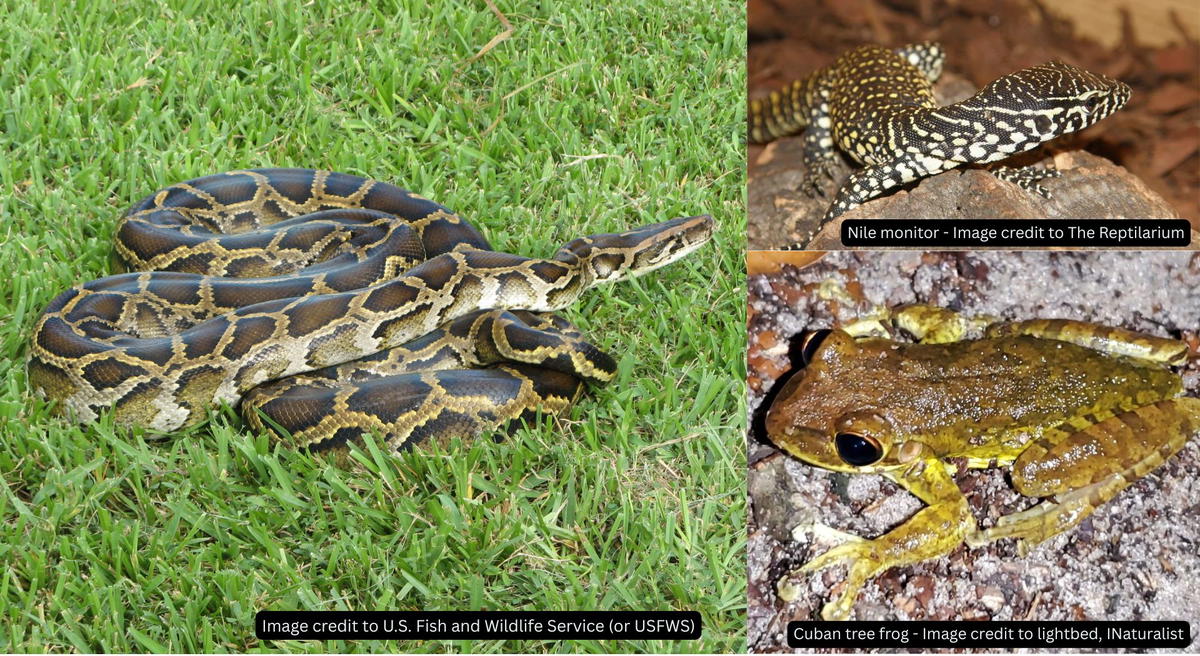
The Burmese python, however, is an introduced predator in Florida. Research by the U.S. Geological Survey has documented significant declines in several mammal populations in areas where pythons became established in the Everglades.
Because native wildlife did not evolve alongside this predator, the presence of large pythons has altered portions of the Everglades food web.
7. What Happens When They Encounter Each Other?
Encounters between American alligators and Burmese pythons are rare but well documented.
Wildlife researchers have recorded situations where either predator consumed the other, depending largely on relative body size.
For example:
- Large alligators have been found with python remains in their stomachs.
- Necropsies of captured pythons have revealed juvenile alligators among their prey.
One widely reported incident occurred in Everglades National Park in 2005, when a Burmese python attempted to swallow a six-foot alligator. The snake ultimately ruptured during the attempt, and both animals died.
These observations suggest that interactions between the two predators are opportunistic rather than a stable predator–prey relationship.
8. What This Means for the Everglades Ecosystem
Understanding the differences between these reptiles helps explain why their presence in the Everglades carries different ecological consequences.
The American alligator is a long-established component of southeastern wetlands and contributes to ecosystem stability through habitat engineering and predator regulation.
The Burmese python, however, represents a relatively recent addition to the ecosystem. Its rapid spread through parts of South Florida has altered wildlife populations and created new predator dynamics in the region.
For wildlife managers and conservation scientists, monitoring how these two predators interact provides valuable insights into the evolving ecology of the Everglades.
References
• U.S. Geological Survey – Invasive Species Research
• Florida Fish and Wildlife Conservation Commission (FWC)
• Everglades National Park scientific monitoring programs
• IUCN Red List assessments for Alligator mississippiensis and Python bivittatus
Frequently Asked Questions
Can a Burmese python kill an alligator?
Yes, large Burmese pythons are capable of killing smaller alligators through constriction. However, large adult alligators can also prey on pythons. The outcome usually depends on the size of the animals involved.
Do alligators eat Burmese pythons?
Yes. Researchers have recovered tracking transmitters from inside alligators after the reptiles consumed tagged pythons during monitoring studies.
Why are Burmese pythons considered a problem in Florida?
Burmese pythons are an invasive species in South Florida. Studies by the U.S. Geological Survey have documented major declines in some mammal populations following the spread of pythons in the Everglades ecosystem.