Introduction
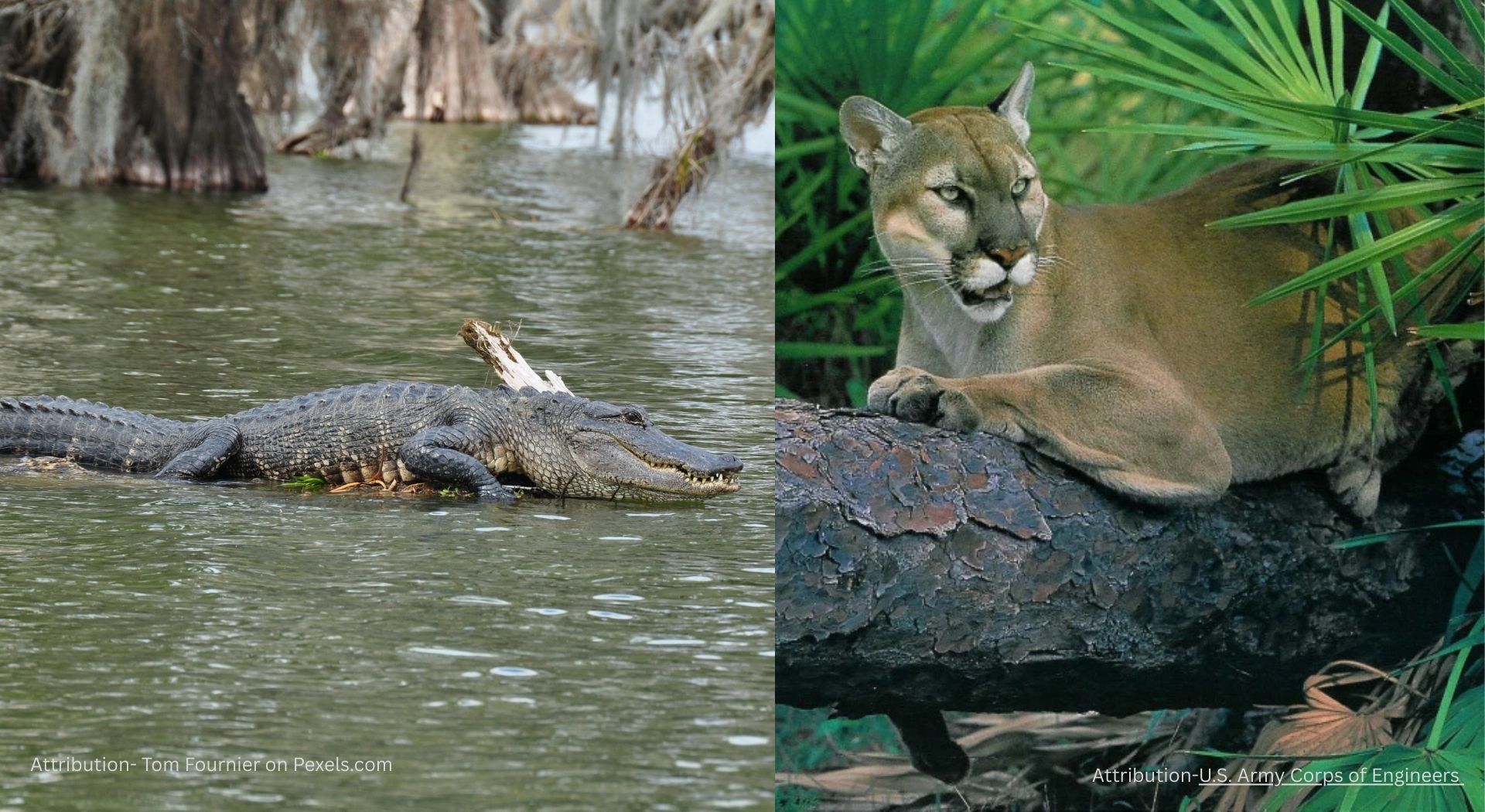
Deep within the wetlands and forests of southern Florida live two very different apex predators: the American alligator (Alligator mississippiensis) and the Florida panther (Puma concolor coryi). One is a powerful semi-aquatic reptile that has inhabited southeastern wetlands for millions of years. The other is a highly elusive mammalian hunter and the endangered Florida population of the cougar.
Because both species occupy the highest trophic levels in the Everglades food web and ecosystem, people often wonder which predator truly dominates the landscape. In reality, the answer is not a simple rivalry. These animals rarely compete directly because they control different parts of the ecosystem. Alligators rule the waterways, while panthers govern the forests.
Understanding how these two predators differ in anatomy, hunting strategies, habitat use, and ecological influence reveals how they share the Everglades without constant conflict.
Quick Comparison
| Feature | American Alligator | Florida Panther |
| Scientific Name | Alligator mississippiensis | Puma concolor coryi |
| Animal Group | Crocodilian reptile | Mammalian carnivore |
| Native Range | Southeastern United States | South Florida (endangered cougar population) |
| Typical Habitat | Marshes, lakes, canals, wetlands | Pine flatwoods, hardwood hammocks, cypress swamps |
| Average Adult Size | 10–13 ft (3–4 m); 400–800 lb | 6–7 ft total length; 100–160 lb |
| Hunting Strategy | Aquatic ambush predator | Terrestrial stalk-and-pounce predator |
| Ecological Role | Keystone wetland engineer | Top terrestrial predator |
| Conservation Status | Least Concern (IUCN) | Endangered under U.S. law |
Power vs. Agility: Body Design
The American alligator and Florida panther represent two very different evolutionary solutions for becoming a top predator.
Alligators are heavily built reptiles designed for mechanical strength. Their bodies are reinforced with osteoderms, bony plates embedded in the skin that act as protective armor and structural support. Combined with massive jaw muscles, these features allow alligators to generate extraordinary bite forces. Biomechanical research on crocodilians has recorded bite pressures exceeding 2,000 pounds per square inch in large individuals.
Florida panthers, by contrast, are built for speed and flexibility. Like other large cats, they possess a highly flexible spine, elongated hind limbs, and retractable claws. These traits allow explosive acceleration, powerful leaps, and the ability to grapple with prey during a hunt.
While a large alligator may outweigh a panther several times over, the panther’s anatomy favors rapid movement and precision rather than brute force.
Water vs. Land: Habitat Dominance
Despite living within the same regional ecosystem, these predators occupy very different environments.
American alligators are strongly associated with aquatic habitats such as marshes, sloughs, ponds, and canals. Their eyes and nostrils sit atop the skull, allowing them to remain nearly submerged while scanning the shoreline for prey. With a sudden thrust of the tail, they can lunge forward and capture animals approaching the water.
Florida panthers operate primarily on terrestrial landscapes. Wildlife tracking conducted by the U.S. Fish and Wildlife Service (USFWS) shows that male panthers maintain territories exceeding 200 square miles. Within these ranges they move through pine flatwoods, cypress swamps, and hardwood hammocks while searching for prey.
Because the two predators dominate different habitats, direct competition between them is uncommon.
Ambush vs. Stalk: Hunting Strategies
The hunting methods of these animals reflect their environments and anatomy.
Alligators rely on aquatic ambush predation. Remaining motionless in shallow water, they wait for fish, birds, turtles, or mammals to approach the shoreline. When prey comes within range, the alligator launches forward with a rapid strike and powerful jaws.
Florida panthers use a stalk-and-pounce strategy typical of large felids. Moving quietly through vegetation, the panther approaches prey before launching a short chase and delivering a bite to the throat or neck.
Research on panther diet shows that white-tailed deer and feral hogs form the majority of their prey, though smaller mammals may also be taken.
These different hunting strategies allow both predators to influence different parts of the Everglades food web.
Abundant vs. Rare: Population Presence
Another major difference between the two predators is population size.
The American alligator is abundant in Florida. The Florida Fish and Wildlife Conservation Commission (FWC) estimates roughly 1.3 million alligators statewide, with large numbers inhabiting the Everglades ecosystem.
Florida panthers are among the most endangered mammals in North America. Monitoring programs by the U.S. Fish and Wildlife Service estimate that only about 120–230 individuals remain in the wild.
Because panthers require vast territories and tend to avoid human activity, they are rarely seen, even within protected areas.
Engineer vs. Hunter: Ecosystem Roles
Although both predators sit at the top of the food chain, they influence the ecosystem in different ways.
American alligators function as keystone species in southeastern wetlands. By excavating depressions known as gator holes, they create small water reservoirs that persist during dry periods. These pools provide refuge for fish, amphibians, and wading birds, supporting biodiversity across the Everglades.
Florida panthers influence ecosystems primarily through predation on large herbivores. By hunting deer and feral hogs, they help regulate populations of animals that might otherwise overgraze vegetation.
Thus, the alligator shapes the physical environment, while the panther regulates prey populations across the landscape.
When Paths Cross: Rare Predator Encounters
Encounters between alligators and Florida panthers are possible where forests meet wetlands, though they are believed to be uncommon.
Large alligators are capable of attacking mammals that approach water sources. Conversely, Florida panthers have occasionally been documented preying on small or juvenile alligators, particularly individuals under roughly 2–2.5 meters (6–8 feet) long.
However, most large predators avoid dangerous confrontations whenever possible. Serious injuries could compromise their ability to hunt and survive. As a result, behavioral avoidance is likely the most common outcome when these animals encounter each other.
So Who Really Rules the Everglades?
In ecological terms, neither predator truly dominates the entire Everglades.
American alligators control the aquatic world of marshes, ponds, and canals, where their strength and ambush tactics make them formidable hunters.
Florida panthers rule the terrestrial landscape, regulating populations of large mammals across forests and swamps.
Rather than competing directly, these predators occupy different ecological niches, together shaping the balance of one of North America’s most complex ecosystems.
References
• Florida Fish and Wildlife Conservation Commission (FWC)
• U.S. Fish and Wildlife Service — Florida Panther Recovery Program
• U.S. Geological Survey — Everglades Wildlife Research
• IUCN Red List assessments for Alligator mississippiensis
Frequently Asked Questions
Can a Florida panther kill an alligator?
Florida panthers are capable of killing small juvenile alligators, but large adult alligators are usually too large and dangerous for a panther to attack.
Do alligators ever kill panthers?
Large alligators may pose a risk to mammals approaching water sources, including panthers. However, confirmed encounters are believed to be rare.
Why are Florida panthers endangered?
Florida panthers declined due to habitat loss, vehicle collisions, and low genetic diversity. In the 1990s, wildlife managers introduced several female Texas cougars into the population to increase genetic diversity—a conservation effort known as the Florida panther genetic rescue program. This program significantly improved population health and helped stabilize the species.