Introduction
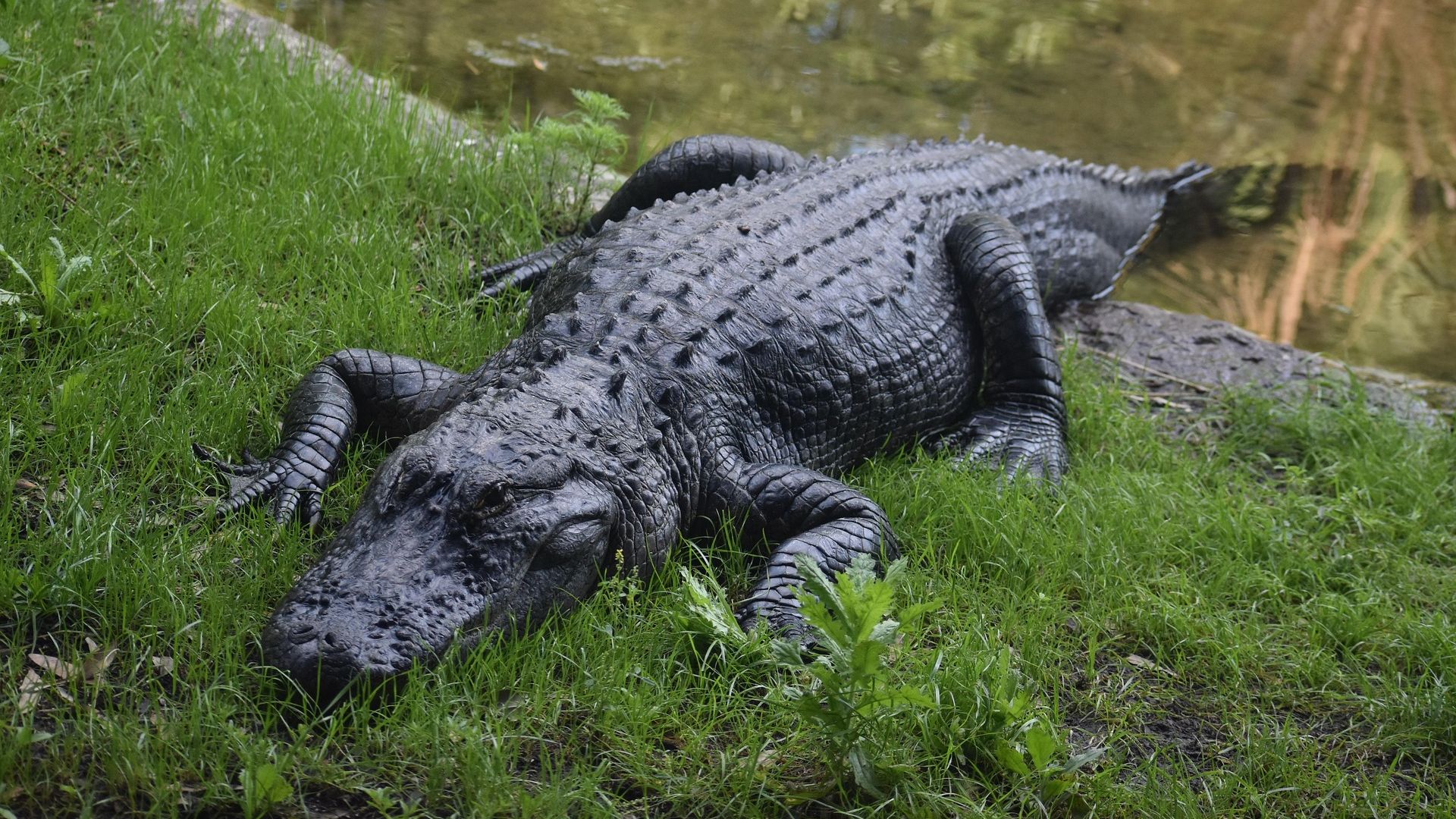
American alligators (Alligator mississippiensis) are often thought of as slow, lumbering reptiles. In reality, these powerful predators can move surprisingly fast over short distances—especially when striking prey near the water’s edge.
An alligator’s speed depends heavily on its environment. On land, it can sprint briefly but tires quickly. In water, however, the animal becomes far more efficient and agile. Combined with one of the strongest bite forces measured in living animals, these bursts of speed make the alligator a highly effective ambush predator.
Here are the key facts about how fast alligators can run, swim, and strike.
1. Alligators Can Sprint About 11–15 mph on Land
Despite their heavy bodies, American alligators can move quickly on land for short bursts. Observational measurements and biomechanical estimates suggest top sprint speeds of about 11–15 miles per hour (18–24 km/h).
When moving rapidly, alligators use a locomotion pattern called the high walk. During this gait, the animal lifts its belly off the ground and moves with partially upright limbs rather than dragging its body.
Most of the propulsion comes from the hind legs, while the muscular tail helps stabilize the body during acceleration.
However, these sprints are extremely brief.
2. Land Sprints Usually Last Only 10–30 Meters
Alligators are built for explosive movement rather than endurance.
Their muscles rely heavily on short bursts of anaerobic energy, which quickly leads to fatigue. Because of this, alligators rarely maintain top speed for more than 10–30 meters.
After this short distance, the animal typically slows and returns to the water.
This is why alligators rarely chase prey across land. Instead, they rely on stealth and short-range attacks near the shoreline.
3. The “30–35 mph” Alligator Speed Is a Myth
Some popular sources claim that alligators can run 30–35 miles per hour (48–56 km/h). Wildlife biologists generally consider these numbers exaggerated.
No controlled biomechanical measurements have confirmed speeds anywhere near this range.
Several anatomical factors limit land speed:
• Crocodilians have a sprawling limb posture, which prioritizes stability over speed.
• Their heavy bodies reduce acceleration efficiency.
• They lack the elastic tendons and flexible spines that help fast-running mammals achieve high velocity.
What sometimes appears to be extreme speed is usually a short lunge covering only a few meters, which can look faster than it actually is.
4. Alligators Are Much Faster in Water
Water is where alligators perform best.
In aquatic environments, they can reach burst swimming speeds close to 20 miles per hour (32 km/h).
Instead of using their legs, alligators propel themselves primarily with their large muscular tails, which can account for nearly half of the animal’s body length. Powerful side-to-side tail movements generate thrust, while the limbs remain tucked against the body to reduce drag.
Their streamlined shape and low profile in the water allow them to approach prey quietly before launching a sudden attack.
5. Their Bite Force Exceeds 2,000 PSI
While speed plays a role in hunting, the most powerful weapon an alligator possesses is its bite.
Biomechanical studies of crocodilians have measured bite forces exceeding 9,000 newtons, equivalent to roughly 2,000 pounds per square inch (PSI) in large American alligators.
This enormous force comes from massive jaw muscles anchored at the rear of the skull. When these muscles contract, they snap the jaws shut with incredible pressure.
This bite allows alligators to:
• crush turtle shells
• grip struggling prey
• immobilize large mammals
Once prey is captured, the alligator may drag it underwater or perform the well-known death roll—a spinning motion used to tear flesh or subdue large animals.
6. Alligator Attacks Happen in a Fraction of a Second
The true danger of an alligator does not come from sustained speed but from sudden acceleration.
Alligators typically remain nearly submerged with only their eyes and nostrils visible above the water surface. This allows them to watch the shoreline without revealing their presence.
When prey approaches within a few meters, the animal launches forward with a powerful thrust of its tail. The jaws clamp shut almost instantly.
Because the attack begins at very close range, prey often has little time to react.
This ambush strategy allows alligators to capture animals ranging from fish and turtles to birds and large mammals visiting wetlands to drink.
Key Takeaways
• American alligators can sprint about 11–15 mph (18–24 km/h) on land.
• Land sprints usually last only 10–30 meters before fatigue sets in.
• Claims that alligators run 30–35 mph are not supported by scientific measurements.
• In water, alligators can reach burst speeds near 20 mph (32 km/h).
• Their bite force exceeds 2,000 PSI, among the strongest recorded for living vertebrates.
• Alligator attacks rely on ambush and sudden acceleration, not long-distance pursuit.
References
• Florida Fish and Wildlife Conservation Commission (FWC)
• U.S. Geological Survey — Wetland and Aquatic Research Center
• Smithsonian National Zoo & Conservation Biology Institute
• Crocodilian bite-force biomechanics research
Frequently Asked Questions
Can a human outrun an alligator?
Yes. Alligators can sprint quickly but only for short distances. Running directly away from an alligator on land is usually effective.
How fast can an alligator swim?
Alligators can reach burst swimming speeds of around 20 mph (32 km/h) using powerful tail propulsion.
How strong is an alligator’s bite?
Large American alligators can generate bite forces exceeding 9,000 newtons (over 2,000 PSI)—one of the strongest bites measured in living animals.