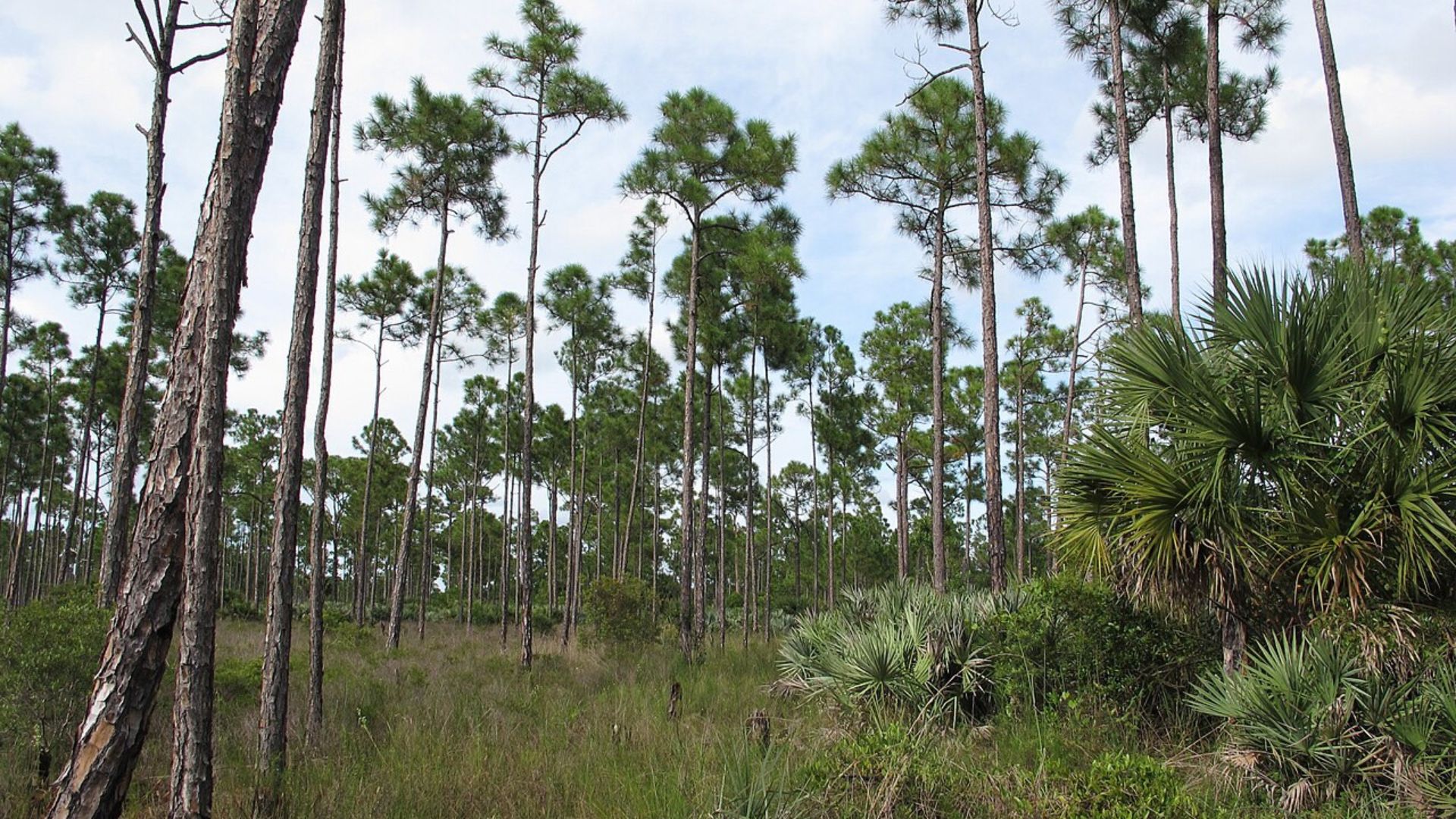
Most visitors to Florida come for the water — the beaches, the springs, the swamps. The uplands are easy to overlook. They do not shimmer. They are not dramatic. At first glance, a Florida pine flatwood can seem almost monotonous: an open canopy of slash pine rising from a knee-high understory of saw palmetto, stretching in every direction with a quiet, sun-dappled uniformity.
That first impression is wrong in almost every particular.
Florida’s upland ecosystems — pine flatwoods, longleaf pine sandhills, scrub, dry prairie, and upland hardwood hammocks — are among the most biodiverse non-wetland habitats in the southeastern United States, and among the most imperilled anywhere in North America. They support a disproportionate concentration of endemic species: plants and animals found nowhere else on Earth, sculpted by millions of years of evolution on Florida’s ancient, infertile sands. The Florida scrub jay (Aphelocoma coerulescens), gopher tortoise (Gopherus polyphemus), and Florida mouse (Podomys floridanus) are not peripheral species that happen to live in these habitats — they are irreplaceable products of them.
This hub brings together NativesOfNature’s complete Florida Uplands and Pine Flatwoods coverage: in-depth ecosystem explainers, species profiles, fire ecology guides, and conservation resources reviewed by our zoology team. What follows is an introduction to one of Florida’s most misunderstood and most urgently threatened landscapes.
The Ancient Sands: What Makes Florida’s Uplands Ecologically Extraordinary
Florida’s upland habitats rest on a foundation that is genuinely ancient. The sandy ridges running through the centre of the peninsula — the Lake Wales Ridge, the Ocala Uplands, the
Brooksville Ridge, the Trail Ridge — are the remnants of barrier islands and dunes that existed when sea levels were much higher, during warm interglacial periods millions of years ago. These ancient sands are deeply weathered, leached of nutrients, and poorly watered. They are, by most conventional agricultural measures, terrible soils.
For specialised plants and animals, however, these infertile sands created opportunity. Over hundreds of thousands of years, repeated cycles of sea-level rise and retreat left isolated populations of species stranded on the ridges — biological islands in a sea of surrounding lowland. These isolated populations diverged. Speciation occurred. The result is a concentration of endemism — species unique to Florida’s uplands — that rivals the biodiversity hotspots of the tropics in terms of irreplaceability.
The Florida Scrub is the starkest expression of this ancient landscape. Dominated by scrub oaks (Quercus inopina, Q. geminata, Q. chapmanii) and Florida rosemary (Ceratiola ericoides) growing from bare white sand, it looks more like an Arizona desert community than anything typically associated with the Deep South. Rainfall drains almost instantly through the coarse sand, making drought a near-constant condition despite Florida’s high annual precipitation.
Key statistic: The Florida Natural Areas Inventory (FNAI) estimates that Florida has lost over 85% of its original scrub and sandhill habitats since European settlement, making these among the most heavily converted natural community types in the continental United States. Of the scrub that remains, a substantial fraction is fragmented into patches too small to support viable populations of area-sensitive species.
The fire imperative: Unlike Florida’s coastal wetlands, which are shaped primarily by hydrology, the upland ecosystems are shaped primarily by fire. Lightning-ignited fires historically burned through pine flatwoods and sandhills on a return interval of two to eight years, maintaining an open, sunlit understory and preventing the hardwood mid-storey vegetation that would otherwise shade out the ground layer and its associated wildlife communities. Without fire — or its management equivalent — Florida’s uplands succeed rapidly toward a closed-canopy oak or hardwood hammock that supports far fewer of the specialist species these habitats evolved to hold.
Pine Flatwoods: Florida’s Most Extensive Upland Ecosystem
Pine flatwoods are the dominant upland ecosystem in Florida, historically covering approximately 50% of the state’s land area. They remain the most common native upland habitat type, though decades of drainage, conversion to timber plantation, and fire suppression have significantly altered their character and reduced their biodiversity value.
Two pine species define Florida’s flatwoods: slash pine (Pinus elliottii) on wetter, more poorly drained sites, and longleaf pine (Pinus palustris) on better-drained, sandier ground. The distinction matters enormously for wildlife. Longleaf pine flatwoods, maintained by frequent fire, support the highest diversity of ground-layer plants and animals; slash pine flatwoods tend to be denser and less open, particularly when fire-suppressed. Historically, longleaf pine was the dominant species across much of the southeastern U.S. coastal plain, but it has been reduced to approximately 3% of its original range — one of the most dramatic declines of any North American tree species.
The structural key to pine flatwood wildlife diversity is the ground layer. A well-burned flatwood has a nearly continuous carpet of wiregrass (Aristida stricta and A. beyrichiana) beneath an open pine canopy, with clumps of saw palmetto (Serenoa repens), gallberry (Ilex glabra), fetterbush (Lyonia lucida), and scattered wildflowers. This open, structurally diverse ground layer provides food and cover for an exceptional community of ground-nesting and ground-foraging birds, reptiles, and mammals.
The red-cockaded woodpecker (Dryobates borealis) is the flagship species of the longleaf pine ecosystem and one of the most extensively studied birds in North America. Unlike other woodpeckers, it excavates its nest cavity exclusively in the living heartwood of mature longleaf pines — a process that can take the bird one to six years. The resin wells it maintains around the cavity entrance, kept flowing to deter predators such as rat snakes, give active cavity trees their distinctive white-streaked appearance. The species is listed as Endangered under the U.S. Endangered Species Act; Florida supports several important populations, including those within the Apalachicola and Osceola National Forests.
Bachman’s sparrow (Peucaea aestivalis) is one of the most fire-dependent songbirds in North America, and one of the most difficult to detect. It sings from exposed perches atop wiregrass or palmetto fronds in open, recently burned flatwoods, producing a single pure note followed by a rapid trill — hauntingly beautiful, and increasingly rare. Breeding density is closely correlated with time since last fire: populations crash within a few years of fire exclusion as the ground layer closes and nest sites are lost.
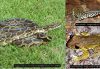
Herpetological diversity: Pine flatwoods are exceptional habitat for reptiles and amphibians. The eastern indigo snake (Drymarchon couperi) — the longest native snake in North America, reaching over 2.5 metres — hunts through flatwoods, scrub, and sandhill in search of prey including gopher tortoises, which it follows into burrows. Listed as Threatened, the indigo snake is an umbrella species whose conservation requires the protection of large, connected patches of upland habitat. The pine snake (Pituophis melanoleucus mugitus), Florida pine woods kingsnake (Lampropeltis extenuata), and Florida scarlet snake (Cemophora coccinea) are among the other specialist reptiles of the flatwood system.
Longleaf Pine Sandhills: The High Ground of Florida’s Uplands
Where the landscape rises onto well-drained sandy ridges and ancient dune fields, the pine flatwood gives way to longleaf pine sandhill — a more xeric, sunlit, and species-rich variant of the upland pine community. Sandhill habitat sits on the old marine sands of Florida’s interior ridges: the Lake Wales Ridge running through Polk and Highlands Counties, the Ocala Uplands of Marion County, and scattered sandridge systems throughout the northern and central peninsula.
The longleaf pine sandhill is arguably the most ecologically rich upland habitat in Florida. Under a sparse canopy of widely spaced longleaf pines, wiregrass forms a nearly continuous ground cover interspersed with turkey oak (Quercus laevis), sand post oak (Q. margarettiae), and a diverse assemblage of herbaceous plants including blazing stars (Liatris spp.), scrub mints (Conradina spp.), gopher apple (Licania michauxii), and various composites and legumes. The ground layer of a well-maintained sandhill community can contain 40 to 50 plant species per square metre — among the highest local plant diversity of any temperate community in the world.
The gopher tortoise (Gopherus polyphemus) is the keystone species of the sandhill ecosystem and one of the most ecologically important animals in Florida’s uplands. A single adult tortoise excavates a burrow averaging 4.5 metres long and 2 metres deep — a stable thermal refuge that buffers temperatures year-round. These burrows are used by over 360 other species: burrowing owls (Athene cunicularia), Florida mice, indigo snakes, gopher frogs (Rana capito), scarlet snakes, and dozens of invertebrate species shelter in active and abandoned gopher tortoise burrows. The tortoise is not merely a resident of the sandhill — it is its principal architect.
The Florida sandhill crane (Antigone canadensis pratensis) breeds in moist clearings within sandhill and flatwood habitats, particularly where wet prairies adjoin upland edges. Pairs maintain large territories and return to traditional nesting sites for decades; crane family groups — the paired adults with their single colt — are a characteristic sight of Florida’s upland roadsides and open sandhill prairies from January through April. Unlike the migratory greater sandhill crane that winters in Florida, the Florida sandhill crane is a year-round resident, a non-migratory subspecies whose entire global population is confined to the state.
The pocket gopher ecosystem engineer: The southeastern pocket gopher (Geomys pinetis) is a fossorial rodent that excavates elaborate tunnel systems through the sandy soils of sandhills and flatwoods, pushing characteristic “sand mounds” to the surface. These bare sand disturbances are critical microhabitats for a suite of specialist plants and invertebrates that cannot compete in intact vegetation — including several endemic scrub plants that maintain populations almost exclusively on gopher tortoise mounds and pocket gopher disturbances.
Florida Scrub: The Ancient Island in a Sea of Sand
Florida scrub is the most biologically distinctive upland ecosystem in the state — and the rarest. It occupies the ancient sand ridges of Florida’s interior, where deep, droughty, nutrient-poor soils support a community of low-statured, fire-adapted shrubs that has no ecological equivalent anywhere else in North America. Botanists and ecologists treat it as a relict of a drier, more continental climate that existed during the Pleistocene, preserved on the ridges that were never flooded as sea levels rose and fell around them.
The dominant plants of Florida scrub are shrubby oaks and Florida rosemary, growing from bare white sand. Sand pines (Pinus clausa) stand in scattered clumps or dense groves, their canopy so dense in mature unburned scrub that the ground beneath becomes too dark and dry for most other vegetation. This senescent, closed-canopy condition — “old scrub” — is a fire-suppressed
dead end, eventually collapsing as the sand pines age and die. Renewal requires hot, stand-replacing fire followed by a period of open, sandy conditions in which scrub specialists can recruit.
The Florida scrub jay (Aphelocoma coerulescens) is found nowhere on Earth except Florida’s scrub habitats, and nowhere in Florida except where scrub exists in the right structural condition. It is the only bird species entirely endemic to a single U.S. state. Scrub jays are cooperative breeders: offspring from previous years remain with their parents as “helpers,” assisting in territory defence, predator warning, and feeding of the next brood. This cooperative system is an adaptation to the patchy, unpredictable scrub habitat, where territories are limited and dispersal is risky.
The scrub jay’s habitat requirements are exacting. It needs scrub oaks of a specific height range — typically 1 to 3 metres — with open sandy patches interspersed among them. Oaks that are too short provide insufficient food (acorns) and shelter; oaks that are too tall, in unburned scrub, create a closed canopy that eliminates the bare sand openings jays use for caching acorns and detecting predators. Managing scrub for scrub jays means managing fire with almost agricultural precision.
Many of Florida’s rarest plants are scrub endemics. Highlands scrub hypericum (Hypericum cumulicola), four-petal pawpaw (Asimina tetramera), Carter’s mustard (Warea carteri), and Avon Park harebells (Crotalaria avonensis) are among the dozens of plant species found almost entirely on the Lake Wales Ridge and associated scrub systems — some with global populations of fewer than a thousand individuals confined to a handful of sites. The scrub also supports a distinctive herpetofauna: the Florida scrub lizard (Sceloporus woodi), short-tailed snake (Lampropeltis extenuata), and sand skink (Neoseps reynoldsi) are all scrub endemics.
Dry Prairie: Florida’s Grassland Savanna
Before European settlement, dry prairies extended across large areas of south-central Florida, particularly in Okeechobee, Glades, and Highlands Counties — a vast, tree-sparse grassland maintained by frequent fire and seasonal flooding that occupied the landscape between the flatwoods and the wetland marshes of the Kissimmee Valley. Today, fewer than 160,000 acres of dry prairie remain in Florida, making it one of the most reduced habitat types in the state. The majority has been converted to improved pasture for cattle ranching, a transformation so complete in some areas that it is difficult to reconstruct the original vegetation from aerial photography.
Dry prairies are dominated by wiregrasses, bluestems (Andropogon and Schizachyrium), and broom sedge, with scattered cabbage palms (Sabal palmetto) and saw palmettos. They are structurally open and visually expansive — among the few remaining places in Florida where you can see an unbroken horizon across native vegetation.
The Florida grasshopper sparrow (Ammodramus savannarum floridanus) is one of North America’s most critically endangered birds, with a global population estimated at fewer than 80 individuals as of 2023. It nests exclusively in dry prairie, requiring large, unfragmented expanses of short-to-medium-height grassland with low shrub cover. Its decline is a direct result of dry prairie conversion: as prairies became cattle pasture and pasture became residential development, the sparrow’s habitat shrank faster than its reproductive capacity could compensate. A captive breeding and reintroduction programme at White Oak Conservation Centre and the Zoo Miami Grasshopper Sparrow Recovery Programme represents a last line of defence for this subspecies.
The Florida cracker horse and Florida cracker cattle — both landrace breeds descended from animals brought by Spanish settlers in the 1500s — are historically associated with dry prairie ranching. Cattle grazing at appropriate stocking densities has long been recognised by FWC and conservation biologists as compatible with, and in some cases beneficial to, dry prairie wildlife communities: grazing maintains the short, open sward structure that grasshopper sparrows and other grassland birds require.
Upland Hardwood Hammocks: Refugia on the Ridge
Where fire frequency is naturally lower — on north-facing slopes, in moist depressions within upland landscapes, or on rocky limestone outcrops — a closed-canopy upland hardwood community develops: the upland hardwood hammock. These “high hammocks” are dominated by live oak (Quercus virginiana), laurel oak (Q. laurifolia), magnolia (Magnolia grandiflora), red cedar (Juniperus virginiana), and pignut hickory (Carya glabra), with a rich understory of American beautyberry (Callicarpa americana), sparkleberry (Vaccinium arboreum), and native ferns.
Upland hammocks are more structurally complex than the surrounding open upland communities and support a different guild of wildlife. They are critical winter refugia for neotropical migratory songbirds: warblers, thrushes, tanagers, and vireos moving through Florida in October and November concentrate in hammock patches that offer sheltered foraging and roost sites. The hammock’s dense canopy and accumulated leaf litter also support populations of forest-interior mammals including the southeastern fox squirrel (Sciurus niger shermani) — a large, disjunct-pattern subspecies that requires both open pine for foraging and hammock trees for nesting.
The relationship between hammocks and the surrounding matrix habitats is dynamic. Without fire, the open pine sandhill around a hammock patch will succeed toward turkey oak woodland and eventually hammock — a directional succession that has been greatly accelerated by twentieth-century fire suppression. Conversely, a severe crown fire can kill hammock trees at the edge, pushing the boundary back. Maintaining a landscape-scale mosaic of early-successional open pine, mid-successional oak woodland, and mature hammock patches requires active fire management at a scale rarely achieved under modern land ownership patterns.
Keystone Species of Florida’s Uplands
No species in Florida’s upland ecosystems better illustrates the concept of a keystone species — one whose ecological impact is disproportionate to its abundance — than the gopher tortoise. Its burrows constitute the primary thermal and predator refuge for the majority of Florida’s upland herpetofauna and many of its small mammals. Remove the gopher tortoise from a sandhill community and you remove the habitat underpinning for hundreds of dependent species. The tortoise is not simply one species among many; it is infrastructure.
The eastern indigo snake occupies a complementary keystone role as an apex predator of the upland herpetofauna. It consumes rattlesnakes, copperheads, other snakes, lizards, small mammals, and ground-nesting birds — a wide dietary breadth that makes it a significant regulator of prey populations. It is one of very few snake species in North America large enough to prey routinely on other large snakes. Its requirement for large, connected patches of open upland — individual snakes may maintain home ranges exceeding 800 acres — makes it a powerful indicator of landscape-scale habitat connectivity.
The red-cockaded woodpecker functions as a keystone through a different mechanism: cavity creation. Its nest cavities, excavated over years in living longleaf pines, persist in the tree for decades after the woodpecker abandons them, becoming primary nest sites for a cascade of secondary cavity users — eastern bluebirds (Sialia sialis), great crested flycatchers (Myiarchus crinitus), eastern screech owls (Megascops asio), flying squirrels (Glaucomys volans), and others — that could not excavate their own cavities in healthy pine heartwood. In a pine flatwood, red-cockaded woodpecker cavities are the limiting resource for cavity-dependent species.
Fire Ecology: Why Upland Florida Burns and Why That Is Essential
Fire is not a disturbance to Florida’s upland ecosystems. It is a process as fundamental to their functioning as rainfall or photosynthesis. The flatwoods, sandhills, and scrub communities of Florida evolved in the presence of frequent lightning-ignited fire; their plant and animal communities are structured around it. Without fire, they do not reach a different stable state — they collapse into an ecologically degraded, species-poor shrubland or hardwood woodland that retains almost none of the original community’s conservation value.
Lightning strike frequency in peninsular Florida is the highest in the continental United States, with the peninsula averaging over 100 lightning strikes per square kilometre per year in summer. Before fire suppression, this translated into frequent, extensive fires through the dry uplands every two to eight years. The result was a landscape maintained in a perpetually early- to mid-successional state — open, bright, and structurally simple — in which ground-layer species thrived and hardwood encroachment was continuously checked.
Fire effects on upland wildlife are almost entirely positive for the specialist community. Immediately post-burn, seed-eating birds including northern bobwhite (Colinus virginianus), Bachman’s sparrow, and various sparrows exploit the flush of seeds and invertebrates. Gopher tortoises graze fresh-sprouting wiregrass and leguminous forbs. Indigo snakes hunt through the blackened, open landscape where prey is more visible. Within two to three years, as the ground layer recovers, breeding densities of flatwood-dependent species reach their peak.
Prescribed fire — the planned application of fire by land managers under controlled conditions — has become the central tool of upland conservation management in Florida. FWC, the Florida Forest Service, and federal agencies burn hundreds of thousands of acres of state and federal upland annually. The science of prescribed fire in Florida is highly developed: managers choose burn season (growing season burns tend to set back hardwood encroachment more effectively than dormant season burns), fire intensity, and return interval with specific ecological outcomes in mind.
The fire gap problem: On fragmented private and municipal lands, prescribed burning is often impossible due to proximity to structures, roads, and adjacent properties. This leaves large areas of Florida’s upland outside any fire management programme. Over decades, these unburned fragments undergo dramatic structural change: the pine canopy thickens, the midstory fills with oaks and wax myrtle (Morella cerifera), the ground layer is shaded out, and specialist species disappear. Restoring fire to long-unburned uplands is technically challenging and expensive, requiring mechanical fuel reduction before the first prescription burn is safe to conduct.
Conservation Status of Florida’s Upland Habitats
Florida’s upland ecosystems rank among the most endangered natural communities in the United States. The Florida Natural Areas Inventory tracks over 600 documented sites supporting globally imperilled scrub communities, the majority of which occur on private land with no formal conservation protection. The principal threats are well understood and largely unchanged from those documented in conservation assessments of the 1980s and 1990s:
• Habitat loss and fragmentation: residential and commercial development has consumed enormous areas of former upland habitat on Florida’s interior ridges, particularly in Polk, Highlands, Lake, Orange, and Brevard Counties — the centre of gravity for Florida scrub endemics.
• Fire suppression: decades of fire exclusion across both public and private uplands have allowed hardwood encroachment to degrade habitat quality across hundreds of thousands of acres of otherwise intact pine flatwood and sandhill.
• Invasive species: cogon grass (Imperata cylindrica), air potato (Dioscorea bulbifera), and Brazilian pepper (Schinus terebinthifolia) invade disturbed upland edges and openings, outcompeting native ground-layer species and altering fire behaviour. Feral hogs (Sus scrofa) root through sandhill communities, destroying the soil structure and native vegetation that gopher tortoises, scrub lizards, and ground-nesting birds depend on.
• Hydrological alteration: widespread ditching and drainage of low areas within the flatwood matrix has lowered the water table across large areas, changing the seasonal flooding regime that historically maintained the transition zones between upland and wetland communities.
• Small population dynamics: many upland endemic species now persist in small, isolated populations on habitat fragments too small to buffer against stochastic events. A single hurricane, outbreak of disease, or drought can eliminate the remaining population of a scrub plant species from an entire county.
Conservation efforts are concentrated on the Lake Wales Ridge, where The Nature Conservancy, Florida Chapter, manages the Lake Wales Ridge Ecosystem Working Group — a coalition of private, state, and federal landowners coordinating landscape-scale fire management, exotic plant control, and habitat acquisition. The Archbold Biological Station in Venus, Highlands County, has conducted continuous ecological research on the Lake Wales Ridge scrub since 1941, making it one of the longest-running upland ecology research programmes in the world.
State and federal protected areas covering significant upland habitat include Ocala National Forest, Osceola National Forest, Apalachicola National Forest, Jonathan Dickinson State Park, Lake Arbuckle State Forest, Arbuckle State Forest, and the Lake Wales Ridge State Forest complex. The Florida Forever land acquisition programme, funded by state documentary stamp tax revenue, has protected millions of acres of upland habitat since its inception in 2000, including numerous tracts on the Lake Wales Ridge.
Florida Upland Wildlife Watching: Where and When to Go
Florida’s upland ecosystems offer some of the most rewarding and under-appreciated wildlife watching in the southeastern United States. Unlike the coastal habitats where wildlife is often conspicuous and predictable, the uplands reward patience, early hours, and a willingness to sit quietly and listen.
Best Sites for Longleaf Pine and Sandhill Wildlife
Ocala National Forest in Marion County is the largest sand pine scrub in the world and also supports extensive longleaf pine sandhill communities, including active populations of red-cockaded woodpeckers in the Juniper Prairie Wilderness area. The Croom Tract of the Withlacoochee State Forest in Citrus County offers accessible sandhill trails with reliable gopher tortoise activity year-round. Gold Head Branch State Park in Clay County preserves an exceptional longleaf sandhill landscape including a live spring-fed ravine system, unusual in the upland context.
Best Sites for Florida Scrub Jay Observation
Merritt Island National Wildlife Refuge on the Space Coast contains some of the most accessible Florida scrub jay habitat in the state, with resident family groups habituated to close human observation along the Scrub Ridge Trail and Black Point Wildlife Drive. Oscar Scherer State Park in Sarasota County supports one of the most studied scrub jay populations in Florida. Archbold Biological Station conducts scrub jay research and offers limited public access — contact the station directly for guided research visits.
Dry Prairie and Grasshopper Sparrow Observation
Three Lakes Wildlife Management Area in Osceola County preserves one of the best remaining dry prairie landscapes in Florida, managed with regular prescribed fire and supporting the critically endangered Florida grasshopper sparrow. Kissimmee Prairie Preserve State Park in Okeechobee County — the largest dry prairie preserve in the U.S. — offers night sky viewing of exceptional quality alongside grassland bird watching.
Best Times to Visit
The Florida uplands are most rewarding from October through April. Winter brings migratory sparrows — Henslow’s, Le Conte’s, and grasshopper sparrows winter in open flatwoods and dry prairies — and the crisp air makes extended walking comfortable. March and April are peak breeding season for red-cockaded woodpeckers and Bachman’s sparrows. Gopher tortoises are most active from February through May. Prescribed burns are most commonly conducted from January through April, and a recently burned flatwood in spring, covered with returning wildflowers and active with birds, is among the most memorable wildlife experiences Florida offers.
Recent Research in Florida Upland Ecosystems (2020–2025)
Scientific understanding of Florida’s upland ecosystems continues to advance, with several significant findings in recent years:
• Gopher tortoise population reassessment: A 2022 range-wide population assessment coordinated by the Gopher Tortoise Council estimated the Florida gopher tortoise population at approximately 700,000 individuals — a figure that represents a significant decline from historical estimates, driven by habitat loss and insufficient fire management. The assessment recommended immediate revision of the species’ conservation status at state and federal levels.
• Scrub jay cooperative breeding genetics: Research published in Evolution (2023) by Archbold Biological Station researchers demonstrated that helping behaviour in Florida scrub jays is influenced by both relatedness and territory quality — helpers invest more in broods when they are closely related to the breeding pair and when territory quality is high. The study provided new insight into the evolutionary maintenance of cooperative breeding in habitat-limited populations.
• Longleaf pine restoration outcomes: A multi-site study by the Longleaf Alliance (2024) evaluating 20-year outcomes of longleaf pine restoration on sandhill sites across the southeastern coastal plain found that sites restored from slash pine monoculture to longleaf pine with wiregrass understory showed significant recovery of ground-layer plant diversity and herpetofaunal communities within 10–15 years, provided prescribed fire was maintained on appropriate return intervals.
• Florida grasshopper sparrow captive programme: As of 2025, the Florida grasshopper sparrow captive population at White Oak Conservation Centre exceeded 300 individuals, with ongoing releases into Three Lakes WMA, Kissimmee Prairie Preserve, and Buck Island Ranch. Survival of released birds remains a critical research question, with preliminary data suggesting that birds released into areas with high arthropod abundance from recent prescribed burns show significantly higher first-year survival rates.
Conclusion: The Case for Florida’s Overlooked Interior
Florida’s upland ecosystems are not spectacular in the way of the Everglades or the Keys. They do not have the immediate visual drama of a roseate spoonbill against mangrove foliage or the ancient menace of a crocodile in the shallows of Florida Bay. Their beauty is subtler: the call of a Bachman’s sparrow rising from a March-green wiregrass meadow; the slow, deliberate progress of a gopher tortoise across a sandhill morning; the flash of an eastern indigo snake across a fire-blackened road.
But the ecological stakes in the uplands are, in some ways, higher than anywhere else in the state. The species that live in Florida’s scrub and sandhill communities evolved here over hundreds of thousands of years, on these specific ancient sands, under these specific fire regimes. They exist nowhere else. When a scrub jay population disappears from a Lake Wales Ridge fragment, it does not simply move elsewhere — it is gone. The evolutionary lineage it represented is extinguished. That is a different kind of loss from the decline of a widespread species: it is permanent and irreversible.
The tools to prevent these losses exist. Prescribed fire is scientifically understood and practically achievable. Habitat acquisition through Florida Forever and local conservation land programmes remains possible. Restoration of longleaf pine to former slash pine plantations is happening at scale. The captive breeding and release programme for Florida grasshopper sparrows is running. These are not aspirational proposals — they are active programmes producing measurable results.
What they require is continued public attention and political will. Florida’s uplands are easy to undervalue because they are easy to overlook. Understanding them is the first step toward protecting them — and protecting them is among the most consequential conservation investments the state can make.
References & Sources
• Archbold Biological Station. (2024). Long-term Ecological Research on the Lake Wales Ridge. Venus, FL.
• Florida Fish and Wildlife Conservation Commission (FWC). (2023). Florida Gopher Tortoise Management Plan. Tallahassee, FL.
• Florida Natural Areas Inventory (FNAI). (2022). Guide to the Natural Communities of Florida, 3rd edition. Tallahassee, FL.
• U.S. Fish and Wildlife Service (USFWS). (2024). Red-cockaded Woodpecker Recovery Plan, 2nd revision. Atlanta, GA.
• Walters, J.R. (1991). Application of ecological principles to the management of endangered species: the case of the red-cockaded woodpecker. Annual Review of Ecology and Systematics, 22, 505–523.