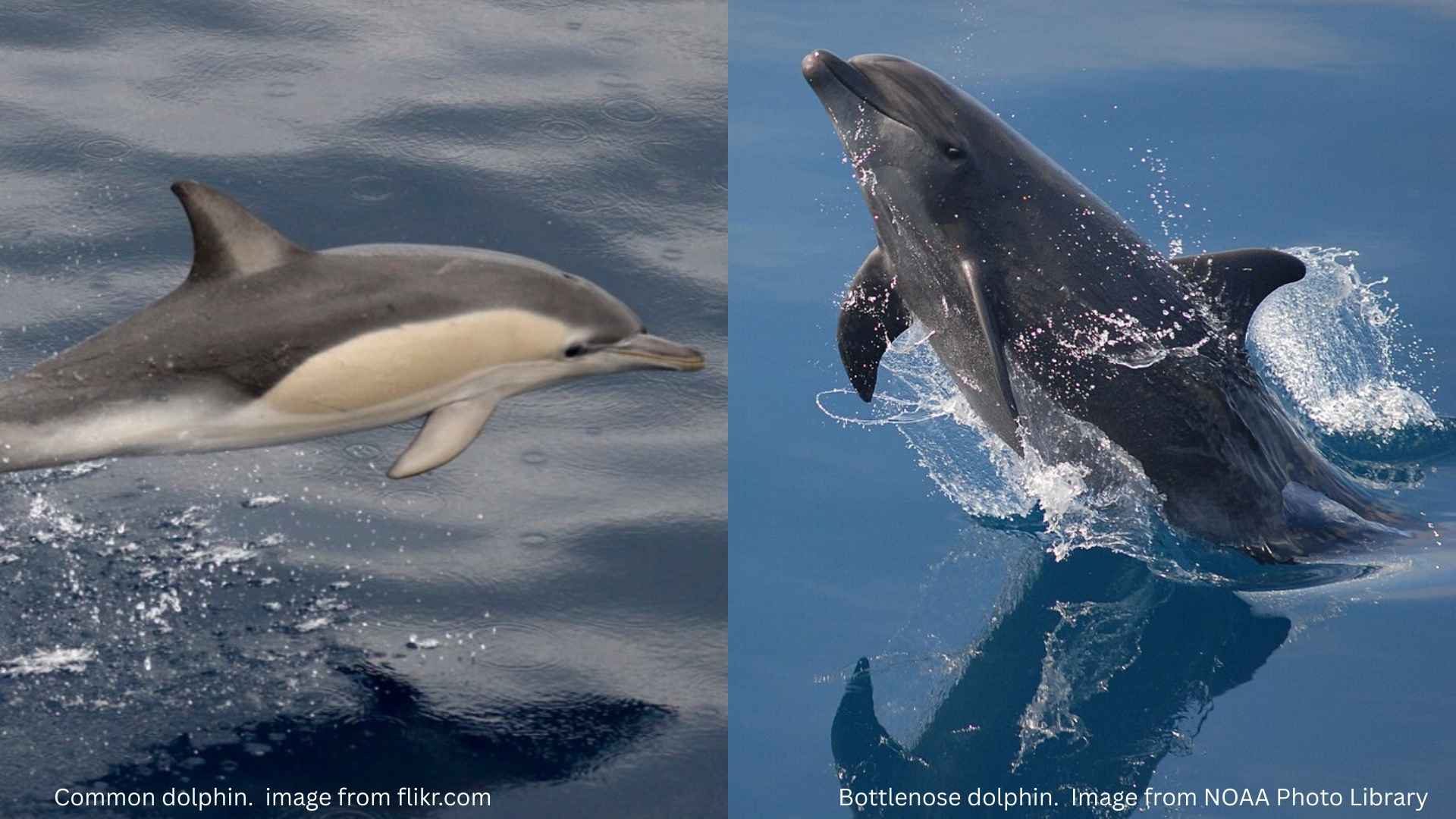
Off the Azores, 3,000 yellow-hourglass torpedoes rocket past a research vessel at 51 km/h, leaping 9 m clear of the water in perfect sync.
Twenty miles closer to shore, a lone bottlenose rises vertically, locks eyes with the captain, and blows a heart-shaped bubble ring before vanishing.
Same family. Same ocean. Two completely different universes.
Tursiops truncatus vs. Delphinus delphis: the coastal genius who learns your name and the blue-water sprinter who outruns speedboats. Here are 10 viral-worthy differences backed by 2024–2025 science that will make you screenshot every line.
1. Size & Build: Rugby Player vs. Olympic Sprinter
Bottlenose Dolphin: 2.5–4 m (8–13 ft) | up to 650 kg (1,430 lb) | thick neck, short stubby beak built for power moves.
Common Dolphin: 1.7–2.6 m (5.6–8.5 ft) | max 135 kg (300 lb) | torpedo shape cuts drag 25 % better (NOAA Fisheries 2025).
2. Paint Job You Can Spot From a Plane
Bottlenose: monochrome charcoal-to-light gray—elegant stealth mode.
Common: electric yellow-hourglass flanks that flash like lightning. From above, a super-pod looks like one giant predator (Marine Mammal Science 2025).
3. Dorsal Fin Signature
Bottlenose: tall, scarred, falcate—battle-worn from 30-year alliances.
Common: darker, notched trailing edge. When 5,000 fins break the surface, it creates a visible “fin wave” from aircraft (Cornell Lab aerial surveys 2025).
4. Home Address: Your Local Bay vs. The Blue Desert
Bottlenose: never leaves the continental shelf. Sarasota dolphins return to the same 3 km² pass their great-grandmothers owned (55-year study).
Common: satellite-tagged individuals swam 12,000 km (7,500 mi) in 90 days—London to Sydney nonstop (NOAA SWFSC 2025).
5. Social Life: Mafia Families vs. Mega-Cities
Bottlenose: 6–15 lifelong allies. Male “super-alliances” last 30+ years (Shark Bay).
Common: super-pods of 100–10,000+—largest stable groups of any cetacean. Strangers hunt together in minutes (Pelagos Institute 2024).
6. Hunting Style: Surgical Strike vs. Blitzkrieg
Bottlenose: mud-ring architects, sponge-tool users, 150-year human partnerships in Brazil (98 % success).
Common: corral sardines into bait balls the size of city buses, then blitz at 45 km/h. Energy return 40 % higher (Marine Ecology Progress Series 2024).
7. Top Speed: Power Burst vs. Sustained Missile
Bottlenose: 0–35 km/h in <3 sec (perfect for beach raids).
Common: sustains 51 km/h (32 mph)—fastest recorded delphinid (U.S. Navy trials 2025). Leaps 9 m (30 ft) horizontally on ship bow-waves.
8. Voice: Personal Names vs. Stadium Chants
Bottlenose: unique signature whistles recognized after 20+ years apart (St Andrews 2023).
Common: burst-pulse “yells” travel 3× farther in open water. Super-pod chatter sounds like 10,000 fans at once (Woods Hole 2025).
9. Predator Defense: Brain vs. Brawn
Bottlenose: outsmart sharks with alliances + echolocation precision.
Common: safety in numbers + sheer speed. Tiger sharks reroute 68 % of the time after hearing alarm barks (Shark Bay 2025).
10. Human Threats: Different Killers, Same Ocean
Bottlenose: 300,000+ die yearly in ghost nets + plastic (coastal kings, coastal traps).
Common: 100,000+ annually in purse-seine bycatch (Eastern Pacific alone). IUCN still “Least Concern” because schools are planet-sized (IUCN 2025).
Quick Comparison Table – Bottlenose vs. Common Dolphin
| Feature | Bottlenose (Tursiops truncatus) | Common (Delphinus delphis) |
| Length | 2.5–4 m | 1.7–2.6 m |
| Weight | 150–650 kg | 70–135 kg |
| Color | Uniform gray | Yellow-hourglass flash |
| Beak | Short, stubby | Long, slender |
| Dorsal fin | Tall, scarred, falcate | Notched, two-tone |
| Habitat | Coastal bays | Open ocean highways |
| Group size | 6–15 (30-yr bonds) | 100–10,000+ super-pods |
| Top speed | 35 km/h burst | 51 km/h sustained |
| Cultural tricks | Sponge tools, human deals | None documented |
| Biggest threat | Ghost nets + plastic | Industrial purse-seine bycatch |
Two Dolphins, One Ocean, Zero Excuses
One remembers your boat for decades.
The other outruns it with 5,000 friends.
Both prove the sea evolved intelligence in stereo—intimate and epic.
Silence their ocean with noise and nets, and we lose two living libraries older than most nations. Protect the genius. Protect the sprint. Protect every shade of blue.
References
- Wells, R. S., Sarasota Dolphin Research Program (2025) – 55-year residency
- NOAA SWFSC (2025) – 12,000 km migrations
- Mann, J. et al. (2024) Marine Mammal Science – Cultural review
- IUCN Red List (2025) – Updated bycatch mortality
- Woods Hole (2025) – Acoustic range comparison
- U.S. Navy Marine Mammal Program (2025) – 51 km/h speed trials
- Pelagos Cetacean Research Institute (2024) – Super-pod dynamics
FAQs – Bottlenose vs. Common Dolphin
Which is bigger?
Bottlenose—up to 4 m & 650 kg vs. common’s 2.6 m max.
Which has the yellow hourglass?
Common—impossible to miss from a drone.
Which lives near the beach?
Bottlenose—your local bay resident.
Which forms 10,000-strong pods?
Common—biggest parties in the ocean.
Which is faster?
Common—51 km/h vs. bottlenose 35 km/h bursts.
Which uses tools & works with humans?
Bottlenose—sponge masks + 150-yr Brazil deal.