Introduction
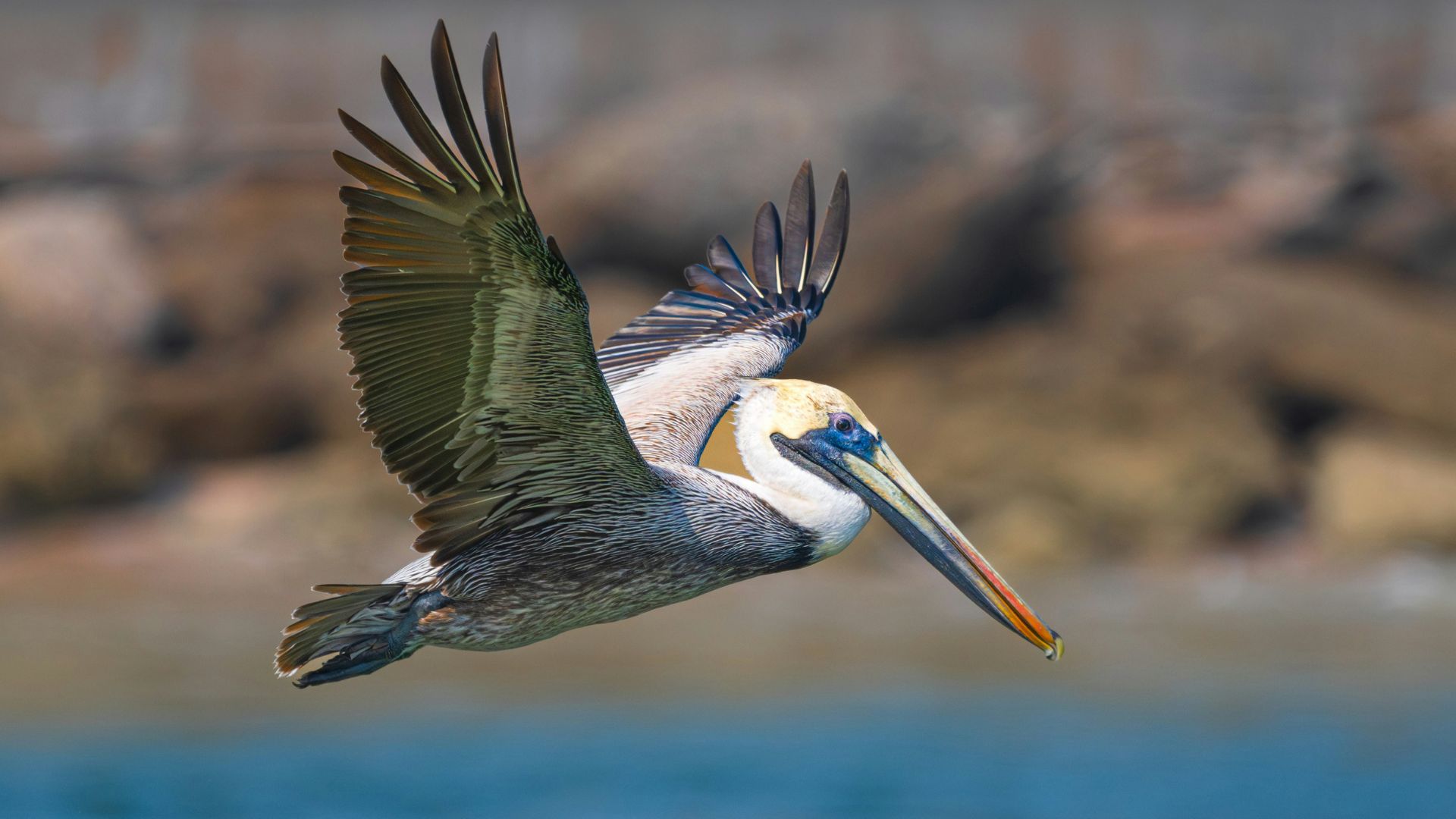
The Brown Pelican (Pelecanus occidentalis) is one of the few seabirds that regularly hunts by plunge-diving from the air into coastal waters. This feeding strategy requires a combination of efficient flight, precise aerial targeting, and anatomical adaptations that allow the bird to withstand repeated impacts with the water surface. Because plunge-diving involves both aerial maneuvering and high-speed descent, Brown Pelicans display notable performance in both sustained flight and diving.
Field observations and ornithological measurements indicate that Brown Pelicans typically fly at speeds approaching 30 miles per hour (48 km/h) during normal travel and foraging movements. During hunting dives, however, their velocity increases substantially as gravity accelerates the descent. Plunge-dives can reach approximately 40 miles per hour (64 km/h) at the moment of water entry.
Understanding these speeds provides insight into the biomechanics of seabird predation. Aerodynamic wing structure, visual targeting, and specialized anatomical features—such as subcutaneous air sacs and protective eye membranes—work together to allow Brown Pelicans to locate prey, strike the water safely, and capture fish near the surface.
1. Brown Pelicans Can Fly at Speeds Around 30 mph
Brown Pelicans are efficient coastal flyers capable of reaching speeds of about 30 miles per hour (48 km/h) during sustained flight. Their wingspan—typically 2.0–2.3 meters (6.5–7.5 feet)—creates a large aerodynamic surface that generates lift while allowing relatively slow wingbeats.
Unlike many seabirds that rely on constant flapping, pelicans alternate between short bursts of flapping and extended gliding. Observational studies summarized by the Cornell Lab of Ornithology indicate that pelicans spend a large portion of flight time gliding, which significantly reduces metabolic energy expenditure during travel.
Wind conditions also influence flight performance. Tailwinds can increase ground speed beyond 30 mph, while headwinds may slow forward progress. Because pelicans forage along coastlines where winds are predictable, they often align flight paths with prevailing breezes to maintain efficient travel.
This moderate but energy-efficient flight speed allows Brown Pelicans to patrol long stretches of shoreline while searching for schools of small fish near the ocean surface.
2. Dive Speeds Can Exceed 40 mph
Although their cruising flight speed is moderate, Brown Pelicans become much faster during hunting dives. During a plunge dive, the bird may strike the water at speeds approaching 40 miles per hour (64 km/h).
The dive begins when the pelican detects a fish school near the surface. The bird then folds its wings tightly against its body and angles downward. With reduced aerodynamic drag and gravity accelerating the descent, velocity increases rapidly in the final seconds before impact.
A steep dive angle—often close to vertical—helps improve targeting accuracy. Light refracts when passing from air into water, making fish appear slightly displaced from their true position. By descending nearly vertically, pelicans minimize this optical distortion and align the bill directly with the prey.
This high-speed plunge allows the pelican to break the water surface and capture fish swimming just below it, making the technique highly effective for catching schooling species such as anchovies and sardines.
3. Pelicans Typically Dive From 60–100 Feet Above the Water
Brown Pelicans generally begin their dives from heights between 18 and 30 meters (approximately 60–100 feet) above the water. From this vantage point, the bird can visually track fish movements while positioning itself directly over a potential prey patch.
Dive height strongly influences the speed achieved during descent. A higher starting point allows gravity to accelerate the bird for a longer period, increasing the velocity reached before impact.
However, dives rarely begin from extreme altitudes. Very high dives would increase impact forces and make precise targeting more difficult. Observations recorded in seabird behavioral studies indicate that most successful plunge dives originate within the 60–100 foot range, where pelicans can achieve sufficient speed while maintaining accurate alignment with prey.
This height range represents an effective balance between generating kinetic energy and maintaining visual control during the descent.
4. Subcutaneous Air Sacs Cushion the Impact of High-Speed Dives
Striking water at speeds near 40 mph produces strong deceleration forces. Brown Pelicans withstand these impacts because of an extensive system of subcutaneous air sacs located beneath the skin of the chest, neck, and abdomen.
These air sacs are connected to the bird’s respiratory system and become slightly inflated before impact. When the pelican hits the water, the sacs compress and distribute the force across the body surface, reducing stress on internal organs and bones.
This pneumatic cushioning system functions similarly to an airbag, absorbing part of the collision energy while preventing sudden compression injuries. The same air-filled structures also increase buoyancy, allowing the pelican to quickly float back to the surface after entering the water.
The air-sac system is therefore a key biomechanical adaptation that allows Brown Pelicans to perform repeated high-speed plunge dives without sustaining injury.
5. Body Rotation Protects the Neck During a Dive
In addition to anatomical cushioning, Brown Pelicans use a characteristic body posture to protect their necks during plunge dives. Just before entering the water, the bird typically rotates slightly to the left while tightening neck muscles and tucking its head toward the body.
This motion helps protect the trachea and esophagus, which lie along the right side of the neck in birds. By rotating the body, the pelican shifts these delicate structures away from the primary line of impact.
The head is also aligned with the body axis, which stabilizes the bill and reduces drag during descent. High-speed observations of plunge-diving pelicans show that this posture occurs milliseconds before water contact.
This coordinated movement represents a behavioral adaptation that reduces injury risk during repeated high-velocity dives.
6. A Protective Third Eyelid Shields the Eyes During Impact
Brown Pelicans also possess an important visual adaptation that protects the eyes during plunge dives. Like many aquatic and semi-aquatic birds, they have a nictitating membrane, a translucent third eyelid.
Just before entering the water, the membrane sweeps horizontally across the eye. It functions as a protective barrier against sudden water pressure and debris encountered during impact.
Unlike a standard eyelid, the nictitating membrane allows partial light transmission. This means the pelican can maintain limited visual orientation while the eye remains protected.
After the bird resurfaces, the membrane retracts quickly and normal vision returns. This protective structure enables pelicans to perform repeated dives without damaging sensitive eye tissues.
7. Ground-Effect Flight Helps Pelicans Conserve Energy
Although pelicans can fly relatively fast, they frequently conserve energy by flying just inches above the water’s surface. This behavior uses an aerodynamic phenomenon known as ground effect.
Ground effect occurs when air becomes compressed between the bird’s wings and the surface below—in this case, the ocean. The compressed air increases lift and reduces induced drag.
As a result, pelicans can glide long distances with minimal wing flapping. Studies of seabird aerodynamics show that flying within a few tens of centimeters above the surface can significantly reduce energy expenditure compared with higher flight.
This flight style allows Brown Pelicans to patrol large areas of coastline while searching for prey, conserving energy for the physically demanding plunge-diving that follows.
8. Formation Flying Can Reduce Energy Use During Travel
Brown Pelicans sometimes travel in loose V-shaped or line formations when moving between feeding sites or roosting areas. This formation flight can reduce aerodynamic drag for birds positioned behind the leader.
Each wingbeat creates small upward air currents called upwash. Birds flying slightly behind and to the side can take advantage of these currents, gaining additional lift while expending less energy.
Although formation flight is most extensively studied in geese and other migratory birds, pelicans also appear to benefit from these aerodynamic interactions during group travel.
By sharing the aerodynamic advantages of group flight, pelicans can move efficiently along coastlines and between feeding areas while conserving metabolic energy.
9. Brown Pelicans Can Soar to High Altitudes
While pelicans often fly close to the water during foraging, they are also capable of soaring at much higher altitudes. Observations indicate that Brown Pelicans can ride thermal updrafts to heights of several thousand feet, occasionally approaching 3,000 meters (about 10,000 feet).
At these elevations, rising warm air currents provide lift that allows the bird to glide without flapping its wings. This soaring behavior reduces energy expenditure during longer-distance travel.
High-altitude soaring may also help pelicans locate productive feeding areas by providing a broader visual perspective over coastal waters.
The ability to alternate between high-altitude soaring and low-level ground-effect flight gives Brown Pelicans flexibility in how they travel, search for prey, and conserve energy.
Key Takeaways
• Brown Pelicans typically fly at speeds of around 30 mph (48 km/h) during sustained coastal flight.
• Plunge dives can reach approximately 40 mph (64 km/h) as the bird strikes the water.
• Most hunting dives begin from heights of 60–100 feet, allowing gravity to accelerate the descent.
• Subcutaneous air sacs absorb impact forces and help protect internal organs during water entry.
• A slight leftward body rotation shields the trachea and esophagus during high-speed dives.
• The nictitating membrane protects the eyes while allowing partial vision during underwater impact.
• Energy-efficient flight strategies—including ground-effect gliding and formation flight—help pelicans conserve energy while searching for prey.
References
Cornell Lab of Ornithology – Birds of the World
Smithsonian National Zoo & Conservation Biology Institute
NOAA Fisheries