Introduction
The Brown Pelican (Pelecanus occidentalis) displays some of the most distinctive behavioral adaptations among coastal seabirds. Observers along shorelines frequently witness pelicans performing dramatic plunge dives, gliding low above ocean waves, or resting in large floating groups. These behaviors are not random actions; they represent highly specialized responses shaped by the demands of marine hunting, thermoregulation, and reproduction.
Unlike most pelican species, the Brown Pelican relies on aerial plunge-diving to capture fish, making its behavior particularly dependent on precise coordination between vision, flight mechanics, and buoyancy adaptations. Field observations from coastal ecosystems throughout the Americas reveal a range of remarkable behaviors that allow the species to survive in dynamic marine environments.
Studying these behaviors provides valuable insights into how seabirds balance energy conservation, prey detection, and reproductive care while living in habitats where food resources are patchily distributed. The following eight behaviors illustrate how Brown Pelicans have evolved highly specialized strategies for life along coastal waters.
1. Plunge-Diving From Significant Heights to Capture Fish
The most recognizable behavior of the Brown Pelican is its high-speed plunge dive, a hunting technique unique among pelican species. While flying above coastal waters, pelicans typically scan the ocean surface from heights of approximately 18–21 meters (60–70 feet), although dives may begin from heights approaching 30 meters (about 100 feet).
Once prey is detected—usually schooling fish such as anchovies, sardines, or menhaden—the bird folds its wings tightly against its body and drops almost vertically toward the water. During the descent, the pelican accelerates rapidly and strikes the surface at speeds approaching 60 kilometers per hour (around 40 mph).
Unlike many diving seabirds that pursue fish underwater, pelicans typically capture prey within the upper 1–2 meters of the water column. At impact, the bird’s expandable gular pouch opens and rapidly fills with water and fish.
This plunge-diving strategy allows pelicans to capture multiple small fish in a single strike while minimizing time spent underwater.
2. Air Sacs Cushion the Impact of High-Speed Water Entry
Surviving repeated plunge dives requires specialized anatomical adaptations. Brown Pelicans possess a network of subcutaneous air sacs beneath the skin of the neck, chest, and abdomen, which act as shock absorbers during water entry.
When the bird strikes the water at high speed, these air sacs compress and redistribute the force of impact, helping protect internal organs and skeletal structures. The sacs also increase buoyancy, enabling the pelican to resurface rapidly after briefly submerging.
Immediately before entering the water, pelicans perform a subtle leftward rotation of the body. This maneuver helps shield delicate structures located on the right side of the neck, including the trachea and esophagus, from direct impact forces.
Together, these anatomical and behavioral adaptations allow pelicans to perform repeated high-velocity dives during a single foraging period without sustaining injury.
3. Pelicans Incubate Eggs Using Their Webbed Feet
Brown Pelicans exhibit an unusual incubation behavior compared with most birds. Rather than warming eggs with a bare abdominal brood patch, adults incubate eggs using their large webbed feet.
During nesting, the pelican stands over the eggs and carefully cups them with its feet. The webbing contains a dense network of blood vessels, allowing heat from circulating blood to transfer efficiently to the eggs.
Egg incubation typically lasts about 28–30 days, and both parents participate in the process. The adults alternately guard and warm the clutch while maintaining balance on exposed nests built on islands, mangroves, or coastal vegetation.
This foot-based incubation method is relatively rare among birds but occurs in pelican species. It likely evolved because the pelican’s large feet provide both thermal transfer and physical stability, helping protect eggs in open nesting colonies exposed to wind and sun.
4. Gular Fluttering Helps Pelicans Regulate Body Temperature
Brown Pelicans inhabit warm coastal environments where preventing overheating is essential. Because birds lack sweat glands, pelicans rely on a specialized cooling behavior known as gular fluttering.
During gular fluttering, the pelican opens its bill slightly and rapidly vibrates the thin membrane of the gular pouch, which is richly supplied with blood vessels. This vibration increases airflow across moist tissues in the throat, enhancing evaporative heat loss.
The movement resembles panting in mammals but requires relatively little muscular effort because only the throat membrane moves rather than the entire respiratory system.
Gular fluttering becomes especially common during hot weather or after physically demanding activities such as repeated plunge dives or long-distance flights.
By dissipating excess heat efficiently, pelicans maintain stable body temperature while remaining active in exposed coastal habitats.
5. “Head Throw” Movements Drain Water From the Pouch
After a successful plunge dive, the pelican’s gular pouch may contain both fish and several liters of seawater. Before swallowing the prey, the bird must remove this excess water.
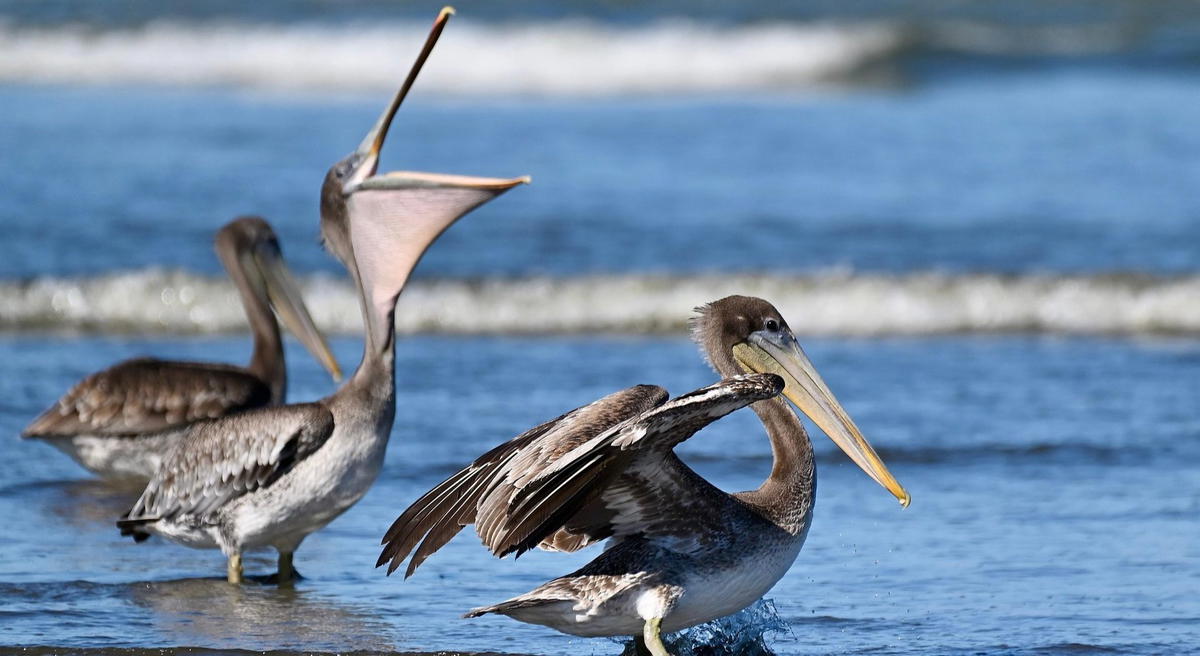
Pelicans accomplish this using a distinctive behavior often described as a “head throw.” After resurfacing, the bird tilts its bill downward, allowing much of the water to drain from the pouch.
If additional water remains trapped inside the flexible pouch, the pelican sharply lifts its head upward while pressing the pouch against its breast. This motion forces remaining water out while retaining the captured fish.
The gular pouch can temporarily hold up to about 11 liters (roughly 3 gallons) during a dive. Efficient drainage therefore ensures that pelicans swallow fish without ingesting large quantities of seawater.
This rapid handling behavior allows pelicans to prepare quickly for additional dives when fish schools remain nearby.
6. Ground-Effect Flight Allows Pelicans to Glide Efficiently
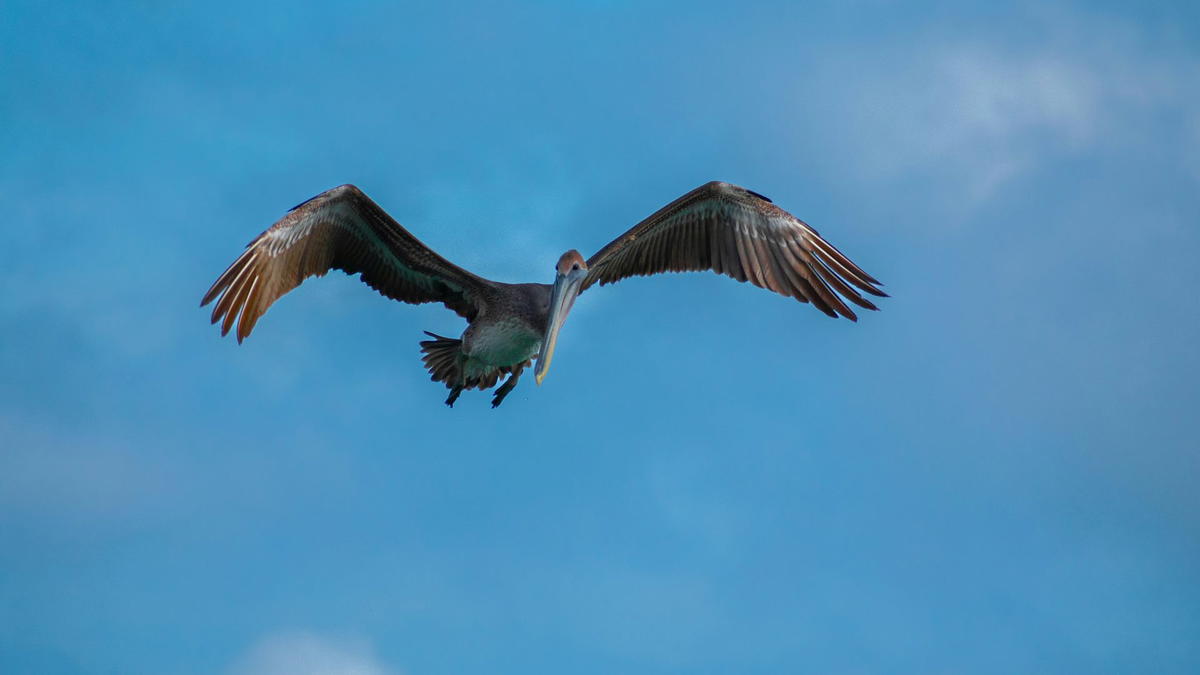
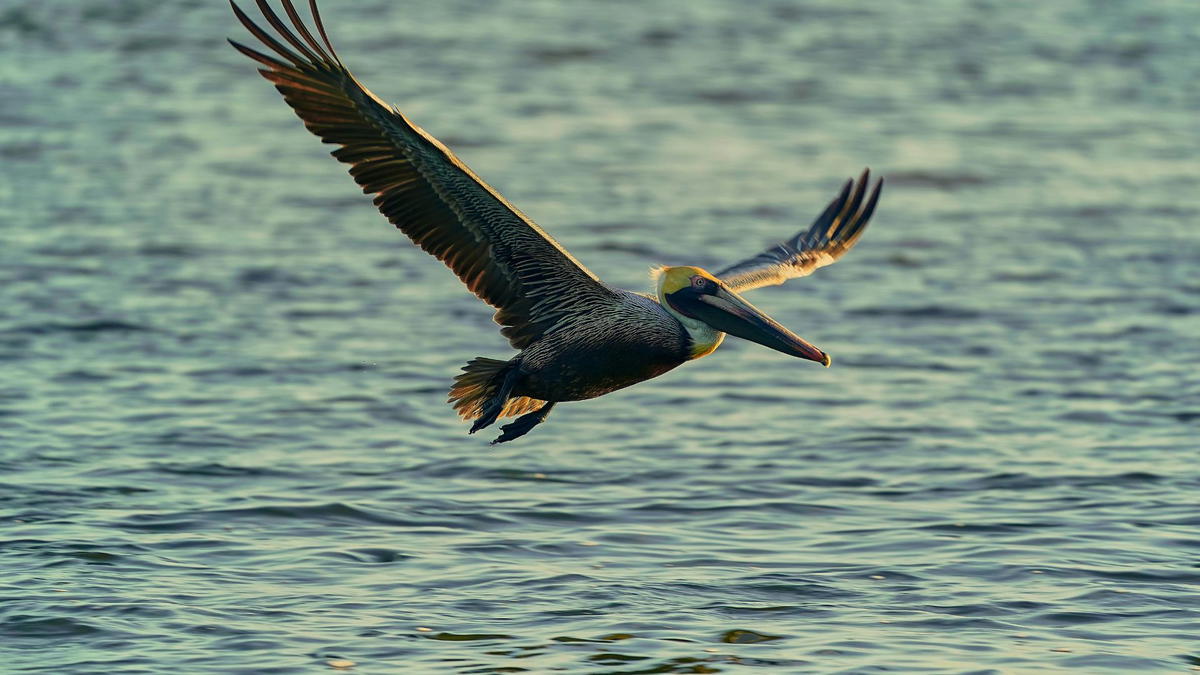
Brown Pelicans are frequently observed flying just above the ocean surface, often gliding 10–50 centimeters above the waves. This flight pattern allows them to exploit a physical aerodynamic phenomenon known as ground effect.
Ground effect occurs when air becomes compressed between the bird’s wings and the water surface. This compression reduces induced drag and increases lift, allowing the bird to maintain flight with less energy.
Aerodynamic research indicates that flying in ground effect can reduce flight energy expenditure by approximately 15–25 percent compared with higher-altitude flight.
Pelicans often travel in loosely spaced single-file lines while using this technique along coastlines.
By minimizing flapping during long-distance travel, ground-effect flight helps pelicans conserve energy for their demanding plunge-diving hunting strategy.
7. Kleptoparasitism Occurs Among Pelicans and Other Seabirds
Although Brown Pelicans are skilled hunters, they sometimes engage in kleptoparasitism, a behavior in which animals steal food captured by other individuals.
Pelicans may attempt to steal fish from other pelicans or from diving birds such as Double-crested Cormorants when those birds surface with prey. By forcing the other bird to release its catch, the pelican gains food without performing a dive.
However, pelicans are also frequent targets of kleptoparasitism themselves. Smaller seabirds such as Laughing Gulls often gather around feeding pelicans. When a pelican surfaces and begins draining water from its pouch, gulls may snatch escaping fish before the pelican can swallow them.
These interactions illustrate how multiple seabird species compete for the same fish resources within coastal ecosystems.
8. Pelican Chicks Feed by Reaching Into the Parent’s Pouch
Brown Pelican chicks rely entirely on parental feeding during early development. Adult birds deliver food by regurgitating partially digested fish collected during foraging trips.
Newly hatched chicks initially consume liquefied food regurgitated onto the nest floor. As they grow stronger, chicks develop a distinctive feeding behavior in which they insert their heads deep into the adult’s open throat pouch.
This behavior—sometimes informally described as “head-in-the-pouch” feeding—allows chicks to retrieve regurgitated fish directly from the adult’s pouch.
The method minimizes food loss in crowded nesting colonies and ensures efficient transfer of nutrients to rapidly growing chicks.
Parental provisioning continues for several weeks until juveniles are capable of flying and eventually learning to capture fish independently.
Key Takeaways
• Brown Pelicans display specialized behaviors adapted for aerial plunge-diving and coastal foraging.
• Their plunge-diving hunting method relies on high-speed water entry and an expandable gular pouch for capturing fish.
• Subcutaneous air sacs and body rotation protect the bird from injury during high-impact dives.
• Pelicans uniquely incubate eggs using their webbed feet, transferring heat through highly vascularized skin.
• Gular fluttering provides an effective cooling mechanism in warm coastal environments.
• Behaviors such as ground-effect flight, kleptoparasitism, and pouch-feeding of chicks illustrate how pelicans balance energy efficiency, competition, and parental care in marine ecosystems.