Introduction
The bald eagle (Haliaeetus leucocephalus) is a large raptor whose flight performance is closely linked to its hunting strategy. Unlike falcons that rely primarily on extreme dive speeds, bald eagles combine moderate cruising speed, controlled acceleration, and precise maneuverability to capture prey, especially fish near the water’s surface.
Field observations and aerodynamic analyses show that bald eagles typically fly at 30–50 mph (48–80 km/h) in level flight, while diving speeds during hunting can reach 75–100 mph (120–160 km/h). These speeds reflect biomechanical trade-offs between lift, drag, and control, influenced by wing loading, body mass (typically 3–6.3 kg), and wing structure.
Understanding these flight capabilities is scientifically important because it reveals how large birds optimize energy efficiency while maintaining hunting success. Their performance demonstrates how wing shape, muscle power, and aerodynamics shape predatory behavior, as documented by organizations such as the U.S. Fish and Wildlife Service.
1. Bald Eagles Cruise at 30–50 mph for Energy Efficiency
Bald eagles typically maintain speeds between 30 and 50 mph (48–80 km/h) during routine flight and foraging. This range represents an energy-efficient speed where aerodynamic drag is minimized relative to lift, often referred to as the minimum power speed.
Their large wingspan (approximately 1.8–2.3 meters) allows them to generate significant lift, enabling long periods of gliding with minimal flapping. Instead of continuous powered flight, they often use thermal updrafts, ridge lift, and wind currents to stay airborne.
From a biomechanical perspective, this speed balances energy use, wingbeat frequency (about 2–3 beats per second), and aerodynamic efficiency. Flying faster increases drag, while flying slower reduces control.
This efficiency allows bald eagles to cover large areas while conserving energy for hunting.
2. Diving Speeds Can Reach 75–100 mph During Hunting
When hunting, bald eagles can accelerate into a gravity-assisted dive (called a stoop), reaching speeds of 75–100 mph (120–160 km/h). These dives usually begin from moderate heights, often between 150 and 300 meters.
During the dive, the eagle partially folds its wings to reduce drag while still maintaining control. Unlike peregrine falcons, bald eagles do not fully streamline their bodies, allowing better maneuverability.
Dive angles typically range from 30 to 60 degrees, prioritizing control over maximum speed.
This controlled diving strategy is essential because bald eagles hunt prey near the water’s surface, where precision is more important than extreme velocity.
3. Hunting Speed Is Adjusted for Accurate Prey Capture
Bald eagles rarely strike prey at their maximum dive speed. Instead, they slow down to about 30–40 mph (48–64 km/h) during the final phase of the attack.
As they approach the water, they extend their wings and talons, increasing drag and lift to reduce speed. This prevents injury and allows precise timing.
During the strike, the eagle keeps its body above the water while extending its talons forward to grab fish. Usually, only the feet touch the water surface.
This controlled deceleration demonstrates advanced coordination and allows successful hunting in a medium where water resistance is much higher than air.
4. Carrying Prey Reduces Flight Speed
After catching prey, bald eagles experience a decrease in flight speed due to added weight and drag. Their speed typically drops to around 25–30 mph (40–48 km/h).
Carrying prey increases wing loading, meaning the bird must generate more lift to stay airborne. This requires more energy and reduces climbing ability.
If the prey is too heavy, the eagle may drag it across the water or abandon it.
This limitation directly influences prey selection, as eagles tend to target animals they can efficiently transport.
5. Bald Eagles Are Highly Maneuverable
Despite their size, bald eagles are highly maneuverable, especially at speeds between 20 and 40 mph. Their broad wings and flexible feathers allow quick adjustments in direction.
They can perform sharp turns with steep banking angles while maintaining stability. This is important when tracking moving prey or flying in complex environments such as rivers and coastlines.
Aerodynamically, maneuverability is achieved through wing shape adjustments and tail control, which alter airflow and lift distribution.
This ability allows bald eagles to prioritize accuracy and control over raw speed during hunting.
6. Flight Performance Compared to Golden Eagles
Bald eagles are fast, but they are not the fastest raptors. The golden eagle (Aquila chrysaetos) can reach dive speeds of up to 150 mph (240 km/h).
This difference reflects different hunting strategies. Golden eagles often hunt land animals in open areas, where high-speed dives increase impact force.
In contrast, bald eagles specialize in catching fish, requiring controlled descent and precise timing rather than extreme speed.
Their broader wings and higher drag profile favor stability and lift over maximum velocity, showing how flight performance evolves based on ecological needs.
7. The Extraordinary Biomechanics of an Eagle’s Wing
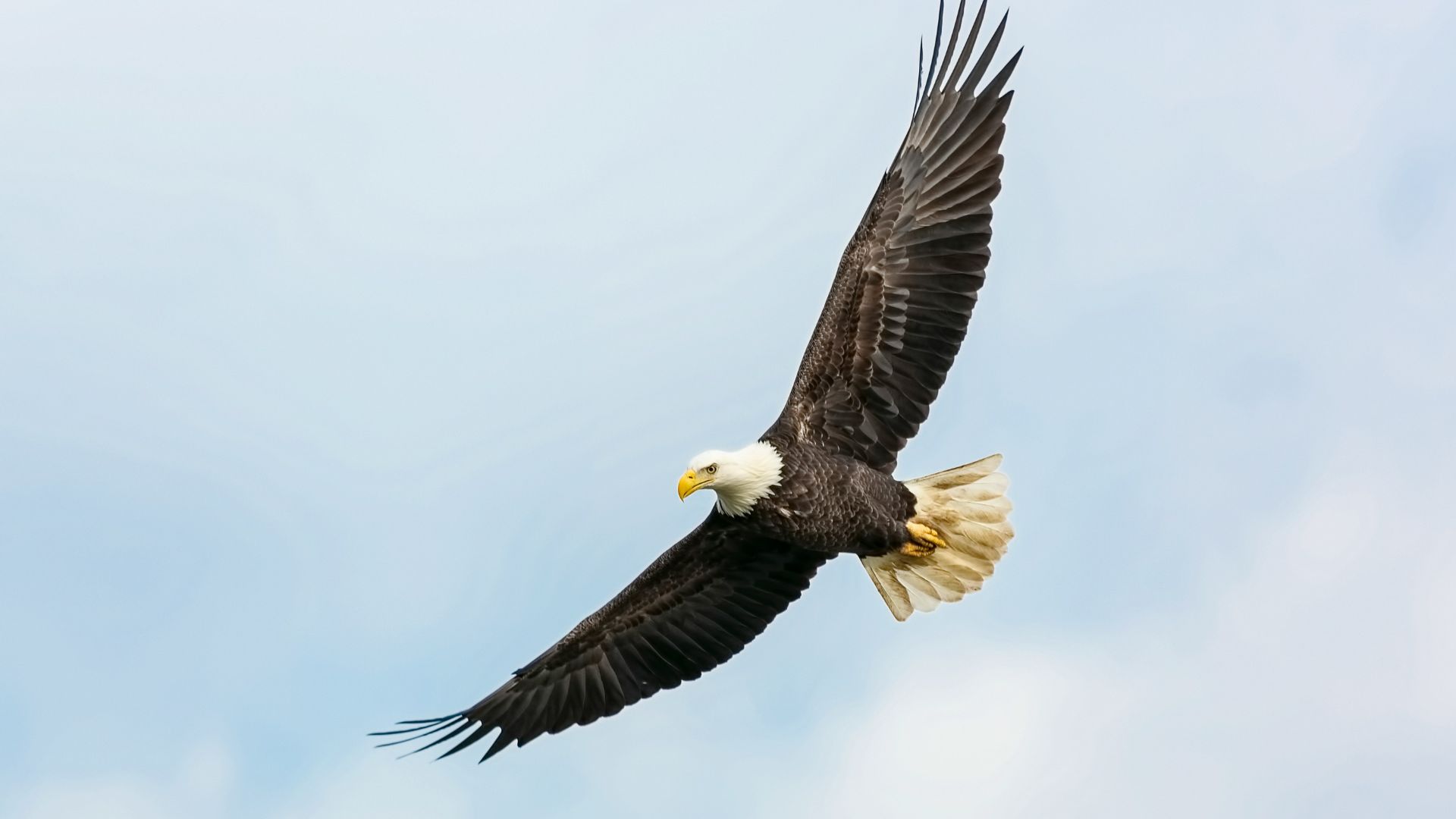
Beyond the raw numbers of speed and dive performance, the true wonder of a bald eagle’s flight lies in its incredible wing morphing ability. Recent research reveals that eagles don’t just flap their wings; they are master shape-shifters of the sky . A bald eagle can dynamically transform the shape, span, and area of its wings in a coordinated and mesmerizing way . When soaring slowly, they extend their wings to maximize area, deploying feather tips to control stalls and increase efficiency . In a high-speed dive or stoop, they swiftly tuck their wings to minimize drag . During the critical final approach to catch a fish, they increase wing area and lift, deploy their legs as airbrakes, and even use their feathers as “spoilers” to achieve a steep, stable, and accurate landing . This astonishing adaptability is made possible by a highly flexible skeletal structure, particularly in the wrist joint, allowing for a much greater range of motion than previously understood . Adding another layer of aerodynamic mastery, the bald eagle’s wing features distinctive “wingtip slots”—gaps at the ends of the wings. Recent scientific studies on the aerodynamics of these slots have shown that they create complex and beneficial vortex interactions during flapping, effectively allowing the eagle to generate significantly more lift compared to a wing without them . This remarkable combination of morphing wings and slotted tips allows the bald eagle to perform a wide array of flight maneuvers with an unmatched balance of control, efficiency, and power.
Bald Eagle Flight Speed at a Glance
A bald eagle’s speed changes depending on whether it is soaring, pursuing prey, diving or carrying a catch. The table below summarizes its principal flight speeds and provides further reading.
| Flight situation | Approximate speed | What happens | Related article | External resource |
|---|---|---|---|---|
| Normal flight and soaring | 30–50 mph (48–80 km/h) | Broad wings allow efficient cruising, gliding and soaring while the eagle searches for food. | Explore the Bald Eagle profile | National Eagle Center FAQ ↗ |
| Hunting dive | 75–100 mph (120–160 km/h) | The eagle partially folds its wings and accelerates toward prey, while retaining enough control to adjust its direction. | Discover more Bald Eagle adaptations | National Park Service: Bald Eagle hunting ↗ |
| Final fishing approach | About 30–40 mph (48–64 km/h) | The eagle slows down, extends its wings and positions its talons to seize fish close to the water’s surface. | Bald Eagle vs Osprey | Cornell Lab: Bald Eagle identification ↗ |
| Flying with prey | About 25–30 mph (40–48 km/h) | The additional weight and aerodynamic drag reduce speed and increase the amount of lift the eagle must generate. | Animals that interact with Bald Eagles | U.S. Fish & Wildlife Service species profile ↗ |
| Compared with Golden Eagles | Golden Eagle: up to approximately 150 mph in a dive | Golden eagles are generally associated with faster, steeper dives, while bald eagles prioritize controlled approaches near water. | Bald Eagle vs Golden Eagle | National Eagle Center speed comparison ↗ |
Note: Flight speeds are approximate and can vary with wind, altitude, flight angle, body size and whether the eagle is carrying prey.