Updated: July 2026
Yes, Alligators, particularly younger ones under 1.5 meters, can scale near-vertical tree trunks to heights of 2–3 meters to bask in the sun and survey their surroundings. While they are capable of climbing, they are often easily startled and will retreat into the water if threatened
1. Introduction: A Behavior Long Known, Rarely Studied
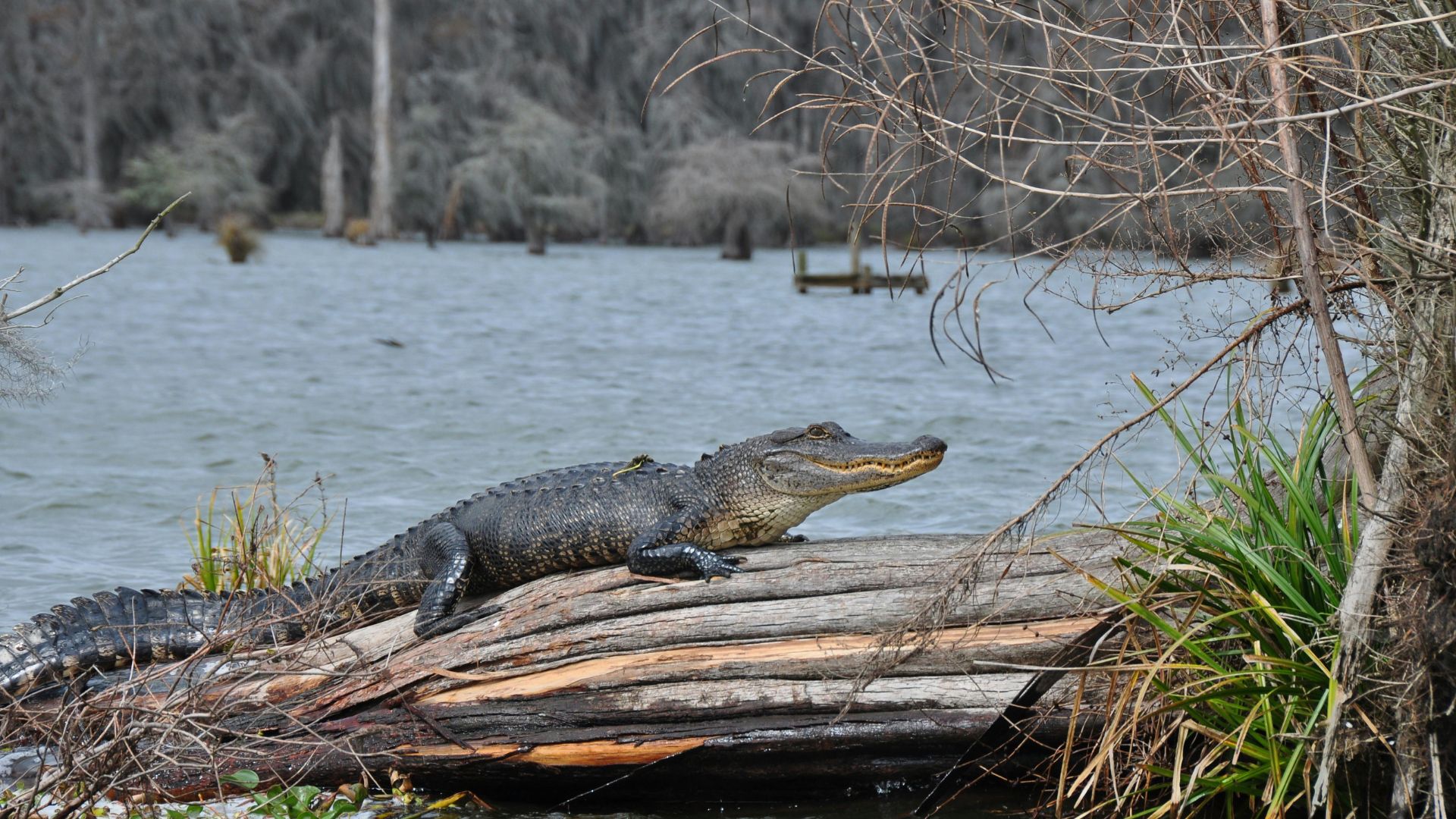
The American alligator (Alligator mississippiensis) is widely recognized as a powerful aquatic predator in the wetlands of the southeastern United States. Yet observations from wildlife researchers have revealed a lesser-known ability: alligators and their crocodilian relatives can climb trees and other elevated structures.
Although this behavior appears unusual for a large reptile, field reports and scientific studies confirm that climbing occurs across multiple crocodilian species. The first detailed scientific documentation appeared in a 2014 study published in Herpetology Notes by Vladimir Dinets (University of Tennessee), Adam Britton (Charles Darwin University, Australia), and Matthew Shirley (University of Florida/SFM Safari Gabon). Their paper compiled field observations of crocodilians perched in trees and shrubs across three continents, challenging the long-standing assumption that crocodilians are strictly ground- or water-bound animals (Dinets et al., 2014).
Nearly a decade later, a 2023 laboratory study in the journal Amphibia-Reptilia by Annelise Swords and colleagues provided the first quantified biomechanical data on alligator climbing performance, confirming and extending the field observations with controlled experiments (Swords et al., 2023).
Importantly, the 2014 paper’s authors noted that while the behavior had been “briefly mentioned” in scientific literature as early as 1972 — when Guggisberg wrote that baby crocodiles “can climb into bushes, up trees and even hang on reeds like chameleons” — it had never been described in detail (Guggisberg, 1972, cited in Dinets et al., 2014).

2. Which Crocodilian Species Climb Trees?
The 2014 study documented climbing behavior through original field observations on four crocodilian species, all from two crocodile genera (Crocodylus and Mecistops):
- Australian freshwater crocodile (Crocodylus johnstoni) — observed in river systems across the Northern Territory, Western Australia, and Queensland
- American crocodile (Crocodylus acutus) — observed in Costa Rica, the Dominican Republic, Colombia, and Florida’s Everglades National Park
- Central African slender-snouted crocodile (Mecistops cataphractus) — observed in Gabon and the Democratic Republic of Congo; described by the authors as the species for which tree-climbing is “most discussed”
- Nile crocodile (Crocodylus niloticus) — observed in Botswana, Namibia, Zambia, and Malawi
The American alligator was also documented in the paper, but only through anecdotal and photographic reports — juveniles on branches 0.5–1 m above water in the United States and a sub-adult perched 2–3 m above water at the Pearl River Delta, Mississippi. It was not one of the four species with systematic original field observations (Dinets et al., 2014).
The 2023 laboratory study by Swords et al. confirmed this distinction, explicitly noting that the Dinets et al. paper “did not include coverage of Alligator mississippiensis” in its original observations (Swords et al., 2023).
Beyond these primary species, the 2014 paper compiled anecdotal reports of tree-climbing in at least six additional crocodilian species from around the world:
| Species | Scientific name | Reported location |
|---|---|---|
| Estuarine (saltwater) crocodile | Crocodylus porosus | West Papua, Indonesia |
| New Guinea crocodile | Crocodylus novaeguineae | Elevala River, Papua New Guinea |
| Philippine crocodile | Crocodylus mindorensis | Philippines |
| Siamese crocodile | Crocodylus siamensis | Laos |
| Dwarf crocodile | Osteolaemus sp. | Captive (Bristol Zoo, UK — one escaped by climbing) |
| West African crocodile | Crocodylus suchus | Mentioned in range comparison |
3. How High Can They Actually Climb?
The 2014 study’s height data falls into three distinct tiers, reflecting different levels of evidence:
Anecdotal maximum (10 m / 33 ft): Local residents in Isla de Salamanca National Park, Colombia, reported routinely observing juvenile American crocodiles basking in mangrove trees up to 10 meters above ground. This is the highest figure in the paper, but it comes from personal communications rather than direct researcher observation (Dinets et al., 2014).
Directly observed maximum (4 m / 13 ft high, 5 m / 16 ft from bank): In Gabon’s Loango National Park, a 1.4-meter Central African slender-snouted crocodile was observed basking at the end of a fallen tree approximately 4 meters above the water surface and 5 meters from the riverbank. To reach this position, the crocodile would have had to scale a 4-meter vertical bank and navigate through branches. This is the highest climb directly documented by the researchers (Dinets et al., 2014).
Typical observations (0.25–3 m): Most climbing observations across all four primary species occurred at much more modest heights. Australian freshwater crocodiles typically climbed to 1–2 m above water. American crocodiles in mangrove trees were usually found up to 1 m above the water surface, with one individual approximately 3 m above water at high tide. Nile crocodiles were observed on branches less than 1 m above water. American alligator observations were limited to 0.5–1 m (juveniles) and 2–3 m (one sub-adult in Mississippi) (Dinets et al., 2014).
4. Juveniles Are the Most Skilled Climbers
Climbing ability in crocodilians is strongly influenced by body size and mass. The 2014 field study and the 2023 laboratory study both confirm this pattern, though they provide different types of evidence.
Field evidence (Dinets et al., 2014)
The 2014 paper states plainly: “the ability to climb decreases with increasing size and mass.” Key findings include:
- Crocodilians observed basking or resting in tree branches were rarely larger than 1.5 meters (approximately 5 feet) in total length
- Hatchlings of both Australian freshwater and estuarine crocodiles are lightweight enough that, with their relatively strong claws, they can even climb vertical brickwork — the authors note this is the cause of occasional crocodile farm escapes
- Juvenile crocodilians can climb on relatively thin, vertical branches by gripping from the sides, or even across multiple branches using them as a ladder and lifting the body vertically
- Australian freshwater crocodiles were observed attempting to climb chain-link fences up to 1.8 meters tall
Laboratory evidence (Swords et al., 2023)
The 2023 study by Swords et al. provided the first controlled, quantified assessment of size-dependent climbing performance in American alligators:
- Juvenile alligators (51–53 cm total length) readily and voluntarily climbed the testing apparatus, even when it was positioned at true vertical (90°). They showed no hesitation — when placed at the base, they climbed to the top and “perched” every trial
- Sub-adult alligators (167–188 cm, 11.8–27.2 kg) successfully climbed inclines up to 55°, but required encouragement and entered the apparatus as an “escape behaviour,” never voluntarily exiting the far end
- Larger sub-adults (178–188 cm) moved inconsistently, exhibiting defensive rather than locomotor behaviors, preventing quantification of their climbing performance
- The study concludes that “climbing mechanics are fundamentally different in hatchling/yearling alligators than they are in adult animals” and that vertical climbing “may be impossible for larger adults” (Swords et al., 2023)
The biomechanical explanation
The difficulty of climbing is proportional to the steepness of the slope, the smoothness of the surface, and the strength of the animal relative to its weight. As the 2014 paper explains: “Climbing a steep hill and climbing a tree branch are mechanically similar assuming the branch is wide enough to walk on.” The larger the animal, the more its mass works against its ability to grip and pull upward — which is why adults exceeding roughly 1.5 meters are rarely seen in trees (Dinets et al., 2014).
5. How Alligators Climb: Biomechanics and Gait
Despite lacking specialized climbing anatomy — no adhesive toe pads like geckos, no prehensile tails — crocodilians possess several features that permit limited but effective climbing.
Gait: “Low walk,” not “high walk”
A common assumption is that alligators use their semi-erect “high walk” posture (body lifted off the ground, supported by the limbs) when climbing. However, the 2023 laboratory study directly tested this and found otherwise:
“During the trials, both the sub-adult and juvenile alligators used a ‘low walk’ gait, rather than a distinctive climbing gait. In all trials conducted, with different size alligators, different substrates, and different angles of inclination, the alligators always moved using what appeared to be the same ‘low walk’ gait.”
In the low walk, the body is kept closer to the substrate, with the belly potentially making contact. This posture may actually provide greater stability on inclined surfaces by lowering the center of mass and increasing friction (Swords et al., 2023).
Claws and grip
Alligator limbs are equipped with keratinized claws capable of gripping bark, roots, and rough surfaces. Unlike arboreal reptiles that rely on adhesive pads, alligators depend on friction-based locomotion — pressing their bodies against the surface while claws anchor into bark or gaps in the substrate.
The 2023 study confirmed active claw engagement during climbing. When alligators traversed an open grate (with 2.5 cm gaps between bars), their stride duration increased significantly, presumably due to the time spent inserting and retracting claws and digits into the gaps for grip. This demonstrates that claw interaction with the substrate is an active, deliberate component of climbing, not passive contact (Swords et al., 2023).
Velocity and angle
One of the most striking findings from the 2023 study is that sub-adult alligators maintained the same stride velocity at 0°, 30°, and 55° inclinations. This matches patterns previously described in climbing lizards: the animals shorten both stride length and stride duration with increasing inclination, maintaining similar velocity. As the authors note: “an alligator can move up a bank nearly as quickly as it can over horizontal ground” (Swords et al., 2023).
6. Why Do They Climb? Thermoregulation and Surveillance
The 2014 study proposes two primary drivers for tree-climbing behavior, supported by observational evidence:
Thermoregulation
Alligators and other crocodilians are ectotherms — they rely on external heat sources to regulate body temperature. In densely vegetated wetlands, ground-level basking areas may be limited because shoreline vegetation or canopy cover blocks direct sunlight.
The 2014 paper found that “the most frequent instances of tree climbing occur with species or populations that are living in areas with few terrestrial basking sites (e.g., heavily forested or mangrove coastlines).” By climbing onto branches or leaning trunks, crocodilians can access solar radiation above shaded ground — an adaptive thermoregulatory strategy rather than accidental movement (Dinets et al., 2014).
However, thermoregulation is not only about warming up. A 2024 study on estuarine crocodiles (Crocodylus porosus) in Australia’s Wenlock River found that cooling down is as important as warming up for tropical crocodilians. Body temperatures ranged from 21.0 to 39.9 °C in the wild, and the animals employed both warming and cooling behaviors throughout the year — cooling was common in summer, warming in winter. This suggests tree-climbing may also serve as a cooling strategy, providing access to shade or breezes above water level, not just sun exposure (Barham et al., 2024).
Site surveillance
The second proposed function — and arguably the more important one — is environmental surveillance. The key evidence comes from an observation that thermoregulation alone cannot explain: crocodilians were frequently found in trees at night.
“This, however, does not explain the more interesting observation of high frequency nighttime ‘basking’ amongst these tree climbing species, or rather the frequency of nighttime arboreal basking compared to nighttime terrestrial basking.”
Since crocodilians do not bask for warmth at night, their continued presence in trees after dark suggests that the elevated vantage point serves a surveillance function — allowing them to detect potential threats and monitor their surroundings from a position where “escape is as easy as falling off a log.” The authors propose that “a secondary benefit may be increased detectability of prey under such conditions” (Dinets et al., 2014).
Importantly, the researchers emphasize that climbing does not appear to function primarily as a hunting strategy — crocodilians do not climb trees to ambush prey from above. Instead, it serves as a resting and basking behavior that incidentally provides improved situational awareness.
7. Skittish Behavior: Why Tree-Climbing Remained Hidden
One of the most remarkable findings of the 2014 study is how skittish crocodilians become when perched in trees — and how this extreme wariness may explain why the behavior remained scientifically undocumented for so long despite being relatively common.
Approach distances
The paper provides specific fleeing distances that vary by species and time of day:
- American crocodiles in trees were “extremely wary” and jumped or fell into the water when an approaching observer was still more than 10 meters away
- Central African slender-snouted crocodiles during daytime were even more sensitive, usually dropping off their basking sites on first sight of the survey crew at distances greater than 50 meters
Day vs. night approachability
A critical behavioral difference emerged between day and night:
- During the day, arboreal crocodilians were “much more skittish, fleeing at further distances, than their terrestrial basking or resting in the water counterparts”
- At night, arboreal individuals did not differ in approachability from other nighttime individuals — they could often be “approached and hand-grabbed or noose-captured off the trees”
The authors note that this day/night approachability difference is “a large factor in why crocodilian population surveys are largely nocturnal” (Dinets et al., 2014).
Why the behavior stayed hidden
The extreme daytime wariness of tree-climbing crocodilians means that most casual observers would never see them in trees — by the time a person gets close enough to notice, the animal has already fled into the water. The authors suggest this “might explain why tree-climbing behaviour in crocodilians remains relatively little known despite being relatively common.”
In Gabon, the behavior is so frequent that the authors compared it to birds: “crocodiles and African darters (Anhinga rufa) are equal candidates for glimpses of animals jumping off trees into the water throughout this area” (Dinets et al., 2014).
8. Where in the World: Geographic Observations
The 2014 study documented tree-climbing across three continents, with observations spanning multiple countries and specific national parks:
Australia
Australian freshwater crocodiles were observed climbing into low branches above water in:
- Daly and Douglas Rivers (Northern Territory)
- Mary and McKinlay Rivers (Northern Territory)
- Chamberlain River (Western Australia)
- Mitchell River (Queensland)
Observations were made both during the day and at night, across a variety of creeks and water bodies.
The Americas
American crocodiles were observed in mangrove trees at:
- Santa Rosa National Park (Costa Rica) — N > 30 individuals, May 1995
- Lago Enriquillo (Dominican Republic) — N = 4, February 2008
- Isla de Salamanca National Park (Colombia) — N = 4, January 2007
- Everglades National Park (Florida, USA) — N = 1
Additional anecdotal reports came from Tulum, Mexico, where juvenile American crocodiles were observed basking in mangrove trees.
Africa
The Central African slender-snouted crocodile was observed tree-basking in:
- Loango National Park (Gabon) — N > 50
- Ivindo National Park (Gabon) — N > 10
- Moukalaba-Doudou National Park (Gabon) — N = 3
- Okapi Faunal Reserve (Democratic Republic of Congo) — N = 2
Nile crocodiles were documented in trees at:
- Okavango Delta (Botswana)
- Mahango Game Reserve (Namibia)
- South Luangwa National Park (Zambia)
- Liwonde National Park (Malawi)
A notable geographic gap
Interestingly, while tree-climbing in Central African slender-snouted crocodiles was frequent and well-documented, no records exist from West Africa. The authors note that West and Central African slender-snouted crocodiles are in the process of being recognized as distinct species, and this behavioral difference “could reflect interspecies behavioural divergence despite ecological niche convergence” (Dinets et al., 2014).
9. What This Means for Paleontology
The study’s findings extend beyond living crocodilians to the interpretation of fossil evidence. Because modern crocodilians can climb trees despite lacking any obvious morphological adaptations for arboreality — no curved climbing claws, no grasping feet, no prehensile tail — the authors argue that paleontologists cannot reliably infer climbing ability from fossil morphology alone.
“The degree of arboreality of extinct crocodilians and many other Archosaurian taxa cannot always be ascertained from fossil material. Any small, highly terrestrial crocodilian, such as the recently extinct Trilophosuchus rackhami, could be arboreal to some extent.”
This prediction gained support in 2025, when researchers in Queensland, Australia, discovered 55-million-year-old crocodile eggshells potentially belonging to ancient mekosuchine crocodiles — nicknamed “drop crocs” — believed to have climbed trees to ambush prey below. Co-author Professor Michael Archer described some of these extinct creatures as “at least partly-arboreal,” suggesting a hunting strategy similar to leopards dropping from trees (BBC News, 2025; Dinets et al., 2014).
Key Findings: Can Alligators Climb Trees?
Scientific evidence confirms that American alligators can climb steep surfaces and elevated vegetation, although climbing ability decreases as body size and mass increase.
| Topic | Evidence-based finding | Important qualification |
|---|---|---|
| Can American alligators climb? | Yes. Juvenile and sub-adult American alligators successfully climbed inclined surfaces in controlled laboratory experiments. | Their climbing ability is strongly affected by body size, surface texture and slope. |
| Juvenile performance | Juvenile alligators measuring approximately 51–53 cm climbed a testing apparatus positioned at a true vertical angle of 90°. | This result came from a laboratory apparatus and should not be interpreted as proof that every juvenile can climb a vertical tree trunk in natural conditions. |
| Sub-adult performance | Sub-adult alligators successfully climbed inclines of up to 55° during the 2023 laboratory study. | They required encouragement and generally entered the apparatus as an escape response rather than climbing voluntarily. |
| Effect of body size | Climbing ability decreases as crocodilians become larger and heavier. Juveniles are generally the most capable climbers. | Large adults are rarely observed climbing high, and vertical climbing may be impossible for the largest individuals. |
| American alligator field reports | Juvenile American alligators have been reported on branches approximately 0.5–1 m above water. One sub-adult was reported around 2–3 m above water in Mississippi. | These American alligator records were anecdotal or photographic, not part of the systematic original field observations in the 2014 study. |
| Highest reported height | The 2014 paper mentioned an anecdotal report of juvenile American crocodiles reaching approximately 10 m (33 ft) in Colombian mangroves. | This figure applies to American crocodiles, not American alligators, and was reported by local residents rather than measured directly by the researchers. |
| Highest directly observed climb | Researchers directly observed a Central African slender-snouted crocodile approximately 4 m above the water and 5 m from the bank. | This was another crocodilian species, not an American alligator. Most recorded climbs across species were below 3 m. |
| How alligators climb | They use a low-walk gait, strong limbs, claw engagement and friction against bark or other rough surfaces. | Alligators lack specialized arboreal adaptations such as adhesive toe pads or prehensile tails. |
| Why crocodilians climb | Proposed functions include thermoregulation and surveying the surrounding area for threats. An elevated position also permits a rapid drop into the water when disturbed. | Climbing does not appear to be primarily a method of ambushing prey from above. Improved prey detection may be a secondary benefit. |
Principal sources: Dinets, Britton and Shirley (2014), Climbing Behaviour in Extant Crocodilians; Swords et al. (2023), Alligator Ascension: Climbing Performance of Alligator mississippiensis.
References
- Dinets, V., Britton, A. & Shirley, M.H. (2014). Climbing behaviour in extant crocodilians. Herpetology Notes, 7: 3–7. Published online 25 January 2014. Available at: http://dinets.info/crocs_climbing.pdf
- Swords, A., Cramberg, M., Parker, S., Scott, A., Sopko, S., Taylor, E. & Young, B.A. (2023). Alligator ascension: climbing performance of Alligator mississippiensis. Amphibia-Reptilia, 45(1): 37–44. DOI: 10.1163/15685381-bja10165
- Barham, K.E., Dwyer, R.G., Frere, C.H., Bentley, L.K., Baker, C.J., Campbell, H.A., Irwin, T.R. & Franklin, C.E. (2024). Cooling down is as important as warming up for a large-bodied tropical reptile. Proceedings of the Royal Society B. Available at: https://pmc.ncbi.nlm.nih.gov/articles/PMC11537756/
- Kledzik, D., Felkler, D., Brueggen, J., Hutchinson, J., Houston, K., Vliet, K. & Chang, Y.-M. (2019). Divergent evolution of terrestrial locomotor abilities in extant Crocodylia. Scientific Reports, 9: 19302. Available at: https://pmc.ncbi.nlm.nih.gov/articles/PMC6917812/
- Guggisberg, C.A.W. (1972). Crocodiles: Their Natural History, Folklore and Conservation. David & Charles, Newton Abbott, pp. 122–123.
- BBC News (2025). Evidence of ancient tree-climbing ‘drop crocs’ found in Australia. 12 November 2025. Available at: https://www.bbc.com/news/articles/c2lpyrnjleeo
FAQs
Can alligators really climb trees?
Yes. Scientific documentation of crocodilian tree-climbing was formally published in 2014 by Dinets, Britton, and Shirley in Herpetology Notes, with field observations across Australia, Africa, and the Americas. A 2023 laboratory study in Amphibia-Reptilia by Swords et al. then quantified alligator climbing performance experimentally, confirming that both juvenile and sub-adult American alligators can climb inclines up to 55°, and juveniles can even climb at true vertical (90°) (Dinets et al., 2014; Swords et al., 2023).
How high can alligators climb?
Most observations are modest — typically 0.5 to 3 meters above water. The highest directly observed climb by a researcher was a Central African slender-snouted crocodile perched 4 meters (13 feet) above the water in Gabon. The highest anecdotal report comes from Colombia, where local residents described juvenile American crocodiles in mangrove trees up to 10 meters (33 feet) above ground. For American alligators specifically, observations are limited to 0.5–1 m (juveniles) and 2–3 m (one sub-adult in Mississippi) (Dinets et al., 2014).
Can adult alligators climb trees?
Large adults are rarely seen in trees. The 2014 study found that crocodilians observed basking in branches were rarely larger than 1.5 meters (about 5 feet) in total length. The 2023 laboratory study confirmed this: larger sub-adult alligators (178–188 cm) moved inconsistently and exhibited defensive rather than locomotor behavior, preventing quantification of their climbing. The study concludes that vertical climbing “may be impossible for larger adults” (Dinets et al., 2014; Swords et al., 2023).
Can baby alligators climb walls?
Remarkably, yes. The 2014 study reports that hatchlings of both Australian freshwater and estuarine crocodiles are lightweight enough, with sufficiently strong claws, to climb vertical brickwork. The authors note this is the cause of occasional crocodile farm escapes. The 2023 laboratory study confirmed this extreme capability: juvenile alligators (51–53 cm) climbed testing apparatus positioned at true vertical (90°) with no hesitation — they climbed to the top and perched in every trial (Dinets et al., 2014; Swords et al., 2023).
Why do alligators climb trees?
The 2014 study proposes two primary drivers. The first is thermoregulation — in densely vegetated areas where ground-level sunlight is scarce, climbing onto branches gives crocodilians access to solar radiation. The second is site surveillance — an elevated vantage point allows them to detect threats and monitor their surroundings. The key evidence for surveillance is that crocodilians were frequently found in trees at night, when basking for warmth would serve no purpose. A 2024 study also found that cooling down is as important as warming up for tropical crocodilians, suggesting tree-climbing may also provide access to shade and breezes (Dinets et al., 2014; Barham et al., 2024).
Do alligators climb trees to hunt from above?
No. The researchers emphasize that climbing does not appear to function primarily as a hunting strategy. Crocodilians do not perch in trees to ambush prey from above. Instead, tree-climbing serves as a resting and basking behavior that incidentally provides improved awareness of the surroundings. The authors describe prey detection as “a secondary benefit” rather than the main purpose (Dinets et al., 2014).
Can alligators climb fences?
Yes. The 2014 study documents Australian freshwater crocodiles attempting to climb chain-link fences up to 1.8 meters (about 6 feet) tall. Their ability to climb steep slopes and angled surfaces extends to artificial structures. However, this was observed in smaller individuals — larger crocodiles would struggle with vertical barriers (Dinets et al., 2014).
Which crocodilian species is the best tree climber?
The 2014 study describes the Central African slender-snouted crocodile (Mecistops cataphractus) as the species for which tree-climbing is “most discussed.” In Gabon, the behavior was so frequent that researchers compared crocodiles jumping from trees to birds — “crocodiles and African darters (Anhinga rufa) are equal candidates for glimpses of animals jumping off trees into the water.” The Australian freshwater crocodile is also noted as a particularly capable climber, able to scale steep riverbanks that saltwater crocodiles would struggle with (Dinets et al., 2014).
Do alligators climb trees at night?
Yes — and this is one of the most scientifically interesting findings. Australian freshwater crocodiles and Central African slender-snouted crocodiles were both observed in trees at night. The slender-snouted crocodile showed roughly equal frequency of daytime and nighttime tree use. This nighttime behavior is what led researchers to propose surveillance as a key function, since basking for warmth at night serves no thermoregulatory purpose. Notably, American crocodiles were never observed in trees at night despite extensive nighttime observations (Dinets et al., 2014).
How do alligators grip trees without climbing adaptations?
Alligators lack the adhesive toe pads of geckos or the prehensile tails of some lizards. Instead, they rely on friction-based locomotion — pressing their bodies against the surface while their keratinized claws anchor into bark, roots, or gaps in the substrate. The 2023 laboratory study confirmed this: when alligators traversed an open grate with gaps between bars, their stride duration increased significantly, presumably because they were actively inserting and retracting their claws and digits into the gaps for grip. This demonstrates deliberate, active claw engagement rather than passive contact (Swords et al., 2023).