Introduction
The Brown Pelican (Pelecanus occidentalis) and the American White Pelican (Pelecanus erythrorhynchos) are two large North American pelican species that are often confused because they share a similar body structure, long bill, and expandable throat pouch typical of the pelican family (Pelecanidae). However, they are distinct species within the same genus (Pelecanus), each adapted to very different ecological environments and feeding strategies. The Brown Pelican is primarily a coastal marine seabird, famous for its plunge-diving hunting technique, while the American White Pelican is largely an inland freshwater species that feeds cooperatively on the water’s surface.
Confusion sometimes occurs where their ranges overlap during winter along the southern United States coastlines, where both species may be observed resting in the same bays or estuaries. Despite their shared anatomy, these pelicans differ significantly in body size, plumage, feeding behavior, migration patterns, and social structure. Ornithological authorities such as the Cornell Lab of Ornithology, the U.S. Fish and Wildlife Service (USFWS), and BirdLife International / IUCN highlight these distinctions in field identification guides and ecological studies.
This comparison examines the key scientific differences between the two pelican species, focusing on measurable traits, behavior, and ecological adaptations.
Quick Comparison Table
| Feature | Brown Pelican | American White Pelican |
| Scientific Name | Pelecanus occidentalis | Pelecanus erythrorhynchos |
| Taxonomic Classification | Family Pelecanidae | Family Pelecanidae |
| Geographic Range | Coastal Americas (Atlantic, Pacific, Gulf) | Interior North America; winters along southern coasts |
| Habitat Preference | Marine coasts, estuaries, islands | Inland lakes, marshes, large rivers |
| Average Size | Length: 1–1.52 m (3.3–5 ft); Weight: 2–5 kg (4.4–11 lb) | Length: 1.27–1.7 m (4.2–5.6 ft); Weight: ~5–9 kg (11–20 lb) |
| Wingspan | 2.0–2.3 m (6.5–7.5 ft) | 2.4–2.9 m (7.9–9.5 ft) |
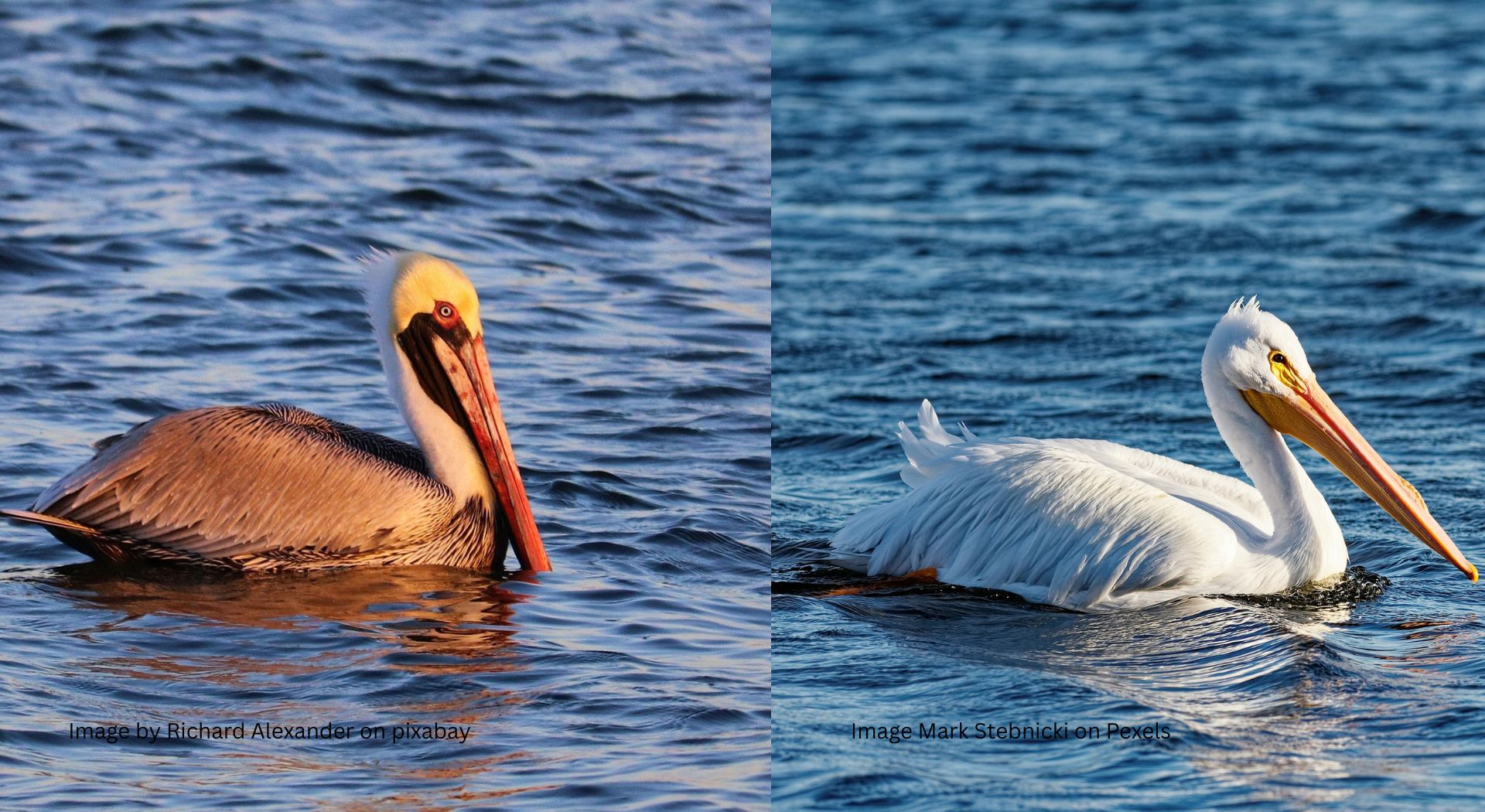
| Key Physical Difference | Dark brown body with pale head | Mostly white body with black flight feathers |
| Behavioral Difference | Plunge-diving predator | Cooperative surface feeder |
| Conservation Status | Least Concern (IUCN) | Least Concern (IUCN) |
1. Body Size and Wingspan
One of the most measurable differences between these species is overall body size. American White Pelicans are substantially larger than Brown Pelicans, both in body mass and wingspan. Adult White Pelicans typically weigh about 5–9 kilograms (11–20 pounds), though exceptional individuals may exceed this range, and their wingspans can reach 2.4–2.9 meters (7.9–9.5 feet). Brown Pelicans are noticeably smaller, weighing 2–5 kilograms (4.4–11 pounds) with wingspans of 2.0–2.3 meters (6.5–7.5 feet).
These differences reflect distinct flight and feeding strategies. The American White Pelican’s larger body and broad wings support efficient thermal soaring, allowing birds to travel long distances between inland lakes while conserving energy. Individuals frequently circle in rising warm air currents to gain altitude before gliding long distances.
Brown Pelicans rely more on aerodynamic agility. Their lighter bodies help reduce impact forces when diving from heights of approximately 18–21 meters (60–70 feet) to capture fish near the water’s surface. Consequently, body size differences directly reflect the contrasting mechanical demands of soaring flight versus plunge-diving.
2. Plumage Color and Visual Identification
Plumage coloration provides the most immediate visual distinction between the two species. Brown Pelicans display brown, gray, and white plumage, with darker bodies and lighter heads. During the breeding season, adults develop a pale yellow crown and a darker chestnut-brown hindneck.
American White Pelicans are predominantly white, with black flight feathers that become visible when the wings are extended. These black primaries create a strong contrast against the otherwise bright white body.
Beyond identification, plumage coloration may reflect environmental adaptation. Brown Pelicans inhabit coastal environments where darker plumage can reduce glare from reflective ocean surfaces and provide partial camouflage against darker water or rocky shorelines. American White Pelicans forage in open inland wetlands where group coordination is important, and bright plumage may enhance visual communication among flock members during cooperative feeding.
Because of this strong contrast, plumage remains the quickest field mark for distinguishing the species even at long distances.
3. Feeding Method and Hunting Strategy
The most fundamental behavioral difference between the two species lies in how they capture fish. Brown Pelicans are plunge-diving predators, whereas American White Pelicans capture prey by scooping fish from the water’s surface.
Brown Pelicans locate fish from the air and then descend steeply, folding their wings before striking the water headfirst. Upon impact, the expandable gular pouch beneath the bill inflates and captures fish along with several liters of water. The bird then surfaces and drains the water before swallowing the prey.
American White Pelicans never dive. Instead, they swim on the water’s surface and dip their bills underwater, often working cooperatively. Groups may form lines or semicircles that herd fish into shallower water before multiple birds scoop prey simultaneously.
These strategies reflect anatomical specialization. Brown Pelicans possess structural adaptations—including air sacs beneath the skin and flexible jaw structures—that help absorb the impact of plunge dives. White Pelicans lack these features and instead rely on cooperative foraging behavior to capture prey efficiently.
4. Habitat Preference: Coastal vs Inland
The two species occupy distinctly different habitats for most of the year. Brown Pelicans are strongly associated with marine environments, including ocean coastlines, bays, estuaries, and offshore islands. Their plunge-diving technique depends on clear water and access to schooling marine fish such as anchovies, sardines, and menhaden.
American White Pelicans primarily inhabit freshwater ecosystems, breeding on large inland lakes, marshes, and reservoirs across the northern United States and southern Canada. These habitats provide the shallow water conditions necessary for cooperative surface feeding.
During winter, many White Pelicans migrate to coastal regions such as the Gulf of Mexico or Pacific coast, but they usually remain in sheltered bays or estuaries rather than open ocean environments.
These contrasting habitat preferences shape the species’ feeding behavior, movement patterns, and ecological roles across North America.
5. Bill Color and the Unique Breeding “Horn”
The two species also differ in bill appearance, especially during the breeding season. American White Pelicans develop bright orange-yellow bills, and breeding adults grow a temporary structure known as a keratinous breeding “horn” on the upper mandible.
This flattened plate-like growth forms in early spring and is shed after courtship and egg-laying. Ornithologists believe the structure functions as a visual signal during mate selection and colony displays. The American White Pelican is the only pelican species known to develop this distinctive breeding feature.
Brown Pelicans do not develop a bill horn. Their bills remain grayish with darker markings, and breeding displays instead involve changes in head and neck feather coloration.
The presence of a seasonal bill horn therefore provides one of the clearest breeding-season identification features between the two species.
6. Neck and Head Coloration
Seasonal coloration patterns further distinguish the two pelican species. Brown Pelicans show pronounced changes in head and neck coloration during breeding. Adults develop pale yellow crowns combined with darker chestnut or cinnamon-colored hindnecks.
American White Pelicans display far less variation in feather coloration. Their head and neck remain largely white year-round, although subtle changes may occur in bill color and bare facial skin during breeding.
These differences highlight distinct signaling strategies. Brown Pelicans rely more heavily on feather coloration changes to indicate breeding condition within colonies. American White Pelicans emphasize bill coloration and horn development as their primary visual display features.
Thus, the two species employ different anatomical cues for communication during the breeding season.
7. Flight Behavior and Soaring Style
Although both species are strong fliers, their flight behavior differs markedly. Brown Pelicans typically fly low over the ocean surface, often gliding just above the waves in single-file lines. This behavior allows them to exploit aerodynamic lift created by wind moving across the water surface, reducing the need for continuous wingbeats.
American White Pelicans, by contrast, frequently soar high on thermal air currents. Large flocks circle in rising warm air to gain altitude and then glide long distances between feeding areas.
These contrasting flight styles reflect environmental conditions. Inland landscapes generate strong thermals that White Pelicans can exploit, while open ocean environments provide fewer reliable updrafts. Consequently, low-level gliding is more efficient for Brown Pelicans searching for fish over coastal waters.
Flight style therefore provides another practical field clue for distinguishing the species.
8. Nesting Locations and Colony Structure
Both pelican species breed in colonies, but their nesting habitats differ. Brown Pelicans often nest in coastal environments, including mangrove trees, shrubs, or ground sites on small offshore islands.
American White Pelicans typically nest directly on the ground, especially on isolated islands within large inland lakes or reservoirs. These remote locations help protect nests from terrestrial predators.
Colony structure also differs slightly between the species. Brown Pelican nests may be spaced among vegetation or trees, while American White Pelican colonies often consist of dense ground-nesting groups.
These nesting differences reflect the environments each species inhabits: coastal vegetation offers elevated nesting sites for Brown Pelicans, whereas isolated inland islands provide safe ground nesting sites for American White Pelicans.
9. Social Feeding Behavior
Both pelican species are social birds, but American White Pelicans display more coordinated feeding behavior. Large groups may cooperate by herding fish toward shallow water before capturing them.
Brown Pelicans typically forage individually or in loose groups, with each bird diving independently when it detects prey from the air.
Cooperative feeding increases efficiency in inland lakes where prey may be dispersed or difficult to locate. Brown Pelicans rely instead on aerial spotting and rapid plunge dives to capture schooling fish in coastal waters.
This contrast illustrates how feeding strategy influences social organization within closely related species.
10. Migration Patterns
Migration behavior also differs significantly between the species. American White Pelicans are highly migratory, breeding primarily in the northern interior of North America and traveling southward during winter.
Their wintering areas include the Gulf Coast, Mexico, and parts of Central America, and they often migrate in large soaring flocks that follow inland air currents.
Brown Pelicans exhibit more limited migration. Many populations remain year-round residents along coastlines, although some northern birds move seasonally along the Atlantic and Pacific coasts.
These contrasting migration patterns reflect differences in habitat stability: marine food supplies tend to remain relatively consistent throughout the year, while inland freshwater ecosystems experience stronger seasonal fluctuations.
Key Takeaways
• American White Pelicans are larger, with wingspans approaching 9.5 feet compared with about 7.5 feet in Brown Pelicans.
• Brown Pelicans capture fish by plunge diving, while White Pelicans scoop fish from the water surface, often in cooperative groups.
• Brown Pelicans inhabit coastal marine ecosystems, whereas White Pelicans primarily use inland lakes and wetlands.
• Only the American White Pelican develops a temporary breeding horn on the bill during courtship.
• Brown Pelicans usually fly low over water, while White Pelicans soar high on thermal air currents.
• Both species belong to the genus Pelecanus but occupy distinct ecological niches shaped by feeding strategy and habitat.